
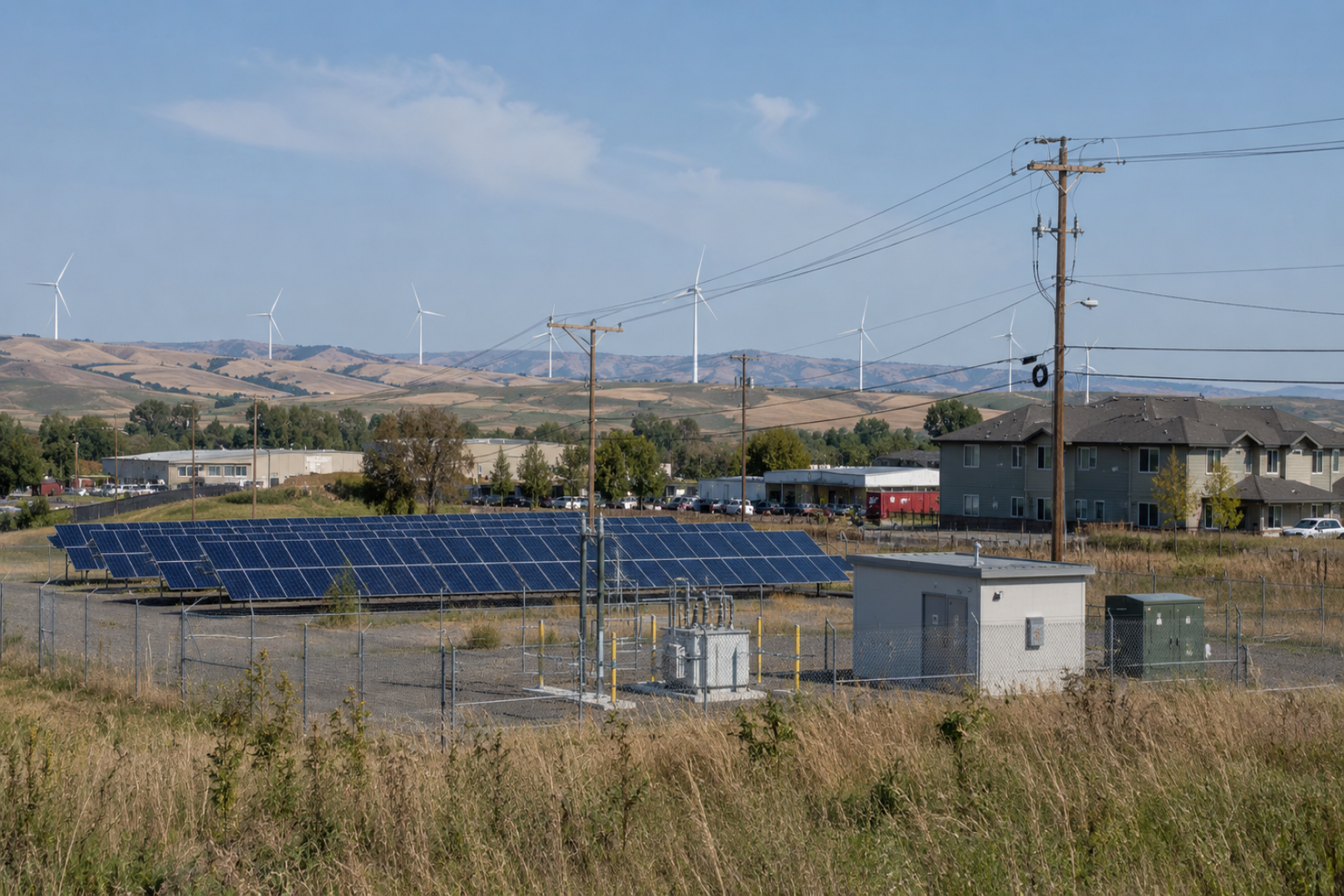
Renewable energy is not magic, and it is not one single technology. Solar panels, wind turbines, hydropower, geothermal systems, biomass, batteries, and power grids all solve different problems.
That is where many renewable energy articles go wrong. They talk about clean power as if every source works everywhere, at every hour, for every building, without tradeoffs. Real projects are more practical than that.
Renewable energy works best when the source matches the site, the demand, the grid, the budget, and the maintenance plan. A sunny roof, a windy rural site, a strong river, a geothermal resource, or a biomass supply are not interchangeable.
This guide explains the main renewable energy sources, where they work, where they struggle, and why storage, transmission, land, materials, and timing matter as much as the energy source itself.
What renewable energy means
Renewable energy comes from sources that are naturally replenished. Sunlight, wind, flowing water, geothermal heat, and some forms of organic material can be used again and again because the source is renewed by natural processes.
The important detail is that renewable energy is still limited by availability. The sun does not shine at night. Wind is not constant. Water flow changes. Geothermal resources depend on underground conditions. Biomass depends on how organic material is grown, collected, transported, burned, or replaced.
A better way to think about renewable energy is this: the source can renew, but the project still has limits.
Those limits include:
- local resource quality
- land or roof area
- grid connection
- storage
- permitting
- construction cost
- maintenance
- equipment replacement
- material supply
- how much energy is needed and when it is needed
Renewable energy is a cleaner direction than fossil fuel dependence, but good design still has to be honest about performance.
The main types of renewable energy
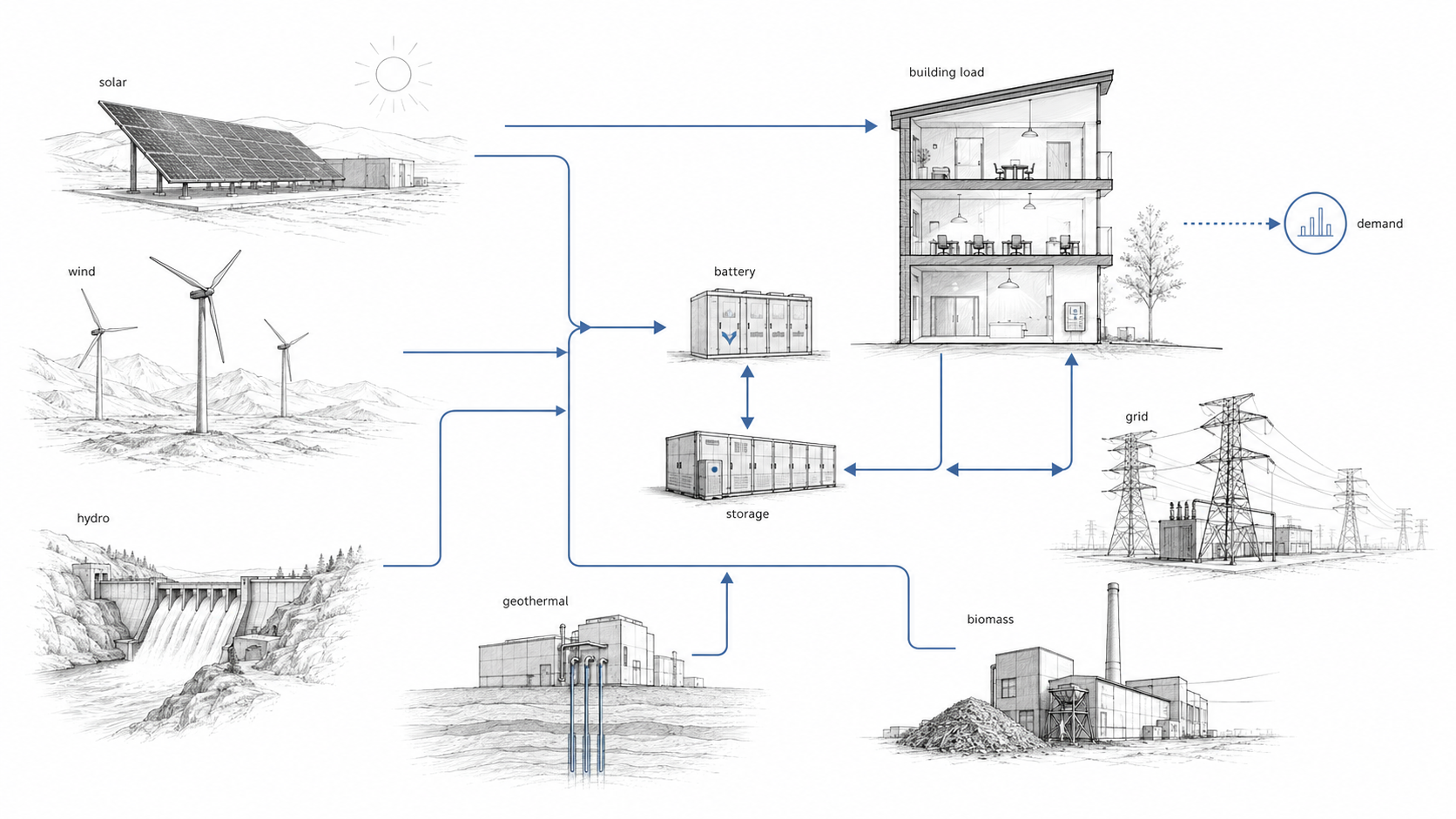
The major renewable energy sources are solar, wind, hydropower, geothermal, and biomass. Each one works differently, and each one has a different role in homes, buildings, utilities, and regional power grids.
Solar energy
Solar energy uses sunlight to make electricity or heat. The most familiar system is solar photovoltaic, often called solar PV, where panels convert sunlight into electricity.
Solar can work on rooftops, parking canopies, open land, commercial buildings, schools, farms, and utility-scale solar fields. It is popular because sunlight is widely available, equipment is easier to scale, and systems can range from a small house array to a large power plant.
Solar still has limits. It produces more during sunny hours, less during cloudy weather, and nothing at night. Roof direction, shade, snow, dust, panel layout, inverter choice, utility rules, and storage all affect the real output.
Wind energy
Wind energy uses turbines to convert moving air into electricity. Large wind farms can produce major power when placed in strong wind areas. Offshore wind can be powerful because wind over water is often stronger and steadier than wind over crowded land.
Small residential wind is harder. A turbine on a short tower in turbulent suburban air usually performs poorly. Wind works best where there is open exposure, enough tower height, good wind data, room for setbacks, and permission to install the equipment.
Hydropower
Hydropower uses moving or falling water to generate electricity. Large dams can provide steady power and grid support, while smaller hydro systems can help certain rural or remote sites.
Hydropower is reliable when water flow is reliable, but it can have serious environmental and social impacts. Dams can affect fish movement, river ecology, sediment, flood patterns, land use, and communities. It is renewable, but it is not automatically harmless.
Geothermal energy
Geothermal energy uses heat from the earth. In some places, high-temperature geothermal resources can generate electricity. In many ordinary buildings, geothermal usually means ground-source heat pumps that use stable underground temperatures for heating and cooling.
Geothermal can be efficient and comfortable, but it is site-dependent. Drilling, trenching, loop fields, ground conditions, contractor skill, and upfront cost matter. It is not the same as adding a small appliance. It is a building-system decision.
Biomass energy
Biomass energy uses organic material such as wood waste, agricultural residues, landfill gas, biogas, or biofuels. It can produce heat, electricity, or fuel.
Biomass is complicated because the carbon and pollution story depends on the source, harvesting method, replacement cycle, transport distance, combustion quality, and land-use impact. Burning waste material near where it is produced is different from cutting forests badly and calling the result clean energy.
How renewable energy differs from fossil fuels
Fossil fuels such as coal, oil, and natural gas are formed over very long periods of time. When they are burned, they release carbon dioxide and other pollutants. They also depend on extraction, refining, transport, pipelines, mines, wells, shipping, and fuel markets.
Renewable energy uses sources that are replenished by natural systems. Solar and wind do not burn fuel during operation. Hydropower uses water flow. Geothermal uses underground heat. Biomass uses organic material that can be replaced if managed responsibly.
The main difference is not only “clean versus dirty.” The deeper difference is fuel dependence.
Fossil fuel systems must keep buying, extracting, transporting, and burning fuel. Renewable systems often have higher upfront equipment and infrastructure costs, but the energy source itself does not have to be mined or shipped in the same way.
That changes the long-term economics. It also changes the risks. Fossil fuel systems are exposed to fuel price swings. Renewable systems are exposed to resource variability, grid connection limits, storage needs, permitting delays, and equipment supply chains.
Why solar and wind are growing fastest
Solar and wind have become the visible face of renewable energy because they can be deployed quickly compared with many older power systems.
Solar PV is especially flexible. It can go on a house, a warehouse, a school, a farm structure, a parking canopy, or a utility-scale site. That does not mean every roof is good for solar. It means the technology can be adapted to many project sizes.
Wind is less flexible at the small-site level, but large wind projects can produce a lot of electricity when the site is right. Offshore wind can add large capacity near coastal demand centers, although it brings its own cost, permitting, maintenance, marine, and grid-connection challenges.
Global renewable capacity keeps growing, and solar is expected to dominate new renewable electricity expansion through 2030. That growth matters, but it does not remove the need for storage, transmission, maintenance, and better demand planning.
The growth of solar and wind creates a practical problem: timing. Solar is strongest in daylight. Wind varies by weather, season, and location. The power system has to balance production with demand. That is why storage, transmission, flexible loads, demand management, and grid planning are now central to renewable energy.
Where renewable energy works well
Renewable energy works best when the resource and the use case line up.
Solar works well where there is good sun, clear roof or land area, acceptable utility rules, and enough electrical demand to make the system useful. It can be strong for homes, commercial roofs, farms, schools, warehouses, parking canopies, and large solar farms.
Wind works well in open, windy locations with proper tower height, grid connection, and room for setbacks. It usually works better at larger scale than on small residential lots.
Hydropower works where water flow, elevation change, permitting, ecological impact, and infrastructure support the project. It can be highly reliable, but the site must be suitable.
Geothermal can work well for buildings with serious heating and cooling loads, especially when the site can handle drilling or loop installation and the owner can manage the upfront cost.
Biomass can work where there is a reliable local waste stream or fuel source that does not create a larger land, air-quality, or carbon problem than it solves.
Where renewable energy gets harder
Renewable energy gets harder when the project ignores real constraints.
Solar gets harder when roofs are shaded, old, small, badly oriented, crowded with vents and equipment, or not ready structurally. It also gets harder when the electrical panel, utility rules, inverter location, or battery plan is not considered early.
Wind gets harder in low-wind areas, dense neighborhoods, heavily wooded sites, low towers, and places with strict zoning. A small turbine in bad wind is not a clean-energy solution. It is expensive decoration.
Hydropower gets harder when river ecology, fish movement, drought, sediment, community impact, or permitting make the project damaging or unrealistic.
Geothermal gets harder when the site has poor access, difficult ground conditions, limited space, high drilling cost, or weak contractor availability.
Biomass gets harder when fuel has to travel far, when combustion creates local air pollution, or when land use and harvesting are not managed responsibly.
The lesson is simple: renewable energy should be chosen, not worshipped. The best source depends on the site.
Storage, grids, and the problem of timing
The biggest practical issue with renewable electricity is not only how much energy can be produced. It is when the energy is produced.
Solar can produce a lot of electricity at midday and little or none at night. Wind can produce strongly during certain weather patterns and less during calm periods. Demand may peak when renewable output is low. That mismatch has to be handled.
Batteries help, but they do not make energy unlimited. A battery stores a certain amount of electricity for a certain amount of time. The more loads it has to support, the larger and more expensive the system becomes.
Grids also matter. Renewable energy often needs new transmission, smarter distribution systems, better interconnection rules, and demand-side coordination. A solar farm is not useful if the grid cannot accept the power. A home solar system can become frustrating if utility rules, export limits, or panel upgrades are ignored.
Renewable energy is partly about generation. It is also about timing, storage, controls, wires, rules, and demand.
Renewable energy for homes and buildings
In buildings, renewable energy should come after energy demand is reduced. A leaky house or inefficient building needs a larger system to cover the same comfort level.
For homes, the most common path is usually efficiency first, then solar, then battery storage if backup or rate structure justifies it. Wind may work on certain rural sites. Geothermal may work when the heating and cooling load, site access, and budget support it.
For commercial buildings, the issue is often roof area, equipment placement, load timing, utility demand charges, parking canopies, façades, storage, and maintenance access. A low-rise warehouse may have a lot of roof area. A tall office building may not have enough roof area to offset its full load.
This is why renewable energy belongs inside building design, not just after construction. The roof, structure, service equipment, shading, envelope, mechanical systems, and future maintenance all affect whether the system works.
For a homeowner-focused version of this topic, read renewable energy home design. For building-level system planning, read renewable energy solutions for buildings.
Renewable energy is not automatically sustainable
This is the part many clean-energy summaries skip. Renewable energy can reduce operating emissions, but every system still has a physical footprint.
Solar panels require materials, manufacturing, mounting systems, inverters, wiring, shipping, installation, maintenance, and eventual replacement. Wind turbines require foundations, towers, blades, roads, grid connections, maintenance, and end-of-life planning. Hydropower can affect rivers. Biomass can create air pollution or land-use problems if it is managed badly. Batteries require mining, manufacturing, fire-safety planning, recycling, and replacement.
None of that means renewable energy is bad. It means “renewable” should not be used as a free pass.
Good renewable energy planning asks:
- does the project reduce real emissions?
- does the site make sense for this source?
- can the grid or building use the energy at the right time?
- what materials and land are required?
- what happens when the equipment reaches the end of its service life?
- who maintains the system?
- does the project solve a real demand problem or only look green?
Renewable energy is strongest when it is paired with efficiency, durable design, responsible material choices, and realistic operations.
How to think about renewable energy choices
The right renewable energy choice depends on the question being asked.
If the question is “How do I cut energy bills at home?” the answer may start with insulation, air sealing, efficient equipment, and then solar.
If the question is “How do we power a warehouse?” the answer may involve a large roof array, demand management, utility coordination, and possibly battery storage.
If the question is “Can this rural property run off-grid?” the answer may involve solar, batteries, backup generation, load control, water pumping, heating choices, and a much stricter energy budget.
If the question is “How should a city reduce fossil fuel dependence?” the answer may include large renewable projects, transmission, building electrification, storage, public policy, and demand reduction.
Use this order:
- Reduce demand first.
- Match the energy source to the site.
- Check the timing of production and demand.
- Plan storage, grid connection, and backup.
- Include maintenance and replacement costs.
- Avoid treating one renewable source as the answer for every project.
What renewable energy means for architecture and construction
Renewable energy is changing architecture because buildings are no longer passive users of power. A building may produce electricity, store electricity, shift demand, charge vehicles, use heat pumps, connect to smart controls, or participate in a larger energy network.
That changes design decisions. Roof shape matters. Mechanical rooms matter. Electrical service matters. Shading matters. So do access, fire clearance, inverter placement, roof replacement timing, and how equipment will be repaired later.
A renewable-ready building should make clean-energy systems easier to add, inspect, maintain, and replace. That is a construction issue, not just an energy-policy issue.
For related design context, see net zero architecture and sustainable design strategies.
FAQ
What is renewable energy?
Renewable energy comes from sources that are naturally replenished, such as sunlight, wind, water, geothermal heat, and some organic materials. The source renews, but the usable energy still depends on location, timing, equipment, and demand.
What are the main types of renewable energy?
The main types are solar, wind, hydropower, geothermal, and biomass. Some projects also combine renewable generation with battery storage, smart controls, or grid upgrades.
Is renewable energy always clean?
It is usually cleaner in operation than fossil fuel combustion, especially for solar and wind, but every system has impacts. Materials, mining, land, transmission, water, construction, maintenance, and end-of-life planning still matter.
Which renewable energy source is best?
There is no single best source. Solar may be best for one roof, wind for one rural region, geothermal for one heating-heavy building, and hydropower for one suitable water site. The best source depends on the resource and the demand.
Why does renewable energy need storage?
Some renewable sources produce energy at times that do not match demand. Solar is strongest during daylight, and wind varies by weather. Storage, transmission, and flexible demand help balance that mismatch.
Can renewable energy power homes?
Yes, but the design depends on the house. Roof sun, shade, electrical service, utility rules, heating load, battery needs, and backup expectations all affect the plan.
Can renewable energy power large buildings?
Sometimes, but larger buildings often need a mix of efficiency, electrification, on-site renewables, off-site clean power, storage, and demand management. Roof area can be a major limit.
Is renewable energy cheaper than fossil fuel energy?
It depends on the project, location, financing, fuel prices, grid rules, and storage needs. Many renewable systems have low operating fuel cost, but upfront equipment, permitting, connection, and maintenance still matter.
Read This Next
Start with renewable energy home design if you are planning a house.
Read renewable energy solutions for buildings for system planning at the building scale.
For performance targets, use net zero architecture.
For energy demand before renewables, read sustainable design strategies.
References
Sources used for this article
- U.S. Energy Information Administration: Renewable Energy Explained
- International Energy Agency: Renewables 2025, Renewable Electricity
- International Renewable Energy Agency: Renewable Capacity Statistics 2026
- U.S. Department of Energy: How Does Solar Work?
- U.S. Department of Energy: How Do Wind Turbines Work?
- U.S. Department of Energy: Hydropower Basics
- U.S. Department of Energy: Geothermal Basics
- U.S. Department of Energy: Bioenergy Basics