
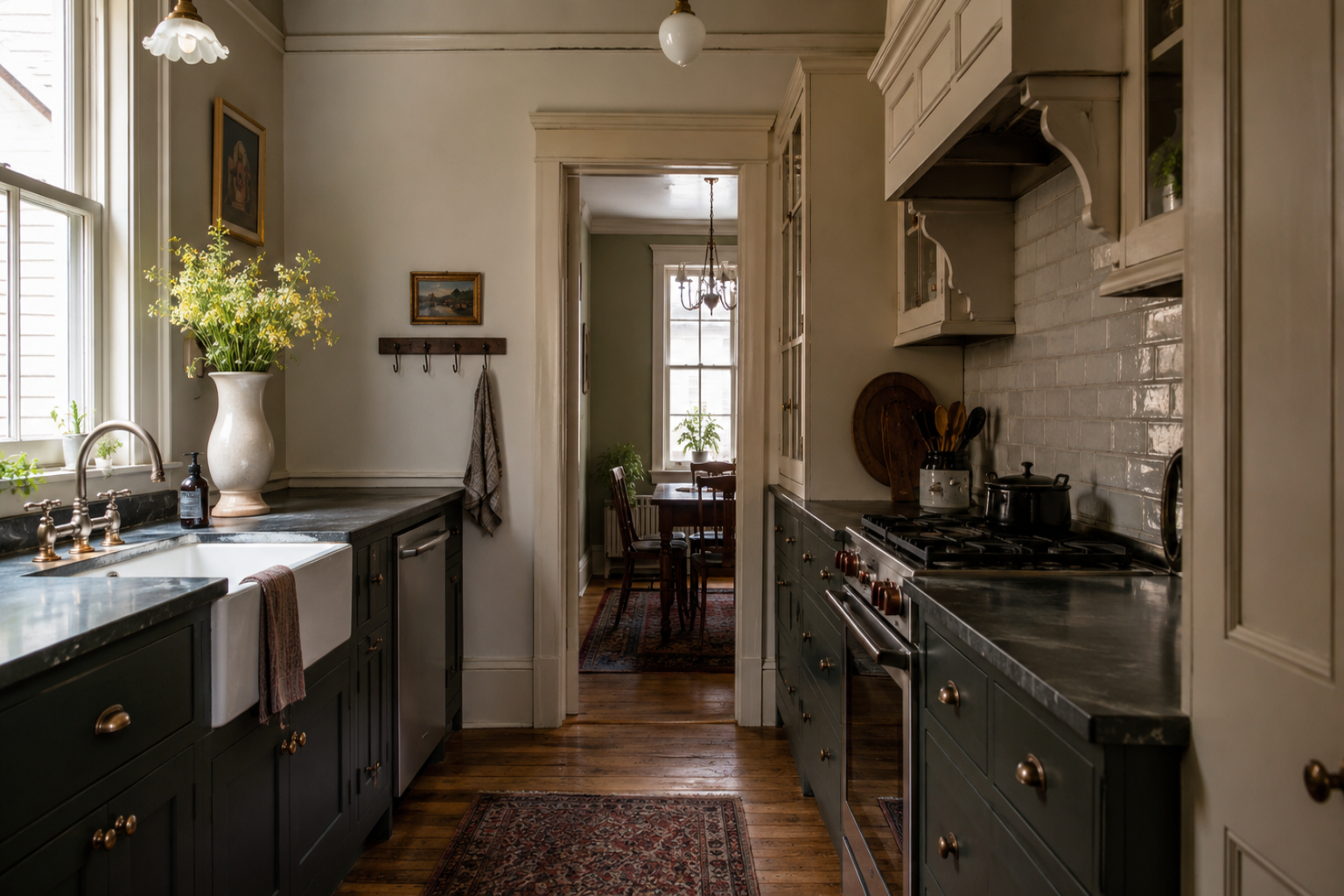


The kitchen is where a Victorian house gets embarrassed fastest.
A bad 1990s cabinet run can wipe out the room’s character. So can a new remodel that tries to fix the problem with brass knobs, dark paint, a farmhouse sink, and a giant island the room never had space for.
A Victorian kitchen remodel has to do two jobs at once. It has to make the kitchen work for modern cooking, storage, lighting, ventilation, and appliances. It also has to stop the room from looking like a themed restaurant.
The expensive mistake is starting with style. The better place to start is the room itself: the windows, the old trim, the floor level, the service walls, the back door, the chimney, the pantry, and the awkward places where earlier remodels already cut into the house.
Useful anchor piece: Cast Iron Apron Sink – Fireclay Vintage-Style
A heavy apron-front sink can help a Victorian kitchen feel grounded, but it is not a first purchase. Check the base cabinet size, counter support, rough plumbing, and floor strength before ordering one.
Before and After Should Show a Real Change
A good before-and-after is not a faucet swap with better lighting.
The room should change in a way that solves something: the range wall becomes clearer, the sink stops fighting the window, storage stops depending on loose furniture, the island stops blocking the aisle, and the modern appliances stop shouting over the old house.
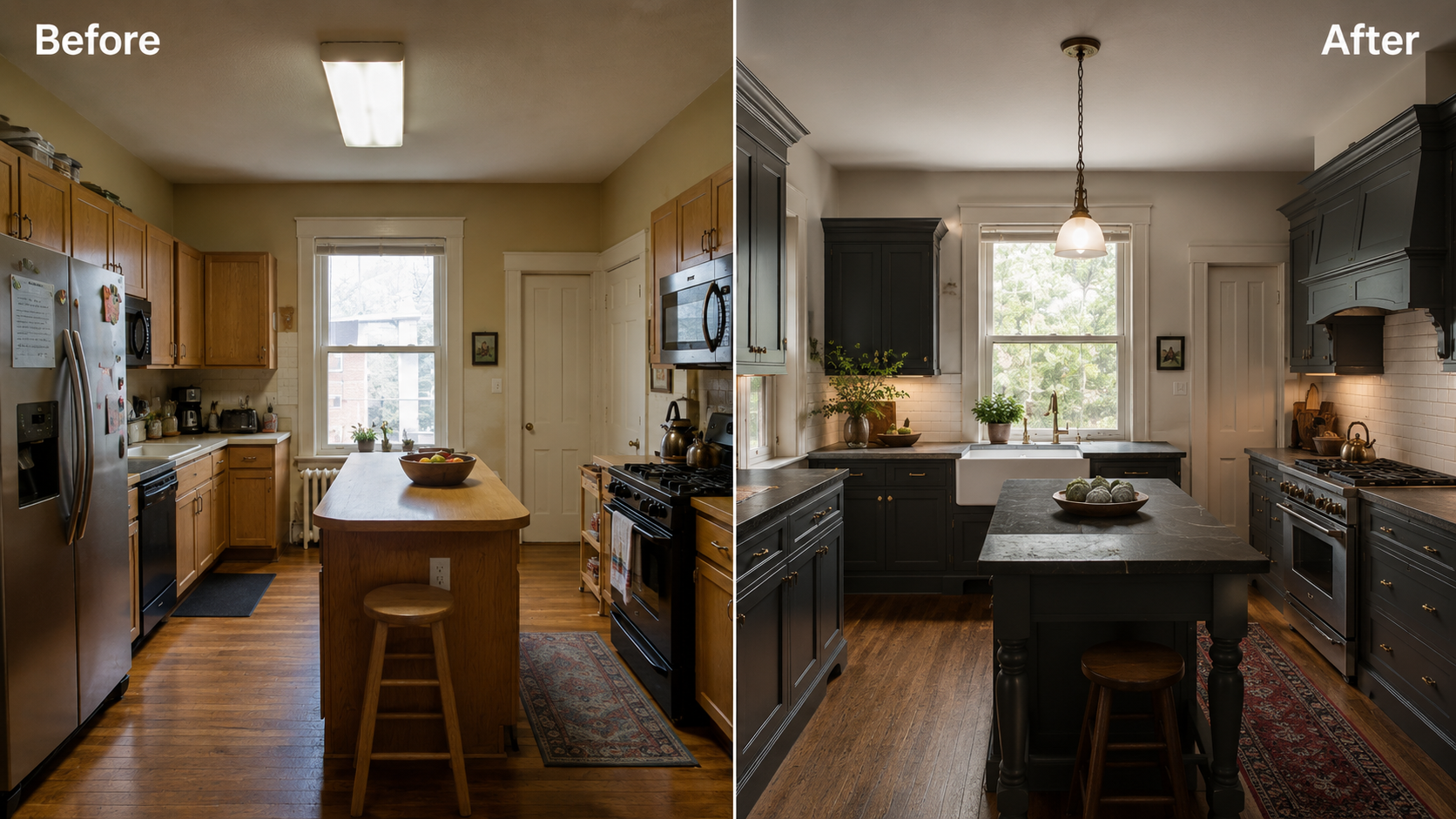
Image by ArchitectureCourses.org. A good Victorian kitchen remodel usually changes the room in a visible way: better cabinetry, better materials, better lighting, and a layout that fits the house more naturally.
The “after” does not need to be more ornate. It needs to be better fitted. In a real Victorian house, that can mean a calmer range wall, better cabinet proportions, a smaller worktable instead of a bulky island, or a refrigerator placed where it does not dominate the first view into the room.
Start With the Room
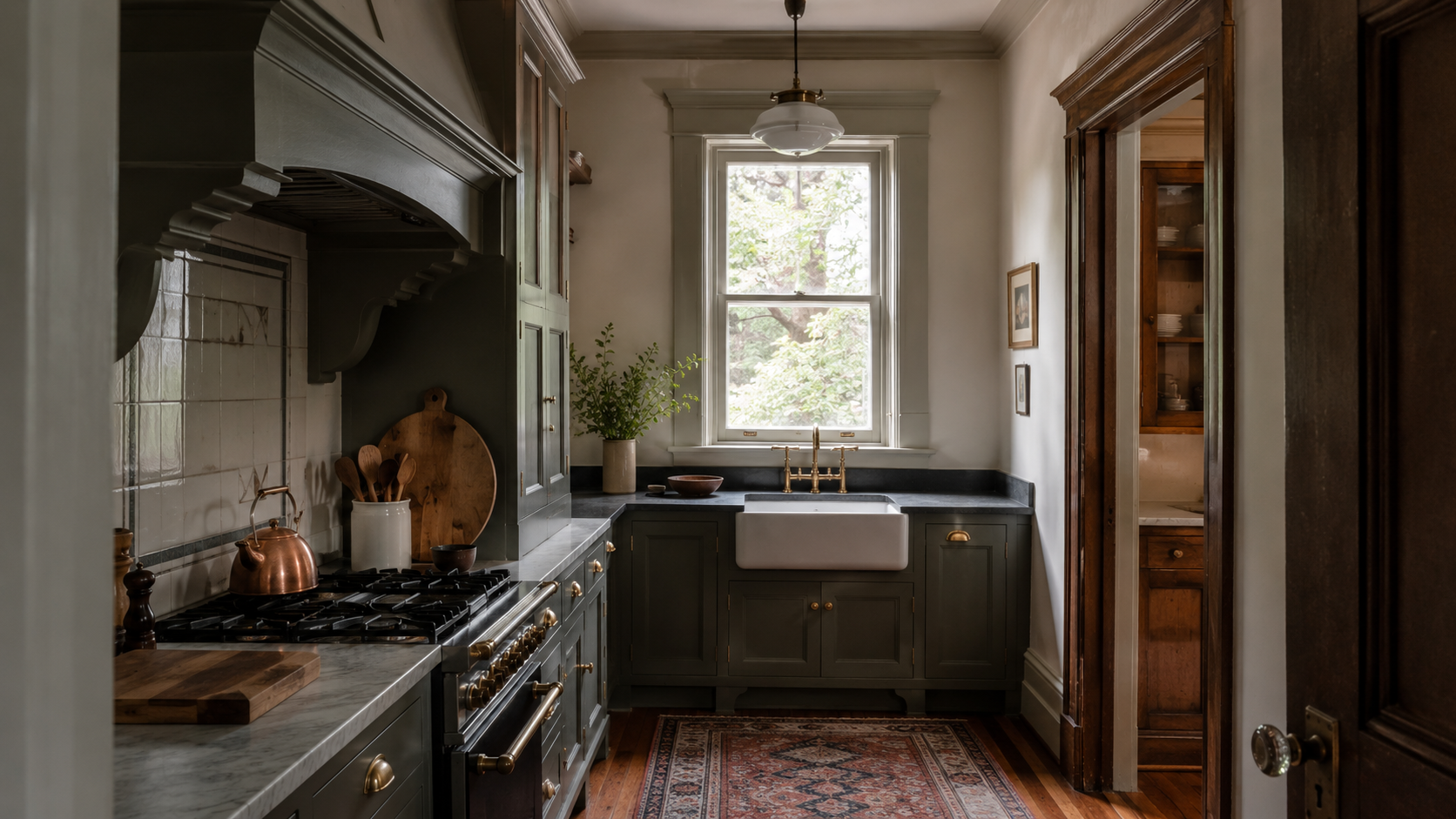
Image by ArchitectureCourses.org. This Victorian kitchen remodel keeps the room tied to the older house: tall window casing, built-in cabinetry, an apron-front sink, aged brass hardware, and a range wall that feels built into the architecture instead of placed on top of it.
Victorian kitchens were working rooms. They were service rooms, sculleries, pantries, rear rooms, or later additions that changed over time. The kitchen in a Victorian house today may have very little original kitchen fabric left.
That is normal. It also means the remodel should not pretend history is simple.
Older kitchens often have narrow proportions, rear doors, odd window heights, chimney breasts, sloped floors, thick casing, patched plaster, and floor layers from several different decades. Some of those problems are charm. Some are cost.
| Existing condition | Weak remodel response | Better move |
|---|---|---|
| Narrow kitchen | Force a wide island into the aisle | Use a worktable, shallow pantry wall, or built-in storage |
| Original window rhythm | Ignore it and center everything on cabinets | Let windows, trim, and circulation shape the cabinet layout |
| Old chimney or fireplace wall | Remove character to make a blank wall | Use it as a range, storage, or visual anchor if safe |
| Uneven floor layers | Install new tile over unknown layers | Check subfloor, old adhesive, deflection, rot, and height changes first |
| Dark rear room | Paint every surface dark | Keep depth low in the room and lighten ceilings, walls, or work surfaces |
The Layout Decides More Than the Cabinets
Layout mistakes in a Victorian kitchen are expensive because they spread. Move the sink and you may move plumbing, cabinets, counters, flooring, dishwasher lines, wall repair, and electrical. Move the range and the hood route may become the real problem.
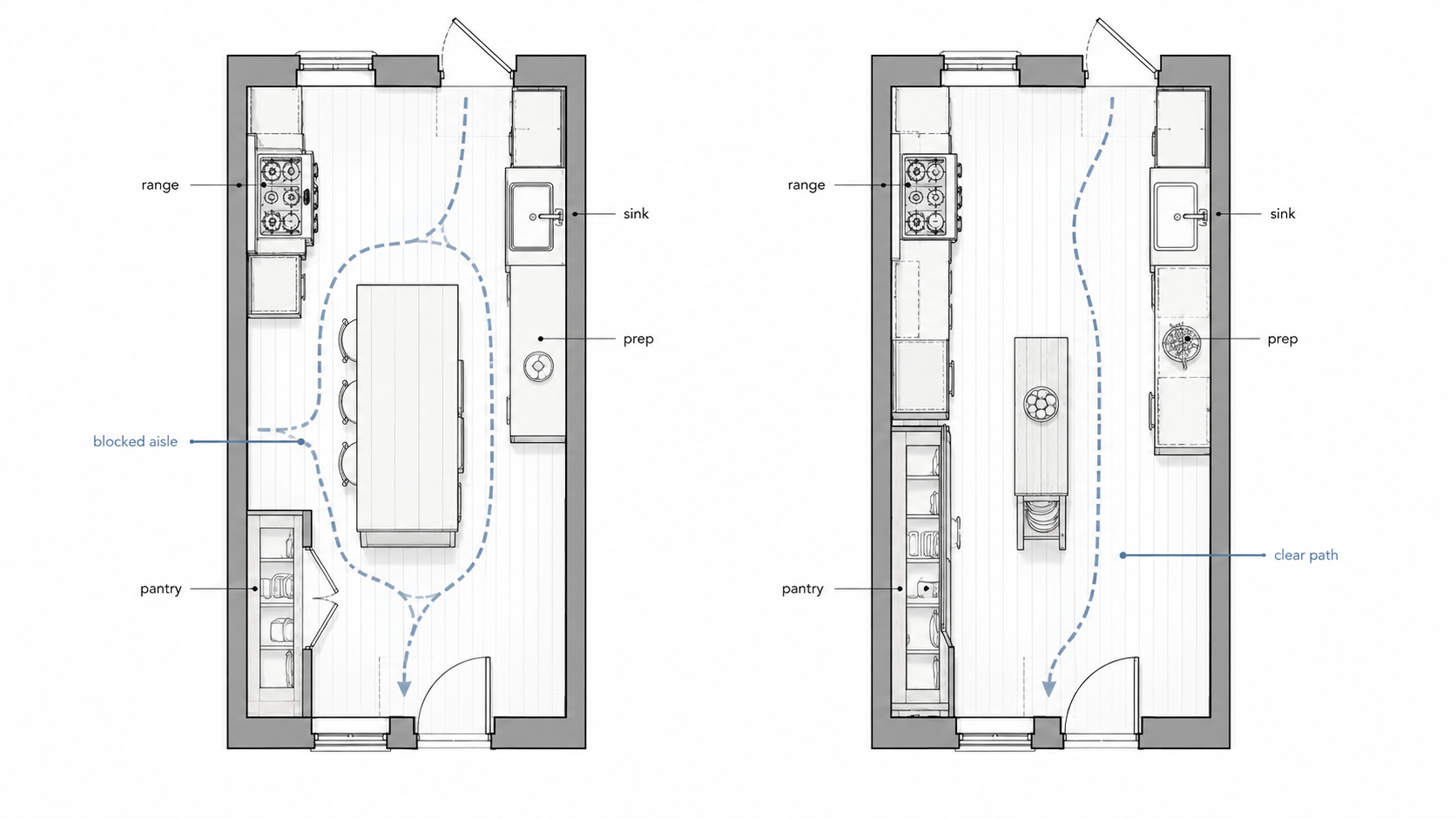
Illustration by ArchitectureCourses.org. A Victorian kitchen remodel should organize cooking, washing, prep, pantry storage, and circulation before choosing cabinets, color, or decorative trim.
Work zones are useful, but only if they fit the room. A small Victorian kitchen does not need a showroom triangle drawn over it. It needs a place to prep, a place to wash, a place to cook, a place to store food, and a clear path to the door.
The island is usually the first test
In a narrow kitchen, an island can turn every task into a sideways move. It blocks the back door. It tightens the range aisle. It gives the room a “remodeled” look while making cooking worse.
A long table, a butcher-block work surface, a shallow pantry cabinet, or a freestanding hutch often fits the house better. Less impressive in a photo. Better to live with.
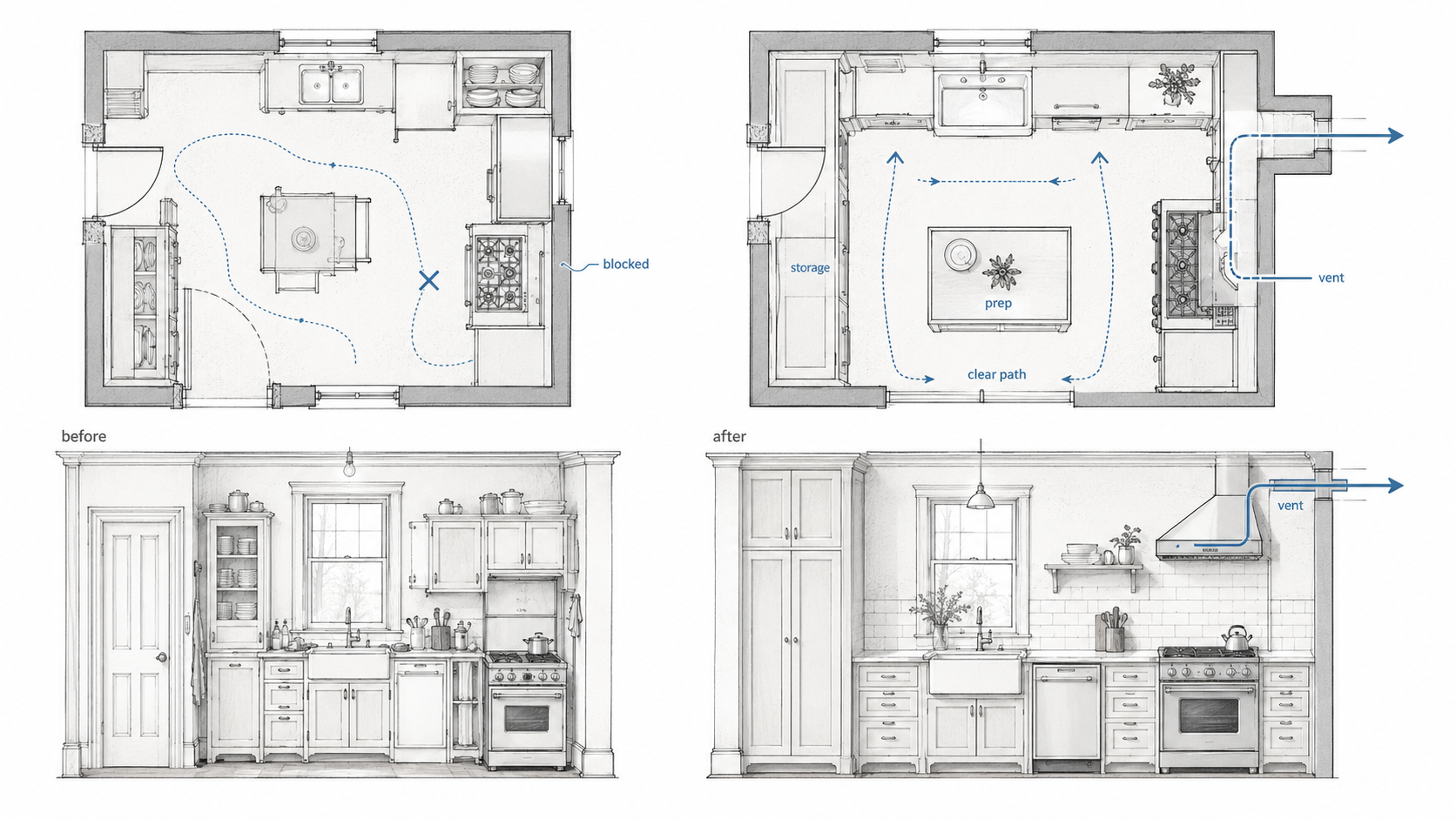
Illustration by ArchitectureCourses.org. A good Victorian kitchen remodel usually improves layout and systems before it adds period details.
What Makes the Room Feel Victorian
A believable Victorian kitchen has weight. The doors have depth. The hardware feels attached to the cabinetry. The hood belongs to the wall. The sink, table, pantry, and trim feel like parts of the room rather than products arranged for a photograph.
Use stronger pieces, not more pieces.
- inset or raised-panel cabinet doors with real depth
- painted wood, stained wood, stone, tile, brass, bronze, or butcher block
- glass-front storage where display makes sense
- a range wall that looks built in, not staged
- lighting that fits the ceiling height and gives task light
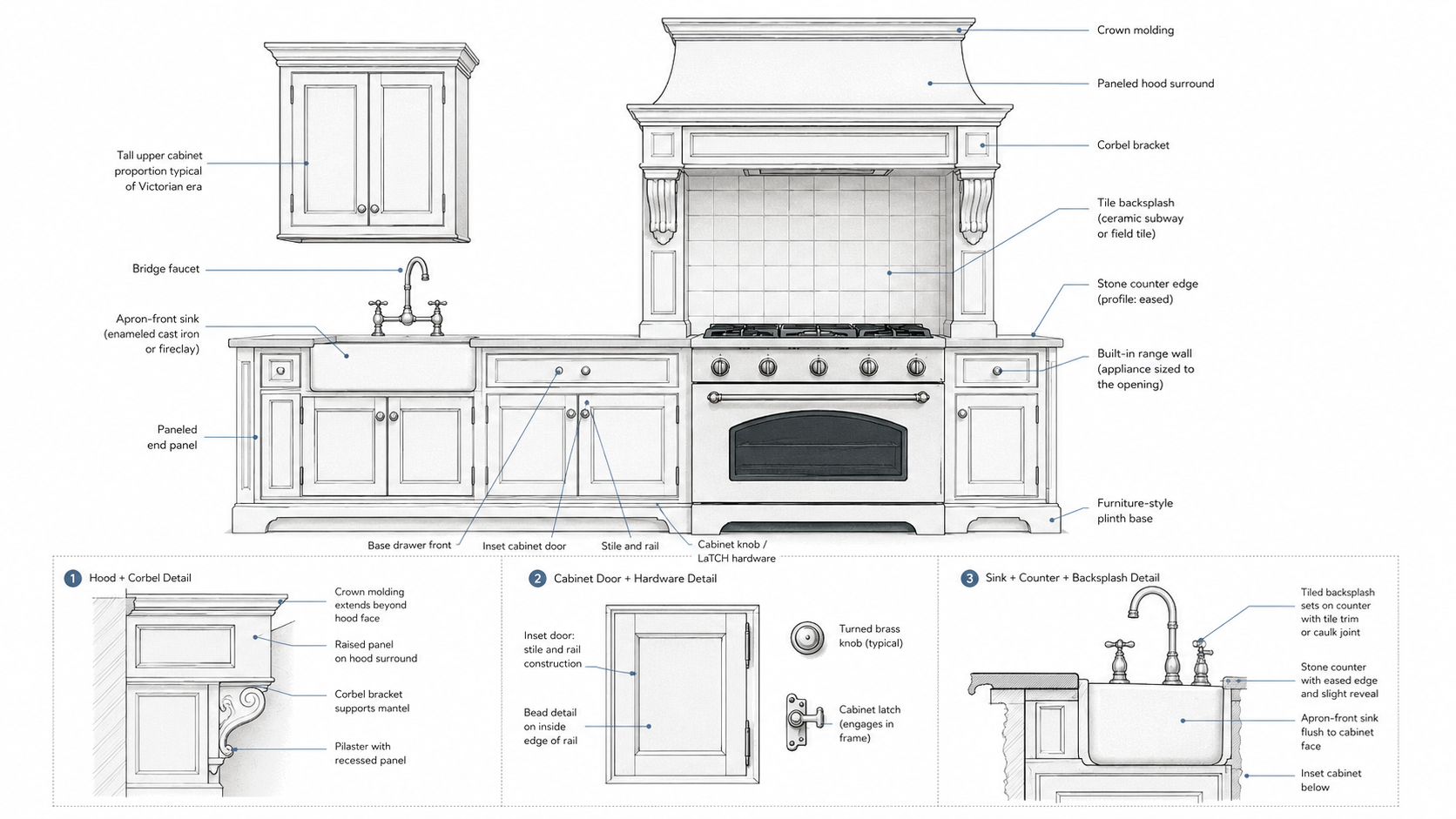
Illustration by ArchitectureCourses.org. Victorian kitchen detailing works best when the room is built from real architectural parts: inset doors, stile-and-rail frames, crown molding, plinth bases, paneled hood surrounds, corbels, simple tile, stone counters, and hardware that feels attached to the cabinetry instead of pasted on.
Where Fake Victorian Kitchens Go Wrong
Fake Victorian kitchens usually fail from the same handful of moves. Thin cabinet doors. Shiny hardware. Oversized pendants. Fake antique signs. A range hood shaped like furniture but built like a prop. Too much pattern in a room that already has trim, windows, doors, and cabinet lines competing for attention.
The room does not get more authentic when every surface performs.
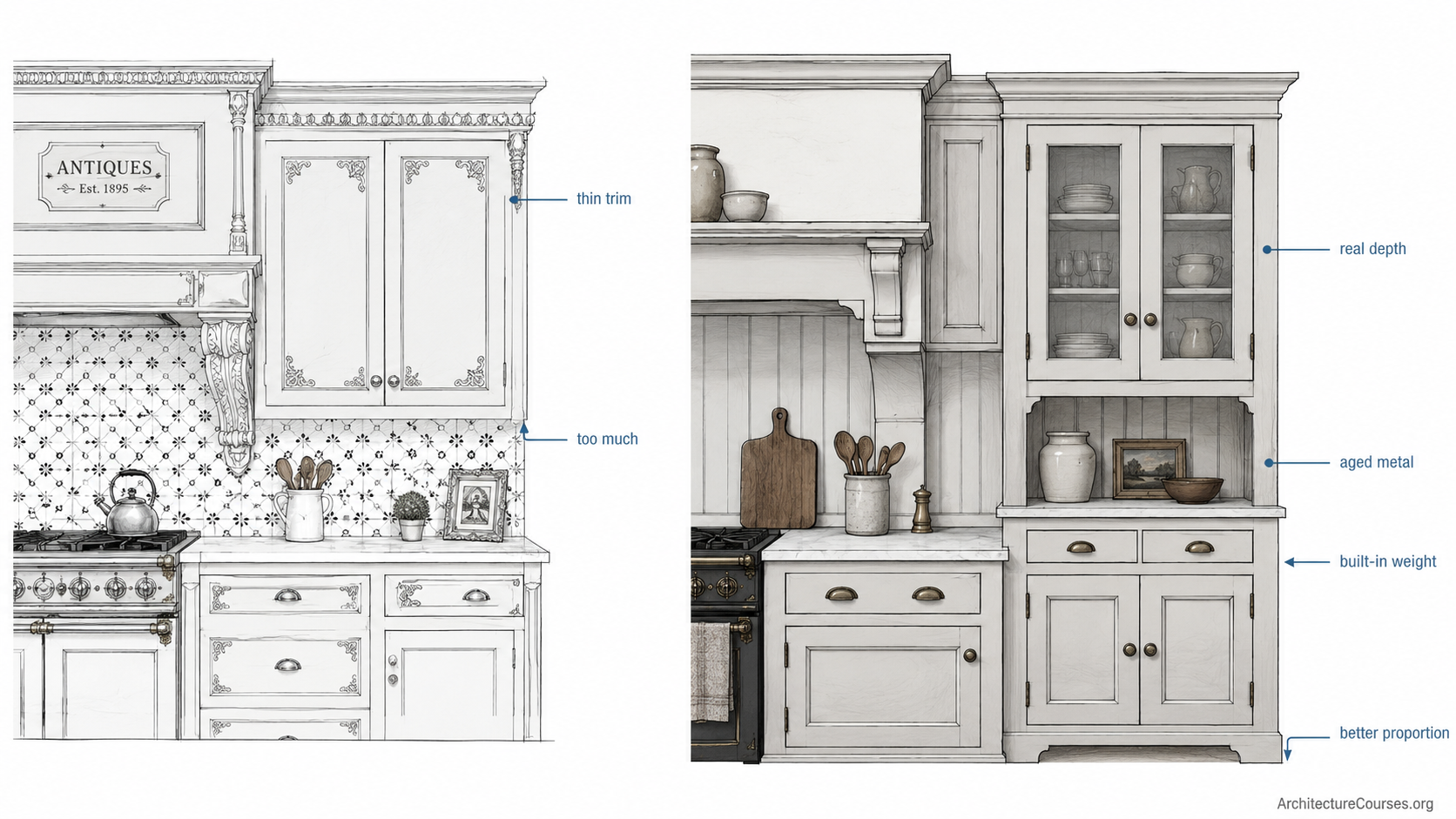
Illustration by ArchitectureCourses.org. Fake Victorian kitchens usually fail from too many thin decorative details. Better remodels use fewer, heavier, more believable pieces.
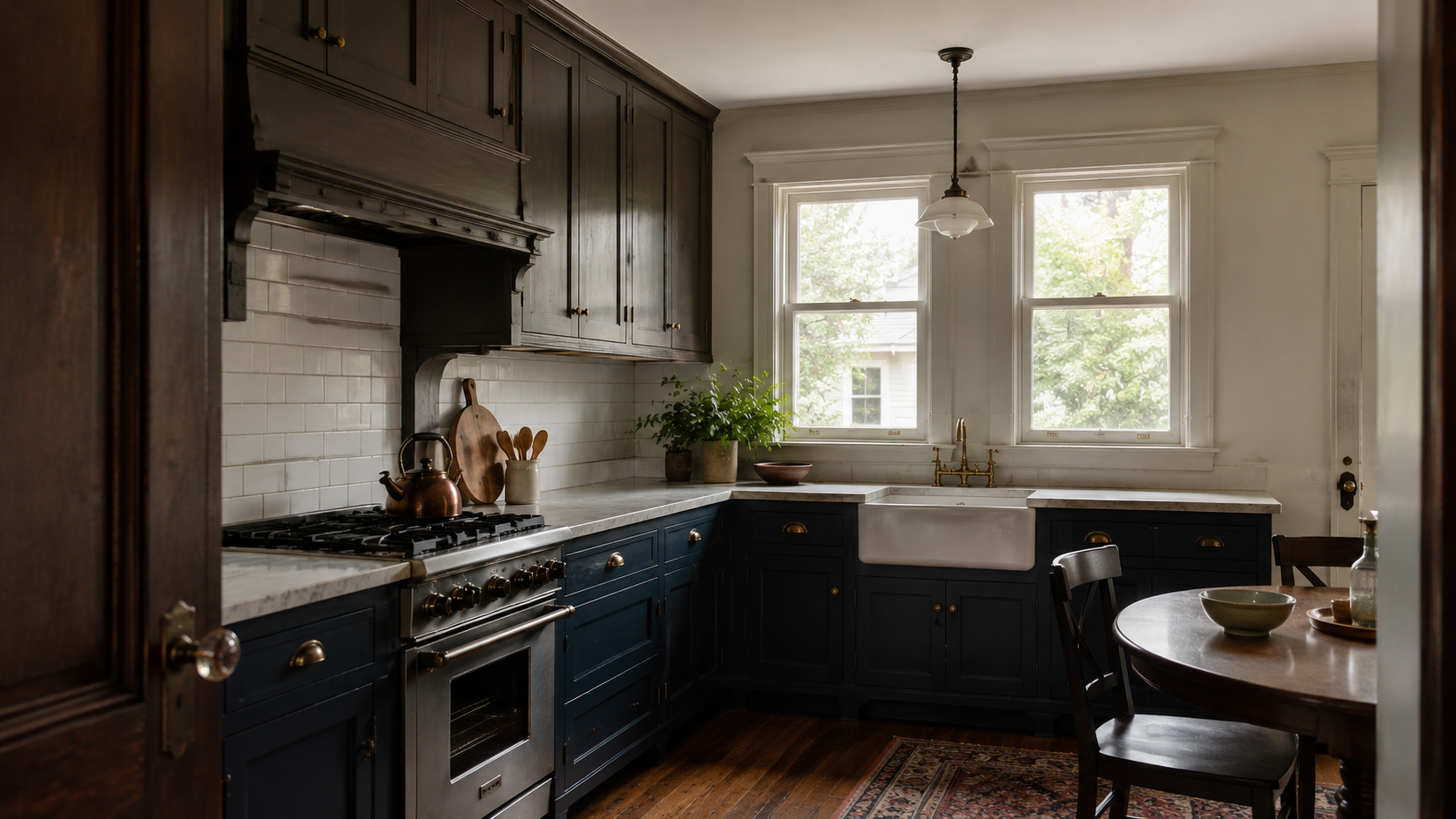
Image by ArchitectureCourses.org. This Victorian kitchen remodel works because the room still feels tied to the older house. The tall windows, built-in range wall, inset cabinetry, apron-front sink, brass hardware, and small table do more than decorative “Victorian” props would.
Cabinets: Built-In, Freestanding, or Both
A full wall of identical cabinets can look wrong in an old house even when the cabinets are expensive.
Victorian kitchens often look better with a controlled mix: built-in base cabinets where the work happens, a tall pantry piece where storage is needed, a glass-front cabinet for dishes, and maybe one freestanding hutch or table. The point is not randomness. The point is to break the showroom wall.
Raised-panel doors work. Inset doors work. Beadboard ends, cup pulls, plinth bases, and furniture-like feet can work. Flat slab doors usually need a very careful modern-Victorian room around them or they read too clean for the house.
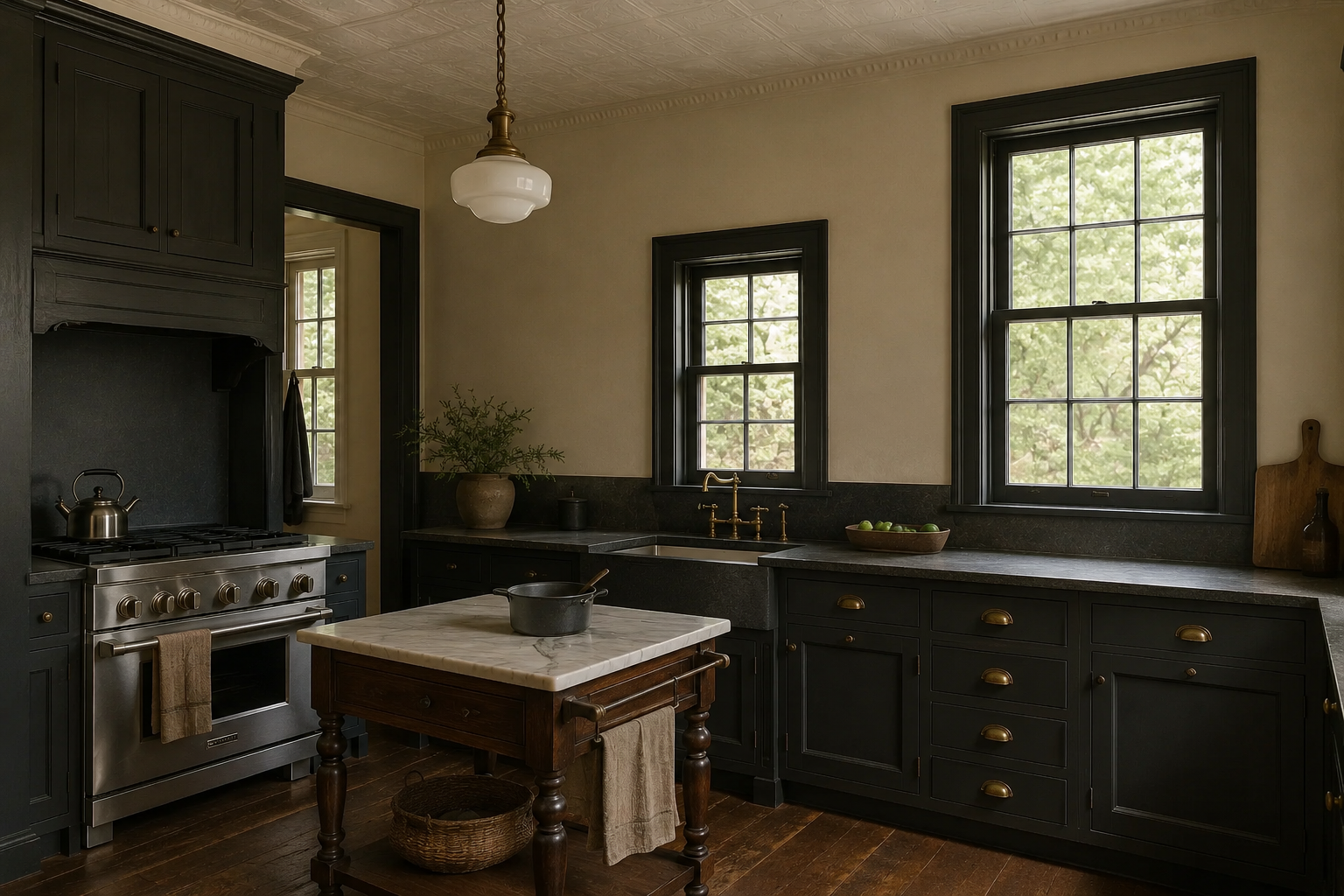
Image by ArchitectureCourses.org. An updated Victorian cooking space works best when dark cabinetry, old-house trim, brass hardware, and modern appliances feel built into the room instead of staged as decoration.
Counters, Backsplash, and Floors
Material choices should quiet the room down, not make every surface compete.
| Element | Works better | Use carefully |
|---|---|---|
| Counters | Soapstone, honed marble, butcher block, dark stone, restrained quartz | Glossy fake stone patterns, busy slabs, bright polished finishes |
| Backsplash | Small tile, beadboard, restrained pressed metal, simple glazed tile | Oversized trendy tile, fake antique panels, too many patterns |
| Floors | Wood, checkerboard tile, small-format tile, repaired original flooring | Thin vinyl pretending to be old wood, slippery polished tile, busy pattern in tight rooms |
| Hardware | Aged brass, bronze, blackened metal, cup pulls, simple knobs | Bright chrome, oversized novelty pulls, mixed metals with no plan |
| Lighting | Milk glass, shaded pendants, small chandeliers, wall sconces | Huge pendants, glare-heavy bulbs, decorative fixtures with weak task light |
Checkerboard floors deserve special care. In a scullery, pantry, rear kitchen, or larger room, they can look right. In a cramped kitchen with dark cabinets and patterned wallpaper, they can make the room feel jumpy.
The Quote Usually Misses the Old-House Work
This is where the job gets away from the pretty picture.
A cabinet quote may include cabinet boxes, doors, hardware, and installation. It may not include plaster repair, floor leveling, electrical upgrades, plumbing changes, vent routing, radiator conflicts, window trim repair, lead-safe work, old adhesive testing, or the extra labor needed to scribe cabinets into walls that are not square.
The first three weeks after demolition are where the budget starts telling the truth. The floor under the sink is soft. The old vent does not reach outside. The appliance circuit is undersized. The wall behind the range has been patched twice. The cabinet plan assumes a flat wall, but the room has a belly in it.
None of that is a style problem. It is the difference between a kitchen that photographs well and a kitchen that passes inspection, vents properly, drains properly, and does not hide rot behind new work.
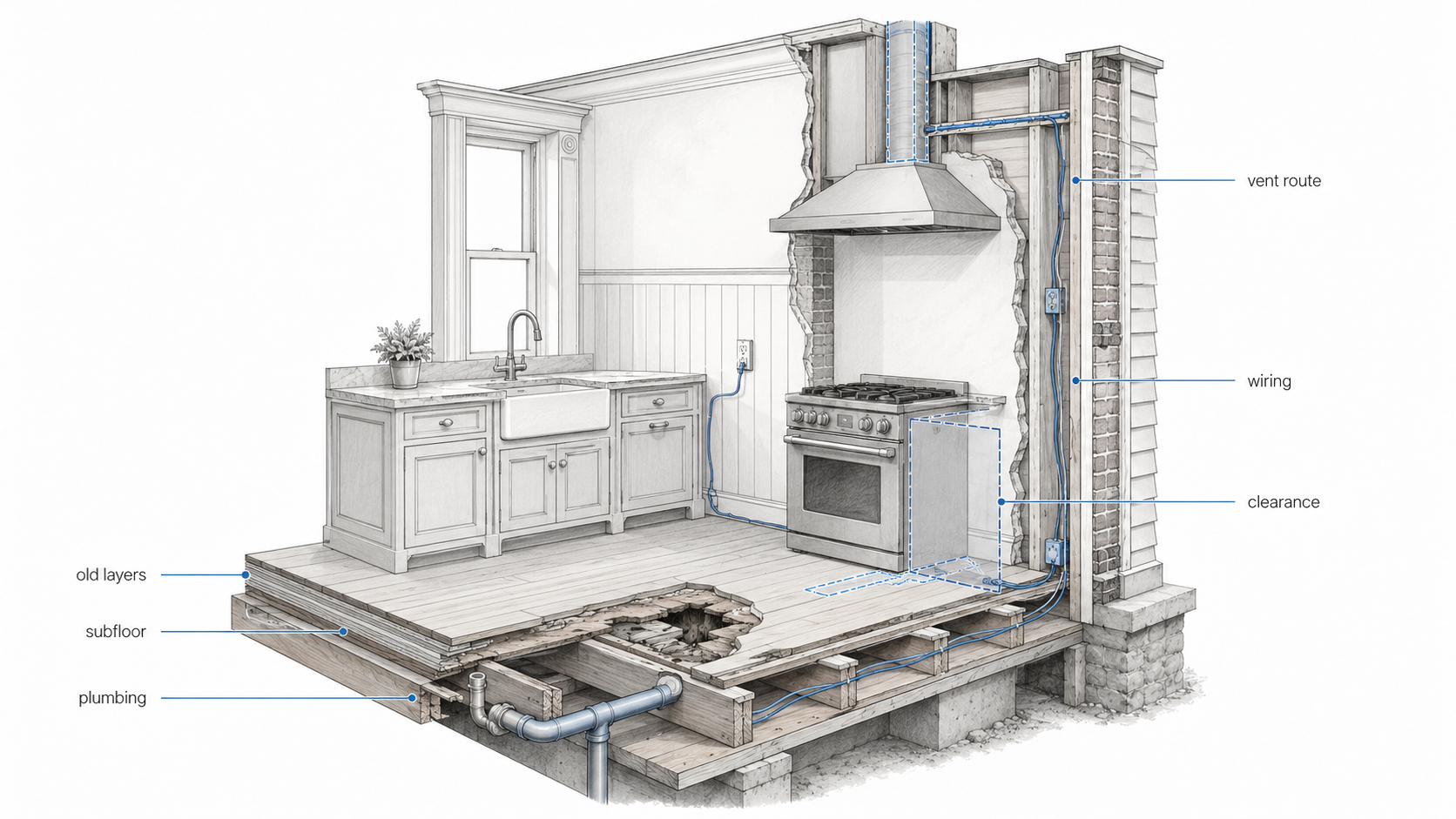
Illustration by ArchitectureCourses.org. The expensive part of a Victorian kitchen remodel is often hidden under the floor, inside the walls, or behind the appliance plan.
Check before ordering finishes
- floor level changes at doorways
- soft flooring near the sink, dishwasher, exterior door, or old radiator pipes
- old vinyl, mastic, or adhesive layers that may need testing before removal
- range hood route to the exterior, not a recirculating fan hidden in a pretty hood
- electrical capacity for range, dishwasher, microwave, fridge, lighting, and outlets
- cabinet depth around old trim, windows, radiators, and doors
The Hood Can Become the Hardest Part
A beautiful range wall is useless if the hood cannot vent.
Victorian houses were not built around modern high-output ranges. The wall you want for the range may back into a chimney, an old exterior wall, a porch roof, a second-floor room, or brick that nobody wants to cut. A recirculating hood is easier to sell because it avoids the hard route. It also leaves heat, moisture, grease, and odor in the house.
If the kitchen has a gas range, serious cooking use, or a large range, the ventilation plan belongs near the front of the project. Waiting until cabinets are ordered can force a bad hood, a bad route, or an ugly compromise through trim that should have been protected.
Appliances Without Wrecking the Room
Appliances are where modern life gets loud.
A stainless refrigerator can dominate a Victorian kitchen if it sits beside delicate casing or a small original window. A large range can look impressive and still create clearance, heat, and ventilation problems. A dishwasher can be easy to hide, but the sink base and plumbing still have to make sense.
Three approaches usually work.
- Hide it. Use panel-ready appliances where the cabinet run can handle them.
- Make it quiet. Choose a restrained appliance finish instead of turning the appliance into the focal point.
- Give it a zone. Put the most modern pieces on the working side of the room, not in the old-house view that carries the character.
Lighting Has to Do Work
A chandelier can make the photograph. It can also leave the counter dark.
Victorian kitchens with deep paint, dark wood, or stone counters need layered lighting: task light at the work surface, decent general light, and fixtures that do not glare in your face while you cook. Milk glass, brass, bronze, iron, and shaded fixtures can all work. The fixture should feel attached to the room, not dropped in as a decoration.
Under-cabinet light is not historically romantic, but it can save the kitchen if it is detailed quietly.
Dark Color Can Kill a Small Room
Dark green, navy, burgundy, oxblood, charcoal, cream, muted teal, dusty rose, and warm wood can all belong in a Victorian kitchen.
Placement matters more than the color name.
In a small or rear-facing kitchen, stronger color often works better low in the room: base cabinets, island table, hutch, or pantry piece. Keep the ceiling, upper walls, backsplash, or counters lighter if the room already struggles for daylight.
A kitchen can feel rich without feeling heavy.
Modern Victorian Without the Costume
A modern Victorian kitchen works when the old-house parts and the modern parts know their roles.
The cabinetry, trim, hardware, counters, windows, and room proportions carry the old-house character. The modern systems do the quieter work: lighting, storage, dishwasher, refrigerator, outlets, ventilation, and better workflow.
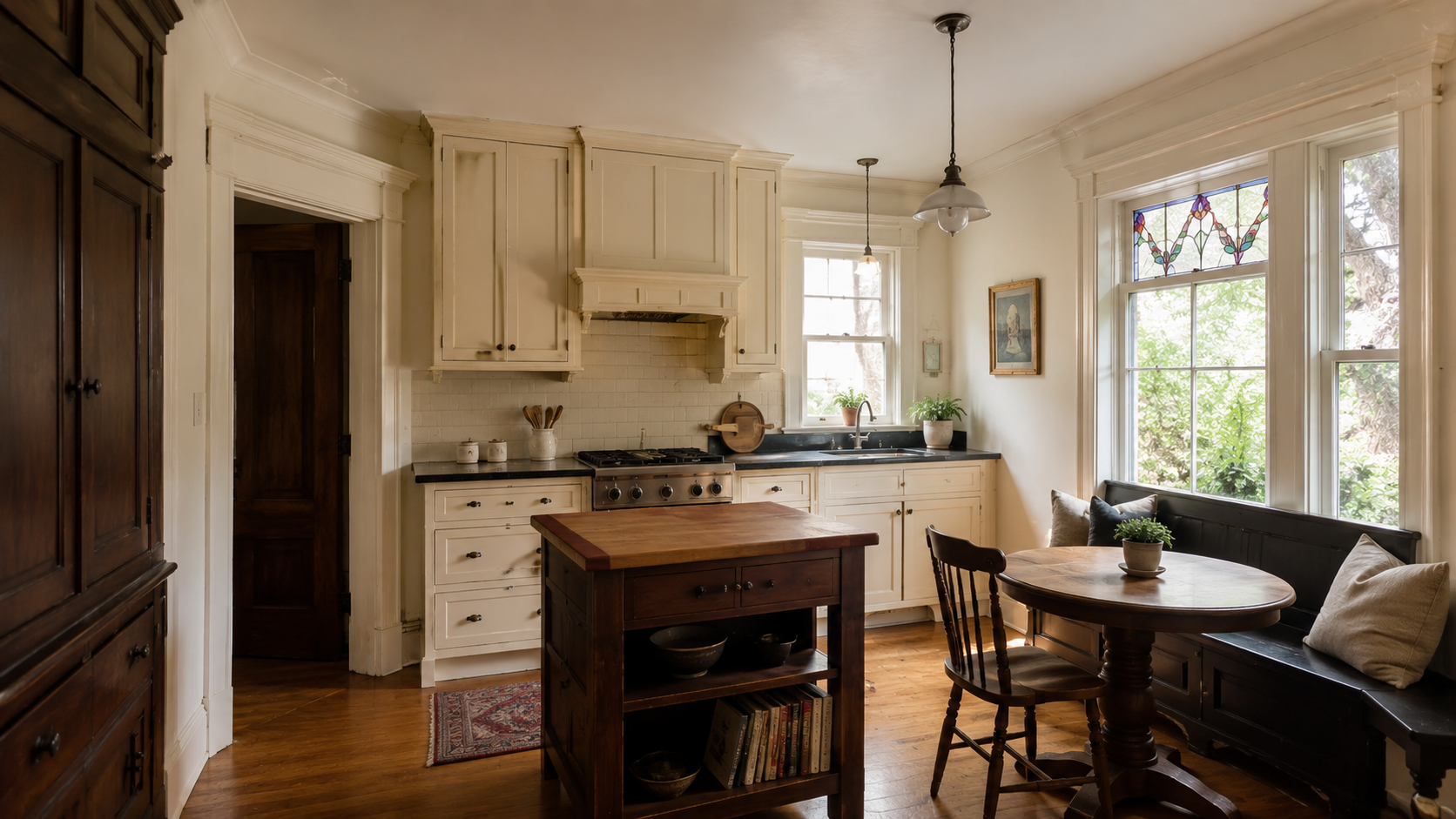
Image by ArchitectureCourses.org. This kitchen shows the safer way to blend modern function with an older Victorian-era house: built-in cabinetry, a modest worktable, traditional trim, warm wood, and a small eating area instead of a giant showroom island.
Ideas That Survive Real Use
Some ideas look good once. Better ideas still make sense six months later.
| Idea | Where it works | Where it goes wrong |
|---|---|---|
| Apron-front sink | Traditional cabinet runs, scullery-style kitchens, rear additions | Wrong base cabinet, weak counter support, bad plumbing location |
| Freestanding hutch | Blank walls, dish storage, limited upper cabinets | Blocks circulation in a narrow kitchen |
| Glass-front cabinets | Dish display, pantry zones, upper cabinets in darker rooms | Looks cluttered if the storage is messy |
| Butcher-block table | Small kitchens where an island is too bulky | Needs maintenance and enough clearance around it |
| Pressed metal backsplash | Small accent area behind range or prep wall | Too much of it can look like a theme restaurant |
For a wider visual list, see Victorian kitchen design ideas. Use that page for inspiration, then come back to the remodel plan before buying anything.
What to Keep, Replace, or Add
| Feature | Keep if... | Replace if... | Add if missing... |
|---|---|---|---|
| Original trim | It is intact, safe, and fits the room | It is rotten, badly patched, or blocking required work | Use simple, proportionate trim, not oversized fake molding |
| Wood floor | It can be repaired and handles kitchen use | It is too damaged, wet, or structurally weak | Choose wood or tile that fits the room’s age and traffic |
| Old pantry or nook | It gives useful storage or character | It blocks the only functional layout | Add a pantry cabinet, hutch, or shallow built-in |
| Fireplace or chimney breast | It is safe and helps anchor the room | It creates major clearance, venting, or code problems | Use the wall as a range, display, or storage focal point |
| Old windows | They can be repaired and still light the room | They leak badly or conflict with cabinet function | Respect the opening rhythm when adding new windows |
Where the Budget Usually Breaks
Victorian kitchen budgets usually break when the homeowner prices finishes but not the old-house work behind them.
- Floor work: leveling, subfloor repair, old adhesive, damaged boards, height transitions.
- Electrical: appliance circuits, outlet spacing, lighting circuits, panel capacity.
- Plumbing: sink relocation, dishwasher line, old pipe replacement, venting.
- Ventilation: range hood route, exterior wall or roof penetration, makeup air concerns.
- Cabinet fit: out-of-square walls, old trim, radiators, window heights, uneven floors.
Keeping the sink, range, and major walls in place can keep the project controlled. Moving them may still be worth it, but it should be priced as a systems change, not a style upgrade.
Spend Here, Not Here
| Spend here | Be careful spending here | Why |
|---|---|---|
| Cabinet construction and fit | Extra applied trim | Good proportions make the kitchen feel built in. Thin decoration makes it look fake. |
| Ventilation route | Decorative hood face only | A pretty hood that does not vent well leaves heat, grease, and moisture in the room. |
| Floor repair and leveling | Expensive finish flooring over unknown layers | New tile over a bad floor can crack, lift, or hide water damage. |
| Task lighting | One dramatic fixture | The room still needs light at the sink, range, pantry, and prep surfaces. |
| Good hardware at touch points | Novelty antique props | Hardware gets used every day. Props become clutter. |
Before You Spend Money
- Is the sink staying, moving, or changing size?
- Where will the range hood vent?
- Can the floor handle tile, stone, a heavy sink, or a large island?
- Are the walls and floor square enough for the cabinet plan?
- Is there enough landing space beside the range and sink?
- Will the refrigerator dominate the main view?
- Does the lighting plan include task light?
- Are old floor layers or adhesives being tested before removal?
- Does the remodel still feel like the house it belongs to?
Product note: Victorian-style faucet
A vintage-style faucet can help the sink wall read correctly, but scale matters. A delicate faucet on a large apron sink can look undersized, while an oversized bridge faucet can crowd a small counter.
Useful read: The Victorian Kitchen by Jennifer Davies
This is useful before a serious remodel because it explains how Victorian kitchens worked, not only how they looked.
For the broader house style, see Victorian Period Architecture. For component-level choices, see Victorian Kitchen Essentials.
FAQ
What makes a kitchen look Victorian?
Weight, proportion, and material depth. Inset or raised-panel cabinets, aged metal, stone or butcher block, old-house trim, glass-front storage, and good lighting usually do more than decorative props.
Can a Victorian kitchen still have modern appliances?
Yes. Panel-ready appliances, restrained finishes, and careful placement work better than a stainless appliance wall facing the main view.
Is a dark Victorian kitchen always better?
No. Dark paint can work, but small kitchens usually need lighter ceilings, walls, backsplash, or counters. A dark room with poor light becomes tiring fast.
Should I add an island?
Only if the clearances work. Many older kitchens are better with a narrow worktable, hutch, pantry wall, or built-in storage.
What is the biggest hidden cost in a Victorian kitchen remodel?
Old-house work behind the finishes: subfloor repair, electrical upgrades, plumbing changes, vent routing, floor leveling, plaster repair, and cabinet fitting around crooked walls or thick trim.
What should I avoid?
Avoid fake antique signs, oversized islands, cheap ornate trim, glossy fake stone, weak ventilation, and decorative lighting that leaves the work surfaces dark.
Can a modern Victorian kitchen look authentic?
Yes, if the room keeps old-house proportions and material weight. The modern parts should support the kitchen quietly instead of becoming the loudest thing in the room.