
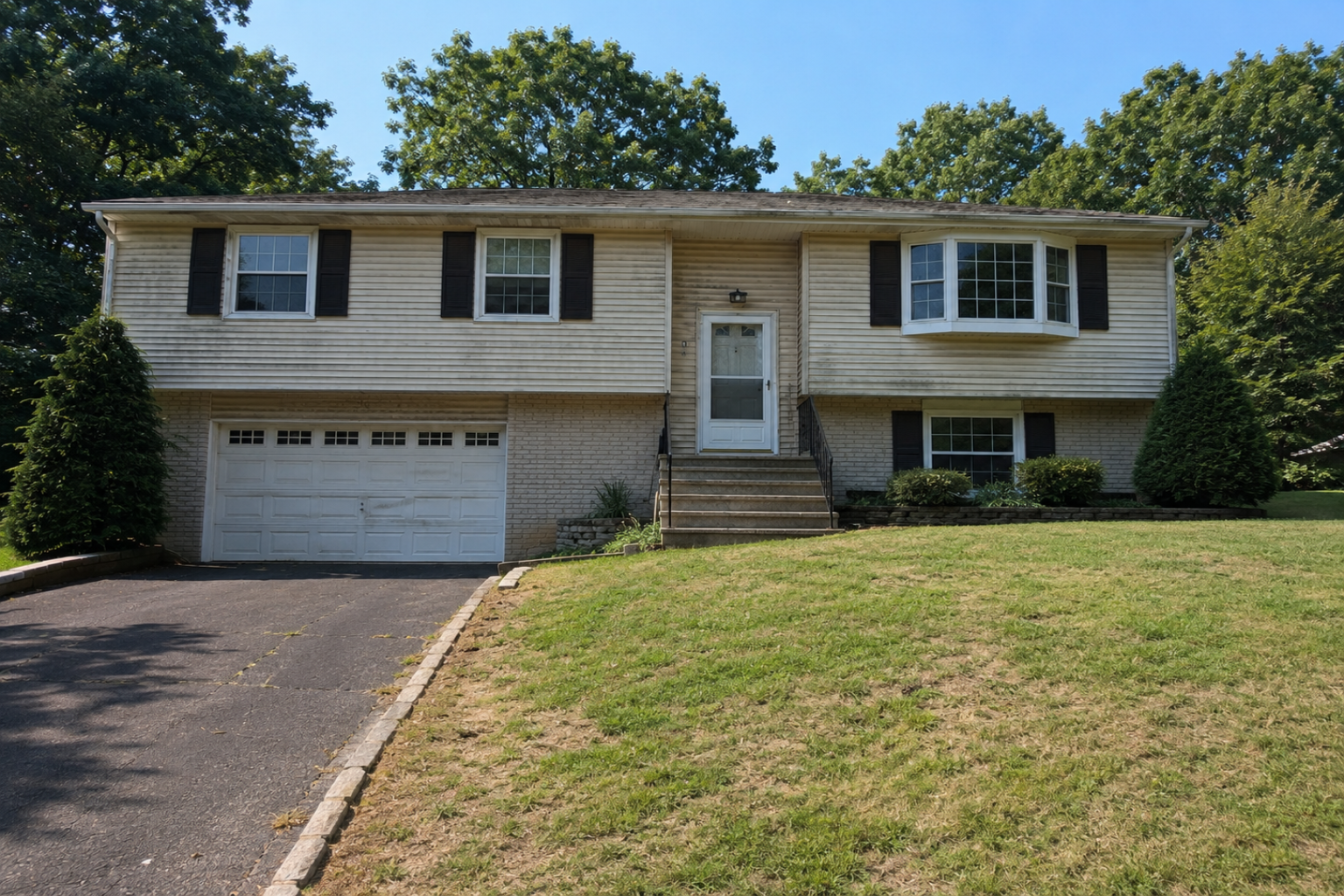


A raised ranch remodel usually goes wrong at the front door.
The entry is tight. One stair goes up. One stair goes down. The garage pulls attention away from the door. The lower-level windows sit small and low. Before any siding or porch work, the house already has a balance problem.
The mistake is adding weight to hide it: a bigger porch, stone veneer, black windows, a darker garage door, or a busy roof. The better remodel starts with the entry, garage, light path, kitchen wall, and lower-level windows.
If those parts stay wrong, new finishes can cost a lot and still leave the same awkward raised ranch underneath.
Small Front Fixes First
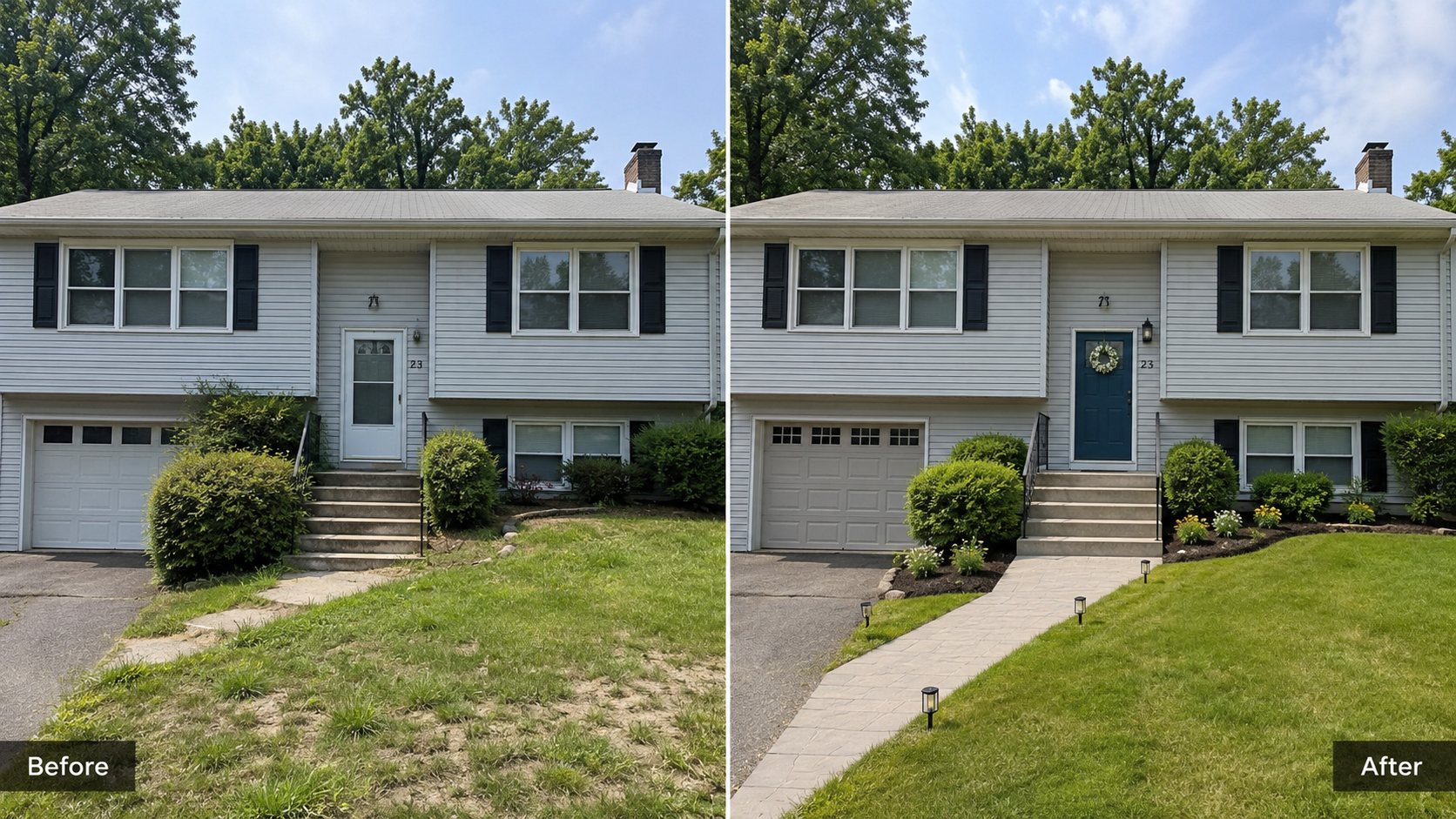
The change here is mostly cleanup and front-yard work, not a full remodel. The door, shrubs, mulch, garage color, light, and planting beds do most of the work. Rebuilding the walkway costs more, but the lesson is still the same: the first impression can change before the house gets a major exterior renovation.
You do not have to spend a fortune to make a raised ranch look better from the street.
Clean the path. Cut back the shrubs. Paint the front door. Change the house numbers. Add a better porch light. Make the garage door quieter. Put one low planting bed where the eye should go.
Those fixes will not solve a bad landing, a dark stair, a load-bearing wall, or tiny lower-level bedroom windows. They can still help a lot when the goal is resale, listing photos, or a cleaner first impression.
There are levels to this. A pre-sale cleanup needs calm and order. A long-term remodel may need entry work, windows, drainage, structure, and code. Do the level that fits the house, not the level someone online says you have to buy.
What Makes a Raised Ranch Feel Wrong
A standard ranch is one floor stretched out at grade. A raised ranch is a different animal. Under the skin it is a split-level with the front door landing between two floors, a garage cut into the lower story, and a front that has to organize three things at once: the entry, the garage, and the lower-level windows under the main floor.
The tension between those three is what makes raised ranches feel awkward from the curb. The garage door is wider than the front door and closer to eye level. The entry landing is often set back and shadowed. The lower-level windows are small because the foundation wall is short.
A remodel that treats this like a normal ranch — new roof, new siding, new porch — usually makes the awkward parts more obvious, not less. The garage still dominates because it was never the problem the porch was supposed to solve.
Inside, the split entry is the main design fact. Guests walk in and are asked to choose, up or down. Nobody stands there without a reason. So the entry becomes a narrow pause point: no bench, no light, no dropoff for boots or bags. Just stairs.
Do Not Hide the Split
The split is not the thing to erase.
A raised ranch already does two jobs at once. The upper level wants light, living space, bedrooms, kitchen, and yard connection. The lower level wants garage access, storage, laundry, mechanical space, a family room, or finished space that still has to deal with grade, moisture, windows, and exits.
Bad remodels pretend the split does not exist. They add a tall entry, heavy porch, fake gable, or new siding pattern that tries to turn the house into a different type. That rarely works because the floor levels, window heights, garage position, and front stair are still visible.
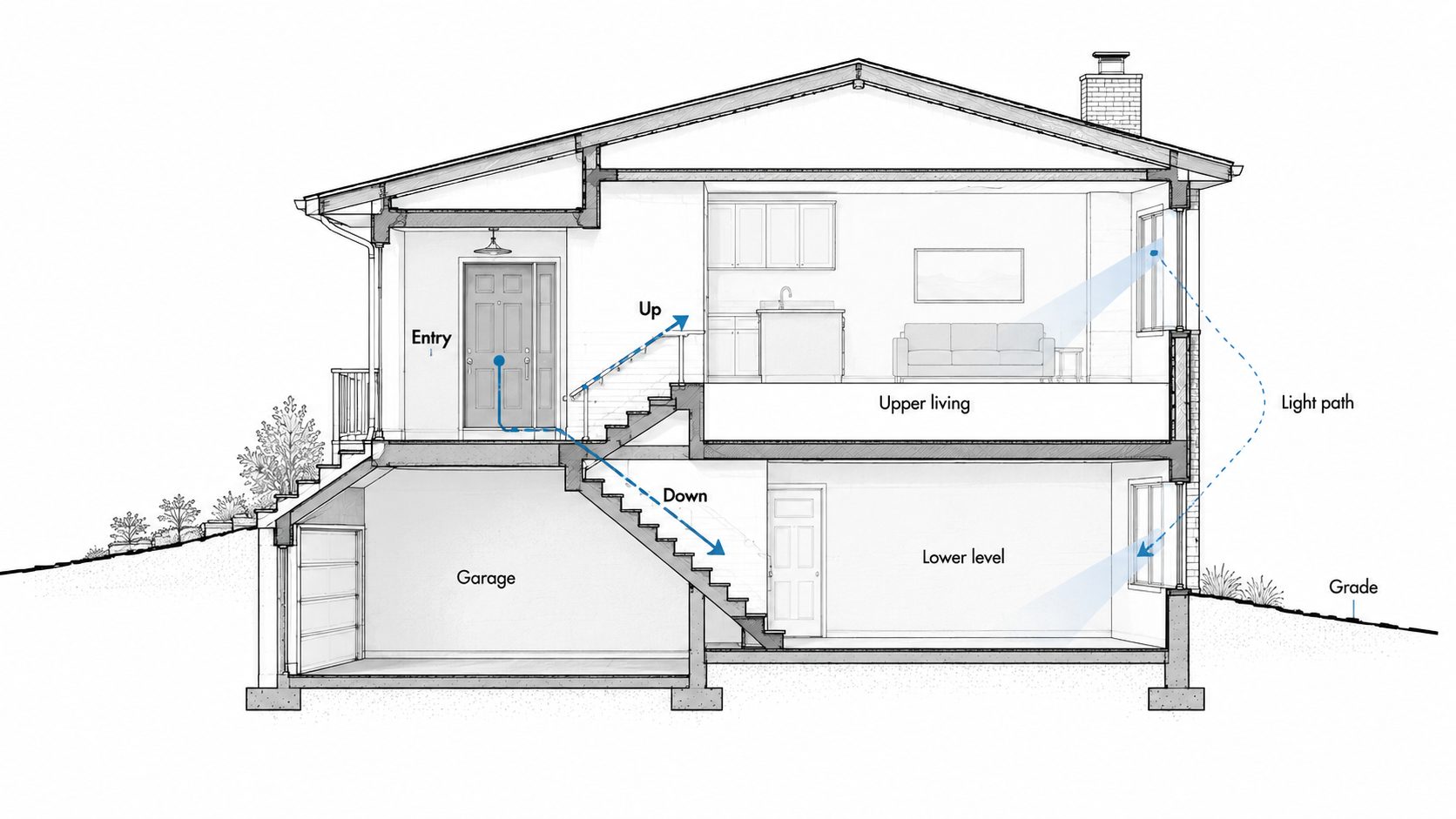
The better move is to organize the split. Make the entry clearer. Calm the garage. Give the lower level real windows if it is living space. Improve the stair and landing. Let the upper floor stay light instead of dragging the whole front down with heavy materials.
The Split-Entry Landing Is Often Already Below Code
Under IRC R311.7.6, the landing at the top and bottom of an interior stairway has to be at least as wide as the flight it serves, and if the stair is a straight run, the depth in the direction of travel has to be at least 36 inches. On many raised ranches built in the 1960s and 1970s, the entry landing between the two half-flights is closer to 30 inches deep. That may have been accepted when the house was built. It is not the standard for new work today.
Here is why that matters even if you were not planning to touch the stairs. As soon as the permit gets pulled to move the front door, rework the entry wall, add a new light, or reframe the landing floor to fit new tile, the inspector can flag the existing landing as a life-safety issue and require you to bring it up to current code.
That means enlarging the landing, which means extending the floor framing, which means opening the wall on both sides, which may mean moving the front door outward or the stair inward. What started as a small entry refresh can become a structural project because the permit touched an old condition.
The way experienced remodelers handle this is to measure the landing before drawing anything, then decide whether the plan is cosmetic-only or whether the entry is being opened enough to do it properly. What does not work is starting with a cosmetic scope and getting caught in the middle.
Fix the Entry First
The front entry is the best place to start.
Not because it needs to be large. Because it needs to be understandable.
A lot of raised ranch entries feel mean from the street. A small door sits between upper and lower windows. The landing is tight. The stairs start too soon. The roof over the entry is weak or missing. Visitors are not sure where to stand. Packages land in the way.
In winter climates, the entry becomes a narrow wet zone where boots, snow, and door swings all fight for the same few square feet.
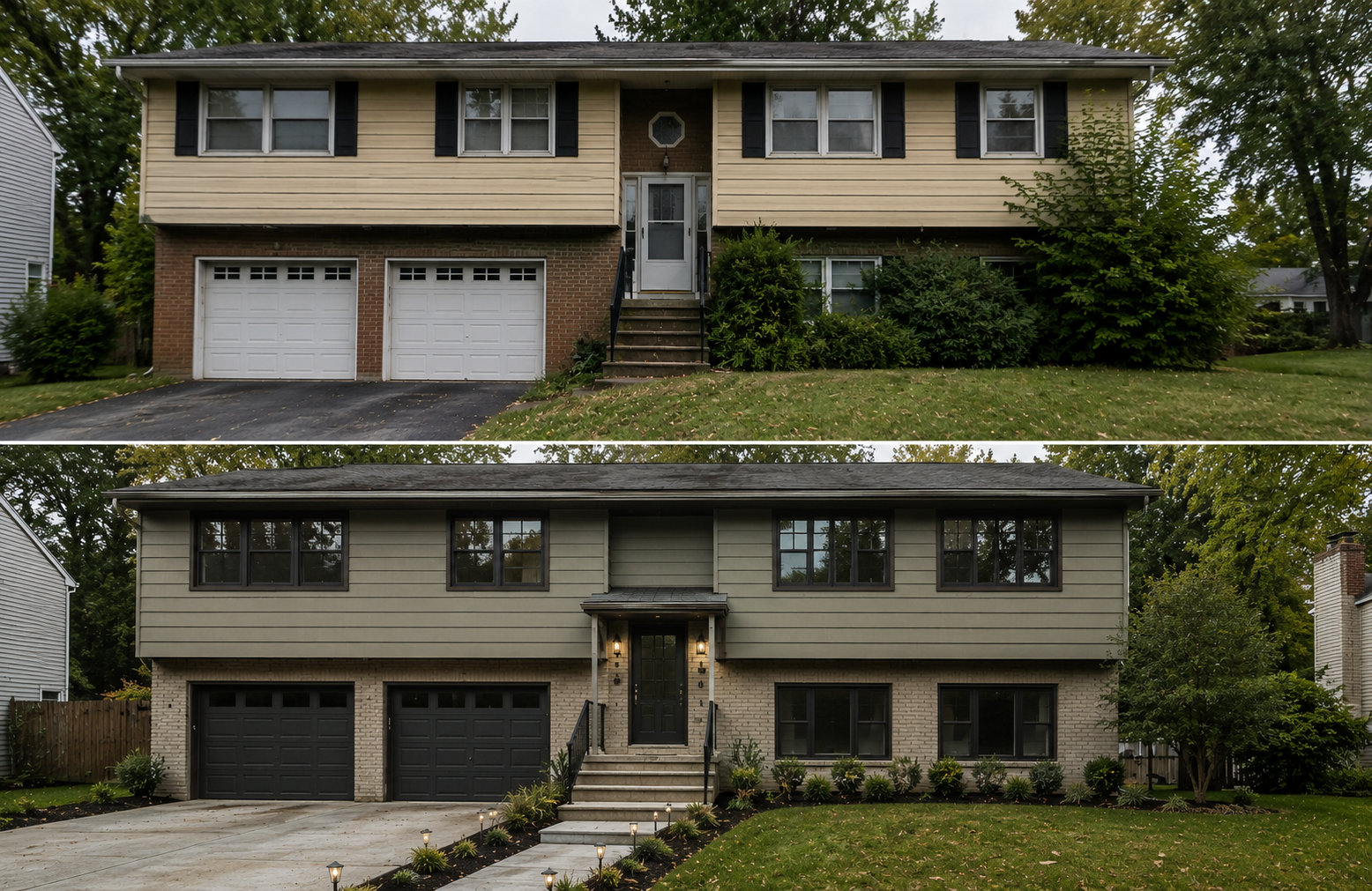
The useful fix is often modest: a clearer path, better landing, stronger light, cleaner door surround, and a small roof that protects the threshold without pretending the house has a grand porch.
Outside, the door benefits from one of three moves. A porch roof carried on real posts so it looks structural, a recessed entry so the wall becomes the frame, or a simple canopy that lines up with a window or a roofline above. Pick one. Two is already too many.
The goal is to make the door visible, protected, and clearly the front door — not to build a small addition around it.
Quiet the Garage
The garage door sits low, wide, and close to the driveway.
Above it, the living level can look like it is floating. If the front door is weak, the garage becomes the face of the house. A remodel that makes the garage darker, more decorative, or more contrasty can make the problem worse.
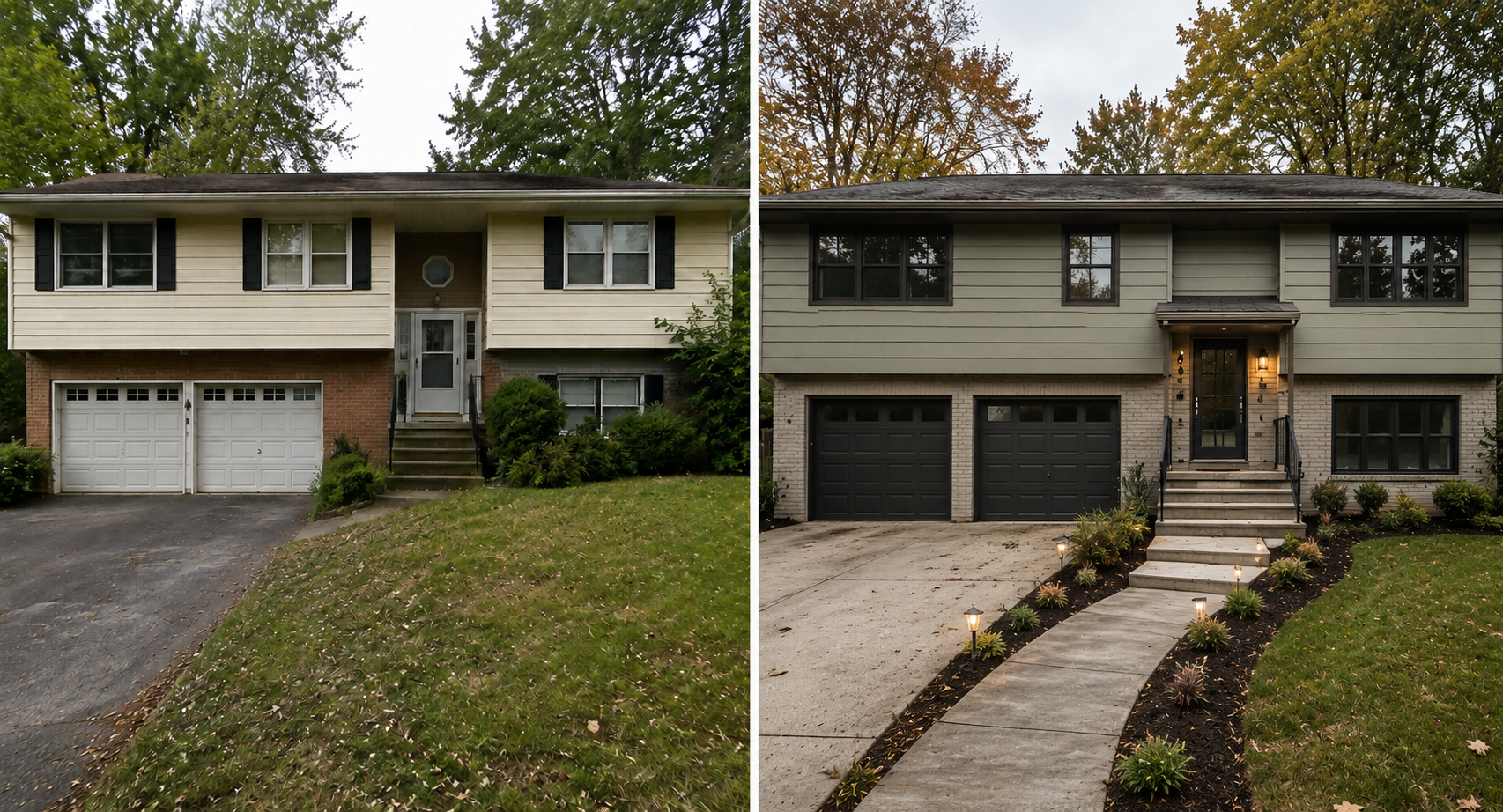
The safer move is to quiet the garage. Use a door color that sits with the body of the house. Avoid busy carriage hardware if the house is already visually split. Keep window inserts simple. If the garage is below the main living level, do not turn it into a second focal point.
The trap is homeowners who want to add a second story over the garage to balance the front. On many raised ranches, the garage roof was framed with 2×6 or 2×8 rafters at a slope suitable for shingles, not with joists sized for a habitable floor above.
Adding a real room up there means new footings under the garage slab if the existing footings were not sized for the added load, a new engineered floor system, and often a full re-roof. Budget for that can run from $80,000 to $180,000 in many markets before finishes, and it changes the whole house — not always for the better.
Rooflines Usually Decide Whether the Remodel Works
A raised ranch has one roof idea: a low-sloped ridge running the length of the house, with modest overhangs. Every successful remodel keeps that idea.
The failures come from remodels that try to add gables, dormers, timber trusses, and covered porches all at once. The front ends up with four or five roof shapes fighting for attention on a house that was always meant to have one.
The version that works: pick one strong roof move — usually a gable over the entry, a low shed dormer across the front, or a full-width covered porch with its own clean roofline — and let the rest of the roof stay flat and simple.
A gable entry canopy at 8/12 slope reads as intentional when the rest of the roof is at 4/12. A gable entry canopy at 4/12 disappears against the main roof. Slope contrast is what makes the move register.
The Structural Line Item Nobody Warned You About
This is the one that catches most raised ranch remodels off guard. It is not in the design magazines and it usually does not show up until demolition is underway.
The upper floor of many raised ranches is framed with 2×8 or 2×10 joists spanning between the exterior walls and a central bearing wall. That central bearing wall is often the wall between the kitchen and the living room. It is what helps hold the roof up. When a homeowner asks to open the kitchen to the living room, they may be asking to remove a load-bearing wall on a house that has no beam sized for that span.
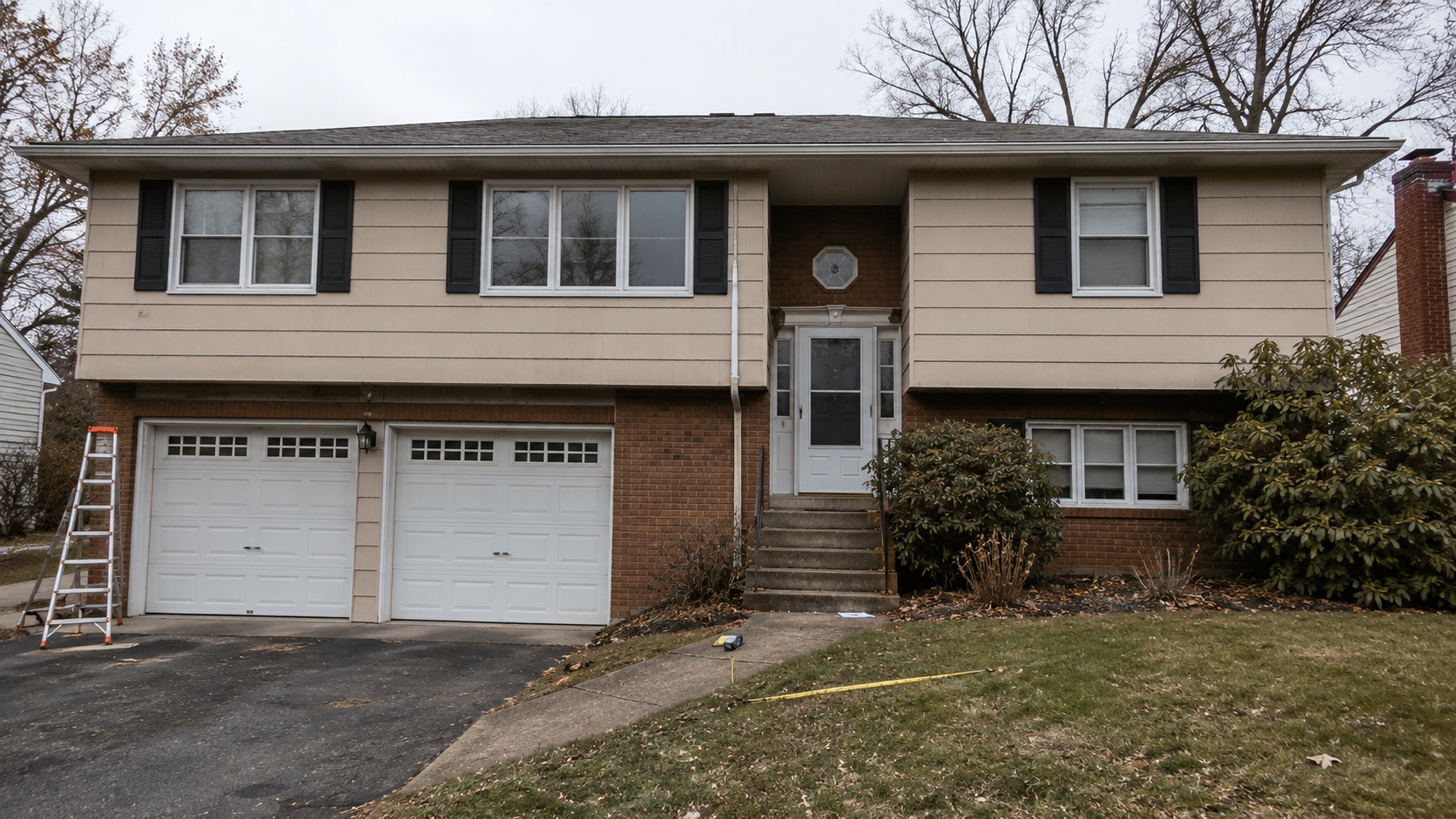
A typical raised ranch is often 24 to 28 feet wide, which means a beam replacing that wall may have to carry roughly 12 to 14 feet of tributary load from the roof and ceiling system. Depending on the load and the span, that beam is often an engineered LVL in the 11-7/8 inch to 14-inch depth range, sometimes doubled or tripled, sometimes replaced with a steel W-beam if the depth needs to be minimized to keep the ceiling flat.
The line-item cost in 2026 for that structural work — engineered beam, temporary shoring during install, new posts at each end, new footings under those posts if the existing foundation cannot take the point load, patch and finish — can run $4,500 to $12,000 in many markets. On a slab-on-grade or shallow-basement raised ranch, the footing work can push it higher because concrete may need to be cut for new pads.
The reason this matters for the budget: many raised ranch remodel quotes that come in low do not include this. The contractor bids the demo and the finishes assuming the wall comes out clean, and the beam becomes a change order after the plaster is off.
Ask about it before signing. Any contractor who has done a raised ranch before should know that the kitchen wall may need structure priced upfront. A contractor who says “we’ll figure that out during demo” may be handing you a five-figure surprise.
Lower-Level Bedrooms and Egress Windows
The lower level of a raised ranch is the part homeowners most want to brighten up and convert into usable space — a rec room, a home office, sometimes a bedroom or a rental suite. The part that gets skipped is that any room used for sleeping has to meet egress requirements, and many existing raised ranch lower-level windows do not.
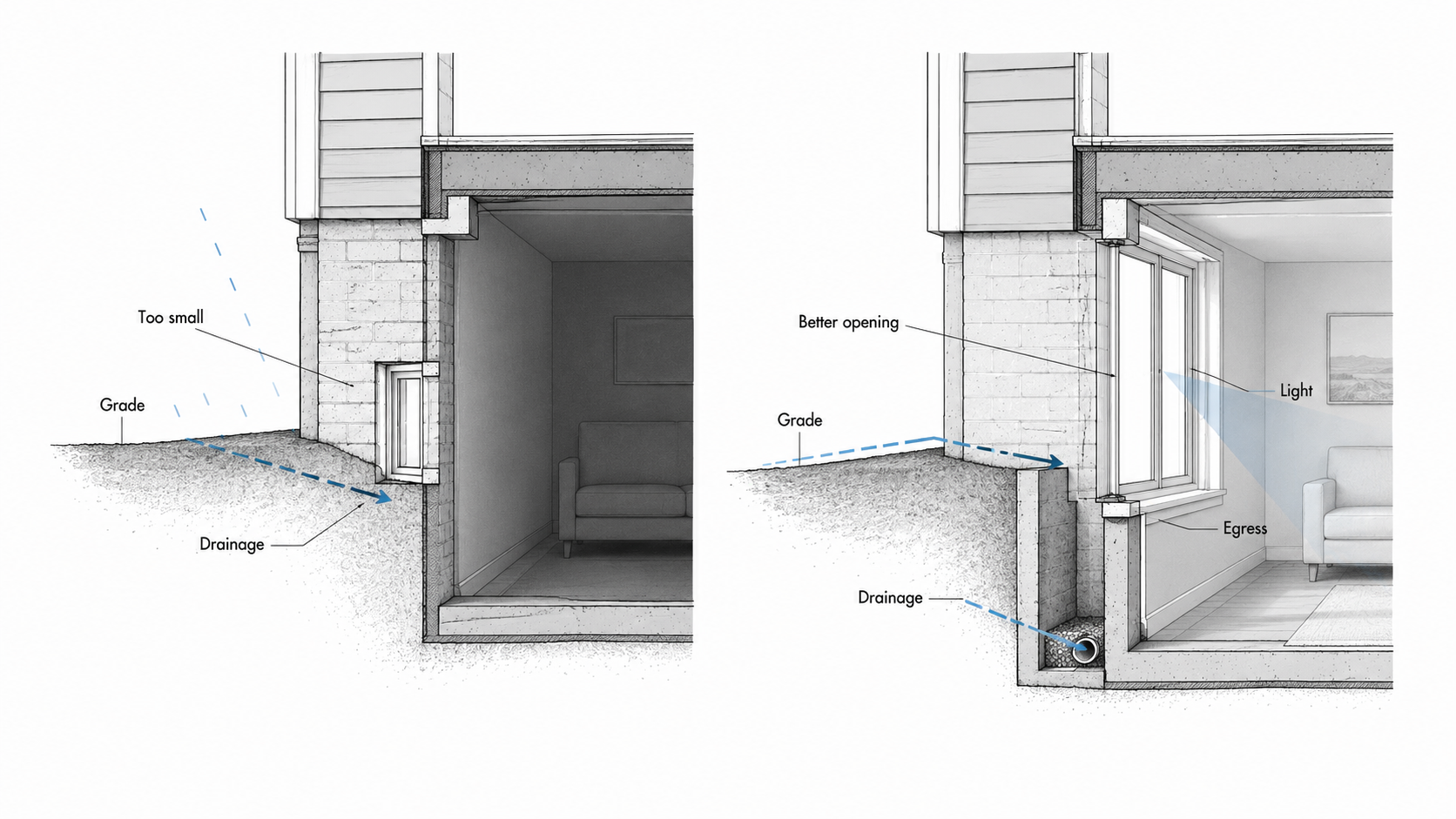
IRC R310 requires an emergency escape and rescue opening with a net clear opening of at least 5.7 square feet, or 5.0 square feet for a grade-level opening. It also requires a minimum clear height of 24 inches, a minimum clear width of 20 inches, and a sill height no more than 44 inches above the finished floor.
Many older raised ranch lower-level windows are far smaller than that and set high in the wall. Making that space legal as a bedroom can mean cutting the foundation wall to enlarge the opening downward, installing a code-sized window, and adding a window well outside.
The well itself has code requirements too: 9 square feet of horizontal area, 36 inches of projection from the wall, and a permanently attached ladder or steps if the well is deeper than 44 inches.
Budget for one egress-compliant window on a poured concrete foundation can run $3,500 to $8,000 including concrete cutting, the new window, the window well, drainage, and interior finish repair. For two lower-level bedrooms, that can become $7,000 to $16,000 in code work before paint or flooring.
Two more things are worth doing right at the same time. Every window well needs drainage tied to the perimeter drain, or it can become a bathtub against the foundation. And the enlarged window should be tall enough that the lower level feels like a room, not a basement wearing new drywall.
Exterior Updates Should Not Add More Weight
Raised ranches already carry visual weight.
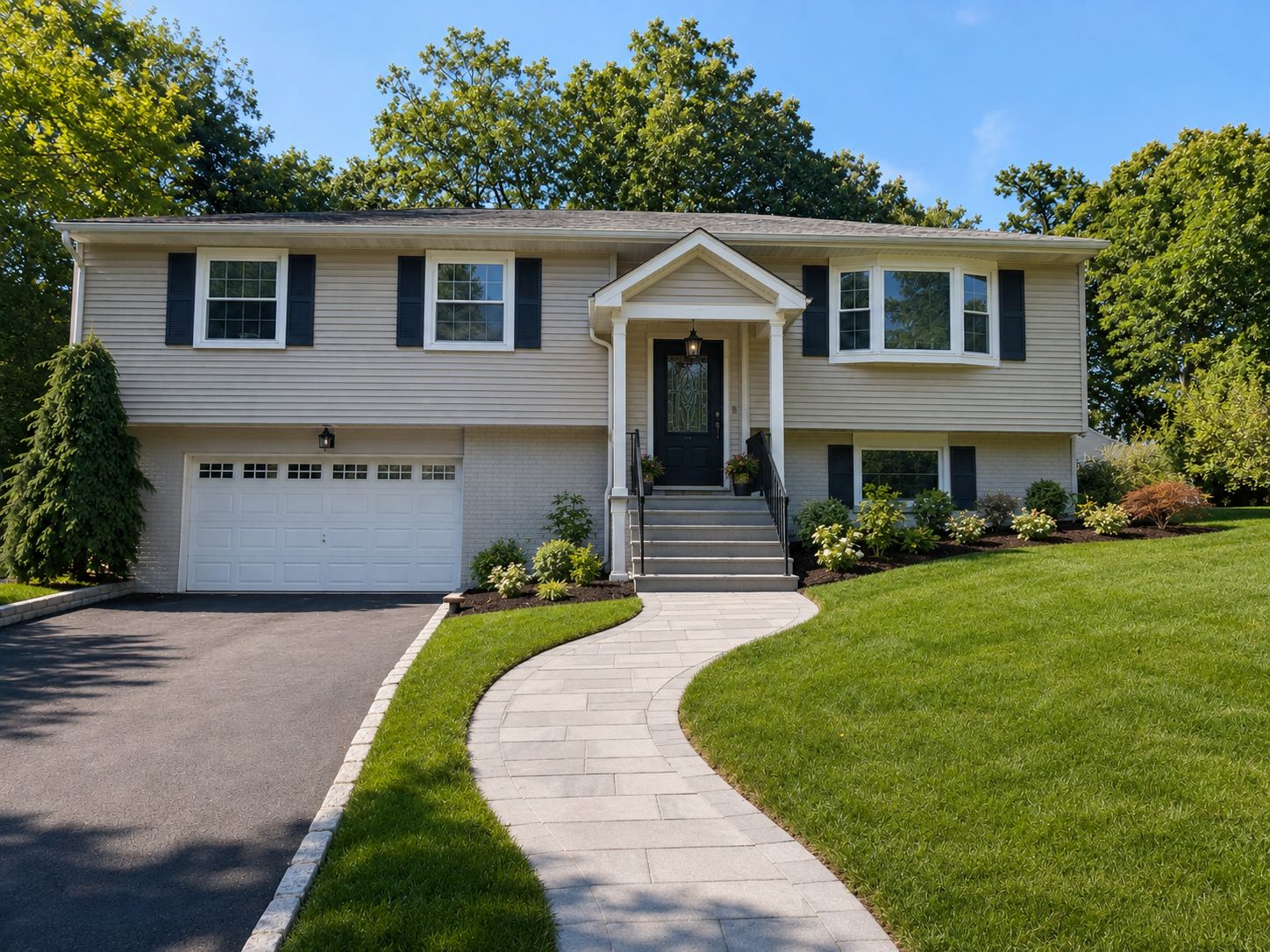
The lower level, garage, entry stair, and upper floor all compete before the remodel starts. Add heavy stone veneer, black trim, tall porch posts, a deep gable, and three siding materials, and the front starts to feel stacked instead of organized.
The expensive mistake is trying to make the house look more valuable by adding heavier materials. A stone base under an already-heavy lower level can make the house squat. Board-and-batten above brick or block can make the upper level feel pasted on. Black windows can outline mismatched openings. A tall entry roof can fight the roofline instead of helping the door.
Raised ranch updates need subtraction first. Fewer materials. Calmer garage. Clearer entry. Better window order. Lower planting. Cleaner trim.
For the broader front-elevation sequence, see what to fix on a ranch house exterior, and what to leave alone.
Bad Overlay vs. Better Edit
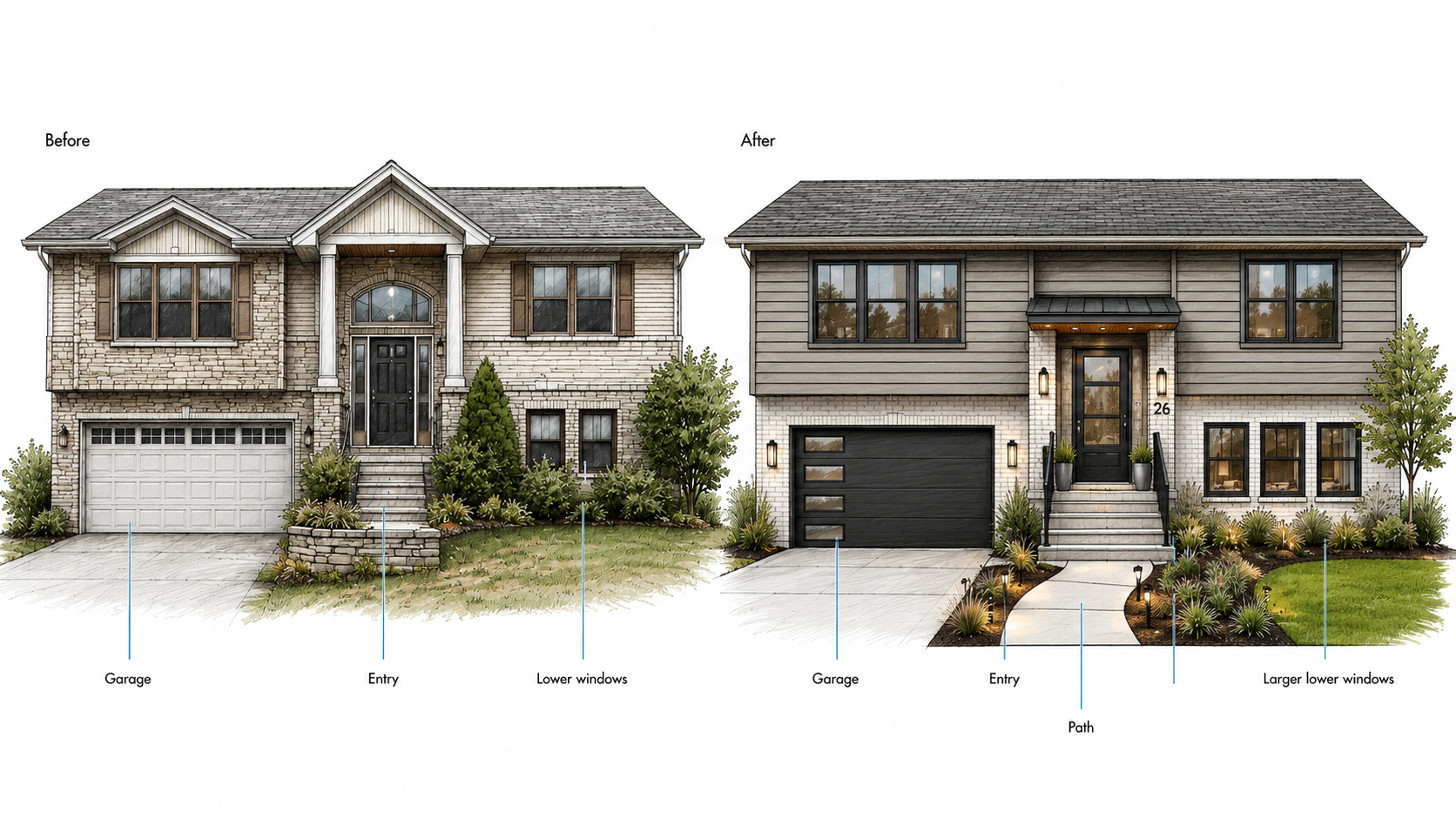
The worst raised ranch remodels are easy to recognize.
The house gets a fake farmhouse face. White siding. Black windows. A big gabled entry. Stone veneer at the bottom. Heavy porch posts. A black garage door. Maybe a timber bracket. Each piece may look current on its own. Together, they make the split entry louder.
A better edit works with what the house already is. The lower level becomes calmer. The entry gets clearer. The stair gets safer and better lit. The upper floor gets cleaner windows and trim. The garage stops shouting. The yard path finally leads to the door instead of the driveway.
| Move | Bad overlay | Better edit |
|---|---|---|
| Front entry | Oversized gable portico that towers over the low-slope roof | A modest shed or gable canopy that lines up with the existing eaves |
| Materials | Stone base, vinyl siding, and shakes in the gable | One siding, one wood-tone accent at the entry, painted trim |
| Windows | Every window replaced with black-framed grid windows | Matched replacement windows sized to the original openings, entry sidelight added |
| Garage door | Bright faux-carriage door with heavy hardware | Simple horizontal-panel door in a color close to the siding |
| Landscaping | Foundation shrubs pressed against the wall, no separation | A defined path to the door, low planting bands, one small tree that anchors the entry |
| Interior main level | Full open plan with the split still awkwardly hidden behind a half-wall | Selective openings between kitchen, dining, and living, with the stair kept as a real feature |
| Lower level | Finished with drop ceiling, dim recessed lights, small windows unchanged | Enlarged egress windows, brighter ceiling treatment, one main room and one flex room |
The Interior Problem Starts at the Landing
Raised ranch interiors can fail in the first ten seconds.
The entry door opens and there is nowhere to pause. One stair goes up. One stair goes down. The coat closet may be too small or badly placed. The landing gets wet, crowded, dark, and noisy. The whole house may be fine upstairs, but the first impression says the opposite.
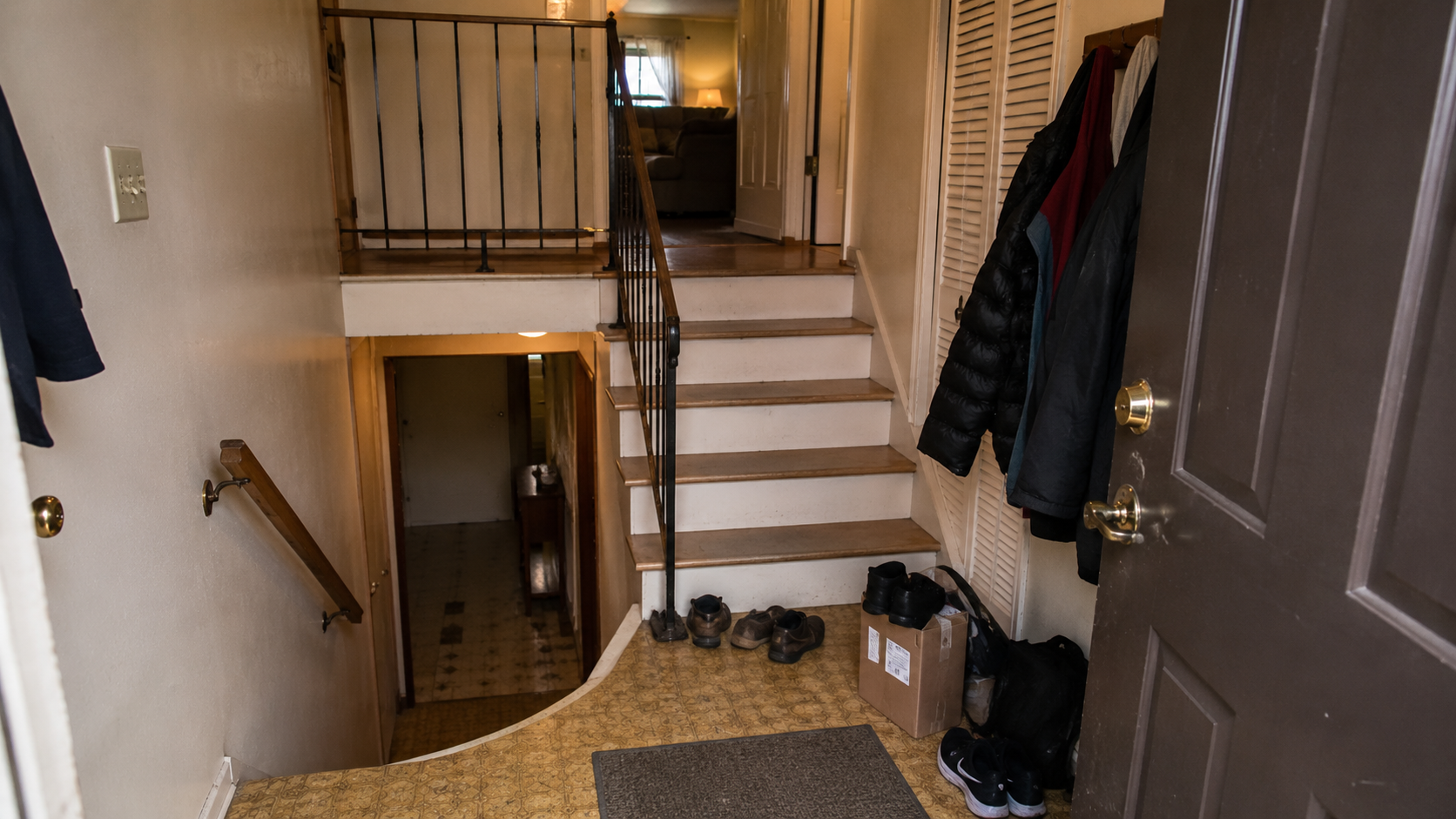
Do not spend all the money on the living room before checking the split landing. Better light, safer railings, better stair finish, a tougher floor at the entry, cleaner storage, and a door that does not swing into chaos can change how the house feels every day.
This is not glamorous work. It is the work people notice when they carry groceries, kids, boots, bags, and packages through the front door.
Opening Walls Upstairs Does Not Fix the Entry
The upper level may need a better kitchen, dining, and living connection.
A wall opening can improve light and flow on the main level. It can make the kitchen feel less boxed in. It can connect the dining area to the living room. But if the entry below still feels cramped and the stair still dumps people into confusion, the house remains awkward at the point where everyone enters.
If walls are being opened upstairs, check structure before assuming the cost is only finishes. Raised ranches can have load paths, beams, stair openings, and mechanical runs that complicate a clean-looking plan. For the layout side, see open floor plan ranch house.
Dark Main Rooms Need a Light Path
Some raised ranches have decent windows and still feel dark.
The problem is often the path of light, not the number of windows. A front living room gets light. A rear kitchen gets light. The middle stays dim. Walls, cabinets, soffits, stair partitions, and dark finishes stop light before it reaches the center.
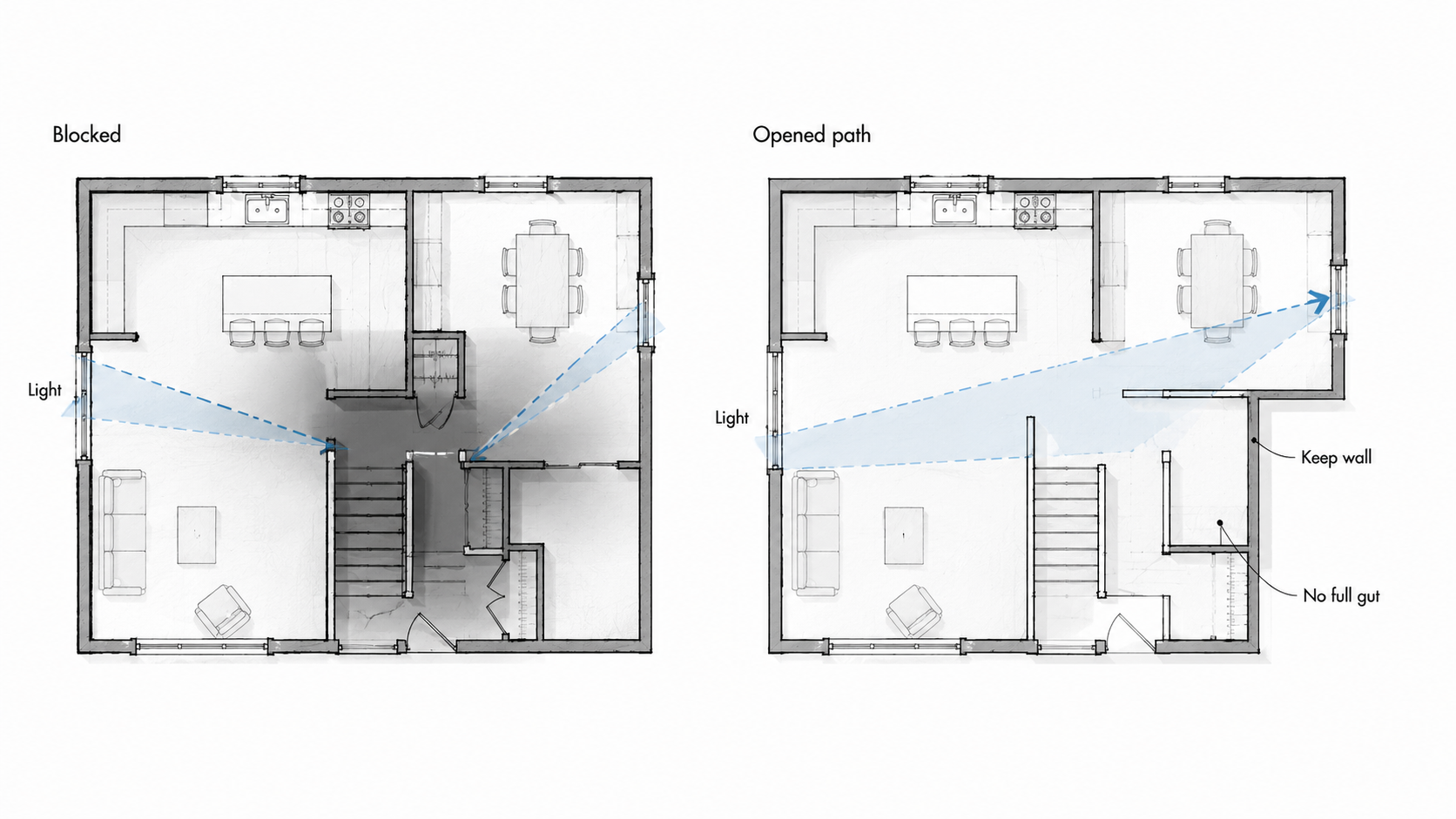
The fix may be a wider opening, a better rear door, lighter stairwell finishes, cleaner interior trim, or a window change in the right place. It does not automatically mean removing every wall.
For a deeper version of that problem, see how to brighten a dark ranch house without opening every wall.
Kitchens Usually Sit in the Wrong Half of the House
In most raised ranches built during the 1960s and 1970s, the kitchen sits at the back of the house with a small window over the sink. The living room takes the front, where the daylight is. That layout worked when kitchens were considered utility spaces and living rooms were formal.
It does not work as well now that kitchens are where families spend more time.
Two moves usually fix this without a full gut renovation. First, if the wall between the kitchen and the living room is not load-bearing, opening it up can bring front-of-house daylight into the kitchen. Second, and more commonly needed, a small rear addition off the kitchen — 8 to 12 feet deep, spanning the back of the house — can create room for an eat-in area with new windows or sliders facing the backyard.
That second move typically runs $60,000 to $130,000 depending on foundation type, roof integration, and how the existing kitchen ties into the new space.
The trap is homeowners who spend $40,000 to $60,000 on new cabinets, counters, and appliances in the existing footprint, then realize the kitchen is still in the dark, awkward spot. The finishes are new, but the room is the same.
The Lower Level Changes the Scope Fast
This is the part that gets missed when the remodel is sold as an entry update or lower-level refresh.
A lower level sits closer to grade. That means moisture, insulation, ceiling height, slab condition, mechanical access, and window wells matter before finishes. If the room is becoming a bedroom, egress matters. If the garage wall is being finished, fire separation may matter. If a bigger window is cut into masonry, drainage outside the opening matters as much as the window size.
A finished lower level that still feels damp, dark, low, or hard to exit is not a successful remodel. It is a finished version of the old problem.
Before framing walls, check moisture, exterior grade, window height, ceiling height, heating and cooling, electrical access, and safe exit requirements. That sequence protects the budget better than picking flooring first.
What the Contractor Quote May Not Include
This is where raised ranch remodels surprise people.
The quote may say entry update, porch, new stairs, new siding, or finished lower level. That does not mean it includes structural work, drainage correction, railing code changes, egress windows, garage separation, electrical upgrades, insulation, or drywall repair after hidden work is opened.
The split-level condition creates scope creep because one change touches several systems. A new front entry may affect stairs, railings, landing size, lighting, siding, roof tie-in, and drainage. A finished lower-level bedroom may trigger egress and insulation questions. A new garage wall finish may raise fire-separation issues. A bigger lower window may require excavation, well drainage, masonry cutting, and inspection.
Ask what the quote excludes before the work starts. The dangerous number is the one that prices the visible remodel and leaves the code, drainage, structure, and hidden repairs for later.
- The structural beam over the removed kitchen wall
- Bringing the split-entry landing up to current IRC code if the permit triggers it
- Cutting the foundation for egress-compliant lower-level windows
- Window well drainage tied into the perimeter drain
- Roof tie-in flashing where any new gable or canopy meets the existing roof
- Electrical service upgrade if the panel is original to the house and cannot handle new circuits
- Insulation upgrades where walls are opened
- Removing and reinstalling siding to allow structural or window work behind it
Any contractor who has remodeled a raised ranch before knows this list. A contractor who has not will find it during the project — at the homeowner's expense.
Raised Ranch Remodels Cost More Than They Look Like
A raised ranch can look like a simple remodel from the street. It rarely prices like one.
Compared with a single-story ranch, the split entry, lower level, garage wall, stair opening, window wells, drainage, and two-level facade all create extra places for the budget to move.
A new entry is not only a front-door update. It may touch stairs, rails, roof tie-ins, siding, lighting, landing depth, and drainage. A lower-level room is not only a finish project. It may need moisture control, insulation, egress, ceiling-height checks, heating, cooling, and electrical access.
That does not make the house a bad remodel candidate. It means the estimate has to treat the split as a real condition, not a style problem. The cheapest raised ranch quote is often the one that has not priced the lower-level and entry complications yet.
| Scope | Planning range | What it usually includes |
|---|---|---|
| Cosmetic exterior refresh | $15,000 to $40,000 | Paint or new siding, front door replacement, entry canopy, exterior lighting, minor landscape work. |
| Kitchen-to-living opening with new beam | $25,000 to $55,000 | Engineered beam, temporary shoring, new posts and footings, drywall and finish repair. Does not include cabinets. |
| Lower-level finish with egress | $45,000 to $95,000 | Egress window or windows with wells, insulation, drywall, flooring, HVAC extension, and a basic bathroom. |
| Kitchen remodel plus rear addition | $120,000 to $250,000 | 8-12 ft addition, new foundation, roof integration, kitchen relocation or expansion, new windows or sliders, full finish. |
| Full facade rework with new entry | $60,000 to $140,000 | New roof over entry, structural changes at the split landing, new front door and sidelight, siding, porch, or canopy. |
| Second story over garage | $180,000 to $350,000+ | New footings, engineered floor system, framing, roofing, exterior finish, interior finish, HVAC extension, and often other code upgrades. |
Where Raised Ranch Remodels Waste Money
| Money goes here | Usually better spent on |
|---|---|
| Tall entry gable | Clearer landing, better lighting, lower canopy, safer steps |
| Heavy stone veneer | Garage balance, drainage, window order, trim repair |
| Black windows everywhere | Matched window proportions and better lower-level light |
| Finished lower level first | Moisture, insulation, egress, and mechanical checks first |
| Open plan upstairs only | Entry landing, stair, coat storage, and light path |
The expensive mistake is trying to make the house look transformed before the entry, garage, lower level, and light path are fixed.
When the Lower Level Should Stay Practical
Not every lower level should become polished living space.
Some raised ranch lower levels work better as tough, useful rooms: garage, storage, laundry, mudroom, workshop, mechanical space, or a simple family room that can handle wear. Turning every lower-level room into finished living space can create moisture, ceiling height, egress, heating, cooling, and sound problems.
A practical lower level is not a failure. It may be the part of the house that makes the upper level easier to live in.
Finish it only after moisture, insulation, ceiling height, windows, mechanical access, and safe exits are understood.
What to Fix, Open, and Leave Alone
| Move | Use it when | Watch for |
|---|---|---|
| Improve the entry | The split landing is dark, tight, or confusing | Oversized porch or gable that fights the low house |
| Calm the garage | The garage dominates the front | High-contrast door that becomes the main object |
| Open the upper living area | Kitchen, dining, and living feel chopped up | Beam, duct, stair, and ceiling complications |
| Add lower-level windows | The lower level is used as real living space | Egress, drainage, privacy, and masonry cuts |
| Finish the lower level | Moisture, height, heat, exits, and access are already solved | Creating finished space that fails inspection or feels damp |
| Leave the split visible | The house works better when the levels are organized, not hidden | Trying to disguise the house with heavy exterior overlays |
What Not to Touch Yet
Do not remove the wall between the kitchen and the living room without an engineer's beam spec in hand. This is the single most common raised ranch remodel disaster: homeowners tear the wall out on the assumption that a header will handle it, find mid-project that the roof is not properly supported, and pay double for emergency structural work with the ceiling already cut.
Do not enlarge lower-level windows before checking egress code and window well drainage. A window well that fills with water during storms because it was not tied into the foundation drain becomes a swimming pool feeding directly into the new room you just finished.
Do not add a second story over the garage without an engineer confirming the existing foundation and framing can carry it. The garage foundation on many raised ranches was designed for a garage roof, not a floor and roof.
Do not build a large front porch that projects past the garage face without studying the light and shadow. It may make the garage recede, but it can also create a low, deep shadow across the entry — the exact problem you were trying to fix.
Do not paint or side over rotting sill plates. On raised ranches with grade issues, the sill plate above the foundation can be the first thing to fail. Painting the siding buys cosmetics for a short time, then the paint bulges and peels because the wood underneath is soft.
Questions Worth Asking a Contractor Before Signing
- Have you remodeled a raised ranch before, and can I see one that has been finished for at least three years?
- What size and type of beam do you plan to use if we open the kitchen wall, and is that spec from an engineer or your framer?
- Are footings included for the new posts, or is that a change order after demo?
- Does the current entry landing meet code, and does the permit require me to bring it up if we touch the wall?
- Are the lower-level windows going to meet R310 egress, and is the window well included in the number?
- Is the sill plate above the foundation being inspected before finish work starts?
- If we add a porch or canopy, how does the roof tie into the existing roof, and is the flashing detail in the drawings?
- What is the change-order policy: flat rate, percentage, or negotiated per item?
Decision Point
A raised ranch is worth remodeling when the layout has good bones: reasonable ceiling heights on both floors, no major foundation issues, and a lot that supports whatever addition you might want.
It is worth walking away from when the foundation is failing, the roof structure is sagging, the lower level has moisture problems that have never been addressed, or the neighborhood ceiling on resale will not support what the remodel will cost.
Before spending serious money on a raised ranch remodel, get a structural engineer to walk the house, not only a general home inspector. Get a straight answer on the beam, the foundation, the garage structure, and the sill plate condition.
That $600 to $1,200 fee is often the best money you spend on the project. It is the line item that separates raised ranch remodels that stay controlled from the ones that do not.
What to Leave Alone
Leave the split visible when it is working.
A raised ranch does not need to pretend it is a center-hall colonial, farmhouse, or new-build modern box. The better remodel makes the split entry safer, clearer, brighter, and less awkward. It organizes the house instead of disguising it.
Keep the simple roofline, the usable garage, and the practical lower level when they still serve the house. Those are not defects by themselves. The mistake is covering them with heavy exterior moves before fixing the entry, light, drainage, and lower-level use.