

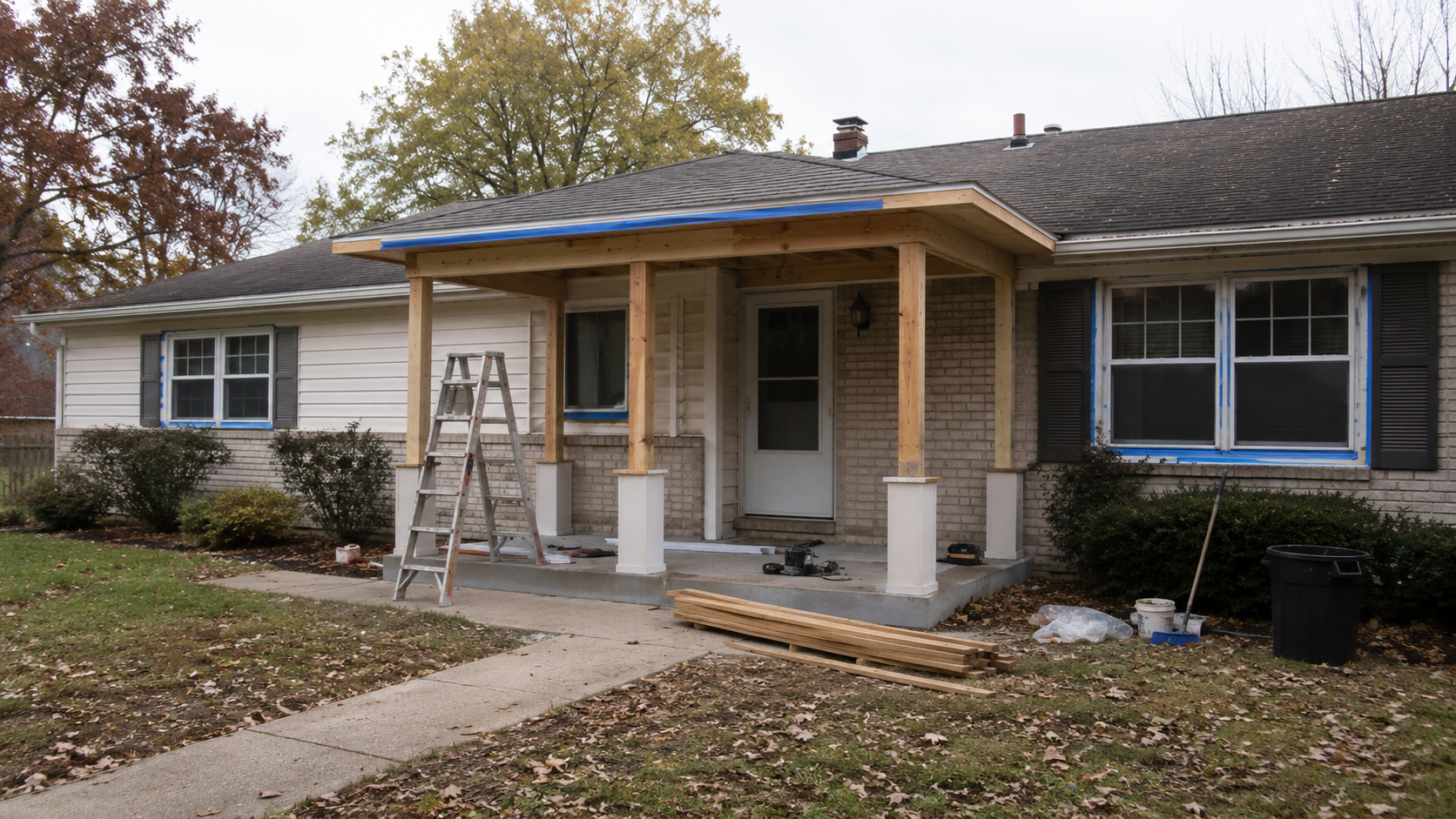
Image by ArchitectureCourses.org. A ranch porch remodel works best when the new roof, posts, steps, and entry stay low enough for the original house to remain the main reading.
A ranch front porch can fix the entry.
It can also make the whole house worse.
The front door is often too quiet, the garage may be too loud, and the low roofline leaves very little room for a dramatic porch move. The remodel starts with a reasonable complaint: nobody can find the door, the entry feels flat, the front looks tired.
Then the fix gets too tall.
A heavy gable gets added. The posts grow. The porch roof starts fighting the original roof. The new entry becomes more visible, but the house stops reading as a ranch. It looks like a small low house wearing a taller house’s front.
The Porch Has to Respect the Low House
A ranch house is usually a long, low building. That is not a weakness to erase.
The porch should make the entry easier to understand without turning the front into a different kind of house. The new roof, posts, landing, steps, trim, and walkway all need to stay subordinate to the main roofline.
The common mistake is adding height to solve visibility. Height does make the entry obvious. It also breaks the quiet horizontal shape that makes the house work. A ranch can take a small canopy. It can often take a modest low porch. It usually struggles with a tall gabled portico, especially when the rest of the house still has a low eave and simple window rhythm.
A porch should make the entry clearer. It should not become the whole front elevation.
Entry Marker First, Porch Second
Start with the smaller problem.
A weak entry does not always need a full porch. Sometimes it needs a clearer path, better lighting, a cleaner door surround, repaired steps, and one small roof or canopy that says “this is the entrance.” That is an entry marker. It solves orientation.
A porch is a bigger claim. It adds usable depth, posts, roof structure, steps, railings in some cases, and a stronger front composition. That can be worth doing, but only when the house has enough proportion to carry it.
A lot of ranch houses do not need a porch. They need the front door to stop looking like an afterthought.
| Entry Move | Use It When | Watch For |
|---|---|---|
| Small canopy | The door needs visibility and light weather cover | Making the canopy too tall or too decorative |
| Low porch | The entry needs a real landing and better approach | Posts and roof mass overpowering the low facade |
| Front portico | Rarely, only when the house has enough width and roof discipline | Fake farmhouse or colonial proportions pasted onto a ranch |
| Walkway and lighting only | The porch is not the main problem | Spending on structure before fixing the approach |
Small Canopy, Modest Porch, Too Heavy
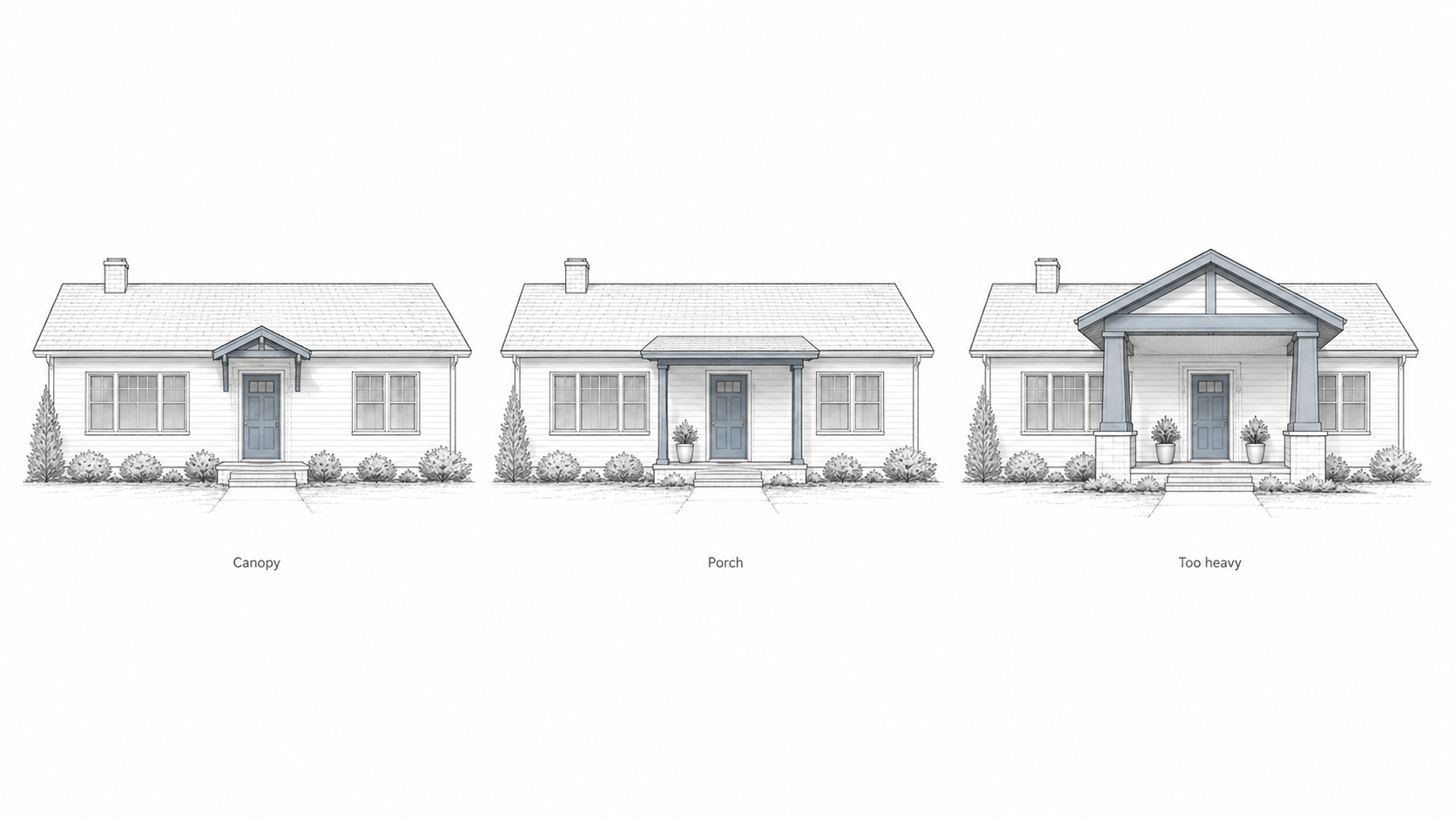
Illustration by ArchitectureCourses.org. Ranch front porches work best when the entry becomes clearer without making the low house feel taller, heavier, or out of scale.
Most ranch entry options fall into three groups.
A small canopy is the lightest move. It marks the door, gives a little weather protection, and can sharpen the front without changing the whole elevation. This works well when the existing landing is usable and the entry only needs a stronger read.
A modest porch adds more. It gives the door breathing room, creates a better arrival point, and can make the front elevation feel more intentional. Low roof, simple posts, enough depth to stand comfortably, and no attempt to turn the house into a grand porch house.
The too-heavy version is easy to spot. Big gable. Tall posts. Deep roof. Decorative truss. Chunky bases. The door may look important, but the ranch looks smaller and weaker beside its new front piece.
The Roof Tie-In Is Where the Porch Becomes Construction
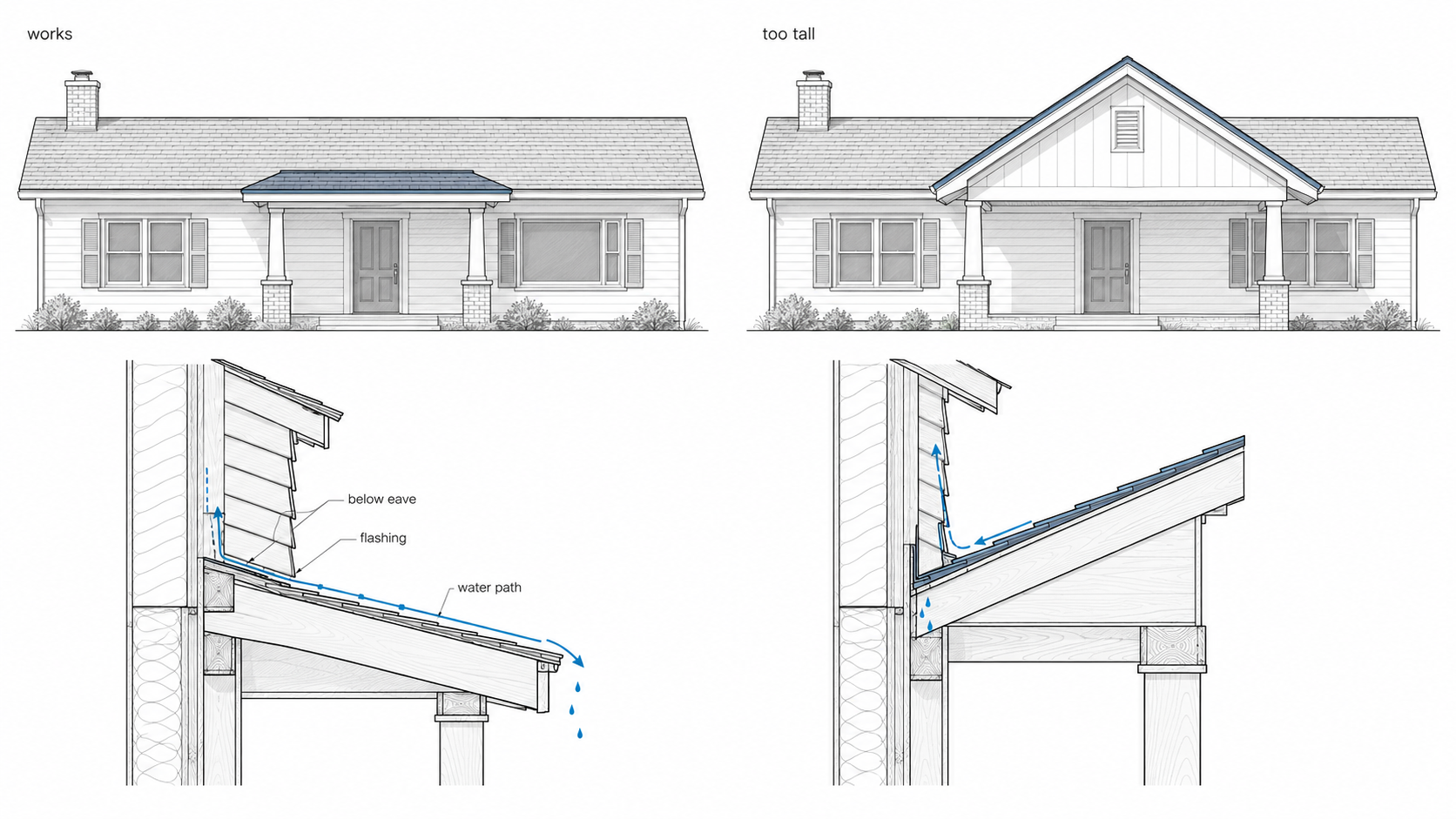
Illustration by ArchitectureCourses.org. A ranch porch roof needs a clean tie-in, low slope, flashing, drip edge, and water path; a tall porch roof can overpower the house and create leak-prone junctions.
A porch roof is not only a design feature.
It has to shed water, tie into the existing wall or roof, carry load, clear the door, avoid trapping water at the siding, and not create a leak path under the eave. This is where a pretty porch idea becomes a flashing, slope, drainage, and framing problem.
A low porch roof can work well when it sits below the main eave, drains cleanly away, and has a flashing detail that sends water out instead of behind the siding. A taller gable may look stronger in a rendering, but it often creates a messier connection. The new roof cuts into the old roofline, creates valleys or awkward returns, and gives water more places to slow down.
If the roof shape is hard to explain in section, be careful.
The porch roof should not need five little tricks to keep water out. Clean slope. Clean flashing. Clean drip edge. Clean load path. Boring roof details leak less.
The Posts Still Need a Real Footing
A porch can look light and still need serious support.
The roof load has to land somewhere. Posts sitting on weak slab edges, patched steps, thin pads, or wet soil can move, settle, twist, or rot at the base. In cold areas, shallow support can heave. In wet areas, a bad post base can trap water where the wood or wrapped column meets the porch surface.
This is where a small porch stops being only curb appeal. Check the footing, post base, drainage, ledger or wall connection, and whether the new roof load has a clean path to something solid. A porch that looks modest from the street can still create sagging, leaks, cracked steps, or failed inspection if the support is improvised.
Garage-Heavy Ranch Fronts Need a Quiet Entry
Some ranch houses have a simple problem: the garage is louder than the front door.
A porch can help, but it can also make the garage problem worse if it adds another competing object to the front. The goal is not to make the door scream louder than the garage. The goal is to calm the garage down and give the entry enough presence to be understood.
A small porch with a clear walkway, better lighting, and a door surround can shift the eye without turning the front into a stage set. A heavy porch roof beside a large garage door may create two big competing moves: garage mass on one side, porch mass on the other. The house starts to feel assembled from parts.
For the broader exterior logic, see what to fix on a ranch house exterior, and what to leave alone.
Porch Depth Beats Porch Style
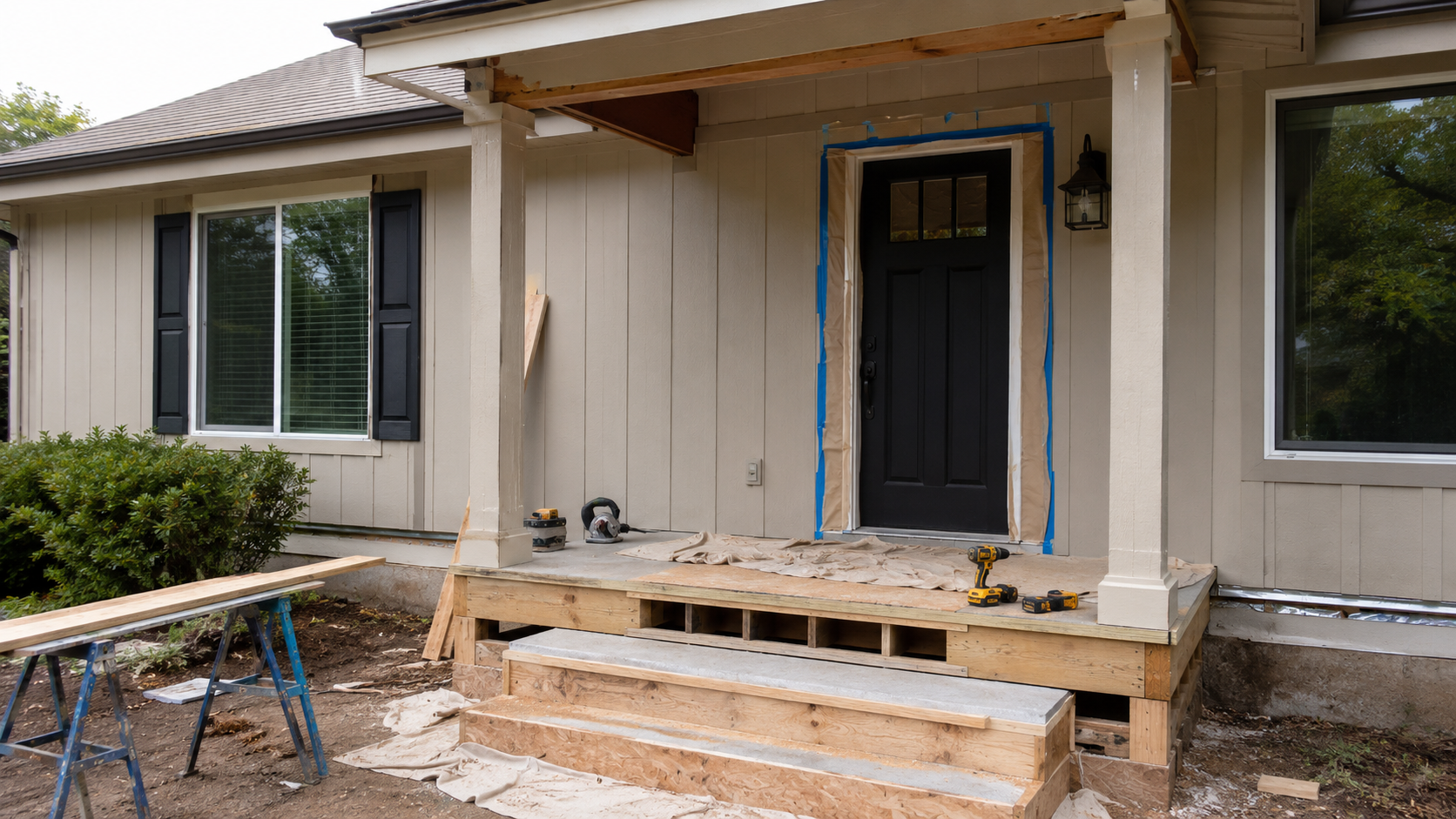
Image by ArchitectureCourses.org. The useful porch work often happens at the landing, steps, post bases, door surround, and roof connection before the finished entry looks clean.
A porch that is too shallow is mostly decoration.
A person should be able to stand at the door, unlock it, step aside, hold a bag, and avoid backing down the steps. That does not require a huge porch. It does require enough landing depth and a sane relationship between the door swing, steps, posts, and walkway.
This is where drawings can lie. In elevation, a shallow porch may look fine because the front view hides the depth. In real use, the landing feels pinched. The storm door hits someone’s shoulder. The package sits in the walking path. The post lands where the step wants to be. The porch looks finished and still works badly.
Check the plan, not only the front view.
Posts Should Not Look Stronger Than the House
Porch posts carry weight visually even when the structural load is modest.
Thin posts can look weak. Oversized posts can make a low ranch look shorter and heavier. Stone bases can work on some houses, but they are overused. Big tapered columns can make a simple ranch look like it borrowed parts from a craftsman bungalow without understanding the rest of the house.
Most ranch porches do better with simple posts, clean bases, and trim that matches the rest of the exterior. The post should look capable, not heroic.
If the post is the first thing the eye notices, it is probably too much.
Steps, Walkway, and Landing Decide the Entry
The roof gets attention. The ground plane does a lot of the work.
A ranch entry can improve dramatically from a better walkway, wider landing, safer step rhythm, and lighting that makes the route obvious. These are not decorative details. Bad steps create trips. A tight landing makes the door awkward. A crooked walkway keeps the entry from feeling settled. Poor drainage near the stoop can stain concrete, rot trim, or push water toward the foundation.
Before spending on a bigger porch roof, check the approach. If people still walk through grass, squeeze past shrubs, or climb narrow steps into a dark doorway, the porch is not doing its job.
What the Estimate Should Spell Out
This is where porch projects turn into arguments.
A porch estimate should not only say “new porch” or “new covered entry.” It should say what happens to the existing stoop, steps, siding, trim, gutters, flashing, roofing, concrete, railings, lighting, and drainage. It should say who handles rot if the old entry wall opens up and the framing is soft. It should say whether the posts get new footings or sit on existing concrete. It should say how the porch roof ties into the house and who is responsible if that joint leaks.
Vague porch estimates make the first price look better than the real project. The roof tie-in gets excluded. The electrical work becomes separate. The old stoop demolition is “as needed.” The siding repair becomes another trade. Then the homeowner is surprised when the small porch starts behaving like a real construction project.
Ask those questions before the porch is framed. If the answers are weak, the drawing is not ready.
Where Porch Remodels Waste Money
Money gets wasted when the porch is asked to solve every exterior problem at once.
The entry is weak, so the porch gets bigger. The facade is flat, so the roof gets taller. The garage is too dominant, so the porch gets heavier. The siding is tired, so the porch gets extra materials. None of those moves fixes the underlying order. They just add cost and mass.
| Money Goes Here | Usually Better Spent On |
|---|---|
| Tall gabled portico | Low canopy, clean flashing, better door surround |
| Oversized columns | Simple posts scaled to the ranch roofline |
| Decorative truss or fake timber | Cleaner roof tie-in and better entry lighting |
| Heavy stone bases | Landing, steps, drainage, and walkway repair |
| Deep porch on a tight front | Small covered entry plus better yard-side living space |
The cheaper move is often the better one because ranch houses do not need much to become clearer.
When a Bigger Porch Earns Its Size
A bigger porch is not always wrong.
It can make sense when the house has a wide enough front, the main roofline can remain dominant, the porch sits low, and the added depth creates a genuinely better entry. It can also make sense when the front yard is the real outdoor space and the house has no useful side or rear connection.
But the porch has to earn the size. It should give better arrival, better weather protection, safer steps, and a place to stand or sit without blocking the door. Size alone is not value.
A big porch with bad drainage, awkward steps, weak lighting, and a roofline that fights the house is a more expensive mistake.
When the Porch Should Wait
Do not build the porch first if the roof, siding, windows, or drainage are about to change.
That is how rework happens. The porch roof gets tied into siding that is later removed. Posts land where a new walkway wants to go. The porch is built before the window plan changes. The entry gets finished, then the garage door and trim update make the porch look wrong.
A porch belongs inside the exterior plan. It should be coordinated with window replacement, siding work, front steps, roof repairs, gutter routing, and drainage. If those pieces are still undecided, the porch design is not ready.
For window planning, see ranch house window replacement.
Permits, Rails, and Small Rules That Change the Job
A small porch can still trigger rules.
Depending on the height, stair count, local code, and scope of work, the project may need permits, handrails, guards, landing dimensions, footing depth, electrical updates, or inspection. This is not the part people put on the mood board. It is the part that changes the cost after the design already feels chosen.
Check this before committing to the porch size. A low canopy over an existing stoop may be a smaller job. A deeper porch with new steps, railings, roof structure, lighting, and footings is a different project. Treating those as the same thing is how budgets drift.
What to Leave Alone
Leave the low roofline alone when it is still doing its job.
Leave a modest entry alone if it only needs repair, lighting, or a clearer path. Leave simple brick or siding fields alone if they help the house stay calm. Leave the front porch small if the real living connection belongs at the rear yard.
A ranch porch does not have to prove the remodel happened. It has to make the entry work.
Front Porch or Backyard Connection?
Some ranch houses do not need a bigger front porch because the better outdoor room belongs somewhere else.
The front may need only a clear entry marker, while the rear needs doors, windows, patio connection, or a covered outdoor space. That is common on ranch houses because kitchens, dining rooms, and living rooms often want more light and yard connection at the back.
If the porch budget is really about outdoor living, check whether the front is the right place to spend it. A front porch used for arrival is different from a rear covered space used every evening.
For interior light and yard connection, see how to brighten a dark ranch house without opening every wall.
Read Next
What to fix on a ranch house exterior, and what to leave alone. Useful before adding porch mass, new siding, trim, or garage changes.
Ranch house window replacement. Important when porch posts, rooflines, or entry changes affect window balance.
How to brighten a dark ranch house without opening every wall. Helpful when the porch is part of a larger daylight and entry problem.
Open floor plan ranch house. Useful if the entry, living room, and circulation are being planned together.