


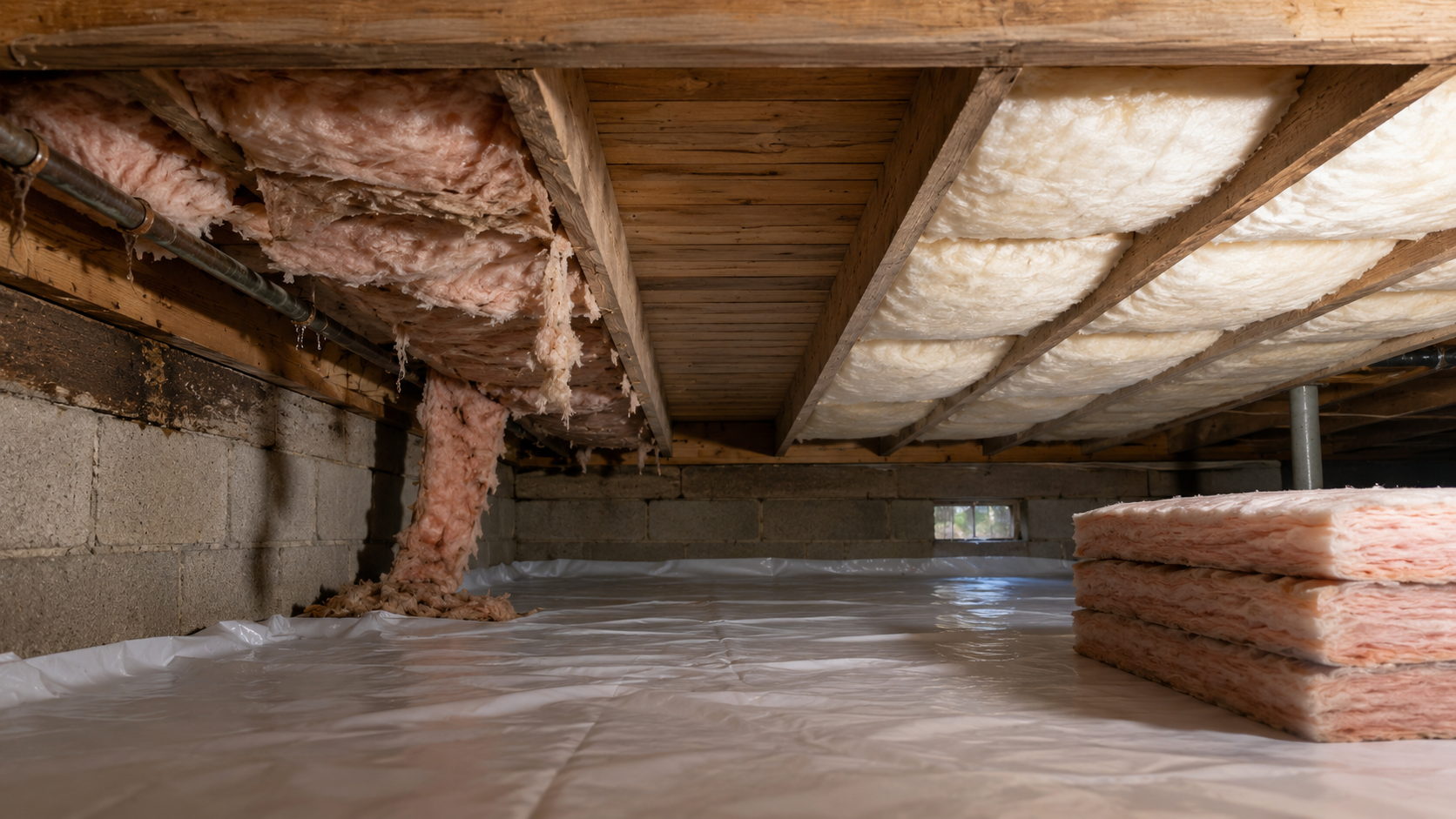
What Goes Where
A lot of crawl-space insulation advice quietly assumes the crawl is still outside.
That assumption breaks once the crawl is encapsulated.
If the liner is sealed, the vents are closed, the air is being controlled, and the crawl is supposed to stay dry and stable, the old floor-batt logic often stops making sense. People leave the dirty floor insulation in place because it was already there, or they replace it out of habit, then wonder why the crawl still feels half-finished.
That is the real issue here. Encapsulation changes the job. It changes what the crawl is supposed to be, where the thermal boundary belongs, and which insulation layers still earn their keep.
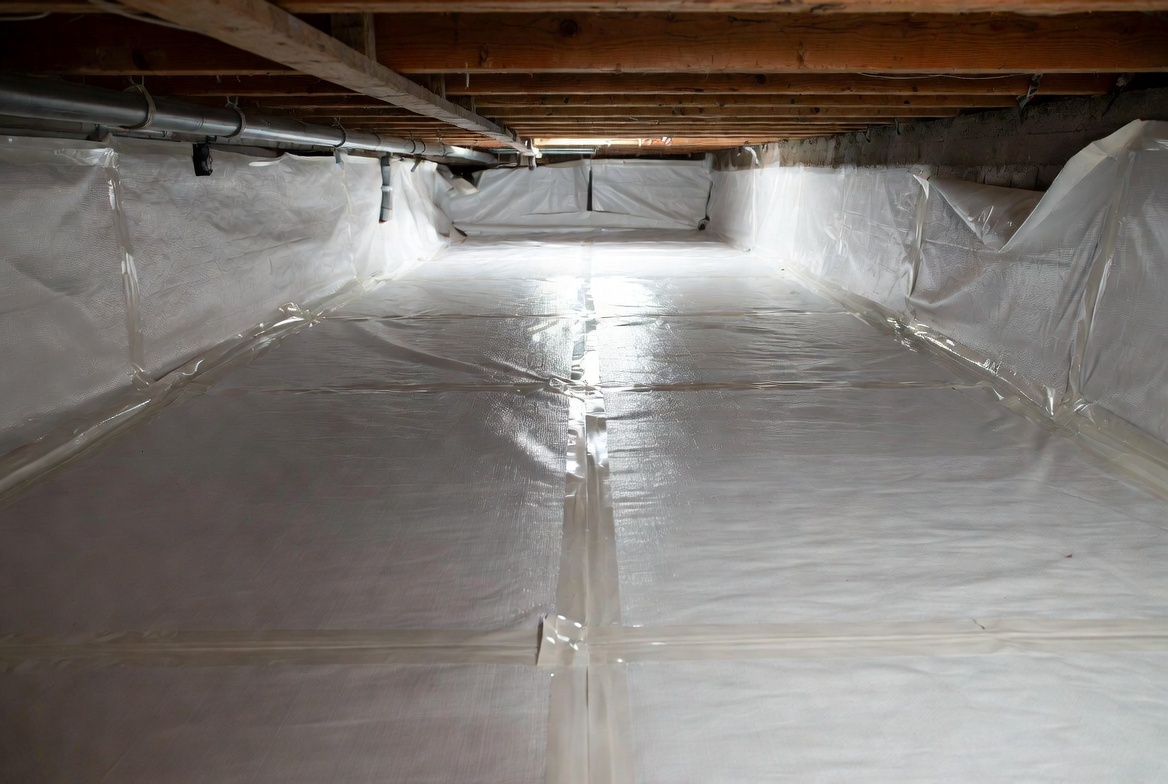
Image by ArchitectureCourses.org. Once the crawl space is sealed across the floor and up the walls, the insulation plan usually has to change with it.
Encapsulation moves the boundary
In a vented crawl, the floor above is usually the thermal boundary. The crawl is outside-ish. The house starts at the subfloor. So insulating between the joists makes sense.
In an encapsulated crawl, that is often no longer true.
Now the crawl is moving toward controlled space. The floor is no longer the clean dividing line it used to be. If the crawl is dry, sealed, and stable enough to protect ducts, pipes, and framing, the logic starts shifting toward the perimeter walls instead of the joist bays.
That does not mean every encapsulated crawl should automatically be rebuilt the same way. It means the old floor-only approach should stop getting a free pass just because it is familiar.
Why the old floor insulation keeps surviving longer than it should
Because it is already there.
That is usually the whole reason.
Homeowners pay for encapsulation, look up, see insulation between the joists, and assume it should either stay or get replaced. It feels wasteful to remove something that once made sense. But if the crawl is now being treated as part of the protected enclosure, that old floor insulation can turn into leftover logic from the previous system.
That is why encapsulated crawl spaces so often end up half old and half new. Fresh liner below. Old batts above. A dehumidifier somewhere in the middle. The crawl is technically improved, but it never fully settles into one clear strategy.
| If the Crawl Is... | The Insulation Usually Belongs... | Why |
|---|---|---|
| Vented and behaving like outside air | In the floor above | The floor is still the thermal boundary |
| Encapsulated and treated as controlled space | At the perimeter walls | The crawl is moving inside the enclosure |
| Half-sealed, inconsistent, still damp | Nowhere new yet | The system still needs to be sorted out first |
Do you keep the old floor insulation?
Sometimes. Not automatically.
If the old insulation is dry, clean enough, properly fitted, and not working against the new crawl-space strategy, some people leave it for a while. That can happen, especially if the crawl was encapsulated after years of being vented and the owner is phasing the work instead of rebuilding everything at once.
But a lot of old floor insulation in encapsulated crawls is not worth defending. It is dirty, sagging, rodent-damaged, mold-stained, or simply left over from when the crawl was still being treated like outside space.
If it is wet or failing, the answer is easy. It goes.
If it is dry but the crawl is now supposed to function as a cleaner controlled environment, the better question is whether the old floor insulation is still doing useful work or just trapping the crawl between two systems.
Dirty old batts are usually dead weight after encapsulation
This is the part people resist because it feels wasteful.
They finally pay for the liner, sealing, and moisture work, but the old fiberglass is still hanging above them. It is ugly, dusty, sometimes half falling out, but it is technically still there. So they leave it because removing it feels like paying twice.
That logic is understandable. It is also how a lot of encapsulated crawls stay half-finished.
If the crawl below is now supposed to be cleaner, drier, and more stable, leaving a dirty damaged insulation layer overhead often works against the point of the project. The crawl may perform better anyway, but it never feels fully corrected.
If the old insulation looks like a leftover problem, it probably is.
Wall insulation usually fits the new logic better
Once the crawl is controlled, wall insulation usually does more useful work.
It keeps the crawl closer to the house instead of pushing it back out. It protects ducts and pipes running through the crawl. It reduces the penalty of having systems below the old floor-insulation line. It also matches the logic of a sealed liner turned up at the walls and a crawl that is no longer supposed to ride the weather the way a vented crawl does.
That is why perimeter-wall insulation is usually the cleaner answer in a real encapsulated crawl. It aligns with the system instead of arguing with it.
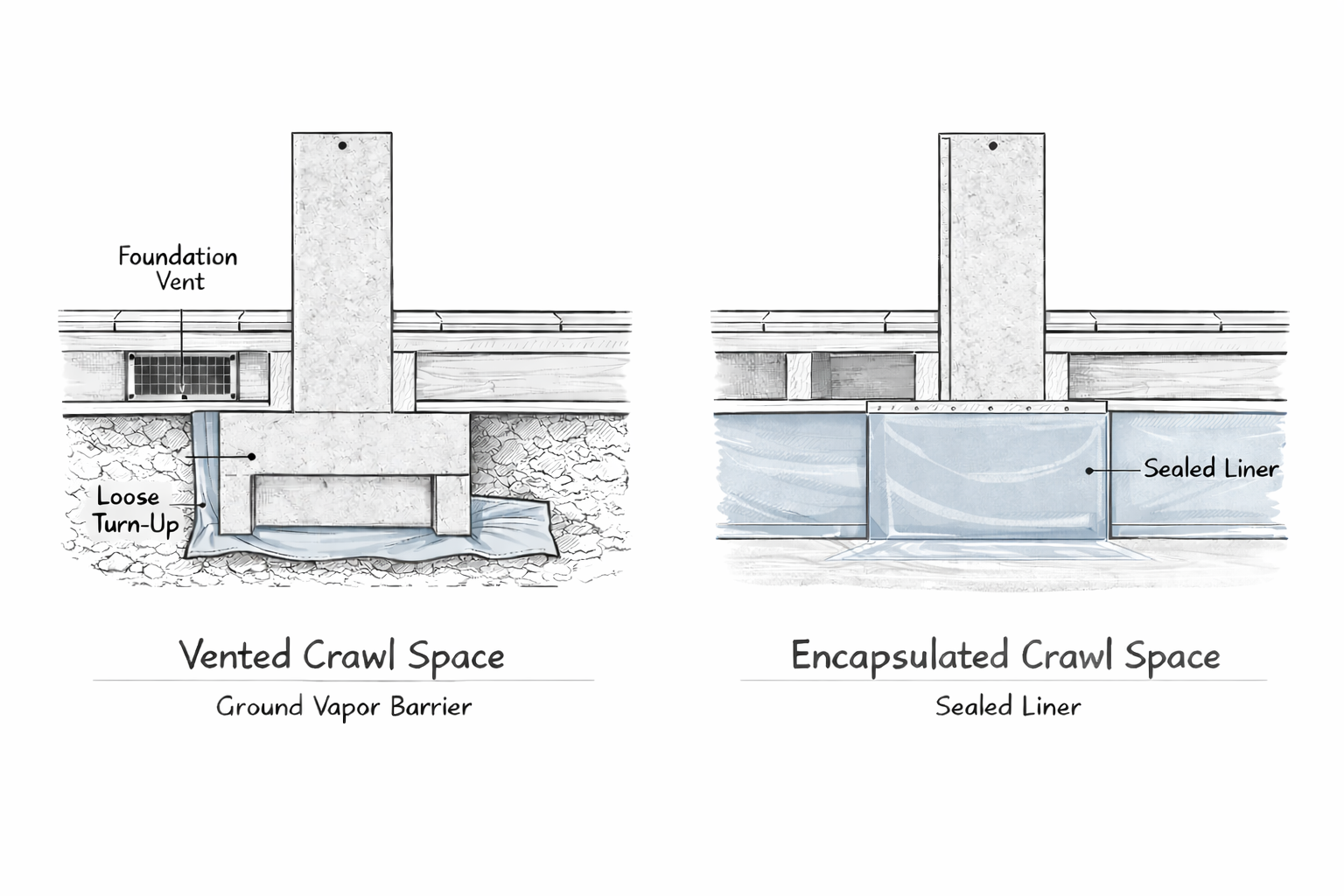
Illustration by ArchitectureCourses.org. Once the crawl is sealed and controlled, the insulation strategy usually shifts away from the floor and toward the perimeter.
What usually makes sense on the walls
Rigid foam board is common because it gives you continuous insulation and a cleaner wall strategy. Closed-cell spray foam can make sense in selected areas, especially where the wall geometry is awkward or the air-sealing value is doing real work. Mineral wool can make sense in some assemblies, but it is usually less common in this particular crawl-space role.
The main point is not the brand or product line. The main point is that the insulation belongs where the crawl-space strategy says it belongs.
Expensive foam in the wrong place is still the wrong answer. Cheap batts left over from the old vented setup do not become smart just because they were already there.
Ducts and pipes are part of the argument
This is one of the biggest reasons encapsulated crawls exist in the first place.
If the crawl carries ducts and plumbing, bringing that area into a more stable environment can pay off fast. Cold floors, sweaty ducts, seasonal humidity swings, and vulnerable pipes all push the logic away from a purely vented-floor-insulation mindset and toward a better-controlled crawl.
That is why leaving the crawl outside the thermal strategy after encapsulation often feels backward. The liner is sealed. The vents are closed. The air is being controlled. But the services are still sitting below a floor boundary that assumes the crawl is basically outdoors.
That is the kind of half-solved condition people end up paying to revisit.
Half-encapsulated crawls are where bad insulation decisions start
Some crawls are not really encapsulated in the full sense. They have plastic on the floor, maybe some wall turn-up, maybe closed vents, maybe a dehumidifier, but the whole system is still loose.
That is where insulation decisions get sloppy.
If the crawl is still taking on moisture, if the liner detailing is weak, if the vents are not truly dealt with, or if the air is not really controlled, then wall insulation may be premature. On the other hand, rebuilding the old floor batt system may also be the wrong move if the crawl is clearly heading toward a more controlled setup.
That kind of crawl needs a real decision before it needs more insulation.
If that is where the house is sitting, go next to crawl space encapsulation vs vapor barrier only and conditioned crawl space vs encapsulated crawl space.
If it still feels damp, stop talking about insulation
If the crawl remains humid, smells stale, or shows damp surfaces after encapsulation, insulation is still not the first problem.
That usually points to something unfinished or misread in the crawl system itself. Maybe there is still bulk water getting in. Maybe the ground liner is incomplete. Maybe the vents are not actually under control. Maybe the dehumidifier is undersized or badly placed. Maybe the crawl was sealed, but not really finished.
A lot of people try to solve that vague unfinished feeling with more insulation because insulation feels visible and decisive. Usually the missing piece is elsewhere in the system.
That is why the next move is often crawl space humidity or crawl space dehumidifier installation, not more insulation talk.
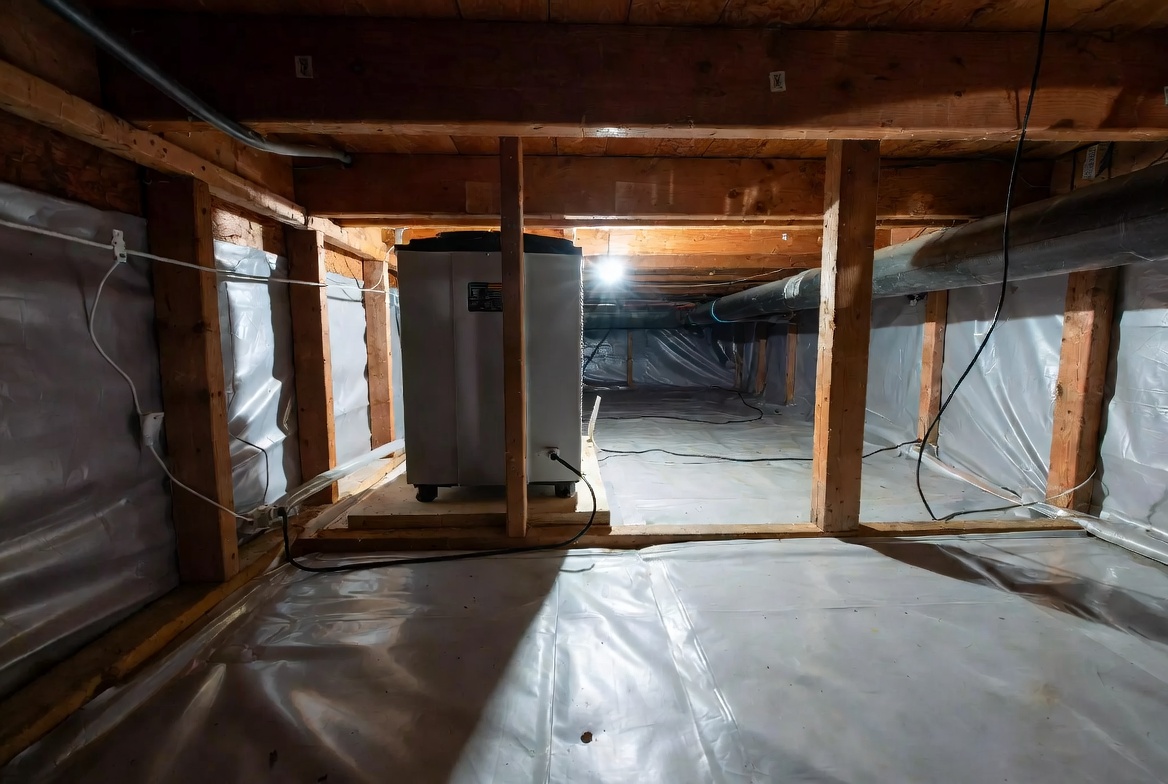
Image by ArchitectureCourses.org. In a truly controlled crawl, the liner, wall treatment, and humidity-control equipment should be working together instead of fighting leftover vented-crawl logic.
When keeping some floor insulation can still make sense
There are cases where leaving some floor insulation in place is reasonable.
If the crawl was recently encapsulated, the old insulation is still dry and intact, the owner is phasing the work, and there is no clear downside yet, keeping it for a while may be fine. Some houses also sit in climates or conditions where the insulation strategy gets muddier and the best immediate move is not full removal.
But that is different from pretending old dirty batts are still part of a clean controlled system just because they exist.
The floor insulation should either earn its place or stop getting defended by inertia.
Where money gets wasted
The repeat-cost pattern is pretty consistent.
- encapsulating the crawl but keeping clearly failed insulation overhead
- replacing old floor batts without deciding whether the crawl is now inside the thermal boundary
- paying for wall insulation before the encapsulation work is truly finished
- using premium foam to cover up an unfinished moisture-control system
- treating the crawl like both outdoor space and conditioned space at the same time
The expensive mistake is not always the material choice. A lot of the time it is the refusal to choose one crawl-space strategy and finish it properly.
Pick one thermal boundary
This is where the page lands.
Once you seal and control the crawl, the insulation plan has to follow that decision. Otherwise the project stays half old and half new, and the crawl keeps carrying the confusion.
That is why “what insulation should I use in an encapsulated crawl space?” is not really a product question first. It is a system question.
The crawl either stays outside the thermal boundary or it moves inside it. Most of the waste happens when people try to split the answer down the middle and keep both systems alive at once.
What I would check before changing the insulation
- whether the crawl is truly sealed and dry enough to act like controlled space
- whether the old floor insulation is clean, dry, and actually worth keeping
- whether ducts and pipes are still sitting outside the thermal logic of the crawl
- whether wall insulation would better match the crawl the house now has
- whether the humidity-control side of the system is already doing its job
If those answers still sound vague, the insulation decision is probably early.
FAQ
Should you insulate the floor in an encapsulated crawl space?
Usually not as the main strategy. In a truly encapsulated crawl, perimeter-wall insulation usually makes more sense than rebuilding the old floor-only setup.
Can you leave old floor insulation in place after encapsulation?
Sometimes. If it is dry, clean, intact, and not working against the new crawl-space strategy, it may stay for a while. A lot of old floor insulation does not meet that standard.
Where should insulation go in an encapsulated crawl space?
Usually at the perimeter walls, because the crawl is moving inside the protected enclosure instead of staying outside it.
What insulation works best on encapsulated crawl-space walls?
Rigid foam board is common. Closed-cell spray foam can make sense in selected areas. The better choice depends on the crawl configuration and whether the rest of the encapsulation system is actually finished.
Does encapsulation replace insulation?
No. Encapsulation handles sealing and moisture control. Insulation still matters, but its location and purpose often change after the crawl is encapsulated.
Why does an encapsulated crawl space still feel unfinished?
Often because the liner is new but the rest of the crawl is still carrying old vented-crawl logic, especially dirty floor insulation, incomplete sealing, or weak humidity control.