
Why Architectural Design Has 5, 6, or 7 Phases — And What That Actually Means
Not every architecture project follows the same number of phases — and that’s not a mistake. Below, we break down why some professionals use 5, others 6 or 7, and how each framework works in real life. No jargon, just real context.
Why Architectural Design Has 5, 6, or 7 Phases — Explained Simply
Architecture Projects Don’t All Follow 5 Phases — Here’s Why That’s Okay
Why This Even Matters
Architecture Design Process: Clients get confused. Students get stuck. Architects have to explain it over and over.
So let’s clear it up — no jargon, no fluff.
This article breaks down:
● Why different design phase models (5, 6, or 7) exist
● What each phase usually covers
● Which version fits what kind of project
● What real pros actually follow — and when they break the rules
Let’s start with the real reason this is a “thing.”
How Did We End Up With Different Numbers of Phases?

There’s no grand conspiracy. It’s just that different professionals group tasks differently.
But the work? Pretty much the same everywhere.
The Breakdown:
● 5 Phases – The most common summary. This is what you’ll see in the AIA (American Institute of Architects) standard.
→ It skips some extras and combines things like bidding and admin into the bigger phases.
● 6 Phases – This version either adds a “bidding” phase or breaks out programming into its own step.
→ Good for public projects or client-heavy jobs with multiple proposals.
● 7 Phases – The full version. Adds a post-occupancy evaluation (basically “what happens after the building is in use”).
→ Often used in government, healthcare, or education sectors.
So Which One Is “Correct”?
All of them.
▪ Some firms use 5 to keep things simple.
▪ Others use 6 when bidding or prep work is complex.
▪ Big institutions (like schools, hospitals, or LEED projects) often go with 7.
What matters isn’t the number. It’s clarity and scope.
If the team knows what’s covered — and the client knows what they’re paying for — it works.
Real-World Example:
A small coffee shop build may only need 5 clear phases: design → build → done.
A university lab with energy modeling, peer review, and occupancy surveys? That’s a 7-phase project all day.
What You’ll See in This Guide
We’ll walk you through:
● The 5-phase AIA model
● When 6 or 7 phases make sense
● A full breakdown of each step
● What real architects do (and skip)
● A quick reference table
● Mistakes to avoid when planning a project
Architectural Design Phases Explained Simply (5, 6, or 7?)
Confused by Design Stages? Here’s Why There’s No Single Answer
The 3 Common Frameworks Architects Use (And Why)
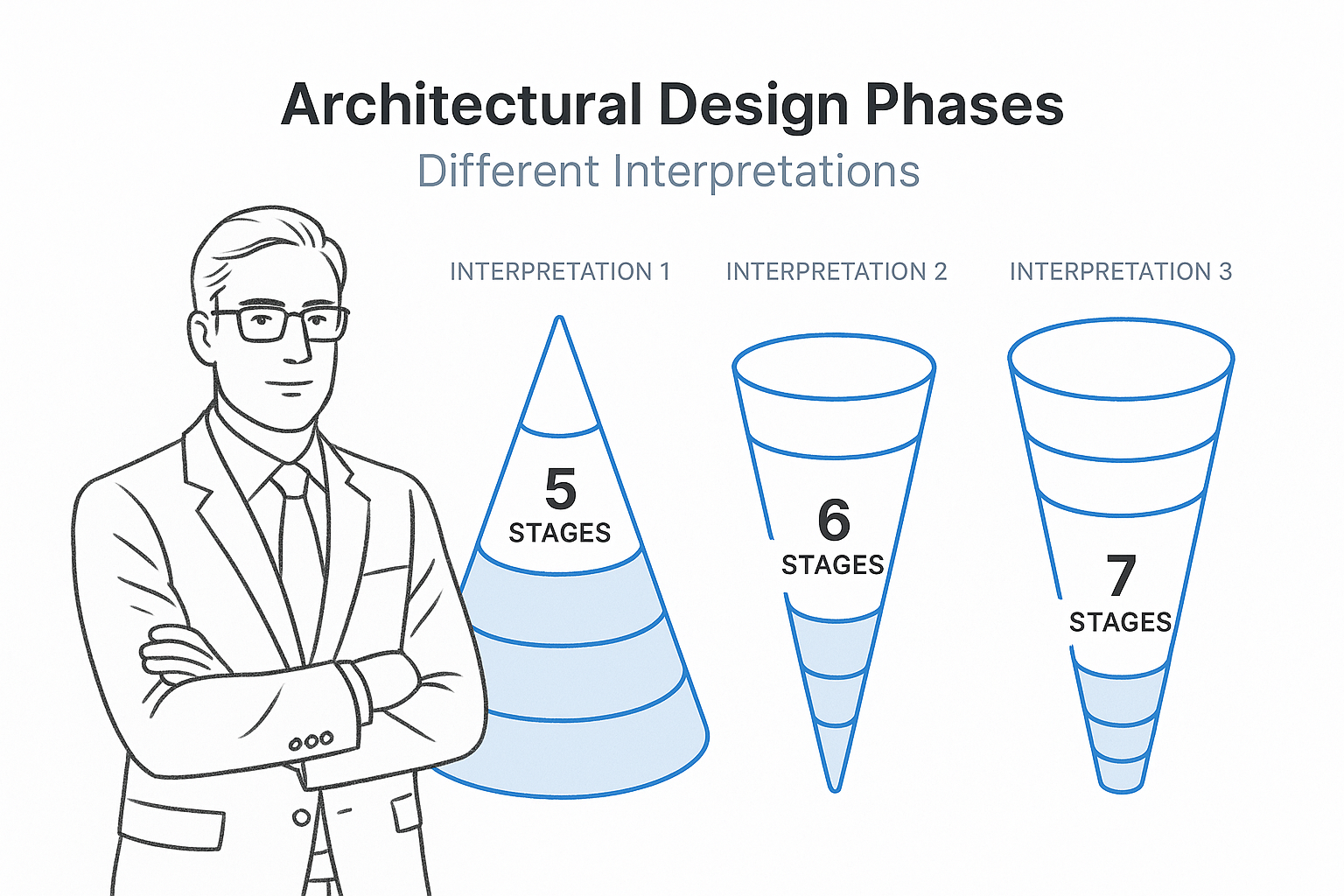
Why does the design process change from one architect to another? Understand the logic behind the 5, 6, or 7 stage models.
Not all architects speak the same “phase language.” Here’s why—and how to make sense of it.
1. AIA Design Phases (U.S.) – The 5-Step Classic
If you’ve worked with architects in the U.S., this is the one you’ve seen.
The 5 Phases According to AIA:
● Pre-Design (sometimes grouped in or skipped)
● Schematic Design (SD)
● Design Development (DD)
● Construction Documents (CD)
● Construction Administration (CA)
(Optional: Post-Occupancy)
Why It’s Used:
▪ Standardized for contracts, billing, and legal stuff
▪ Used in almost every firm in the U.S.
▪ Keeps things lean and simple for most projects
What’s Missing?
No clear post-project review. Programming often rolled into early stages. For some jobs, that’s fine. For others? Not enough detail.
2. RIBA Plan of Work (UK) – The 8-Stage Deep Dive
The British system (from the Royal Institute of British Architects) is more detailed.
RIBA’s 0–7 Framework:
0. Strategic Definition
-
Preparation and Brief
-
Concept Design
-
Spatial Coordination
-
Technical Design
-
Manufacturing and Construction
-
Handover
-
Use (aka Post-Occupancy)
Why It’s Used:
● Big on clarity, especially for public jobs and institutional builds
● Covers lifecycle of the building — not just the design and build
● Used for everything from schools to infrastructure to mixed-use
Downside:
Can feel like overkill on a simple remodel or home build.
But for complex work? It’s gold.
3. Education, BIM, and Other Global Models
Other systems exist depending on region or tech stack.
Examples:
▪ Australian Institute of Architects – Similar to RIBA but more flexibility
▪ Academic Design Thinking – Adds sketching, iteration, reflection
▪ BIM-Based Workflows – Breaks phases into data-driven steps (geometry, info, coordination)
What’s Different?
Not much in the actual work. The difference is in how it’s tracked, who’s involved, and how it's billed.
Quick Takeaway:
→ The AIA 5-phase model is still the most used in North America.
→ RIBA’s 0–7 gives a more full-picture timeline, including after move-in.
→ Some projects need both structure and flexibility — that’s where custom frameworks come in.
What’s the Right Number of Architecture Phases: 5, 6, or 7?
The 7 Phases of Architectural Design — Broken Down Simply
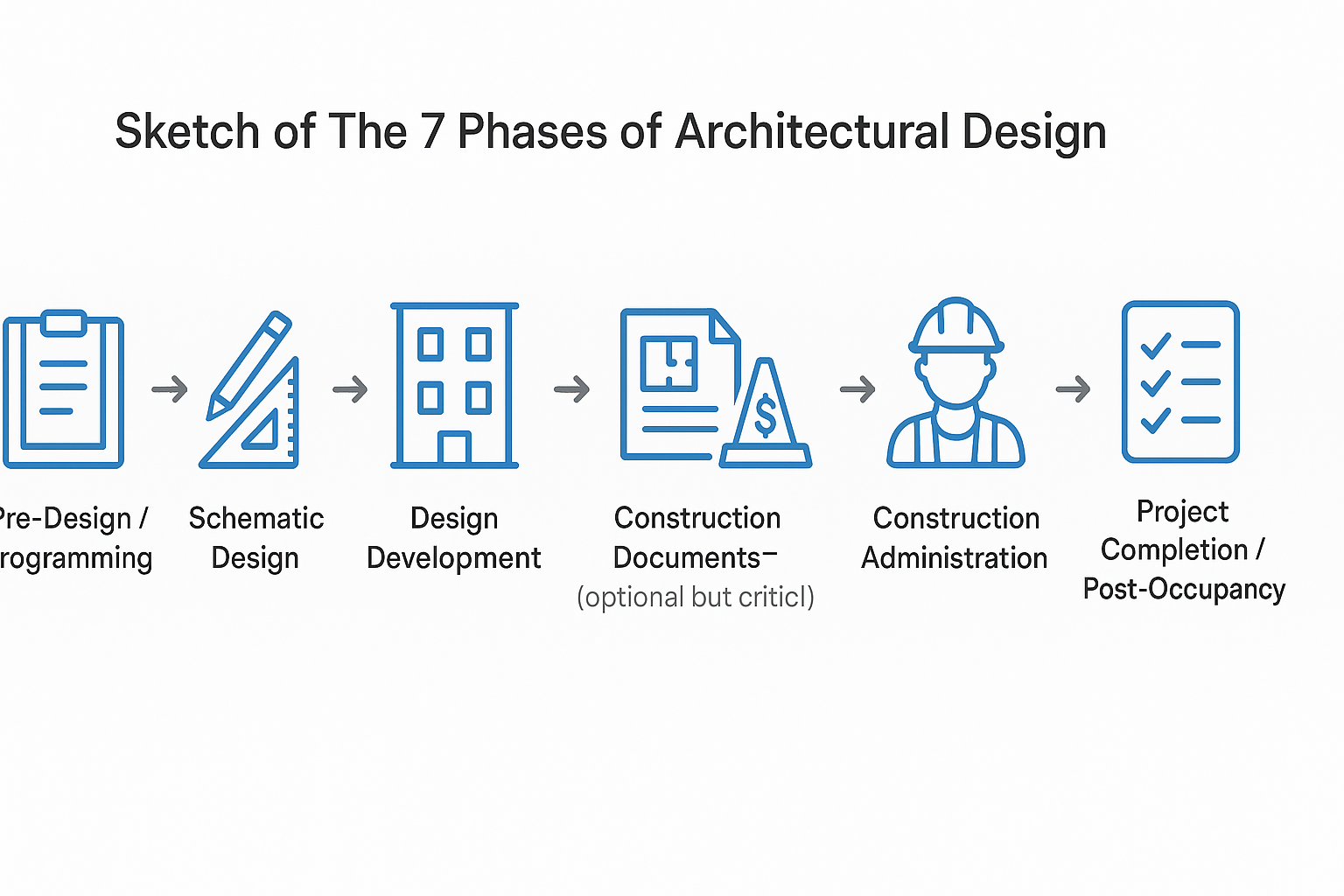
Image: Visual infographic clearly representing the seven key phases of architectural design, from pre-design through construction and post-occupancy evaluation.
These are the real steps most projects follow, no matter what the paperwork says. Whether your contract calls them five, six, or seven phases doesn’t change the work. The actual process? It looks like this:
1. Pre-Design / Programming
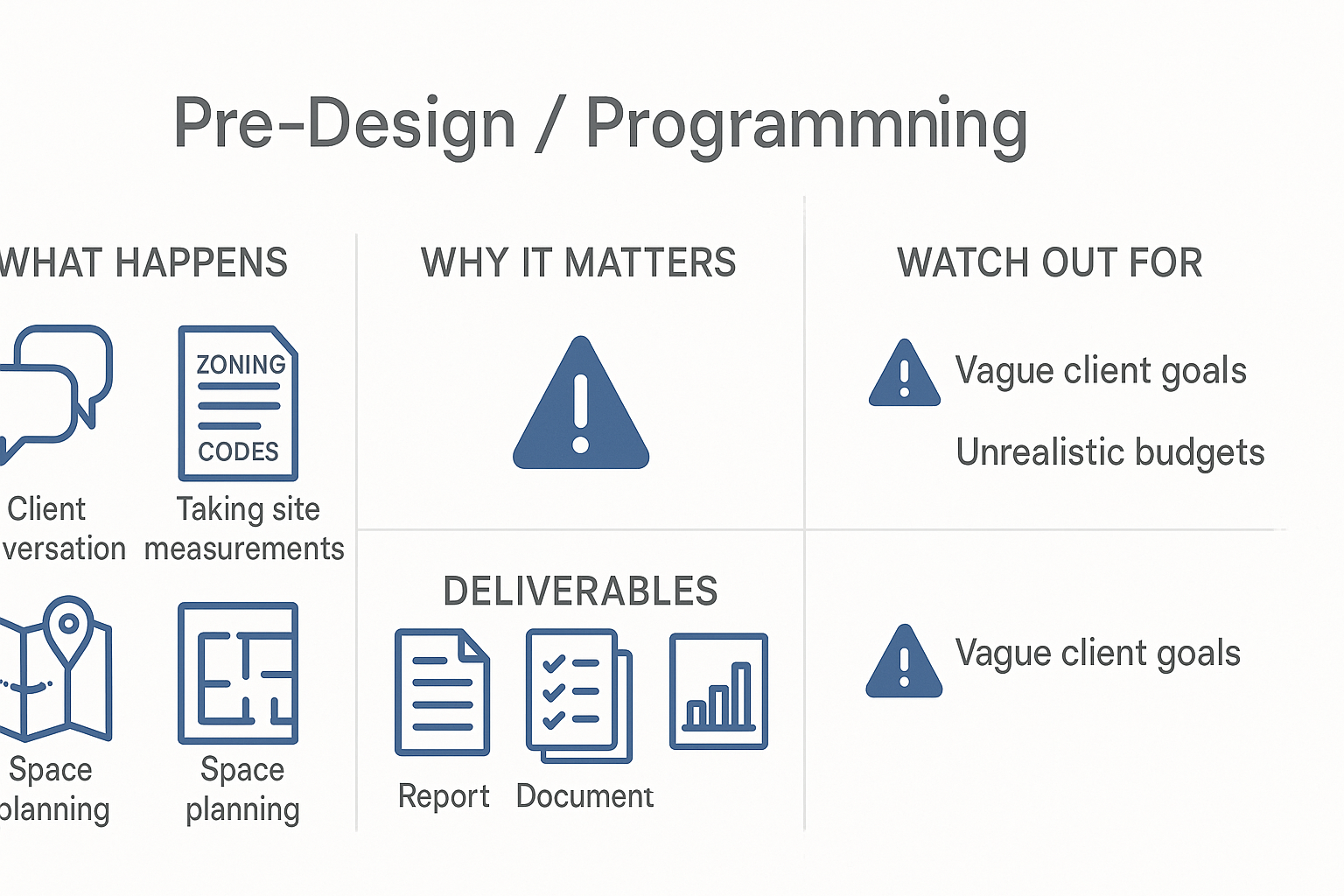
Image: Infographic detailing the pre-design or programming phase in architecture, covering client discussions, site analysis, and project goal setting before design begins.
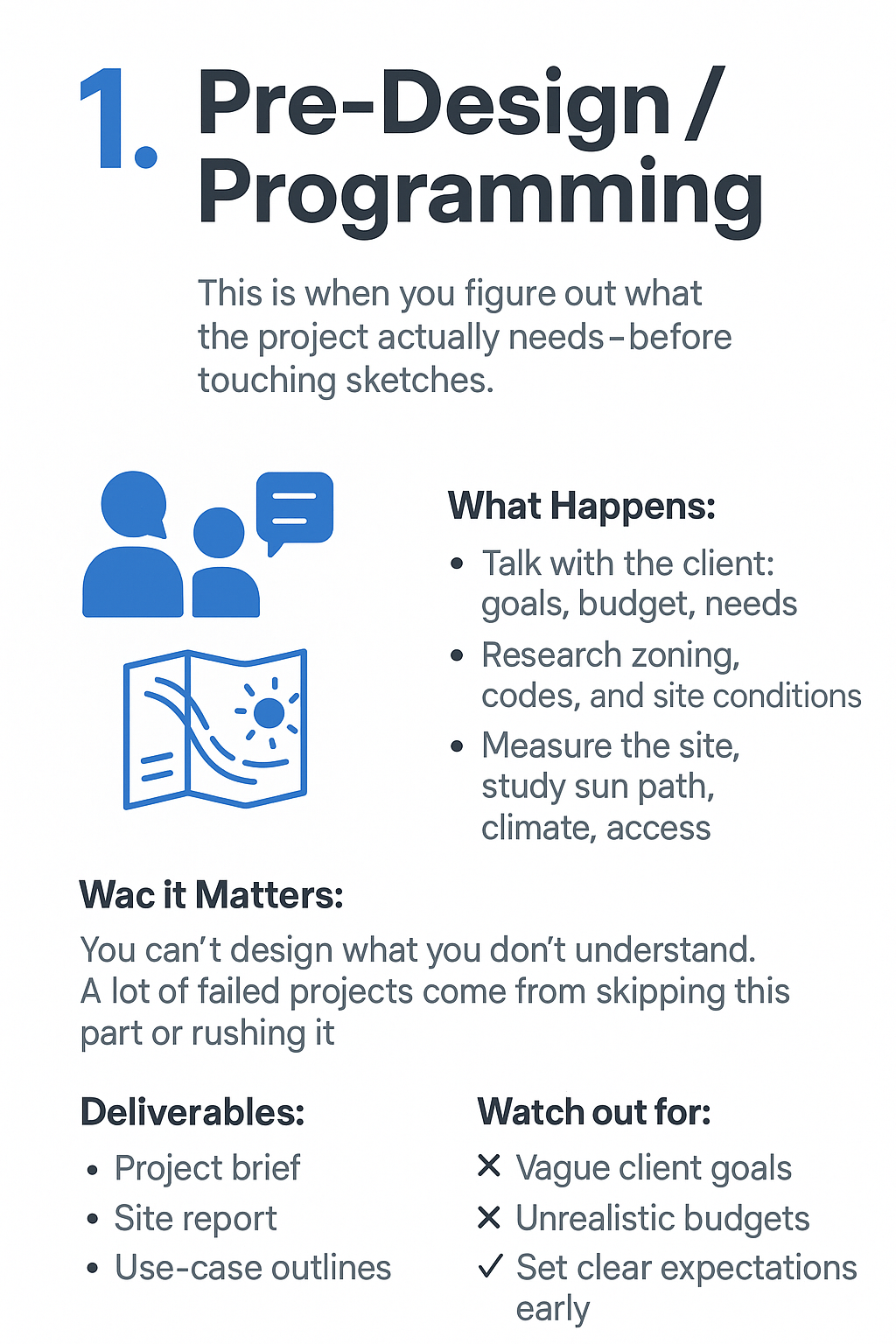
This is when you figure out what the project actually needs—before touching sketches.
What Happens:
● Talk with the client: goals, budget, needs
● Research zoning, codes, and site conditions
● Measure the site, study sun path, climate, access
● Figure out the space list (rooms, sizes, functions)
Why It Matters:
You can’t design what you don’t understand. A lot of failed projects come from skipping this part or rushing it.
Deliverables:
▪ Project brief
▪ Site report
▪ Use-case outlines
▪ Early feasibility studies
Watch out for:
✕ Vague client goals
✕ Unrealistic budgets
✓ Set clear expectations early
2. Schematic Design (SD)
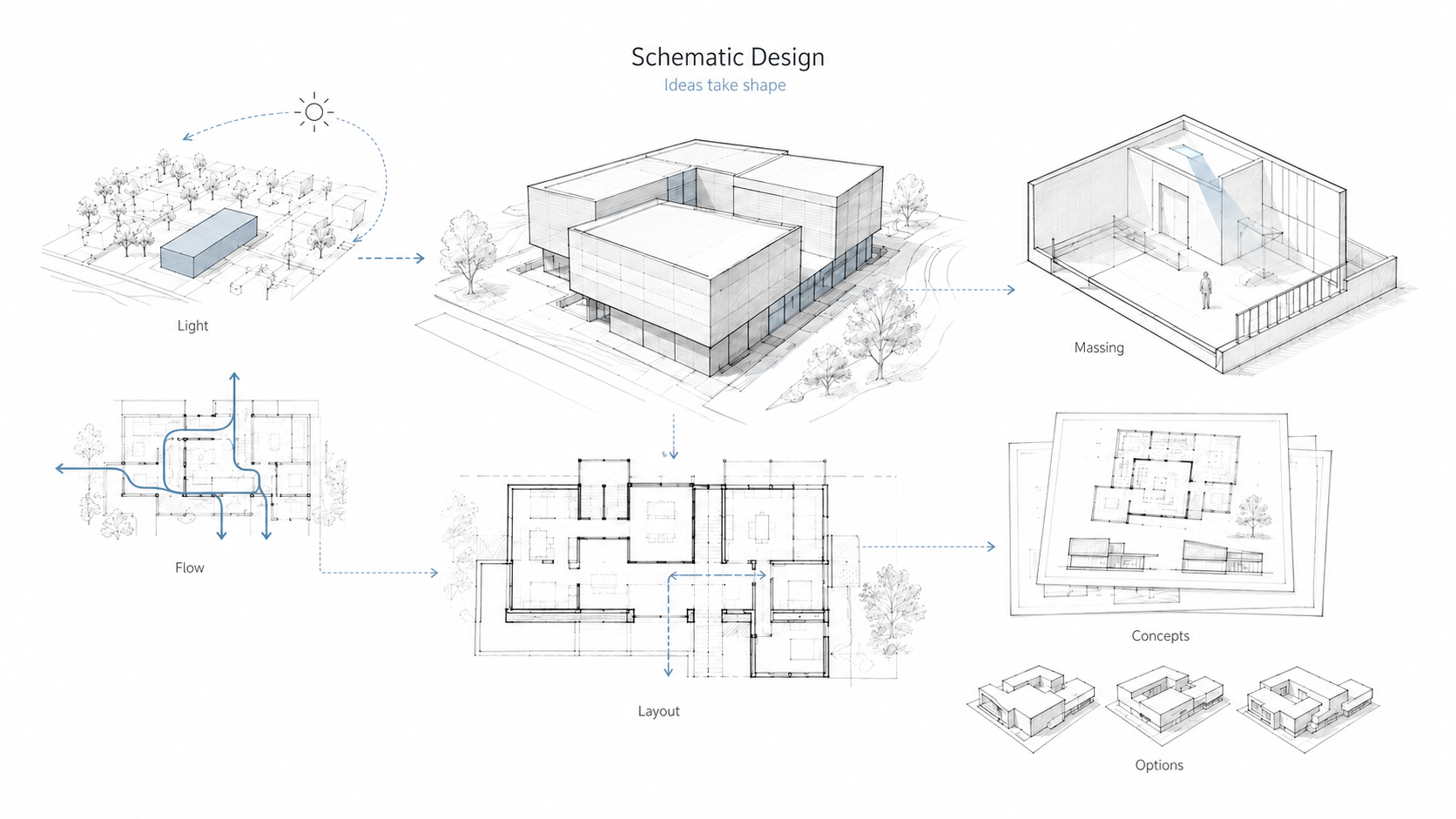
Image: Infographic describing the schematic design phase, where initial layouts, massing studies, and concept drawings begin shaping the architectural vision.
This is where ideas start taking shape.
What Happens:
● Sketch rough layouts
● Test massing (the shape of the building)
● Explore flow, sunlight, noise, and function
● Do early consultations if needed (engineers, city, stakeholders)
Deliverables:
▪ Concept drawings (floor plans, elevations, maybe 3D)
▪ Multiple options or studies
▪ Updated budget ballpark
Important Tip:
→ Don’t skip ugly sketches. The best ideas often start messy.
3. Design Development (DD)
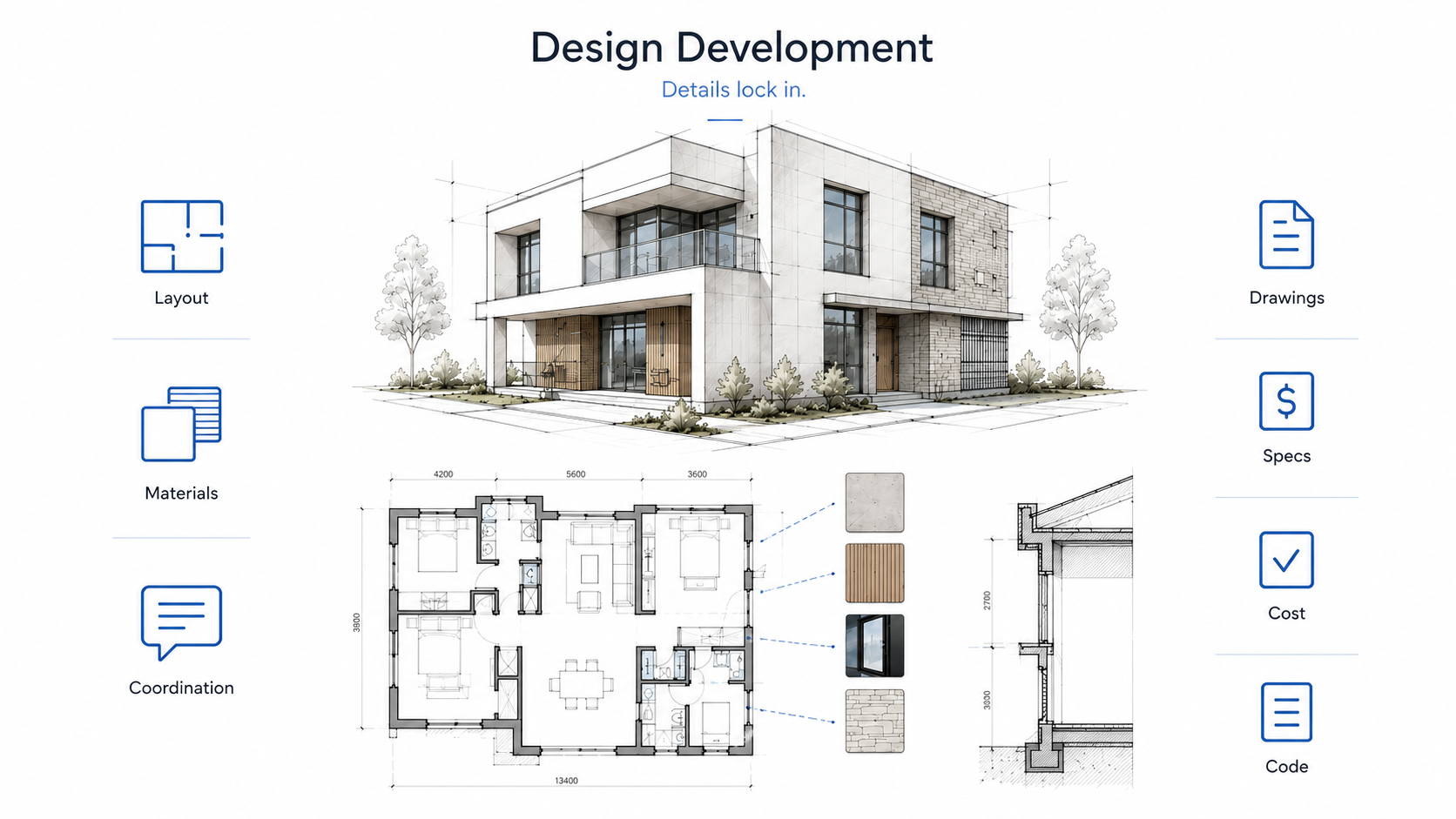
Now you pick a direction and go deeper.
What Happens:
● Pick your main layout and refine it
● Choose materials, windows, structure
● Start early coordination with engineers (MEP, structural)
● Develop exterior and interior language
Why It Matters:
This is where 90% of the big decisions get made. If this phase is sloppy, the project will have issues later.
Deliverables:
▪ Refined drawings
▪ Outline specs
▪ Updated cost estimate
▪ Code review basics
4. Construction Documents (CD)
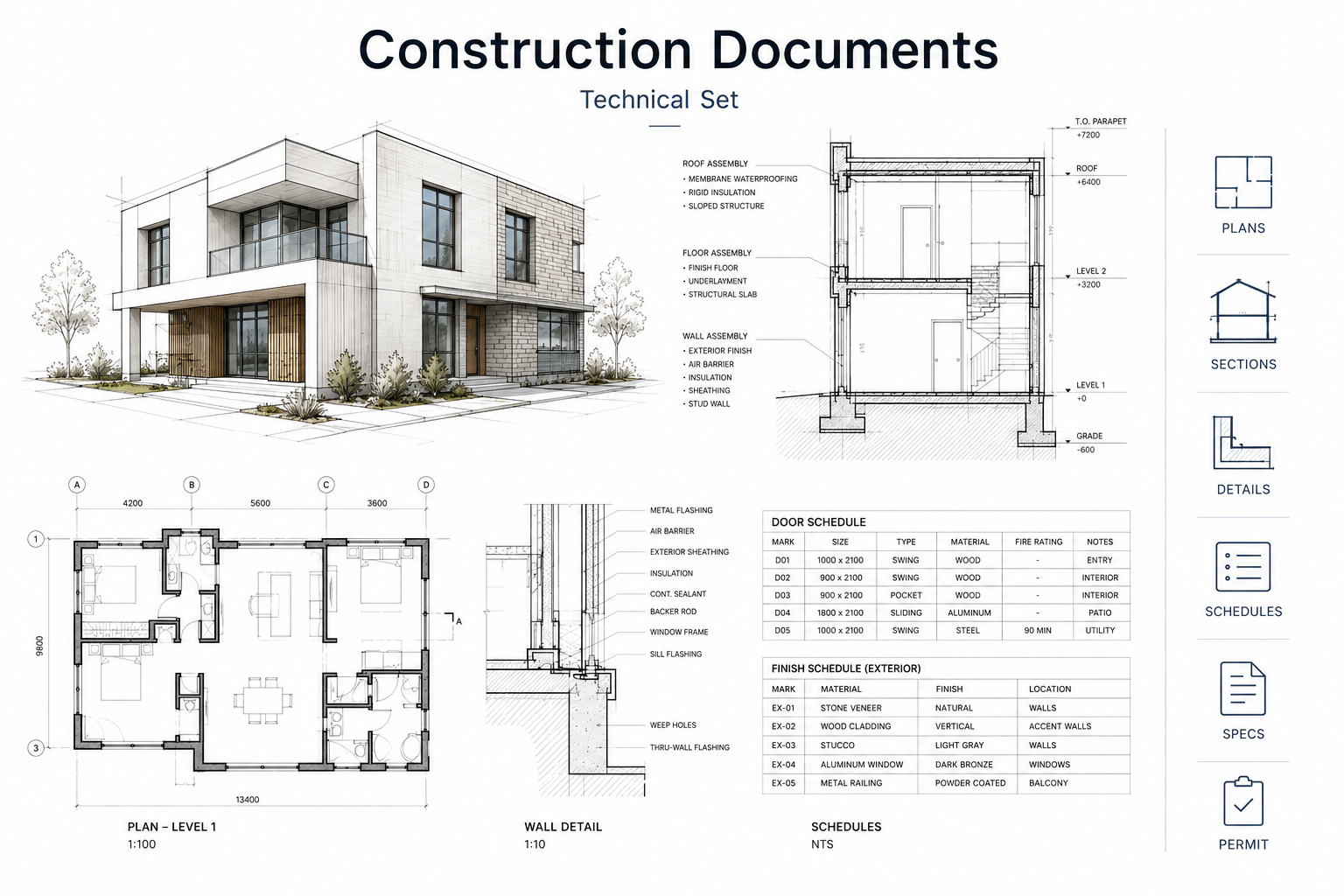
This is the technical phase. You prep everything a contractor needs to build it.
What Happens:
● Add dimensions, materials, wall types
● Coordinate with engineers in full
● Lock in details like egress, fire rating, waterproofing
● Prep permit and tender docs
Deliverables:
▪ Full CD set (plans, sections, details, schedules)
▪ Specs, notes, coordination drawings
▪ Permit application ready
Pro Tip:
→ The better your CDs, the fewer headaches on site.
5. Bidding / Negotiation (optional but critical)
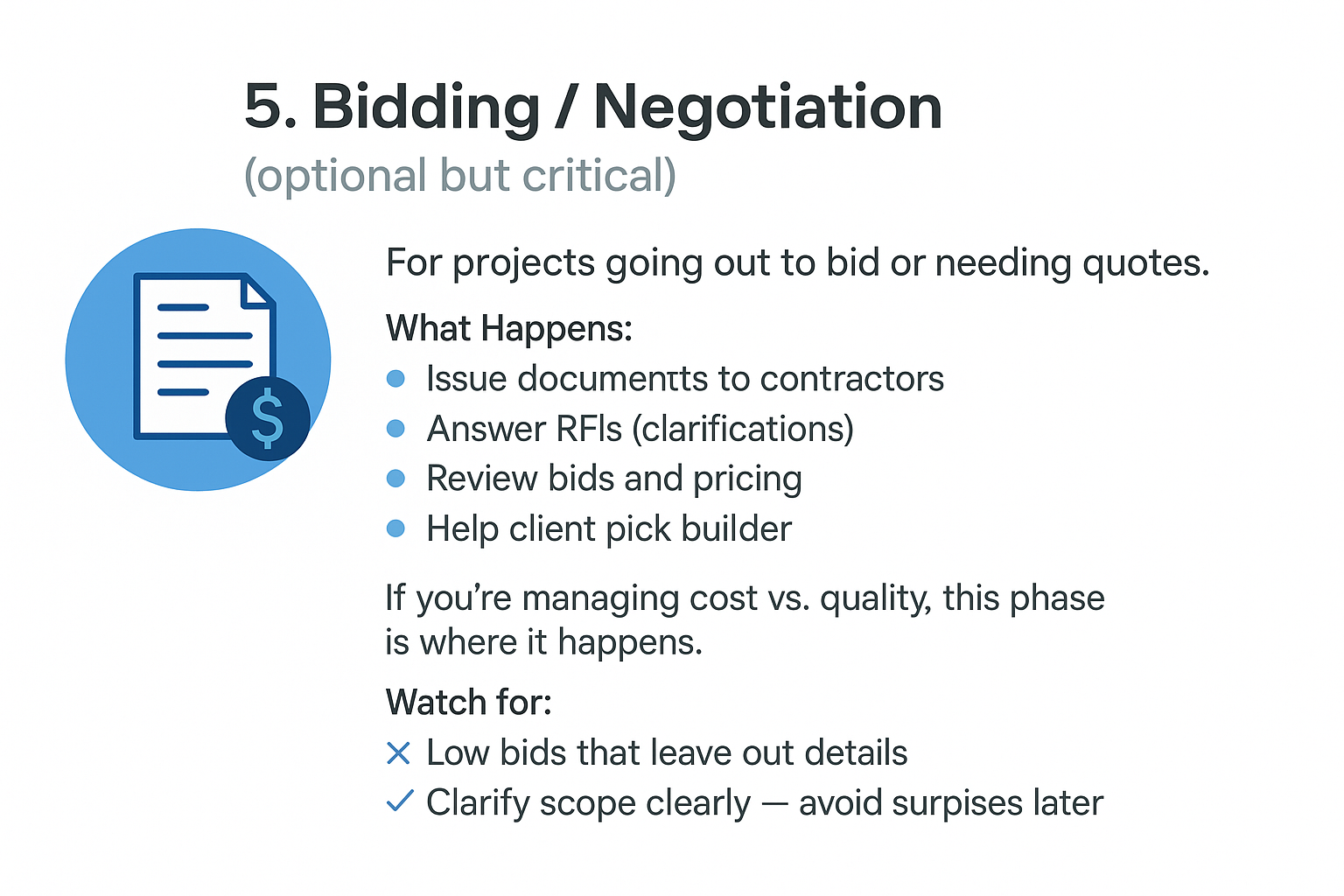
Image: Visual breakdown of the bidding and negotiation phase in architecture, showing how bids are reviewed, questions answered, and builders selected to balance cost and quality.
For projects going out to bid or needing quotes.
What Happens:
● Issue documents to contractors
● Answer RFIs (clarifications)
● Review bids and pricing
● Help client pick builder
Why It’s Needed:
If you’re managing cost vs. quality, this phase is where it happens.
Watch for:
✕ Low bids that leave out details
✓ Clarify scope clearly — avoid surprises later
6. Construction Administration (CA)
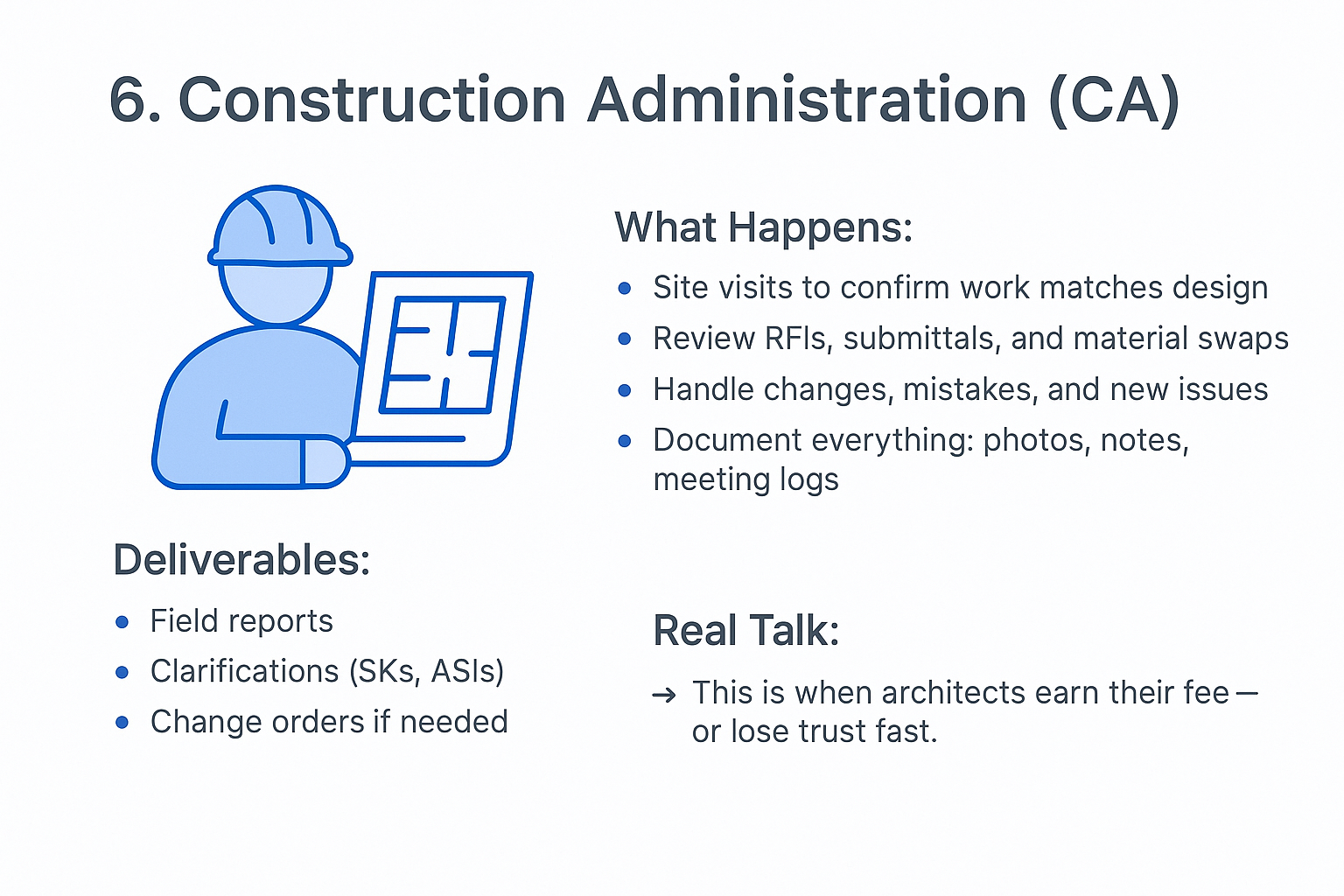
Image: Infographic showing the construction administration phase of architecture, including site visits, RFIs, field reports, and how architects manage changes during building.
Now the drawings meet reality.
What Happens:
● Site visits to confirm work matches design
● Review RFIs, submittals, and material swaps
● Handle changes, mistakes, and new issues
● Document everything: photos, notes, meeting logs
Deliverables:
▪ Field reports
▪ Clarifications (SKs, ASIs)
▪ Change orders if needed
Real Talk:
→ This is when architects earn their fee — or lose trust fast.
7. Project Completion / Post-Occupancy
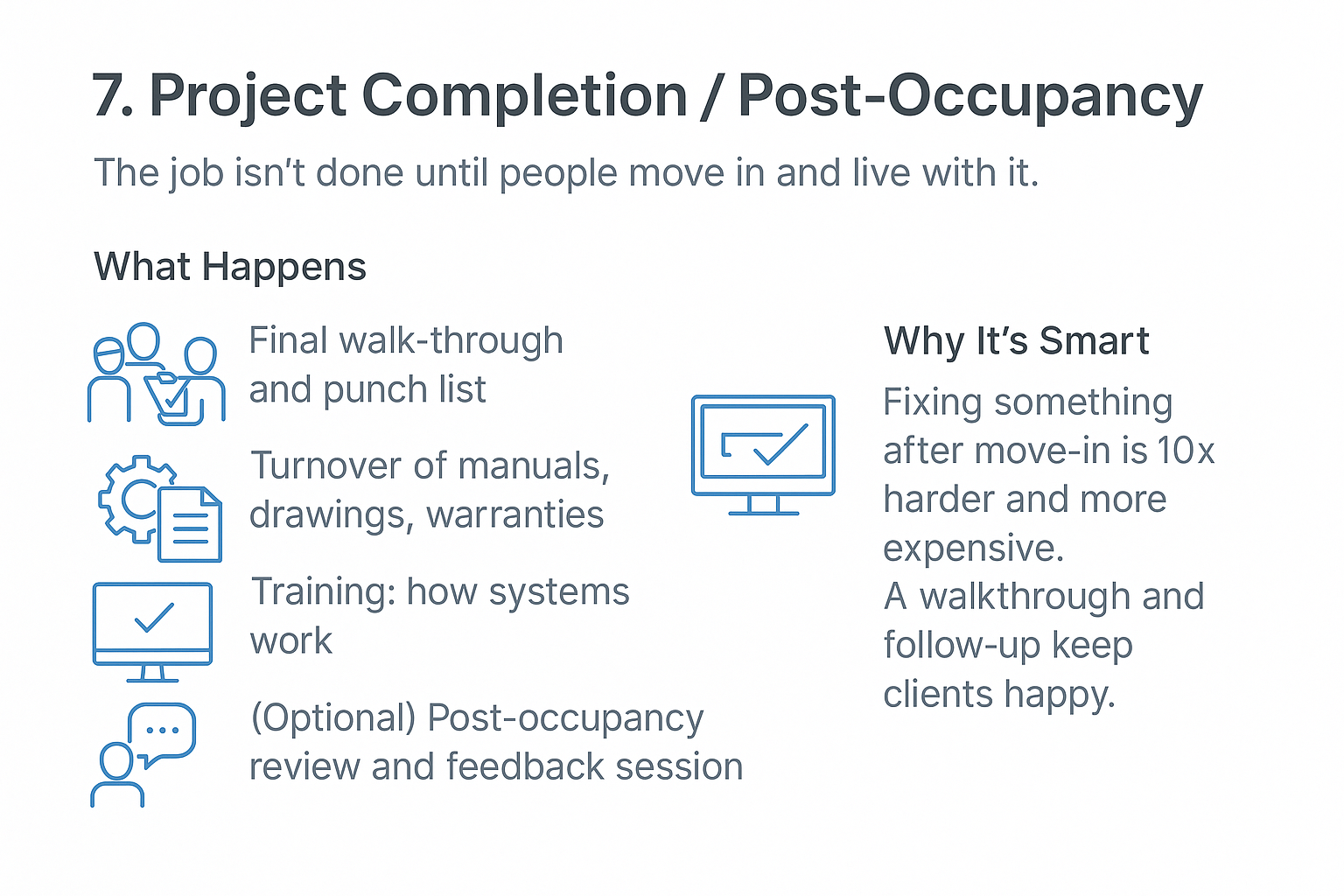
Image: Infographic showing the final architectural design phase, including punch lists, system training, turnover of documents, and the importance of post-occupancy feedback for long-term success.
The job isn’t done until people move in and live with it.
What Happens:
● Final walk-through and punch list
● Turnover of manuals, drawings, warranties
● Training: how systems work
● (Optional) Post-occupancy review and feedback session
Why It’s Smart:
Fixing something after move-in is 10x harder and more expensive. A walkthrough and follow-up keep clients happy.
Are There 5, 6, or 7 Architecture Phases? The Honest Breakdown
Why Architects Use Different Design Phases (And Which Ones Matter Most)
Learn why architecture projects use 5, 6, or 7 design stages — and why none of them are wrong. Simple breakdowns, not theory.
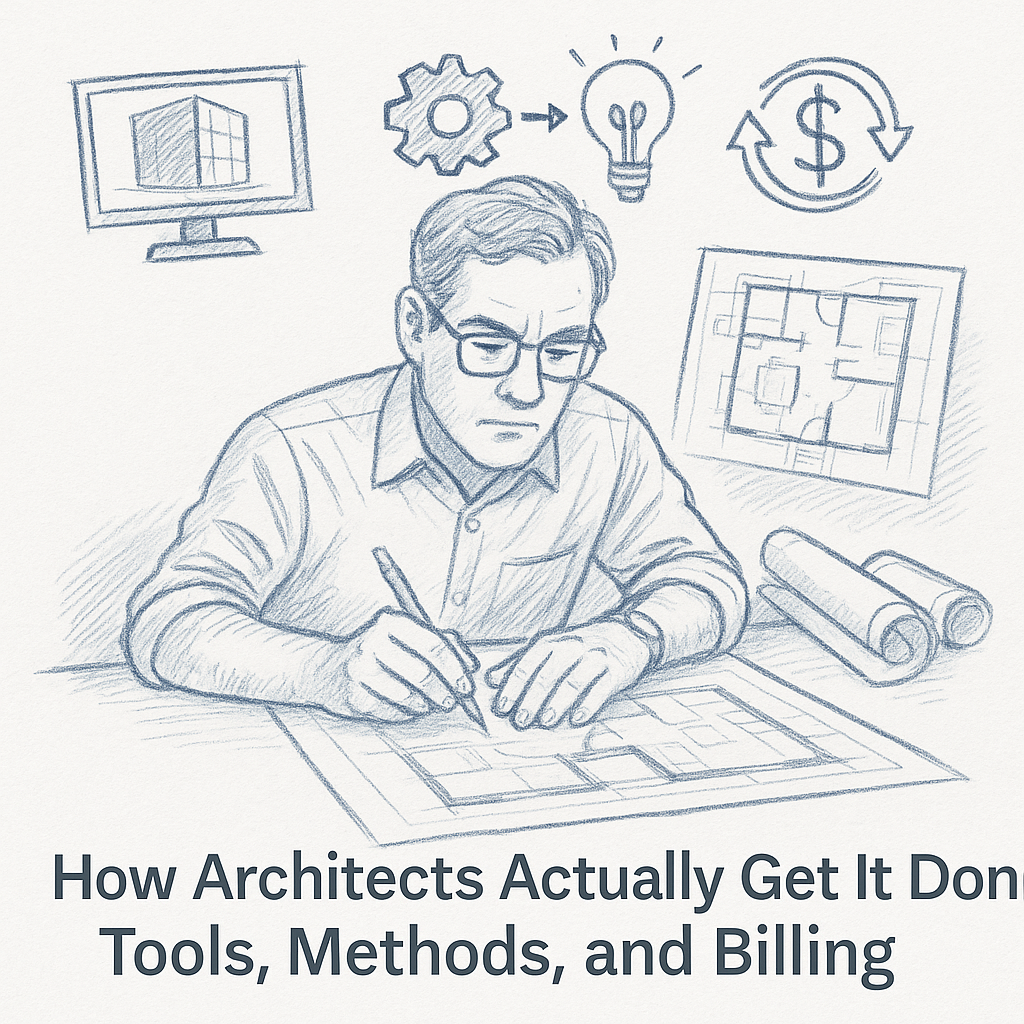
How Architects Actually Get It Done: Tools, Methods, and Billing
We’ve broken down the phases. Now let’s look at what makes them work.
This isn’t just about drawings. It’s about how the work flows, how decisions get made, and how people get paid — from idea to handover.
What Tools Do Architects Use Today? (Beyond Pencils and Paper)
Let’s be clear: tools don’t just mean software. Tools = anything that helps you do the job better.
Here’s what shows up on most modern projects:
● BIM (Building Information Modeling)
→ Think of it as a smart 3D model that holds geometry, data, materials, cost info, and scheduling all in one.
→ Helps teams collaborate and catch problems before they’re expensive.
● CAD (Computer-Aided Design)
→ Still around for 2D drawings. Simple, clean, easy for technical docs.
→ BIM's cooler younger sibling doesn’t fully replace it.
● Design Thinking Frameworks
→ Architects use this during early phases. It’s all about asking the right questions, testing fast, and keeping users in mind — not just the “look.”
● Project Management Tools (Asana, Monday, Trello, MS Project)
→ To keep timelines, RFIs, approvals, and tasks under control.
● Cost Estimation Tools (Bluebeam, CostX)
→ Used during design dev and CDs to keep cost estimates up-to-date with drawings.
What’s the “Methodology” Behind It All?
It’s not just “draw stuff and hope it works.” Real architects use tested systems to guide work:
▪ BIM-Based Workflows
Tracks info from concept to construction. Ensures nothing gets lost between stages.
▪ Lean Design
Cut waste. Only do what adds value. Avoid rework. Keep client goals in focus.
▪ Integrated Project Delivery (IPD)
Everyone (owner, architect, contractor) signs one agreement — they share risks and rewards. More alignment = fewer surprises.
▪ Value Engineering (VE)
Not just “cut costs.” It’s finding smart substitutions that hit the same performance but lower cost.
→ Example: swapping imported stone for local precast that looks the same but costs 30% less.
▪ Design-Bid-Build vs. Design-Build
Know the difference:
-
Design-Bid-Build: Classic. Architect designs → contractor builds.
-
Design-Build: Architect + builder are one team. Faster, but client has less control.
Architect Billing: How Do Firms Get Paid Per Phase?
Clients always ask this. So let’s break it down simply.
Most Common Structure (Percentage-Based Fees):
| Phase | % of Total Fee (Typical) |
|---|---|
| Pre-Design | 5–10% |
| Schematic Design | 15% |
| Design Development | 20% |
| Construction Documents | 30% |
| Bidding / Negotiation | 5% |
| Construction Admin | 20–25% |
✓ This breakdown varies by firm, project type, and contract.
Other Billing Models:
● Fixed Fee:
Straight price for full service. Good for small/simple jobs. Risky for unknowns.
● Hourly:
Used during unclear or open-ended work (site research, client meetings, etc.)
● Per Square Foot:
Used in early feasibility studies or for repetitive projects (warehouses, schools).
What Pros Actually Do (That Textbooks Don’t Teach)
● Mix and match tools: BIM for technical drawings, hand sketches for early ideas.
● Stay flexible with clients: Sometimes “design development” goes longer because the budget keeps shifting.
● Document everything: From sketch notes to client texts — it’s all part of protecting the process.
● Build relationships early: Engineers, planners, code reviewers — get them in the loop during concept stage, not after.
Quick Recap
● BIM and design thinking are core to modern design.
● Lean, phased, and integrated delivery methods keep things aligned.
● Billing varies, but it usually follows phase percentages.
● Real-world flexibility beats rigid stage boxes every time.
How Architects Keep Design Quality High — Even When Everything’s Pushing Back
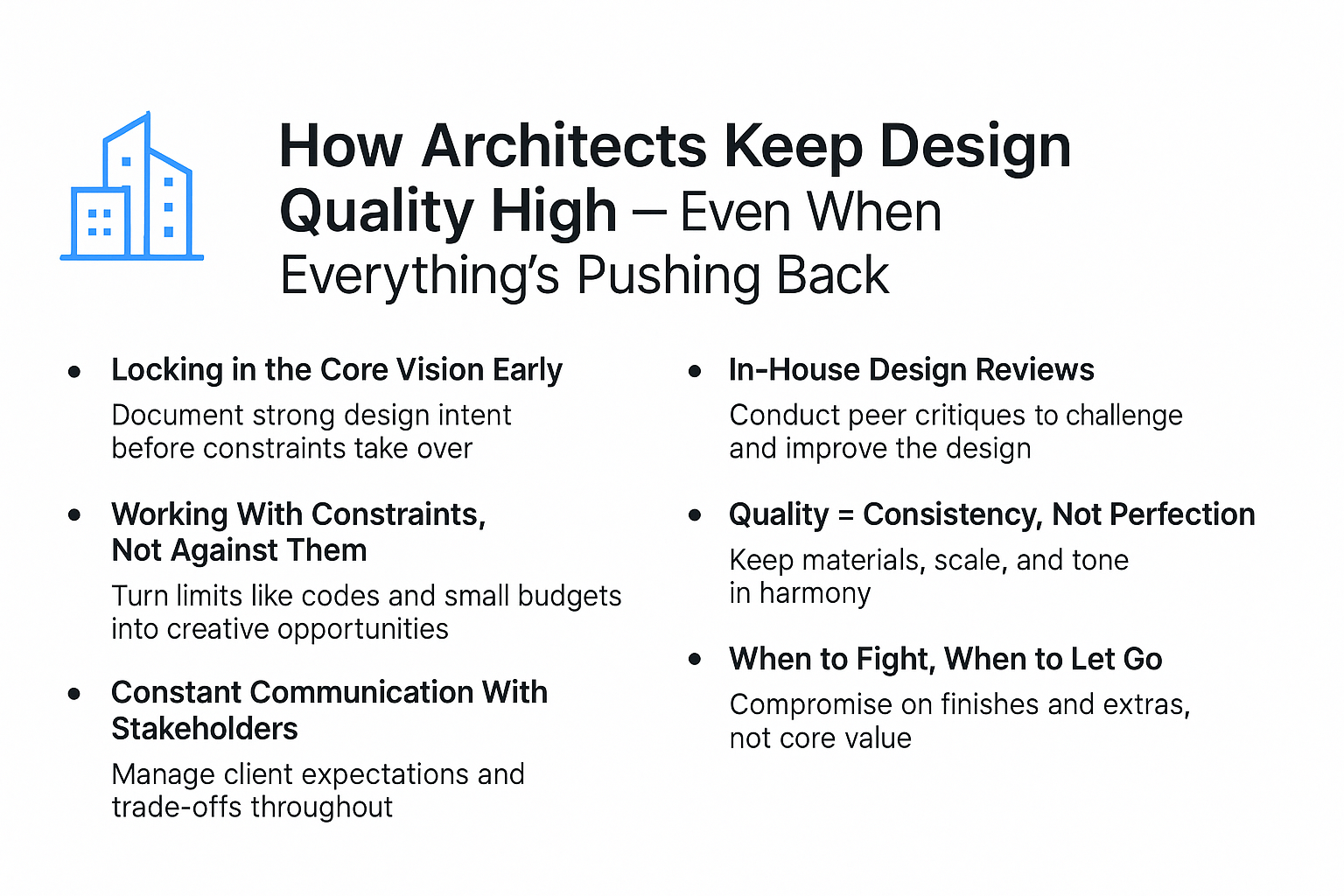
Designing a great building isn’t just about good taste or clever ideas. It’s about keeping the core vision intact while juggling codes, budgets, tight sites, shifting client opinions, and real-world chaos.
Sound tough? That’s because it is.
Here’s how real architects handle it without losing control of the final result.
● Locking in the Core Vision Early
Before the budget gets sliced or the zoning office throws curveballs, the core design logic needs to be solid.
✓ Set a strong design concept during the schematic phase
→ One that answers the “why” behind every choice
✓ Document it clearly — not just pretty renderings, but intent-driven plans
→ Think: why the light enters from that angle, why circulation flows that way
● Working With Constraints, Not Against Them
Let’s be real — every project has limits. But smart architects use those limits to refine the idea, not weaken it.
▪ Small site? → Use vertical circulation smartly
▪ Tight budget? → Strip down to materials that add impact, not noise
▪ Difficult code? → Design around it early, don’t “patch” it later
One architect we worked with used setback constraints to create a stepped façade that ended up defining the entire project’s identity. That’s how you use rules creatively.
● Constant Communication With Stakeholders
It’s not just about drawing. It’s about listening, clarifying, and managing expectations — especially with clients.
→ Weekly syncs keep everyone aligned
→ Design review check-ins help maintain the thread
→ Clear language wins over vague promises
Important: Don’t wait until DD to tell the client the rooftop garden is too expensive. Get ahead of the trade-offs early.
● In-House Design Reviews
Good studios don’t let bad ideas slide because the team is “too close” to it. Internal critique is where quality sharpens.
✓ Peer reviews every 1–2 phases
✓ Fresh eyes catch what familiarity misses
✓ Use BIM and model overlays to spot design clashes before they hit construction
● Quality = Consistency, Not Perfection
Design quality doesn’t mean perfection. It means every part of the project speaks the same language.
✓ Same tone in materials
✓ Same rhythm in openings
✓ Same logic in scale and detail
Think of it like music: a few good notes don’t make a good song — the structure and rhythm do.
● When to Fight, When to Let Go
Not every battle is worth it.
→ Fight for layout flow, natural light, and structural logic
→ Let go of overpriced finishes if it keeps the core intact
→ Compromise on extras, not essentials
Pro Tip: Use value engineering to redirect—not erase—the best parts of the design.
Best-Selling Architecture Books on Amazon
Based on Amazon's best-sellers list, here are some top-rated architecture books:
-
Architecture: Form, Space, and Order by Francis D.K. Ching
A foundational text that explores the basic elements of architecture. -
The Architect's Handbook of Professional Practice by The American Institute of Architects
A comprehensive guide covering all aspects of architectural practice. -
The Architecture Reference & Specification Book by Julia McMorrough
A compact resource detailing essential architectural information. -
A Field Guide to American Houses (Revised) by Virginia Savage McAlester
An authoritative guide to American residential architecture. -
The Eyes of the Skin: Architecture and the Senses by Juhani Pallasmaa
An exploration of the sensory experience in architectural design.
Additional Tools for Architectural Design
Beyond the commonly used tools, architects also utilize:
-
Energy Modeling Software: Tools like EnergyPlus and eQuest help in simulating building energy consumption.
-
Project Management Platforms: Software such as Trello or Asana assists in tracking project progress and collaboration.
-
Virtual Reality (VR) Tools: Applications like Enscape or IrisVR enable immersive visualization of designs.
In Focus: Sustainable Design Practices
Sustainability is integral to modern architecture. Key practices include:
-
Passive Design Strategies: Utilizing natural ventilation and lighting to reduce energy consumption.
-
Green Roofs and Walls: Incorporating vegetation to improve insulation and biodiversity.
-
Recycled Materials: Using reclaimed wood or recycled steel to minimize environmental impact.
FAQ
1. What are the main phases of architectural design?
Typically, the process includes:
-
Pre-Design
-
Schematic Design
-
Design Development
-
Construction Documents
-
Bidding/Negotiation
-
Construction Administration
-
Post-Occupancy Evaluation
2. How long does each design phase take?
Timelines vary, but generally:
-
Pre-Design: 2-4 weeks
-
Schematic Design: 4-6 weeks
-
Design Development: 6-8 weeks
-
Construction Documents: 8-12 weeks
-
Bidding: 3-4 weeks
-
Construction Administration: Duration of construction
3. What is the purpose of the Schematic Design phase?
To develop conceptual designs that meet the client's requirements and explore different design options.
4. Why is the Design Development phase important?
It refines the chosen design, detailing materials, systems, and dimensions, ensuring the project is feasible and aligns with the budget.
5. What are Construction Documents?
Detailed drawings and specifications used for permitting, bidding, and construction.
6. How does Bidding/Negotiation work?
Contractors review the construction documents and submit bids. The architect assists the client in evaluating bids and selecting a contractor.
7. What happens during Construction Administration?
The architect oversees construction to ensure it aligns with the design, addresses issues, and manages changes.
8. What is Post-Occupancy Evaluation?
An assessment conducted after project completion to evaluate performance and gather feedback for future improvements.
9. How do architects ensure compliance with building codes?
Through regular code reviews during each design phase and coordination with code consultants.
10. What role does Building Information Modeling (BIM) play?
BIM allows for 3D modeling of the building, facilitating coordination among disciplines and detecting conflicts early.
Related
- Architecture Design Process: What Every Client and Architect Should Know
- Mastering the Materials Selection Process: A Step-by-Step Guide
- Building Construction Process: Avoid Costly Mistakes with These Tips
- Parametric Design Process: A Guide to Creating Cutting-Edge Structures
Resources on Architectural Design Phases
-
American Institute of Architects (AIA): Defining the Architect's Basic Services
A comprehensive guide detailing the standard phases of architectural design and the services provided in each phase.
🔗 AIA: Defining the Architect's Basic Services -
National Council of Architectural Registration Boards (NCARB): Project Planning & Design
An overview of the schematic design phase, including building layout, code review, and coordination with consultants.
🔗 NCARB: Project Planning & Design -
Whole Building Design Guide (WBDG)
Managed by the National Institute of Building Sciences, this resource offers extensive information on integrated design approaches and building performance.
🔗 WBDG: Whole Building Design Guide -
MasterSpec by AIA
A master guide specification system providing detailed construction specifications, developed by the AIA for architects and engineers.
🔗 MasterSpec by AIA -
Construction Specifications Institute (CSI): Standards and Formats
Offers best practices for construction documentation, specifications, and project delivery methods.
🔗 CSI: Standards and Formats
Tools and Resources for Architects
-
WBDG Tools
Provides information on a variety of desktop or web-based tools used in the building industry.
🔗 WBDG: ToolsWBDG -
CSI Learning Resources
Offers practice guides, learning libraries, and certification programs for construction professionals.
🔗 CSI: Learning ResourcesCSI Resources -
NCARB ARE Study Resources
Access practice exams and study materials for the Architect Registration Examination (ARE).
🔗 NCARB: ARE Study Resources