

A top architecture school can still be the wrong school.
The name looks safe. The ranking looks impressive. The studio photos look serious. Then the student arrives and finds the program is too expensive, too theoretical, too isolated, too harsh, or not the right degree path for licensure.
That is why this page is not a simple top-10 list.
Architecture schools in the United States do different jobs. Some are better for a direct B.Arch route. Some are stronger for graduate M.Arch study. Some are research-heavy. Some are practice-oriented. Some give students strong local firm access. Some are famous but expensive in cities where rent changes the whole decision.
The better question is not “Which school is ranked highest?” The better question is:
Which U.S. architecture school fits the degree path, cost, region, studio culture, and career you actually want?
Start With NAAB, Not the Ranking
Before comparing famous names, check the degree.
In the United States, students who want the cleanest path toward licensure usually need to understand NAAB accreditation. A school can have a strong design reputation and still offer different types of architecture-related degrees. A B.Arch, a BS in Architecture, a BA in Architectural Studies, and an M.Arch do not all do the same job.
That is where students lose time.
A professional degree can move the student toward the experience and exam path after graduation. A pre-professional degree may still be useful, but it often means the student needs a professional M.Arch later. A technical or drafting route can lead to real work in the industry, but it is not the same as becoming licensed as an architect.
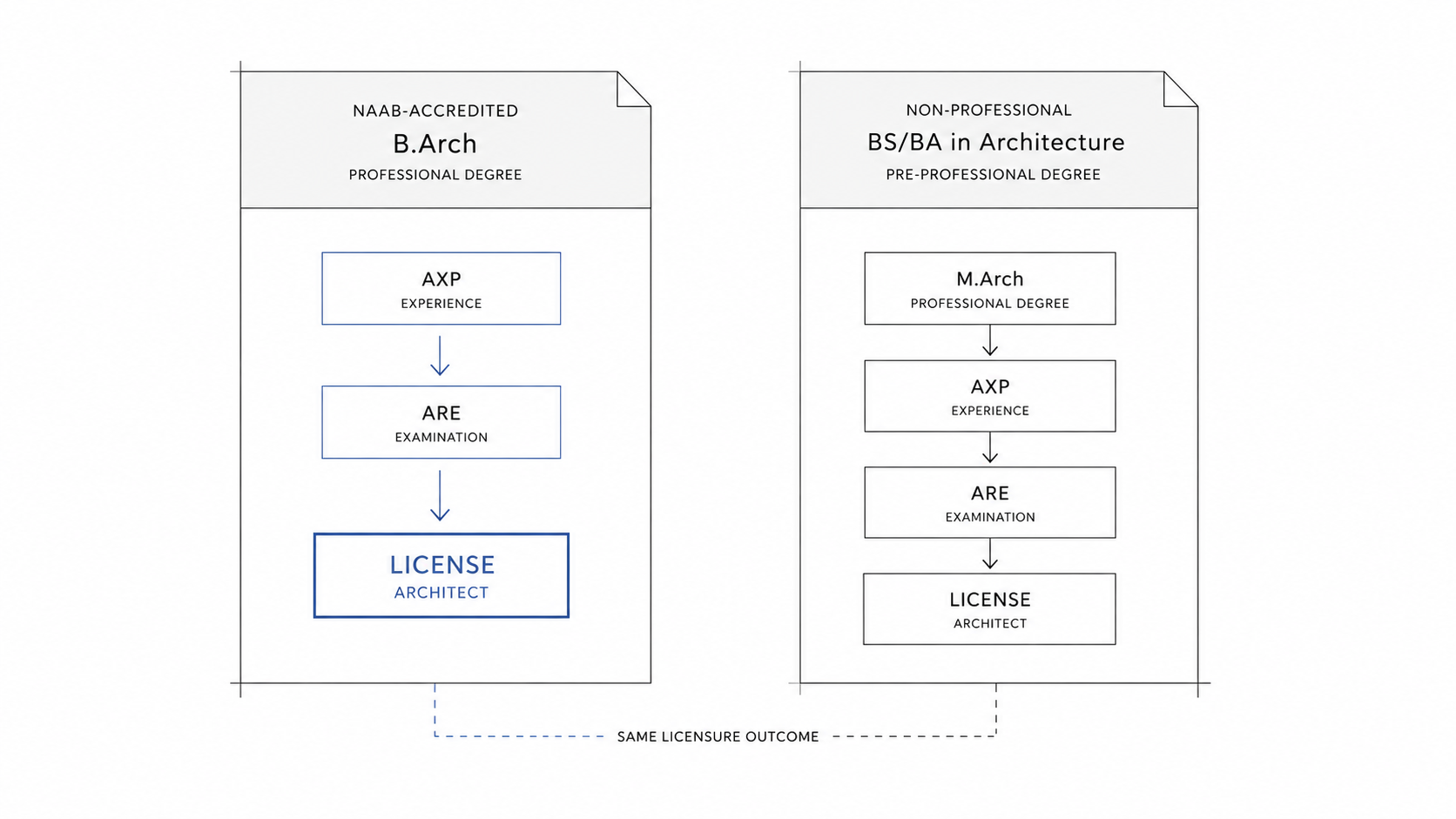
Before applying, check the official NAAB program directory. Do not rely only on a school’s marketing page.
Useful starting point: NAAB accredited programs.
The Quick U.S. School Filter
Use this before falling in love with a campus.
| What to check | Why it matters | Warning sign |
|---|---|---|
| Degree path | A B.Arch, BS/BA, and M.Arch can lead to different timelines. | The school uses “architecture” everywhere but does not clearly explain what the degree qualifies you to do. |
| NAAB status | Students planning for licensure need to know whether the program is a professional accredited route. | The school talks about creativity and careers but avoids the professional licensure path. |
| Studio culture | Studio shapes daily life more than the campus tour does. | The program celebrates burnout or shows only polished final images. |
| Location | Region affects climate design, internships, job access, rent, and local practice culture. | The school is expensive or isolated without a clear practice network. |
| Internships | Office exposure helps students understand drawings, deadlines, consultants, and real projects. | The school says “career support” but cannot show where students actually intern. |
| Total cost | Architecture students pay for more than tuition. | The school sells prestige but avoids materials, software, housing, and studio costs. |
Best Schools for Different Students
A serious U.S. architecture school comparison should not pretend every student wants the same thing.
A student who wants a direct undergraduate professional route is not making the same decision as a student applying to graduate school. A student who wants public-interest work is not making the same decision as a student who wants computation, fabrication, or high-end design culture. A student who needs low debt is not making the same decision as a student with a major scholarship.
Use school names as starting points for research, not trophies.
| If your priority is... | Start your research with schools like... | What to check before applying |
|---|---|---|
| Direct undergraduate professional path | Cornell, Rice, Cal Poly San Luis Obispo, Syracuse, Virginia Tech | Confirm the exact professional degree, studio workload, total cost, and licensure sequence. |
| Graduate design culture and research | Harvard GSD, MIT, Columbia GSAPP, Yale, Princeton, Michigan | Check whether the program fits your portfolio direction, budget, and tolerance for theory-heavy studio work. |
| Urban design and city systems | Columbia, MIT, Berkeley, Penn, Illinois Chicago, City College of New York | Look at planning links, housing studios, public-space work, transit access, and local firm networks. |
| Technical practice and building logic | Georgia Tech, Virginia Tech, Auburn, Kansas State, Illinois Urbana-Champaign | Check structures, environmental systems, building technology, fabrication, and construction-document training. |
| Experimental design and visual culture | SCI-Arc, UCLA, Columbia, Pratt, Cooper Union | Make sure the experimental culture still gives you useful skills and a realistic path after school. |
| Lower debt and regional practice access | Strong public universities in the state or region where you want to work | Compare tuition, housing, scholarships, local firms, alumni, and how well the school places students nearby. |
This is not a ranking. It is a way to begin the shortlist.
Undergraduate B.Arch or Graduate M.Arch?
One of the biggest U.S. school decisions happens before the student ever compares campuses.
Do you want a professional undergraduate route, or do you want a broader undergraduate degree followed by a professional graduate degree?
A B.Arch can be the more direct route. It can also be intense from the beginning. Students often enter studio early, commit sooner, and spend five years inside a professional architecture track.
A BA or BS route can offer more flexibility. It may allow more room for liberal arts, design studies, planning, art, engineering, or another field. But if the student wants licensure later, the M.Arch may still be required.
The M.Arch route can be powerful for students who discover architecture later or want a graduate-level professional education. It can also add time, admissions pressure, and cost.
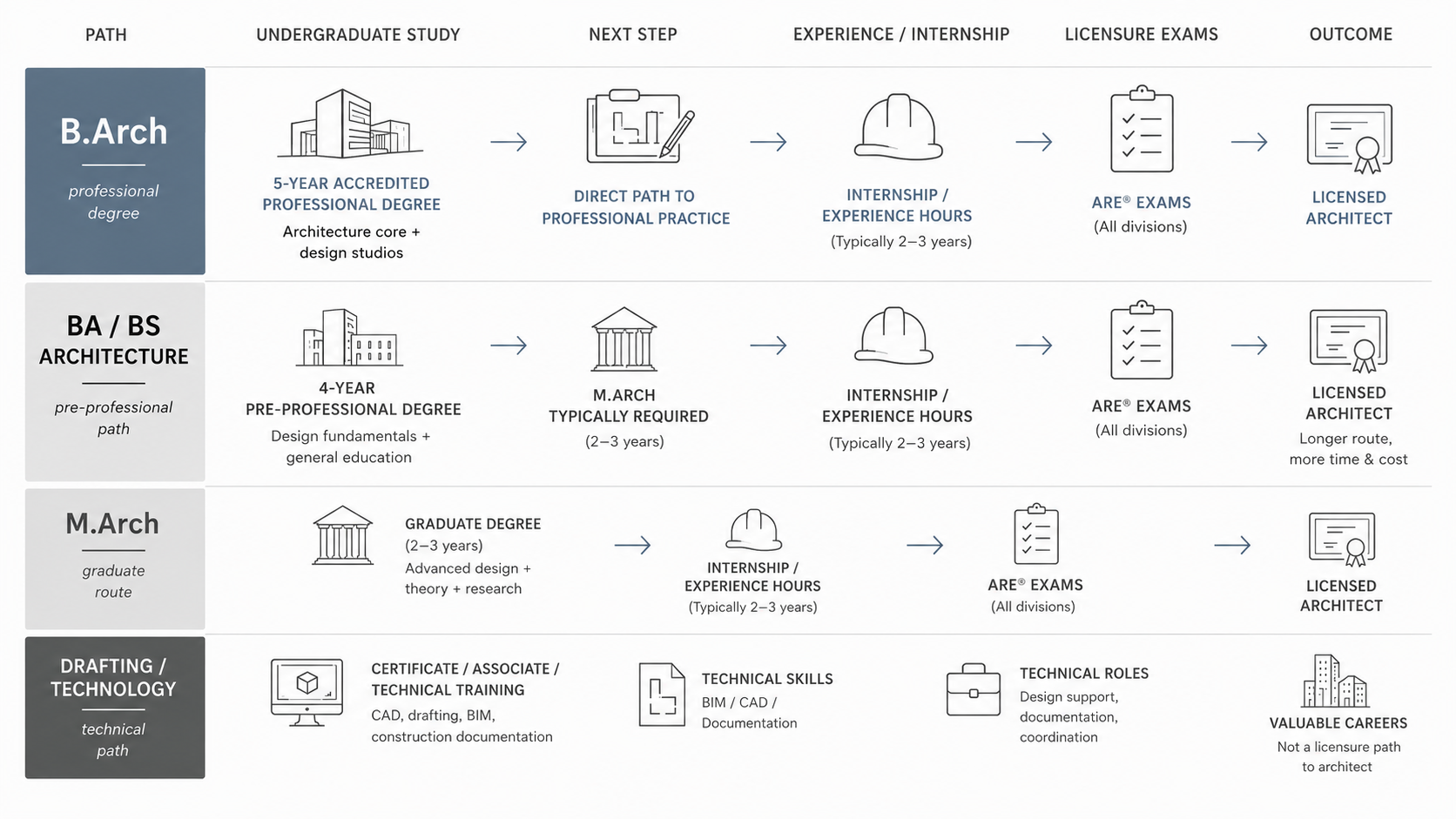
The right choice depends on the student’s maturity, budget, certainty, portfolio strength, and tolerance for a long studio path.
The U.S. Licensure Path After School
Graduation is not the finish line.
In the United States, licensure is controlled by state and territorial boards. The path usually combines the right education, professional experience, the Architect Registration Examination, and any extra jurisdiction rules.
That matters when choosing a school because architecture education should prepare the student for the next handoff.
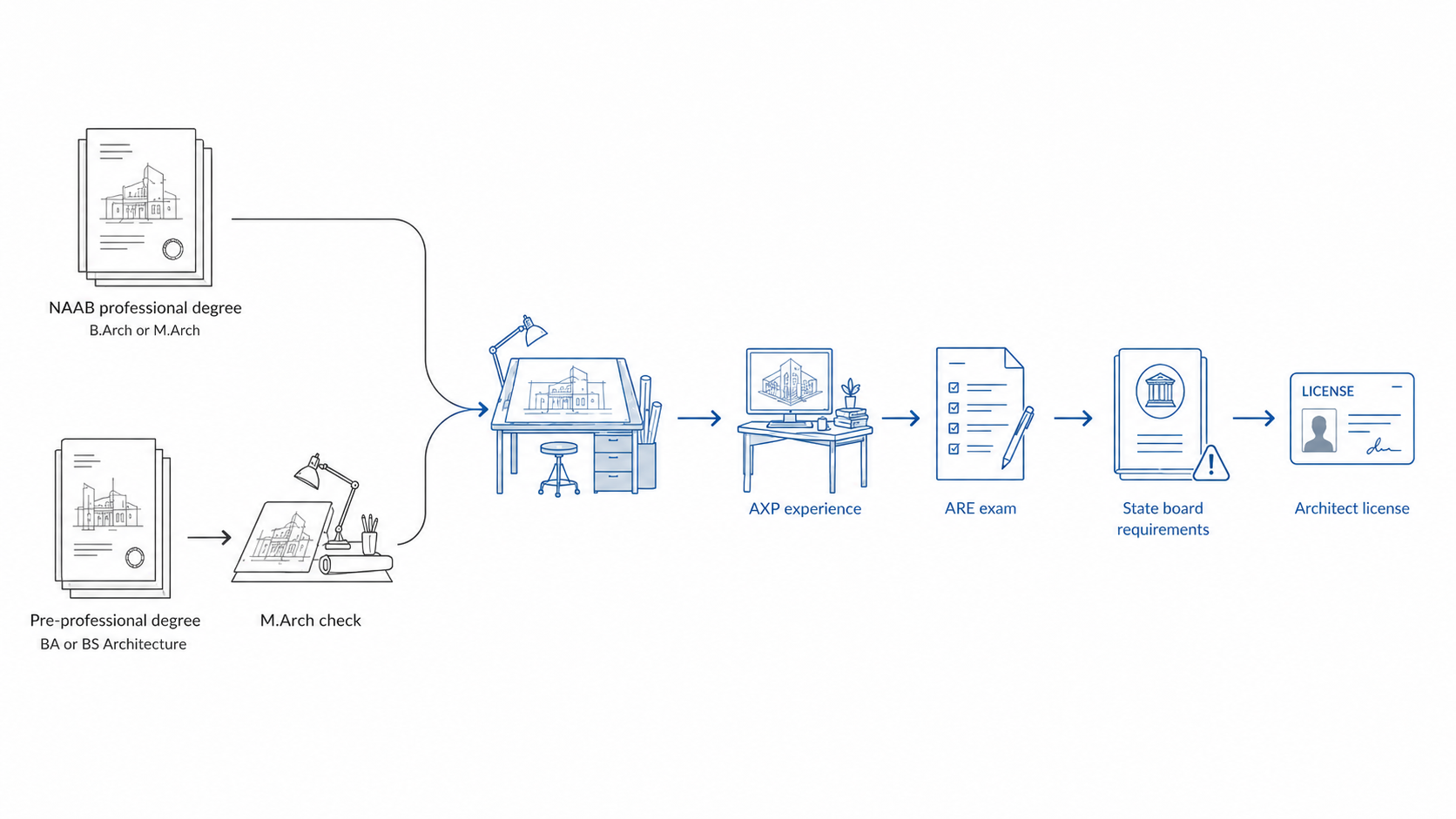
A strong school should help students understand what comes after studio: AXP experience, ARE exams, office work, jurisdiction rules, and the difference between graduating from architecture school and becoming licensed as an architect.
Why Region Changes the School Decision
Location is not just lifestyle.
Where you study can shape the work you see, the firms you meet, the climate problems you design for, and the internships you can reach without expensive travel.
A school in the Northeast may expose students to dense cities, older buildings, transit, housing pressure, preservation questions, and major firms. A school in California may give stronger exposure to wildfire, housing scarcity, seismic design culture, tech, fabrication, and experimental design scenes. A school in the South may push heat, humidity, storm risk, regional materials, and fast-growing cities. A school in the Midwest may offer stronger cost control, practical building culture, urban legacy, and regional firm access.
None of those regions is automatically better.
The better question is:
Do you want the school’s region to become part of your early professional network?
If you want to work in Los Angeles, New York, Chicago, Boston, Houston, Atlanta, Seattle, or Miami, studying near that professional ecosystem can matter. It is not required, but it can make internships, firm visits, reviews, and alumni contacts easier.
Studio Culture Matters More Than the Brochure
Architecture school is lived in studio.
Studio is where students learn how to test ideas, draw clearly, take criticism, revise, build models, explain choices, and survive a long project without losing the point of the work.

Some studios are demanding and useful. Some are demanding and careless. The difference is not how hard the school is. The difference is whether the difficulty teaches.
A good studio gives feedback students can use. It teaches revision. It makes students explain why a plan, section, wall, room, path, or material choice works. A weaker studio may reward dramatic boards and big language while leaving students unclear about what improved.
Before applying, look at recent student work. Not only the winning projects. Look for ordinary studio work too. The average work tells you more about the school than the best poster.
The Internship Pipeline Is Part of the School
A school is also a bridge to offices.
That bridge can be strong or weak.
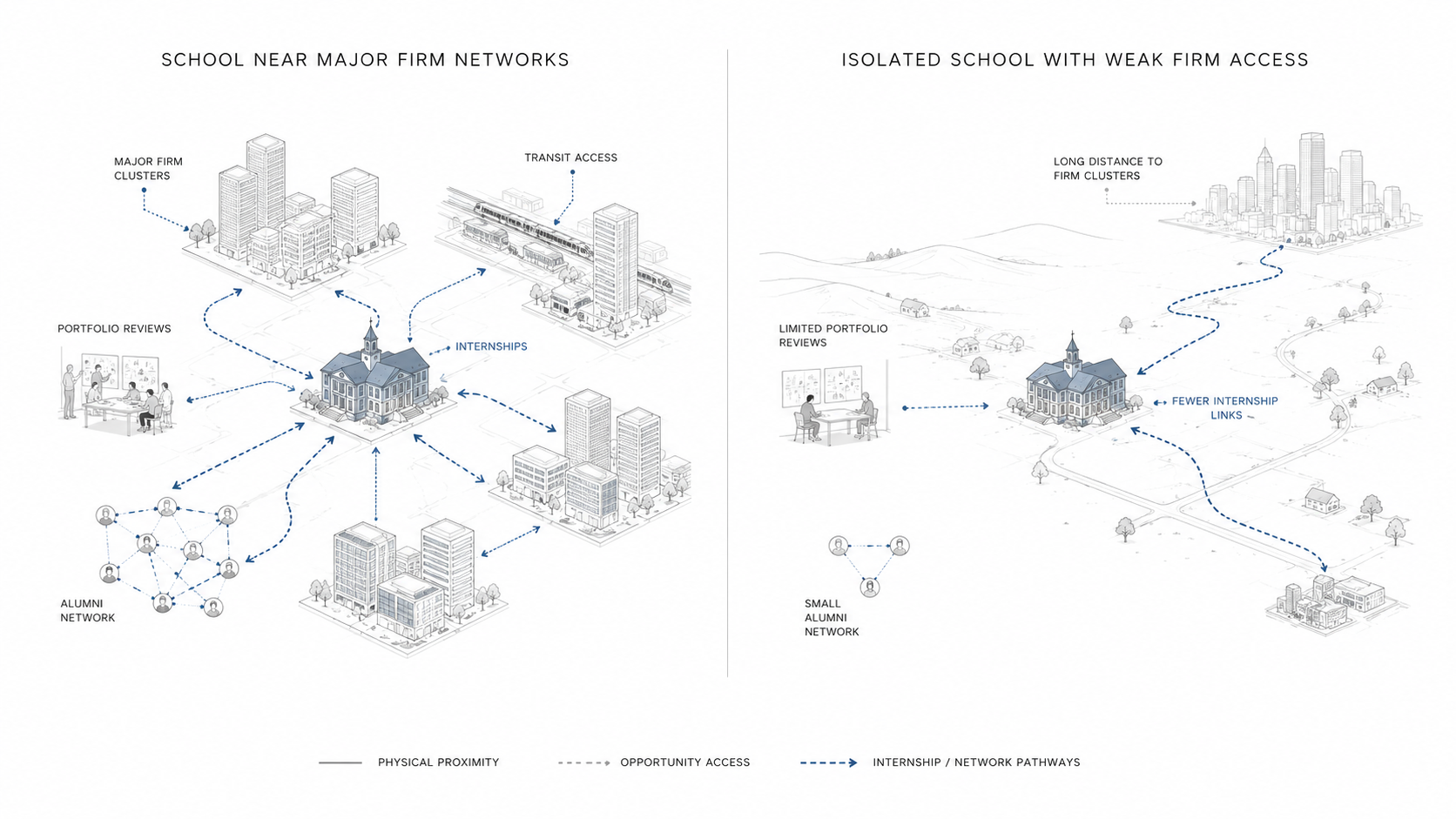
A school with strong firm ties, alumni reviews, public-agency access, co-op options, career fairs, and visiting critics can give students more openings. A school with weak practice ties may still teach strong design, but students may have to build the bridge alone.
Internships matter because office work teaches what studio cannot fully teach. Students see deadlines, consultant comments, client limits, code questions, drawing coordination, and the gap between a good idea and a buildable project.
Ask this before applying:
Where did recent students intern, and how did they get those positions?
If the answer is vague, the school may be selling career language without proving access.
The Cost Problem Nobody Puts in the Ranking
U.S. architecture school can get expensive in quiet ways.
Tuition is the obvious number. It is not the whole number.
Students also pay for models, prints, materials, software, hardware, storage, transport, site visits, books, portfolio materials, and sometimes better computers. Studio can also make part-time work harder during review weeks.

That is why a cheaper school on paper may not be cheaper in real life. A public university can become expensive if housing is high. A famous private school can become risky if debt limits the student’s choices after graduation. A regional school can be the smarter decision if it keeps debt lower and connects students to local firms.
| Cost to compare | What students forget | Why it matters |
|---|---|---|
| Tuition | Fees, studio charges, yearly increases, and required technology. | The listed tuition may not show the full academic cost. |
| Housing | Rent near campus, transit, food, safety, and late-night studio access. | A school in a costly city can erase scholarship savings. |
| Materials | Models, prints, boards, blades, glue, paper, and replacement tools. | Small purchases repeat all semester. |
| Technology | Software, laptop power, storage, rendering needs, and repairs. | Weak equipment slows studio work and may cost more later. |
| Extra years | A pre-professional degree followed by an M.Arch can stretch the timeline. | More school usually means more debt and delayed income. |
Where Students Waste Money
The biggest waste is not always choosing a weak school. It is choosing a strong school for the wrong reason.
Students waste money when they chase prestige without checking the degree route. They waste money when they choose a costly city without enough scholarship support. They waste time when they start a pre-professional route thinking it is already a professional degree. They waste effort when they build portfolios that look polished but do not show process, structure, site, or building logic.
The school’s job is not only to make students excited about design. It should help students move from school work to professional work.
How to Compare Famous U.S. Architecture Schools
Use famous schools as comparison anchors, not as automatic winners.
MIT, Harvard GSD, Yale, Columbia, Cornell, Rice, Berkeley, Michigan, SCI-Arc, Virginia Tech, Georgia Tech, Cal Poly, Syracuse, Penn, and Pratt all attract attention for different reasons. But putting them into one clean ranking can mislead students because they do different jobs.
A graduate research school is not the same as a direct undergraduate B.Arch route. A highly experimental program is not the same as a practice-heavy public university. A school with powerful name recognition is not always the school with the best daily teaching for a particular student.
| School type | Good fit for | Possible problem |
|---|---|---|
| Prestige-heavy graduate school | Students who want research, theory, global networks, advanced studios, or teaching paths. | Cost and abstraction can be high if the student wants practical office readiness. |
| Direct professional B.Arch school | Students who are ready to commit early to architecture. | The path can feel intense if the student is unsure about the field. |
| Public university architecture program | Students who need stronger cost control, regional networks, and practical pathways. | Some programs may have larger cohorts or less personal faculty access. |
| Experimental design school | Students who want conceptual risk, visual culture, media, computation, or speculative design. | May be a poor fit for students who want traditional practice training. |
| Technical or building-focused program | Students who want structure, systems, BIM, construction documents, and practice skills. | May feel less exciting for students who want theory-heavy design culture. |
International Students Need a Different Checklist
International students should be careful with U.S. school advice because their risks are different.
The school may be excellent, but the student also has to think about visa support, cost of living, health insurance, work rules, internships, OPT or CPT guidance, and whether the U.S. degree will be recognized in the country where they may work later.
A famous school name can help, but it does not solve every practical problem.
Before applying, international students should ask:
- Does the school have clear international student support?
- Can international students access internships during the program?
- How expensive is housing near the campus?
- Does the degree help if the student returns home?
- Are graduates working in the countries or regions the student cares about?
Do not choose a U.S. architecture school only because it is famous abroad. Choose it because the degree, cost, visa support, studio culture, and next step make sense.
What Employers Care About After Graduation
Employers may notice the school name. They still hire the person and the work.
A strong portfolio, clear drawings, software competence, curiosity, reliability, internship experience, and basic building knowledge matter. A famous school can get attention, but weak work loses attention fast.
Students who want office work should leave school with more than beautiful images. They need plans, sections, diagrams, process work, models, technical thinking, and the ability to explain decisions without hiding behind design language.
Employers can teach office standards. They have less patience for graduates who cannot take feedback, organize drawings, meet deadlines, or think through a design problem.
The School Visit Should Change Your Shortlist
A school visit should not only impress you. It should make you more specific.
Look at the studio walls. Are the projects only beautiful, or do they show process? Listen to a review. Are critics teaching, or only performing? Ask students what they wish they knew before enrolling. Ask how much they spend on materials. Ask whether they would choose the school again.
Do not only ask admissions staff. They are there to recruit.
The most useful answer may not be cheerful. A serious student will tell you what is hard and why they stayed anyway.
A Better U.S. School Shortlist
Do not build one dream list. Build three.
First, make a professional-path list. These are schools where the degree route is clear and matches your licensure plan.
Second, make a cost-safe list. These are schools where tuition, housing, scholarships, and living costs will not trap you after graduation.
Third, make a career-access list. These are schools with useful internships, alumni, firm networks, co-op systems, or strong regional practice connections.
Then compare the overlap.
The best architecture school is not the one that looks strongest in a ranking. It is the one that gives you the clearest route into the kind of work you want without wasting years or money.
Questions to Ask Before You Apply
- Is this a professional B.Arch, professional M.Arch, pre-professional BA/BS, or another kind of degree?
- Is the program currently NAAB-accredited, in candidacy, or not a professional licensure route?
- What does the first-year studio actually teach?
- How often do students receive useful desk critiques?
- What firms or offices do students intern with?
- How much do students spend on models, prints, software, and tools?
- How expensive is housing near campus?
- What does average student work look like, not only prize-winning work?
- Do graduates work in the cities or fields you care about?
- Would current students choose the program again?
FAQ
What are the top architecture schools in the USA?
There is no single top architecture school for every student. Schools such as MIT, Harvard GSD, Cornell, Columbia, Yale, Rice, Berkeley, Michigan, SCI-Arc, Virginia Tech, Georgia Tech, Cal Poly, Syracuse, and others are often compared, but the right choice depends on degree path, cost, studio culture, location, and career goals.
Should I choose the highest-ranked architecture school I get into?
Not automatically. A highly ranked school may still be too expensive, too theoretical, too isolated, or the wrong degree path. Use rankings to discover names, then compare accreditation, cost, internships, studio culture, and graduate outcomes.
Is a B.Arch better than an M.Arch?
One is not always better. A B.Arch is usually a direct professional undergraduate route. An M.Arch is a graduate professional route and may fit students who started with a pre-professional degree or another background. The better option depends on timing, cost, certainty, and career plan.
How important is NAAB accreditation?
For students who want the cleanest U.S. path toward licensure, NAAB accreditation is very important. Students should check the official NAAB directory before applying because the exact degree and accreditation status matter.
Are public universities good for architecture?
Yes. Some public universities offer strong architecture programs, better cost control, regional firm access, and practical training. A public university can be a smarter choice than a famous private school if it fits the student’s path and budget.
What should international students check before applying to U.S. architecture schools?
International students should check degree recognition, visa support, internship access, cost of living, OPT or CPT guidance, and whether graduates work in the countries or regions they care about after school.
What is the biggest mistake students make when choosing a U.S. architecture school?
The biggest mistake is choosing by name before checking the route. Students should understand the degree type, NAAB status, cost, studio culture, internship access, and graduate outcomes before they commit.
Read Next
If you need the broader U.S. education-system explanation, read Architecture Education in the United States.
If you are comparing degree types, read Types of Architecture Degrees: Which Path Is Right for You?.
If you want the full school-to-license sequence, read How to Become an Architect and How to Become a Licensed Architect?.
If you are comparing programs outside the United States, read Architecture Schools by Country: What to Check Before You Apply.