
The Systems That Keep You Comfortable: From the Ground Up
What Holds Them Together
How buildings work in real life. Why they stand, fail, heat, cool, and change with time. Practical insight into architecture that lasts.
Buildings aren’t magic. They stand because people figured out structure, materials, and design over thousands of years.
Below we show how buildings began, what keeps them standing, and how design moved from stone huts to glass towers.
By the end, you’ll be able to look at a building and actually understand why it works.
The Anatomy of Buildings
Bones, Skin, and Breath: How Buildings Stay Alive
Why Buildings Work Like Us
Think of a building as a human body. The foundation is the bones in your feet and legs, pressing weight into the ground. The structure is your skeleton, carrying loads and keeping you upright. The enclosure is your skin. It keeps rain and wind out but lets light and air in through controlled openings.
Environmental control is your lungs and sweat glands. Breathing, cooling, heating, balancing moisture. Passive design is your instinct to move into shade on a hot day. Active systems are the jacket or fan you put on when instinct isn’t enough.
Finishes are the clothes. They don’t keep you alive, but they change how you’re seen and how you feel inside the body.
Every part works together. Bones without skin fail. Skin without lungs suffocates. Clothes without structure collapse. A building, like a body, only makes sense when all the systems sync.
Structure and Loads
Every building has to stand up. Structure is about carrying loads down to the ground.
How Buildings Stand Up
Loads, Beams, and Balance
The Logic of Structural Systems
Every building is a fight against forces. Gravity pulls everything down. Wind and earthquakes push it sideways. If the structure fails, nothing else matters. The skeleton keeps everything alive.
How loads move
Think of a load path. The roof takes the hit first, then beams carry it to columns or walls, then it drops into the foundation and finally into the earth. Trace that path in your head when you walk through a building. That’s how you start seeing structure the way engineers do.
Examples that teach
The Seagram Building in New York is a clean steel frame. The glass is just a skin, not part of the load. That honesty is why it still looks powerful. The Tacoma Narrows Bridge, on the other hand, collapsed in 1940 because the engineers forgot how wind would set the deck vibrating. One stands for precision, the other for what happens when you forget lateral forces.
Mistakes to watch for
People often think only about weight pressing down. The sideways push of wind or an earthquake can do more damage than the vertical load. Even small-scale renovations go wrong when someone cuts into a load-bearing wall for “more open space” without adding support. Cracks and sags always follow.
How to train your eye
Every time you step inside a building, try to follow the structure with your eyes. Look up, find the roof beams, follow them to the columns, then imagine the weight sinking into the foundation. That’s how architects and builders think.
Where this leads
A skeleton alone isn’t enough. It needs the ground to hold it and a skin to protect it. That’s why the next step is foundations and enclosure.
You might like: Intro to Architectural Technology: How Design Meets Construction
Foundations and Ground
The base of the building. They spread loads into soil or rock.
Foundations and the Ground Below
Soil, Concrete, and Load: The Foundation Basics
Why the ground decides everything
A building is only as good as what it sits on. Put a heavy structure on weak soil and it will crack, sink, or tilt. That’s why the first job is not designing walls or roofs. It’s testing the ground.
What foundations really do
They spread loads into the earth so the building doesn’t punch holes in the soil. A shallow strip footing under a house wall works when the soil is strong. A deep pile foundation is used when the top layers are too soft, like in parts of Dubai or Shanghai. Different ground, different answer.
Examples that make the point
The Leaning Tower of Pisa tilted because the foundation was set on poor soil that couldn’t handle the weight. On the flip side, the Petronas Towers in Kuala Lumpur are planted on 100-meter-deep piles. That’s the only reason those twin giants stand steady in weak clay.
Mistakes you see everywhere
Small builders often skip real soil testing. They assume every lot is the same. Then years later cracks open up in walls or doors stop closing because the foundation shifted. The failure doesn’t happen fast. It sneaks up on the structure.
How to train your eye
When you walk past an old brick house with diagonal cracks at the corners of windows, that’s the ground moving under it. When you see a skyscraper rising, notice how much time they spend digging and pouring concrete before anything vertical happens. That’s where the real money and stability go.
Where this leads
Once the load path is carried into the soil, the next layer of thinking is what wraps and protects the structure above ground: the envelope of walls, windows, and roofs. That’s where form, function, and weatherproofing collide.
You might like: House Foundations & Groundworks: Guide to Construction
Enclosure (Walls, Roofs, Windows)
The skin of the building. Keeps weather out, lets light and air in.
How Buildings Keep Weather Out
Walls, Roofs, and Windows Explained
Enclosure: Walls, Roofs, and Windows
The skeleton can stand tall, but without skin it won’t survive. Enclosure is the armor. It keeps weather out, controls temperature, and still has to let light and air in. If structure is the bones, enclosure is what makes the body livable.
Walls that matter
Some walls hold the building up. Others just hang like a curtain. A brick load-bearing wall is doing structural work. A glass curtain wall on a tower just hangs off the frame like clothing. Knowing the difference matters because you can remove one type but not the other.
Roofs that fight gravity
Roofs are more than hats. A pitched roof sheds water fast, a flat roof has to fight to drain it. Every roof is a battle with water, heat, and snow. Add layers: waterproofing membranes, insulation, sometimes ballast. If the layers fail, the whole interior pays the price.
Windows as weak spots
Every hole in the skin is a weakness. Windows leak heat, sometimes water. A well-detailed window can save energy and last decades. A sloppy one will rot a wall from the inside out. Good design is about how you frame, seal, and drain around the glass.
Examples that teach
The leaky condo crisis in Vancouver wasn’t about bad architecture on paper. It was enclosure failure. Thin walls, poor sealing, no proper drainage. Whole neighborhoods had to be stripped and rebuilt. On the other side, look at traditional stone houses in Europe. Thick walls, deep windows, overhangs. Centuries of survival because the builders respected water.
Mistakes to watch for
Flat roofs without proper slope. Flashing details skipped to save cost. Walls built tight but without ventilation, trapping moisture inside. Water always finds the weak point, and gravity always wins.
How to train your eye
When you see a building, check how the walls meet the ground. Follow how the roof edges shed water. Look at the window sills: do they slope out, or will water pool against the glass? These small details tell you if a building will age gracefully or start leaking in year five.
Where this leads
Now you have bones and skin. But a building is more than shelter. It has to breathe, light up, heat, and move people through it. That’s where systems come in next.
Environmental Control
Comfort systems inside. Heating, cooling, ventilation, moisture.
How Buildings Stay Comfortable
Passive First, Active Second
Comfort Inside: Sun, Shade, and Systems
Heat, Air, and Moisture Control
Comfort is not just temperature. It is air quality, humidity, light, and sound. Get those right and people feel good. Get them wrong and no design trick will save the space.
Passive first
Start with the site and the sun. Face main living areas to the right light. Use overhangs and shading to block high summer sun while letting winter sun in. Insulate the shell so heat stays where you want it. Seal the leaks, then plan controlled fresh air. A south-facing house with proper shading can cut cooling loads in half. That is free comfort from orientation and shade.
Active when needed
After you squeeze every passive gain, add machines to do the rest. Heat pumps, boilers, chillers, fans, and filters move heat and air to fine-tune comfort. Good controls matter. A small, well-tuned system that runs steadily often beats a big unit that short cycles and never removes humidity.
Examples that teach
Traditional courtyard houses in hot, dry climates stay cool with shade, thick walls, and night flushing. The form does the work. Passive House projects in cold regions use airtight shells, serious insulation, and heat-recovery ventilation so a tiny heater can carry the load. Both prove the same point. Reduce the demand first, then add just enough equipment.
Mistakes to watch
Sealing a building without planned ventilation is a mold factory. Big air conditioners that cycle on and off leave rooms clammy because they do not dehumidify. Thermal bridges at window frames and slab edges turn into condensation lines in winter. Moisture wins if the details are sloppy.
How to train your eye
Walk around a building and read the facade. Do south windows have shade from overhangs or fins. Are west windows small or protected. Inside, find supply vents and return paths. Stand under an overhang at noon and feel how much heat it blocks. These small checks tell you if comfort was designed or guessed.
Where this leads
Comfort rides on the materials you touch and the surfaces that shape sound and light. Next comes finishes and interior surfaces, because floors, ceilings, and wall layers change how a room feels, ages, and performs.
Services and Systems
The hidden guts. Plumbing, electrical, fire protection, elevators.
How Buildings Breathe, Light Up, and Flow
Mechanical, Electrical, Plumbing: The Building’s Organs
Systems You Don’t See but Depend On
What keeps a building alive
A building without systems is just a box. It can stand up, but it won’t be livable. Power, water, air, and waste flow through pipes, ducts, and wires. These hidden organs are what make a house warm in winter, cool in summer, and safe to live in.
How systems work together
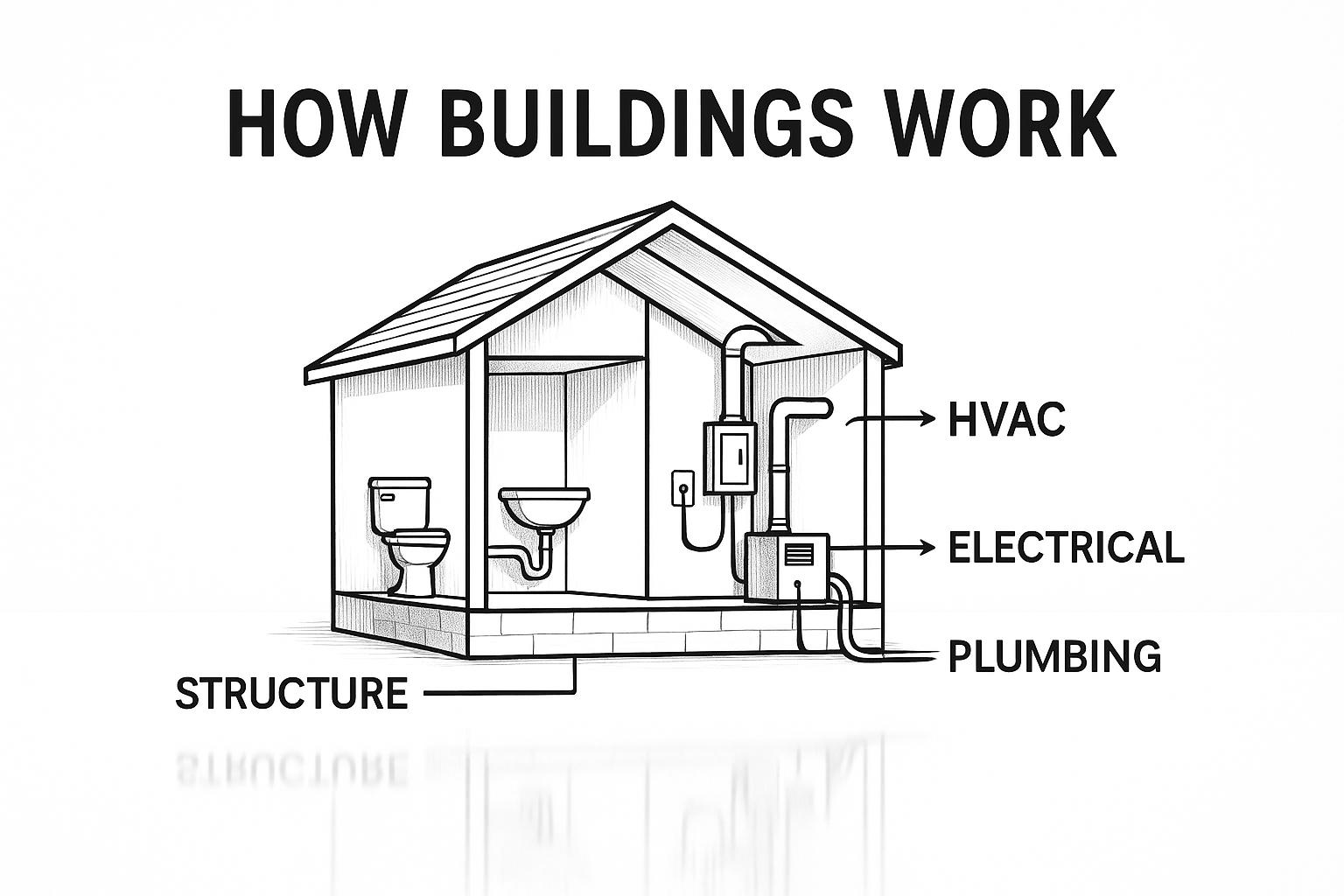
Plumbing brings in clean water and takes waste away. Electrical wiring lights rooms and powers tools. HVAC moves air to keep it breathable and comfortable. Fire protection stands guard in the background. These are not separate—they have to weave around each other without fighting for space. That’s why coordination drawings exist: so a duct doesn’t run through a beam or a pipe doesn’t block a window.
Examples that teach
The Centre Pompidou in Paris made a radical choice: instead of hiding the ducts and pipes, it put them on the outside. The color-coded systems became the architecture itself. Compare that to most apartment towers, where systems are tucked into ceilings and risers so carefully that residents forget they’re there. Both approaches teach the same lesson: systems are essential, whether you celebrate them or hide them.
Mistakes to watch for
Bad coordination is the classic failure. A contractor installs ducts first, leaving no space for sprinklers. Or plumbers run pipes without slope, leading to clogs. Another mistake is ignoring maintenance access. A hidden shutoff valve behind a wall is useless in an emergency. These errors cost more to fix after construction than they would if caught on paper.
How to train your eye
Look up in any commercial building. See the ducts, lights, sprinklers, and wires? Notice how they run parallel, lined up in grids. That’s no accident—it’s coordination in action. In houses, peek into basements and utility rooms. Follow how water enters, how the furnace moves air, how wires run to the panel. Once you start tracing paths, you’ll see the building as a living system.
Where this leads
Systems keep people comfortable, but comfort alone isn’t enough. The materials you touch and see every day define the building’s character. That’s where the next step comes in: finishes. Floors, ceilings, and surfaces that turn a skeleton with organs into a place people actually want to be.
Human Use and Flow
Buildings aren’t just boxes. They have circulation, exits, access.
How People Move in Buildings
Circulation and Access
Designing Movement Inside
Stairs, Elevators, and Exits
A building that ignores people is useless. Flow is about how humans move through space. It’s the difference between calm order and chaos in an emergency.
Circulation and Access
Every plan has two main paths. Horizontal routes are hallways, ramps, or open walkways. Vertical routes are stairs and elevators. Together they form the circulation network. If that network is weak, frustration builds. If it’s clear, people move without thinking.
The Flow of People
Good design anticipates peaks. Think of a stadium right after a game. Thousands of bodies pour through exits. If doors or corridors are too tight, panic starts. Even in smaller settings, like schools, an undersized hallway creates daily bottlenecks.
Examples That Teach
The Guggenheim Museum in New York is one long spiral ramp. You start at the top and walk down, seeing art in one continuous flow. That’s circulation turned into experience. Contrast that with Penn Station before its recent rebuild. Narrow passages, low ceilings, and confusing signs made even a small crowd feel like a crush.
Mistakes to Watch For
Designers often shrink circulation to “save space.” But shaving a few feet off a corridor or reducing stair width always backfires. Flow is invisible until it fails, then it dominates the building. Fire codes are written in blood—most disasters come from blocked or inadequate exits.
How to Train Your Eye
When you walk into any building, ask yourself: could I find my way out if the power went off? Do the routes feel natural or forced? Notice where people hesitate or bunch up. Those are pressure points in circulation.
Where This Leads
Circulation is the bloodstream of a building. But flow doesn’t stop at movement. It ties directly into how people feel in space—whether they are safe, welcome, or trapped. That leads into the next piece: how buildings shape comfort through environmental control.
See also: Introduction to Architecture: A Beginner’s Guide to Building Design
Lifespan and Maintenance
Buildings age. Materials fail. Systems need replacement.
How Buildings Age
Lifespan: From Day One to Decay
The Work of Maintenance
A building isn’t finished when construction ends. From the first day, it begins to age. Materials weather, systems wear out, and small cracks grow if ignored. The real test of design is how it performs in year 30, not just on opening day.
What Fails First
Every part has its clock. Roof membranes last 15 to 30 years before leaks force replacement. Mechanical systems like boilers and chillers run about 20 to 25 years. Cladding weathers faster if detailing is sloppy. Structure is the exception. With care, it can outlast empires. Stone aqueducts in Rome still stand after 2,000 years because masons understood water always wins unless it’s directed away.
Designing for Repair
Good design accepts that failure is coming. Flat roofs should be easy to re-cover. Mechanical rooms should have access for swapping out big units. Details that hide fasteners or block inspection turn a small fix into a major rebuild. Think of it like car design—if you need to pull the engine just to replace the battery, it’s bad engineering.
Examples That Teach
The John Hancock Center in Chicago (now 875 N Michigan) was detailed with accessible steel and exposed joints. Its structure can be inspected and repainted. That’s why it still holds up. By contrast, Vancouver’s leaky condo crisis in the 1990s came from ignoring maintenance. Developers wrapped buildings too tight, trapped moisture, and gave owners no way to fix the problem until it was catastrophic.
Mistakes to Watch For
The most common error is designing for perfection on day one. Smooth walls, hidden joints, and sealed envelopes look sharp at handover but trap problems. Buildings that can’t be easily repaired end up demolished earlier than necessary. Sustainability isn’t just about green materials—it’s about giving a building a long, repairable life.
How to Train Your Eye
When you see a building, ask: how will this age? Where will the first leak show? Can the cladding be replaced without tearing everything apart? Look for drip edges, access panels, and exposed fasteners. Those are signs of a building that was designed to be fixed.
Where This Leads
No building lives forever, but some are kept alive for centuries because they were built and maintained with repair in mind. The last piece of how buildings work is understanding their whole life cycle—from birth to inevitable decay.
See also: Creating Beautiful and Functional Spaces: Expert Tips for All Levels
-
The Whole Machine
-
Buildings as Living Systems
-
From Ground to Life Cycle
The Whole Machine
A building is not just a box. It’s a machine for living, working, and moving. Every part—from foundations to maintenance—is connected. Leave one out and the rest suffers.
The Core Parts Recap
-
Structure keeps it standing.
-
Foundation locks it into the ground.
-
Enclosure keeps out water and weather.
-
Environment keeps people comfortable.
-
Flow lets people move safely and efficiently.
-
Maintenance keeps it alive for the long haul.
The Analogy That Works
Think of a body. Bones are structure. Skin is enclosure. Lungs and heart are HVAC and systems. Circulation is halls and stairs. Food and care are maintenance. Stop one, and the whole body collapses. Buildings work the same way.
Why This Matters
If you only see the surface—pretty cladding, glass walls, shiny interiors—you’re missing the real story. Buildings that look sharp but leak, trap heat, or block circulation fail fast. The best architecture makes all the parts work together: solid bones, smart skin, clear flow, comfortable air, and a plan for repair.
The Final Mistake to Avoid
Believing that buildings are permanent. They are not. They live only as long as their systems are cared for. Rome’s aqueducts still stand because their builders respected water. Vancouver condos rotted because developers didn’t. The difference is maintenance and detail.
How to Train Your Eye
Next time you walk into a building, don’t just look at finishes. Ask: How does it stand? Where does the water go? How do people flow? How will this age? That’s the real education.
Closing Line
Buildings are not frozen objects. They are living systems fighting against gravity, weather, and time. Understand that fight, and you understand architecture.
The Rhythm of Use
Architecture and Daily Cycles
Buildings as Time Machines
We talk about how a building stands. We rarely talk about when it stands. Every building carries time inside it. Morning light lands one way, afternoon another. Offices fill at nine, empty at five. Stairwells surge at lunch. Lobbies at closing. A stadium is dead most of the week, then shakes the ground for three hours on game night.
Why It Matters
Design without time in mind and you get dead corridors, overheated glass boxes, or lobbies that sit empty most of the day. A good building breathes with the rhythm of people moving through it.
Examples That Teach
Grand Central Terminal in New York works because it swallows rush-hour crowds and still feels grand but not hollow at mid-day. Suburban strip malls show the opposite. Vast empty parking lots most of the time, chaos on Saturday. Same tools of architecture, but one respects daily rhythm and the other ignores it.
Mistakes to Avoid
Designing only for the photo moment. A building might look sharp at noon in the rendering, but what about seven in the morning when glare blinds the workers. Or midnight when security needs sightlines. The daily cycle is as real a force as gravity or water.
How to Train Your Eye
Visit a building twice. Once in the morning and once in the evening. Watch how shadows, noise, and people flow differently. That is the time dimension at work.
The History of Buildings: From Stones to Steel
Early Shelters
The first buildings were survival tools. Caves, huts of mud and timber, stone circles like Stonehenge. They weren’t about beauty. They were about staying alive and marking rituals.
Egypt
The pyramids were built as tombs, but they also proved you could move millions of tons of stone with enough labor and planning. Precision blocks. Perfect alignment. Still standing after 4,000 years.
Greece
The Greeks wanted order. Columns, proportions, symmetry. The Parthenon is their proof. Simple forms, repeated with logic.
Rome
The Romans were engineers at heart. They gave us arches, domes, aqueducts. The Colosseum held entire cities’ worth of people because they understood concrete and structural rhythm.
Middle Ages
Gothic cathedrals like Notre Dame weren’t just places to worship. They were engineering experiments. Flying buttresses, rib vaults, glass walls the size of fields.
Industrial Revolution
Steel and concrete changed everything. The Crystal Palace was iron and glass in prefabricated parts. Skyscrapers in New York rose because of steel skeletons.
Modernism
Modern architects cut the decoration. Frank Lloyd Wright made houses that blended with landscapes. Le Corbusier treated buildings like machines for living. Form matched function.
Contemporary
Now we’re in the age of extremes. The Burj Khalifa in Dubai is the tallest in the world. Built with high-tech materials, wind modeling, and massive foundations that go deep into desert sand.
What to Focus On
Every jump in architecture followed a jump in technology. New tools. New materials. New ideas. That’s the pattern worth remembering.
FAQs
40 Architecture FAQs That Actually Teach Something
Foundations and Structure
Q: How do I know if a wall is load-bearing?
Look for continuous alignment from roof to foundation. Check if beams or joists rest on it. If unsure, assume it is until proven otherwise.
Q: Why do some buildings last centuries and others fail in 30 years?
Durability is about detail. Stone aqueducts shed water. Modern flat roofs often trap it. Material plus detailing equals lifespan.
Q: What is a “load path” and why does it matter?
It is the chain of weight moving from roof to ground. If the chain breaks anywhere, the building fails.
Q: Can foundations fail even if the structure looks fine?
Yes. Soil movement, poor drainage, or shallow footings can crack and tilt buildings regardless of strong walls above.
Enclosure and Skin
Q: Why do modern glass towers overheat?
Glass lets in more sun than it blocks. Without shading or double skins, cooling costs explode.
Q: Why are flat roofs seen as risky?
Water does not drain easily. If detailing or maintenance is poor, leaks follow fast.
Q: Are curtain walls structural?
No. They hang off the frame like a skin. They keep weather out but carry no real loads.
Q: Why did Vancouver condos leak in the 1990s?
Architects copied California stucco details without adjusting for heavy rain. Local climate ignored = massive failures.
Environmental Control
Q: What is the biggest energy leak in a house?
Windows. Poor frames and bad detailing leak heat more than walls.
Q: Why do sealed modern houses get mold?
Tight envelopes without ventilation trap moisture. You need controlled airflow, not zero airflow.
Q: What is the cheapest passive energy strategy?
Orient the building to the sun. Shade in summer, capture warmth in winter. Costs nothing, saves forever.
Q: Why are mechanical rooms always hidden but critical?
Because HVAC, boilers, and chillers run comfort. If planned poorly, the whole building feels wrong.
Circulation and Flow
Q: Why are stairs often placed in the middle of towers?
To shorten travel distance for safety. People must reach an exit fast during fire.
Q: What happens if corridors are too narrow?
Congestion, safety hazards, failed fire codes. Schools and hospitals feel it most.
Q: Why do airports feel confusing?
Because circulation is stretched over long distances. Clear wayfinding and sightlines make or break them.
Q: Can a bad elevator layout ruin a building?
Yes. Long waits waste thousands of work hours per year in office towers.
Lifespan and Maintenance
Q: What part of a building fails first?
Roofs. They take weather head-on.
Q: Why do mechanical systems rarely last past 25 years?
Wear, efficiency loss, and outdated tech. Unlike stone or concrete, machines have built-in expiry.
Q: Can design actually plan for repair?
Yes. Access panels, modular systems, and visible fix points make future work possible.
Q: What is the most overlooked maintenance factor?
Water. Almost every long-term failure traces back to water entry.
Time and Use
Q: Why do stadiums feel wasteful?
Because they sit empty most of the year. Design tied to short time windows can make huge spaces obsolete.
Q: Can the same building work differently at day and night?
Yes. Lighting, shadows, and use shift completely. Good design adapts across the cycle.
Q: Why do malls keep failing?
They were built for 1980s retail rhythms. E-commerce killed that rhythm. Time changed, design did not.
Q: Should architects visit their buildings after opening?
Always. Real use over time exposes flaws you will never see on paper.
Materials and Craft
Q: Is concrete really permanent?
No. Without cover depth, steel reinforcement corrodes and the concrete cracks.
Q: Why do old brick walls outlast new ones?
Older ones often used lime mortar, which breathes and flexes. Portland cement mortar is stiffer and cracks.
Q: What is the most sustainable material?
Wood, if sourced right. It stores carbon and can be renewed.
Q: Can cheap finishes ruin a good design?
Yes. Bad detailing at joints, edges, and corners makes a building look and age poorly.
Practice and Learning
Q: What is the single best way to learn architecture?
Draw buildings you see. Plans, sections, sketches. Drawing burns lessons into memory.
Q: Why do architecture students struggle with scale?
Because they draw in isolation. Standing inside real spaces teaches scale better than any studio.
Q: What do famous architects actually excel at?
Not everything. Some master structure (Nervi). Some master light (Kahn). Some master skin (Herzog & de Meuron). Learn by focusing on what they did best.
Q: Why do so many buildings feel generic today?
Because copying images online replaces thinking about site, use, and time.
Mistakes and Failures
Q: What kills more buildings than anything else?
Water intrusion.
Q: Why do renovations often destroy structure?
Cutting into load-bearing walls or beams for “open plans” without adding support.
Q: What was the Tacoma Narrows Bridge failure about?
Engineers ignored wind resonance. The bridge tore itself apart in 1940. Lesson: lateral forces matter.
Q: What do failed malls, housing estates, and towers all share?
They ignored human flow and long-term use.
Vision and Future
Q: Will AI replace architects?
No. AI can generate forms and options, but judgment, context, and ethics stay human.
Q: Why do cities push green roofs and solar panels?
Because roofs are unused real estate. They can cut heat, manage water, and generate energy.
Q: What is the next big frontier in design?
Adapting old buildings for new uses. Recycling structures is cheaper and greener than tearing down.
Q: Can architecture really shape behavior?
Yes. Wide stairs make people use them. Dark alleys discourage walking. Design sets choices before people even notice.