

Architecture Degrees and What You Can Specialize In
Types of Architecture Programs and Focus Areas
Understanding Architecture Education
To learn architecture is to learn how space affects life—and how to design with that in mind.
You might start with an undergrad program, explore areas like urban design or digital modeling, or go further with a master’s—architecture school shifts how you see the world.
This guide helps you find your focus, prep your portfolio, and succeed long-term.
Choosing the Right Architecture Program: What Path Fits You Best?
Find Your Focus: Specializations in Architecture
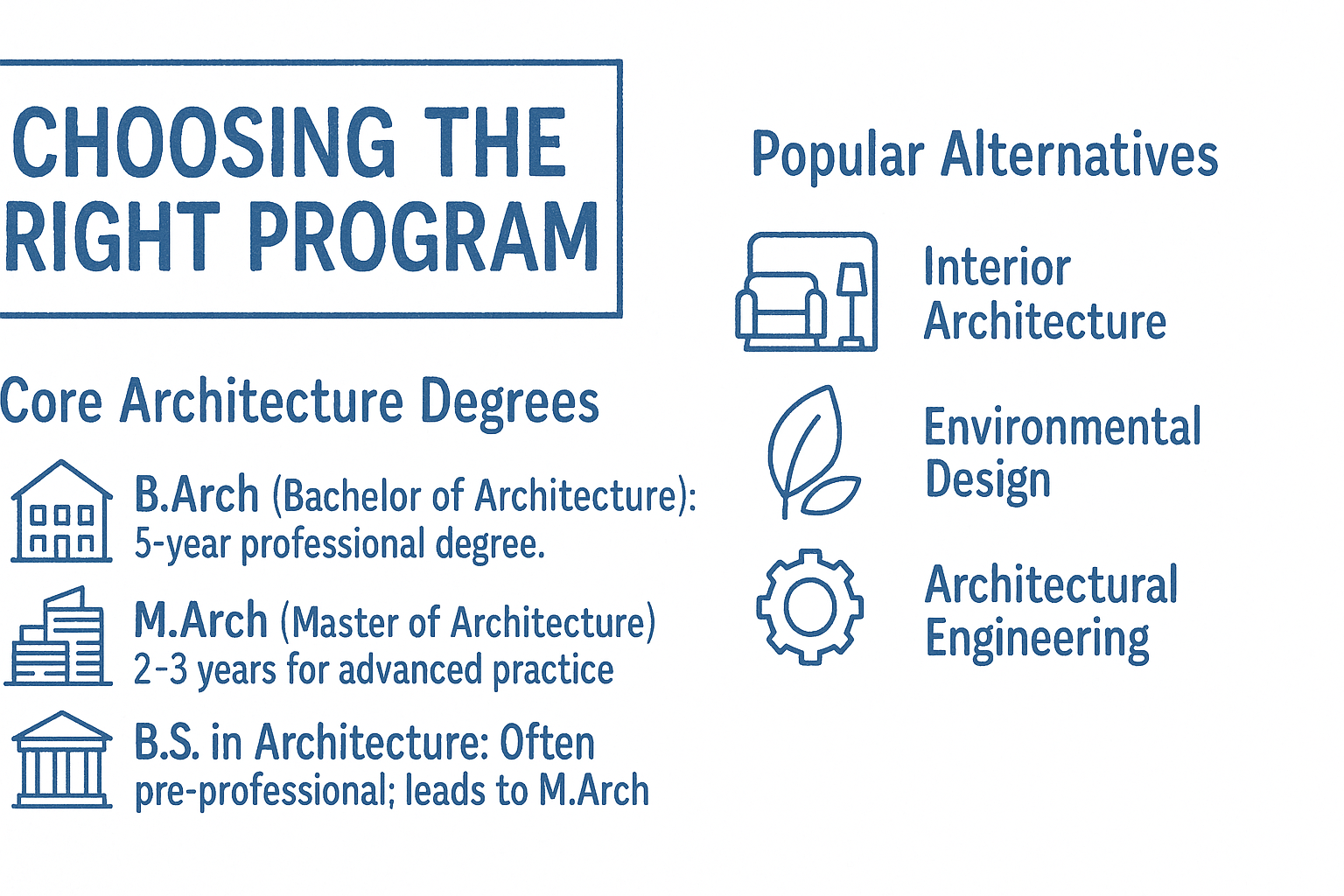
Choosing an architecture program means picking how you’ll learn to see buildings, spaces, and the way people live in them.
Core Architecture Degrees
B.Arch (Bachelor of Architecture)
Duration: 5 years (professional degree)
This is the direct route to becoming a licensed architect. It combines design studios, theory, history, structures, and tech. Many students choose B.Arch to go straight into practice or internships after graduation.
M.Arch (Master of Architecture)
Duration: 2–3 years (depending on your background)
Ideal for students coming from other fields or pre-professional degrees. It’s also required in many regions to qualify for licensing. Offers deeper design training and access to advanced research or teaching.
B.S. in Architecture
Duration: 4 years (pre-professional degree)
More technical and broad. Often used as a launchpad for a Master’s. Offers exposure to design, theory, and technology, but usually needs an M.Arch for licensing.
Ph.D. in Architecture
Duration: 3–7 years (research-based)
Focused on theory, history, design methods, or technology. Good for those aiming to teach at universities or shape academic discourse. Doesn’t lead to licensure.
Popular Alternatives (Related Paths)
Interior Architecture
For those interested in space-making on the human scale. Bridges architecture and interior design, often with strong technical and aesthetic focus.
Environmental Design
Focuses on sustainable planning and ecological impact. Great fit if you want to design for climate, landscape, and the long-term.
Architectural Engineering
The technical backbone of building. Emphasizes structural systems, building performance, and engineering design. Ideal if you enjoy math, mechanics, and precision.
How to Decide
Ask yourself:
- Do I want to practice as a licensed architect? (B.Arch or M.Arch)
- Do I enjoy research, teaching, or theory? (Ph.D.)
- Do I lean toward sustainability, interiors, or building tech? (Alternatives)
Visit program pages. Talk to alumni. Compare studio culture, faculty, internship options, and curriculum structure.
A good program doesn’t just teach you how to design—it shows you how to think.
Specializations That Actually Matter
Specializations in Architecture: Where Architecture Can Take You
Architecture Paths: From Urban Design to Sustainability
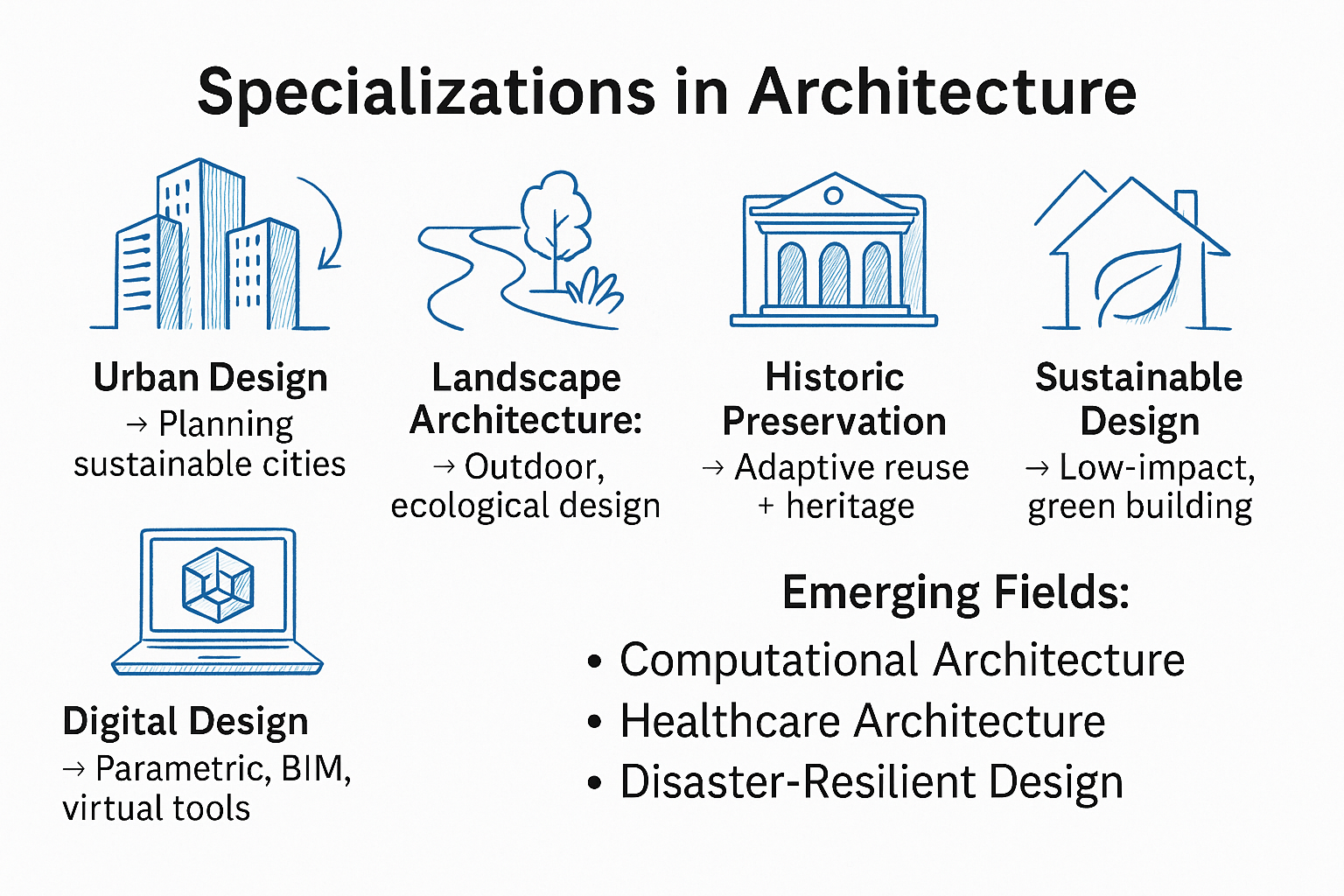
Architecture is a branching system. Once you've built a foundation in design, structure, and theory, the question becomes: where do you want to make impact?
Different Paths. Same Foundation.
This section breaks down the major specializations that matter today.
Real Fields, Real Impact - Pick Your Focus.
Architecture Isn’t One Job — It’s Many. What Kind of Architect Do You Want to Be?
Core Specializations That Matter
Urban Design
Designing How Cities Work
Urban design focuses on streets, plazas, transit, and public spaces—the infrastructure of daily life. You'll work at the scale of neighborhoods and districts, blending policy, community needs, and long-term planning.
- Key Skills: zoning codes, placemaking, transportation networks
- Project Types: downtown revitalization, mixed-use developments, transit corridors
Landscape Architecture
Greenspace as Infrastructure
More than gardens. It’s about shaping terrain, managing water, restoring ecosystems, and designing for both beauty and function.
- Key Skills: site analysis, grading, ecology, planting design
- Project Types: urban parks, waterfronts, campus landscapes
Digital Design & Technology
Architecture Meets Code
This is where tech-forward designers thrive. Use scripting, simulation, and computation to create responsive architecture.
- Key Skills: parametric modeling (Grasshopper), BIM (Revit), generative design
- Project Types: adaptive facades, algorithmic structures, digital fabrication
Historic Preservation
Saving the Past, Adapting for the Future
Preserve buildings that tell stories—and make them usable for today. This field is about careful restoration, adaptive reuse, and protecting heritage.
- Key Skills: materials conservation, heritage law, adaptive reuse
- Project Types: landmark restorations, historic retrofits, reuse masterplans
Sustainable Design
Building with Impact in Mind
Design low-carbon buildings, use climate data, and make spaces that perform over time. Green is a necessity.
- Key Skills: passive design, energy modeling, life-cycle analysis
- Project Types: net-zero schools, resilient housing, LEED-certified campuses
Emerging + Niche Specializations
Computational Architecture
Focus on advanced algorithms, simulation, AI, and systems-thinking. This is architecture driven by data.
Healthcare Architecture
Design for healing, infection control, and staff efficiency. Hospitals, clinics, and wellness centers need specialized spatial strategies.
Disaster-Resilient Design
Respond to climate change and crisis. Build structures that can withstand floods, quakes, and displacement—from shelters to long-term housing.
How to Choose
Ask yourself:
- What problems do I want to solve?
- What scale excites me: interiors, buildings, or cities?
- Do I enjoy working with people, systems, or tools?
Your specialization should match the kind of architect you want to become—not just what’s trending.
How to Get Into Architecture School
Build a Winning Portfolio:
- Show hand + digital work
- Include process sketches, not just finals
- Tell your design story
Prepare For Admissions:
- Research faculty + school focus
- Write a direct, personal statement
- Choose references who know your design work
What You'll Learn in School
Studio: Core of every program. Concept to detail.
Support Courses:
- Building Tech
- History & Theory
- Structures & Materials
- Digital Modeling
Skills You Need:
- Time management
- Critique resilience
- Digital fluency (AutoCAD, Rhino, Revit, Adobe Suite)
Internships & Licensing
Internships (AXP): 3,740 hours of real work experience, often paid.
Licensing (U.S.):
- Pass all 6 divisions of the ARE (Architecture Registration Exam)
- Meet education + experience requirements
Other Countries: RIBA Part I-III (UK), RAIC Syllabus (Canada), NCARB reciprocity
Career Directions
Traditional: Firm architect, project lead, technical designer
Non-Traditional:
- Real estate development
- Design entrepreneurship
- Construction management
- Government + policy
Emerging:
- Climate-focused architecture
- Mixed-reality environments
- Data-informed urbanism
Insider Tips for Success
- Master software early (Revit, Rhino, V-Ray)
- Ask for critiques from both profs + peers
- Balance studio + theory — both matter
- Use electives wisely to explore niches
- Stay connected through orgs like AIA, RIBA, NOMA
FAQ
Q: Do I need to know math?
A: Basic geometry and algebra, yes. Advanced math, rarely.
Q: Do I have to draw well?
A: No. You have to communicate ideas visually — and that can be learned.
Q: What’s the difference between B.Arch and M.Arch?
A: B.Arch is an undergrad professional degree; M.Arch is often a postgrad path to licensure.
Q: Can I switch specializations?
A: Yes. Most schools offer flexible electives + studio options.
Q: How long does it take to become licensed?
A: 7–10 years including school, internship (AXP), and exams (ARE).
Discover More
- NCARB Licensing Requirements
- Architectural Review
- Design Intelligence Rankings
- Scholarships (via AIAs)
Final Thought
Specialize Smart: Architecture Programs That Stand Out
To study architecture is to train your mind to solve complex problems with space. You won't just learn to design buildings. You'll learn to shape lives.