
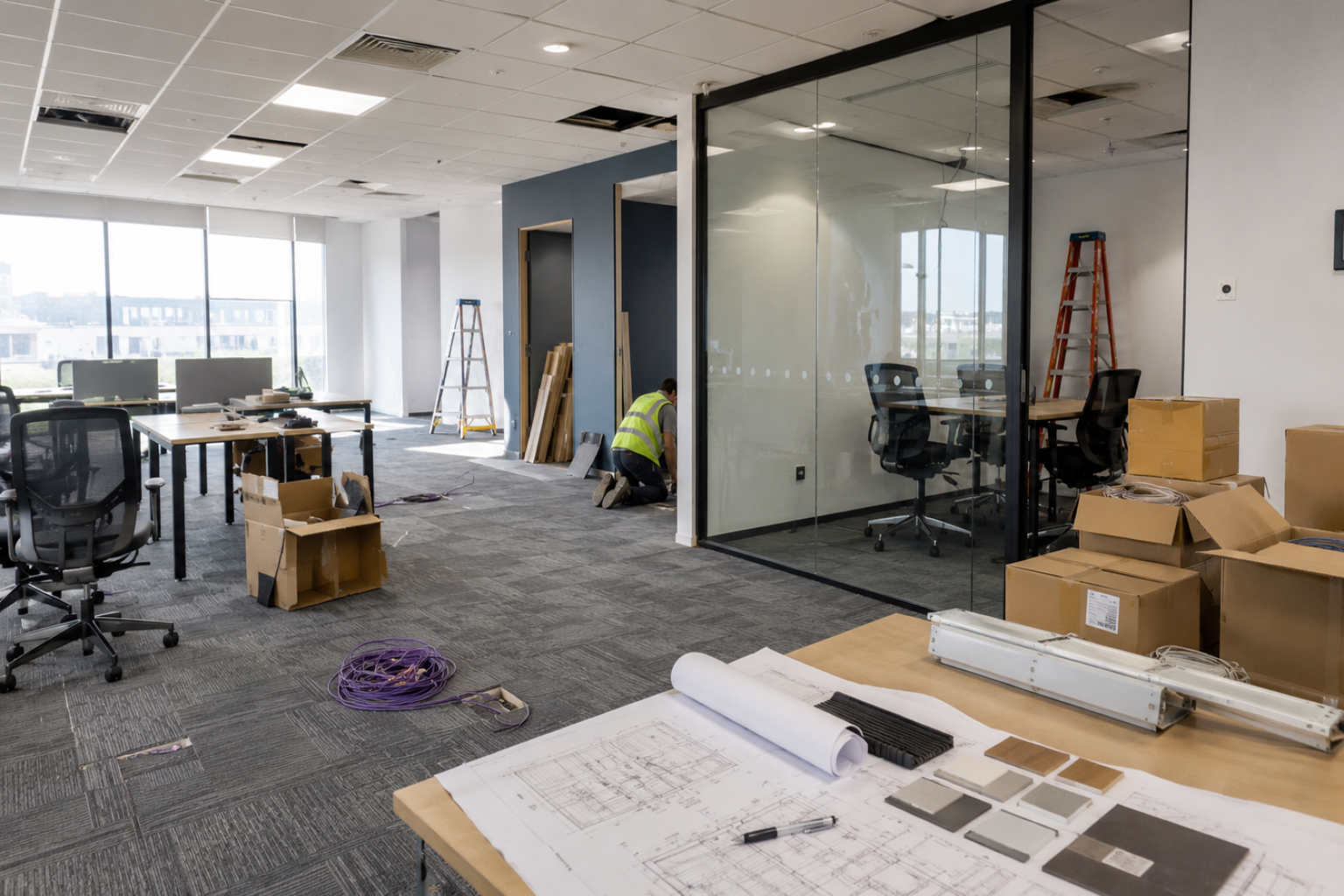
Most office budgets are too neat at the beginning.
The space has a size. The designer has a fee. The contractor gives a number. The furniture quote sits in a separate file. Everything looks countable.
Then the project starts touching the building.
Power has to move. Data drops are missing. The meeting room needs acoustic help. The glass wall costs more than expected. The landlord limits work hours. Furniture lead times push against the move-in date. The office still looks simple, but the price is no longer simple.
That is the real problem with office interior design cost. The first number often prices the visible office. The final number has to pay for the working office.
Current fit-out benchmarks prove how wide the range can be. JLL’s 2026 U.S. and Canada office fit-out guide puts a medium-quality corporate office fit-out around $295 per square foot on average. That is useful for early planning, but it is not a quote. A small office with difficult building rules, dense technology, glass meeting rooms, custom furniture, or a short move-in schedule can still surprise you.
The first number is usually missing something
A design fee is not a fit-out cost. A fit-out cost is not always an all-in project cost. A furniture quote is not the same as furniture delivered, installed, powered, and ready to use.
This is where office budgets go soft. One person is talking about design services. Another is talking about construction. Another is talking about furniture. Another is talking about IT, access cards, screens, cameras, or low-voltage cabling. The total sounds smaller because the pieces are being discussed separately.
Cushman & Wakefield’s office fit-out guide makes this point clearly: construction cost figures do not automatically include low-voltage cabling, audio-visual equipment, security, furniture, fixtures, equipment, or soft costs. That matters because those are not optional afterthoughts in a real office. People need to plug in. Rooms need to support calls. Doors need to lock. Furniture has to arrive. The office has to open.
| Early number | What it may leave out |
|---|---|
| Interior design fee | Engineering, permits, procurement, site visits, furniture ordering, landlord coordination, or construction management. |
| Construction price | Furniture, low-voltage cabling, AV, security, signage, moving, legal review, and some soft costs. |
| Furniture quote | Freight, delivery, installation, storage, lead-time risk, cable management, and replacement pieces. |
| Pretty design image | Power, data, HVAC, acoustic privacy, access control, landlord rules, and move-in logistics. |
The budget becomes more honest when those pieces are separated early. Not later, when the move-in date is already set.
A refresh, a fit-out, and a rebuild are not the same office
The cheapest office project is the one that avoids touching the building too much.
Paint, loose furniture, better lighting, carpet replacement, and small layout cleanup can make a tired office feel better without turning into a full construction job. Once the work starts moving walls, cutting ceilings, adding glass rooms, shifting power, opening floors, changing HVAC, or coordinating access control, the office is in a different cost category.
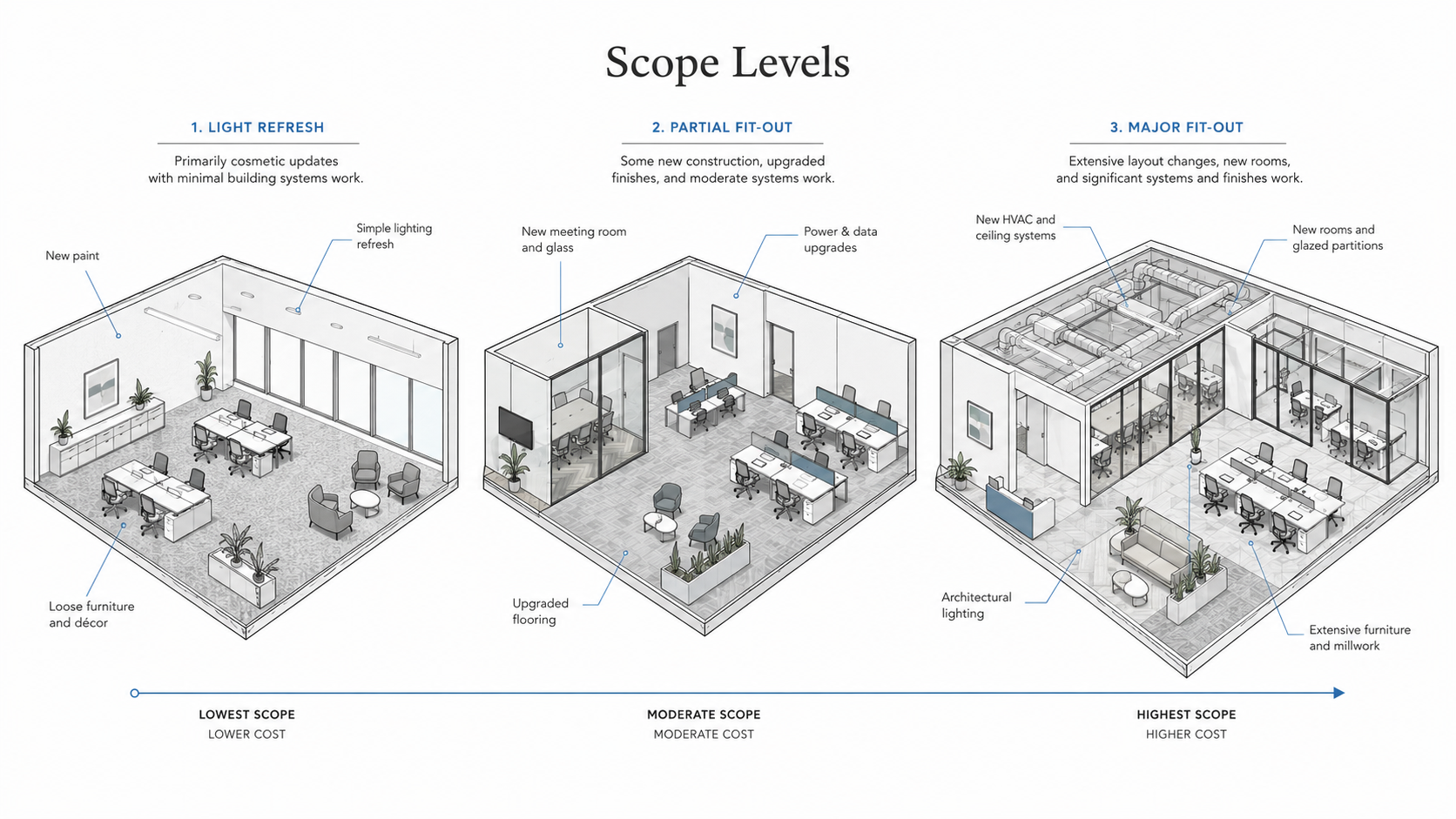
A 4,000-square-foot office with new paint, some new chairs, and better storage is one thing. The same 4,000 square feet with new meeting rooms, glazed partitions, data cabling, lighting controls, a reception desk, acoustic treatment, and a full furniture package is another.
The floor area did not change. The job did.
The boring parts carry the bill
The costliest office decisions are not always the ones people notice first.
A glass meeting room looks clean. The cost can sit in the frame, door, hardware, film, acoustic performance, seals, ceiling coordination, lighting, ventilation, and installation. A neat desk layout looks simple. The cost can sit in floor boxes, cable trays, task chairs, monitor arms, privacy screens, data drops, delivery, and installation. A new ceiling looks calm. The cost can sit in lights, sensors, sprinklers, diffusers, returns, fire devices, and after-hours labor.
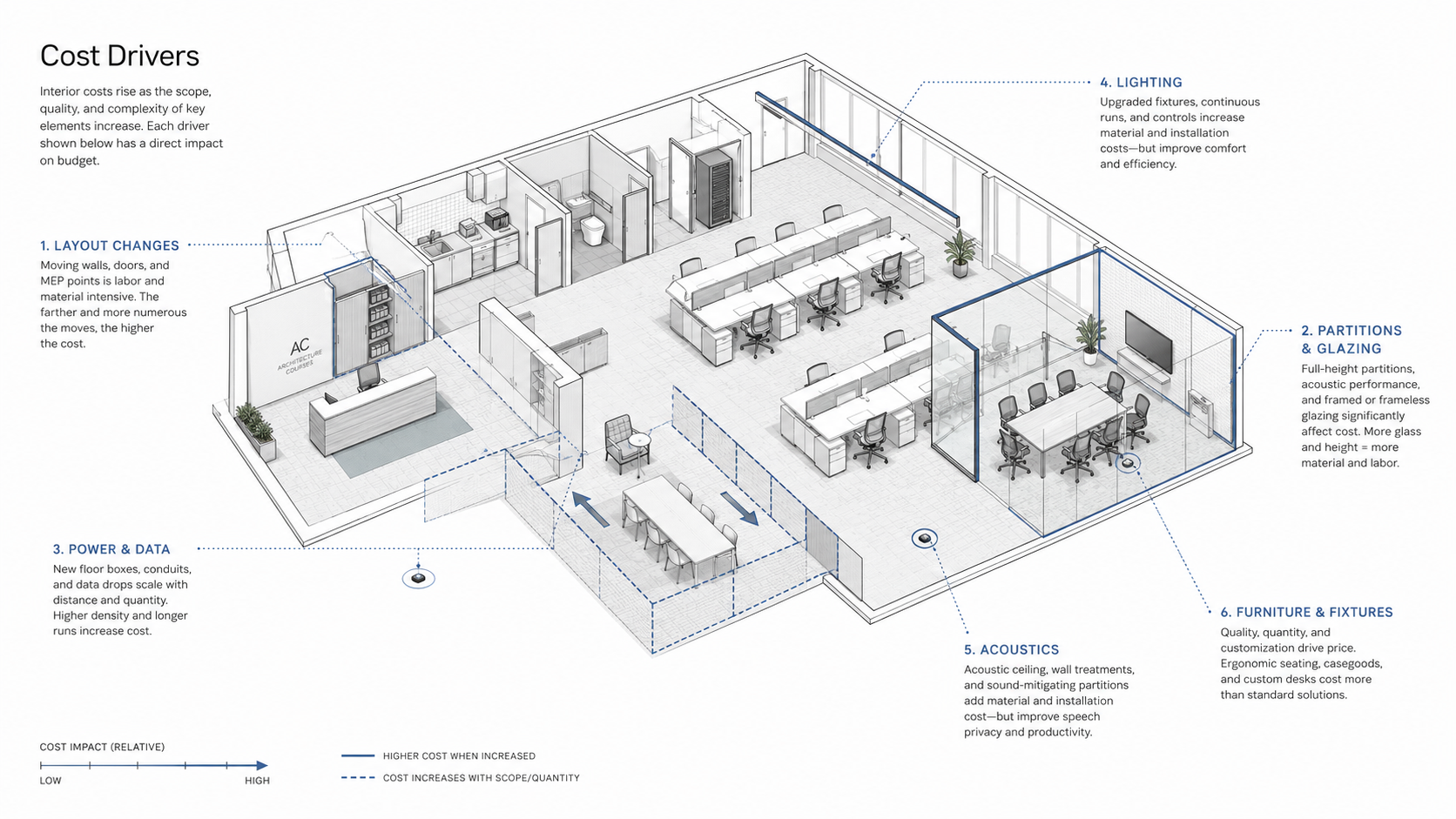
This is why a small change on a plan can become a large change in the budget. Moving a room is not only moving a line. It can affect trades, inspections, landlord review, furniture, and the schedule.
Furniture should not wait until the end
Office furniture is not decoration.
It decides how many people the office can hold, where power lands, where cables run, how wide the paths need to be, whether meeting rooms can work, and how long the project takes to finish.
A desk needs more than its rectangle on a plan. It needs a chair pulling back. It needs a person sitting there. It may need a monitor arm, cable tray, pedestal, privacy screen, power module, and a data connection. A meeting table needs chair clearance, screen view, camera position, floor box location, and enough space for people to enter without squeezing behind one another.
Furniture also has a schedule. If the office is built around a package that arrives late, the room can be physically finished and still unusable. If the furniture size is wrong, the fix is not just aesthetic. It can change circulation, power, storage, and meeting-room function.
The office can look done before it can operate
This is the part that hurts because it usually appears late.
The glass is clean. The carpet is down. The chairs are in place. The office photographs well.
Then Monday arrives.
The meeting room leaks sound. The screen works, but the camera angle is wrong. The data drops do not match the desk layout. The reception desk needs power for hardware that nobody priced early. The access reader is delayed. The HVAC diffuser blows over one workstation all day. Staff have nowhere for coats, deliveries, supplies, or cleaning equipment. The landlord will not approve signage without another review cycle.
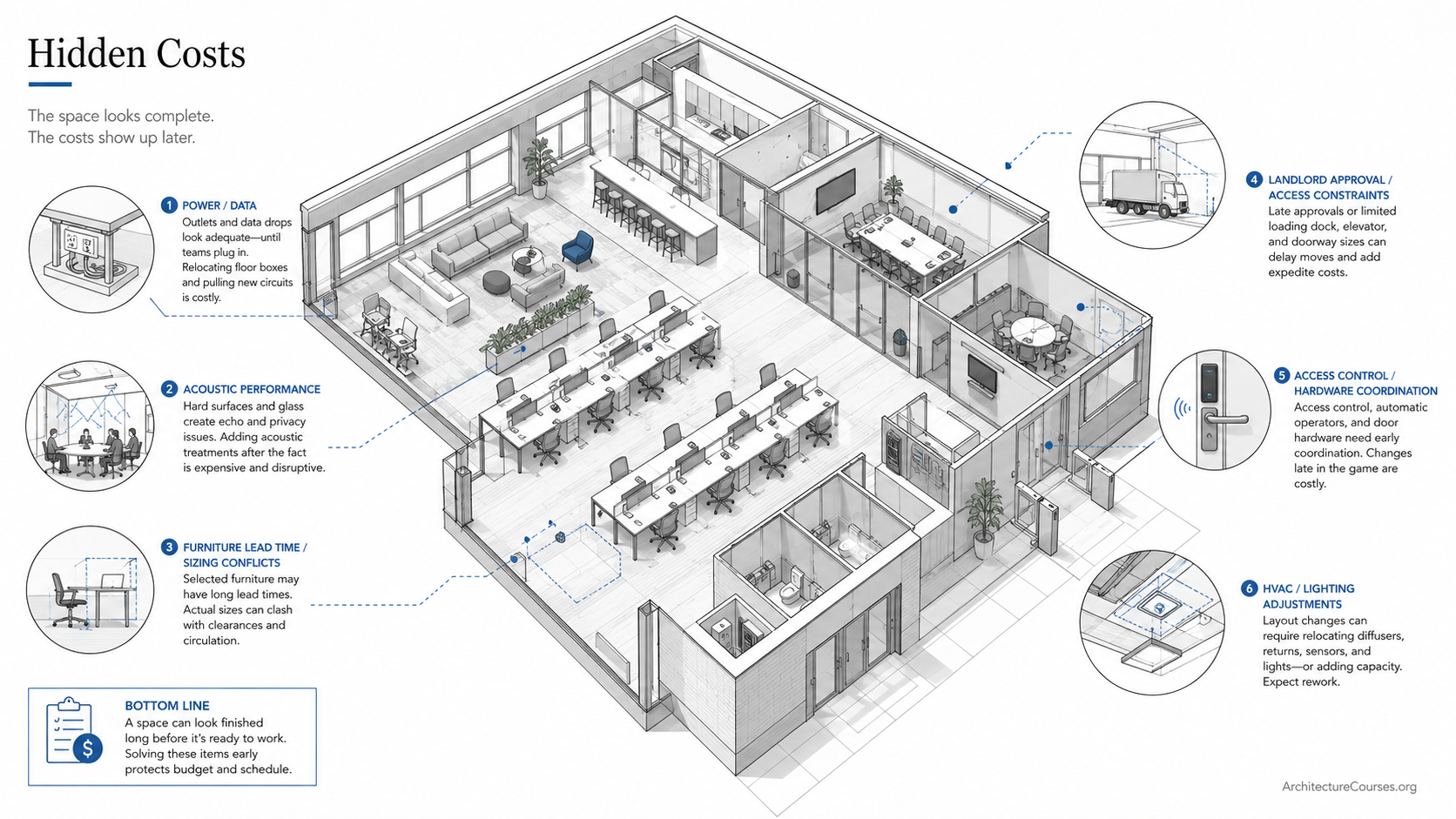
These are not small polish items. They decide whether the office works.
A better budget treats the office as an operating system. Power, data, AV, acoustics, lighting, HVAC, access control, furniture, landlord approvals, delivery access, and move-in timing need to be part of the conversation while the plan is still easy to change.
Open plan saves walls, not always money
Open offices often look cheaper at first because there are fewer enclosed rooms.
That can be true. It can also be misleading.
A dense open office still needs power, data, task chairs, cable management, storage, lighting, acoustic control, meeting support, and places for calls. If the layout creates too much noise, the savings can come back as phone booths, acoustic panels, meeting rooms, white noise, or staff frustration.
Privacy gets paid for one way or another. The only question is whether it is planned into the project or patched after people complain.
Meeting rooms are small, but they are not simple
A meeting room looks easy on a floor plan. Table. Chairs. Door. Screen.
In real use, it is one of the most demanding rooms in the office.
It needs acoustic privacy. It needs fresh air. It needs lighting that does not glare on screens. It needs camera and display positions that work for hybrid meetings. It needs power and data in the right place. It needs enough space for chairs to pull back. It needs a door that does not crash into furniture.
The cheap meeting room often fails in the same ways. It echoes. It gets stuffy. Calls sound bad. Conversations leak into the open office. The table is too large. The camera sees only half the room. Fixing that after move-in is usually more disruptive than planning it before construction.
The lease can change the design
The office is not sitting in a blank box. It sits inside a building with rules.
Some landlords control work hours, loading dock access, freight elevator booking, approved contractors, insurance, fire alarm work, signage, waste removal, security procedures, and after-hours noise. Some require review before partitions, doors, plumbing, electrical work, mechanical changes, or hardware are touched.
None of that feels like interior design when the mood board is being approved. It becomes interior cost when the schedule starts slipping.
Before trusting a budget, read the lease and building manual. A cheap plan on paper can become expensive if the building will not let the work happen the way the schedule assumes.
The smallest fix may be the best one
A good office designer should not turn every complaint into construction.
A company may ask for another meeting room when the real problem is acoustic privacy. It may ask for more desks when the real problem is bad storage. It may ask for a full rework when a clearer furniture plan, better circulation, or two small phone rooms would solve most of the pain.
This is where spatial planning protects money. It asks what is actually failing before the project pays to change walls, ceilings, power, glass, furniture, and approvals.
The useful question is not “how do we make the office look better?” The useful question is “what exact problem is making work harder, and does that problem really need construction?”
A cleaner way to read the budget
Look at the office by the decision that causes the cost.
| Decision | Cost hiding behind it |
|---|---|
| Add a glass meeting room | Framing, hardware, acoustic privacy, door seals, film, lighting, HVAC, AV, cleaning, and installation. |
| Add more workstations | Power, data, chairs, cable management, storage, circulation, future flexibility, and acoustic pressure. |
| Move the reception desk | Power, data, access control, visitor flow, signage, millwork, lighting, and delivery routing. |
| Upgrade lighting | Fixtures, controls, sensors, emergency lighting, ceiling work, glare, and electrical labor. |
| Buy new furniture | Lead time, freight, installation, storage, warranty, replacement parts, and real clearance in the room. |
That is the better way to think about office interior design cost. Not as one clean number. As a chain of decisions that either stays coordinated or becomes expensive late.
AI can help early, but it cannot price the office
AI can help test rough layouts. It can compare desk counts, show planning options, surface likely conflicts, and help you ask better questions before meeting a designer or contractor.
It is weakest where office cost becomes real: local code, landlord rules, sprinkler changes, HVAC capacity, electrical load, AV design, furniture pricing, lead times, permit requirements, and contractor pricing.
Use AI to prepare. Do not use it as proof that the budget is right.
FAQ
How much does office interior design cost?
It depends on whether you mean design fees, a light refresh, a partial fit-out, or a major office build-out. Current U.S. and Canada fit-out benchmarks can sit in the hundreds of dollars per square foot, but the real number depends on scope, building rules, furniture, technology, and schedule.
Why do office interiors cost more than expected?
The first budget often leaves out the operating pieces: power, data, AV, lighting controls, acoustics, access control, furniture delivery, landlord approvals, and move-in logistics.
Is office interior design the same as office fit-out?
No. Interior design is the planning and design service. Fit-out is the physical work that turns the space into a usable office.
Can an office look finished and still not be ready?
Yes. The office can photograph well while still having poor acoustics, missing power, wrong data locations, delayed furniture, bad lighting, access-control problems, or HVAC issues.
What should be checked before approving an office design?
Check the layout against real work first. Then check furniture dimensions, power, data, AV, acoustics, lighting, HVAC, landlord approvals, delivery access, and move-in timing.
Read This Next
For the larger planning logic behind office layouts, read spatial design.
For the process of turning needs into zones, paths, and adjacencies, go to spatial planning and design.
For furniture clearance and room-level layout problems, use space planning and layout in interior design.