
What Decides the Risk
Prefabricated homes can be safe. The factory is usually not the weak part.
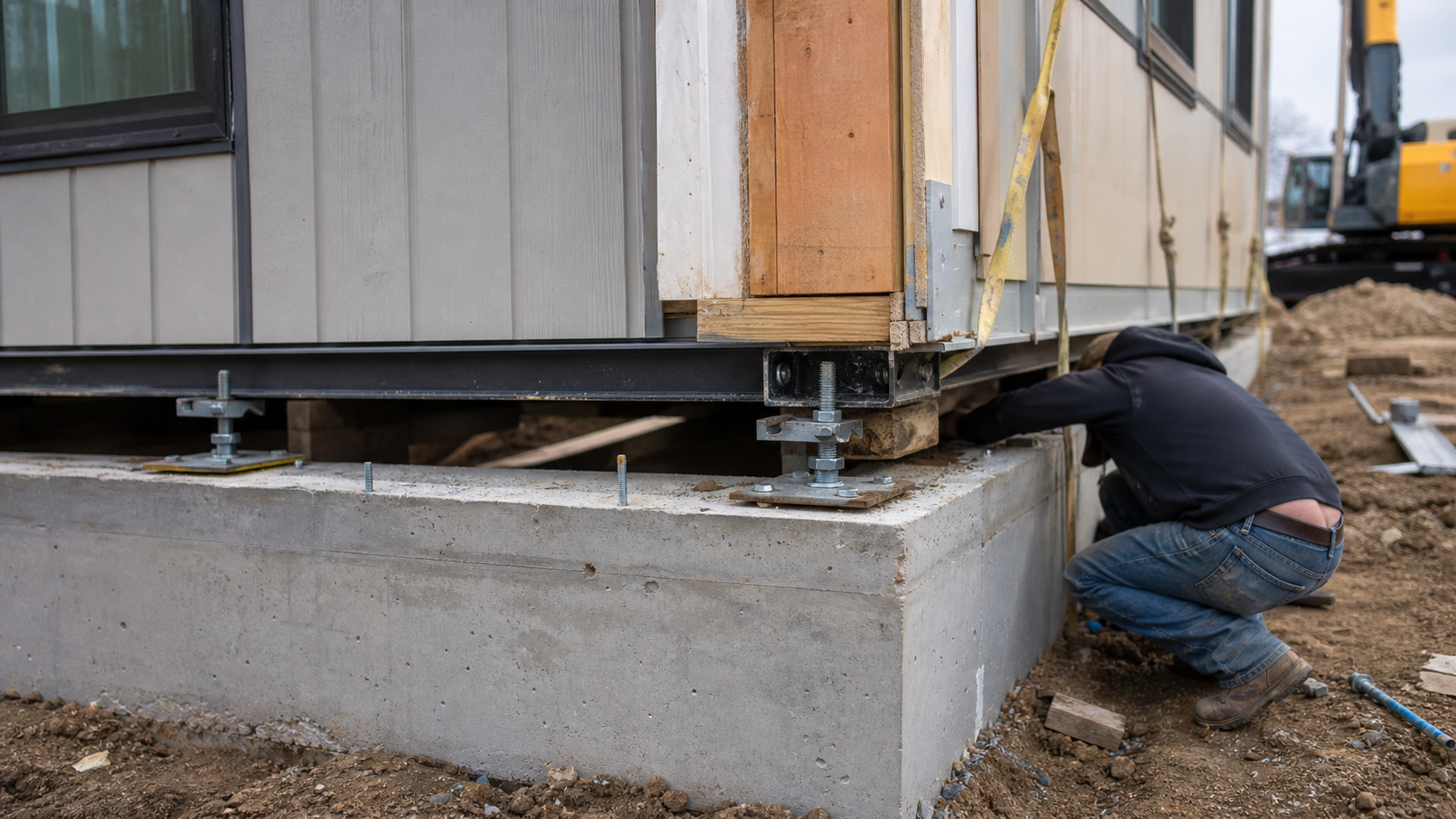
The problems start when the wrong type of prefab home is treated like the right one, when the foundation is poor, when anchoring is skipped, or when a model built for one climate gets dropped into another. A prefab house in a mild suburb is not the same safety question as a manufactured home in tornado country or a modular house on a steep wet site.
So the better question is not "are prefab homes safe?" It is: what kind, built to which code, installed on what foundation, in what climate?
Prefab Is Too Broad a Word
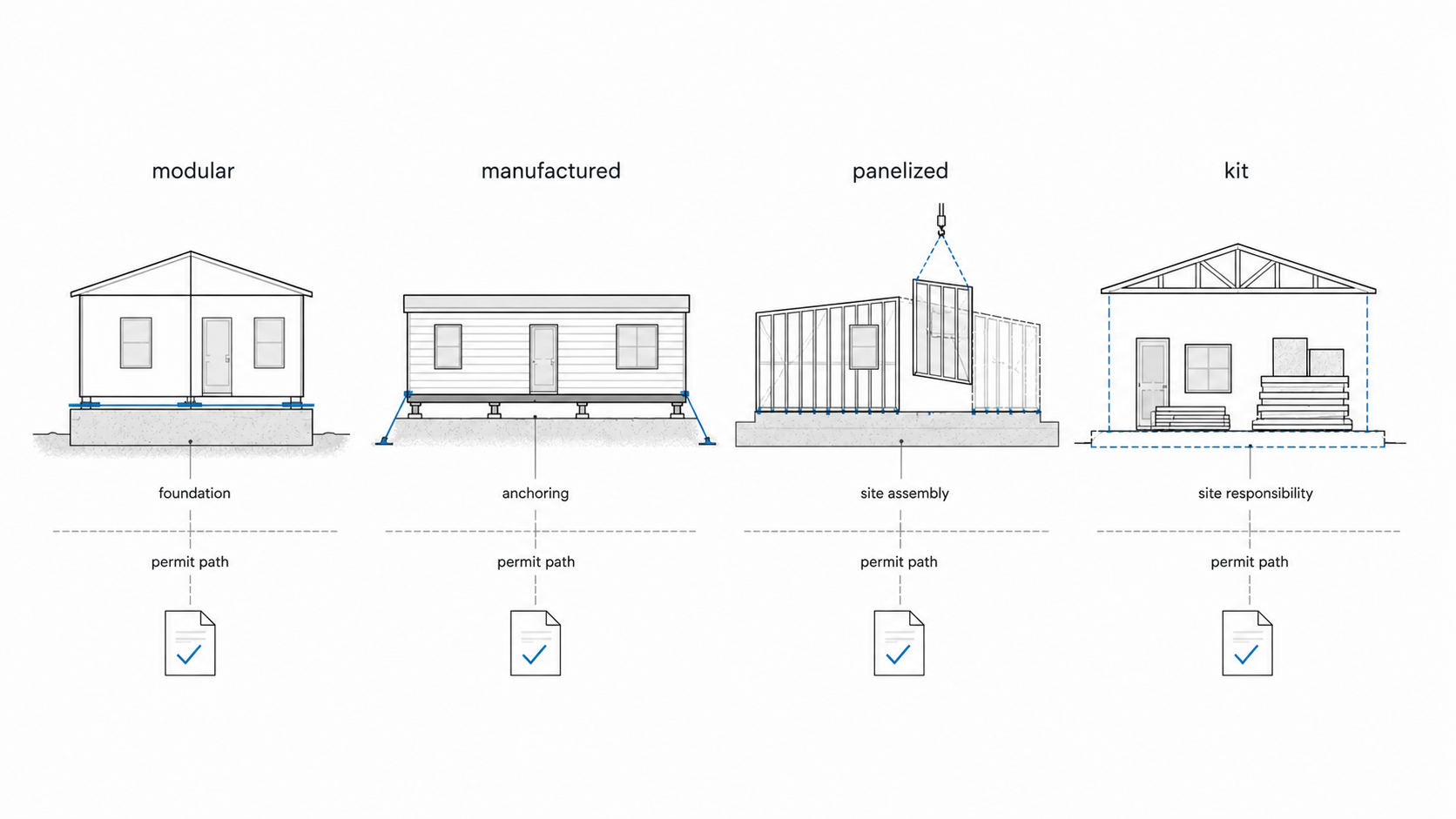
Illustration by ArchitectureCourses.org. Prefab is not one house type; modular, manufactured, panelized, and kit homes follow different safety and responsibility paths.
Where to use: Prefab Is Too Broad a Word.
This is where most bad advice starts. "Prefab" covers at least five different building types that follow different codes, sit on different foundations, and fail in different ways.
| Type | What It Usually Means | Safety Question |
|---|---|---|
| Modular home | Large sections built in a factory, transported, assembled on a permanent foundation. | Does it meet local residential building code, and was it installed correctly on the site? |
| Manufactured home | Factory-built to the federal HUD manufactured housing standard. | Is it HUD-certified, properly installed, anchored, and matched to the correct wind zone? |
| Mobile home | Older units that may predate modern manufactured-home standards. | How old is it, how is it anchored, and does it have known storm or fire-safety weaknesses? |
| Panelized home | Wall, floor, or roof panels built off-site, assembled on-site. | Was the site assembly, fastening, weatherproofing, and inspection done correctly? |
| Kit or cabin package | Parts shipped as a package, often with significant site work left to the owner. | Who is responsible for structural detailing, permits, foundations, utilities, and inspections? |
A safe modular home and a poorly anchored manufactured home should not be discussed as if they are the same product.
Type and Site Decide the Risk
A prefabricated home can be as safe as a site-built home when it is designed to the right code, placed on a proper foundation, installed by qualified crews, inspected, and matched to the site. The factory can improve quality. It cannot fix a bad site.
It can also be unsafe when buyers focus on the sticker price and ignore everything else — transportation damage, anchoring, utility connections, snow load, wind zone, drainage, fire separation, permits. Those are not minor items. They are the items that decide whether the house stays where it was put.
Why Factory Work Can Help
Factory construction has real advantages. Materials stay dry. Framing cuts are more consistent. Fastening gets checked repeatedly. Crews work in a controlled setup instead of fighting weather and missing deliveries.
That does not make the home safe by itself. A clean module can become a problem if it is set on a weak foundation, tied down badly, flashed poorly, or connected by trades who do not know where the factory work ends and the site work begins. The manufacturer, installer, foundation contractor, site trades, and inspector still have to work from the right standard — and in practice, that handoff is where most problems start.
For a broader comparison, see prefab homes vs traditional construction.
Where Safety Problems Start
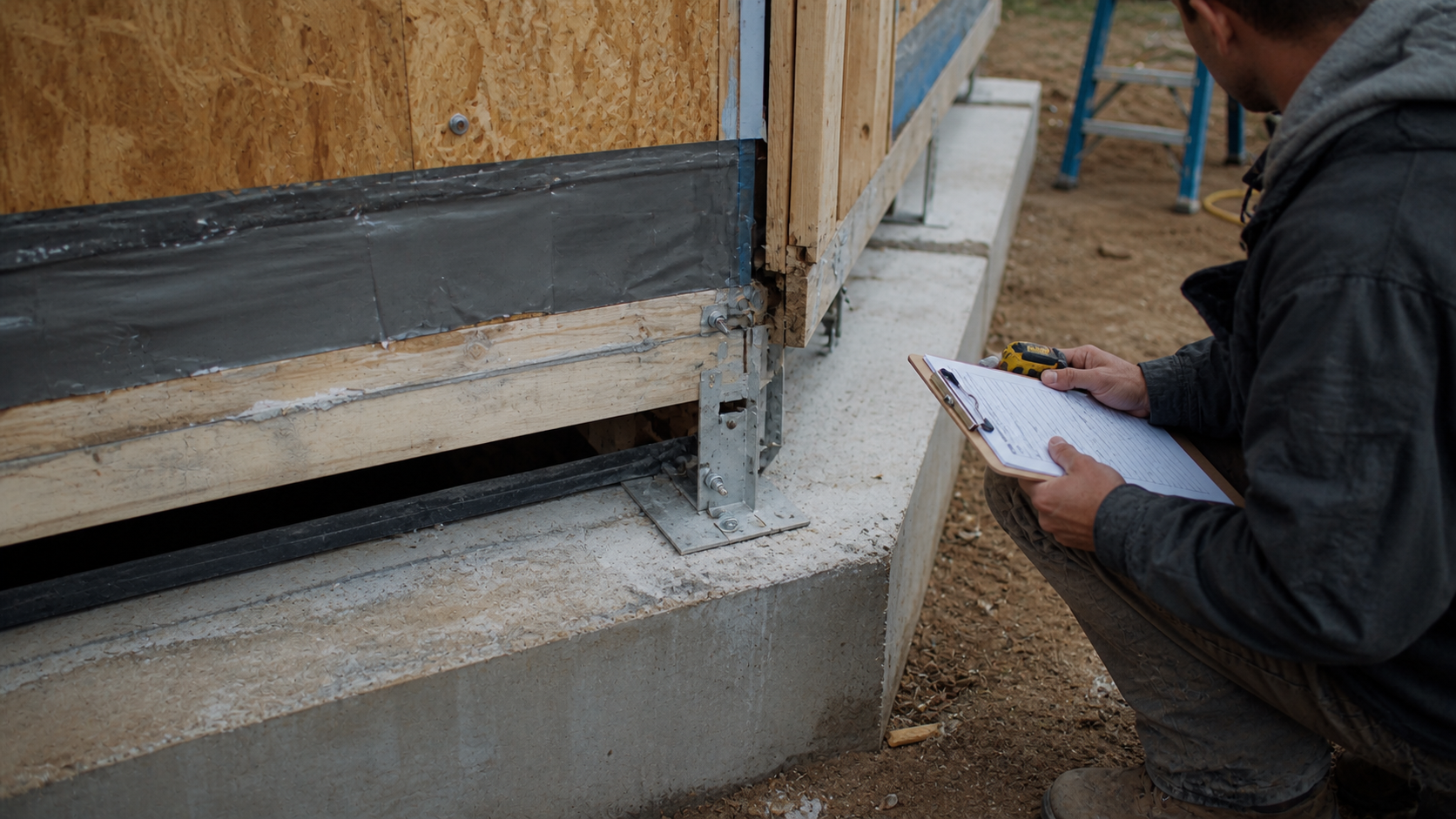
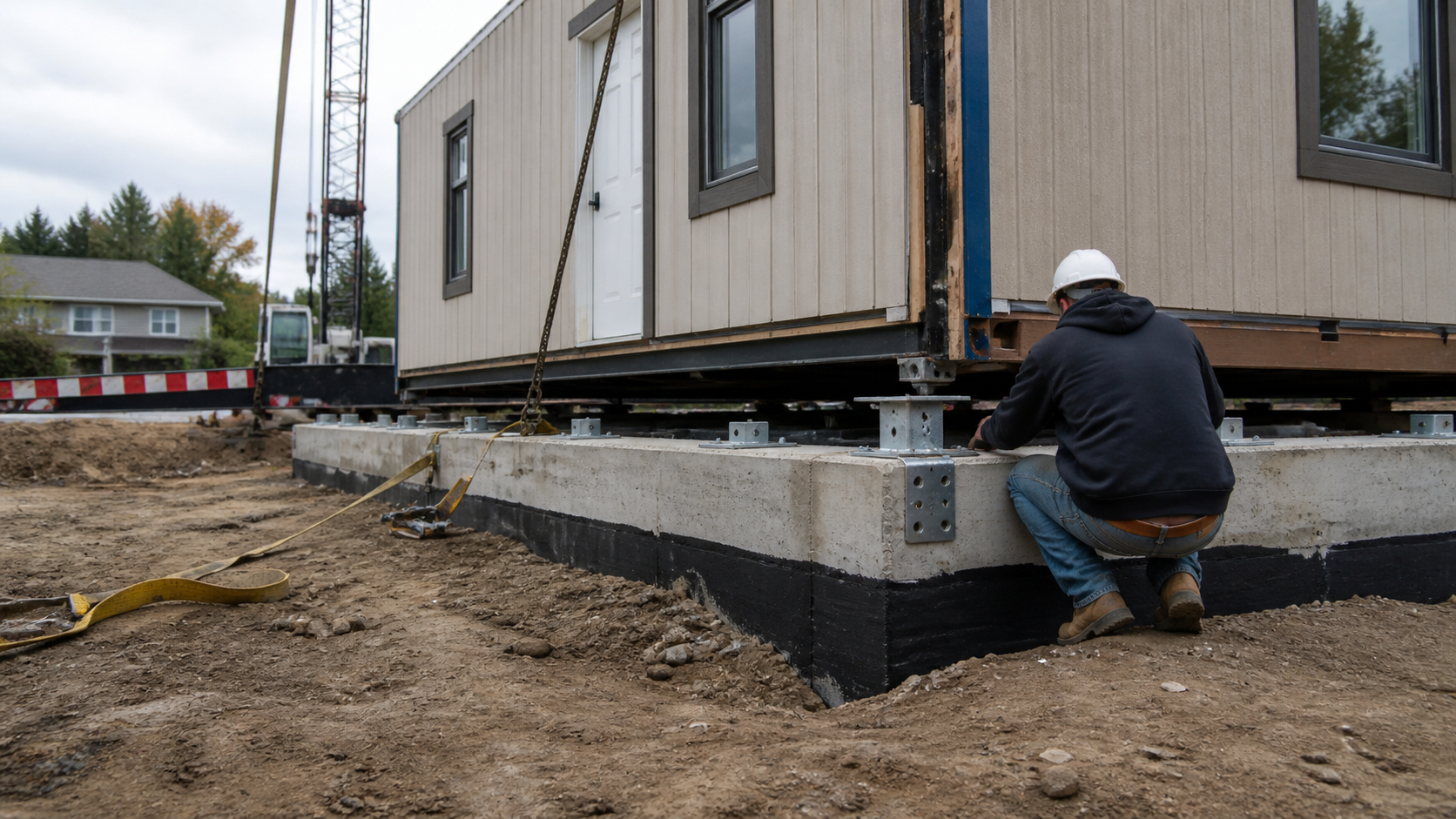
Image by ArchitectureCourses.org. The factory can build the module well, but the site connection still has to be checked before the work is covered.
The weak point is the handoff. Almost always.
The factory builds the module well. Then it ships. It gets lifted, set, connected, sealed, inspected, and tied into the site. Every one of those steps can introduce a problem, and nobody in the factory is there to catch it.
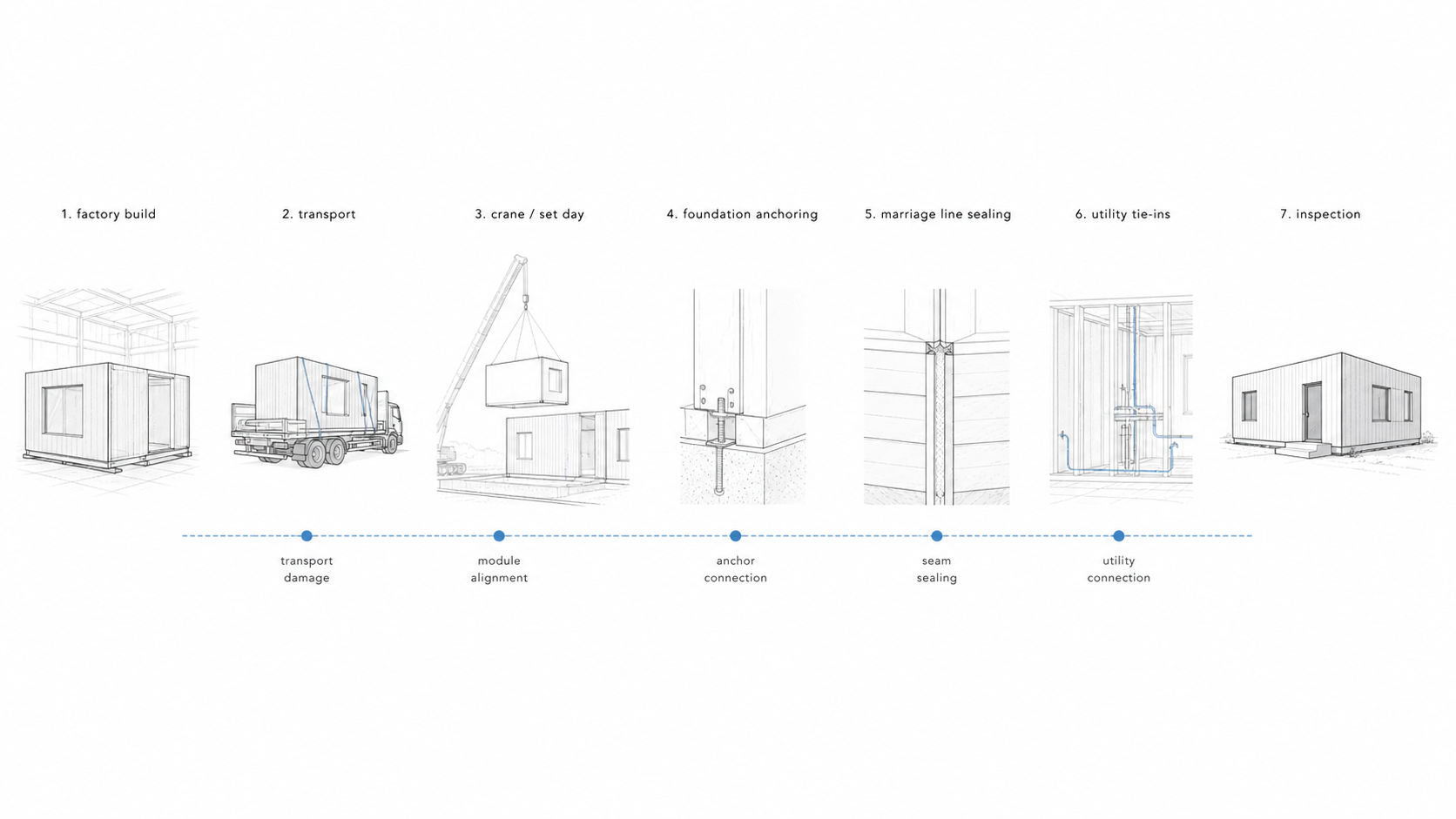
Caption: Illustration by ArchitectureCourses.org. Prefab safety depends on each handoff: transport, set day, anchoring, seam sealing, utilities, and inspection.
Transport can leave cracks, racking, water stains, or seams that no longer sit cleanly. Crane setting can throw modules slightly out of alignment — and slightly is enough when the marriage line between two modules has to be weather-tight. That marriage line is one of the most common leak points in modular construction. If the crew rushes the seam work, the homeowner discovers it during the first hard rain or the first winter when condensation starts showing up at the ceiling joint.
Then there is the foundation. A module can be square, dry, and well built, and if the base below it settles, drains poorly, or was never designed for the actual soil, the house still moves. Foundation problems do not care how good the factory was.
Utilities are another gap. The factory may have done its part. The site electrician, plumber, gas fitter, or HVAC contractor still has to make the final connections correctly — and those connections need inspection, not trust. I have seen utility tie-ins where nobody was sure whether the factory or the site crew owned the last three feet of wire. That kind of ambiguity is where fires start.
If the builder cannot clearly explain who owns each handoff, that is not a detail. That is a warning.
Modular Homes vs Manufactured Homes
This difference matters more than most buyers realize.
A modular home is usually built in sections and assembled on a permanent foundation under state or local building-code rules — the same rules that apply to a house framed on site. A manufactured home is built to the federal HUD manufactured housing standard, which is a separate code entirely. Both can be safe. They are regulated differently, financed differently, and insured differently.
| Question | Modular Home | Manufactured Home |
|---|---|---|
| Code basis | Local or state residential building code. | Federal HUD manufactured housing standard. |
| Foundation | Permanent foundation, similar to site-built housing. | Varies by installation, home type, and local requirements. |
| Inspection path | Factory and local/site inspections both apply. | HUD certification plus installation and local requirements. |
| Storm performance | Depends on local design loads, structure, foundation, and connections. | Depends on HUD wind zone, installation, anchoring, and site exposure. |
| Common buyer mistake | Assuming factory-built means the site work is simple. | Assuming HUD-certified means tornado-safe. |
Do not let a sales brochure blur these categories.
Wind, Tornadoes, and Hurricanes
This is the part that kills people. It deserves more space than the rest of this article.
A home can meet code-required wind loads and still not be a safe place to shelter from a violent tornado. That is true for many houses, not only prefab. FEMA safe-room guidance exists specifically because ordinary homes — site-built or factory-built — are not designed to survive the strongest tornadoes. The distinction between "code-compliant" and "tornado-safe" is the distinction between a house and a bunker. They are not the same thing.
Manufactured homes need extra caution. The home's wind zone rating, anchoring system, foundation type, skirting, age, and installation quality all matter. But even a newer, properly installed manufactured home should not be treated as a tornado shelter. The National Weather Service is direct about this: in a tornado warning, leave a manufactured or mobile home and go to a substantial building or storm shelter. That is not a suggestion. It is a safety instruction based on decades of fatality data.
In hurricane zones, the question shifts from shelter-in-place to whether the home can handle sustained high winds, wind-borne debris, and storm surge. Anchoring, opening protection, roof-to-wall connections, and foundation all have to work as a system. A strong roof on weak anchoring is not a strong house.
| Hazard | What to Ask Before Buying | What Not to Assume |
|---|---|---|
| High wind | What wind design does this home meet for this exact location? | Not every prefab model is suitable for every wind region. |
| Hurricane zone | What are the anchoring, opening protection, roof, and foundation requirements? | Shutters or strong windows alone do not solve the whole load path. |
| Tornado risk | Where is the safe room, storm shelter, or nearby sturdy building? | A manufactured or mobile home is not a tornado shelter. Period. |
| Open rural site | Is wind exposure higher than a protected suburban lot? | Same model, different exposure, different risk. |
If the site is in tornado country, hurricane territory, or an exposed open area, safety planning has to happen before the home is ordered. After delivery is too late.
Fire Safety
A prefab home is not fire-safe because it is prefab. The serious risks are plain: bad electrical tie-ins, unsafe heating equipment, poor venting, missing fire separation at an attached garage, or exterior materials that do not fit a wildfire-prone site. The factory can reduce some workmanship mistakes. The site can add new ones.
The dangerous package is the one where nobody clearly owns the site connections. If the manufacturer says the installer handles it, and the installer says the electrician handles it, and the electrician says the factory already did it — that is the package where fires start.
Water Is the Quiet Risk
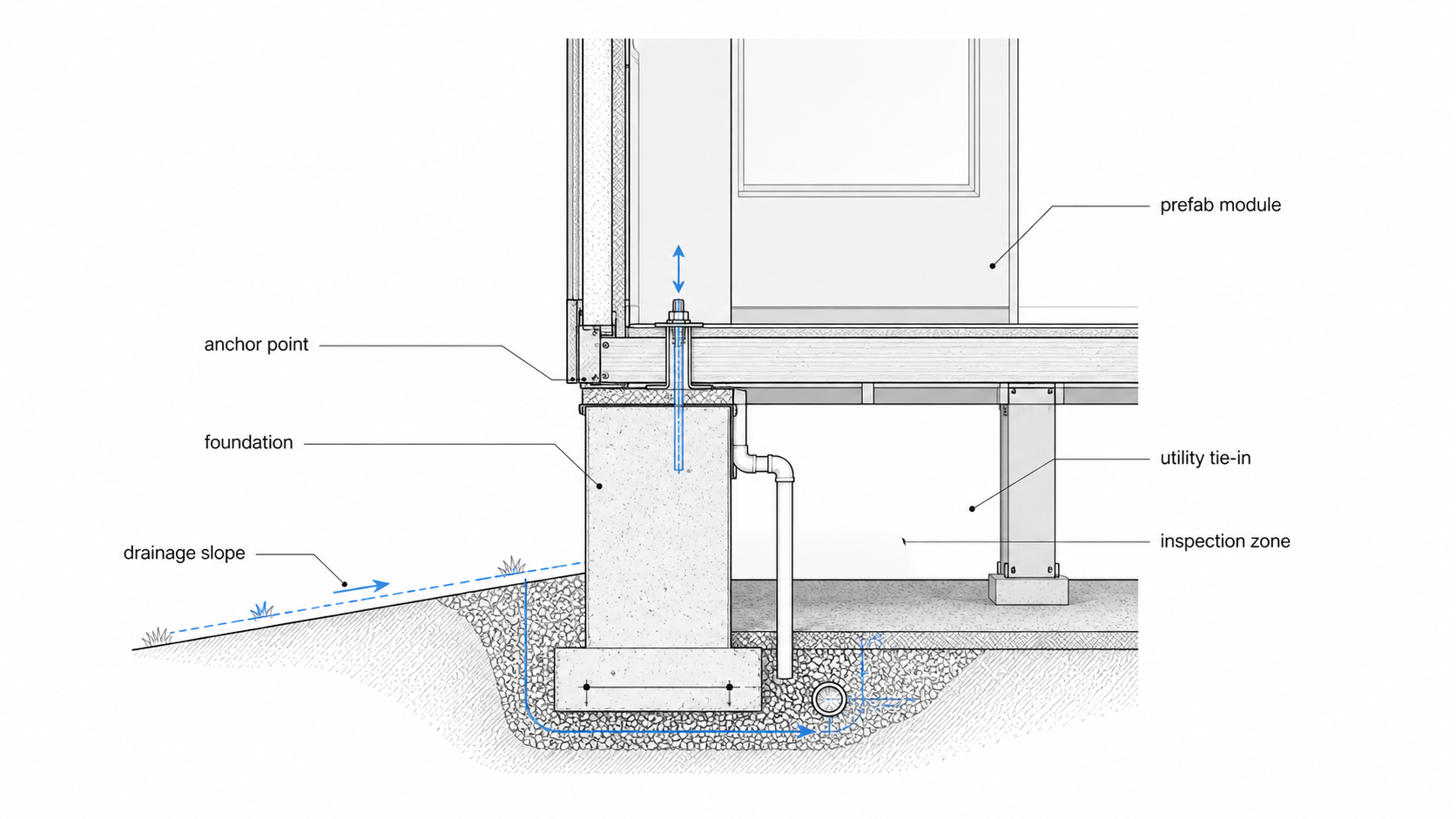
Illustration by ArchitectureCourses.org. Prefab home safety depends on the site connection: foundation bearing, anchor points, drainage, utility tie-ins, and the inspection zone.
Water is less dramatic than wind. It still ruins houses.
A module can leave the factory dry and get wet during transport, storage, setting, roof closing, or utility hookup. Sometimes the damage is obvious — stained sheathing, swollen trim, wet insulation, a roof seam that leaks on the first storm.
The worse version is slower. The module gets damp during a rain event between factory and set day. Repairs cover the evidence. The owner finds the problem six months later as smell, floor swelling, staining, mold, or a soft edge around a seam that was supposed to be sealed. By then the finish work is in the way and the repair is three times what it would have cost on set day.
The places to watch: roof marriage lines between modules, wall seams and floor joints, flashing at roof edges and penetrations, crawl-space moisture below the unit, utility penetrations through floors and walls, and grade and drainage around the foundation.
Ask who seals the module seams, what product is used, and how the work is inspected after setting. Do not let finish trim hide a wet joint before someone checks it.
If you are building on your own land, site prep is not a minor line item. Read site preparation before treating the prefab package as the whole project.
The Foundation Decides More Than People Think
A good factory-built home on a weak foundation is still a weak house. That sentence should not need to be written, but it does because foundation work is the part of a prefab project that gets the least attention from buyers and the most attention from problems.
The foundation has to match the home, soil, frost depth, slope, flood risk, and anchoring requirements. The basic checks — bearing, frost depth, drainage, anchor points, flood elevation if needed — are not complicated. They are just not optional. For the larger foundation picture, see house building foundations.
If you are early in the process, start with building on your own land and utilities and infrastructure. The prefab order comes after the site is understood, not before.
What to Ask Before You Buy
A safe prefab purchase starts with boring questions. The answers matter more than renderings.
| Question | Why It Matters |
|---|---|
| Is this modular, manufactured, panelized, or a kit? | The code path and inspection process change by type. |
| What code or standard is it built to? | You need the governing standard, not a sales claim. |
| Who designs and approves the foundation? | Foundation errors undermine everything above them. |
| Who is responsible for transport damage? | Document damage before acceptance gets blurry. |
| Who handles utility tie-ins? | Electrical, gas, plumbing, and HVAC safety depend on site work. |
| What wind, snow, flood, fire, or seismic conditions is it designed for? | The home has to match the site, not a generic brochure region. |
| What inspections happen in the factory and on-site? | Factory inspection does not replace local site inspection. |
| What warranty covers structural, water, and transport issues? | A warranty is only useful if it covers the failure you are worried about. |
If the answers stay vague, that tells you something.
Red Flags
The biggest red flag is not a high price. It is unclear responsibility.
If the seller cannot clearly explain who handles the foundation, delivery damage, crane setting, anchoring, weather sealing, utility tie-ins, and inspections, the deal is not simple. It is just unfinished on paper. The problems that fall between companies are the problems that do not get fixed until the homeowner pays for them.
Another bad sign: the package price excludes major site work, but the sales pitch still makes the home sound complete. Land prep, utility trenching, driveway access, drainage, foundation work, permits, and local inspections can add tens of thousands of dollars to a project that was sold as affordable.
Be cautious when permits are described as "easy" before anyone has checked the jurisdiction. Be cautious when the installer is not local. And be cautious when transport damage is treated like a cosmetic inconvenience instead of a documented handoff with photographs and repair records.
A cheap prefab home can still be a good buy. A vague prefab home is the one to worry about.
For the cost and planning problems that often come with these projects, see prefabricated homes problems.
Where Prefab Homes Make Sense
Prefab can be a strong choice when the site is understood, the home type is clear, the code path is clean, and the installer has done this work before. Factory control reduces weather exposure during construction. Repeated production catches mistakes that a one-off jobsite build might not. A known foundation contractor with local soil experience takes care of the base.
The good version is not magic. It is just organized. Factory work, foundation work, transport, set day, utilities, and inspections all have owners. Nobody is guessing.
High-Risk Sites Need a Different Conversation
Be more cautious when the home is going into flood-prone land, a wildfire edge, hurricane territory, tornado country, steep slope, poor soil, remote road access, or heavy snow country.
None of those conditions make prefab impossible. They make generic prefab dangerous. The home has to be designed, permitted, delivered, anchored, and inspected for that specific site. A standard model may still work — but it has to be proven against the conditions before money changes hands, not assumed to be fine because it was fine somewhere else.
Safety Checklist
- Confirm the home type: modular, manufactured, panelized, kit, or another system.
- Ask what code or standard the home is built to.
- Verify local permit requirements before signing.
- Have the foundation designed for the actual site — soil, frost, slope, drainage, anchoring.
- Confirm wind, snow, flood, wildfire, and seismic requirements for the location.
- Ask who handles delivery, crane setting, anchoring, and utility tie-ins — and get it in writing.
- Inspect modules at delivery before damage is hidden by repairs or finishes.
- Keep factory, transport, site, and inspection paperwork.
- Do not use a mobile or manufactured home as a tornado shelter.
FAQ
Are prefab homes safe?
They can be. The safety depends on the type of prefab, the code it was built to, the foundation, the installation, and whether the site conditions were matched correctly. The unsafe version is usually caused by poor site work, weak anchoring, or unclear responsibility between the factory and the installer — not the factory itself.
Are modular homes safer than manufactured homes?
Not automatically. Different regulatory paths, different foundation expectations, different inspection processes. A well-installed manufactured home can be safe. A poorly installed modular home can still have problems.
Can a prefab home survive a hurricane?
Depends on the home, foundation, anchoring, wind design, opening protection, roof connections, and site exposure. Do not buy a generic model for a hurricane-prone site without confirming the design meets that location's requirements.
Are prefab homes safe in tornadoes?
Do not treat a manufactured or mobile home as a tornado shelter. The National Weather Service is clear on this. In a tornado warning, leave the home and go to a storm shelter or substantial building. A code-compliant home and a FEMA-rated safe room are two different categories of protection. This applies to site-built homes too, but the risk is higher in lighter-weight manufactured and mobile homes with less robust connections to the ground.
Do prefab homes have more fire risk?
Not because they are prefab. Fire safety depends on electrical work, heating equipment, separations, alarms, and inspections.
What is the biggest safety risk?
The handoff. The gap between factory construction and site completion. Foundation, anchoring, transport damage, weather sealing, utility tie-ins, and local inspections.
Can prefab homes be insured?
Usually yes, but it depends on home type, age, location, foundation, certification, and local hazards. Ask about insurance before signing for the home package, not after.
Sources and Safety References
- HUD Manufactured Housing Homeowner Resources
- HUD Office of Manufactured Housing Programs
- ICC Off-Site and Modular Construction Standards
- FEMA P-361: Safe Rooms for Tornadoes and Hurricanes
- National Weather Service: Mobile and Manufactured Home Safety
Read Next
Prefab Homes vs Traditional Construction — the broader comparison between factory-built and site-built housing. Covers cost, quality, speed, and the trade-offs each method carries.
Prefabricated Homes Problems — the cost, planning, and delivery issues that show up most often in prefab projects. Start here if the budget side concerns you as much as the safety side.
Building on Your Own Land — site assessment, utility access, zoning, and the gap between land cost and build cost. The land decisions that have to happen before the prefab order.
House Building Foundations — foundation types, soil, frost depth, drainage, and anchoring. The part of a prefab project that gets the least attention and causes the most problems.
Site Preparation — clearing, grading, access, erosion control, and utility trenching. What has to happen before delivery day.