
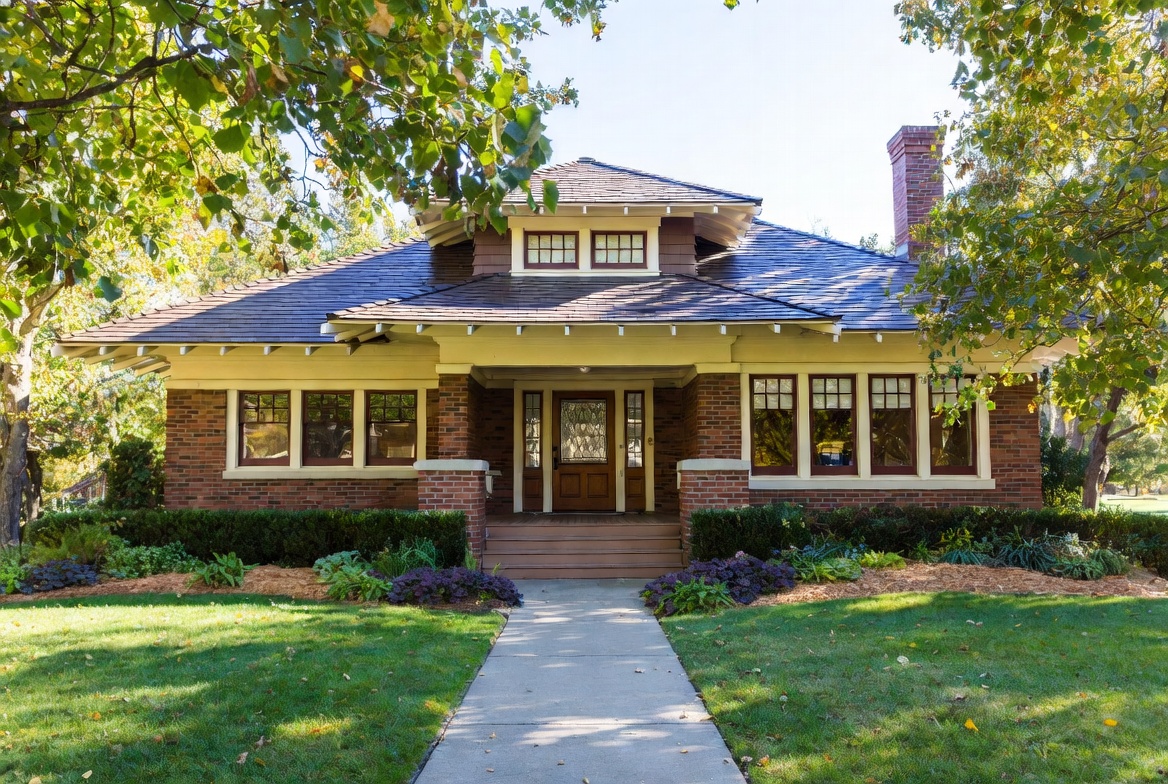
How to spot a true Craftsman bungalow, separate original houses from later lookalikes, and update one without stripping out what made it good.
A real Craftsman bungalow does not need much to make its case.
Low roof. Deep porch. Strong trim where it counts. Built-ins that were meant to be used. Even small ones often feel more deliberate than bigger houses built later.
That does not mean every house sold as a Craftsman bungalow is the real thing. Some are Sears kit houses. Some are local builder versions. Some are later houses with enough tapered columns, brackets, and woodwork to get the label in a listing.
What a Craftsman Bungalow Is
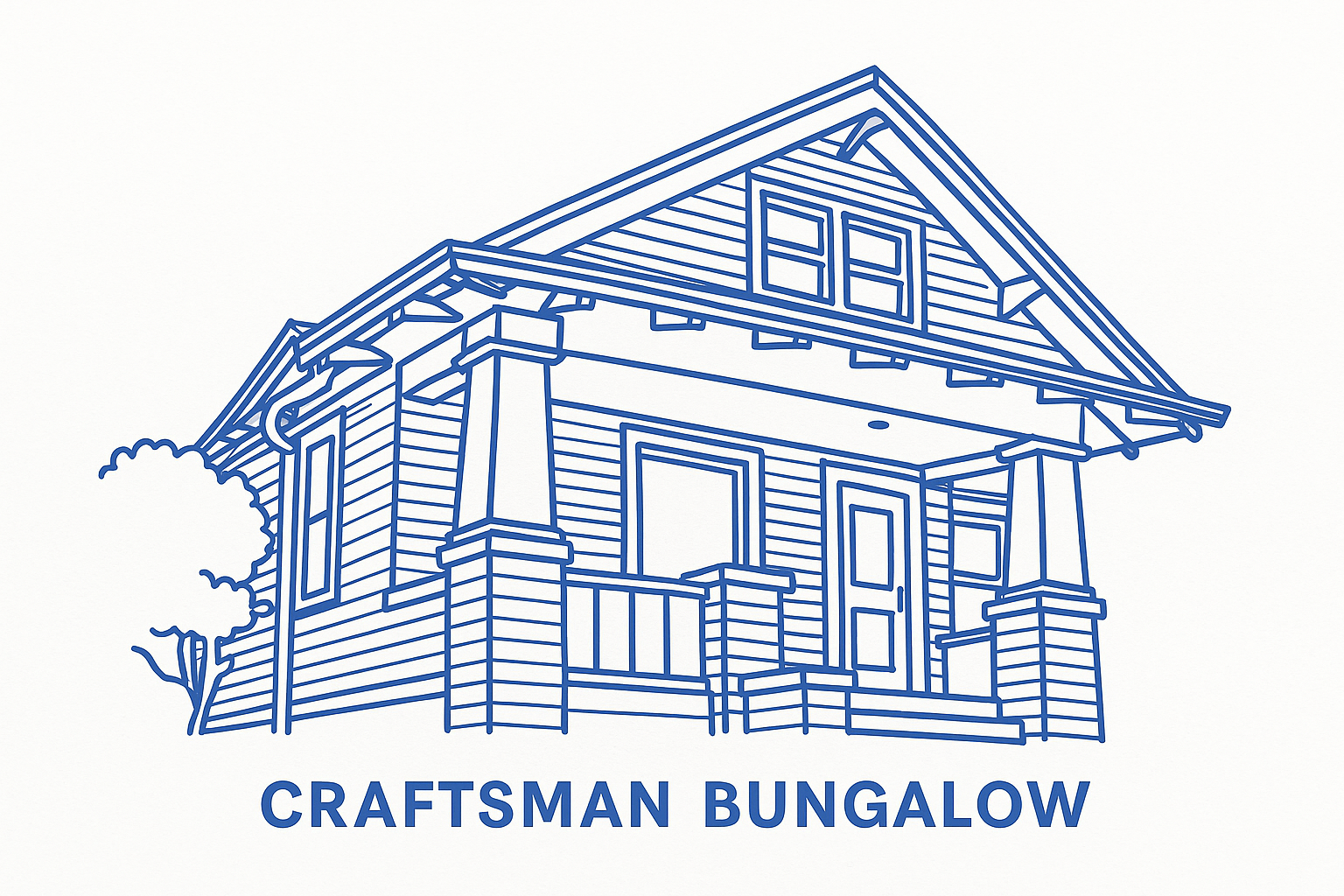
A bungalow is a house type. Craftsman is a style language. The overlap is heavy, which is why people keep using the terms like they mean the same thing, but they are not identical.
A bungalow usually means a low, compact house, often one or one-and-a-half stories, built for efficient everyday living. Craftsman means a design approach shaped by the Arts and Crafts movement: visible structure, natural materials, useful built-ins, deeper porches, stronger woodwork, and a calmer, more grounded feel than the decorative clutter that came before it.
Put those two together in the early 20th century and you get the classic American Craftsman bungalow.
| Term | What It Means | Why People Mix It Up |
|---|---|---|
| Bungalow | A low, compact house form, usually 1 to 1.5 stories | Many of the best-known bungalows were built in Craftsman style |
| Craftsman | A style language shaped by Arts and Crafts ideas | People use it for almost any house with brackets and a front porch |
| Craftsman bungalow | A bungalow-form house designed in the Craftsman tradition | This is the overlap people usually mean when they say “bungalow” |
Worth Knowing: if you want the broader bungalow side first, see What Is a Bungalow?. If you want the era context around these houses, see 1920s House Styles.
Why These Houses Took Off Between 1900 and 1930
Craftsman bungalows arrived at the right moment. The country was urbanizing, streetcar suburbs were expanding, and middle-class families wanted houses that felt solid and dignified without pretending to be mansions.
The Victorian period had pushed domestic design toward ornament, variety, and sometimes outright clutter. The Arts and Crafts reaction pushed back. Simpler forms. Better materials. Visible workmanship. More humane scale. Less show.
That is why Craftsman bungalows still feel different when they are intact. They were not trying to impress from a distance. They were trying to live well up close.
A lot of newer houses feel larger but less legible. These older ones often feel smaller and smarter. The porch belongs to the house. The fireplace gives the living room a center. The dining area exists because daily life needed one. Even the trim is doing more than decoration. It is helping the rooms feel finished and intentional.
Between roughly 1900 and 1930, these houses spread across California, the Midwest, the Pacific Northwest, and many streetcar-era neighborhoods elsewhere in the U.S. Some were custom. Some were regional interpretations. Many were sold as mail-order kits by companies like Sears and Aladdin, then assembled by local builders or owners.
The result was not one identical house repeated forever. It was a wide family of houses that shared the same basic logic: grounded form, strong porches, practical plans, and details that were meant to be used, not just admired.
How To Spot an Authentic Craftsman Bungalow
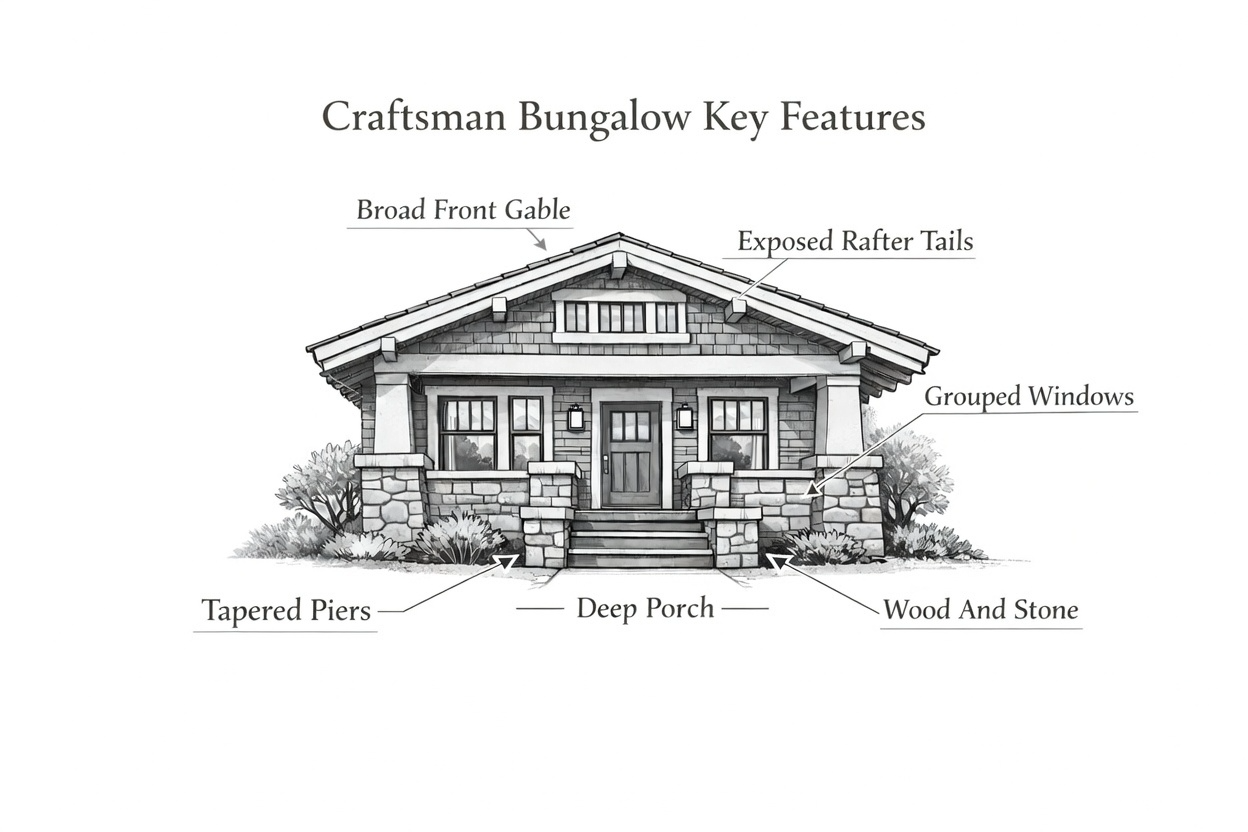
Illustration by ArchitectureCourses.org. Key exterior features that help identify a traditional American Craftsman bungalow.
Do not start with the paint color. Start with the bones.
The strongest signals are usually these:
- Low-pitched roof: often gabled, sometimes broad and sheltering.
- Wide eaves: frequently with exposed rafter tails or brackets.
- Deep front porch: not decorative only, but proportioned to be used.
- Tapered porch columns: often sitting on masonry or heavy piers.
- Natural materials: wood siding, shingles, brick, stone, clinker brick in some regions.
- Wood windows: usually with better proportions than later replacements.
- Built-ins: bookcases, benches, sideboards, window seats, breakfast nooks, plate rails, fireplace cabinetry.
- Strong trim: deep casings, baseboards, beams, and openings with visual weight.
It is not just one feature. The style has to show up in the whole composition.
| Usually Authentic | Usually a Weak Imitation | Why It Matters |
|---|---|---|
| Thick tapered columns on real piers | Skinny wrapped posts or hollow decorative columns | Craftsman depends on weight and believable structure |
| Exposed rafters and broad eaves | Applied brackets on a generic roofline | The roof should help carry the style, not wear it like trim |
| Original or well-matched wood windows | Random vinyl replacements with bad grille patterns | Window rhythm does a lot of the work on these houses |
| Built-ins integrated with trim and room layout | Loose “Craftsman” furniture dropped into a generic room | The house should behave like a bungalow, not just hint at one |
| Human scale | Oversized garages, giant ceilings, bloated fronts | The intimate scale is part of the appeal |
Where Sears Kit Homes Fit In
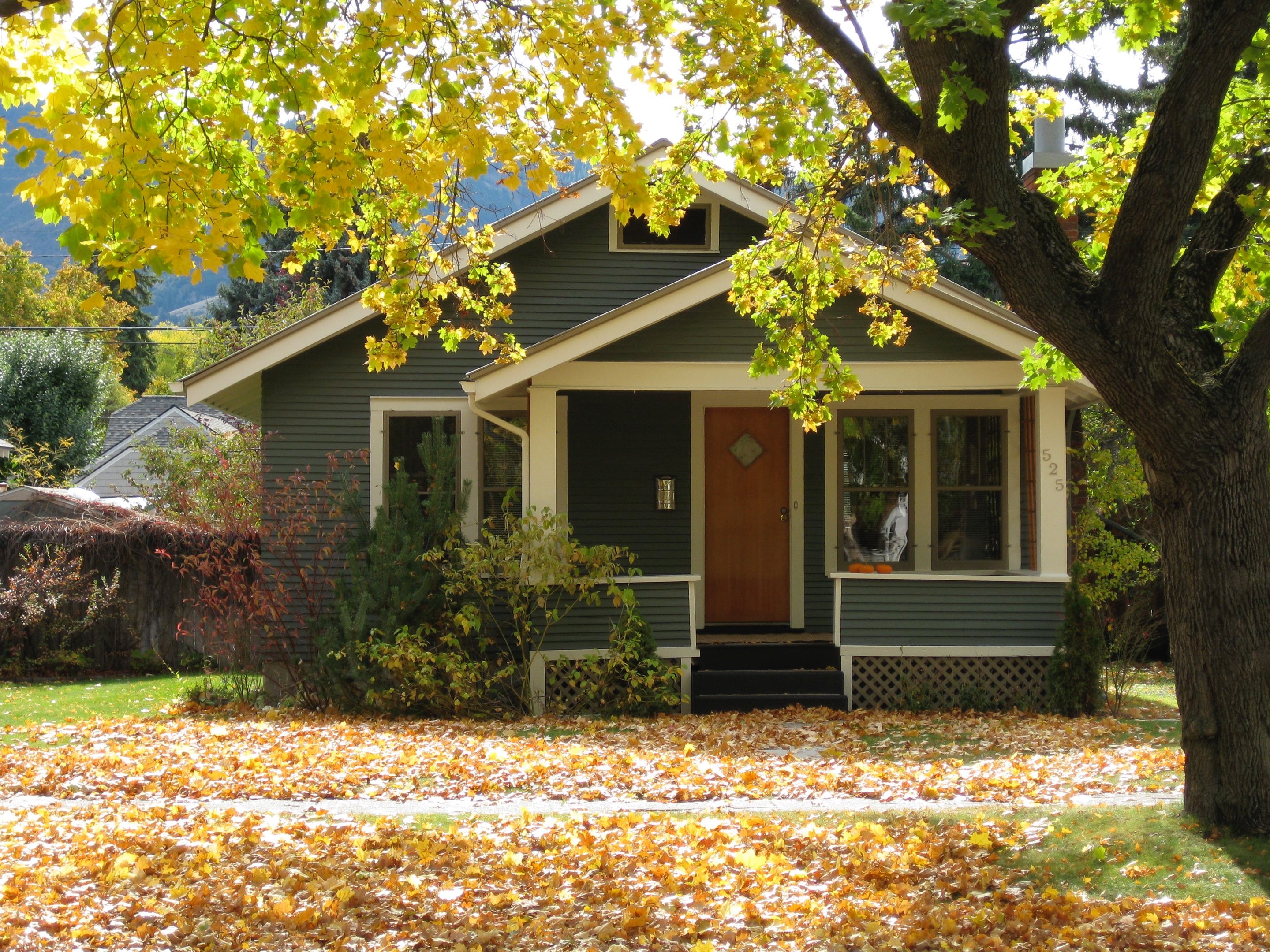
Yes, people really did order houses from catalogs.
From the early 1900s into the 1930s, Sears sold thousands of kit homes. Lumber came pre-cut. Hardware, trim, windows, doors, and instructions shipped by rail. The house was assembled on site by a builder, carpenter, or capable owner.
That does not mean every kit home was a Craftsman bungalow, but many popular models lived in that zone: practical scale, front porches, efficient plans, and simplified Arts and Crafts details that fit middle-class neighborhoods.
Why the Sears angle still matters:
- it explains why similar houses show up in very different regions,
- it helps buyers understand why some bungalows feel standardized but still solid,
- and it gives owners another way to research provenance.
If you are trying to confirm a possible Sears house, people usually look for stamped lumber codes, old plan layouts, historic neighborhood records, or model matches in surviving catalogs. That process is not always clean, but it is often worth the effort.
The bigger point is this: a Sears house is still part of the bungalow story. It is not fake just because it was catalog-sold. In many neighborhoods, those houses are now part of the historic fabric.
What Changed Across the Bungalow Boom
The period from 1900 to 1930 was not one frozen look. The houses shifted as costs, lots, taste, and neighboring styles shifted.
| Period | What You Tend To See | What Was Changing |
|---|---|---|
| 1900–1909 | Heavier Arts and Crafts influence, stronger timber character, deeper porches | High-style influence still close to the movement’s roots |
| 1910–1919 | The classic bungalow boom, kit homes spread, strong built-ins and efficient plans | Mass-market expansion without fully losing the core language |
| 1920–1924 | Refined versions, more brick, more neighborhood standardization | Urban and suburban adaptation on tighter lots |
| 1925–1930 | Smaller forms, simplified details, some Colonial Revival influence creeping in | Cost pressure, taste shifts, and hybridization |
That is why not every 1920s bungalow looks the same. Some still feel firmly rooted in Arts and Crafts ideals. Others are already drifting toward later suburban simplification.
That drift matters when you renovate. A 1912 bungalow and a 1928 bungalow may both be “Craftsman,” but they do not always want the same design decisions.
What Buyers Should Check Before Falling in Love
These houses can be excellent buys. They can also hide a full repair budget behind a handsome porch.
Check the obvious style-carrying parts, but also check the less romantic stuff:
- Foundation and floor movement: cracks, sloping, soft spots, patchwork repairs.
- Roof and drainage: eaves, flashing, gutter behavior, water dumping at the porch or foundation.
- Windows: whether originals survive, whether replacements damaged the look, whether operation is repairable.
- Wood condition: porch members, rafter tails, trim, siding, soffits, and any chronic moisture damage.
- Electrical: old service, outdated wiring, amateur upgrades, overloaded panels.
- Plumbing: supply and drain condition, especially if multiple remodel eras are visible.
- Bad renovations: gutted built-ins, flattened openings, fake stone, cheap flooring, boxed-in porches.
If the porch is intact, the trim still has depth, the fireplace and built-ins survive, and the windows were not butchered, you are already ahead.
If the house was gutted into a generic white box and the front was “improved” with fake Craftsman details, negotiate hard or move on.
How To Renovate One Without Killing It
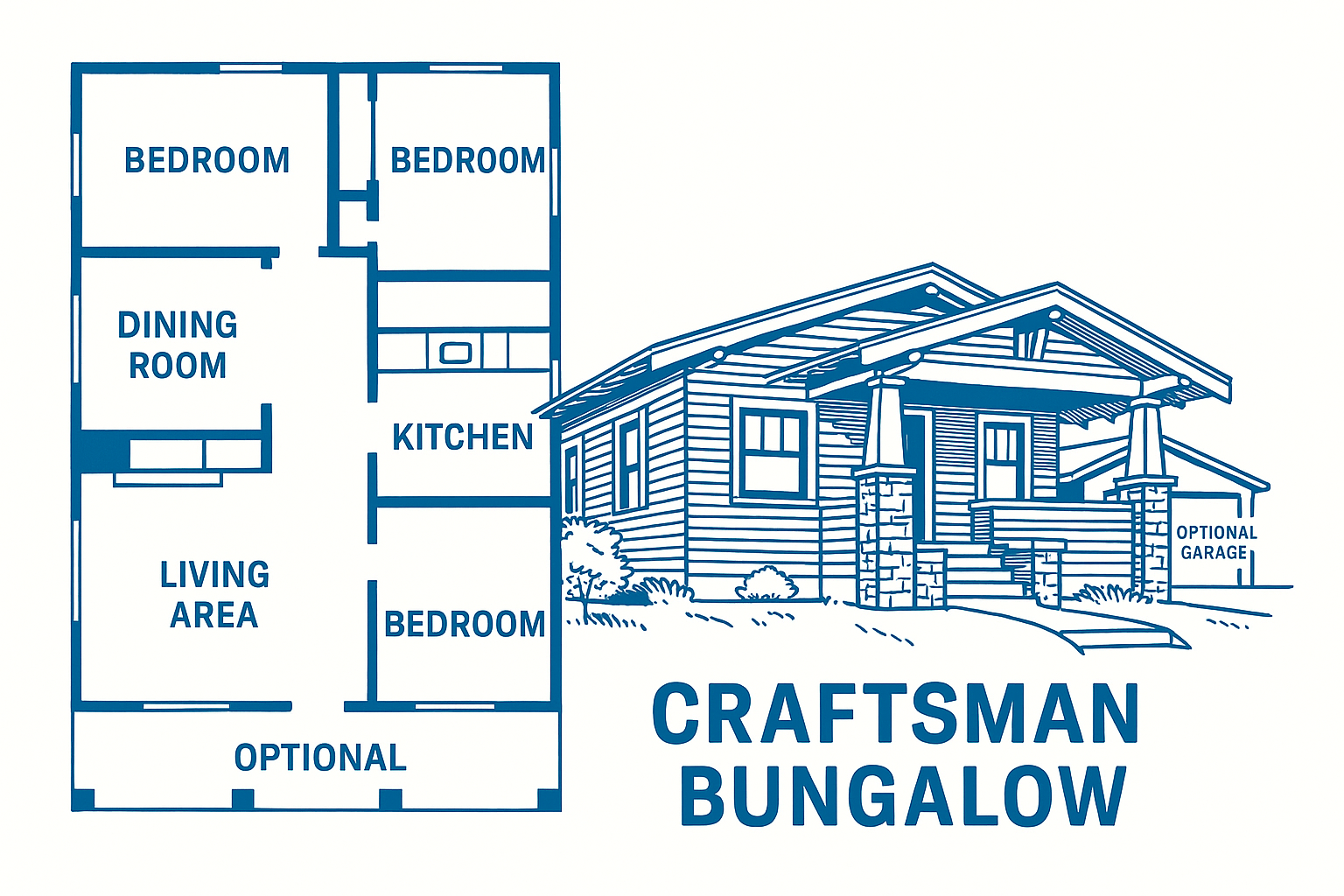
The safest renovation rule is simple: improve the house where daily life was weak, but protect the parts that made the house worth buying.
That usually means:
- Keep original trim and doors where possible.
- Repair built-ins instead of replacing them with generic cabinetry.
- Improve kitchens carefully. Better function is fine. Erasing all room definition is usually not.
- Upgrade wiring, plumbing, insulation, and HVAC quietly.
- Preserve the porch. The porch is not leftover square footage waiting to be enclosed.
- Match window proportions if replacement is unavoidable.
| Better Move | Common Mistake | Why It Works Better |
|---|---|---|
| Open the kitchen selectively | Erase every wall and every threshold | Bungalows need better flow, not total flattening |
| Refinish original floors and trim | Cover them with thin generic replacements | The old material depth is part of the house’s value |
| Restore or replicate built-ins with the right scale | Fill the room with detached furniture instead | Built-ins help the plan feel intentional |
| Repair porch columns and piers honestly | Replace them with lightweight decorative parts | The porch carries a huge part of the style |
| Improve systems behind the walls | Spend first on trend finishes | Good houses need good bones before good styling |
The soul is not in one heroic feature. It is in the accumulation of proportion, material weight, room hierarchy, and detail.
One Story vs Two Story: What Actually Changes
Most classic bungalows stay low, and that low-slung profile is a big part of the type. It keeps the house close to the ground, keeps the porch important, and helps the whole thing feel compact and human instead of showy.
But there are larger bungalow-type houses and later two-story versions that still carry the Craftsman language well. The question is not whether the house has another floor. The question is whether it still feels grounded, proportioned, and believable.
| Feature | 1-Story / 1.5-Story Bungalow | 2-Story Craftsman House |
|---|---|---|
| Typical feel | Lower, more intimate, more closely tied to classic bungalow form | Taller, broader, sometimes more formal |
| Planning | Compact, efficient, easier to age into | More bedrooms and separation, but can lose some of the cozy scale |
| Porch relationship | Usually central to the whole front | Can still work well, but is easier to under-scale or visually weaken |
| Authenticity to bungalow type | Closest to the form most people picture | Can still be Craftsman, but less purely bungalow |
| Renovation risk | Porch and trim loss hurt fast | Poor second-story additions can wreck proportions badly |
One-story versions usually feel more original to the type. Two-story versions can still be excellent houses, but they need better judgment to stay convincing. Once the added height starts fighting the porch, roof, and eaves, the house stops reading as a coherent Craftsman design and starts reading as a compromise.
Are They Still Worth Buying?
Usually, yes. But not because they are cheap vintage charm. They are worth buying when they still have the things that matter.
Why buyers still chase them:
- walkable older neighborhoods,
- good human scale,
- better material character than a lot of newer housing,
- limited supply,
- and strong emotional pull without needing fake nostalgia.
What can make them expensive fast:
- foundation or water issues,
- rewiring and replumbing,
- window replacement done right,
- porch reconstruction,
- poor old remodels that need undoing.
If the house still has its built-ins, porch, fireplace, decent windows, and strong trim, you are paying for more than square footage. You are paying for architectural substance that is harder to replace than people think.
Recommended Books
A lot of books on Craftsman houses are either too decorative or too broad. These are the ones from your list that do something more useful: they help you see the house better, restore it better, or avoid making it worse.
MUST READ: Bungalow: The Ultimate Arts & Crafts Home by Jane Powell
Best for owners who want the real thing: original materials, floor plans, woodwork, color, and what these houses looked like before weak remodels got to them.
FIELD PICK: Bungalow Style: Creating Classic Interiors in Your Arts and Crafts Home by Treena Crochet
Best for the inside of the house: furniture, lighting, mood, and how to keep warmth without turning the place into a period stage set.
ALSO USEFUL: The Craftsman Bungalow by Paul Duchscherer
Best for regional variation and fast visual education. Good when you need to sharpen your eye instead of reading a full restoration manual.
FAQ
What defines a Craftsman bungalow?
A Craftsman bungalow usually combines bungalow form with Craftsman detailing: low-pitched roof, broad eaves, strong porch, tapered columns, natural materials, built-ins, and thick trim.
What is the difference between a bungalow and a Craftsman house?
Bungalow refers to the house type. Craftsman refers to the style language. A Craftsman bungalow is where the two overlap.
Are Sears kit homes considered authentic bungalows?
Yes. Many Sears homes were part of the bungalow boom and are now historic houses in their own right. Catalog origin does not make them less legitimate.
Are original windows worth saving?
Often, yes. In these houses, window proportion and trim depth matter a lot. Repair is often worth considering before replacement.
Can I modernize a Craftsman bungalow without ruining it?
Yes, but the best updates improve kitchens, baths, comfort, and systems without flattening the room structure or stripping out the house’s material character.
Do Craftsman bungalows hold value?
In many established neighborhoods, yes. Houses with intact details, good maintenance, and strong original character tend to hold interest well.
What To Read Next
If this page helped you sort the bungalow side of the question, the next useful move is to get more specific about the era or the wider house family around it.
- 1920s House Styles if you want to place the bungalow inside the larger decade.
- What Is a Bungalow? if you want the broader bungalow form explained more cleanly.
- 1920s Interior Design Style if the real questions are now happening inside the house.