
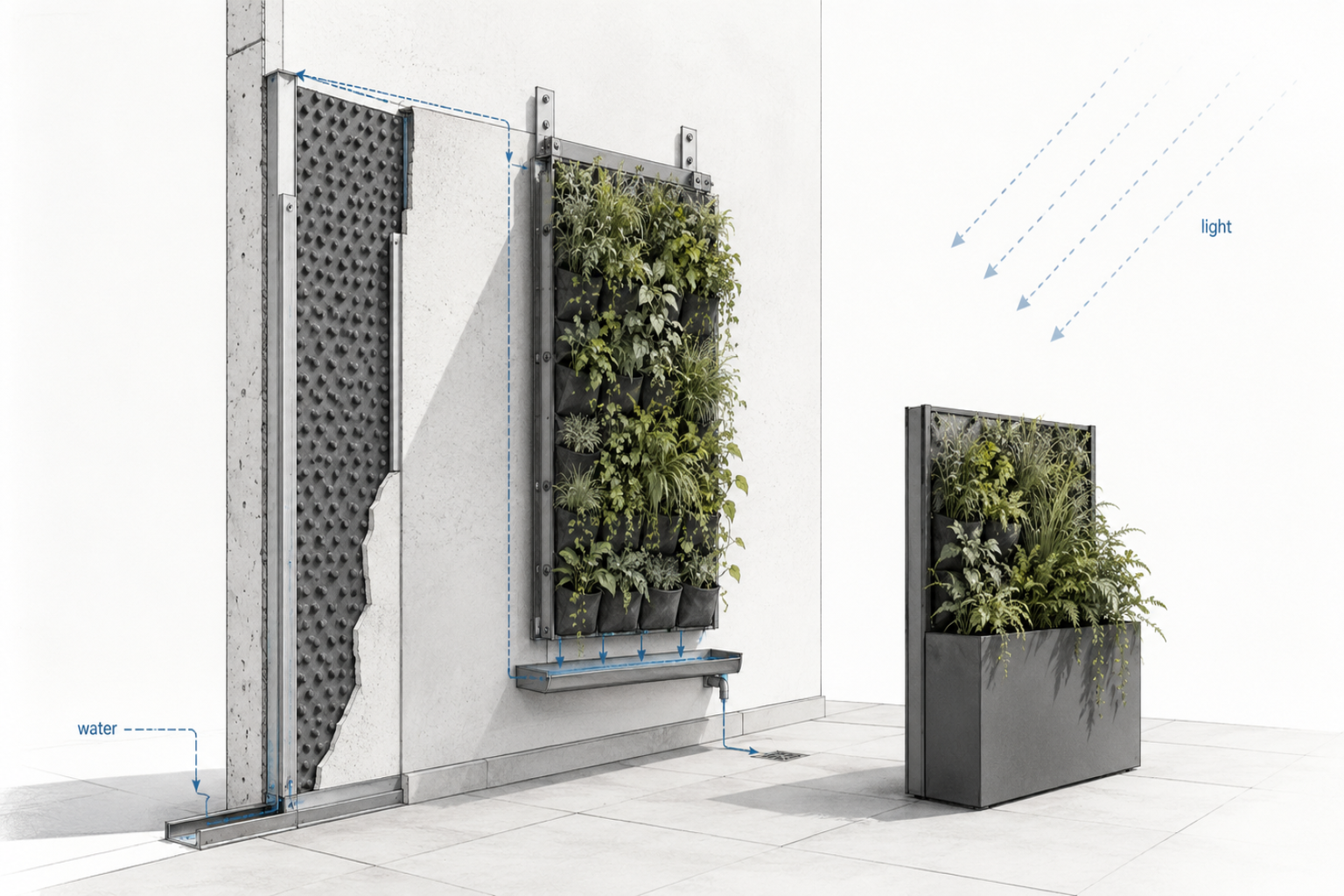
Illustration by ArchitectureCourses.org. A vertical garden works better when the wall, water path, light, and access are planned before the plants are chosen.
A vertical garden can soften a balcony, cool down a small patio, or add a real biophilic layer indoors. It can also stain drywall, trap moisture, cook in afternoon sun, drip onto the floor, overload a weak rail, or turn into a dead plant display after one hot month.
Do not start with the plant list. Start with the wall, the water path, the weight, the light, and the maintenance routine. Those decide whether the garden still looks good months later.
The usual failures are boring: the wall was not protected, the light was guessed, the water had nowhere safe to go, or nobody could reach the plants once they started declining.
Start With The Wall
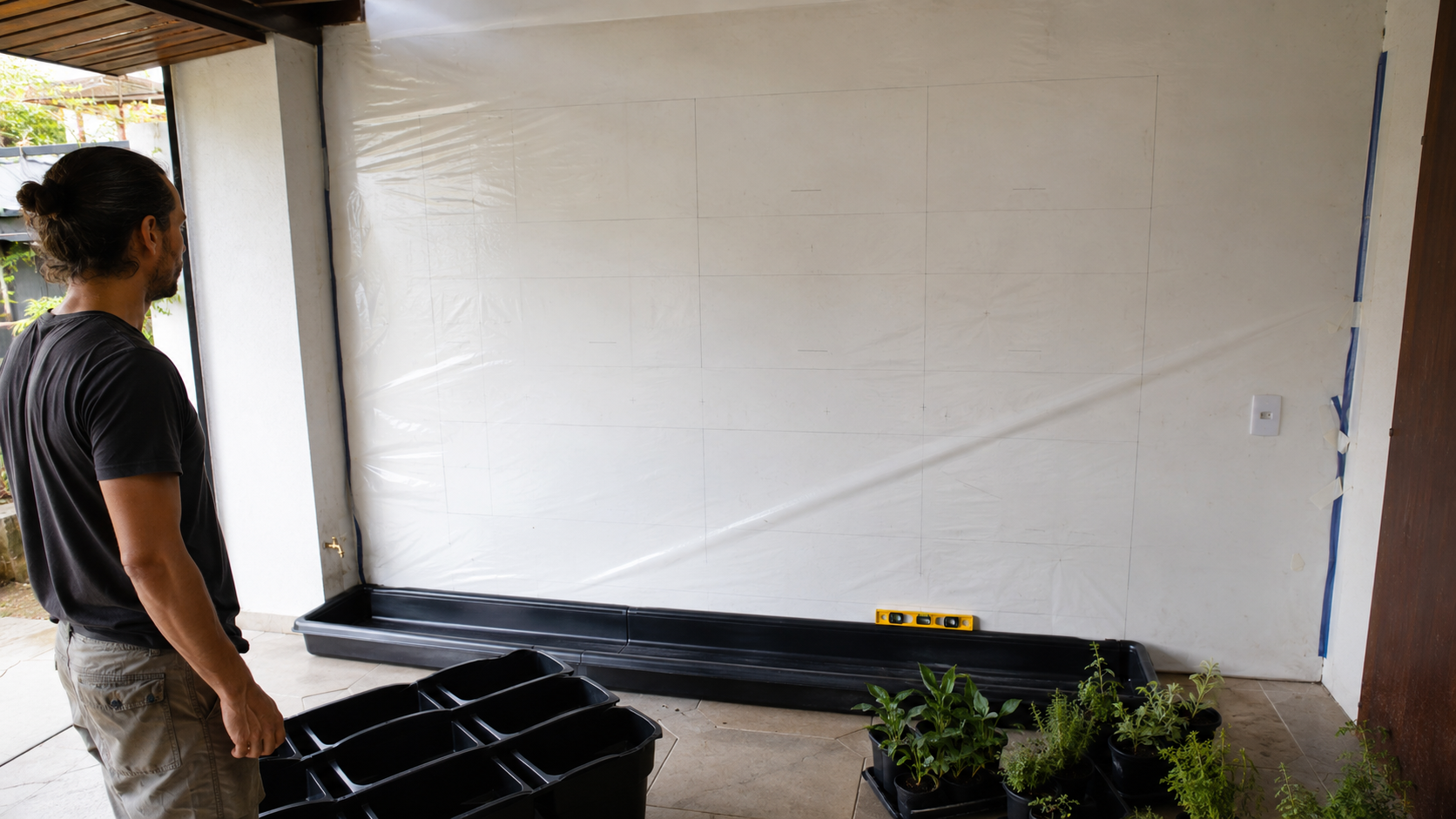
Image by ArchitectureCourses.org. A successful vertical garden starts with wall protection, water control, and access before the plants go in.
A vertical garden adds greenery, but it also adds load, water, and maintenance to the surface behind it. That surface might be drywall, brick, siding, a fence, balcony railing, concrete block, or a freestanding frame. Each one has different limits.
Indoors, the safest beginner move is often not a planted wall at all. It is a freestanding vertical planter, a small rail system, or a shallow wall planter mounted over a protected surface. Drywall and plants are a risky mix when water has no controlled path. A tiny leak repeated every week can damage paint, soften gypsum board, stain trim, or feed mold behind a panel.
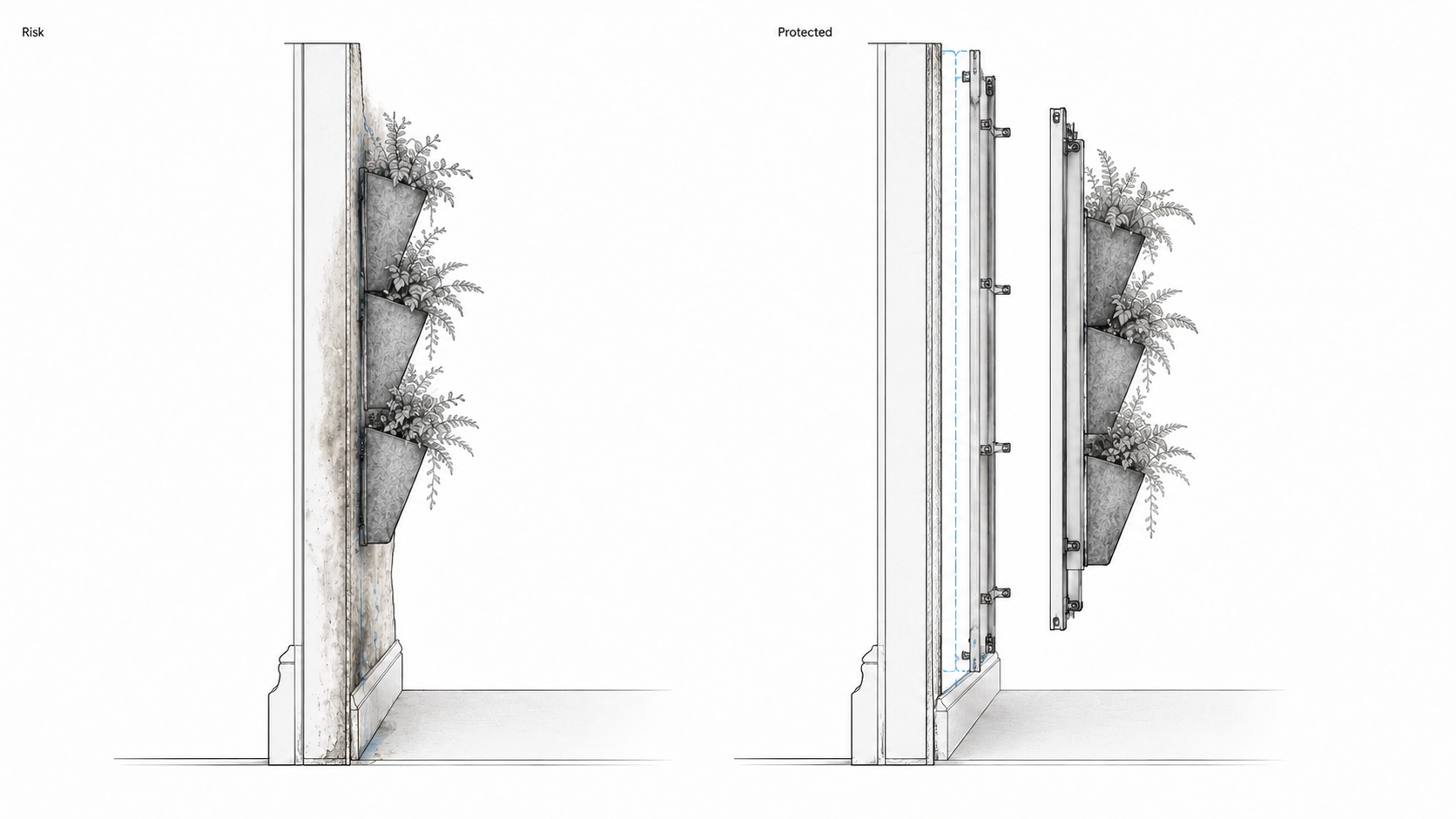
Illustration by ArchitectureCourses.org. A vertical garden should be separated from the finish wall with backing, an air gap, and access for inspection before moisture becomes hidden damage.
Outdoors, the wall may be tougher, but the risk changes. Masonry can stain. Wood fencing can rot. Siding can trap moisture if planters sit tight against it. Balcony rails can hold some things, but not every rail is meant to carry wet soil, a water reservoir, brackets, and mature plants.
The better question is not “Can I hang plants here?” It is “Can this surface carry wet weight, stay dry behind the planter, and still be inspected later?”
What Counts As A Vertical Garden?
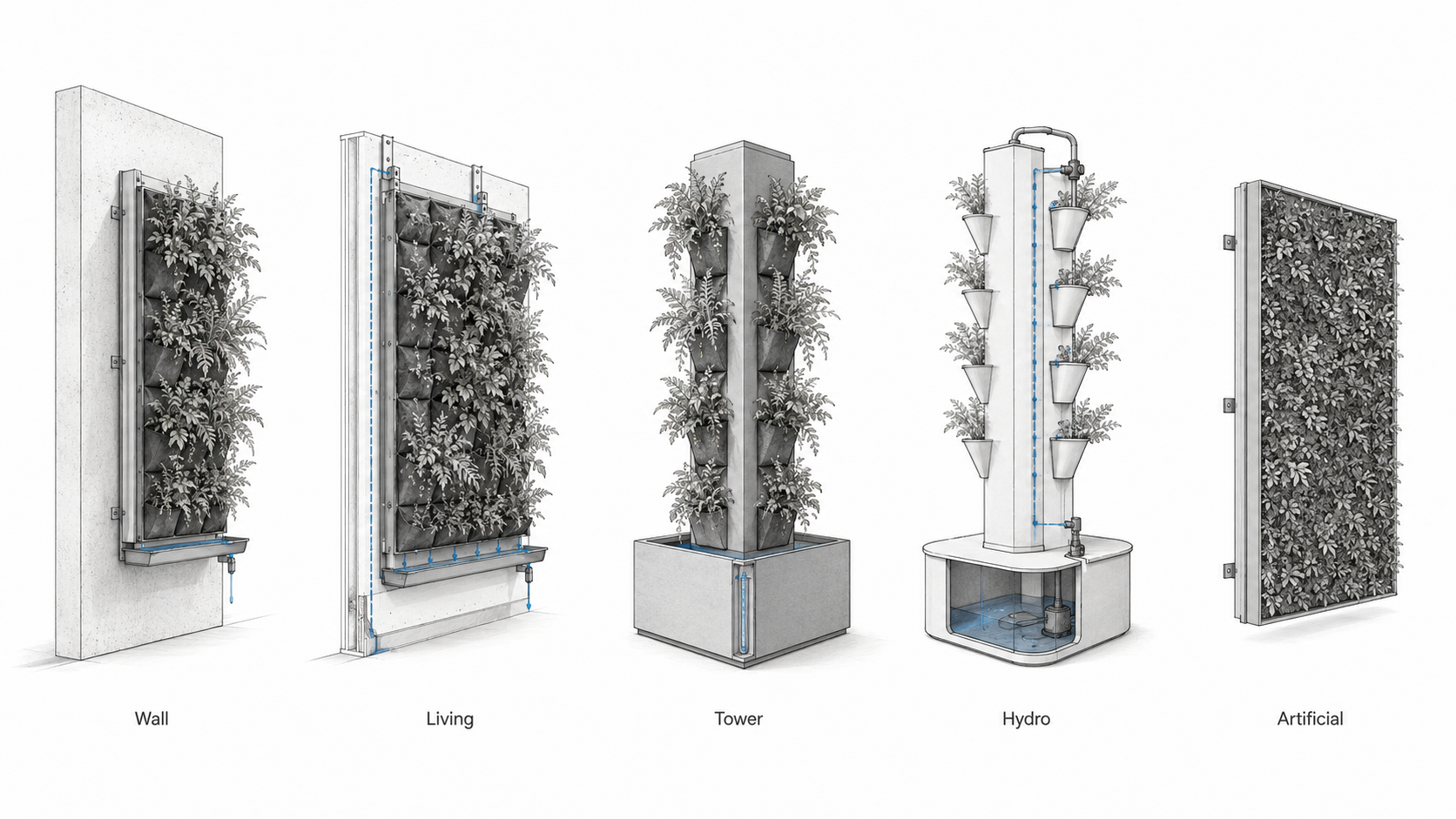
Illustration by ArchitectureCourses.org. Vertical gardens are not one system; each type has different risks for water, light, weight, cost, and maintenance.
The phrase gets used for too many different things. A vertical garden can mean a few herb pots on a rail, a living wall with irrigation, a stackable vegetable tower, a hydroponic grow tower, or artificial greenery on a dark restaurant wall. Those are not the same project.
| Type | Best Use | Main Risk |
|---|---|---|
| Wall planter | Small herbs, flowers, and compact indoor plants | Leaks, dry pockets, and wall staining |
| Living wall | Feature wall in a home, office, lobby, courtyard, or patio | Cost, irrigation failure, and plant replacement |
| Freestanding vertical planter | Renters, patios, balconies, and movable gardens | Tipping, uneven sun, and wet weight |
| Stackable planter tower | Small vegetables, strawberries, herbs, and patio growing | Top pockets drying out while lower pockets stay wet |
| Hydroponic tower | Leafy greens and herbs where food production matters | Pumps, nutrients, cleaning, electricity, and grow lights |
| Artificial green wall | Dark interiors, low-maintenance commercial spaces, and rentals | Dust, repetition, and limited biophilic value |
A simple wall planter can be a weekend project. A real living wall is closer to a small building system. It needs structure, irrigation, drainage, light, and maintenance access. Treating both as the same thing is where weak advice starts.
Indoor Vertical Gardens Need More Than A Pretty Wall
Indoor vertical gardens usually fail from light first, then water. A wall may look bright to the eye and still be too dim for herbs, succulents, or dense foliage. The upper plants may receive good light while the lower pockets sit in shade. Plants near a window may lean hard toward the glass. Plants on an interior wall may need grow lights before they ever need a fancy planter.
Water is the second problem. Small planters can work indoors if they are easy to remove, water, drain, and inspect. Larger living walls need more discipline. Built-in irrigation, drip trays, waterproof backing, and overflow control are not upgrades. They are what protect the building.
Be careful with air-quality claims. Indoor plants can improve how a room feels, soften a hard interior, and support a stronger connection to nature. But a vertical garden should not be sold as a substitute for ventilation, source control, or proper indoor air management. For design, the stronger argument is comfort, texture, mood, and visual connection, not miracle air cleaning.
This is where the vertical garden connects to the larger room strategy. For the broader design layer, read biophilic design. For a more structured pattern-based view, use the 14 patterns of biophilic design.
Outdoor Vertical Gardens Fail Differently
Outside, the problems become sun, wind, rain, and seasonal exposure. A vertical garden on a sheltered east wall may thrive. The same system on a west-facing wall can cook by late afternoon. A balcony tower may look stable when empty and become top-heavy when the soil is wet and the plants catch wind.
Outdoor vertical gardens also dry unevenly. Top pockets often dry first because they receive more sun and air movement. Lower pockets may stay damp because water drains downward. That creates a strange garden: thirsty plants at the top, soggy roots at the bottom, and an owner who thinks watering “the whole wall” solves everything.
In cold climates, freeze-thaw matters. Water held in pockets, trays, and irrigation lines can damage parts of the system. Seasonal maintenance is not optional if the system stays outside through winter.
If the vertical garden is part of a bigger yard or patio plan, connect it to the whole outdoor layout instead of treating it as a wall accessory. This home garden design guide is a useful support read for that broader planning step.
Balcony Vertical Gardens Need A Separate Plan
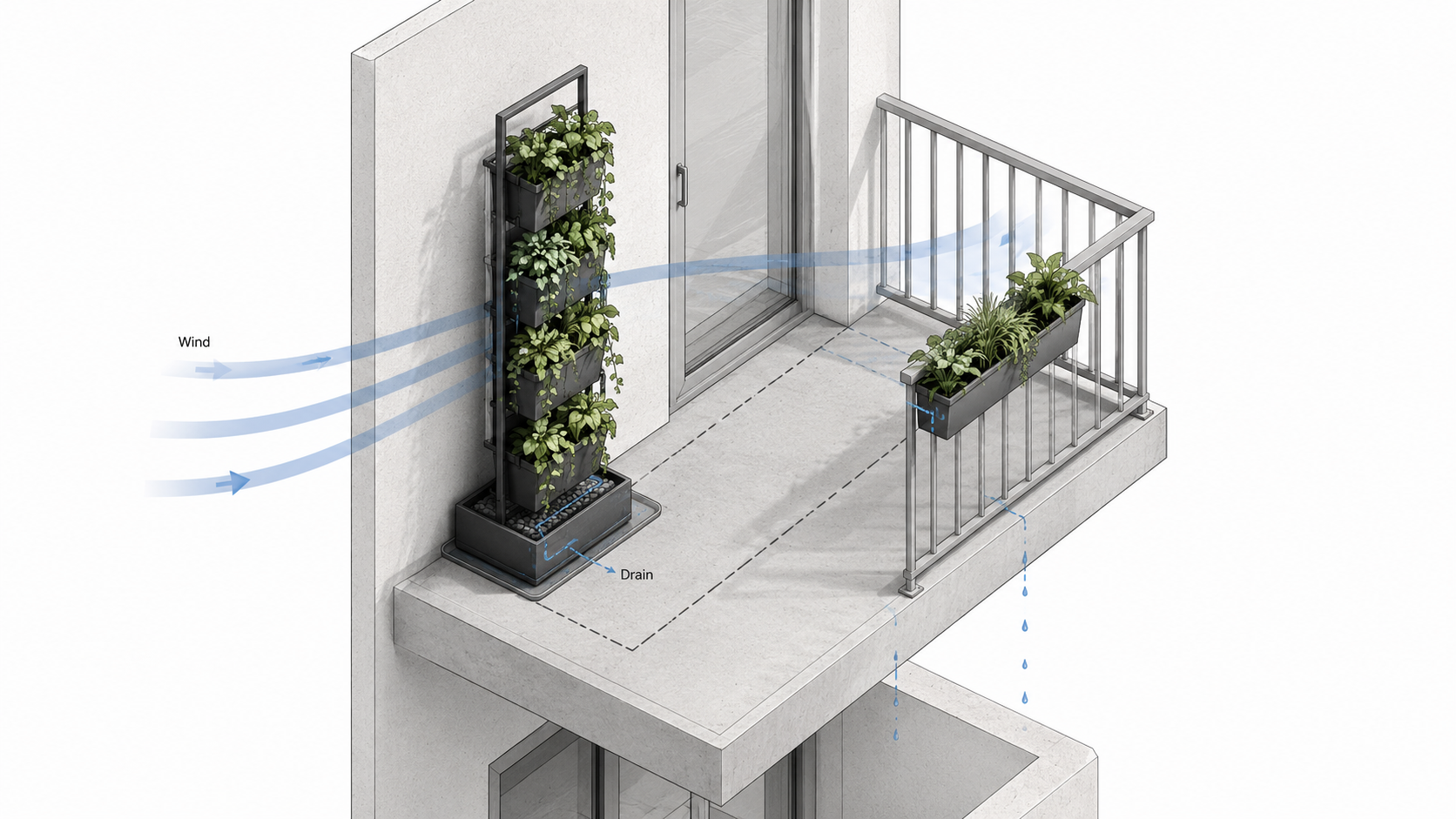
Illustration by ArchitectureCourses.org. A balcony vertical garden needs a stable base, controlled drainage, and enough walking clearance before the plants matter.
A balcony vertical garden has its own problems: wind, drainage, railing limits, narrow walking space, and neighbors below.
Freestanding systems are usually safer than permanent wall-mounted systems for renters. They can move with the sun, come inside during storms, and avoid drilling into the building. Rail planters can work, but only when they are secure, light enough, and allowed by the building rules. A planter that drips onto the balcony below will not feel charming for long.
The best balcony vertical garden usually leaves the wall alone, keeps circulation clear, and uses a stable base. If the balcony is very narrow, a slim tower or shelf may work better than a full green wall.
For a patio or balcony where drilling into the wall is a bad idea, a freestanding vertical raised planter is often the safer product type to compare first. Still check wet weight, wind exposure, drainage, and walking clearance before treating it as renter-safe.
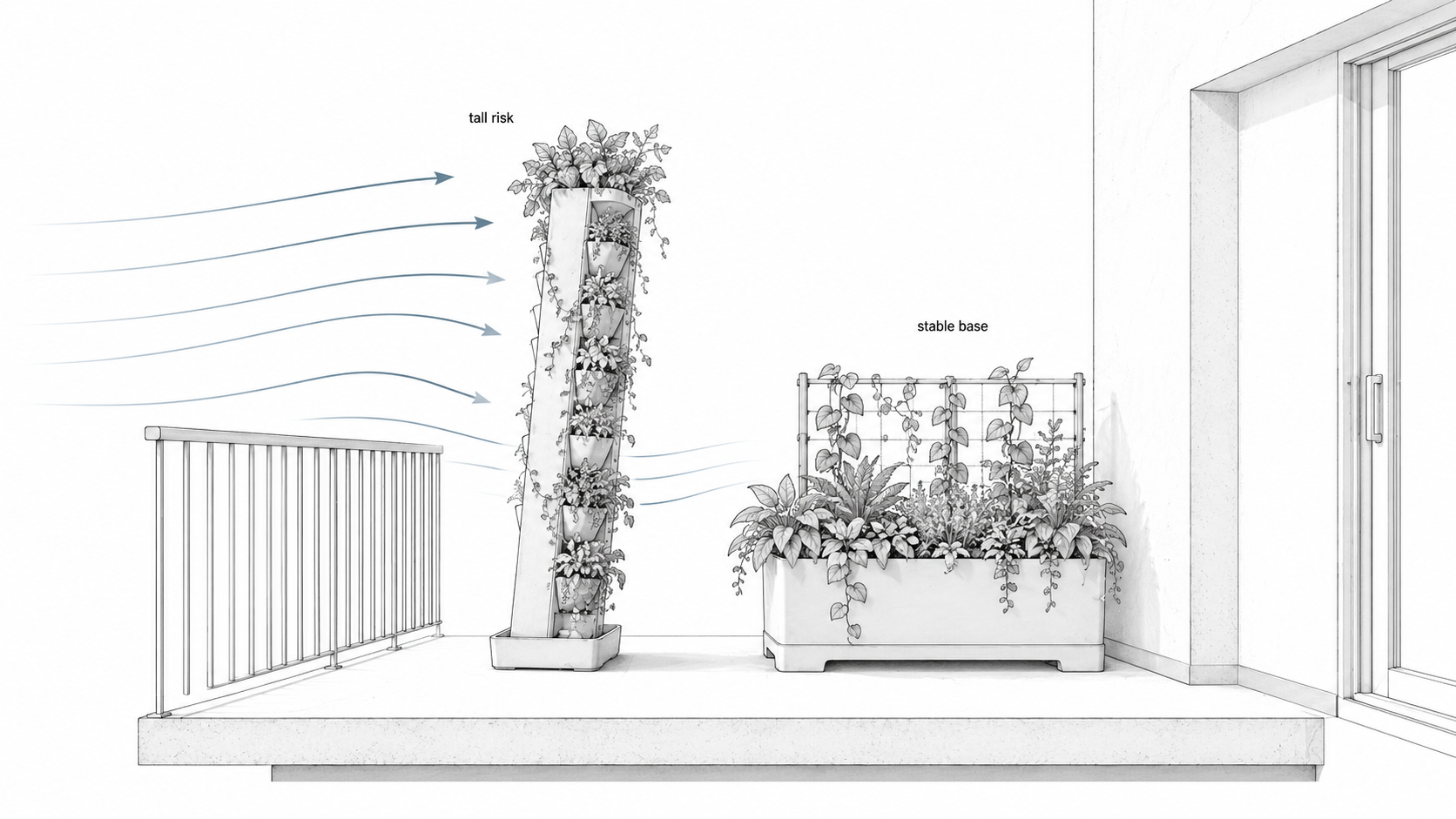
Illustration by ArchitectureCourses.org. Wind can turn a tall balcony planter into a problem, especially after the soil is wet and the plants catch more air.
For the balcony-specific version, use vertical garden ideas for balconies. That page should stay focused on small-space problems: railing rules, drainage, wind, walking clearance, and renter-safe systems.
Living Wall, Green Wall, Or Simple Planter?
The wrong system is expensive even when it looks cheap at checkout. Choose by conditions, not by the product photo.
| Choose This | When It Makes Sense | Avoid It When |
|---|---|---|
| Simple wall planter | You want a small herb wall, a few trailing plants, or an easy starter project | The wall cannot tolerate water, anchors, or regular removal |
| Freestanding vertical planter | You rent, move plants seasonally, or need a lower-risk patio setup | The area is windy and the base cannot be weighted safely |
| Living wall | You want a true feature wall and have budget for irrigation and maintenance | You want low upkeep or cannot access the wall easily |
| Hydroponic tower | You care more about herbs, lettuce, and food production than wall design | You do not want pumps, nutrients, cleaning, or grow-light planning |
| Artificial green wall | The space has no useful light, no water access, or no maintenance owner | You want the benefits of real planting or serious biophilic performance |
For serious living-wall inspiration, The Vertical Garden: From Nature to the City by Patrick Blanc is worth knowing about. I would use it for understanding what mature planted walls can become, not as permission to copy a complex system without the same structure, water, and maintenance planning.
For a smaller indoor starter wall, a modular self-watering wall planter set is closer to the scale most homeowners should test first. It is still not a professional living wall; it is a way to test light, watering, wall protection, and maintenance before committing to something larger.
The Water Path Decides Whether It Lasts
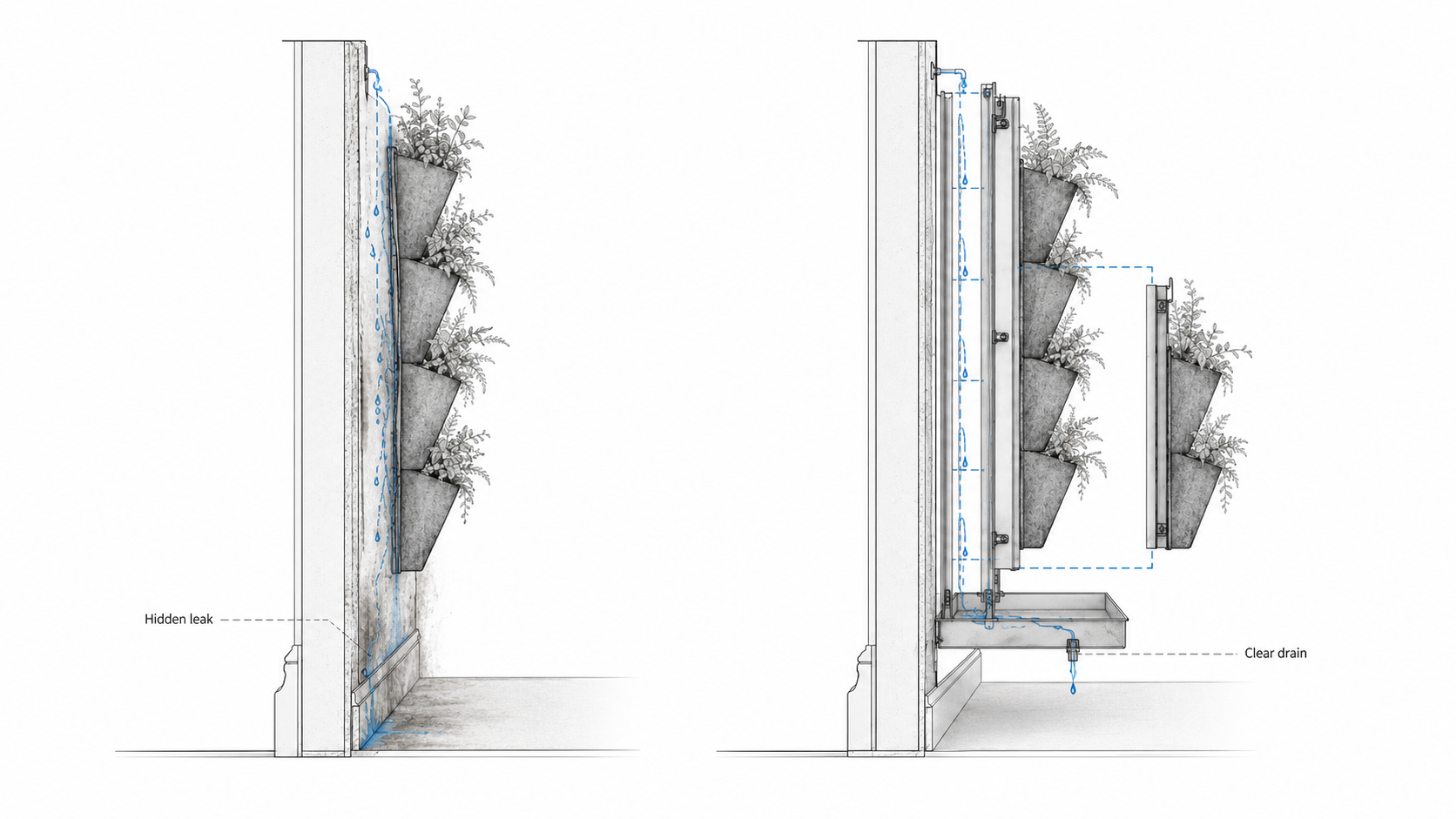
Illustration by ArchitectureCourses.org. The water path is the detail that decides whether a vertical garden stays healthy or becomes hidden wall damage.
Before buying anything, trace the water.
A vertical garden has two water paths. The first is the planned path: water enters at the top, through a reservoir, hose, drip line, or hand watering. The second is the failure path: the place water goes when someone overfills the planter, a drip tube clogs, a pocket leaks, a pump fails, or the lower row receives too much runoff.
If the failure path touches drywall, trim, flooring, siding, balcony decking, or the back face of a wall panel, the design is weak. A drip tray helps only when it is large enough, visible, removable, and checked often. Hidden trays become little rot trays when nobody looks at them.
In a simple wall planter, the solution may be a removable liner and a protected backing board. In a larger living wall, the solution may be integrated irrigation, drainage collection, waterproof backing, and a maintenance contract. In a balcony garden, the answer may be even simpler: keep the system freestanding and drain into a saucer you can see.
The First Three Weeks Matter
The first week usually looks good. Plants are fresh from the nursery, the pockets are full, and the wall photographs well. The useful test starts after that.
By the third week, the weak spots show up. The top row dries faster. A shaded lower pocket turns yellow. One herb grows twice as fast as the plant beside it. A pump hums louder than expected. A drip tray fills with stale water. A wall-mounted planter that looked clean now needs to be removed just to check what is happening behind it.
That is why access matters. If a plant cannot be reached, trimmed, removed, or replaced easily, the wall will slowly become a maintenance problem. A vertical garden is not a framed picture. It changes every week.
Light Is Not The Same Across The Wall
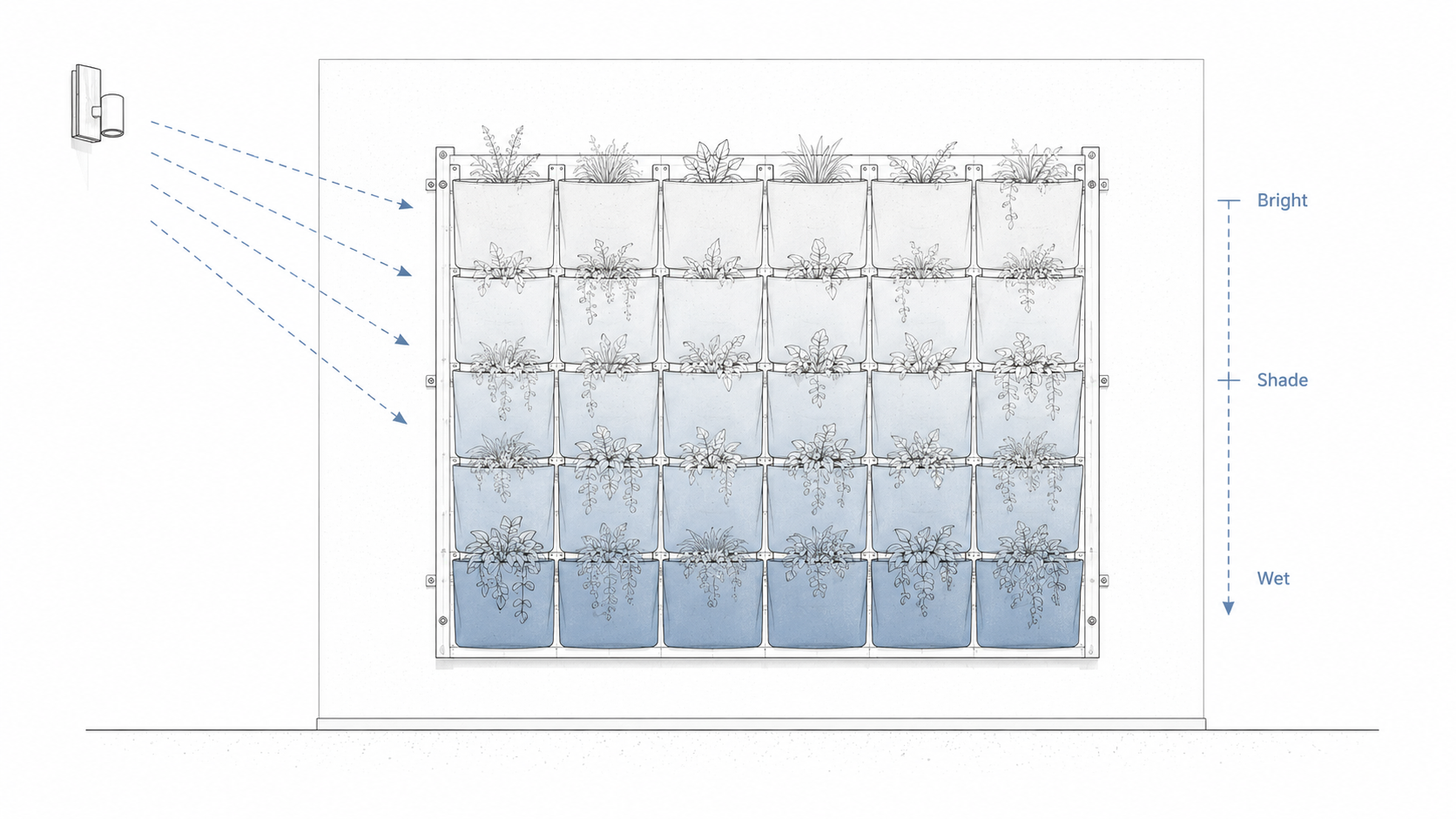
Illustration by ArchitectureCourses.org. Plants should be grouped by light and water needs because the top and bottom of a vertical garden do not behave the same way.
A flat wall does not receive light evenly. The top may be bright. The bottom may be shaded by the plants above. One side may receive window light while the other side stays dim. Outdoors, the wall changes with the season, nearby trees, balcony overhangs, and neighboring buildings.
This is why plant zoning matters. Do not plant the wall like a random flower display. Put plants with similar water and light needs together. Use the brightest zone for plants that need stronger light. Use lower or shaded zones for plants that tolerate it. Keep thirsty plants away from drought-tolerant plants unless you enjoy killing one group slowly.
A simple moisture meter can help on small soil-pocket systems, especially where the top and bottom rows behave differently. Something like a long-probe soil moisture meter is useful as a checking tool. It does not fix bad irrigation, but it can stop you from guessing.
Best Plants For Vertical Gardens
The best plant is not the prettiest one on the label. It is the plant that matches the wall condition, pocket depth, light, watering method, and maintenance access.
| Condition | Better Choices | Be Careful With |
|---|---|---|
| Indoor low light | Pothos, philodendron, ferns, some peperomia | Most herbs without grow lights |
| Bright indoor wall | Herbs, compact greens, trailing foliage | Large fruiting plants with shallow pockets |
| Sunny balcony | Thyme, oregano, strawberries, compact flowers | Thin plastic pockets in strong afternoon sun |
| Outdoor shade | Ferns, ivy-type plants, shade annuals | Succulents in damp shade |
| Dry wall pockets | Succulents, drought-tolerant herbs, tough trailing plants | Leafy greens that need steady moisture |
Herbs are useful, but they are not magic. Basil wants more light than many kitchens provide. Mint grows aggressively. Rosemary hates staying wet. Lettuce works better in a controlled tower or bright outdoor setup than in a dark wall pocket. Succulents look easy, but they fail fast when people put them in damp shade.
Hydroponic And Aeroponic Towers Are A Different Job
Hydroponic and aeroponic towers are often pulled into vertical garden articles because they grow upward. That does not make them the same as a living wall.
A hydroponic tower is usually about food production: lettuce, basil, greens, strawberries, and small crops. It needs water circulation, nutrients, cleaning, electricity, and enough light. Indoors, that often means grow lights. Outdoors, it means heat, algae, pump reliability, and seasonal exposure.
An aeroponic tower is even more dependent on the system working correctly. Roots rely on mist, timing, and nutrient delivery. When the system works, growth can be impressive. When it fails, plants can decline fast.
Use these systems when growing food is the goal. Do not choose one because you want a quiet decorative wall.
Artificial Vertical Gardens Are Not Always Wrong
Artificial vertical gardens get dismissed too quickly, then oversold too aggressively. Both are mistakes.
A fake green wall can make sense in a dark corridor, a rental, a commercial space with no plant-care staff, or a room where water near the wall is a bad idea. It solves light, irrigation, pests, and plant replacement. That is useful.
But it is not a living wall. It does not grow, respond to light, improve humidity, or give the same sensory quality as real planting. Cheap panels also repeat visibly. Dust builds up. Plastic leaves can look flat under strong light.
Use artificial greenery when the honest goal is low-maintenance visual softness. Do not pretend it is the same as a real biophilic planting system.
Cost Is More Than The First Purchase
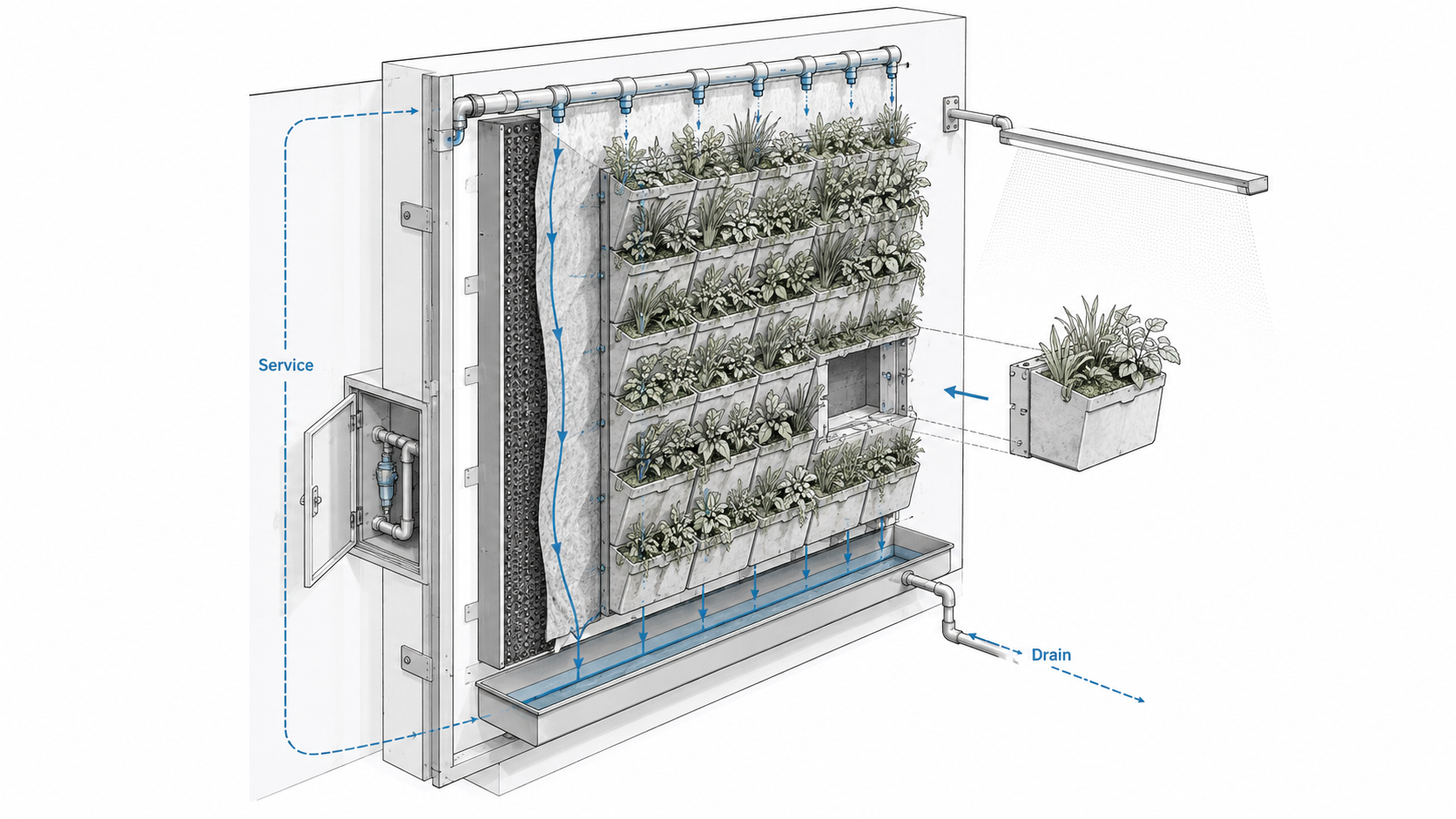
Illustration by ArchitectureCourses.org. The long-term cost of a living wall usually comes from irrigation, lighting, plant replacement, drainage, and access for maintenance.
A vertical garden can cost very little or become a serious installed system. The problem is that people compare them as if they are one category.
A few wall planters are a product purchase. A professional living wall is a design, installation, irrigation, lighting, and maintenance decision. The ongoing cost may matter more than the first invoice.
| System | Typical Cost Level | Cost People Forget |
|---|---|---|
| Small wall planter | Low | Backing board, liners, replacement plants, drip protection |
| Freestanding planter tower | Low to medium | Soil, base weight, seasonal plant replacement, saucers |
| Hydroponic tower | Medium | Nutrients, pump parts, cleaning, lights, electricity |
| Modular living wall | Medium to high | Irrigation, waterproofing, plant replacement, maintenance visits |
| Custom professional living wall | High | Design, framing, lighting, drainage, service access, repairs |
The maintenance line is where many living walls become expensive. A cheap installation with no access, no spare plants, and no clear drainage plan can cost more later than a better-planned system that looked expensive at the start.
The cheap version and the expensive version are not the same thing. One is a planter. The other is a planted wall system. If the quote does not explain irrigation, drainage, lighting, access, and plant replacement, it is not telling the full cost story.
What To Check Before You Buy Or Build
Before choosing plants, answer these questions:
- Can water escape without touching the wall, floor, siding, trim, or balcony below?
- Can you reach every plant without a ladder or awkward stretching?
- Is the wall bright enough, or are grow lights part of the real budget?
- What does the system weigh when the soil, reservoir, and plants are wet?
- Is the system removable if plants fail or the wall needs repair?
- Can dead plants be replaced without taking apart the whole installation?
- Is there a hose, sink, drain, or safe refill point nearby?
If you cannot answer those questions, do not buy the biggest system. Start smaller.
Best Vertical Garden By Situation
The right answer changes by room, wall, owner, and climate.
| Situation | Better Choice | Why |
|---|---|---|
| Renter apartment | Freestanding planter or removable rail planter | Less wall damage and easier removal |
| Dark indoor wall | Artificial green wall or grow-light system | Real plants need light, not optimism |
| Kitchen herbs | Small planter near a bright window | Easy access matters more than size |
| Balcony | Stable freestanding tower | Handles wind and avoids permanent mounting |
| Feature wall | Professionally planned living wall | Irrigation, lighting, and maintenance need coordination |
| Patio vegetables | Stackable planter or hydroponic tower | Better for production than a decorative wall |
| Busy owner | Very small real planter or artificial wall | Maintenance is the real limit |
Mistakes That Kill Vertical Gardens
The common mistakes are not mysterious.
- Mounting planters directly to drywall and hoping the tray catches everything.
- Buying plants before checking light.
- Ignoring wet weight.
- Mixing thirsty plants and dry-loving plants in the same watering zone.
- Trusting a self-watering system without checking where overflow goes.
- Hiding the wall so completely that leaks cannot be seen early.
- Choosing a hydroponic tower when the real goal is a quiet design feature.
The last one matters. A food-growing tower belongs to a different daily routine than a living wall behind a sofa. Both can be useful. They just do different work.
Where Vertical Gardens Make Sense In Design
A vertical garden works best when it solves a design problem, not when it covers one up.
It can soften a hard balcony edge, make a small patio feel less exposed, add texture to a courtyard wall, bring seasonal change into an interior, or turn a blank wall into something with depth. In a biophilic interior, it can support visual connection to nature when the plants are real, healthy, reachable, and maintained.
It should not be used to hide leaks, cracked walls, failed siding, damp masonry, or poor daylight. Plants will not fix a bad envelope. They usually make hidden moisture harder to notice.
For buildings and larger projects, the same idea connects to biophilic architecture. A living wall makes more sense when it works with daylight, material texture, views, air movement, and human use. A lonely green panel on a bad wall is just decoration with a maintenance bill.
FAQ
Is a vertical garden hard to maintain?
It can be easy when it is small, reachable, and matched to the light. It becomes hard when the wall is large, the plants have different water needs, or the irrigation system is hidden and ignored.
Can a vertical garden damage a wall?
Yes. The risk is water, not the plants themselves. Indoor systems need protected backing, controlled drainage, and visible overflow. Outdoor systems need airflow behind the planter and anchors that make sense for the wall material.
What is the difference between a vertical garden and a living wall?
A vertical garden is the broad category. A living wall is usually a denser planted wall system, often with modules, growing medium, irrigation, and planned maintenance. A few wall pots are vertical gardening. A living wall is closer to an installed planting system.
Do indoor vertical gardens need grow lights?
Sometimes. Herbs, succulents, and many compact edible plants need more light than a normal interior wall receives. Foliage plants tolerate lower light better, but even they need enough brightness to keep growing instead of slowly thinning out.
What is the best vertical garden for a balcony?
Usually a freestanding vertical planter, stable tower, or removable rail system. Permanent wall-mounted systems are riskier for renters and harder to manage if wind, drainage, or building rules become a problem.
Are hydroponic towers worth it?
They are worth considering if you want herbs, lettuce, and small food crops in a controlled setup. They are not the best choice if you only want a low-maintenance decorative green wall.
Are artificial vertical gardens a bad idea?
No. They are useful where real plants would fail: dark rooms, busy commercial spaces, rental walls, or places where water near the wall is a bad idea. The mistake is calling them a living wall.
Read This Next
Start with biophilic design if you want the larger design idea behind living walls, daylight, natural materials, and planted spaces.
Use the 14 patterns of biophilic design when you want a more structured framework and want to avoid treating plants as the whole strategy.
For rooms, offices, and interior decisions, go to biophilic interior design. For building-scale thinking, use biophilic architecture.
Build The System First
The best vertical garden is not the fullest one on day one. It is the one with a safe wall, a clear water path, enough light, reachable plants, and a maintenance plan someone will actually follow.
Start small if the conditions are uncertain. Keep water visible. Keep plants reachable. Choose the system before the plant list. A vertical garden should make a space better, not create a hidden wall problem behind a layer of leaves.