
Architect-Proven Ways to Save on Stone Benchtops
(Without Buying Regret)
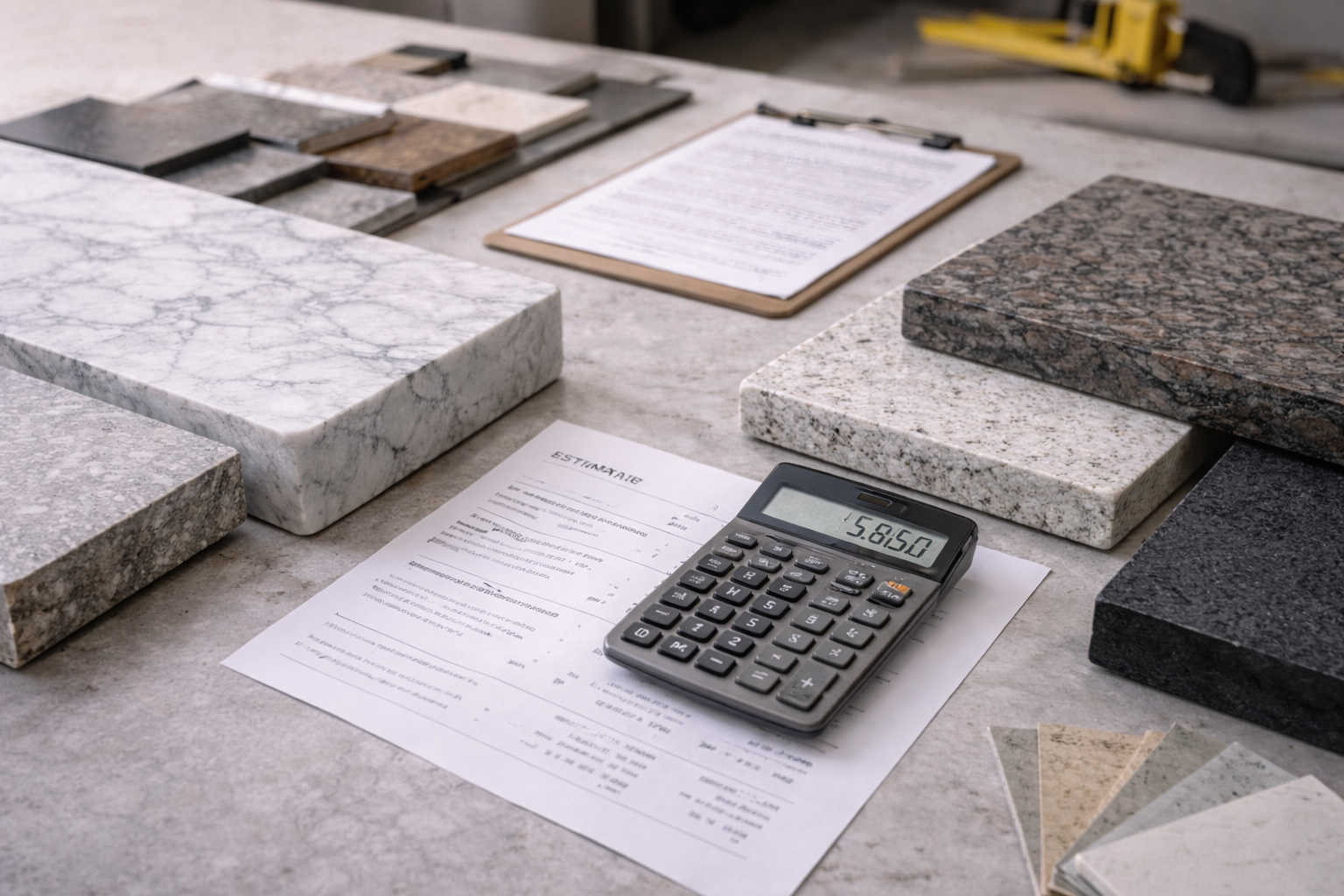
Stone Benchtops Prices: The number you see online is rarely the number you pay. The gap is seams, cutouts, edge build-ups, access, and installer time. This guide shows you where money disappears, how to quote apples-to-apples, and the design moves that keep stone looking high-end without turning into the most expensive “rectangle” in your renovation.
The part nobody explains
I’ve watched people choose a slab the way they choose paint: pick a look, pick a color, done. Then the quote lands and they think someone’s scamming them.
You’re not buying “stone” — you’re buying fabrication
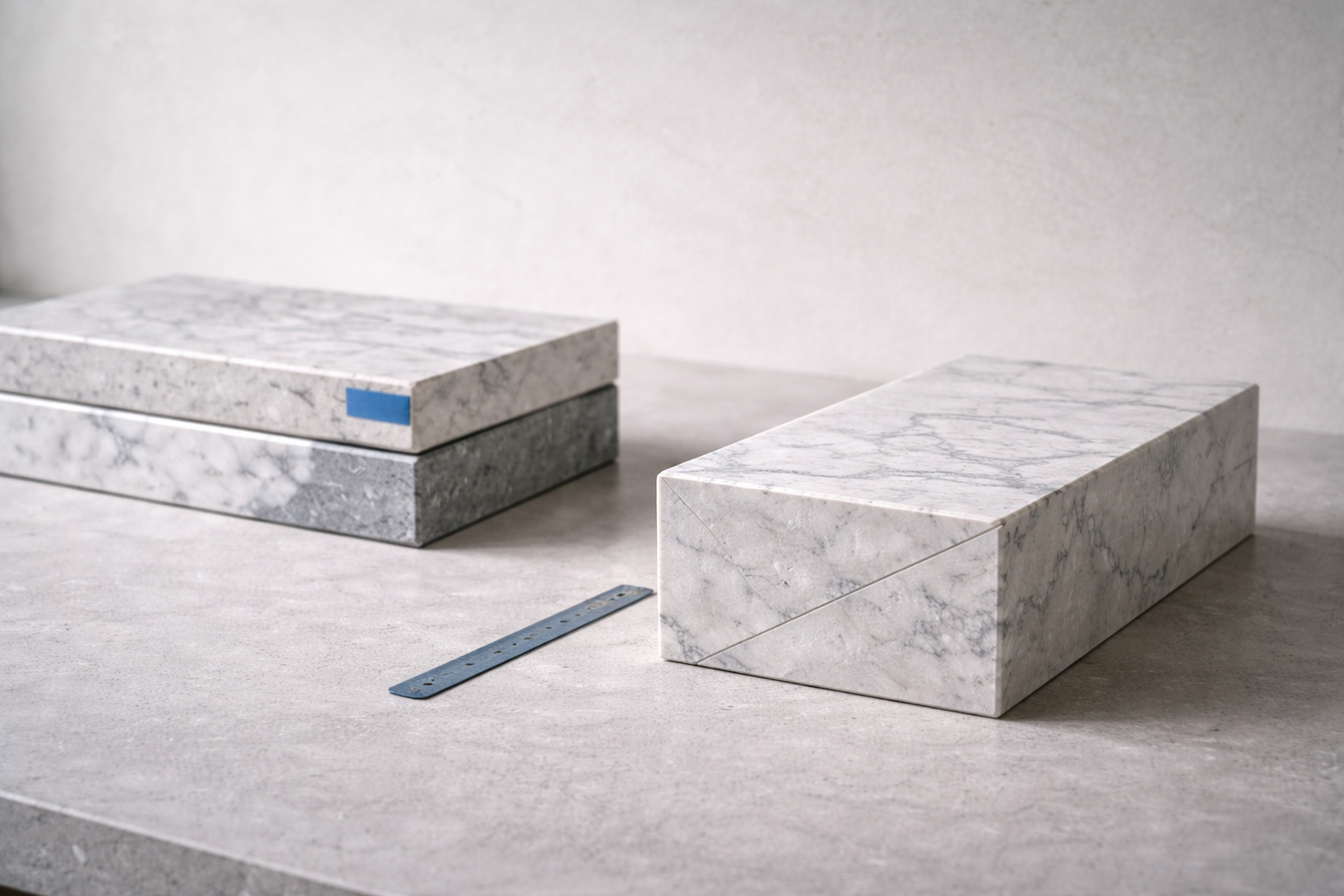
Most of the bill isn’t the slab. It’s measuring, templating, cutting, polishing, reinforcing, joining, transporting, and installing a heavy, fragile object that must land dead-level and still look clean two years later.
So if you want to save money, don’t start with “what stone is cheapest.” Start with: how much work am I forcing the fabricator to do?
Stone benchtops price ranges (2026 update)
Quick note on currency: Benchtop pricing is wildly regional. The ranges below are the “common quote band” you’ll see in many markets that price in $ per m² (benchtops / splashbacks). Treat these as planning numbers, then lock your real number with local quotes based on your exact layout, sink, edges, and access.
Typical price bands (supply + fabricate + install)
| Material / Category | Typical Installed Range (per m²) | Where it jumps | Common repair band (chips) |
|---|---|---|---|
| Composite / engineered “quartz-style” surfaces | $550 – $1,200 | Waterfalls, mitred edges, multiple seams, lots of cutouts | $300 – $600 |
| Granite (natural stone) | $700 – $2,000 | Exotics, thicker looks, big islands, tricky access | $350 – $700 |
| Marble (natural stone) | $1,200 – $2,800+ | White marbles, bookmatching, “statement” slabs | $400 – $900 |
| Porcelain / sintered stone (ultracompact) | $900 – $2,200 | Thin brittle sheets, edge treatment, large-format handling | $350 – $800 |
| Natural stone (general planning band) | $1,200 – $2,000+ | Veining control, slab selection, special finishes | $350 – $900 |
Why I’m not listing “20mm vs 40mm” as a simple multiplier: thickness is often “visual thickness,” not physical thickness. Many 40mm looks are a 20mm slab with a built-up/mitred edge. That can be cheaper than full-thickness stone, or more expensive, depending on edge detail and labor.
Related: If you’re still choosing between natural vs engineered, keep this open in another tab: Natural Stone Benchtops: What You Need to Know
The quote traps that blow budgets
Most “price per m²” numbers assume a clean rectangle with one sink cutout and no drama. Real kitchens are not rectangles.
1) Cutouts (sink, cooktop, tap holes) are not small add-ons
- Undermount sink cutouts usually cost more than drop-in/top-mount because the stone edge must be polished and the mounting needs reinforcement.
- Cooktop cutouts look simple until you have tight clearances, stone overhangs, or a thin strip of stone left behind the cutout that needs steel reinforcing.
- Extra tap holes, filtered water dispensers, soap pumps… each one is a fabrication step.
2) Seams are where “cheap stone” becomes expensive stone
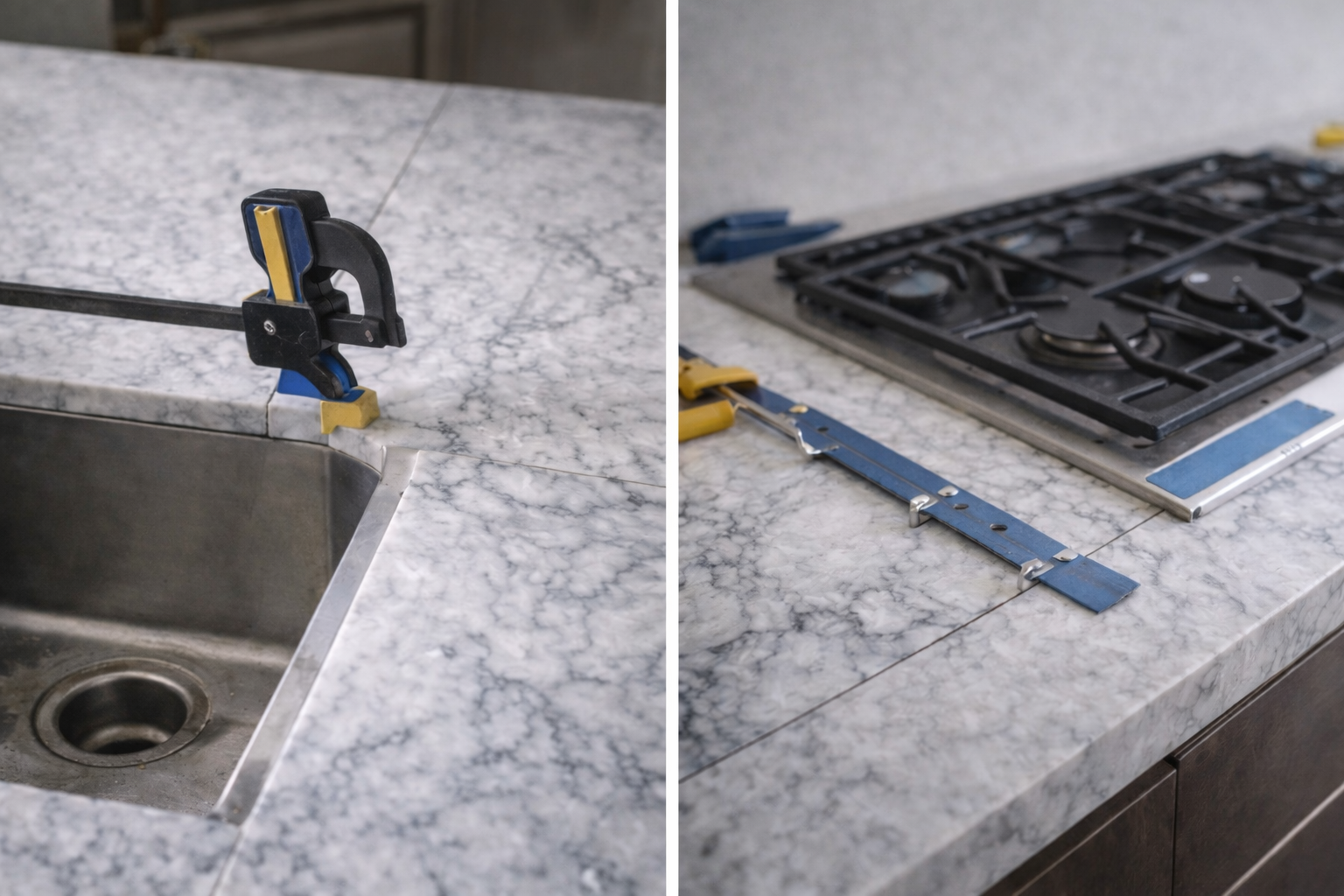
Seams cost money because they cost risk. The fabricator has to align pattern/vein, level both sides, clamp, join, and polish. You also pay for the decisions you make late: moving a sink 40mm can force seam moves and slab re-optimizing.
Rule of thumb: if your layout forces seams through a sink run or right beside a cooktop, expect higher labor and more reinforcement.
3) Waterfall ends (and stone panels) are luxury tax
Waterfalls are pretty. They also add:
- more material (often from a second slab)
- more handling risk (big vertical pieces)
- more mitres / more polishing
If budget matters, keep stone horizontal and do the “wow” somewhere else (lighting, hardware, one strong cabinet decision).
4) Edge profiles are priced like joinery, not like a menu
A simple eased edge is fast. A fancy ogee is slow. A mitred “thick look” edge can be slow in a different way (perfect alignment, consistent glue line, consistent polish). If you want thick-looking stone, ask for a price comparison between:
- full-thickness material
- built-up/mitred edge using thinner slabs
5) Access and stairs matter more than people admit
Apartment stairs, tight hallways, elevator limits, long carries, no parking near the entry — it all turns into labor and risk. Stone installers price risk like insurers do. They don’t want your job to be the one that cracks on the last step.
How architects save money on stone
(the moves that work)
This is the part people want: “tell me what to do.” Here’s what I keep coming back to on real projects — not theory.
1) Design the slab layout before you fall in love with a pattern
If the kitchen is big and the stone has strong veining, you’re buying extra slab to control where the veins land. If you want veining, keep it to the island and choose something calmer on the perimeter. You get the look without paying for full-room vein management.
2) Put stone where it earns its keep
Most households don’t abuse every surface equally. The island gets chopped, leaned on, spilled on. The pantry run gets a toaster and a coffee machine. Mixing materials isn’t “cheap.” It’s targeted spending.
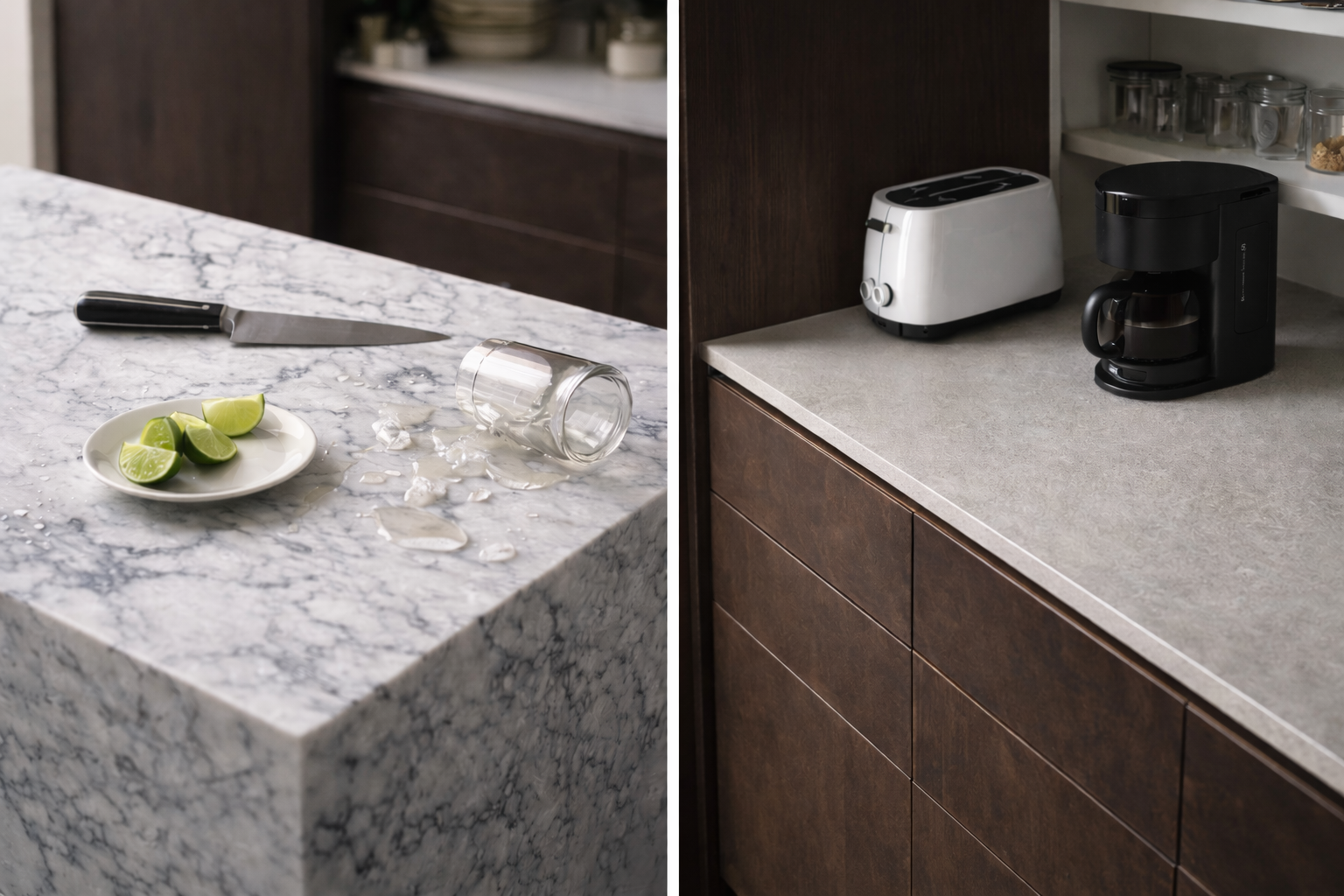
- Stone on the island (visual anchor, high use)
- More budget-friendly surface in pantry/laundry (still clean, still durable)
Related: If you’re making bigger “whole kitchen” choices, this page helps you keep priorities straight: Top Kitchen Benchtops: What’s Hot and What’s Not
3) Choose a “thin” top with a smarter edge (when the style allows it)
People chase 40mm because it looks substantial. In a lot of modern kitchens, a clean 20mm profile looks sharper and costs less. If you still want thickness, a built-up edge can give the visual weight without full-thickness material across the whole surface.
4) Reduce cutouts by simplifying the sink plan
Two common money pits:
- oversized farmhouse sinks that force awkward stone geometry
- adding accessories (soap pump, filtered spout, air switch) after the stone is already ordered
Pick your sink and tap package early. Lock it. Then template. Your fabricator will love you, and your invoice won’t “mysteriously” grow.
5) Remnants are real savings — but only in the right places
Remnants/offcuts can be a win for:
- bathroom vanities
- laundry tops
- small island tops (sometimes)
They’re usually not a win for a complex, multi-run kitchen where seams and slab matching become the main task.
6) Keep the seam line out of the “attention zone”
If a seam lands right beside the sink, you’ll stare at it forever. The cost isn’t only fabrication — it’s psychological rent you pay every day. Spend a little to move it, or design to avoid it.
7) Skip full-height stone splashbacks unless you’re sure
Full-height stone looks clean. It also adds big panels, outlets cutouts, and alignment headaches. If you want the calm look without the price, consider:
- a short stone upstand
- tile for the vertical plane
The “cheaper supplier in another state” idea
(When it works and when it bites)
People ask this constantly: “Should I buy stone out of state / out of town?” Sometimes yes. Often no.
It can work when:
- you’re buying a small piece (vanity, laundry)
- you already have precise templates
- transport is controlled and insured
It usually bites when:
- you’re buying a full kitchen and expecting someone else to template/install
- warranty becomes unclear (“not our slab, not our problem”)
- one crack turns your “savings” into a second purchase
My take: If your job needs on-site templating (most do), the “cheap slab” is the smallest piece of the risk. You’re hiring a process, not a product.
Installation costs: what you’re paying for
Installation is where reality shows up: walls out of square, cabinets slightly off level, corners not 90°, a plumber wants the sink shifted, your cooktop spec changed. Good installers handle this without drama. That’s labor and experience.
Ask your fabricator for a line-item quote
If a quote is one number, you can’t compare it. Ask for line items like:
- templating
- fabrication
- edge profile
- cutouts (sink/cooktop/tap holes)
- seam count
- delivery + install
- removal/disposal of old tops
That’s how you find the hidden “gotchas.”
Material behavior that causes the most regret
Most benchtop regret is not about color. It’s about how the surface behaves at 7:10pm when someone drops a pan, drags a plate, or spills something acidic.
Marble: the beauty tax is etching
Marble can mark from acidic spills (lemon, vinegar, wine). Many people call it a stain. Often it’s etching: a dull spot in the polish. Some households accept it as patina. Some hate it and replace the top within a few years. Decide which household you are before you buy.
Granite: tough, but not invincible
Granite is a workhorse, especially compared with marble. It can still chip at sharp corners (sink cutouts are the classic spot). If you have kids, big pots, or you cook hard, don’t design razor-thin stone strips around a cooktop and expect them to live forever.
Composite / engineered “quartz-style”: low-porosity, heat is the usual weak point
Many quartz-style surfaces handle staining well, but direct heat can be a problem. Hot pans straight off a burner are where people get the “why is there a mark?” moment. Use trivets. Design a landing zone near the cooktop where hot stuff can go without touching stone.
Porcelain / sintered: strong, but edge details matter
These products can be extremely resistant to heat and staining, but thin edges and poor supports are where chips happen. If you’re going ultra-thin and modern, pay attention to how the edge is built and how the cabinets are leveled.
A simple checklist before you pay a deposit
- Final sink + tap model chosen (not “something like this”).
- Edge profile confirmed with a sample, not a name.
- Seam locations drawn and approved.
- Overhang supports confirmed (steel brackets, legs, panels).
- Slab selection method clarified (photo, showroom, yard visit).
- What happens if a slab breaks (lead time, who pays, how delays are handled).
Related: If you’re doing custom shapes/islands, this helps with the planning side: Key Tips for Choosing Your Custom Kitchen Benchtops
FAQ
- How much do stone benchtops cost per m²?
In many markets pricing in m², common installed ranges land roughly between $550 and $2,000+ per m², depending on whether you’re in composite/quartz-style surfaces or natural stone, plus how complex the fabrication is (seams, waterfalls, cutouts). - Why is my quote way higher than “price per m²” online?
Online numbers assume simple shapes. Your quote includes templating, seam work, polished cutouts, edge detailing, delivery, and install. The biggest jumps are usually waterfall ends, lots of seams, and undermount sinks. - Is 40mm stone worth it, or should I do 20mm?
If you like modern kitchens, 20mm often looks cleaner and saves money. If you want visual thickness, ask for a built-up/mitred edge price. You might get the “thick look” without paying for full-thickness slabs everywhere. - What’s the cheapest stone that still holds up?
“Cheap” is usually a composite/quartz-style surface with a simple edge and minimal seams. Granite can also be cost-effective depending on what’s locally available. The “best value” is often the surface that matches your household behavior (heat, mess, kids, heavy pots). - Do stone benchtops need sealing?
Many natural stones benefit from sealing. Sealing helps with staining resistance, not impact resistance. Composite/quartz-style surfaces are often low-porosity and typically don’t need sealing. Ask your fabricator what they apply at install and what maintenance they expect. - Will marble stain?
Marble can mark from acids and oils. Some marks are stains, some are etch spots that dull the polish. If you want marble look with fewer maintenance worries, consider marble-like engineered options or porcelain/sintered alternatives. - How much does it cost to repair a chip?
Many small chip repairs fall roughly in the $300–$600 band, depending on material, color, location (edge vs cutout), and how invisible you need the repair to be. - Are waterfall benchtops worth it?
They’re a design statement with a real cost. If your budget is tight, keep stone horizontal and invest in better cabinetry hardware or lighting instead. If you do a waterfall, plan slab matching early so you don’t buy extra stone late. - Can I save money by using remnant slabs?
Yes — for vanities, laundry, small runs, sometimes islands. For complex kitchens, remnants can force extra seams and compromise vein matching, which can erase the savings. - Is it smart to buy stone from out of town to save money?
It can work for small pieces where templating is controlled. For full kitchens, it often introduces warranty gaps and transport risk. The cheapest slab is not the cheapest kitchen if anything cracks or delays. - What’s one mistake that causes the most cost blowouts?
Changing sinks, taps, or appliance specs after stone is ordered. Those changes can force re-templating, re-cutting, and seam re-planning. Lock the package early.
Recommended reading
If you want deeper kitchen design context (not just stone shopping), these are solid:
WORTH OWNING — The Kitchen Book (Terence Conran)
MUST READ — Kitchen Culture: Re-Inventing Kitchen Design (Johnny Grey)