
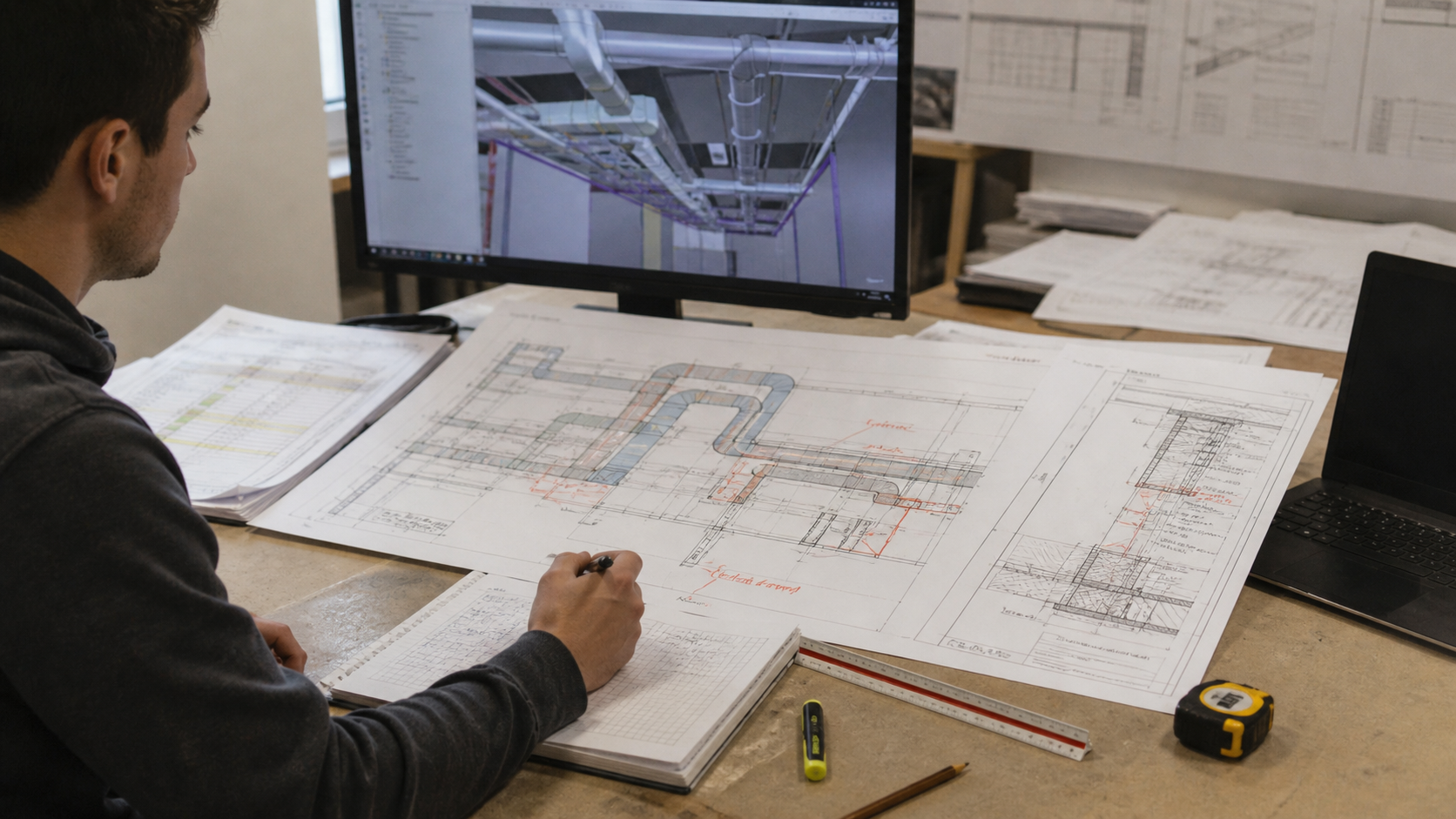
Image by ArchitectureCourses.org. Mechanical drafting often means checking ducts, pipes, ceiling space, access, and installation conflicts before work reaches the field.
Most problems with mechanical drawings do not show up on the screen. They show up later, when something does not fit, cannot be accessed, or gets installed in the wrong order.
A drawing can look clean and still cause trouble on site. That is the gap this page is about.
I would not treat mechanical drafting as a software skill. In construction, it is a coordination problem. The drawing has to survive structure, ceiling depth, access, sequencing, and real installation conditions.
What Mechanical Drawings Actually Do on a Job
In buildings, mechanical drawings are not about parts in isolation. They sit inside a system: ducts, pipes, equipment, supports, clearances, and service access.
The drawing has to answer a few practical questions:
- Does it fit inside the structure and ceiling space?
- Can someone install it without breaking something else?
- Can it be accessed later for maintenance or replacement?
- Does it conflict with electrical, plumbing, or structural work?
If the answer to any of those is unclear, the drawing is not finished.
For how this fits into full project documentation, see construction document sets and building systems basics.
Where Mechanical Drawings Break on Site
The same problems show up again and again. Not because the software is wrong, but because the drawing ignores how buildings are actually assembled.
Clearance That Looks Fine but Isn’t
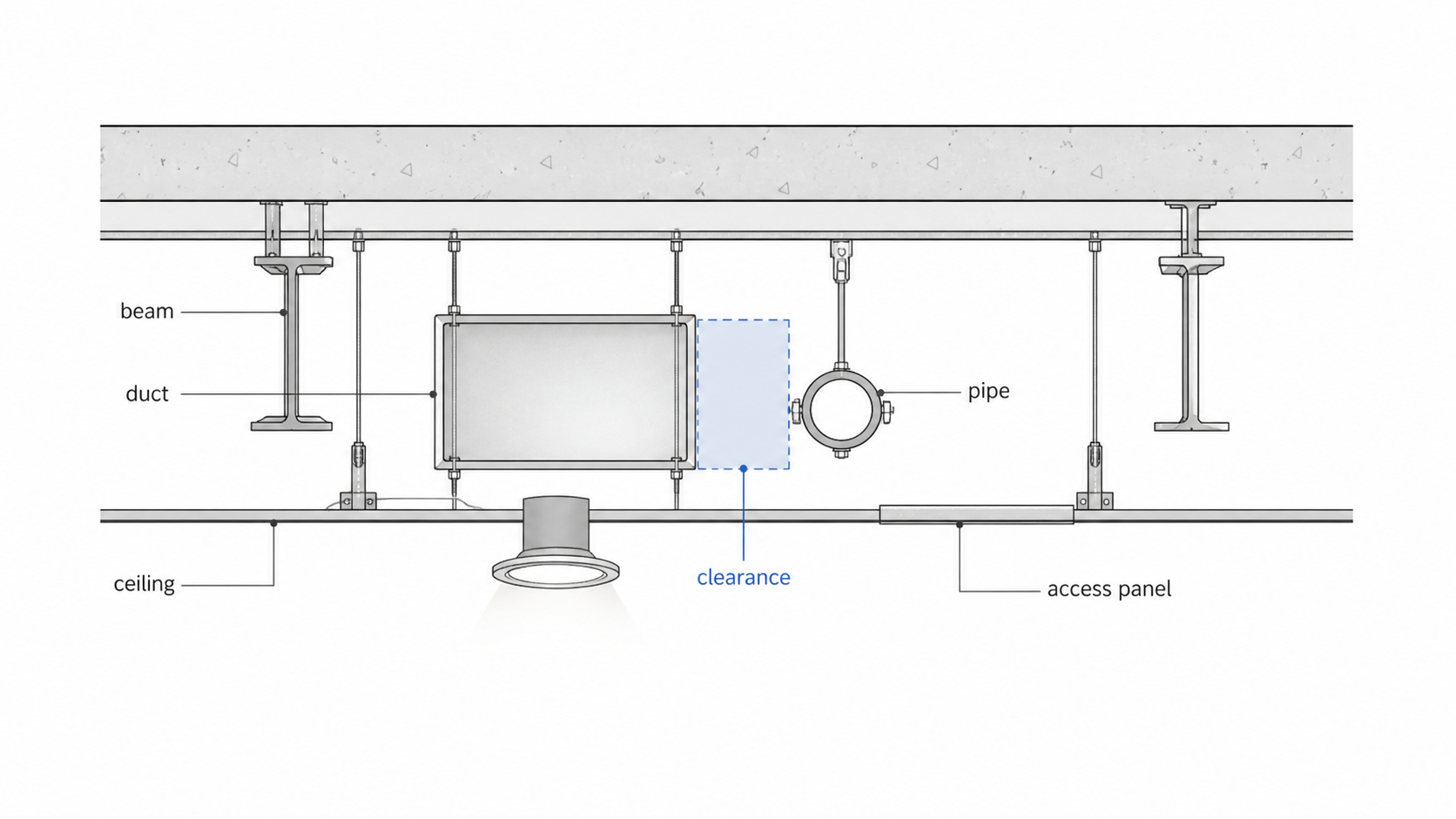
Illustration by ArchitectureCourses.org. Mechanical coordination is not just about drawing clean duct and pipe runs. Clearance, access, hangers, beams, lights, and ceiling height all have to work in the same space.
A duct or unit may technically fit between two beams on a drawing. But once insulation, hangers, fireproofing, or tolerances are added, the space disappears.
I would check the full build-up, not just the clear dimension.
No Access for Maintenance
Filters, valves, panels, and units need access. If a technician cannot reach them later, the system becomes a long-term problem.
This is one of the most common failures in tight ceiling spaces.
Trade Conflicts
Mechanical drawings rarely live alone. They compete with structure, lighting, electrical, and plumbing.
When coordination is weak, the conflict gets solved in the field, usually by whoever arrives last.
Installation Sequence Ignored
Some systems cannot be installed after others are in place. A drawing that works in isolation may fail because it does not consider order.
That is where cost starts to climb.
Shop Drawings That Don’t Match Reality
Shop drawings can look precise and still miss site conditions. Slight changes in structure, levels, or field measurements can break the fit.
This is why field verification matters.
Mechanical Drawings vs Architectural Drawings
Architectural drawings focus on space, layout, and overall building form. Mechanical drawings focus on systems that need to fit inside that space.
The conflict happens at the edges: ceiling height, shaft space, wall thickness, and service zones.
If you want to understand the architectural side better, see architectural drawings and reading blueprints.
Why “Clean Drawings” Still Fail
Clean linework does not mean a drawing is buildable.
A drawing can be visually correct and still fail because:
- critical dimensions are missing
- tolerances are ignored
- access is not checked
- coordination is assumed instead of verified
The mistake is thinking the model proves the work. It does not. The drawing still has to prove it can be built.
What to Check Before Trusting a Mechanical Drawing
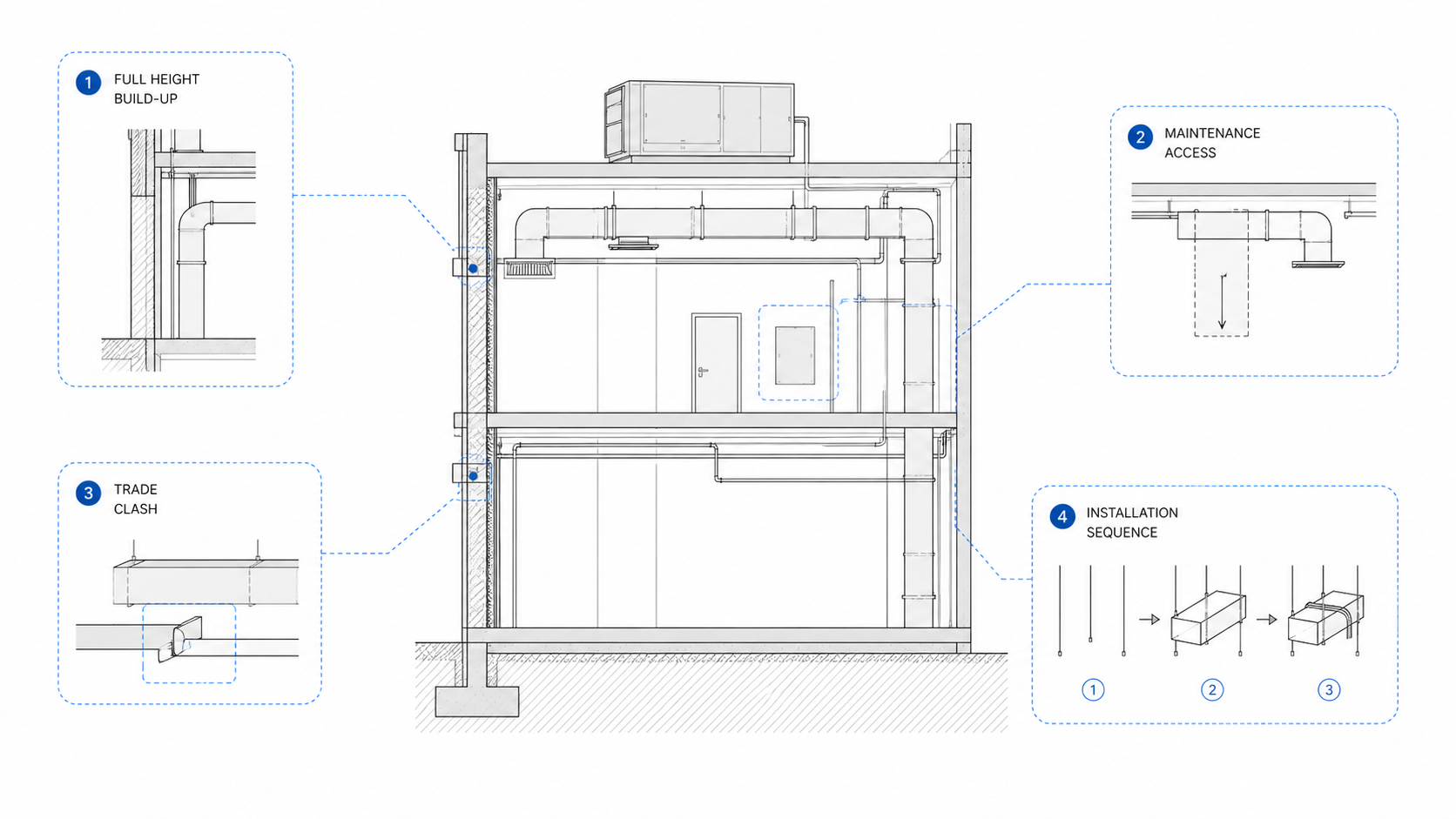
Illustration by ArchitectureCourses.org. Mechanical drawings become more buildable when the review checks height build-up, access, trade clashes, and installation sequence.
If you are reviewing drawings, these checks catch most problems early:
- Confirm full height build-up, not just clear gaps
- Check access for maintenance and replacement
- Look for clashes with structure and other systems
- Ask how the system will actually be installed
I would start with access and sequence before anything else. Those are harder to fix later than size alone.
Where This Fits in Your Work
Mechanical drafting matters most when you are:
- reviewing shop drawings
- coordinating systems in tight spaces
- planning mechanical rooms or ceiling zones
- checking contractor submittals
It is less about drawing and more about avoiding mistakes that only show up during construction.