
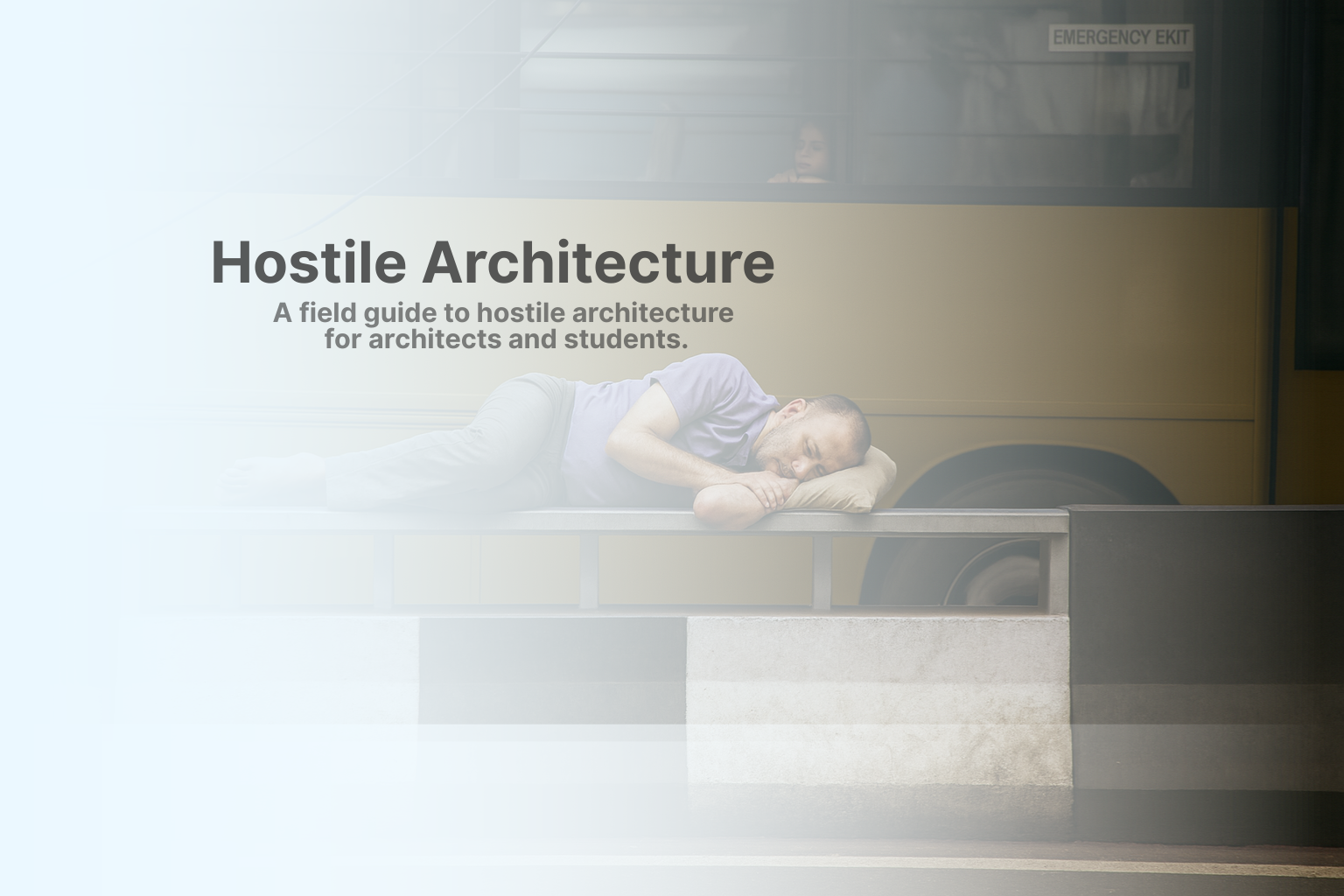
What Hostile Architecture Looks Like in Everyday Life
Hostile architecture sounds dramatic. It is also very literal. It means design choices that quietly push certain people away from public space. Usually people who sleep outside, teenagers who hang around, skaters, or anyone who stays a bit too long.
If you study architecture or work on real projects, you will meet this topic in studio critiques, design guidelines, and client meetings. It sits at the intersection of ethics, politics, risk management, and very practical detailing, the same territory you meet in human values and environmental studies.
Below is a straight guide from a design point of view. What it is, how it works, why cities use it, what it does to people, and what you can do differently in your own work.
What is hostile architecture in simple terms
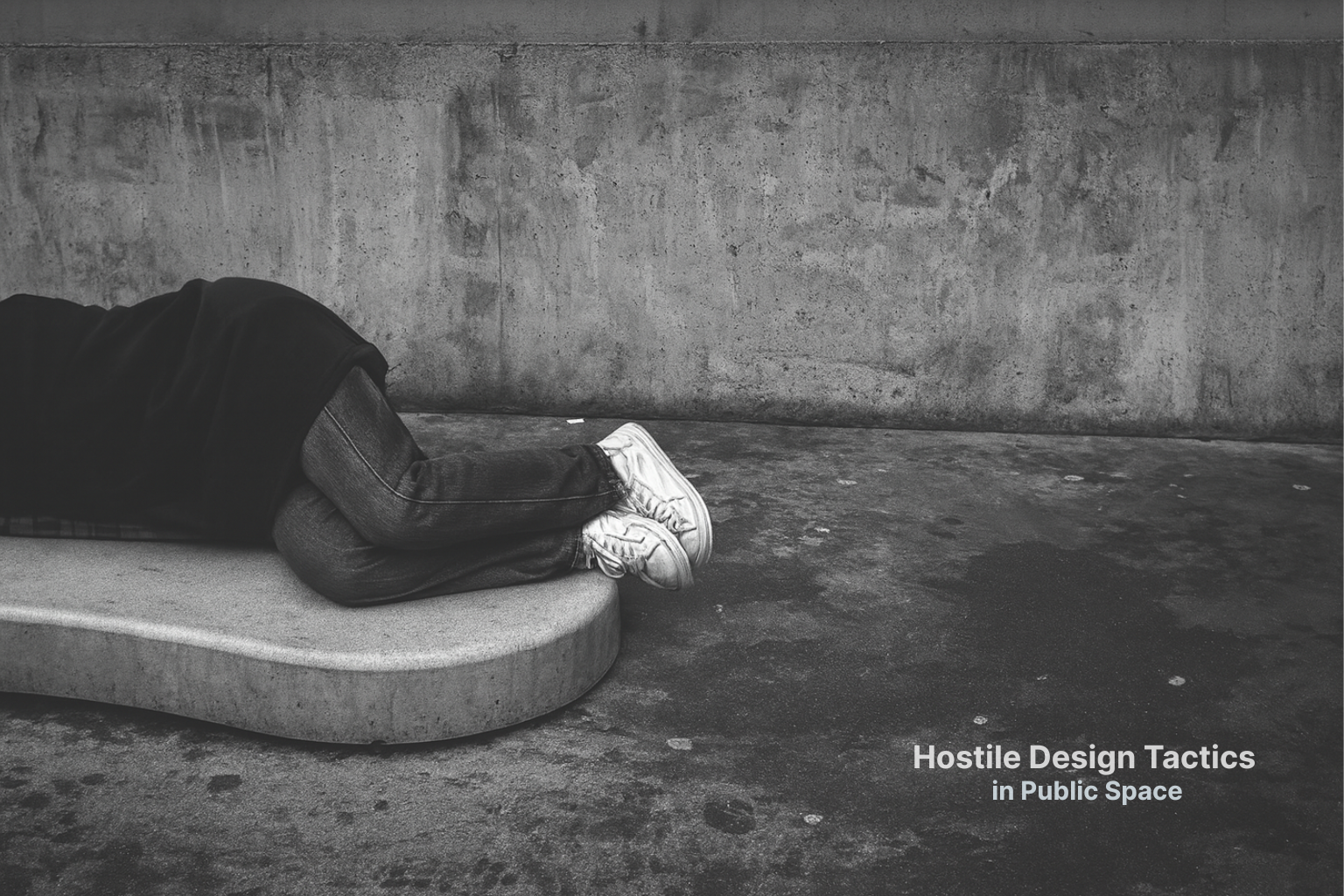
At its core, hostile architecture is any spatial or material decision whose main purpose is to control or discourage certain uses of space. It is sometimes called defensive architecture, unpleasant design, or target hardening.
You can recognize it by three things:
-
It is usually placed in public or semi public space.
-
It targets behaviors like sitting, sleeping, lingering, or gathering.
-
It is often justified as “safety,” “cleanliness,” or “order,” but it mainly filters who feels welcome.
Architects, planners, product designers, city maintenance teams, and private landlords all contribute to it, often without using the term. In many briefs it appears under headings like security, anti loitering, or CPTED (crime prevention through environmental design).
Common examples you already know
You have seen hostile architecture even if you never used the word. A few very typical ones:
Hostile benches
Benches with center armrests every 50 to 60 centimeters, or with a raised slope, or with short individual seats instead of one long slab. The stated aim is ergonomic comfort and accessibility. The side effect is that nobody can lie down. People who try to sleep there simply cannot.
Anti sleeping spikes
Metal studs or spikes placed on flat ledges, under bridges, in recessed doorways, and on low planters. They stop people from sitting or lying down. They are cheap and obvious. Once you see them, you cannot unsee them.
Hostile paving and surfaces
Gravel under bridges where people used to camp. Sharp stone textures on slopes. Raised metal strips along window ledges. Cobblestones under highway ramps that make lying down painful. These work by making the ground uncomfortable or unstable.
Anti skate detailing
Metal “skate stoppers” on handrails. Angled edges instead of square ones. Rough textures on perfect ledges. These details protect railings and stone from grinding and chipping. They also erase a whole youth culture from the space.
Divided ledges and planters
Planter edges broken into small segments with gaps or protrusions. Wide ledges cut with bumps or bollards. This prevents people from lying down and from using edges as informal seating.
Excessive railings and barriers
Guardrails that stretch far beyond the actual hazard. Fences under bridges and along flat lawns. Triumph of “keep out” over “how can this be used safely.”
Acoustic and light tricks
High pitch sound emitters near shop fronts at night, targeted at young ears. Blue or very cold lighting in underpasses and bathrooms to make it harder to see veins. Continuous music loops that make people want to move on.
Time locked public space
Nice plazas that close early. Parks with heavy gates. Benches removed at night. Public furniture treated as temporary props instead of essential infrastructure.
Every item above can be defended as “practical.” That is why hostile architecture is so slippery. It often hides behind technical language.
Why cities and clients use hostile design
You will hear several recurring arguments from municipalities, property managers, and some architects. Take them seriously, but also look at what is left unsaid.
1. Maintenance and cleanliness
Argument: “People sleep here, leave trash, use it as a bathroom. We cannot keep up with cleaning.”
Reality: Cleaning and maintenance budgets are tight. Hostile details are seen as a one time fix. It shifts the problem away from this specific corner. It does not solve the root cause.
2. Safety and liability
Argument: “We have to prevent crime and protect users. If someone gets hurt, we get sued.”
Reality: Some defensive detailing is justified. Good lighting, clear sightlines, and real barriers at dangerous edges protect everybody. The line is crossed when safety becomes a cover for excluding specific groups rather than reducing real risk.
3. Pressure from nearby businesses and residents
Argument: “Shop owners complain. Residents complain. People do not feel comfortable. We need to act.”
Reality: Complaints travel faster than praise. The loudest voices are often the most privileged. Design starts to serve them, not the wider mix of city users.
4. Cheap and quick compared to social services
Argument: “We cannot fix homelessness or poverty. We can at least stop people sleeping in this doorway.”
Reality: Built measures are cheaper and more visible than support systems. Spikes cost less than outreach. This creates the illusion of “doing something” while avoiding harder decisions.
5. Brand control and property values
Argument: “The space must match the image of our development. Our tenants pay premium rent.”
Reality: Public space attached to high value property is often curated for one narrow type of user: shoppers, office workers, condo owners. Everybody else becomes “out of place” by design.
As a designer you will hear these points in meetings. You cannot ignore them. However, you can question the brief, propose alternatives, and show how inclusive design still manages risk.
Hostile architecture and its real impact on people
Hostile architecture is not just about ugly spikes or bad benches. It is about how a city decides who belongs and who must move along. As an architect or student, you hold a small part of that decision every time you set a detail or argue in a meeting.
You will not win every battle. Clients will push for control. Consultants will demand hard edges. Budgets will be tight. Still, you can keep asking the simple questions. Who is this comfortable for. Who does this quietly punish.
Design that respects ordinary human needs is never wasted. It may not be flashy, but it works.
Who feels the impact first
Hostile architecture does not affect everyone equally.
People who sleep rough
Anyone without stable housing feels these design decisions in their body. Every new armrest, spike, or broken ledge is one fewer place to rest. Sleep deprivation then affects health, job prospects, and sanity. Architecture becomes a tool of punishment.
Low income workers and commuters
Shift workers waiting for late buses. Delivery drivers between jobs. Cleaners who sit outside for ten minutes after a night shift. When benches disappear or become uncomfortable, these people lose legitimate rest points in their daily route.
Teenagers and youth cultures
Teenagers who skate, sit on steps, or hang around plazas are common targets. They are labeled as trouble even when they are just visible. Hostile detailing tells them: you are only welcome here when you spend money or pass through.
Older people and disabled users
The irony is that certain anti loitering measures also hurt the very groups that planners claim to protect. Short benches with awkward angles. Planters that remove flat edges. Surfaces that are hostile to wheels and mobility aids. Rest spots become scarce and unequal.
Parents and caregivers
Anyone moving with kids needs pauses. If there are no comfortable, generous places to sit, the city becomes harder to use. Care work loves generous benches and shade. Hostile design erodes that.
How to spot hostile architecture as a designer
Anti homeless architecture examples
Train your eye. Next time you walk through your city, look for the same patterns you map when you study Kevin Lynch’s five elements of the city:
● Seating that seems almost, but not quite, comfortable.
● Surfaces that look deliberately broken or spiky in spots where someone might sit.
● Handrails and ledges with little metal bumps at regular intervals.
● Bridges and covered spaces where the ground material changes exactly where someone might lie down.
● Spaces that look public but behave like private property, with heavy surveillance and quick security responses.
Ask simple questions:
Who can rest here for 20 minutes without buying anything.
Who can stay for an hour.
Where could you lie down if you were exhausted or sick.
Most hostile architecture is exposed by those questions.
Design ethics: what are we really doing to people
Architectural training often talks about “serving the public.” In practice, every project has a defined client and a narrower user group. Hostile architecture exposes this tension.
Public space as a filter
Instead of seeing space as shared, many contemporary projects treat it like a funnel. Good users in, bad users out. The criteria are rarely written openly. Poverty, youth, visible mental illness, and non consumer presence become quiet reasons to exclude.
Criminalizing ordinary human needs
Lying down, resting, staying warm, gathering with friends. These are basic needs. Hostile architecture treats them as suspicious if they happen in the wrong spot or by the wrong person. Design becomes part of a disciplinary system that punishes visible poverty.
Designers as quiet enforcers
Architects love to talk about social impact when it feels positive. It is harder to accept that the bench detailing you draw can cause real suffering to people who have nowhere else to go. The lines you put in CAD can enforce policy just as effectively as a police patrol.
Recognizing this does not mean every project must solve homelessness. It does mean you cannot hide behind “I was just following the brief.” Ethics in architecture lives in the details.
Where hostile architecture comes from historically
This is not a brand new idea. Versions have existed for centuries.
Medieval cities used spikes, gates, and rough stone elements to control movement and defend against attack. Early industrial cities used park design to keep workers’ leisure heavily supervised. Modernist housing estates used separating distances, fences, and controlled entry points to filter who could enter semi public space.
What feels new now is the combination of:
● Highly privatized public space.
● Strong security and surveillance culture.
● Intense pressure on city centers to feel “clean” and “safe” for tourists and high income users.
Hostile architecture in the twenty first century is less about fortifying against armies and more about controlling poor and marginalized individuals. The language softened, but the logic stayed sharp.
Better questions to ask in studio and practice
If you are working on a plaza, park, transit stop, or street section, try asking these questions at concept stage:
1. Who absolutely depends on this space
Think about bus riders, care workers, low wage staff, kids, older people, people without cars, people without homes. Their needs should drive the baseline. Shade, seating, shelter, toilets, water, and safe movement.
2. What behaviors are we trying to block, and why
Be honest. Is it truly dangerous behavior, or is it visible poverty or youth culture. “We do not want people to sleep here” is not a neutral statement. Challenge it.
3. Can we separate safety from exclusion
Good lighting, clear sightlines, removing hidden corners that invite assault or harassment. These improve safety for everyone without punishing people who rest. Make those your first line of defense, not spikes.
4. What are the unintended targets
If you add armrests to prevent sleeping, test them with older users and wheelchair users. Do they still find the bench usable. If you roughen the pavement, test it against strollers and mobility aids.
5. Are we honest on drawings and visuals
Try including people who sleep rough or loiter in your visuals sometimes. It forces you to face who the space currently serves and who it might displace. Too many renders show only fashionable couples and tidy families.
Designing alternatives to hostile architecture
You cannot fix housing policy with a bench. You can still choose details that are less cruel and more intelligent, grounded in human centered design and architecture rather than punishment.
Generous seating instead of anti sleeping benches
Use long, continuous benches with optional short backrests at intervals rather than fixed armrests that cut the seat. Think in terms of zones, not rigid divisions. Allow lying down in some places. Support sitting with backs in others.
Real shade and shelter
Instead of pointy planters under bridges, provide durable surfaces, lighting, and trash control. Work with maintenance teams on realistic cleaning strategies. It is cheaper and kinder than permanent deterrent measures.
Edges that invite use
Design planter edges, low walls, and wide steps as informal seating. Accept that people will sit, lean, and gather. Detail them to be robust and easy to clean instead of trying to stop use altogether.
Skate friendly zones
On large plazas or campuses, dedicate specific edges for skating and protect others structurally. Work with local skaters, not against them. You can gain informal surveillance and lively space in return.
Clear rules, not silent punishment
If a building truly cannot host sleeping, use open signage that explains why and offers directions to nearby shelters or services. It is still exclusion, but at least it is honest and paired with information. Silent spikes are pure hostility.
Work with social supports, not instead of them
In real projects, propose that part of the “security” budget supports outreach or staff presence instead of more hardware. A visible human presence, trained in de escalation, often works better than a strip of studs.
Studio work: how to critique and design around it
If you are in school, you might be tasked to redesign a plaza or an underpass where homeless people currently sleep. Tutors and visiting critics often throw in phrases like “activate the edge,” “clean up this corner,” or “make the space feel safer.”
Treat those as prompts to ask deeper questions, not as orders to remove people.
In your drawings and models:
● Show where people rest, including rough sleepers.
● Map noise, light, wind, and rain.
● Show which parts of your design offer real comfort for long stays.
● Show what happens at 2 am, not only at golden hour.
In your verbal presentation, be explicit:
“I am not using hostile detailing. I am instead placing seating with clear sightlines and lighting, and accepting that some people will rest here for long periods. The real safety strategy relies on visibility and shared use, not on exclusion.”
This kind of language pushes the conversation toward policy and away from knee jerk “clean it up” comments.
Common mistakes architects make about hostile design
Treating it as a niche activist topic
Hostile architecture is not a niche Twitter debate. It is everywhere. Parking lots, bus stops, pocket parks, campuses. If you think it is fringe, you will design it without noticing.
Seeing only aesthetics, not power
Many defensive details look minimal and stylish. Thin rails. Clean concrete. Bare benches. It is easy to judge them only by form. Always ask what the form is doing to people’s bodies and choices.
Over trusting security consultants
CPTED and security consultants can bring useful insights about real risk. They can also push for aggressive exclusion by default. You are allowed to question and negotiate. You are the one whose drawings carry the final form.
Designing for the “ideal user”
Nice renders show healthy adults, walking briskly, holding coffee. Real cities hold people who move slowly, carry bags, use wheelchairs, push carts, or sleep. Forgetting this leads to hostile choices even when you never meant harm.
How to use this knowledge in your career
You do not need to become a full time activist to resist hostile architecture. Small decisions add up.
In early career jobs
You might not control the brief, but you can:
● Flag obviously hostile details to your project architect and suggest alternatives.
● Draw sections that show how a bench feels to someone lying down or stretching their legs.
● Ask for clarity in design meetings when someone says “we want to stop loitering.”
Sometimes you will lose these fights. Keep asking anyway. It teaches people in the office that these things are visible and not neutral.
In competitions and concept work
Write short concept lines about inclusive public space instead of vague “vibrant, safe, clean” slogans. Show details that invite use rather than block it. Juries notice when projects feel generous, even when you test more experimental work like parametric brick facade concepts with AI.
In teaching and studio crits
If you ever teach, push students to map who their spaces exclude. Ask them where someone can rest, where kids can play, where someone can sleep if they have nowhere else. This trains better designers.
FAQ
Is all security design hostile architecture
No. Real safety interventions protect everybody from harm. Hostile architecture targets specific groups and ordinary needs like resting or sheltering.
Can a bench with armrests ever be ok
Yes. Armrests can support older users and people with limited mobility. The problem is when every bench is broken into tight segments and there is nowhere in the whole area where lying down is possible.
Is it realistic to design inclusive space in a city with high homelessness
You cannot fix structural problems alone, but you can refuse to add extra cruelty. Designing rest points, shade, and clear sightlines is realistic. Spikes are a choice, not an inevitability.
Does hostile architecture work
It “works” in the narrow sense of pushing people away from specific spots. It does not solve the underlying issue. It also damages trust in public institutions and makes cities colder for everyone.