
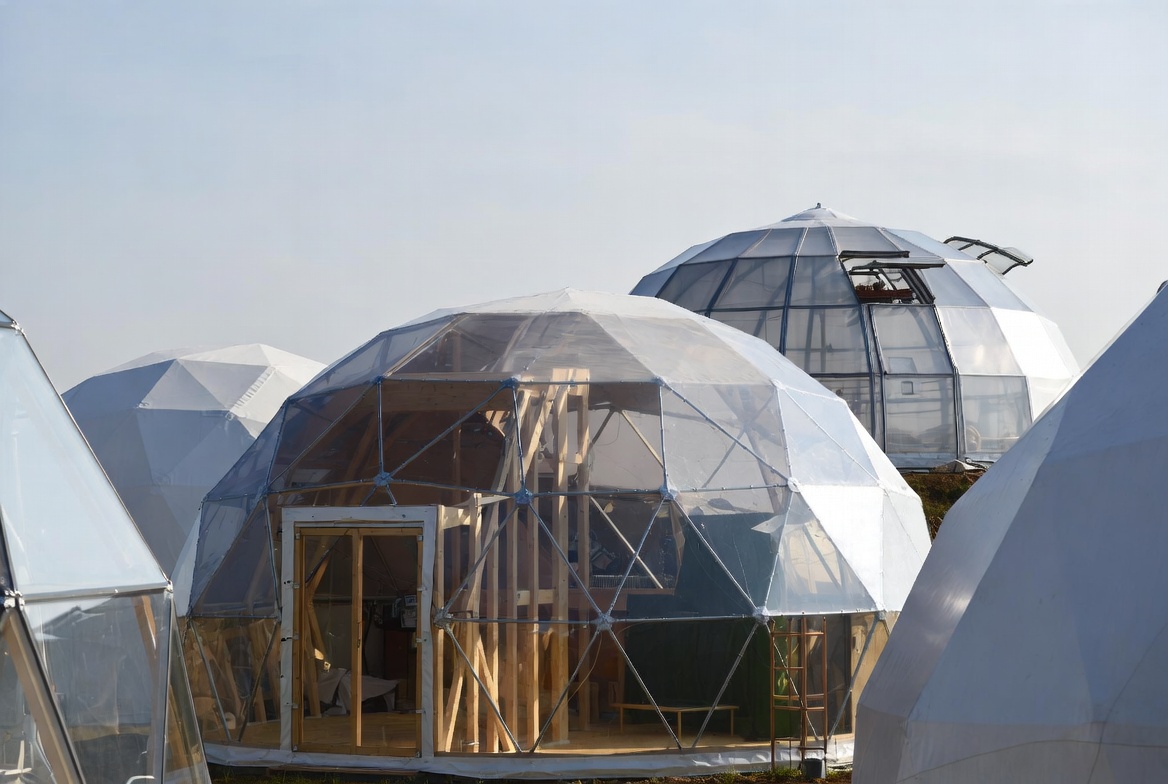
Geodesic domes can be structurally efficient. That does not make them easy houses.
The frame makes sense fast enough. Triangles are stable. Loads get shared. The shell can cover a lot with relatively little material. The harder part shows up later: roofing, seams, glazing, insulation, air sealing, interior layout, financing, and repairs.
Geodesic domes work best when the shell itself is part of the point and the project is ready for custom detailing. They work worst when somebody buys the idea of efficiency and assumes the rest of the house will be simple.
What A Geodesic Dome Is
A geodesic dome is a curved structure built from many short members arranged into a network of triangles. Buckminster Fuller made the form famous because it could enclose a lot of space with relatively little material.
The triangle matters because it is not casual geometry. A rectangle can rack. A triangle holds its shape. Repeat enough triangles across a dome and the shell starts behaving as a system instead of a collection of weak individual spans. That is the part people are usually pointing to when they call geodesic domes strong for their weight.
But strength is only half the story. The same geometry that helps the structure also creates a lot of joints, a lot of angle changes, and a lot of places where structure, weatherproofing, finish work, and interior planning all have to agree. That is where the reputation of the geodesic dome gets more complicated.
A geodesic dome is also not the same as every other dome. It is not a monolithic concrete dome. It is not a fully glazed dome. It is not a fabric glamping dome. People lump all of those together, then wonder why the advice gets muddy.
Why Triangles Still Matter
The structural case for geodesic domes is still the cleanest argument in their favor.
A triangulated shell spreads loads across many members instead of asking a few long members to do everything. That helps explain why geodesic domes can span a surprising amount of space without relying on the same interior support logic you would expect in a more conventional framed building. The form also encloses a lot of interior volume relative to its surface area, which is why dome advocates keep coming back to efficiency.
Still, “efficient” needs some restraint. A good shell does not automatically make a high-performance building. A poorly detailed geodesic dome can still leak air, overheat, trap condensation, and burn money on awkward finish work. The geometry gives you opportunities. It does not excuse weak building science.
The better way to hold it in your head is this: a geodesic dome gives you a strong structural idea and a compact enclosure idea. It does not give you a finished house by itself.
Worth Knowing: if your interest in domes is mostly residential and not structural, step back to Dome Houses first. This page assumes the geometry itself is the thing you are evaluating.
The Shell Is Not The House
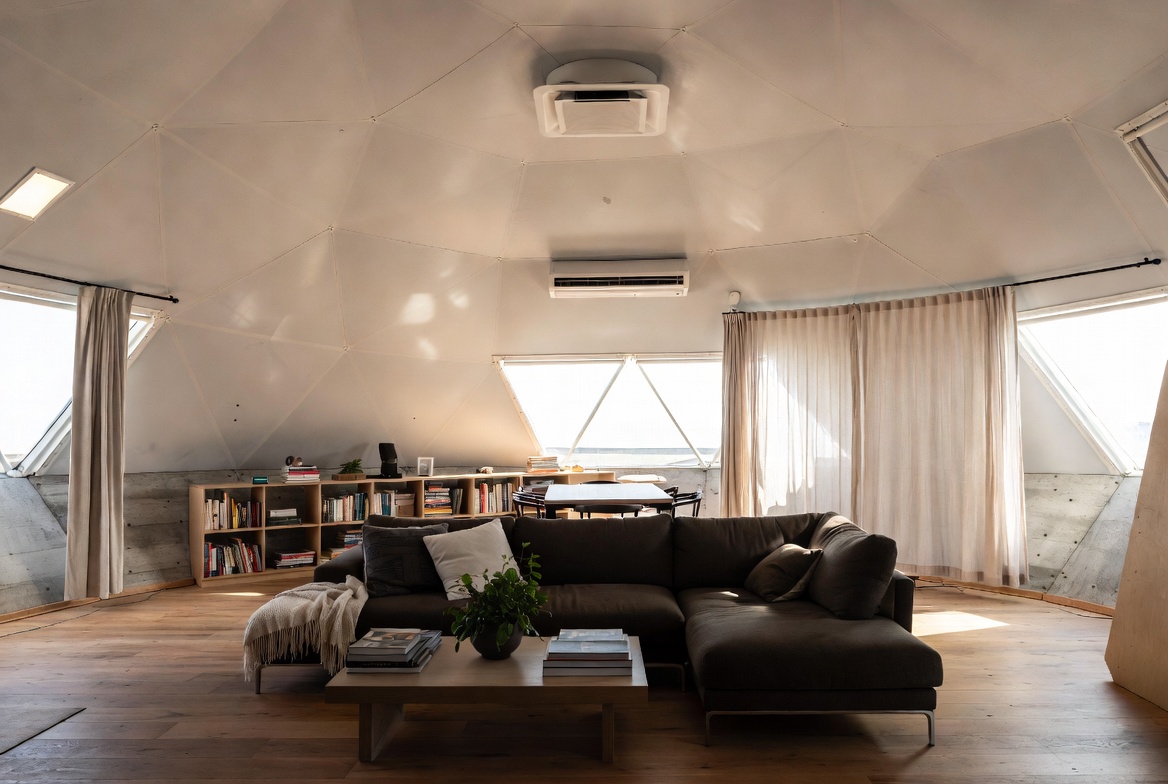
A finished geodesic dome interior showing everyday livability, daylight control, and visible HVAC. Image by ArchitectureCourses.org.
This is where a lot of geodesic dome projects go sideways. Buyers fall in love with the shell, then act surprised when the rest of the house is still hard.
A geodesic dome frame can go up fast compared with the full build that follows. That visual speed is misleading. The shell is just one layer in a much longer chain: foundation, frame, weather skin, openings, insulation, air control, moisture control, interior framing, stairs, lofts, storage, mechanicals, finishes, and all the strange little edge conditions that come from trying to live inside a faceted curve.
Most residential geodesic domes are assembled from repeated struts and connection points, or from prefabricated panels that reduce some of the field layout. Either way, the clean geometry of the frame hides a much messier reality once the house has to become weather-tight, insulated, and livable.
Older dome projects are part of why the form still scares some buyers. The repeated complaints are not random. Seams. Leaks. Hard-to-trace water entry. Awkward furniture. Expensive reroofing. Interiors that looked dramatic but did not absorb ordinary life very well. That does not mean every geodesic dome is a mistake. It means the shell has to be treated as the start of the project, not the shortcut that solves it.
That is why the geodesic dome sits in a strange place in residential construction. Structurally, it can be smart. Domestically, it asks for much more discipline than the diagrams suggest.
Low-Frequency Vs High-Frequency Domes
One practical decision shows up early: how smooth do you want the dome to be, and how many pieces are you willing to manage to get there.
Lower-frequency domes use fewer, larger triangles. They are simpler, cheaper to fabricate, and easier to understand. They also read as more faceted, because they are. Higher-frequency domes use more pieces and create a smoother curve, but the price of that smoother geometry is more joints, more connectors, more cutting, and more places where small errors can stack up.
| Option | What You Gain | What You Pay For It | Best Fit |
|---|---|---|---|
| Lower frequency | Fewer parts, simpler layout, easier assembly logic | More faceted appearance, rougher fit for some openings and finishes | Small domes, simpler builds, tighter budgets, secondary structures |
| Higher frequency | Smoother curve, more refined appearance, better for some larger shells | More members, more joints, more labor, more enclosure discipline required | Larger domes, higher-design projects, teams prepared for more detail work |
This sounds abstract until labor and enclosure work show up. Then it stops being an aesthetic choice and starts being a construction choice.
Wood, Steel, And Panelized Systems
Most geodesic domes end up in one of a few familiar material paths. None is universally best. Each one solves one problem and creates another.
| System | What Actually Works | Where It Starts Hurting | Use This When |
|---|---|---|---|
| Wood-framed geodesic dome | Accessible materials, easier field modification, warmer interior feel | More sensitivity to moisture mistakes, more long-term concern at repeated joints and roof transitions | You want a residential build that can still be adapted by conventional trades with the right guidance |
| Steel-framed geodesic dome | Strong, durable, useful for large spans and some prefab systems | Thermal bridging, connection detailing, corrosion risk if the enclosure strategy gets sloppy | Span, prefabrication, or structural durability is the main priority |
| Panelized or kit-based geodesic system | Faster shell assembly, more predictable fabrication, cleaner repeatability | Buyers can overestimate how much of the full house is actually solved | You want the shell package standardized but still understand that interior and weatherproofing work remain |
| Fully custom one-off dome | Maximum control over layout, openings, and finish quality | Higher design cost, more coordination, more opportunities to invent problems | The project is explicitly custom and budgeted that way from day one |
The weak move here is treating material choice like a brand identity question. The better move is to ask which system your team can detail, insulate, weatherproof, and repair without improvising half the project on site.
How It Actually Goes Together
Dome articles skip this part too often. A geodesic dome is not built in one magic step.
First the project has to choose the dome size and frequency, because those decisions control how many pieces the shell needs and how complicated the assembly becomes. Then the frame system gets locked in: wood, steel, panelized kit, or a more custom approach. After that comes the connection logic. Some domes rely on repeated hubs and struts. Others reduce some of the field work with prefabricated panels or pre-cut members.
Then the hard part starts. The weather skin. Openings. Insulation. Air barrier. Water control layer. Interior framing where the program needs it. That sequence matters. A geodesic dome gets expensive when somebody treats shell assembly as the whole build and leaves the enclosure strategy floating until later.
The cleaner way to think about the job is simple: the frame gives the dome its shape, but the enclosure layers decide whether it performs like a house or just looks like one.
Why Older Geodesic Domes Get A Bad Reputation
The bad reputation did not come from nowhere. A lot of older geodesic domes were punished by exactly the things that still matter now: too many seams handled casually, roofing systems that did not really want to be on that geometry, weak air sealing, awkward glazing decisions, and owners discovering too late that the local labor pool did not love working on them.
There is also a simple human factor here. A geodesic dome attracts people who like the idea of doing things differently. That can be good. It can also mean projects get pushed ahead on enthusiasm before the detailing is mature enough. Some older dome homes were built by ambitious owner-builders. Some were built in eras when energy detailing and moisture control were weaker across the whole housing market, not just in domes. The shell made those weaknesses more visible.
That is why modern dome advocates are not completely wrong when they say newer detailing can fix a lot of older problems. It can. But only if the project uses that knowledge. A geodesic dome is still less forgiving than a simple, well-detailed conventional roof and wall package.
So yes, some of the old warnings are dated. The core warning is not.
Do This Instead Of This
| Do This Instead of This | Better Move | Weaker Move | Why The Better Move Wins |
|---|---|---|---|
| Price the finished building | Budget for shell, openings, insulation, air sealing, interiors, and labor | Comparing a kit price to a finished conventional house | The shell is only one cost layer, and often not the one that breaks the budget |
| Choose the weather skin early | Coordinate frame, sheathing, membrane, flashing, and penetrations together | Putting up the frame first and letting roofing become a late-stage problem | On a geodesic dome, enclosure logic is not secondary. It is the job. |
| Design around usable wall height | Put storage, stairs, baths, and low-priority functions where the geometry is least forgiving | Assuming every part of the perimeter will behave like a normal wall | Interior frustration usually starts at the edge of the shell |
| Use glazing selectively | Orient and shade openings based on climate and comfort | Adding lots of glass because the dome looks more exciting that way | Glass can improve a geodesic dome or turn it into a glare and overheating problem |
| Test finance and insurance early | Talk to lenders, insurers, and appraisers before locking the plan | Assuming an engineered dome will automatically be treated like any other custom house | Unusual properties often move through narrower channels |
Where Geodesic Domes Work Best
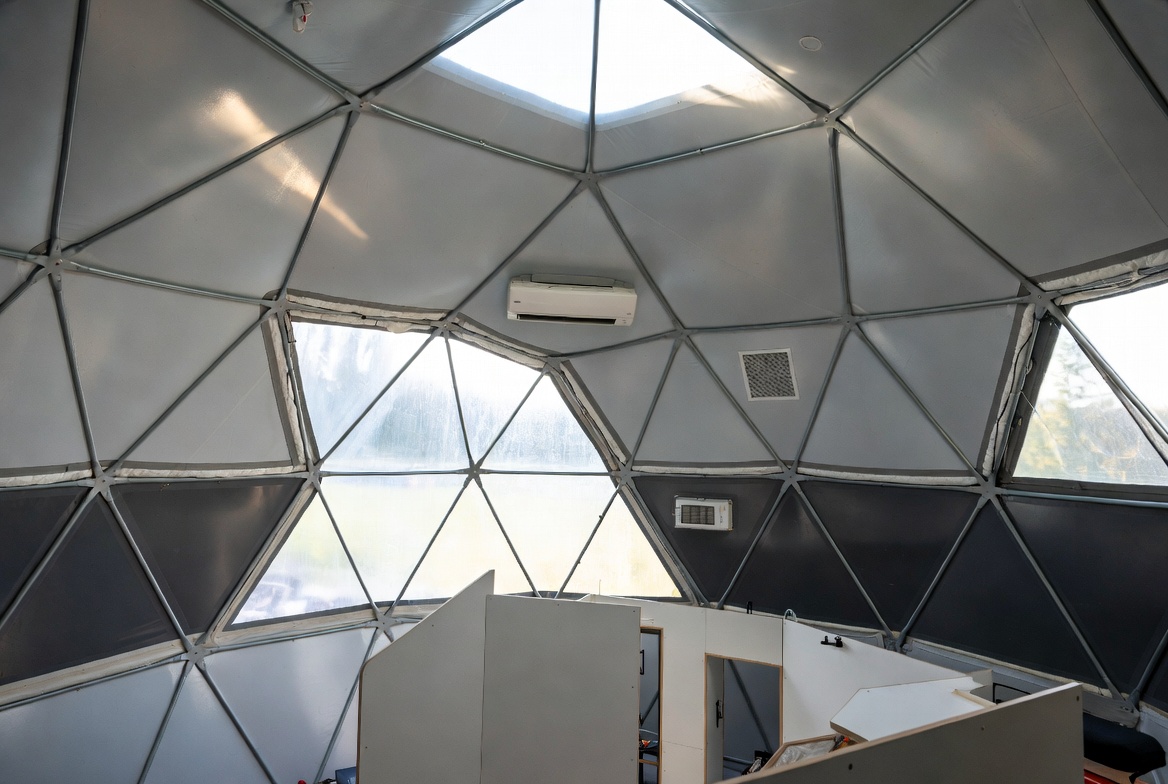
A geodesic dome interior with visible shell geometry, skylight, vents, and mini-split HVAC. Image by ArchitectureCourses.org.
Geodesic domes work best where span efficiency, structural identity, and compact enclosure matter more than conventional room planning.
That usually means a few familiar conditions: small cabins and retreats, distinctive custom homes where the owner knows exactly what they are signing up for, greenhouses and growing structures where the geometry supports light and enclosure goals, event structures, educational or experimental projects, and rural sites where the building does not have to blend into a neighborhood of ordinary comparables.
This is also why geodesic domes often do better as secondary structures than as ordinary family houses. The shell works. The tension starts when the building is asked to behave like a standard house in every domestic way while still refusing most of the assumptions standard houses rely on.
Before You Move On: if the dome is really for plants, not people, the better branch is Greenhouse Domes. A greenhouse dome is a different performance problem with a different success criteria.
Where They Fight The Program
Geodesic domes fight the program when the house needs too much ordinary wall behavior.
Kitchens want long, efficient runs. Closets want depth. Bathrooms want simple partitions and clean waterproofing transitions. Bedrooms want furniture to land normally. Families want storage in places that do not feel like apologies. The more a house depends on those everyday moves, the more a geodesic dome has to compensate with built-ins, custom planning, partial flat-wall strategies, or attached rectilinear spaces that take pressure off the shell.
This is why some of the better geodesic projects stop trying to make the dome do everything. The shell may hold the main volume while service spaces or connectors resolve the ordinary parts of life in more cooperative geometry. That can be a smarter building. It is also a quiet admission that pure dome living is more romantic on the outside than easy on the inside.
If the project you want is mostly about daylight, views, and transparency, the geometry is no longer the only question. At that point the envelope takes over, and Glass Dome House becomes the more useful page.
Permits, Engineering, And The Nonstandard Path
Geodesic domes are not impossible to permit. They are just rarely plug-and-play.
In most jurisdictions, the issue is not that a dome is forbidden. The issue is that it usually has to be demonstrated, detailed, and reviewed as a nonstandard residential design. That means engineering matters more, and the clarity of the documentation matters more. The building department needs a real answer for structure, enclosure, life safety, energy compliance, and the rest of the normal code stack. “It is a dome” is not an answer.
That is why dome projects often move through the code conversation as alternative methods or custom-engineered assemblies rather than through a simple prescriptive path. If the team is ready for that, fine. If the team expected a normal permit package with a quirky shape, the process gets longer fast.
The lending side can be similar. Unusual properties are often judged on structural soundness and marketability, but the underwriter and appraiser may still have a narrower path than they would on a conventional house. That is not a reason to kill the project. It is a reason to stop pretending the paperwork is ordinary.
The Detail People Miss
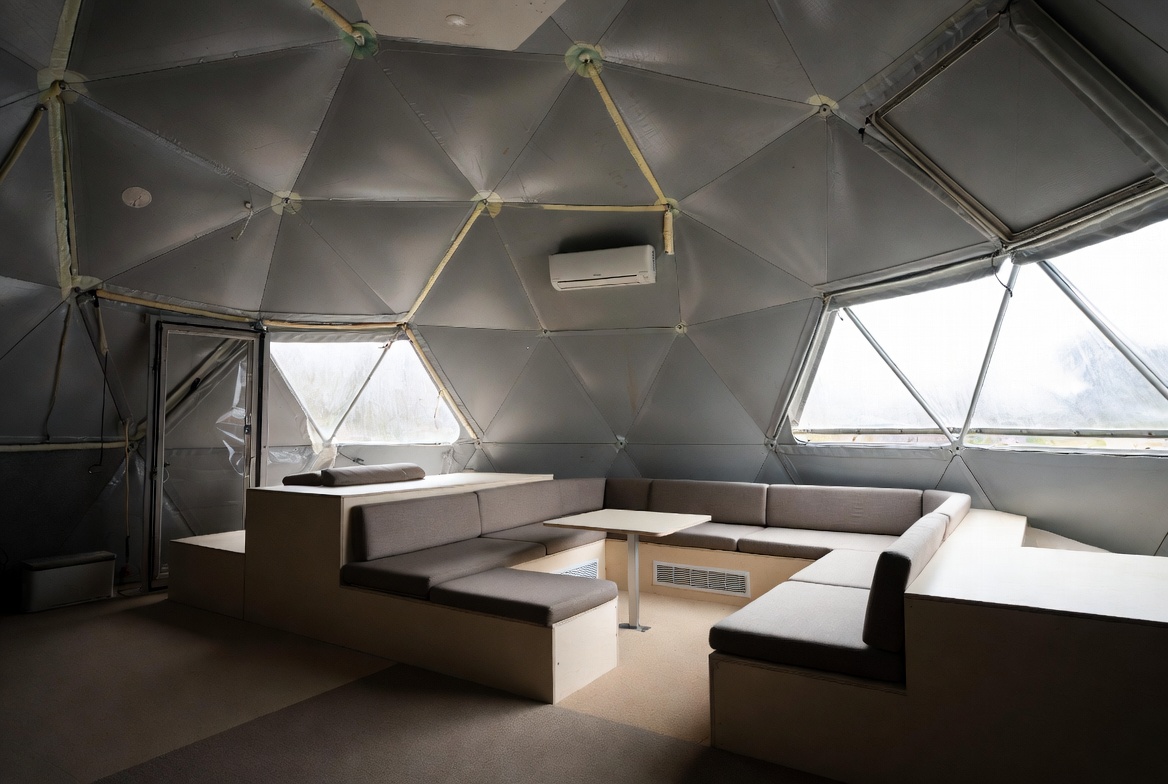
A compact geodesic dome interior showing built-in seating, window openings, and HVAC equipment. Image by ArchitectureCourses.org.
The detail people miss is not the hub connector. It is the air and water layer.
Everyone remembers the frame. Fewer people remember that a geodesic dome is a joint-heavy enclosure that only performs well when the air barrier, water control layer, insulation strategy, and ventilation strategy work together. That is not dome mysticism. It is ordinary building science under less forgiving conditions.
Good geodesic dome projects are obsessive about continuity. Continuity of the weather layer. Continuity of the air control layer. Continuity of insulation where the system allows it. Continuity of responsibility matters just as much. Somebody has to own the shell details. If five trades are each solving one small piece without a shared logic, the enclosure starts drifting apart before the house is even finished.
This is also where glazing gets dangerous. DOE guidance on passive solar design is still blunt on the basics: orientation matters, shading matters, thermal mass matters, and too much unshaded glazing can become an overheating problem. A geodesic dome does not escape those rules because the structure is beautiful. It may need them more.
A Short Checklist Before You Build One
- Do you want a geodesic dome because the shell itself solves a real problem, or because the image is strong?
- Have you priced the finished building, not just the kit or frame package?
- Do you know what the weather skin is and who is detailing it?
- Have you tested storage, stairs, bathrooms, and kitchen layouts against the shell geometry?
- Is your glazing strategy based on climate and orientation, not just appearance?
- Have you asked lenders and insurers about the property type early enough to matter?
- Does the permit set explain the dome clearly as a real engineered building and not a novelty structure?
If more than two of those answers are still vague, the project is still in the fascination stage, not the ready stage.
Read This Next
Use this page to decide whether geodesic geometry is the right structural family. Then narrow down.
- Dome Houses if you need the broader residential call first: who dome living fits, where layout and resale get tricky, and why some owners stay happy while others do not.
- Glass Dome House if the real question is not the triangulated shell but how much glazing a dome can take before comfort, privacy, and condensation start pushing back.
- Greenhouse Domes if your project is about growing conditions, not full-time residential use.
FAQ
Are geodesic domes strong?
Yes. That is one of their clearest advantages. The triangulated shell distributes loads efficiently, which is why geodesic domes are strong for their weight. But structural strength alone does not guarantee a good house.
Are geodesic domes energy efficient?
They can be, but not automatically. A compact shell helps, but insulation, air sealing, glazing discipline, ventilation, and moisture control still decide whether the building performs well.
Why do some geodesic domes leak?
Usually because the dome has many joints and angle changes, and the weatherproofing strategy was weak, mismatched to the geometry, or poorly maintained. Older domes gave this issue a lot of visibility.
Are geodesic domes cheaper to build?
Sometimes the shell looks cheaper early. That does not mean the finished building is cheaper. Interior fit-out, openings, weather skin, custom labor, and dome-specific detailing can erase that advantage fast.
Can a geodesic dome work as a full-time house?
Yes, but it works best when the plan is disciplined and the owners are comfortable with a more custom interior logic. It is usually a better fit for intentional custom living than for people who want a house to behave conventionally in every way.
Are geodesic domes hard to finance or insure?
Sometimes. Because they are unusual, some dome projects run into narrower appraisal, underwriting, or insurance paths than a conventional house would. It is smarter to test that early.