
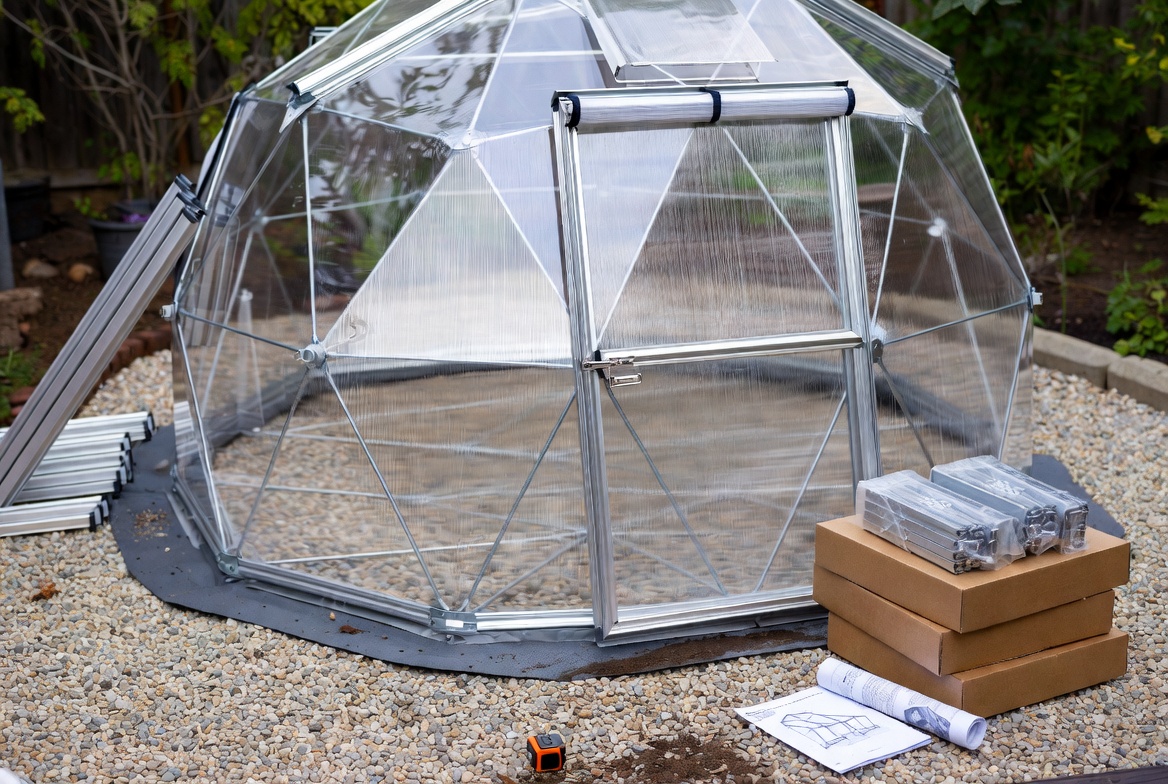
Greenhouse dome kits get sold two ways.
First as a shape. Bright photos, curved shell, snow outside, tomatoes inside.
Then as a build. Diameter, foundation, shipping, venting, panel thickness, fan upgrades, and whether the “kit” is a real greenhouse package or mostly a shell you still have to finish.
That is where shopping gets messy.
Some dome kits are fairly complete. Some are closer to a starter package. Some cost more because they solve more of the hard part for you. Size matters, but it is not the whole story.
Current listings make that obvious. A 42-foot Growing Spaces kit is listed at US$54,750, and Arctic Acres lists a 42-foot kit at C$54,950 plus taxes and delivery. Growing Spaces also notes that shipping, installation, and owner-supplied items are extra.
Start With The Real Buying Question
The real buying question is not “How big a dome do I want?” It is “How much growing space do I need, in what climate, with what level of finish, and how much unfinished work am I willing to absorb after the kit lands?”
A 12-foot dome for seed starting, shoulder-season greens, and a little winter hobby use is one thing. A 22-foot or 26-foot dome meant to support serious year-round production is another. A 33-foot or 42-foot dome with engineered foundation requirements, multiple fans, and more formal installation logistics is already playing in a different category.
The faster you sort those intentions, the faster the market stops looking confusing.
What The Common Size Bands Usually Mean
| Kit Size Band | What It Usually Fits | Where It Starts To Break Down | Who It Usually Suits |
|---|---|---|---|
| 12 to 16 feet | Seed starting, herbs, greens, hobby growing, backyard season extension | Gets tight quickly once you add benches, pathways, or larger crops | Beginners, homeowners, small-yard gardeners |
| 18 to 22 feet | More usable growing area, better headroom, room for mixed planting plans | Foundation, heating, and ventilation decisions start to matter much more | Serious home growers, small-scale year-round users |
| 26 to 30 feet | Small commercial or very serious family growing setups | Now you are paying for real enclosure and systems logic, not just a backyard structure | Heavy hobbyists, homesteads, small production growers |
| 33 to 42 feet | Community garden, education, mixed-use production, larger specialty setups | Permits, engineering, site work, and mechanical support can stop being optional | Institutions, farms, community programs, buyers with real site planning |
The key thing people miss is that a dome does not scale like a shed. Once diameter goes up, floor area jumps fast. So do enclosure costs, foundation demands, airflow problems, and the price of every mistake.
Current Example Prices To Calibrate The Market
These are not identical products, and they should not be treated as apples-to-apples comparisons. That is exactly why they are useful. They show how wide the dome-greenhouse market really is.
| Vendor / Example | Size | Posted Price | Notes |
|---|---|---|---|
| Newroots Geodesic Greenhouse | 12 ft | From C$4,998 | Entry-level listing; 12 ft diameter, about 99.8 sq ft, sold as DIY or installed with upgrade choices |
| Ekodome Luna Greenhouse | 16 ft / 5 m | US$9,500 | 8 mm multiwall polycarbonate, aluminum frame, standard door, hardware, docs; windows and vents listed as upgrades |
| Growing Spaces Growing Dome | 15 ft | US$11,950 | Smallest current listed Growing Dome size in the reviewed lineup |
| Arctic Acres Growing Dome | 18 ft | C$13,950 | 230 sq ft, about 40-hour build target, 16 mm multiwall polycarbonate, pre-cut struts |
| Growing Spaces Growing Dome | 18 ft | US$15,950 | Moves into the more serious home-grower range |
| Ekodome Terra Greenhouse | 22 ft / 7 m | US$16,900 | 22-foot greenhouse version, not the panoramic or residential version |
| Arctic Acres Growing Dome | 22 ft | C$18,950 | 365 sq ft, about 45-hour build target, 16 mm polycarbonate |
| Growing Spaces Growing Dome | 22 ft | US$21,850 | Mid-size dome where year-round ambitions usually start getting more serious |
| Growing Spaces Growing Dome | 26 ft | US$26,850 | Larger backyard or small production range |
| Growing Spaces Growing Dome | 33 ft | US$36,750 | Electric model listing |
| Growing Spaces Growing Dome | 42 ft | US$54,750 | Large electric model listing |
| Arctic Acres Growing Dome | 42 ft | C$54,950 | 1,375 sq ft, about 80-hour build target, includes three electric attic fans |
The point is not that one of these is automatically the best deal. The point is that the market is wide enough that “greenhouse dome kit” tells you almost nothing by itself.
Why Price Jumps So Fast
People often look at dome kits and think the price should scale gently with diameter. It usually does not.
Bigger domes need more frame material, more glazing, more hardware, more site prep, more ventilation planning, more assembly time, and often more serious foundation work. They also create more temptation to use the structure for multiple jobs at once: part greenhouse, part lounge, part storage, part production space. That can be fine. It can also push buyers into the wrong size category for the wrong reason.
The better buying move is to size the dome around your growing program first. What are you actually growing. Benches or in-ground beds. Single central aisle or multiple work zones. Potting area or not. Water storage or not. Seed-starting only, or summer fruiting crops, or year-round mixed production. The dome gets easier to buy once the use stops being vague.
What The Kit May Or May Not Include
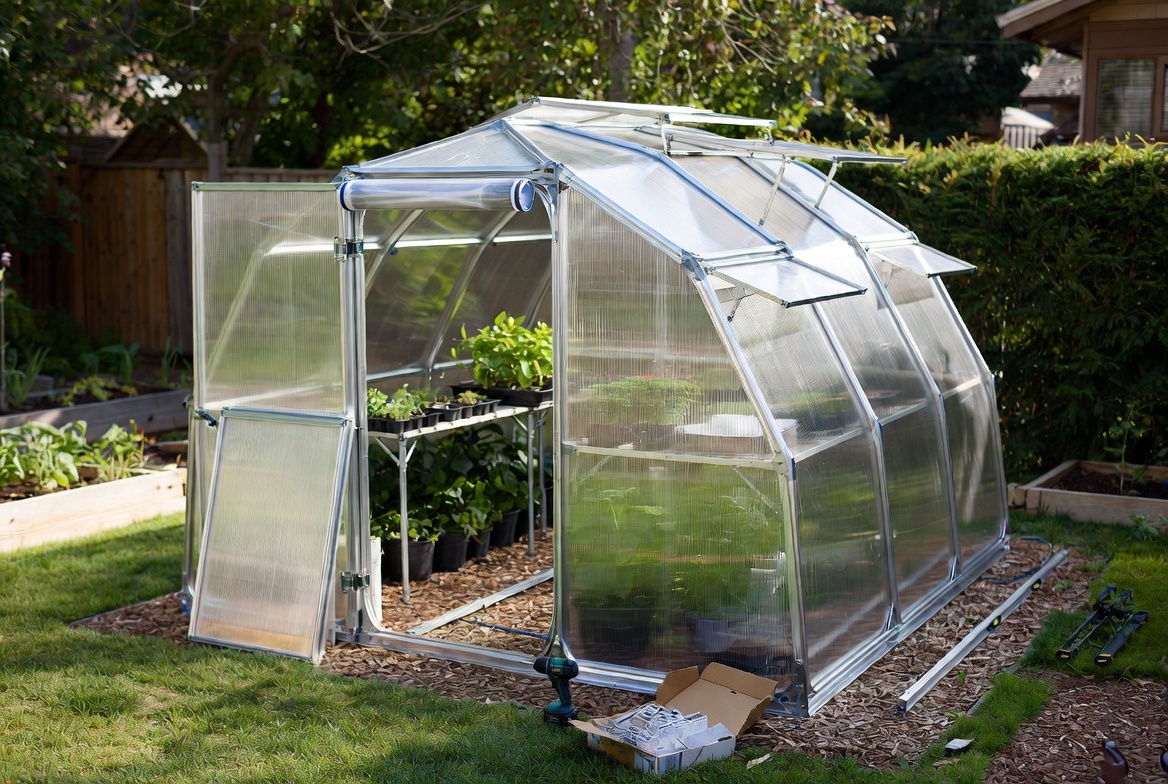
A small backyard greenhouse kit with polycarbonate panels, roof vents, and visible assembly details. Image by ArchitectureCourses.org.
This is where the cheap-looking quote can stop looking cheap.
Some sellers list what sounds like a complete greenhouse, but the actual included package may be closer to frame, shell, door, and documentation. One current 16-foot Ekodome listing includes the aluminum frame kit, multiwall polycarbonate panels, a standard door, hardware, and assembly documentation, while windows and vents are listed as options or upgrades. That is not shady. It just means the buyer has to read the scope, not just the headline. Another current 42-foot Arctic Acres listing includes three electric attic fans, while smaller sizes are much more basic. That is the kind of detail that changes how comparable two quotes really are.
What To Check:
- Does the base kit include the frame, glazing panels, door, hardware, and assembly documents?
- Are vents, fans, windows, insect screens, or shading included or extra?
- Is installation included, optional, or not offered at all?
- Are shipping and delivery extra?
- Are foundation materials excluded?
- Are heating, irrigation, benches, raised beds, and electrical entirely on you?
This is one reason broad dome pages and buyer pages are not the same thing. If you want the general background, start with Greenhouse Domes. If you are already shopping kits, scope is the issue.
Foundation Is Where “Just A Backyard Kit” Stops Being Casual
A lot of buyers underestimate this.
One current vendor guidance page says 15-, 18-, 22-, and 26-foot Growing Domes can sit on a 2-inch compacted gravel ring on a cleared, leveled area, while 33- and 42-foot domes require at least concrete piers subject to soil conditions and local code requirements. That is a big jump, and it is exactly the kind of jump people miss when they compare diameters instead of comparing what the site has to do to support them.
A smaller dome may still be a real project. A larger dome is almost never just a casual weekend shell. Site leveling, drainage, local frost conditions, delivery access, and building department requirements all start to matter much more as the structure grows.
That is why the wrong question is “Can I afford the kit?” The better question is “Can I afford the kit, the foundation, the delivery, the ventilation package, and the rest of the system without making dumb compromises after the shell arrives?”
Cover Material Matters More Than The Shape
Dome buyers spend too much time on geometry and not enough on the actual skin.
The reviewed listings alone show how much variation there is. Arctic Acres lists 16 mm multiwall polycarbonate on its reviewed 18-, 22-, and 42-foot dome pages. Ekodome’s reviewed 16-foot Luna greenhouse lists 8 mm multiwall polycarbonate. Those are not the same enclosure. They do not move heat, light, durability, or replacement cost the same way.
| Better Option | Common Mistake | Why It Matters |
|---|---|---|
| Compare glazing thickness and material first | Shopping by diameter and shape alone | The cover decides a lot of the greenhouse’s real behavior |
| Ask what replacement panels cost | Assuming future repairs will be cheap or generic | Specialty panels and curved systems can get expensive later |
| Match the cover to your climate and use | Buying a thin shell and hoping heaters fix everything | Heating a weak enclosure is usually the expensive way to solve the wrong problem |
A greenhouse dome is still a greenhouse. If the cover is weak for the climate or the use case, the shell shape will not rescue it.
Ventilation Is Not A Small Detail
People buy greenhouses for light. They usually get humbled by heat.
Extension guidance is consistent on the broad principle. Ventilation is there to control temperature, remove moisture, and replenish carbon dioxide. Roof vents with side inlets support natural ventilation. Mechanical systems use exhaust fans and inlet louvers. NC State notes that mechanically ventilated greenhouses are typically sized to exchange total air volume about once per minute, and UMass notes around 8 cfm per square foot for summer ventilation in small commercial greenhouse layouts. You do not need to memorize those numbers to buy a dome kit. You do need to understand what they imply: if the dome kit has weak venting, you are buying a future overheating problem.
This is why kit scope matters again. Does the dome come with enough vent area. Are roof vents included or optional. Are fans included. Are they sized. Are you expected to add everything later. The prettier the shell, the easier it is to ignore the ventilation line item until July punishes you for it.
What To Check Before You Order
This is the section that saves the most money.
- Growing program. Seed starting and herbs need a different dome than mixed year-round production with tomatoes, vines, benches, and storage.
- Real interior layout. Ask how many usable beds, benches, and walkways fit after the door swing, circulation, and equipment are accounted for.
- Foundation requirement. Gravel ring, ground anchors, concrete piers, slab, or something else. Get this answer before you fall in love with the price.
- Cover material and thickness. 8 mm and 16 mm multiwall polycarbonate are not interchangeable choices for all climates and uses.
- Ventilation package. Roof vents, side inlets, exhaust fans, louvers, automatic openers, and shade control all matter more than dome marketing usually suggests.
- Snow and wind engineering. Especially in cold or exposed sites, ask what climate assumptions the seller is designing for.
- Permit path. Even when a small dome sometimes slips under permit thresholds, local rules can still control setbacks, anchoring, utilities, and foundation type.
- Shipping and unloading. A kit that looks affordable on the page can get uglier once freight and access logistics show up.
- Replacement parts. Ask how easy it is to buy future panels, seals, hardware, and upgraded vent components.
- DIY versus installed scope. Some kits are sold as DIY, optional installed, or configurable. That changes the real comparison fast.
Who These Kits Make Sense For
Greenhouse dome kits make the most sense for buyers who want a real greenhouse and are comfortable with a more specialized enclosure than a basic hoop house or box greenhouse.
They fit well when the dome shape solves something useful: wind handling, snow shedding, multiuse backyard space, a strong year-round shell, or simply a more durable kit than the lightest hobby-house category. They make less sense when the buyer mainly wants the look but has not budgeted for foundation, venting, and climate control.
Smaller domes tend to work best for serious hobby use. Mid-size domes are usually where home growers start getting enough space to do more than just dabble. Large domes move into community, farm, education, and multi-program territory fast.
Read This Next: if you want the broader background on how these structures work before you shop, go to Greenhouse Domes. If you want the structural side of the geometry itself, the better technical page is Geodesic Domes.
Bottom Line
Greenhouse dome kits are not one market. They are several markets piled into one search phrase.
At the low end, you can find small dome-greenhouse listings that look approachable enough for a homeowner. In the middle, you start seeing serious backyard and year-round systems with thicker polycarbonate, larger usable floor area, and more meaningful site work. At the top, you are not really shopping a casual backyard kit anymore. You are shopping a greenhouse building system with real foundation, ventilation, and installation consequences.
The buyers who do best here are the ones who stop shopping the dome as an object and start shopping the dome as a full greenhouse project. That is the shift that keeps a pretty shell from becoming an expensive correction later.
FAQ
What size greenhouse dome kit is best for a backyard gardener?
Usually something in the 12- to 18-foot range, depending on whether you want light hobby use or a more serious growing setup. Small domes are easier to place, heat, and vent, but they fill up faster than people expect once benches and pathways go in.
How much does a greenhouse dome kit cost?
Current reviewed examples run from roughly C$4,998 for a small 12-foot listing to around US$54,750 or C$54,950 for 42-foot kits. Most serious mid-size dome kits land much higher than casual buyers first assume.
Are greenhouse dome kits cheaper than standard greenhouses?
Not automatically. Some are more expensive up front because of specialized framing, glazing, and kit complexity. The comparison only makes sense after you compare actual scope, not just shape.
What matters more: diameter or panel material?
Both matter, but panel material and thickness get ignored too often. The shell skin does a lot of the real work in heat retention, light diffusion, durability, and long-term replacement cost.
Do bigger greenhouse dome kits need concrete foundations?
Sometimes, yes. Current vendor guidance reviewed here shows smaller sizes can use simpler prepared foundations while larger sizes may require concrete piers or other more substantial support, depending on soil and local code.
What is the biggest mistake buyers make?
Shopping the dome like a finished greenhouse when the listed price is really only the shell package. The gap between “kit price” and “working greenhouse” is where people usually get surprised.