
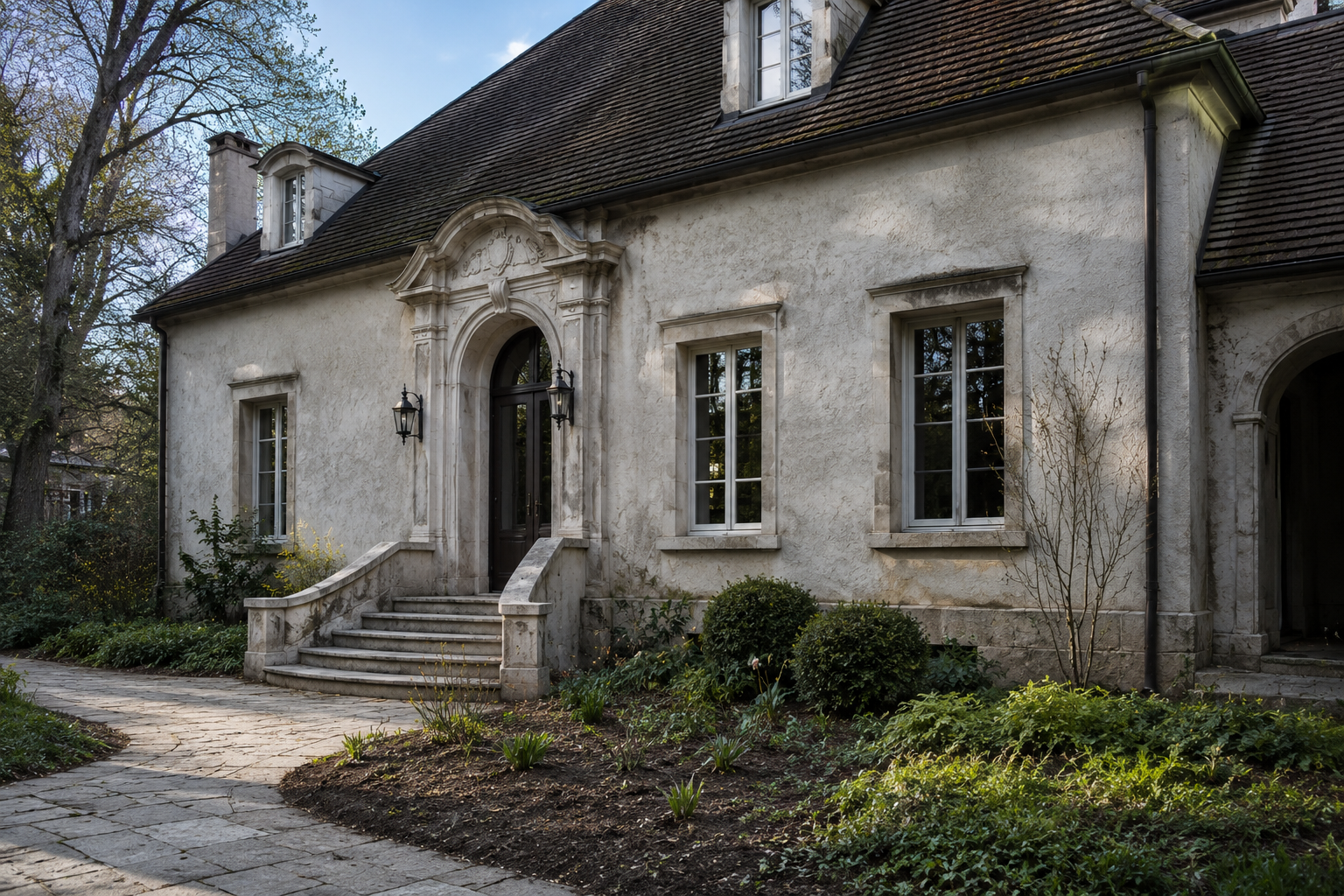
Baroque style houses fail fast when they try to copy palaces.
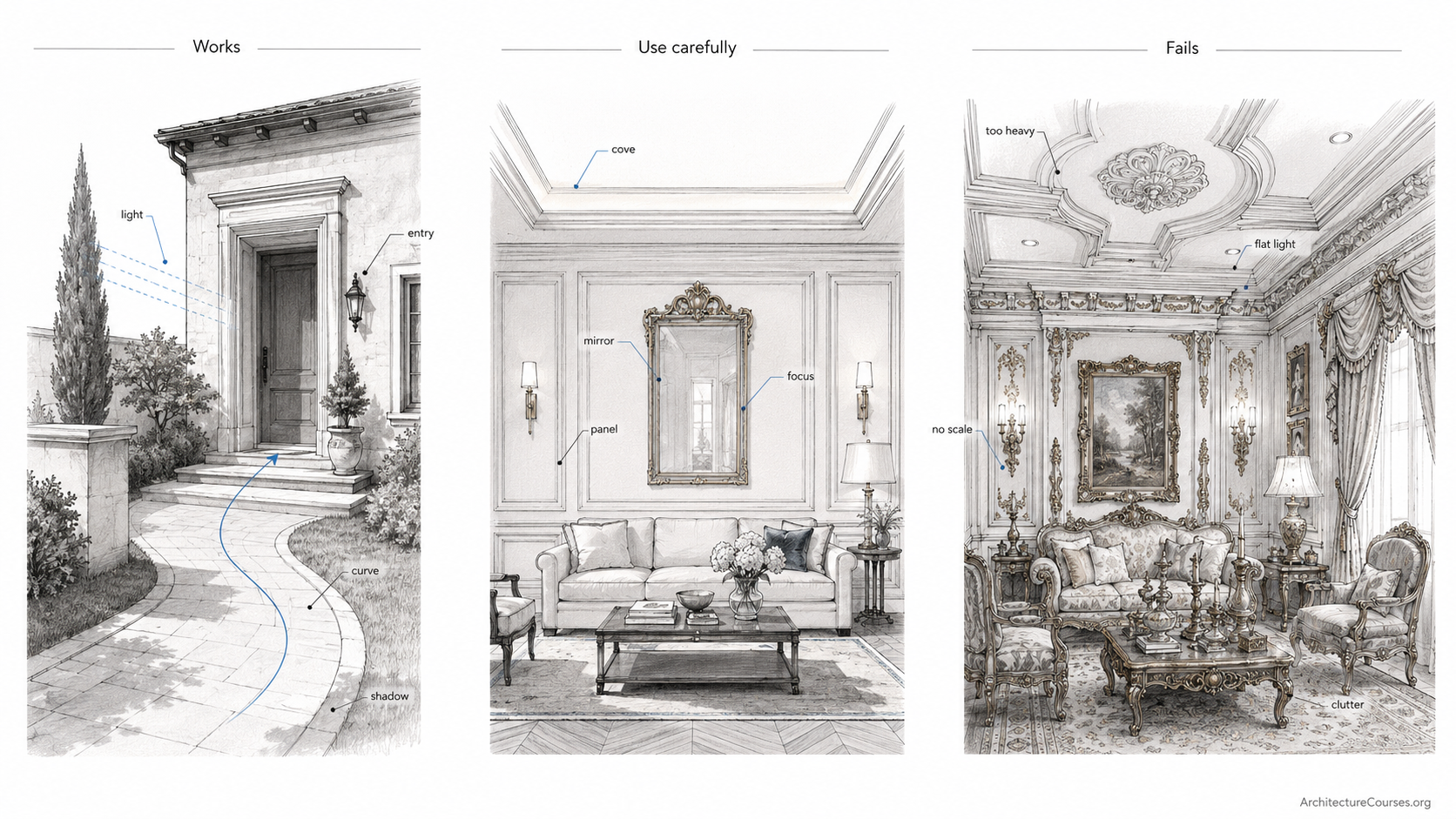
The ceiling is too low. The trim is too heavy. The lighting is too flat. The gold looks cheap. The furniture crowds the room. What felt powerful in a palace can feel fake inside a normal house.
The better move is to borrow the useful Baroque ideas: a stronger entry, controlled light, curved movement, deeper shadows, one rich focal point, and enough quiet surface around the detail. A Baroque-style home works when drama is scaled down and tied to the house’s real size.
The full history of Baroque architecture belongs elsewhere. A house needs a narrower question: which Baroque ideas survive domestic scale, and which ones turn into costume?
What Makes a House Feel Baroque?
A Baroque-style house does not need to be covered in scrolls. It needs a sense of movement, weight, shadow, and arrival.
The clearest signs are usually found at the entry, stair, main room, ceiling edge, windows, and lighting. The house should guide the body toward something: a door, stair, fireplace, garden view, mirror, or central room.
| Baroque idea | Good house version | Bad house version |
|---|---|---|
| Drama | One strong entry, stair, ceiling, or focal wall | Every wall, ceiling, and object fighting for attention |
| Curves | Curved landing, arched opening, oval mirror, soft stair turn | Random curves that do not guide movement or frame anything |
| Ornament | Trim scaled to the room and placed where shadows matter | Oversized crown, plastic scrolls, heavy appliqués, fake gold |
| Light | Warm side light, wall washing, lamps, sconces, shadow bands | Cold recessed lights flattening every surface |
| Richness | Better materials used in fewer places | Cheap shiny finishes spread across the whole room |
Start With the Entry
The entry is the easiest place to use Baroque logic in a house.
A good Baroque-inspired entry does not need to be huge. It needs sequence. A curved path, deeper doorway, small landing, shaped canopy, warm side light, and clear focal point can do more than expensive furniture inside the house.
The entry should slow the body slightly before the door. That can happen with two or three steps, a wider landing, a curved walk, a recessed doorway, or a planted edge that guides the eye inward.
Exterior moves that work
- Deep window reveals: they create shadow and make the facade feel heavier without fake ornament.
- One shaped entry: a curved stair, arched opening, or framed doorway can carry the style.
- Strong center line: a clear door, window stack, or stair axis gives the house order.
- Warm materials: stone, lime-plaster texture, painted wood, brick, and aged metal usually work better than glossy synthetic finishes.
- Garden approach: a path, low wall, hedge, or forecourt can make arrival feel planned.
Keep the rest quiet. If the entry is strong, the windows, roofline, and wall surfaces do not all need to shout.
What Scales Down From Palaces
Some Baroque ideas scale down well to houses. Others do not.
A palace can handle giant stairs, massive cornices, painted ceilings, mirrored galleries, and repeated gilded rooms because the volume is large enough. A house usually needs the same idea translated into smaller moves.
| Palace idea | House version that works | What to avoid |
|---|---|---|
| Grand stair | One curved landing, wider first step, shaped rail, or better stair light | Oversized stair squeezed into a narrow hall |
| Painted ceiling | Simple cove, plaster medallion, soft ceiling wash, or shallow tray | Fake sky murals in low rooms |
| Rich wall panels | One paneled wall or framed mirror composition | Heavy panels on every wall with outlets cutting through them |
| Gilding | Small brass, gold leaf, aged metal, or warm highlight details | Bright sprayed gold trim everywhere |
| Long axis | Clear view from entry to stair, fireplace, garden, or main room | Forcing symmetry where the plan does not support it |
The test is simple: does the Baroque detail improve movement, light, scale, or focus? If it does not, it is probably costume.
Stairs Are the Strongest Baroque Move at Home
A stair can make a house feel Baroque without covering the house in decoration.
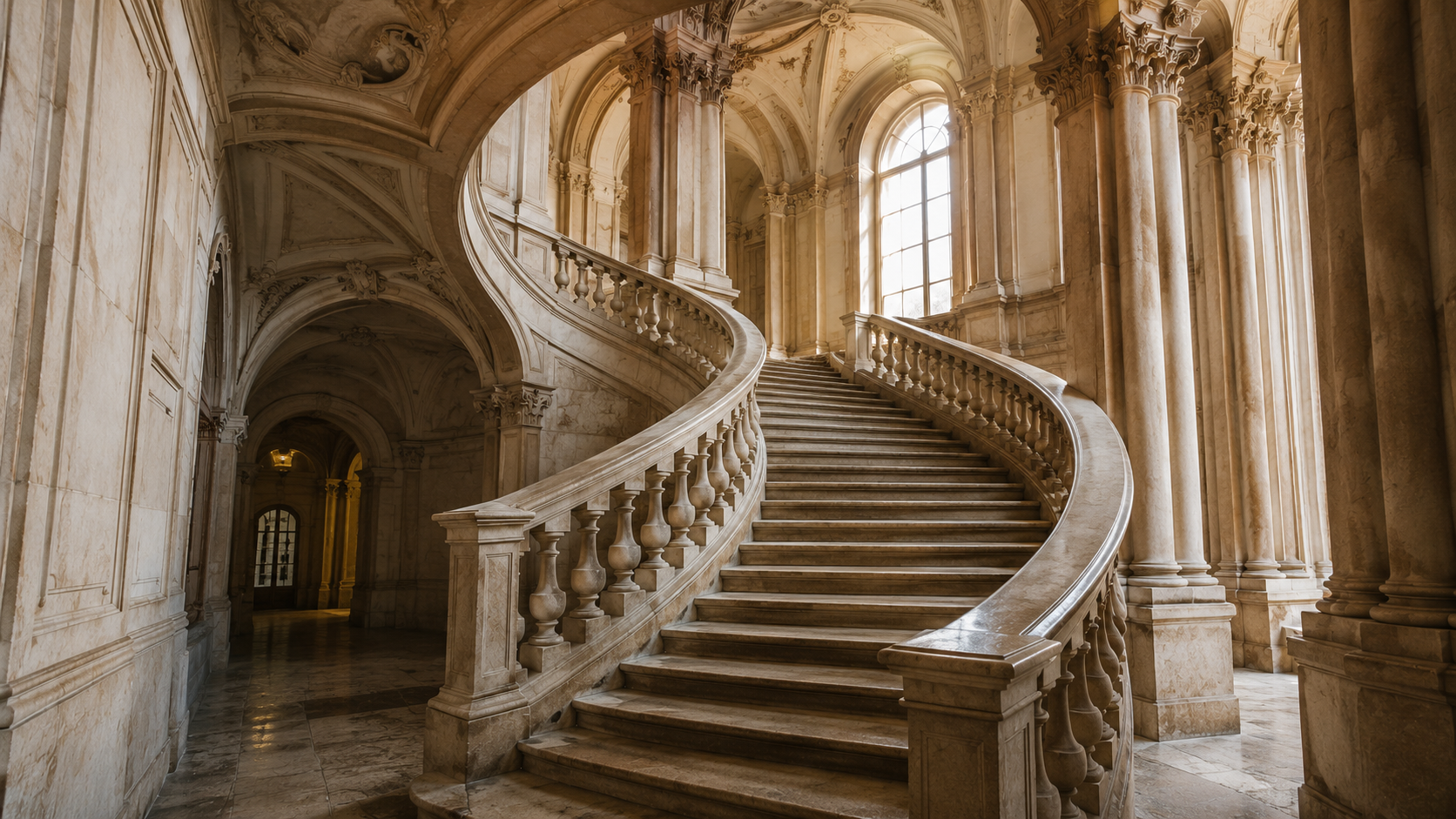
The stair already controls movement. Baroque design simply makes that movement more deliberate. The handrail catches light. The first step widens. The landing gives a pause. A window or sconce marks the turn. A mirror or artwork gives the eye somewhere to go.
Stair ideas that work
- A slightly curved lower step instead of a full curved staircase.
- A warmer handrail material that catches side light.
- A landing with one strong wall light or framed view.
- A deeper stair skirt or shadow line instead of heavy applied trim.
- A single mirror or painting placed where the stair turns.
The mistake is trying to make a small stair act like a palace stair. If the stair is narrow, let it be narrow. Use light, rail detail, and one good landing moment instead of forcing a grand curve.
Living Rooms: One Rich Wall Is Enough
Baroque-inspired living rooms often go wrong because too many surfaces get treated equally.
A strong living room usually needs one main wall: fireplace, mirror, built-in cabinet, art wall, or window wall. That wall can carry richer trim, deeper color, a larger mirror, or a more shaped profile. The other walls should support it quietly.
This is one of the main lessons from Baroque architecture characteristics: ornament works when it has a job. It should frame movement, catch shadow, mark a transition, or organize scale.
What works in real living rooms
- One large mirror over a fireplace or console.
- Wall panels sized around real outlets, vents, switches, and furniture.
- A cove or picture rail that catches warm light.
- Deep paint on one wall with calmer adjacent surfaces.
- Curved furniture used as contrast, not as a matching set.
The room should still be livable. People need places to sit, walk, read, talk, and clean. If the furniture arrangement only looks good from the doorway, the room is not working.
Lighting Makes or Breaks the Style
Baroque style houses depend on shadow.
Cold recessed lighting is one of the fastest ways to ruin the look. It flattens plaster, makes gold look cheap, kills shadow lines, and turns rich colors dull. Baroque-inspired rooms need warmer, lower, more layered light.
| Lighting choice | Effect | Better use |
|---|---|---|
| Cold ceiling cans | Flatten trim and make finishes look fake | Use fewer overhead lights and add wall or lamp light |
| Sconces | Create side shadow and make profiles deeper | Use near mirrors, stairs, halls, and focal walls |
| Cove lighting | Softens ceilings and lifts the room | Keep it warm and indirect |
| Chandelier | Can anchor a room if the ceiling height supports it | Size it to the room, not the fantasy image |
| Picture lights | Give detail a clear job | Use sparingly on art, mirrors, or one rich wall |
Test lighting at night before committing to paint, trim, or metal finishes. A room that looks warm in daylight can look harsh under the wrong bulbs.
Exterior Details That Look Fake Fast
Baroque-style exteriors can fail even faster than interiors because every detail is exposed to weather and distance.
Thin foam trim, oversized fake columns, bright white plastic scrolls, shallow arches, and glued-on ornament rarely age well. They may look acceptable in a rendering and cheap after one winter.
Watch these failure points
- Shallow trim: if the profile is too thin, it will not cast a real shadow.
- Wrong column scale: columns that are too skinny or too short make the house look theatrical.
- Flat arches: an arch with no depth feels pasted on.
- Glossy finishes: shine makes exterior ornament look less convincing.
- Bad water details: deep trim, ledges, and curved features need drip edges and drainage.
The exterior needs construction logic. A deep reveal should shed water. A cornice should have a shadow and a drip. A porch or landing should drain away from the door. Style does not excuse bad detailing.
The Hidden Cost: Baroque Details Need Maintenance
This is the part most style pages skip.
Baroque-inspired houses usually have more surfaces to dust, paint, repair, light, and protect from water. Carved trim catches dirt. Wall panels create seams. Mirrors double clutter. Coves collect cracks. Deep exterior profiles can trap water if they are not detailed correctly.
| Detail | Maintenance problem | Better decision |
|---|---|---|
| Crown molding | Cracks at ceiling joints and collects dust | Use one strong profile instead of multiple small layers |
| Wall panels | Outlets and vents interrupt the pattern | Design panel layout around services first |
| Exterior trim | Can hold water and peel if not flashed or sloped | Use drip edges, sloped caps, and durable material |
| Mirrors | Reflect clutter or bad views | Place mirrors only where they reflect light or depth |
| Curved furniture | Harder to reupholster or repair | Use one or two good pieces, not a full matching set |
A Baroque-style house should not become a cleaning and repair burden. The more ornate the room, the more disciplined the details need to be.
Small Houses Need Less Baroque, Not Cheaper Baroque
A small house can use Baroque ideas, but it needs restraint.
Do not shrink a palace room and copy everything. Choose one effect. A stronger entry. A curved stair landing. A warm mirror wall. A rich powder room. A small library with a deeper ceiling edge. A dining room with one strong light fixture.
In smaller houses, the best Baroque move is often contrast: one rich area beside plain walls, one curved form beside straight rooms, one warm metal detail beside matte surfaces.
Good small-house moves
- A curved garden path to a plain but deep entry door.
- A small foyer with one mirror, one wall light, and a darker paint color.
- A powder room with a shaped mirror and better side lighting.
- A stair wall with warm sconces instead of heavy trim.
- A dining room with one ceiling medallion and a properly sized fixture.
If the house is small, leave more blank surface than you think you need. Quiet walls make one strong detail feel intentional.
Large Houses Still Need Control
A larger home can carry more Baroque influence, but that does not mean every room should be dramatic.
The best approach is hierarchy. Public rooms can be richer. Private rooms can be calmer. Circulation can build anticipation. Service spaces can stay clean and practical. The house should not have the same level of decoration everywhere.
Study actual Baroque architecture examples and you will see this pattern. The main rooms carry the image. The working spaces keep the building alive.
Baroque vs Rococo in a House

Baroque and Rococo often get mixed in home design.
Baroque is stronger, heavier, and more architectural. It works through mass, sequence, light, stairs, deep profiles, and controlled focal points. Rococo is lighter, softer, and more interior-focused. It works through mirrors, curves, pale colors, furniture, shell ornament, and fine surface detail.
In a house, Baroque usually belongs to entry, stair, exterior rhythm, dining room, library, fireplace wall, or main hall. Rococo usually belongs to bedroom, sitting room, powder room, dressing area, or salon-like interior.
For the full comparison, use Baroque vs Rococo.
How to Get the Look Without Making It Fake
The safest method is to choose one Baroque job per room.
- Entry: guide arrival.
- Stair: slow movement and create a turn.
- Living room: create one focal wall.
- Dining room: control light and ceiling emphasis.
- Exterior: use shadow, depth, and entry rhythm.
- Powder room: use richness at small scale.
The room should still work without the decoration. If the plan, light, furniture layout, and circulation are weak, Baroque ornament will only make the weakness more obvious.
What to Avoid
- Oversized crown molding in rooms under normal ceiling height.
- Glossy gold paint on plastic or foam trim.
- Too many chandeliers in one sightline.
- Random arches that do not align with openings, stairs, or structure.
- Wall panels drawn before outlets, vents, switches, and furniture are planned.
- Cold recessed lighting over rich finishes.
- Heavy dark furniture in every room.
- Exterior trim without proper slope, flashing, or drainage.
A Practical Room-by-Room Plan
| Room or area | Best Baroque move | Keep it from looking fake by... |
|---|---|---|
| Entry | Curved path, deeper door reveal, one strong light | Keeping trim simple and scale believable |
| Stair | Better rail, landing view, warm side light | Avoiding oversized curves in tight halls |
| Living room | One focal wall with mirror, fireplace, or paneling | Leaving other walls calmer |
| Dining room | Ceiling medallion, chandelier, deeper color, wall lights | Sizing fixture and medallion to the actual table and ceiling |
| Powder room | Small-scale richness, mirror, sconces, patterned surface | Using good materials in a small area instead of fake luxury everywhere |
| Exterior | Entry depth, shadow, stone or plaster texture, controlled symmetry | Detailing water, thresholds, and trim before adding ornament |
FAQ
What is a Baroque style house?
A Baroque style house is a home that uses Baroque ideas such as strong entry sequence, curved movement, dramatic light, rich materials, deep shadows, symmetry, and ornament. It does not have to copy a palace.
Can Baroque style work in a normal house?
Yes, but it has to be scaled down. Use one strong move per room: a better entry, a curved stair landing, a focal wall, a mirror, a cove, or warmer layered lighting.
What makes Baroque interiors look fake?
The common problems are oversized trim, cheap gold finishes, too much furniture, cold lighting, random curves, and decoration that does not match the room’s scale.
Is Baroque style expensive?
It can be expensive if you use custom trim, plaster, curved millwork, stone, or high-quality lighting. The smarter approach is to use fewer details and make each one better.
What Baroque detail works best in small homes?
A strong entry, curved stair detail, shaped mirror, warm sconces, or one rich focal wall usually works better than heavy trim throughout the whole house.
What is the difference between Baroque and Rococo home design?
Baroque home design feels heavier, more dramatic, and more architectural. Rococo feels lighter, softer, and more decorative, with mirrors, pastel color, curved furniture, and fine surface detail.
The Better Way to Use Baroque at Home
Baroque style houses work when the house still feels like a house.
Use the style to improve arrival, light, movement, shadow, and focus. Do not use it to cover weak planning with decoration. The strongest Baroque-inspired homes usually have fewer dramatic moves, better materials, warmer light, and more quiet surface around each detail.
Copy the design logic, not the palace costume.