
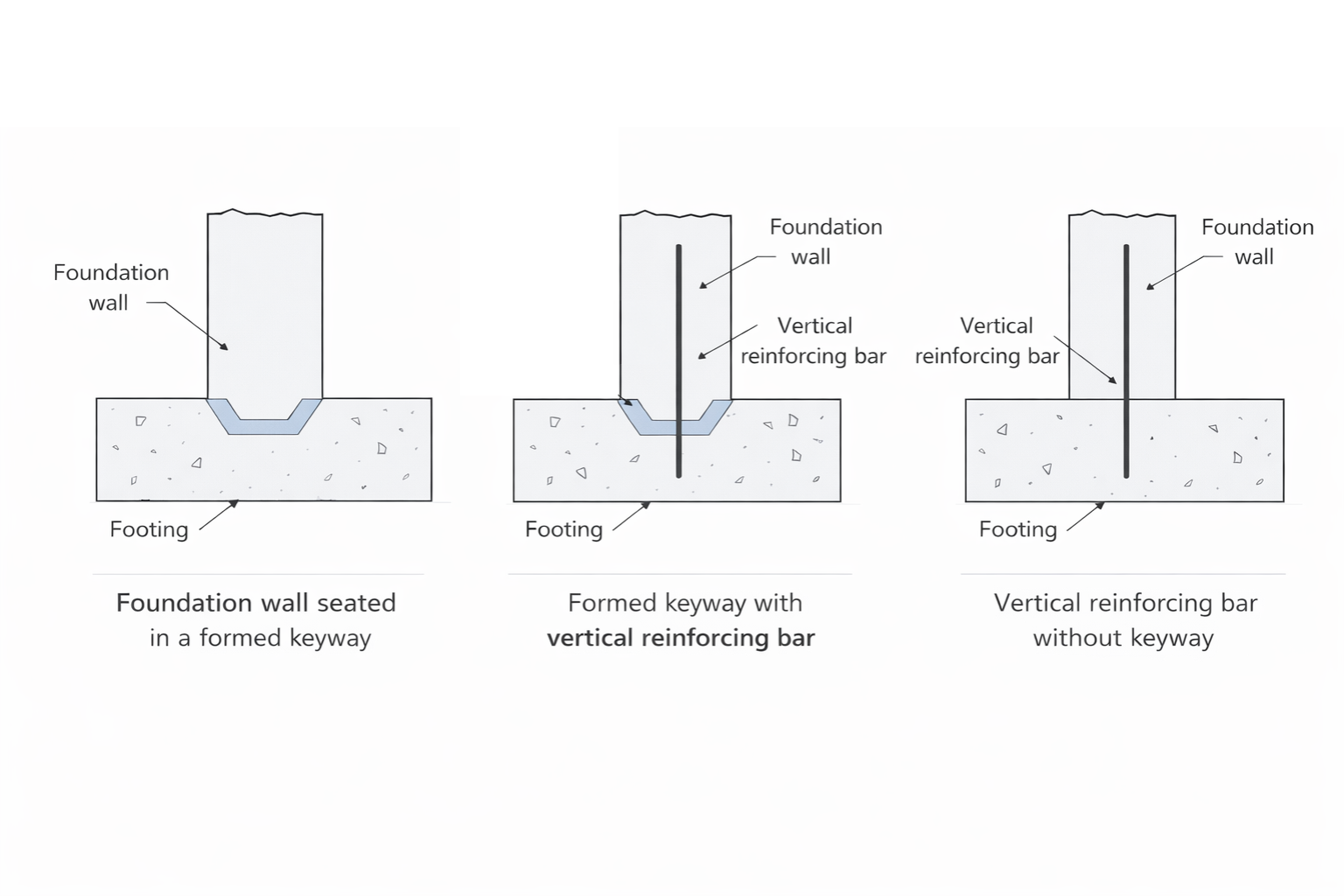
A retaining wall shear key is a narrow detail with a specific job. It projects below the footing and is used to improve sliding resistance when the wall needs more help than base friction alone can provide.
That sounds tidy on paper. In the field, the detail depends on the soil in front of it, the excavation, the drainage, and the wall geometry all being honest.
If you want the broader picture first, start with the main shear key guide. This page stays with the retaining wall version: what it does, when it belongs, what it does not fix, and where the detail starts getting used as a shortcut.
What a Retaining Wall Shear Key Does
A shear key helps a retaining wall footing resist sliding.
It does that by engaging soil below or in front of the footing so the wall has more resistance to lateral movement. That is the point of the detail. Not bearing capacity. Not overturning. Not drainage. Sliding.
That distinction matters because retaining wall problems often arrive in groups. A wall can be short on sliding resistance, carrying too much toe pressure, and holding back water all at once. A key helps only one of those unless the rest of the design is already in order.
| If the Problem Is... | A Shear Key Helps? | What Usually Comes First |
|---|---|---|
| Sliding is short | Often, yes | Check soil, embedment, and drainage first |
| Bearing pressure is too high | No | Rework footing width, loads, or soil assumptions |
| Overturning governs | Not much | Rebalance the wall geometry and stabilizing weight |
| Water is building behind the wall | No | Fix drainage before trusting the stability check |
When a Shear Key Makes Sense
A retaining wall shear key usually makes sense when the wall is close on sliding, or fails it, and the rest of the footing layout is already reasonably disciplined.
That usually means the base width is not obviously undersized, the wall height and surcharge are settled, the footing embedment is credible, and the soil in front of the key is worth counting.
It also means the toe area is likely to stay there. If the soil in front of the wall may be excavated later for utilities, cut back for landscaping, softened by poor drainage, or disturbed during construction, the key can look stronger on the drawing than it will ever be on site.
For that reason, a keyed wall is usually a better fit on a controlled site than on a job where the toe area will be reworked, undercut, or left wet.
What the Key Changes in the Design
The key changes the sliding side of the wall design.
It can add resistance below the footing, and in some systems it changes which interface matters. That is a detail worth paying attention to. A keyed footing is not behaving the same way as a plain footing sitting on bedding or compacted base.
That does not mean the key gives you a free pass on the rest of the checks. The wall still has to work for bearing, eccentricity, overturning, footing design, stem design, drainage, and construction sequence.
The footing still has to be reinforced and built like a footing, not like a sketch. If you need the broader footing context around this detail, foundation footings is the better companion page.
Soil Runs This Detail
Retaining wall shear keys are concrete details, but their value is controlled by the ground.
That is the part that gets flattened too often. The key only develops useful resistance when the soil around it has the strength, confinement, and long-term stability the design assumed. Loose trench spoil, wet backfill, disturbed toe material, frost-susceptible soil, or future erosion can cut into that resistance fast.
The geotechnical side matters early here. Soil strength, groundwater, backfill type, slope at the toe, and how much passive resistance is fair to count are not cleanup questions. They are the design.
Also Useful. If the site assumptions are still fuzzy, soil analysis and site investigation will tell you more about whether a key belongs than another hour spent adjusting concrete dimensions.
Water Can Make the Detail Look Better Than It Is
A retaining wall with a shear key still needs drainage.
That should not be a side note. Water behind the wall adds lateral pressure. Water around the footing changes the ground conditions the key is relying on. Water at the toe can soften the same soil the wall needs for resistance.
This is where retaining wall drawings often get too optimistic. The key is there, the wall looks anchored, and the drainage is treated like a smaller line item. It is not smaller.
Good drainage belongs in the wall from the beginning: free-draining backfill where required, a path for water to leave, and details that still work after fines, freeze-thaw cycles, and ordinary neglect start doing their part.
If the drainage side is still loose, read how to install a French drain with a sump pump the right way before trusting the stability checks too much.
Before You Add the Key, Check the Easier Fixes
A shear key is not always the cleanest answer.
Sometimes the better move is more footing width. Sometimes it is more embedment. Sometimes it is better drainage, lighter retained soil, or a different wall type. Sometimes the site simply needs a more careful geotechnical read before the wall detail gets more complicated.
That is worth saying plainly because keyed retaining walls can become a default habit. The detail gets repeated because it is familiar, not because it is the most buildable answer for that wall.
Construction matters here too. A narrow, deep key may look efficient in section, but it still has to be excavated cleanly, formed or trimmed accurately, reinforced properly, and poured without leaving loose material where the wall is trying to develop resistance.
If depth and trench control are already becoming part of the problem, excavation depth for foundations is the next useful page, not another round of sketch revisions.
Common Mistakes
Using the key as a default detail. A retaining wall shear key should answer a specific sliding problem. It is not a decoration below every footing.
Counting resistance in soil that will not stay put. Backfill that can erode, freeze, get re-excavated, or remain saturated is not the same thing as stable confined soil at the toe.
Letting drainage drift into the background. A wall can look stable on paper and still struggle badly if hydrostatic pressure is allowed to build.
Drawing a key that is hard to build cleanly. Thin sections, messy trench bottoms, and awkward reinforcement layouts are not harmless drafting issues.
Using the key to avoid a broader redesign. If the wall is weak in bearing, poor in layout, or questionable in soil assumptions, the key does not solve the underlying scheme.
Does Every Retaining Wall Need One?
No.
Many retaining walls work without a key. Some are wide enough, heavy enough, embedded enough, or drained well enough that sliding resistance is already where it needs to be. Others need a different wall type altogether.
A key belongs where it earns its place.
FAQ
What does a retaining wall shear key do?
It helps the footing resist sliding by developing added resistance below or in front of the footing.
Does a shear key help with overturning?
Not in the way people usually hope. Its main contribution is sliding resistance, not a full rescue of overturning, bearing, or water problems.
Can you rely on the soil in front of the key?
Only if the design and the site conditions support it. Soil strength, toe depth, groundwater, slope, and future disturbance all matter.
Is drainage still required if the wall has a shear key?
Yes. A key does not replace drainage. Water behind the wall and around the footing can undermine the assumptions the key depends on.
What is the first thing to check before adding a shear key?
Check whether sliding is the governing problem in the first place, then check whether footing width, embedment, or drainage solve it more cleanly.
Bottom Line
A retaining wall shear key is a focused detail. It is there to improve sliding resistance when the wall needs it and the site can support the assumption behind it.
The wall still has to work as a wall. Soil still matters. Water still matters. Construction still matters.
Get those parts right, and the key can be a disciplined fix. Skip them, and it turns into one more confident-looking detail carrying more weight than it should.