
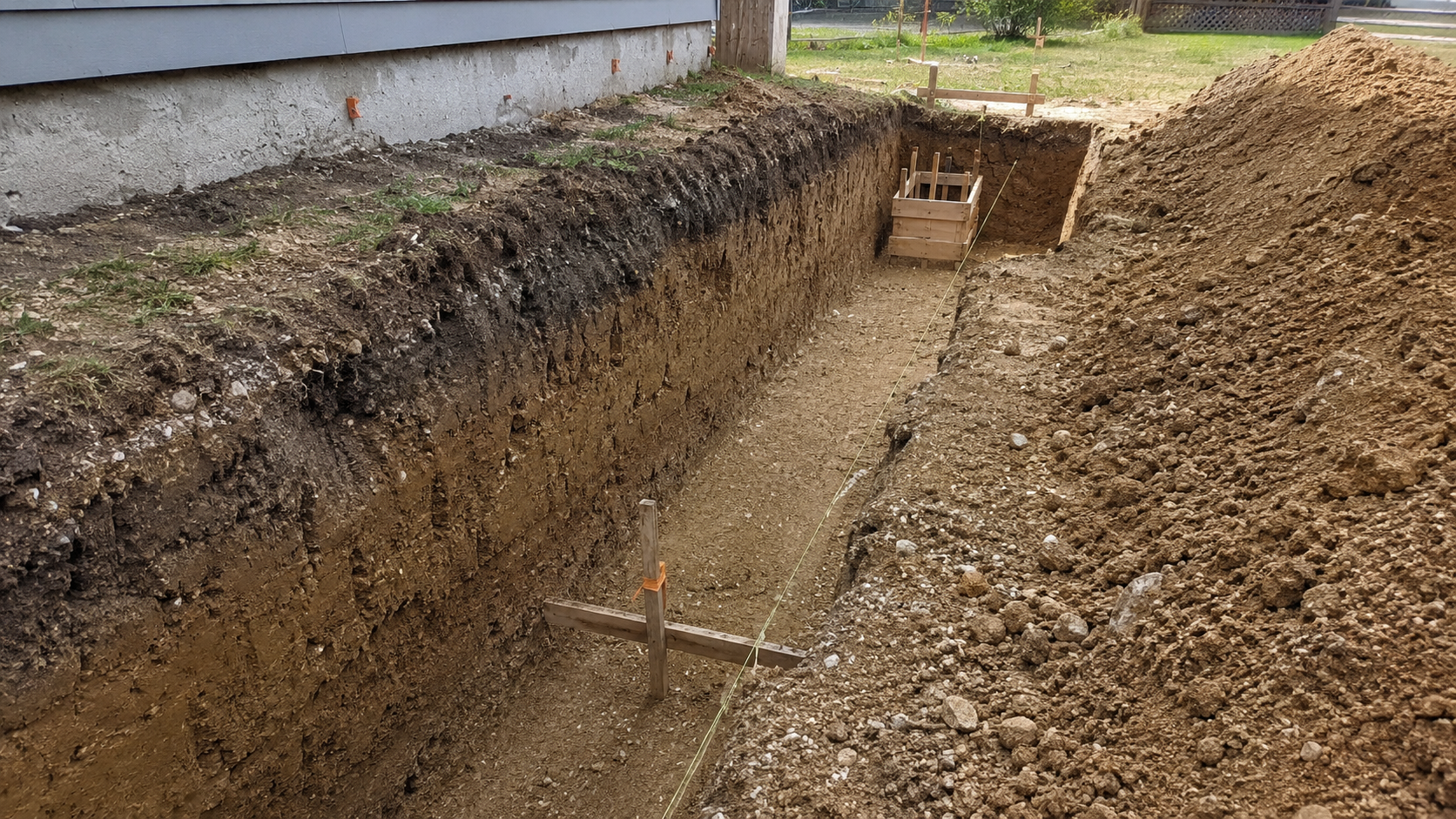
Foundation excavation depth is not just how far someone digs before concrete goes in.
The depth has to match the soil, frost conditions, building load, footing type, groundwater, nearby structures, and local code. A shallow trench can leave the foundation exposed to movement. A trench that is too deep or poorly supported can create collapse risk, extra concrete cost, soft disturbed soil, or water problems before the footing is even poured.
The right depth is not guessed from a chart. It is confirmed from the plans, site conditions, local requirements, and what the excavation actually exposes.
What Controls Foundation Excavation Depth
Several things decide how deep a foundation trench or footing excavation should be. The most important ones are soil, frost, water, building load, nearby foundations, and the foundation system being used.
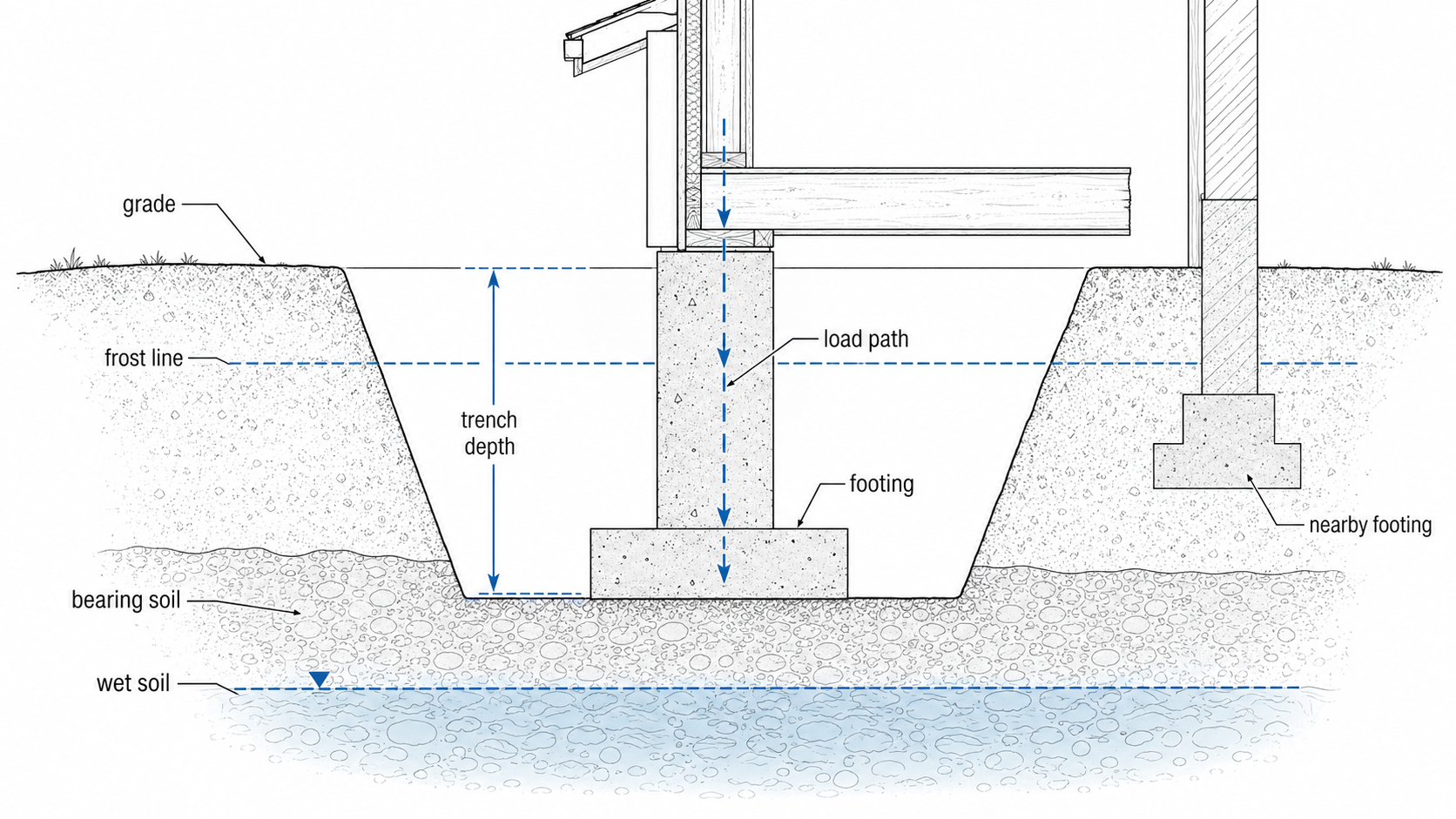
| Factor | Why it changes depth | What can go wrong |
|---|---|---|
| Soil type | Clay, sand, silt, fill, rock, and organic soil carry loads differently. | Settlement, trench collapse, soft bearing, or uneven support. |
| Frost depth | In cold climates, footings often need frost protection or placement below frost depth. | Frost heave, cracking, lifted footings, and seasonal movement. |
| Building load | Heavier loads may need wider, deeper, or engineered foundations. | Cracking, rotation, differential settlement, or undersized support. |
| Water table | Groundwater can weaken soils and flood excavations. | Wet trenches, poor concrete placement, pumping problems, or foundation leaks. |
| Nearby structures | Digging beside existing buildings, roads, or retaining walls can disturb support. | Soil loss, wall movement, settlement, or unsafe excavation sides. |
| Foundation type | Strip footings, trench fill, slabs, raft foundations, piers, and piles work differently. | Wrong foundation system for the soil or load. |
Minimum Depth Is Not the Design Depth
Many codes set minimum rules, but the minimum is not always the right design depth for a specific site. For example, the International Residential Code says exterior footings must be placed at least 12 inches below undisturbed ground surface, and frost-related rules may also apply where required. Local adoption, soil conditions, frost depth, and engineering still control the real project.
That means a shallow footing that meets one minimum may still be wrong if the soil is weak, the site is cold, water is present, or the load requires a different footing design.
Do Not Disturb the Bearing Soil
The bottom of a footing excavation should bear on soil that can support the load. Over-digging and then loosely throwing soil back into the trench can create a weak layer below the concrete.
If a trench is dug too deep, the fix is not casual backfill. Depending on the project, the correction may require compacted engineered fill, lean concrete, a revised footing detail, or approval from the designer or inspector.
This is one of the easiest mistakes to miss because the trench still looks ready from above. The problem is below the footing, where the load will actually transfer into the ground.
Soil Changes the Excavation
Stable ground is very different from loose fill, wet clay, sand, silt, organic soil, or made ground. Some soils stand temporarily in a trench. Others collapse, soften, swell, or move when water enters.
Clay can shrink and swell. Sand can cave. Fill can settle. Organic soil may be unsuitable for bearing. Rock may require different excavation and footing details. A site investigation or soil report helps prevent the foundation from being designed around assumptions.
If the trench bottom reveals soft pockets, old fill, roots, debris, water, or inconsistent soil, stop and get it checked before placing concrete.
Frost Depth Matters in Cold Climates
In cold regions, frost can lift shallow foundations when water in the soil freezes and expands. This is why many foundations must either extend below the local frost depth or use an approved frost-protected shallow foundation design.
Do not copy a footing depth from another region. Frost depth changes by climate, elevation, soil, snow cover, and local code. A footing detail that works in a warm area may fail in a cold one.
Water in the Trench Is a Warning Sign
Water at the bottom of a foundation excavation is not just an inconvenience. It can soften the bearing soil, hide loose material, make inspection difficult, and affect concrete placement.
Common causes include high groundwater, poor site drainage, recent rain, leaking utilities, uphill runoff, or excavation below a perched water layer. Pumping water out may be part of the job, but the water source still matters.
Do not pour concrete into a trench that has loose mud, standing water, collapsed sides, or disturbed bearing soil unless the designer, inspector, or contractor has confirmed the correct repair procedure.
Trench Safety Comes Before Foundation Work
Foundation trenches can collapse quickly. OSHA treats cave-ins as one of the main hazards in trenching and excavation work. Protective systems may include sloping, benching, shoring, or shielding with trench boxes depending on depth, soil, and site conditions.
A competent person should inspect excavations and protective systems daily, after rain, and after other events that could increase hazard. Workers also need safe access and egress where required.
This is not paperwork. A foundation trench can look stable until it is not. Never treat a deep or unstable excavation like a casual DIY hole.
Trench Fill Foundations
A trench fill foundation uses a trench filled mostly or entirely with concrete, often reducing the amount of block or masonry needed below ground. It can be useful where deeper excavation is needed, but it also uses more concrete than a traditional strip footing.
The depth and width depend on soil, load, frost, local code, and the wall above. In some cases, a trench fill foundation may be chosen because it is faster or simpler on site. In other cases, it can become expensive if the trench is deeper than expected or the soil does not stand cleanly.
The key point is that trench fill is not a shortcut around soil or code. The trench still needs proper bearing, safe excavation, and inspection before concrete placement.
Strip Footings, Trench Fill, Raft Foundations, and Piles
Different foundation systems use excavation differently. A shallow strip footing, a deep trench fill foundation, a raft foundation, and a pile foundation are not interchangeable.
| Foundation type | Excavation pattern | Common use | Main risk |
|---|---|---|---|
| Strip footing | Continuous trench below walls. | Stable soil and ordinary residential loads. | Too shallow, too narrow, or placed on disturbed soil. |
| Trench fill | Deeper trench filled with concrete. | Sites where deeper concrete fill is practical. | High concrete volume, trench collapse, or water in excavation. |
| Raft or mat foundation | Broad excavation below a large slab area. | Lower bearing soils or spread-load designs. | Poor subgrade prep, water, reinforcement errors, or edge movement. |
| Piers or piles | Deep holes or driven/drilled supports. | Weak upper soil, high loads, or deep bearing requirements. | Wrong depth, poor installation, or inadequate connection to grade beams. |
Excavation Beside an Existing House
Digging beside an existing foundation is more sensitive than excavating on an open site. The existing footing may depend on nearby soil support. Removing that soil can undermine the wall, crack the foundation, or cause movement above.
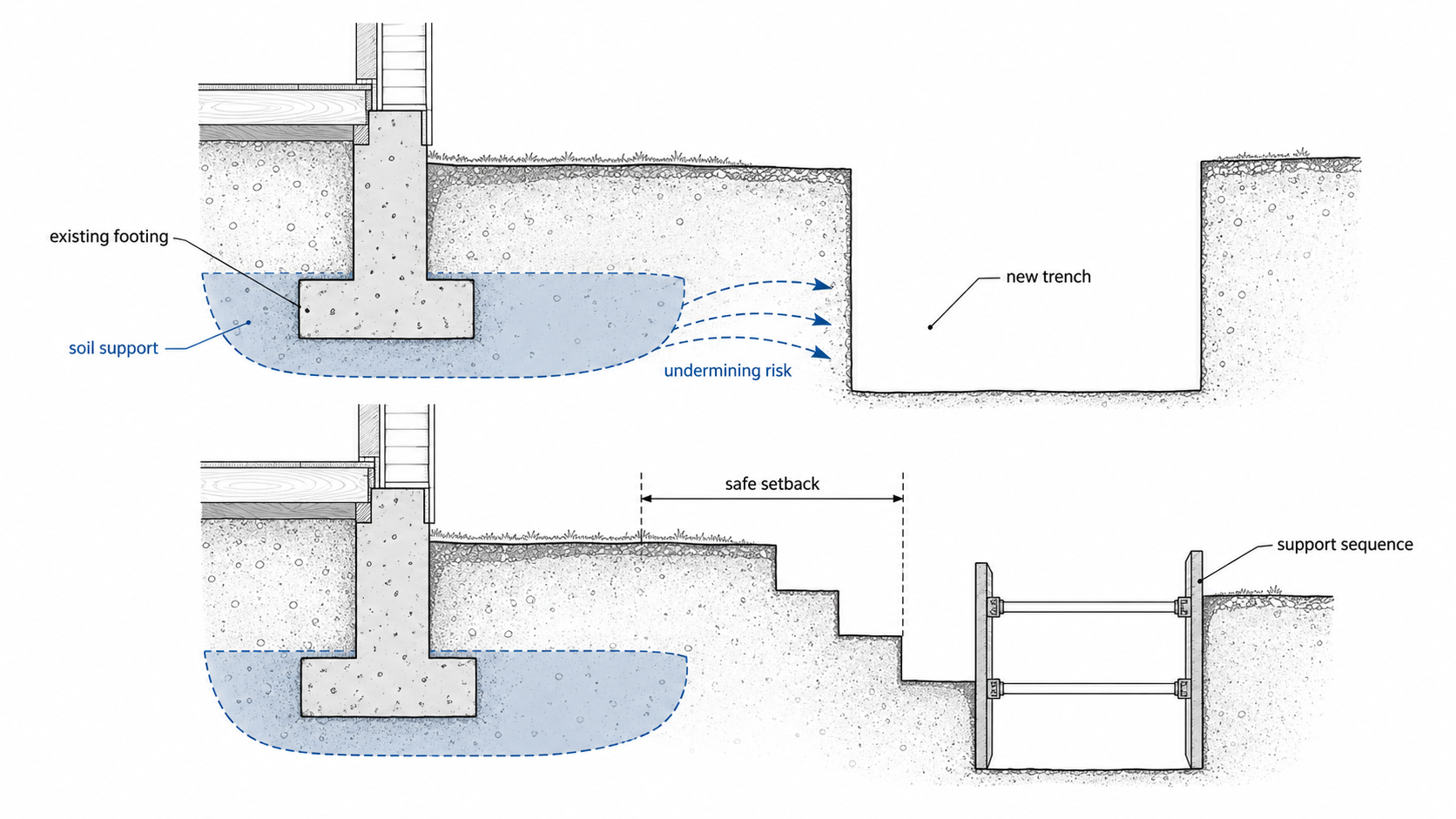
This matters for additions, underpinning, basement waterproofing, sewer work, drainage work, and repairs near old houses. Do not assume that because a trench is outside the house, it cannot affect the structure.
If the new excavation goes near or below the level of an existing footing, the sequence, support, and backfill need to be planned carefully.
Common Excavation Depth Mistakes
- Digging to a generic depth instead of checking local frost and soil requirements.
- Pouring on loose, wet, frozen, organic, or disturbed soil.
- Over-digging and backfilling loosely below the footing.
- Ignoring water in the trench.
- Leaving trenches open long enough for rain, drying, freezing, or collapse to damage the bearing soil.
- Digging beside an existing foundation without checking undermining risk.
- Choosing trench fill, raft, or piles before the soil conditions justify the system.
- Treating trench safety as optional on small residential jobs.
What to Check Before Concrete Is Placed
Before concrete goes into a footing trench, the excavation should be checked carefully. Once the concrete is poured, many mistakes are hidden.
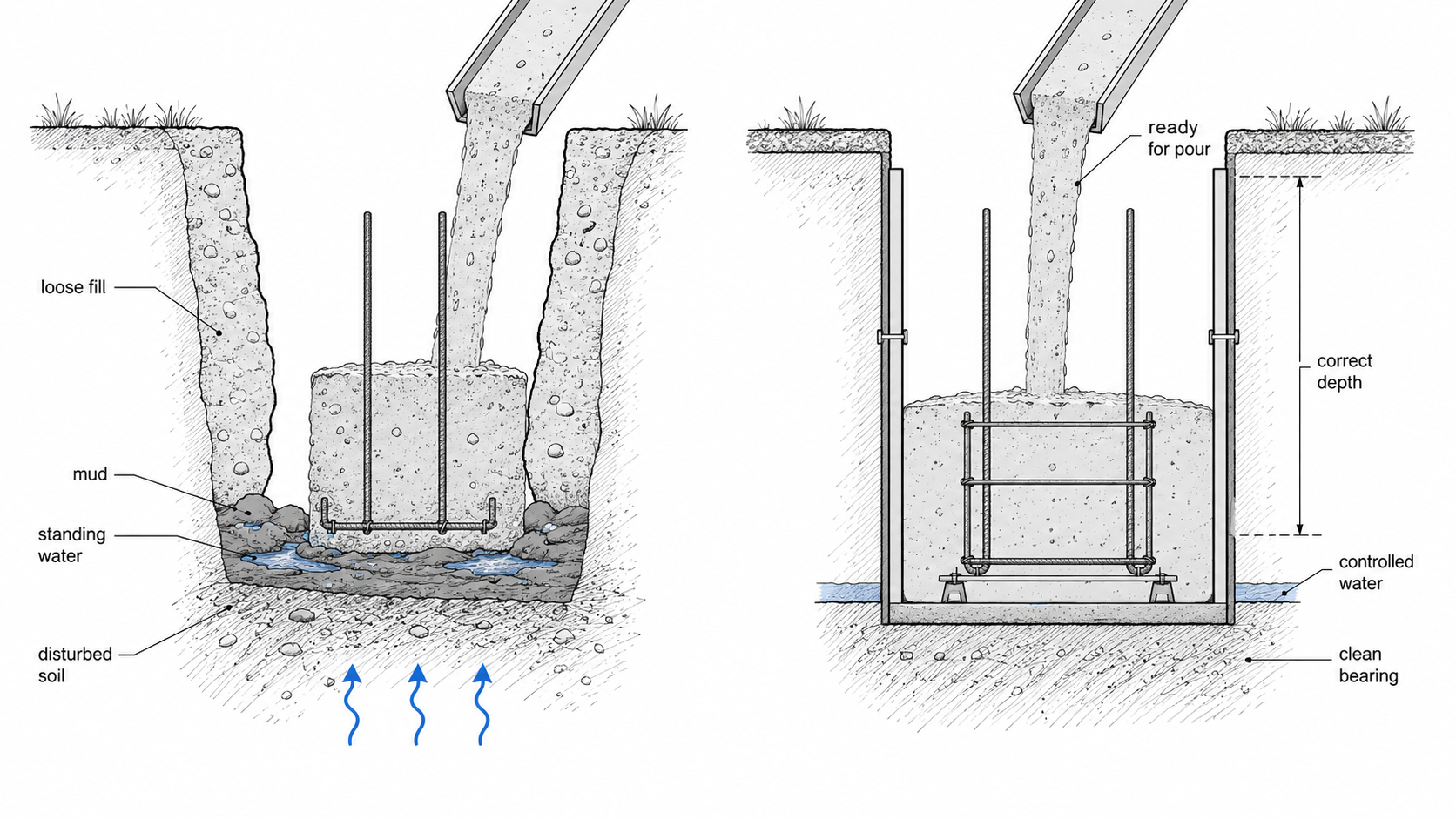
- Correct depth and width for the plans and local requirements.
- Clean bearing surface at the bottom of the excavation.
- No loose soil, mud, organic material, roots, or debris below the footing.
- Water controlled or removed according to the approved method.
- Trench sides stable or properly protected where required.
- Utilities located and protected.
- Reinforcement, forms, or chairs installed where specified.
- Inspector approval where required before the pour.
Useful measuring tools: A 100-foot tape measure and a construction laser level can help check layout, grade references, and depth from safe positions. They do not replace a surveyor, engineer, inspector, or trench-safety plan.
When Excavation Depth Needs an Engineer
Some foundation excavations should not be handled from rule-of-thumb advice. Get engineering or qualified design help when soil is weak, the water table is high, the site is sloped, the excavation is near another structure, the building loads are unusual, or the foundation must go deeper than ordinary local practice.
Engineering is also important when an excavation exposes unexpected soil, old fill, buried debris, soft pockets, groundwater, or signs that an existing foundation may be undermined.
What to Fix First
Fix the site condition before forcing the foundation detail.
If the soil is weak, the footing may need redesign. If water enters the trench, drainage or dewatering has to be handled before the pour. If the trench is too deep, the bearing condition must be corrected properly. If the excavation is near an existing foundation, the support sequence matters.
Foundation depth is not only a number. It is the point where load, soil, water, frost, safety, and code all meet.
FAQ
How deep should a house foundation be?
The depth depends on local code, frost depth, soil, water, load, and foundation type. Do not use one national depth as a rule for every house.
What is the minimum depth for a footing?
Model codes may set minimums, but the actual footing depth must also satisfy local frost requirements, soil conditions, plans, and inspection requirements.
Can a foundation trench be too deep?
Yes. Over-digging can disturb bearing soil and increase concrete cost. If a trench is too deep, the correction should be approved rather than filled casually with loose soil.
What happens if water is in the foundation trench?
Water can soften soil, hide loose material, and interfere with inspection or concrete placement. The water source and trench bottom condition should be addressed before pouring.
Do all foundations need to be below frost depth?
In cold climates, many foundations need frost protection or placement below frost depth. Some approved frost-protected shallow foundation designs use insulation instead. Local code and design requirements control this.
Is trench fill better than strip footing?
Not always. Trench fill can reduce below-grade masonry and work well in some conditions, but it uses more concrete and still needs correct soil bearing, depth, width, and trench safety.
When should an engineer check excavation depth?
Use an engineer when soil is weak, water is present, the excavation is near another structure, the building load is unusual, the site is sloped, or the trench exposes unexpected conditions.