
Ceiling Types, Problems, and Costs
Ceilings start looking important when they crack, sag, stain, peel, echo, or trap heat.
What looks like one flat surface is carrying a lot more than finish material. Structure, insulation, air sealing, wiring, lights, ducts, plumbing, sound control, and fire separation all pass through that layer. When one part goes wrong, the ceiling often shows it first.
Start with the problem you have or the kind of ceiling you are planning. A vaulted room, a basement ceiling, peeling bathroom paint, sound issues, and water stains do not lead to the same fix.

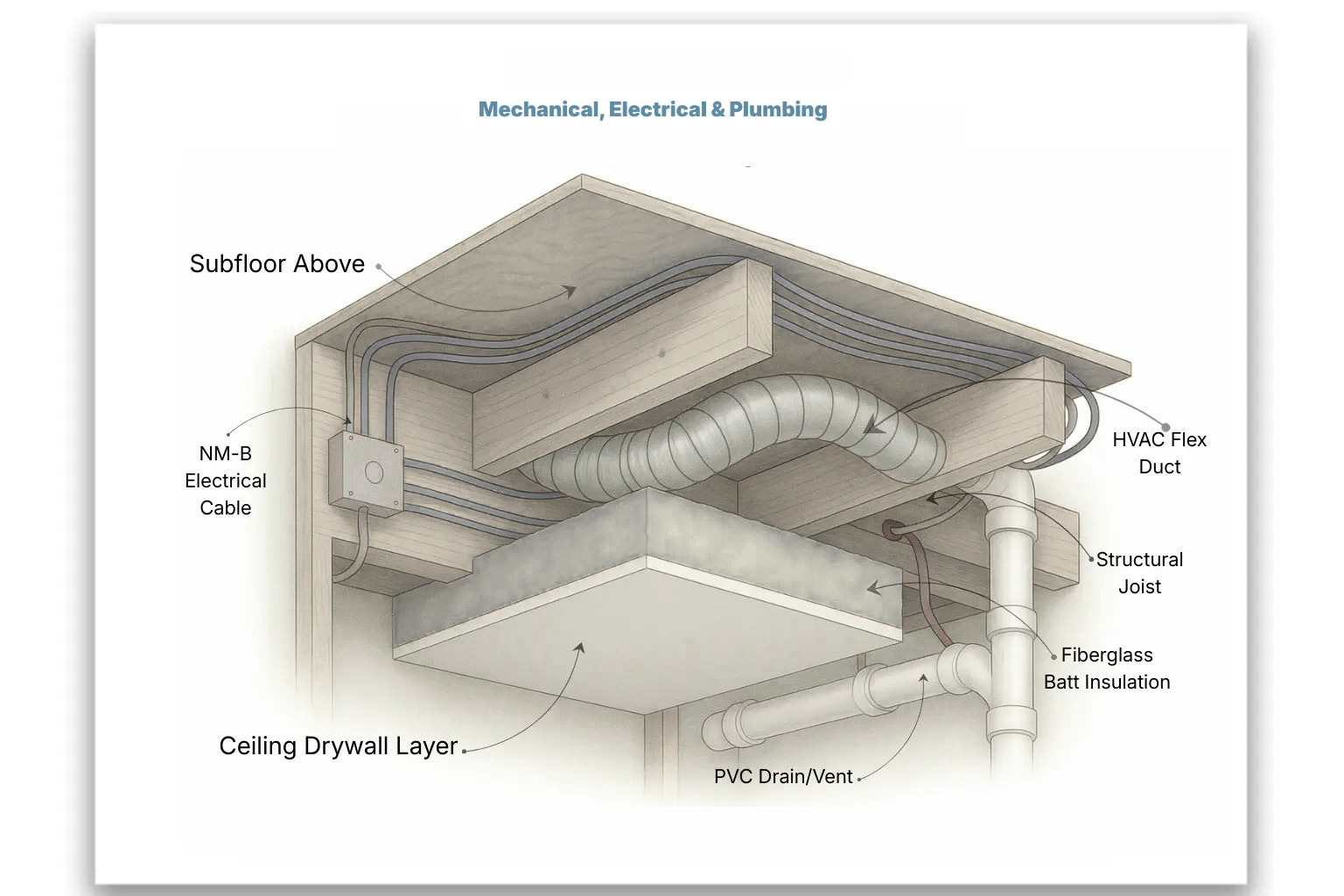
Illustration by ArchitectureCourses.org. Ceiling failures often start above the finished surface, then show up as staining, cracks, sagging, or damaged finish layers.
| If you are dealing with | Start here | What usually decides it |
|---|---|---|
| Sagging, cracks, stains, mold | Ceiling problems and old-house ceilings | Moisture, framing movement, and how fast the damage is changing |
| New framing or a renovation | Ceiling framing and structure | Joists, ties, loads, and what is hiding above the drywall |
| Cold rooms, noise, condensation | Ceiling insulation and sound control | Air leaks, R-value, venting, and acoustic buildup |
| Design changes | Ceiling finishes and ceiling height | Proportion, lighting, cost, and whether the structure can support the look |
| Basement or utility spaces | Drop ceilings and basement ceilings | Access, moisture, headroom, and noise |
| DIY work | DIY ceiling guides and tools | Layout, support tools, dust control, and knowing when to stop |
If you are still planning the house, deal with the rooms first. Ceiling moves work best when the plan underneath makes sense. House Planning for Beginners: A Step-by-Step Guide is the right starting point.
If the rooms already feel cramped on paper, a tray ceiling or a beam detail will not rescue the layout. Space Planning Essentials: A Step-by-Step Guide for Architecture Students helps with that part.
Introduction to Ceilings
Most people notice a ceiling only when something is wrong. Builders learn to read ceilings early because they give problems away fast. A brown ring usually means moisture. A long straight crack can mean movement at a joint. A wavy ceiling can point to framing or bad finishing. A cold spot with mildew often comes back to air leaks and weak insulation.
What ceilings do

- Hide structure
- Hide wiring, pipes, vents, and junctions
- Carry insulation and air-sealing layers
- Shape acoustics and light
- Support lights, fans, alarms, speakers, and fixtures
- Provide fire separation in some locations
- Show every shortcut sooner or later
That last one is the part people learn the hard way.
Two good companion pages here: Reading Blueprints: How to Read Plans Like a Pro for plan-reading, and Guide to Understanding Building Codes Simplified for Beginners for the code side when ceiling height, fire rating, or access starts becoming a permit issue.
Ceiling Framing and Structure
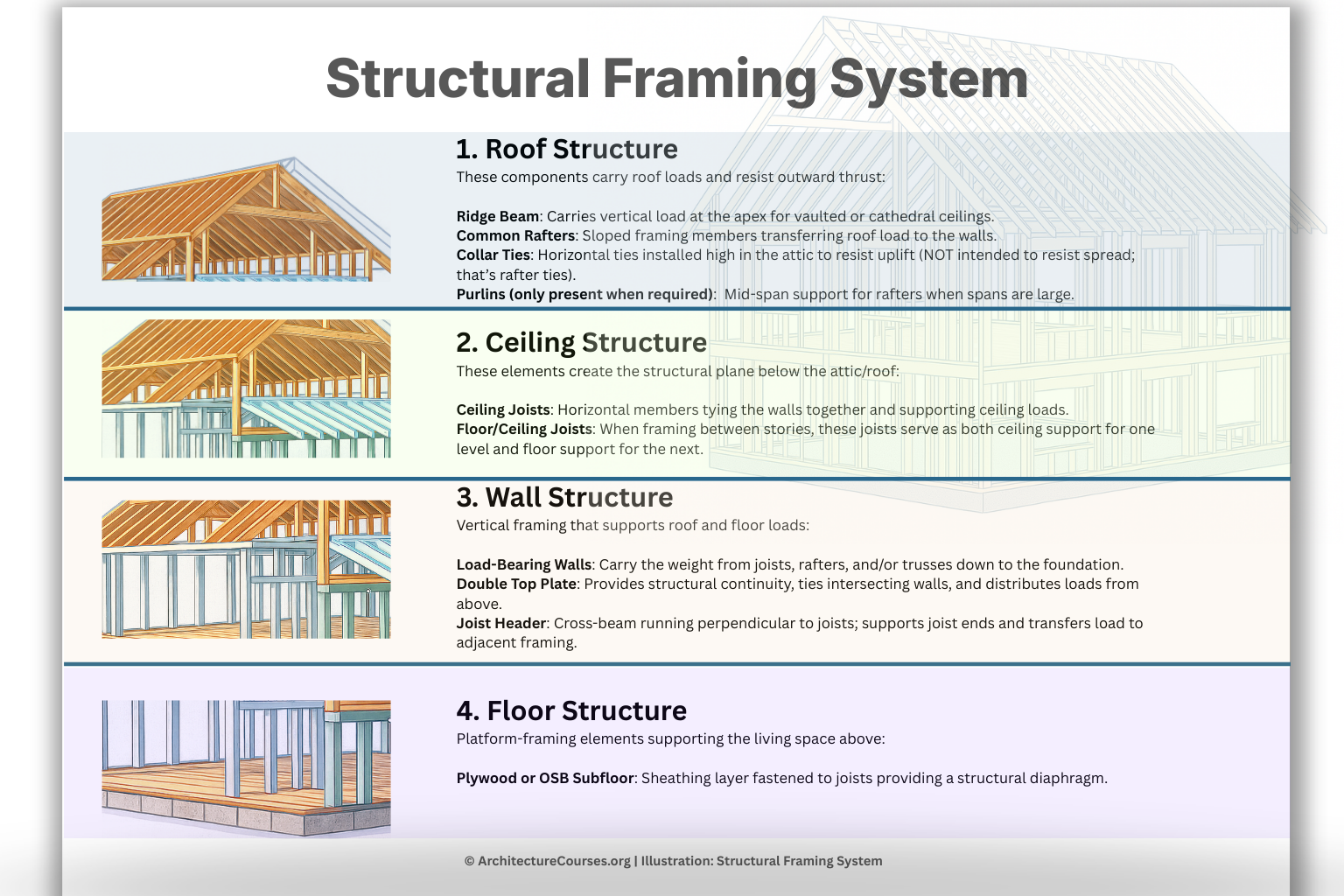
This is the skeleton above your head. Get this part wrong and every later finish becomes damage control.
Pages here
- Ceiling Joists Explained
- Attic Joists vs Ceiling Joists
- How to Frame Ceilings in a New House
- Rafter Ties vs Collar Ties and How They Affect Ceilings
- Vaulted Ceilings: Structure, Cost, and Common Mistakes
- Why Your Ceiling Is Sagging
- Old House Ceiling Framing and Balloon Framing Issues
- Blocking and Bracing for Lights, Fans, and Chandeliers
- Removing a Ceiling to Expose Beams
What matters here
- Joist size, spacing, and span
- How roof and floor loads move down through the walls
- Whether the ceiling is flat, dropped, vaulted, or partly structural
- When sagging means simple reinforcement and when it means reframing
- How soffits are framed around ducts and plumbing
- Fan-rated boxes and backing for heavy fixtures
- Fire-rated ceilings under garages, suites, and some basements
A “ceiling problem” is often a framing problem that got covered. For a short load-path refresher before getting into joists and ties, Structural Design 101: Key Principles Every Architect Should Know is useful.
What Sits Above the Drywall
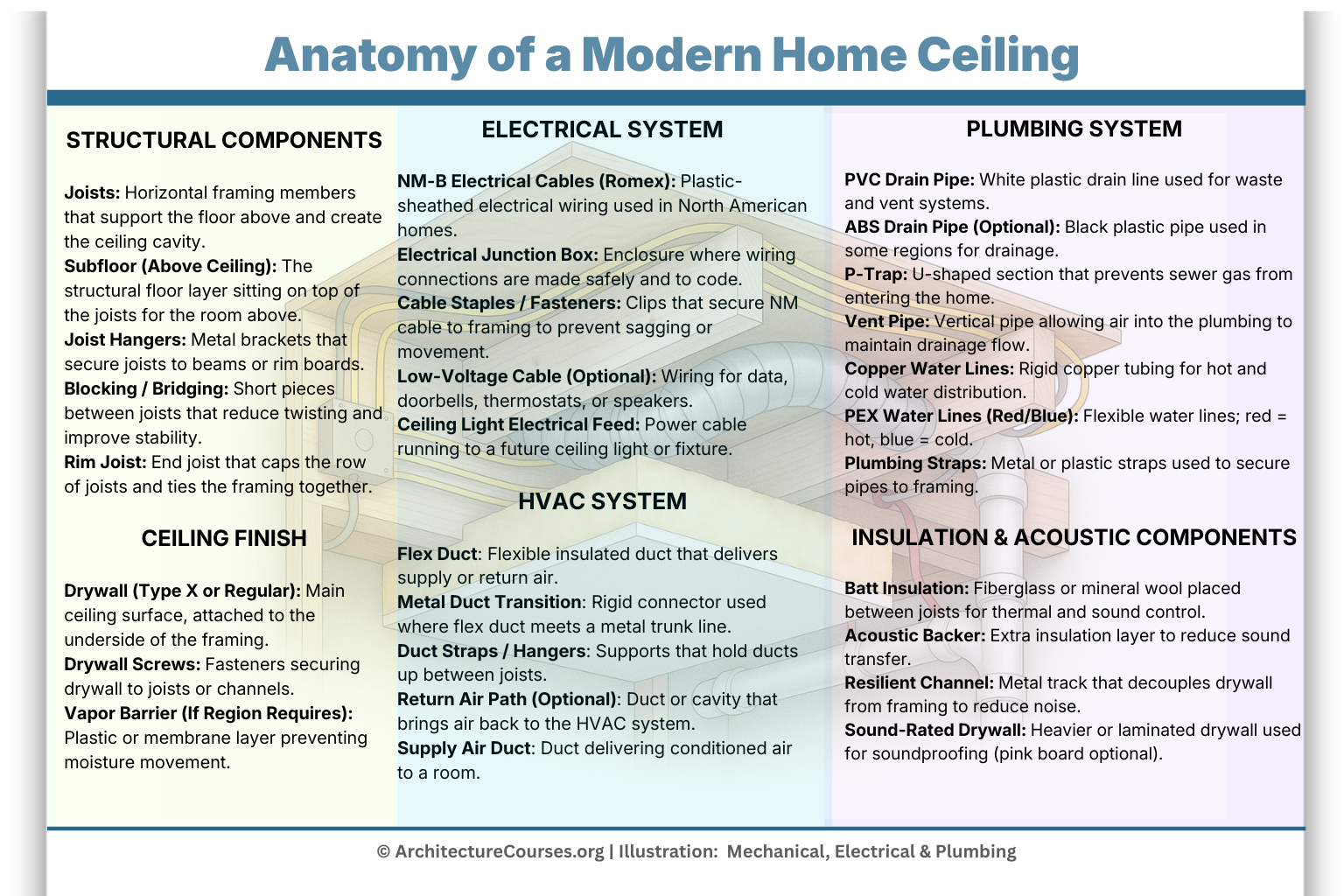
This is where a lot of ceiling jobs go sideways. Nobody wants to open the ceiling. Everybody wants to believe the space above it is simple. It rarely is.
Above a typical ceiling you may have electrical runs, fan boxes, recessed lights, ducts, bath-fan piping, return-air paths, plumbing vents, drain lines, insulation voids, vapor issues, and framing that someone hacked apart years ago to make one more line fit.
Pages here
- Ceiling Electrical Basics
- How to Install a Ceiling Fan Properly
- Recessed Lighting Layouts
- Recessed Lights Causing Attic Moisture
- HVAC Ducts in Ceilings
- Bathroom Exhaust Fans: Ducting, Insulation, and Mold Prevention
- Return Air vs Supply Air
- Plumbing in Ceilings
- Water Stains on Ceilings
- How to Frame Around Plumbing and Ductwork Without Weakening the Ceiling
- Low Voltage in Ceilings
- Sprinkler System Ceilings
Electrical
This part deals with what is allowed inside ceilings, how junction boxes must stay accessible, what fan boxes need to carry, and why recessed lights still cause condensation trouble when the air sealing is sloppy. Ceiling fan failures, wobble, loose boxes, and cracked drywall around fixtures usually start here.
HVAC
Ceilings hide a lot of HVAC mistakes. Sagging flex duct, metal duct sweating in summer, bath fans dumping moist air into attics, oversized supply grilles, weak returns, and soffits framed after the duct layout was already wrong. If a room is cold, loud, moldy, or hard to cool, the ceiling often tells the story first.
Plumbing
Drain lines, vent stacks, and water lines above finished ceilings are common. So are the stains and smells that follow bad joints, slow leaks, or cold pipes that sweat in humid weather. This part shows how to tell roof leaks from plumbing leaks, when to open the ceiling right away, and when moisture testing helps narrow it down first.
For code-side background while you work through these pages, Residential Building Codes Simplified: What You Need to Know is useful. For life-safety context around rated ceilings, duct penetrations, and alarms, NFPA 101 Life Safety Code: Essential Standards for Building Safety helps keep the bigger picture clear.
Ceiling Insulation and Sound Control
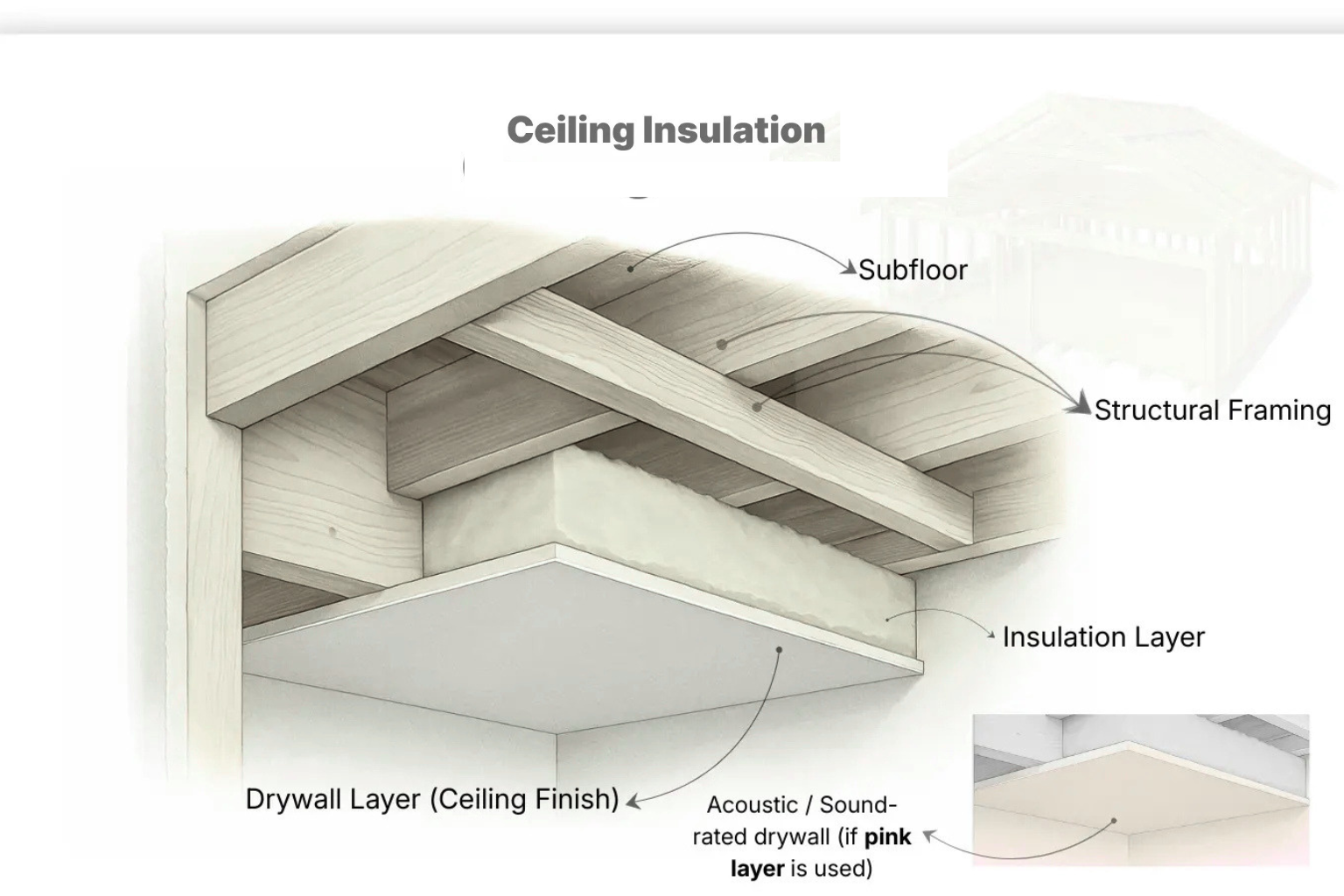
Heat moves. Sound moves. A weak ceiling lets both pass straight through.
Pages here
- Best Ceiling Insulation for Old Houses
- Fiberglass vs Rockwool vs Blown-In vs Spray Foam
- Soundproofing a Ceiling
- R-Value Requirements for Ceilings
- Air Sealing Above Ceilings
What matters here
- Air leaks that undo good insulation
- Baffles that keep roof vents clear
- Recessed light clearances and airtight fixtures
- Attic moisture that shows up first on the ceiling plane
- Cold spots and mold near weak insulation
- Sound isolation in basement ceilings and between floors
- When resilient channel helps and when it gets installed wrong
Most insulation failures are air-sealing failures first. That is why some ceilings stay cold even after extra batts go in. Warm air finds the holes. Moisture follows it. The stain, mildew, or frost comes later.
For the building-science side of that problem, Green Architecture Principles Every Architect Should Know is a good companion page.
Ceiling Finishes and Ceiling Styles
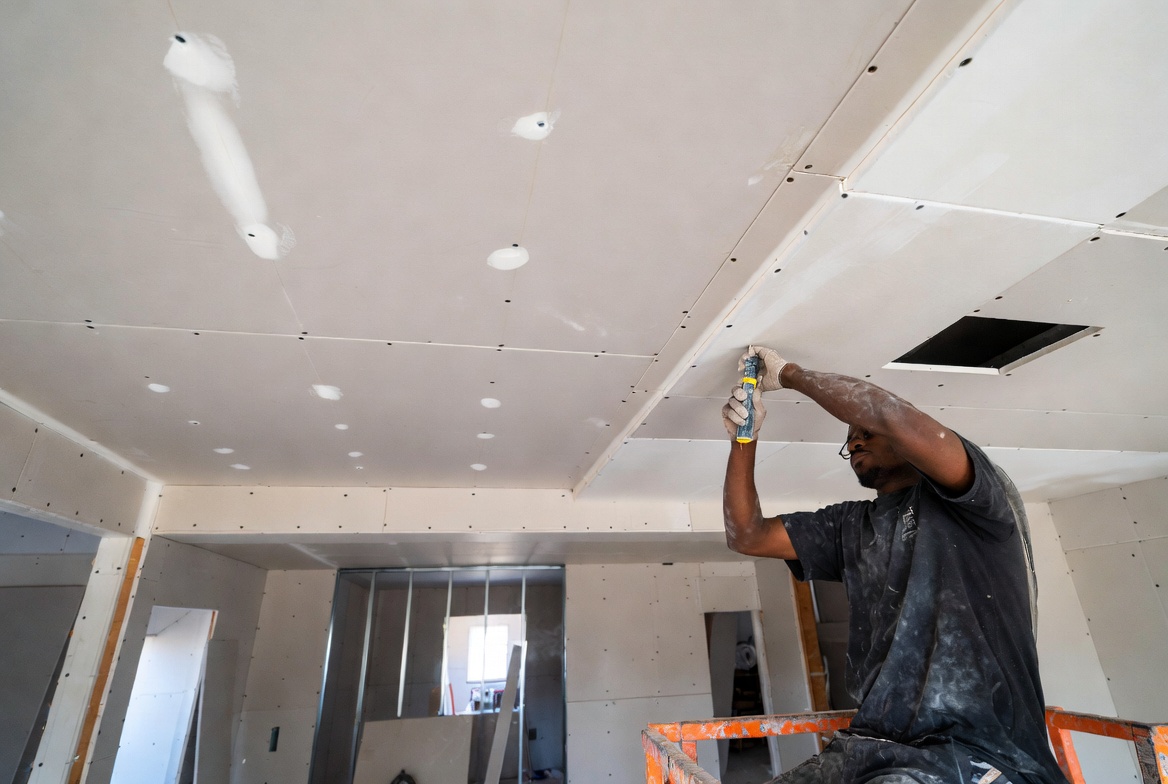
Image by ArchitectureCourses.org. Ceiling installation and finishing labor can change the schedule and cost fast.
This is the part people notice first. Flat drywall. Coffers. Tray ceilings. Tongue-and-groove boards. Exposed beams. Wood slats. Faux beams. Painted plaster. Metal panels. Clean ceilings look easy because the ugly work is already hidden.
Pages here
- Coffered Ceilings
- Tray Ceilings
- Vaulted Ceilings
- Tongue and Groove Ceilings
- Shiplap Ceilings
- Exposed Beam and Faux Beam Ceilings
- Drywall Ceilings: Smooth, Skim, and Level 5
- Glass Ceilings in Sunrooms and Loft Spaces
- Historic and Famous Ceilings
Choices that change the outcome
- Real wood vs MDF in coffers and panels
- Real beams vs lighter hollow beams
- LED cove and tray lighting that does not look dated
- Paint and stain choices that do not flatten the room
- Thermal and condensation problems around glass or metal ceilings
- Drywall finish level and lighting angle
Ceiling style is one of those areas where one wrong move changes the whole room. A shallow tray can sharpen a plain room. A bad tray can make it feel shorter. Exposed beams can look right in one house and forced in the next. For a design-language reset before picking a style, Form Meets Function: Principles for Great Architectural Design and What is Form in Architecture? Principles, Examples, and Applications both help.
Popcorn Ceilings
Popcorn ceilings are still everywhere because they were cheap to spray and good at hiding bad finish work. They are slow to remove, messy to patch, and risky when asbestos is part of the story.
Pages here
- Popcorn Ceilings: What They Are and Why They Exist
- How to Remove a Popcorn Ceiling
- Popcorn Ceiling Removal Tools You Actually Need
- Is Popcorn Ceiling Asbestos?
- How to Test Popcorn Ceilings
- Popcorn Ceiling Removal Cost
- Popcorn Ceiling Repair
This section stays on testing, containment, scraping, patching, skim-coating, and knowing when a ceiling should be left alone until the material is confirmed safe. Plenty of scraped ceilings reveal joints and patches that were ugly long before the texture went on.
Drop Ceilings and Basement Ceilings
Basements, utility rooms, offices, and rental spaces use drop ceilings for one reason: access. Pipes leak. Wires get added. Ducts need service. A ceiling that opens quickly has value.
Pages here
- Drop Ceilings 101
- Ceiling Tiles: Materials, Fire Rating, and Styles
- Best Basement Ceiling Options
- Drop Ceiling vs Drywall
- How to Install a Drop Ceiling
- Drywall vs Exposed vs Drop Ceilings in Basements
- Best Ceiling Tiles for Basements
- Soundproofing Basement Ceilings
Done well, a drop ceiling looks calm and makes future repairs easier. Done badly, it sags, traps moisture, and kills headroom. Basement ceilings are where access, noise, and dampness all fight each other at once.
If you are laying out a finished basement or suite, headroom and fire protection need to be considered from the first sketch, not at the end. Drawings for Planning Permission: What You Actually Need is useful when those plan notes need to become real permit drawings.
Old House Ceilings
This is where the house starts talking back. Plaster keys let go. Lath shifts. Old leaks keep telegraphing through new paint. A bulge that looked harmless last winter suddenly cracks after a wet spring.
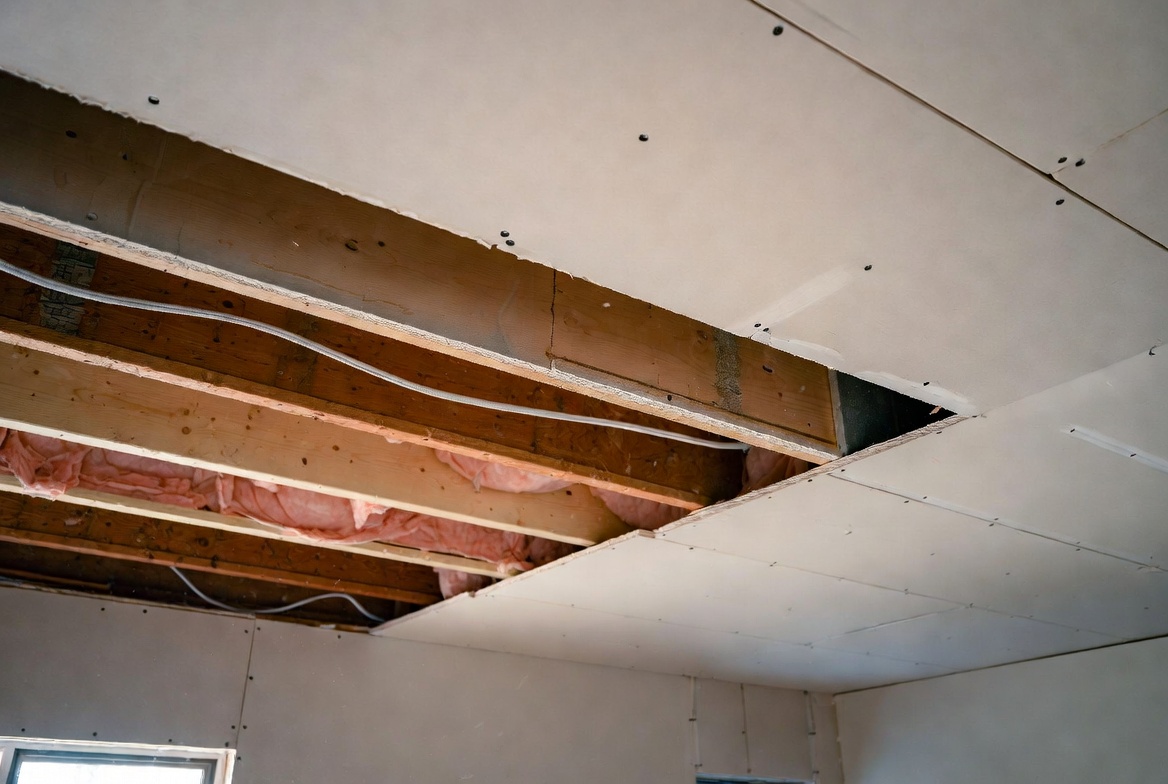
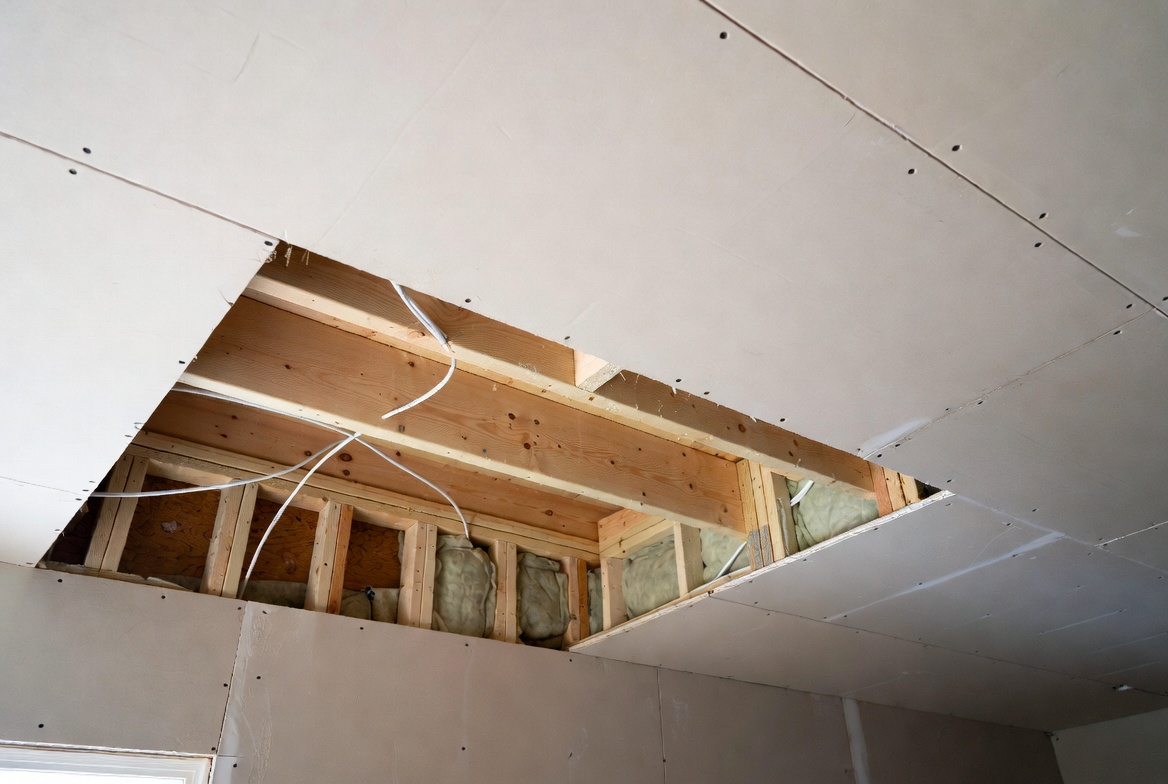
Image by ArchitectureCourses.org. An opened ceiling reveals the framing cavity, insulation, and service runs hidden above the drywall.
Pages here
- Plaster and Lath Ceilings: Cracks, Bulges, and Failing Keys
- How to Fix Sagging Plaster Ceilings
- When to Tear Out a Ceiling and When to Repair It
- Old House Ceiling Restoration
- Ceiling Water Damage: Diagnosis and Repair
Old ceilings are slow work. Temporary support, plaster washers, moisture tracing, and careful opening-up matter more than speed. This part helps you figure out when an old ceiling still has enough integrity to save, and when keeping it becomes riskier than rebuilding it.
If the ceiling movement seems tied to bigger building movement, Step-by-Step Site Analysis for Residential Architecture helps connect what you see indoors to drainage, roof lines, and grade outside.
When the Ceiling Is Telling You Something
Most people land here after a small panic search. Crack. Brown stain. Bowed drywall. Yellow patch above the shower. Smell that will not go away.
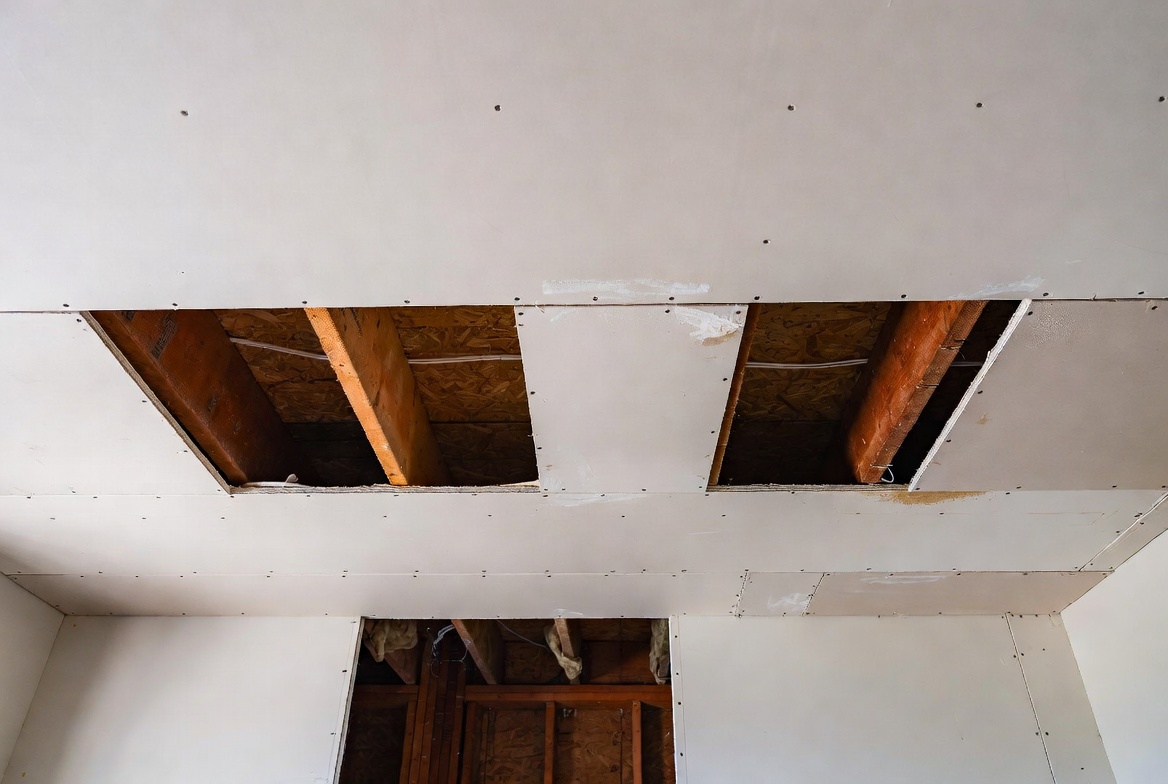
Image by ArchitectureCourses.org. Once the ceiling is opened, the framing cavity and hidden service space become easier to inspect.
Pages here
- Ceiling Cracks: When They Matter
- Why Your Ceiling Is Bowing
- Brown Stains on Ceilings from Leaks and AC
- Ceiling Mold: Causes and Fixes
- Sagging Drywall Repair
- Bathroom Ceiling Peeling
- Yellowing and Grease on Kitchen Ceilings
Some fixes are surface-level. Primer, patching, better paint, better ventilation. Others are early warnings of wet framing, structural movement, or repeated condensation. This is where those differences get sorted.
When cracks or sagging show up in a line through several rooms, the ceiling may only be the messenger. Foundations, Soil Analysis, and Site Investigation helps when the real problem starts lower in the building.
Ceiling Costs and Budgeting
Ceiling work gets underestimated all the time. People price the finish they want and forget the structure, demolition, duct moves, fan boxes, repainting, or insulation cleanup around it.
Pages here
- Cost to Install a Ceiling
- Cost to Remove Popcorn Ceiling
- Cost of Coffered Ceilings
- Cost to Vault a Ceiling
- Shiplap Ceiling Cost
- T&G Ceiling Cost
These pages break costs into labor, materials, typical ranges, and the details that push a project out of the “simple” category. Vaulting a ceiling is the obvious example. The drywall number looks manageable until the structural work, HVAC changes, insulation rebuild, and lighting redesign show up behind it.
If you are planning a larger remodel, House Planning for Beginners: A Step-by-Step Guide helps line ceiling changes up with wall moves, room use, and windows before the ceiling starts getting priced in isolation.
DIY Ceiling Guides and Tools
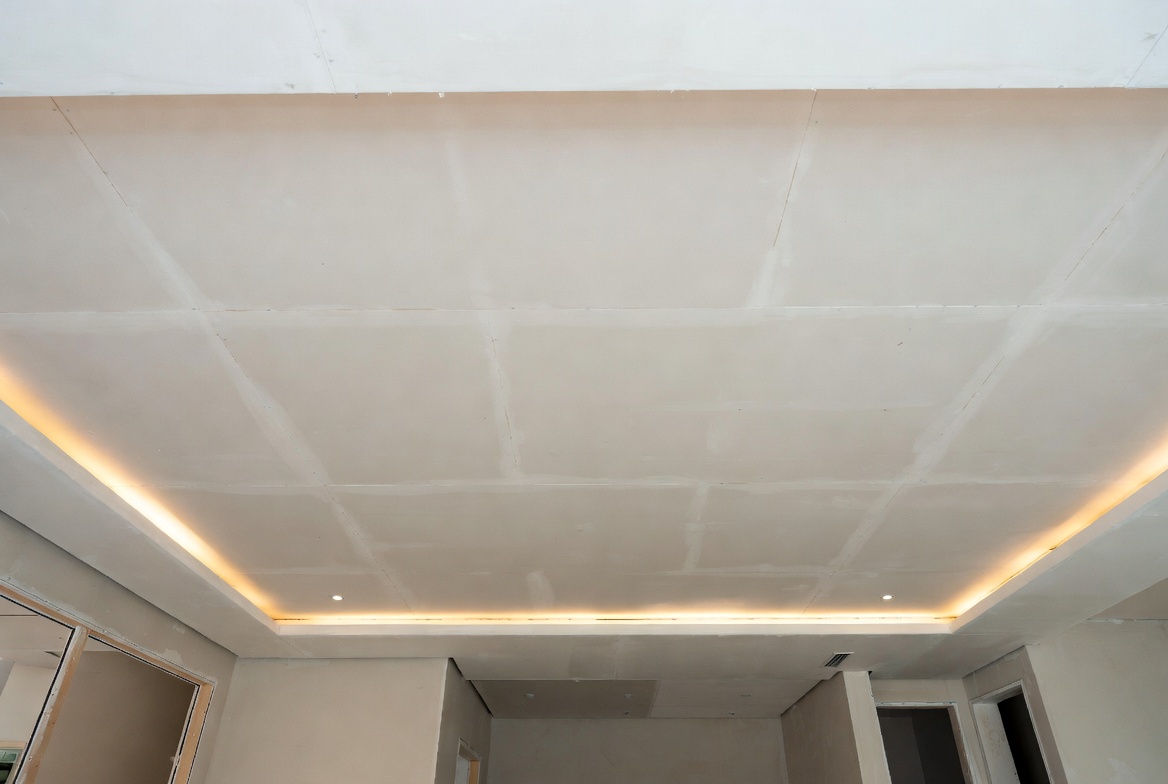
Image by ArchitectureCourses.org. Ceiling cost rises once lighting recesses, soffits, and finish quality get more demanding.
Ceiling work is hard overhead. Even simple jobs get worse when the room is not laid out, the lift is missing, the light is bad, or the patch area was not dried out properly first.
Pages here
- How to Drywall a Ceiling
- How to Mud and Tape Overhead
- How to Patch a Ceiling Hole
- How to Install Shiplap on a Ceiling
- How to Install Faux Beams
- How to Raise a Ceiling
- Best Drywall Tools for Ceilings
- Best Lighting for Ceilings
- Best Ceiling Fan Installation Tools
- Drywall Lift
- Laser Levels
- Dust Containment Kits
- Moisture Meters
These pages stay practical. Layout lines. Support tools. Dust control. Access. Safety. A beginner can handle some of this work. A beginner should not handle all of it.
If you are still getting used to thinking from drawing to jobsite, Basic Techniques and Principles of Architectural Drawing and Basic Drawing Tools for Architects: What You Actually Need and Why both translate well to layout work overhead.
Bathroom and Kitchen Ceilings
These are the two rooms where paint failure, yellowing, and mildew show up fastest. Steam, grease, weak fans, short duct runs, and cheap paint all find the ceiling eventually.
Pages here
- Bathroom Ceiling Peeling
- Best Paint for Bathroom Ceilings
- Exhaust Fan Mistakes That Cause Mold
- Kitchen Ceiling Grease and Yellowing
- Humidity Problems and Fixes
Most bathroom ceiling problems start with ventilation, not paint. Most kitchen ceiling yellowing starts with grease film, not “bad color choice.” These pages sort those problems into the right order so you do not repaint before fixing the cause.
Ceiling Height and Room Feel
Ceiling height changes how a room feels before you add furniture, art, or even much light. Eight feet can feel fine in one room and tight in the next. Nine feet can feel generous or pointless depending on the plan. Ten feet can be worth every dollar or just create an echo chamber.
Pages here
- Standard Ceiling Heights
- 8-Foot vs 9-Foot vs 10-Foot Ceilings
- How Ceiling Height Changes Room Feel
- Best Ceiling Heights by Room Type
- Is It Worth Raising a Ceiling
This section deals with proportion, light, volume, trim, and how ceiling height plays against door heads, windows, and room use. A ceiling move that helps a living room can make a bedroom feel off. That is the level of judgment this part is trying to make easier.
If you want a broader room-proportion lens while thinking through these pages, Spatial Planning and Design: A New Perspective on Architecture and Interiors is the right companion piece.
FAQ
When is a sagging ceiling an emergency?
A ceiling that suddenly sags, feels soft, shows new cracks and fresh staining together, or drops fast after a leak needs immediate attention. Stop using the room below until you know what is happening.
Do I need an engineer to remove or raise a ceiling?
Not every time. You do need to know whether the ceiling is tied to joists, rafters, or another load path. Decorative drops and simple soffits are one thing. Structural ceilings are another.
Can I run plumbing in ceilings?
Yes, but every fitting over finished space becomes a future leak risk. Good support, insulation, access where possible, and careful routing matter.
How do I know whether a popcorn ceiling has asbestos?
You cannot tell by looking at it. If it is old enough to be in the risk range, treat it carefully until it is tested.
What is the best ceiling finish for a bathroom?
Usually smooth drywall, the right primer, and good paint. The bigger issue is the fan and the duct run above it.
Is a drop ceiling always the best basement option?
No. It is often the easiest for access. It also costs headroom and can look cheap when the tile quality is poor. Drywall and exposed ceilings both have cases where they win.
Can a beginner drywall a ceiling?
Yes, but it is harder overhead than on walls. A lift, help, better lighting, and patience matter more than people expect.
Why did my new ceiling crack in the first year?
Common causes are framing shrinkage, settlement, missed backing, bad joint placement, and movement that the finish layer could not absorb.
References, Codes, and Official Resources
This hub stays practical, but ceilings still tie back to code, health, fire, and building-science sources. Use the pages below when you need the official side of the detail.
Building codes and safety
- International Code Council – Model International Building Code and Residential Code
- National Building Code of Canada – Official access and summaries
- NFPA Codes and Standards – Official pages
Energy, insulation, and moisture
- U.S. Department of Energy – Insulation and air sealing basics
- ASHRAE – Ventilation and comfort standards
- Building Science Corporation – Moisture, roof, and enclosure research
Mold, asbestos, and health
- EPA Mold Guidance – Official homeowner guidance
- Health Canada Mold Guidance – Indoor mold FAQ
- EPA Lead and Asbestos Guidance – Renovation safety resources
Always check local code and local permit requirements before changing ceiling height, removing structure, adding a suite, or rebuilding a rated assembly. That is where many “simple” ceiling jobs stop being simple.