
Drawings for Planning Permission: A Complete Guide
Need drawings for planning permission? Learn which plans councils require, how much they cost, and whether you need an architect.
Applying for planning permission without the right drawings is a dead end. Councils reject incomplete sets instantly. The trick is knowing exactly what’s required, who should prepare it, and how much it’s going to cost you.
Site Plans and Block Plans
What a Site Plan Shows
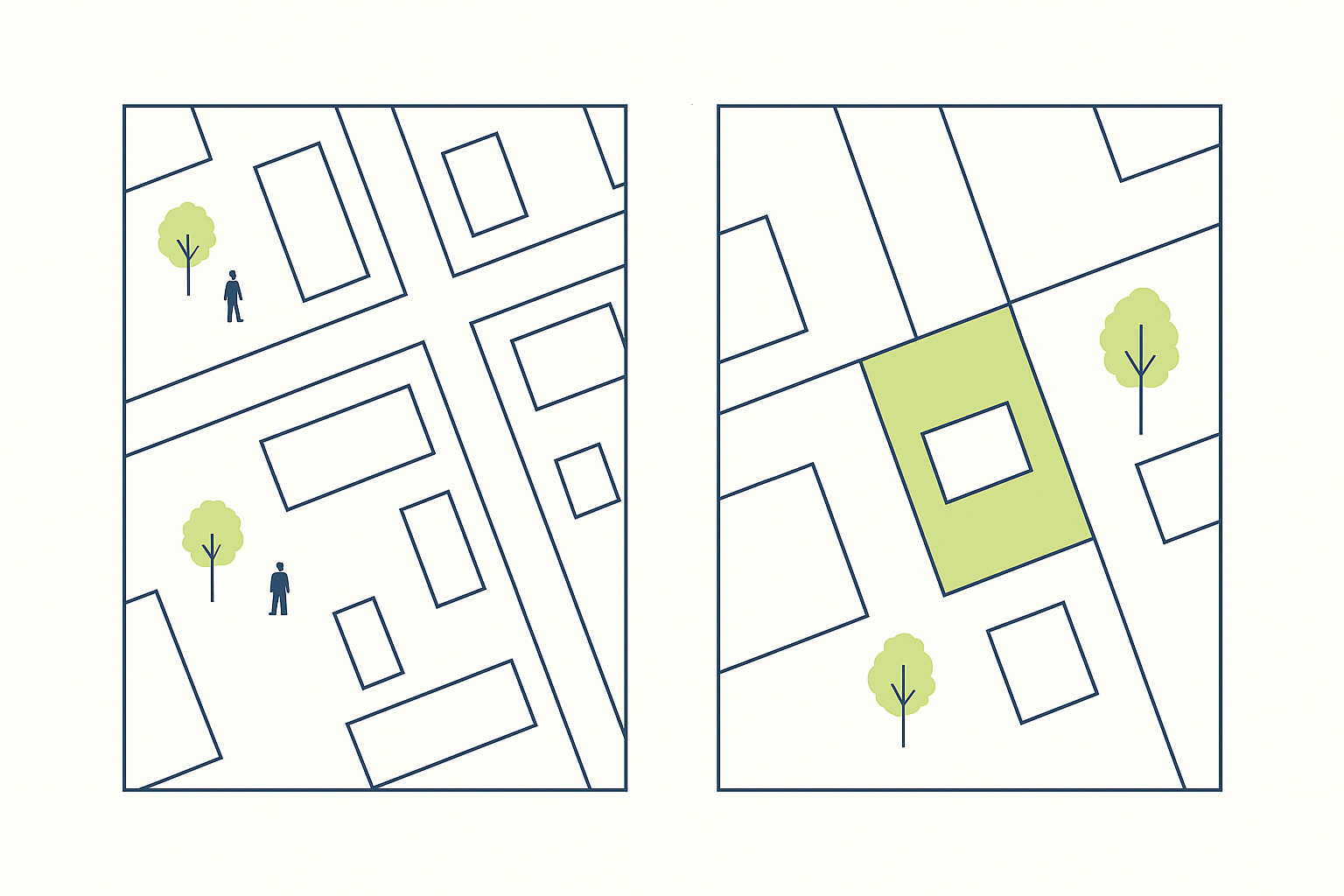
This is the wide-angle sheet. It maps your entire property in context: roads, boundaries, trees, and surrounding buildings. Councils use it to check how your proposal sits in the bigger area.
-
Scale: In the UK, almost always 1:1250. In the US, planning offices often ask for the same but call it a plot plan.
-
Purpose: To show access, proximity to neighbors, and impacts on the wider street or landscape.
-
Tip: Never just screenshot Google Maps. Councils reject plans without scale, north arrow, or boundary clarity.
What a Block Plan Shows
This zooms into your actual plot. It highlights the footprint of what you are changing or adding.
-
Scale: Standard is 1:500.
-
Details: Your existing house outline, the new extension or outbuilding shaded, plus driveways, paths, fences, and boundaries.
-
Purpose: Councils measure coverage, setbacks, parking, and green space.
The UK and US Difference
-
UK councils ask for both site and block plans as standard.
-
US counties vary. Some accept a combined plan, others want a licensed surveyor’s stamp.
You might like: List of Architectural Drawings: 67 Types You Must Know
Elevation Drawings for Planning Permission
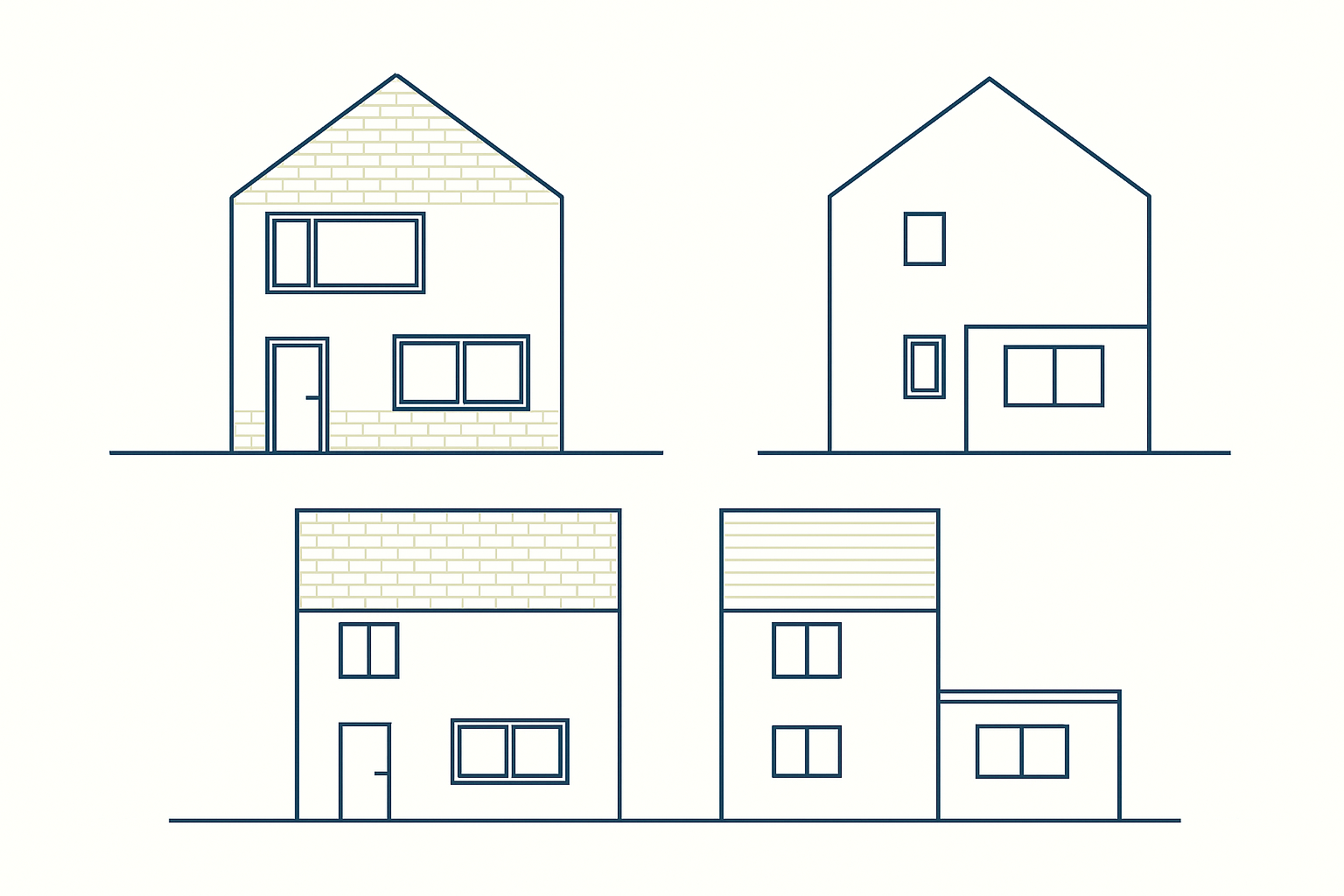
Front, side, and rear elevations are mandatory for any extension or new build. Councils and planning departments want existing and proposed elevations shown side by side. Without both, your application is delayed or rejected.
What They Must Show
• Scale: UK councils usually want 1:100 at A3. In the US and Canada, 1/4” = 1’-0” is common. Australia and New Zealand often accept 1:100 or 1:200, depending on the project size.
• Materials: Note exactly what you are using. Brick, stone, render, cladding, roofing. If you are changing finishes, highlight them clearly.
• Heights and levels: Show ridge height, eaves height, and finished floor levels. This is non-negotiable.
• Openings: Windows, doors, skylights. Every change must be drawn to scale.
• Context: If your extension changes how the house meets the street, show adjoining properties too.
Common Mistakes
• Submitting only the new elevation. Every country expects both existing and proposed.
• Forgetting materials. A blank wall on a drawing usually gets sent back.
• Using sketches without scale. Accepted only for sheds or minor outbuildings in rare cases.
• Leaving out roof pitch. Australia and NZ in particular require roof slope angles.
Country Differences
-
United Kingdom: Strict on side-by-side existing and proposed. Require north arrow, scale, and material notes.
-
United States: City building departments focus heavily on heights and massing. In seismic zones, expect structural elevation notes too.
-
Canada: Municipalities often require context elevations if your build changes the streetscape. Insulation values may also need to be marked.
-
Australia: Councils expect shading diagrams with elevations if your extension blocks sunlight to neighbors.
-
New Zealand: Local authorities require levels tied back to survey data. Flood-prone areas need finished floor level checks on elevations.
Real Example
A homeowner in Melbourne submitted extension drawings with no existing elevations. The council refused to validate the application until both existing and proposed sets were uploaded with material notes. That one oversight cost them eight weeks.
Pro Tip
Print the validation checklist from your local council or planning department before drawing anything. Requirements change by region. Meeting those up front saves months.
Plans and Technical Drawings
A planning set always starts with floor plans. Councils want to see before and after layouts. Label every room, dimension the key walls, and show how people move through the house.
Sections are needed if you are digging basements, converting lofts, or building on a sloping site. A section proves floor levels line up and head heights are legal.
Technical drawings like beam specs, rebar schedules, and connection details are rarely part of planning permission. But you will need them later for building control (UK), building permit review (Canada, US), or building warrant (Scotland). Skip them at the planning stage but budget for them.
Pro tip: Builders hate vague plans. Even if the council only requires a floor plan, add doors, stairs, and openings. Saves fights later.
You might like: Reading Blueprints: How to Read Plans Like a Pro
Outline Planning Drawings
Outline planning permission is concept only. You’re not proving how to build it, just that the idea works on the site.
The set usually includes:
-
Site plan (your land in context).
-
Block plan (your plot zoomed in).
-
Basic elevations (front, side, rear).
-
A short design statement.
If the council approves, you’ll later submit “reserved matters” drawings with full detail. Treat outline as permission in principle, not a green light to start digging.
In Canada, this is like a rezoning or development permit. In Australia and New Zealand, it’s closer to “planning approval” before the building consent stage.
Permitted Development Drawings
Even if your project falls under permitted development (PD) rights, you still need drawings. Why? Because you’ll want a Lawful Development Certificate. Without it, selling the house later can be a nightmare.
Drawings are basically the same as a planning set: site plan, block plan, elevations, and floor plans. The difference is you must prove the project stays within PD limits (height, volume, distance from boundaries).
In the US, this is similar to “as-of-right” zoning work. Councils won’t ask for a full planning application, but drawings still get submitted for permits.
Do You Need an Architect?
The rules are not the same everywhere. Here’s how it breaks down by region.
United States
In most states, small residential work like remodels, porches, or garages can be drawn by drafting firms or design-build contractors. But once you move into new houses, structural changes, or anything commercial, local planning offices will likely demand an architect’s stamp.
-
Drafting service: $1,500–$3,500 for permit-ready plans.
-
Licensed architect: $3,000–$10,000+, depending on project size and complexity.
Tip: Always check with the local building department. Some counties allow designers for homes under a certain square footage, others don’t.
Canada
Rules are provincial. Ontario and BC let qualified technicians (with BCIN/AIBC registration) prepare residential permit drawings. Larger homes, multi-unit, or anything involving structural work usually needs an architect or engineer involved.
-
Drafting service: CAD $2,000–$4,000.
-
Architect: CAD $5,000–$15,000+.
Tip: For new builds in urban centers (Toronto, Vancouver, Montreal), assume you’ll need an architect involved at some level, even if only for sign-off.
United Kingdom
Small extensions or loft conversions can be handled by a technician or draftsperson. But for listed buildings, conservation areas, or larger new builds, councils expect a licensed architect.
-
Architect: £800–£2,500+ for planning drawings.
-
Technician: £400–£1,200.
-
Online services: £250–£500. Fast and cheap, but less support if planners push back.
Australia and New Zealand
Both countries allow draftsmen or building designers to handle straightforward residential work. Larger projects, commercial builds, or council-heavy jobs usually require a licensed architect.
-
Draftsman: AUD/NZD $2,000–$6,000.
-
Architect: AUD/NZD $6,000–$15,000+.
Tip: In Australia, many states have mandatory licensing for “building designers.” Check local boards before hiring.
How Much Do Planning Permission Drawings Cost
The price isn’t flat. It swings with the size of the project, the region, and who does the work.
United States
-
Small additions or remodels: $1,500–$4,000 (often from a drafting service or design–build contractor).
-
New single-family home: $5,000–$15,000.
-
Large or custom projects: $20,000+ if full architectural services are included.
Extras: Many counties tack on permit processing fees and plan review charges. Structural engineer checks are usually separate.
Canada
-
Small extensions: CAD 2,000–4,000.
-
Loft or secondary suite conversion: CAD 3,500–6,000.
-
New custom home: CAD 8,000–15,000+.
Ontario adds a BCIN review requirement, and big cities (Toronto, Vancouver) tend to be on the higher end due to stricter zoning reviews.
United Kingdom
-
Small extension: £500–£1,200.
-
Loft conversion: £800–£1,500.
-
New house: £2,500–£5,000+.
Add the council’s application fee (usually £200–£500), plus structural engineer drawings if needed. If you’re in Scotland, remember building warrant drawings are an extra step after planning.
Australia
-
Minor extension: AUD 1,500–3,000.
-
New house planning set: AUD 3,000–8,000.
-
Complex sites or heritage work: AUD 10,000+.
Local councils may ask for bushfire risk assessments (BAL reports) or stormwater plans, which add cost.
New Zealand
-
Small alterations: NZD 2,000–4,000.
-
New home drawings: NZD 5,000–9,000+.
-
Complex builds: NZD 10,000+.
On top, you’ll pay council building consent fees (often NZD 2,000–4,000 for a house) and sometimes development contributions.
Hidden Costs People Miss
-
Application fees: Non-refundable, charged by councils.
-
Structural engineer: $1,000–$5,000 depending on project size.
-
Building control / warrant drawings: Often another set of technical drawings separate from planning.
-
Special surveys: Topographic, drainage, or heritage assessments.
Local vs Online Services
Searching “drawings for planning permission near me” usually brings up local architects or technicians. Good if you need site visits, especially for measured surveys.
Online services are faster and cheaper. You send photos and measurements, they send CAD files back. Works well for simple extensions. The risk: if the council asks for revisions or extra notes, you might be stuck.
Tips That Save Projects
-
Always check the “drawings required for planning permission” list on your council’s portal. Every council tweaks the requirements.
-
Submit to scale. UK: 1:100 or 1:50 for plans and elevations. North America: 1/4” = 1’-0” standard. Australia and NZ: 1:100 or 1:200.
-
Always show north arrow, boundaries, and dimensions. Councils reject “sketchy” plans.
-
Keep an extra copy stamped “approved.” Builders need these on site. Losing them delays inspections.
EXTRA
How Site and Block Plans Differ
Learn the difference between site plans and block plans for planning permission, with requirements across the UK, US, Canada, Australia, and New Zealand.
United Kingdom
-
Site Plan (1:1250): Shows your property in context: boundaries, roads, nearby houses, trees.
-
Block Plan (1:500): Zooms in on your plot. Outlines the existing building and highlights proposed extensions, garages, or driveways.
-
Tip: Councils reject plans missing scale bars, north arrows, or neighboring buildings.
United States
-
Often called plot plans or property surveys.
-
Some counties accept combined site/block sheets, others demand licensed surveyor stamps.
-
Must show setbacks, easements, drainage, and access roads.
-
Tip: In states like California or New York, you often need a professional stamp, not just a homeowner sketch.
Canada
-
Typically required for building permits, not just planning.
-
Known as site plans and grading plans in most provinces.
-
Must show lot lines, building footprint, drainage slopes, driveway access, and landscaping.
-
Tip: In Ontario, a “Grading and Drainage Plan” prepared by an engineer is common. Councils focus heavily on stormwater management.
Australia
-
Councils (called local shires or LGAs) require site plans and floor/elevation drawings for almost any new build or extension.
-
Standard scale is 1:200 or 1:500.
-
Plans must show orientation, existing structures, new works, site coverage, and relation to neighbors.
-
Tip: Bushfire-prone zones (BAL ratings) add extra requirements for landscaping and setbacks.
New Zealand
-
Local councils under the Resource Management Act ask for site plans and sometimes landscape plans.
-
Must show lot boundaries, existing structures, proposed works, driveway access, and relation to infrastructure.
-
Elevations are usually required with site plans.
-
Tip: NZ councils are strict about drainage, retaining walls, and slope stability. Always include contours.
I’ve seen applications rejected in Toronto for missing slope arrows, in Sydney for not shading the extension clearly, and in Auckland because the contour lines were vague. Councils aren’t being picky for fun—these details affect drainage, sunlight, and fire risk.
You might like: Foundation Excavation Modern Techniques: What Works On Real Sites
Final Word
Drawings for planning permission aren’t just a formality. They’re the language councils, neighbors, and builders read. Get them wrong and you waste weeks. Get them right and your project moves.
FAQ
1. What drawings are required for planning permission?
Usually site plan, block plan, floor plans, and elevation drawings. Councils may also ask for sections or roof plans.
2. Do I need elevation drawings for planning permission?
Yes. Existing and proposed elevations are mandatory to show how the building changes.
3. What scale should planning application drawings use?
Typical: 1:1250 for site plan, 1:500 for block plan, 1:100 for elevations and floor plans.
4. How much do planning permission drawings cost?
From £500–£1,200 for a small extension. A new house can be £2,500+.
5. Do you need architect drawings for planning permission?
Not always. A technician or draftsperson can prepare them. Architects are better for complex projects.
6. Can I draw my own plans for planning permission?
Yes, if you can produce scaled, accurate, and legible drawings. But most people hire professionals to avoid rejection.
7. What’s the difference between a site plan and a block plan?
Site plan shows wider context. Block plan zooms in on the property boundary and proposed works.
8. Are technical drawings needed for planning permission?
No. Technical or structural details are usually for building control, not planning.
9. What is a scale drawing for planning permission?
A scaled drawing (1:100, 1:200, etc.) that can be measured directly. Councils reject drawings marked “not to scale.”
10. What are outline planning drawings?
Basic plans and elevations used to test concept approval before full details are submitted.
11. What is the difference between outline planning permission and full?
Outline tests principle of development. Full requires full plans with all details.
12. What is a permitted development drawing?
Plans submitted with a Lawful Development Certificate to prove an extension or loft is within PD rights.
13. Do I need drawings for permitted development?
Yes. Councils want drawings to confirm the size, height, and layout fit PD rules.
14. Do I need architect drawings for permitted development?
Not required by law. But scaled, professional drawings increase approval odds.
15. What are building warrant drawings?
In Scotland, drawings submitted for technical approval under the building regulations. Equivalent to building control drawings in England/Wales.
16. What are elevation plans for planning permission?
Flat drawings showing each face of the building — front, side, rear.
17. What is included in a planning application drawing set?
Site plan, block plan, floor plans, elevations, roof plan (if relevant), and sometimes sections.
18. How long does it take to get drawings done?
Small extensions: 1–2 weeks. New builds: 3–6 weeks depending on surveys and revisions.
19. Can I get planning permission drawings online?
Yes. Many services offer remote plans. You provide photos, dimensions, and surveys.
20. Are online planning permission drawings accepted by councils?
Yes, if they meet scale, format, and accuracy requirements.
21. Do I need structural drawings for planning permission?
No. Structural drawings are usually needed later for building regulations.
22. What happens if my drawings are wrong?
The council issues a “request for more information.” This delays approval.
23. Who checks planning application drawings?
Planning officers. They check scale, context, accuracy, and compliance with policy.
24. Can I reuse old drawings?
Only if the project is identical. Otherwise, new drawings are required.
25. How detailed should planning drawings be?
Enough to show dimensions, materials, openings, and relationship to neighbors.
26. Do you need roof plans for planning permission?
Only if the roof is changing — loft conversion, dormers, new extension.
27. How much do architects charge for planning applications?
Between £800 and £2,500 for drawings, plus the council’s application fee.
28. Can I submit hand drawings for planning permission?
Yes, but they must be to scale, neat, and professional. CAD drawings are strongly preferred.
29. How do I know what my council requires?
Check the council’s local validation checklist on their website.
30. Do planning drawings need north arrows?
Yes. Site and block plans must include north orientation.
31. Do planning drawings need to show neighboring houses?
Yes, in context. Site and block plans usually show adjacent plots.
32. Can planning permission be refused for poor drawings?
Yes. Incomplete or unclear drawings are a valid reason for refusal.
33. What is the difference between architectural drawings and planning drawings?
Planning drawings show appearance and context. Architectural drawings may also cover construction details.
34. Do planning drawings need dimensions?
Yes. Councils need to check heights, widths, and distances to boundaries.
35. Do planning drawings need to be stamped?
Not before submission. Once approved, the council stamps them “approved.”
36. Can I appeal if my planning drawings are rejected?
Yes. You can revise and resubmit, or formally appeal to the Planning Inspectorate.