
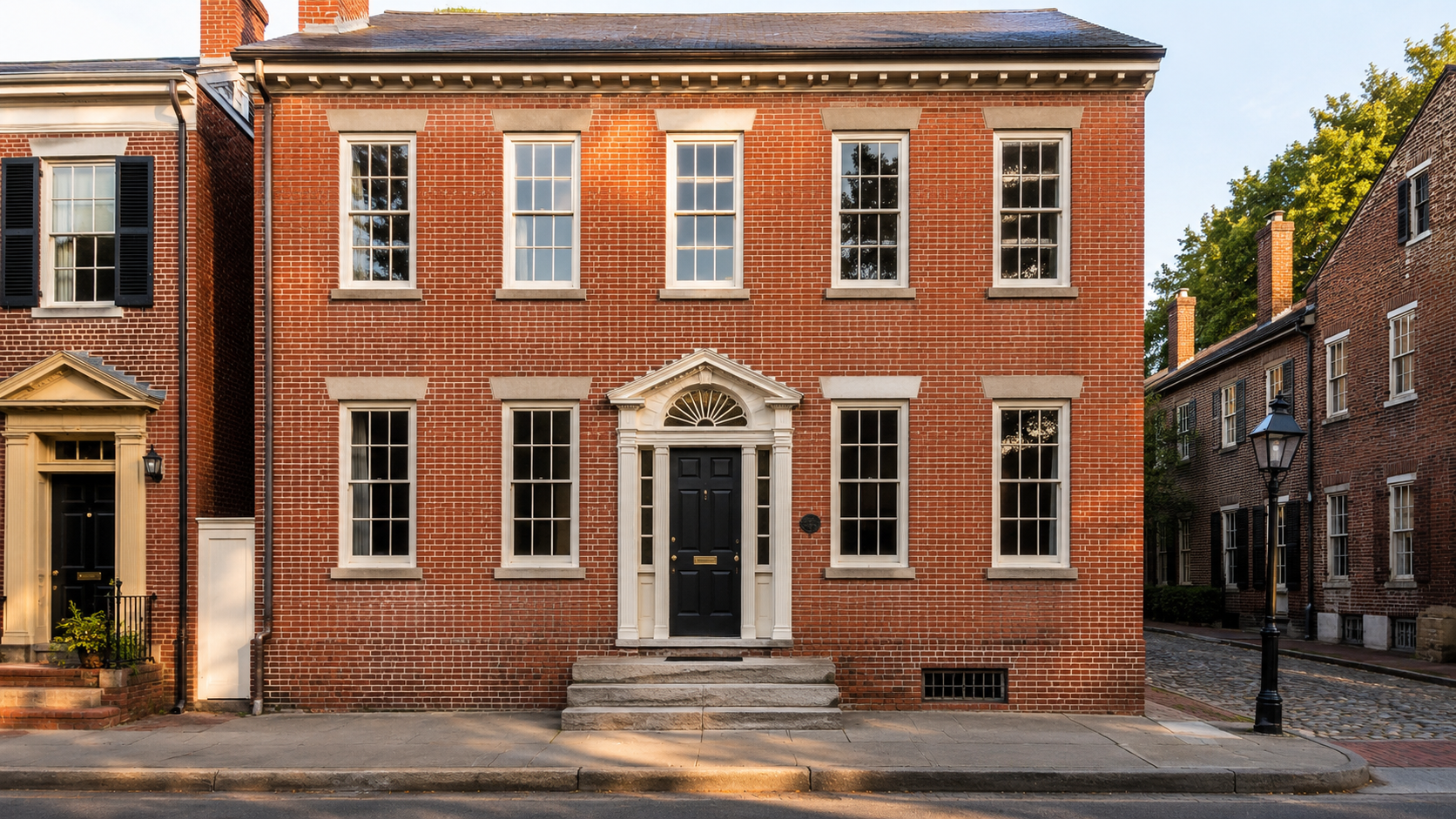
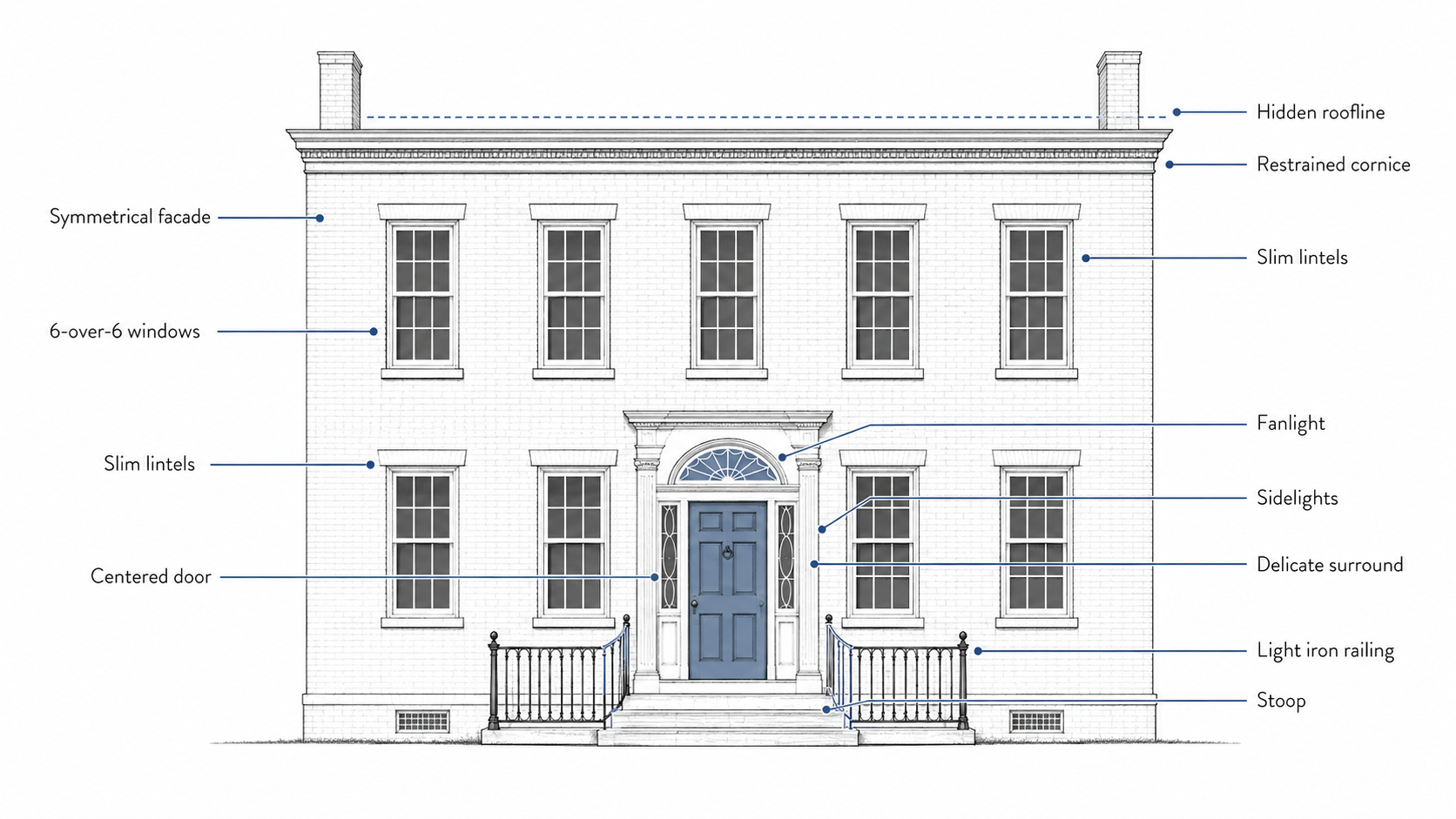
Image by ArchitectureCourses.org. Brick Federal-style houses often rely on balance, tall sash windows, a centered entry, fanlight, sidelights, white trim, and a restrained cornice rather than heavy ornament.
Federal Style grew in the decades after the American Revolution, when the new republic wanted architecture that looked ordered, refined, and distinct from heavier British traditions.
Federal Style was never just a pretty old-house phase.
It became one of the first serious architectural languages for the new United States. Not royal. Not medieval. Less heavy than Georgian precedent. Calm, balanced, classical, and disciplined.
That is why the style matters more than a fanlight or a brick facade. It tells you what the early republic wanted to look like: rational, stable, and permanent.

If you want the spotter guide first, read Federal Style architecture. If you want the room-level side, use Federal Style interior design. For the bigger style map, start with architecture styles. For the older ideas behind Federal design, classical architecture and neoclassical architecture are the right companion pages.
What years count as Federal
The useful working range is the late 1700s through the early 1800s, especially the 1780s through the 1830s.
That timing matters because the style belongs to the early republic. It rose after independence, when Americans wanted buildings that looked civic, measured, and new. It stayed strong until the taste for Greek Revival grew heavier and more explicit.
| Phase | What was happening | What to look for |
|---|---|---|
| Late 1700s | Post-Revolution identity forming | Lighter classical detail, symmetry, calmer facades |
| 1780s–1830s | Peak Federal period | Fanlights, sidelights, tall sash windows, refined entries |
| 1830s–1840s | Transition toward Greek Revival | Heavier columns, bolder cornices, less delicate detailing |
Why it mattered

After independence, the United States did not only need a government. It needed a look.
That look could not lean too hard on old royal or colonial authority, because the whole point was separation. It also could not feel chaotic or improvised, because the new republic was trying to project order. Federal Style solved that problem. It borrowed from Rome, from classical balance, from Georgian discipline, and from broader neoclassical taste, then softened the result into something lighter and more distinctly American.
This is the part broad style pages usually skip: Federal architecture was political image-making before it was a homeowner preference. The buildings were saying something.
If you want one field guide that helps separate Federal, Georgian, and Colonial houses without guessing from memory, a search for A Field Guide to American Houses by Virginia McAlester is worth keeping open while you compare facades.
The style was political before it was decorative
When people reduce Federal Style to columns, fanlights, and brick, they miss the reason it landed so hard in the first place.
The new nation wanted buildings that reflected balance, reason, restraint, and civic seriousness. That is why symmetry mattered. That is why entries were centered. That is why details stayed fine instead of overblown. The style was trying to look like a republic, not a monarchy.
This is also why Federal architecture still reads clearly today. The proportions are carrying ideals, not just decoration.
Where it came from
You can read Federal Style as a three-way inheritance.
From Roman architecture, it took republican symbolism, classical orders, and the belief that proportion could express civic values. From Georgian architecture, it took balance and order, then thinned them out. From neoclassical thought, it took the larger idea that buildings should look rational and composed.
The easiest mistake is treating these influences as the same thing. They are not. Georgian is heavier. Federal is finer. Greek Revival, which comes later, is more blunt and declarative.
If you need a clean design-side support page while reading those differences, architectural proportions is the better companion because this style really does depend on getting the weight and spacing right.
The people who pushed it forward

Charles Bulfinch matters because he helped turn the style into a real American civic language, especially in the Northeast. Benjamin Latrobe matters because he pushed classical ideas into the federal building program with more rigor and force. William Thornton matters because the early Capitol helped give the new nation a visual seriousness it badly wanted.
You can add Thomas Jefferson to the larger conversation, even when his work sits partly in overlapping neoclassical territory. The point is not hero worship. The point is that these figures were not decorating. They were helping build national self-image.
For broader U.S. architectural history, a search for Architecture in the United States by Dell Upton is a stronger next step than another surface-level style list.
Where people mislabel it later
The transition into Greek Revival is where a lot of readers get sloppy.
Federal did not disappear in one clean year. It drifted. Some later buildings still keep Federal rhythm and planning while wearing heavier Greek features on the facade. That is why one entry can still feel Federal in its proportions even when the column language is already moving elsewhere.
Quincy Market is a good example of that transitional problem. So are later civic buildings where the body still behaves like Federal architecture but the face is already leaning into something more monumental.
Buildings that teach the style fast

Decatur House is useful because it stays refined without becoming thin or weak. Georgetown rowhouses are useful because they show how Federal logic worked on narrow urban lots. Salem examples matter because they show just how elegant and controlled the style could get in domestic work.
The point is not tourism. The point is pattern recognition. Once you have seen three or four strong examples, you stop mistaking every symmetrical old house for Federal.
Why it still matters
Federal Style still matters because it proves that architecture can look formal without becoming pompous.
It also proves that restraint ages well. You still see Federal logic in townhouses, custom traditional homes, and newer houses that borrow the centered entry, calm facade, and refined window rhythm without copying the full period costume.
If you want the wider historical backdrop around it, complete architectural styles timeline helps place Federal in the longer sequence without flattening it into a generic “classical” bucket.
FAQ
Is Federal the same as Colonial?
No. Colonial and Georgian work come earlier. Federal keeps the balance but usually feels lighter, finer, and more restrained.
Why is it called Federal?
Because it belongs to the early federal period of the United States, when architecture was helping define the public image of the new republic.
What is the fastest way to spot it?
Look for symmetry, a refined centered entry, fanlight or sidelights, tall sash windows, and trim that feels delicate rather than heavy.
Why do people confuse it with Greek Revival?
Because later buildings often sit in the transition. The proportions may still feel Federal even when the column language gets heavier.
Can Federal ideas still work in a new house?
Yes. The calm entry, balanced openings, and disciplined proportions still work well. The trick is borrowing the logic without pasting on the wrong costume.
Read Next
If you want the main spotter guide, read Federal Style architecture.
If you want the room-level side of the cluster, go to Federal Style interior design.
For the deeper roots behind the style, read classical architecture and neoclassical architecture.