
Why Architectural Photography is Different
Shooting buildings isn’t like shooting people. You can’t fake straight lines. You can’t crop your way out of a tilted wall. Every detail in glass, concrete, and steel shows up. That’s why architectural photography lives and dies on the gear.
The right camera gives you resolution and dynamic range. The right lens keeps verticals straight. The right tripod stops micro-shakes that ruin sharp edges.
What the Masters Used
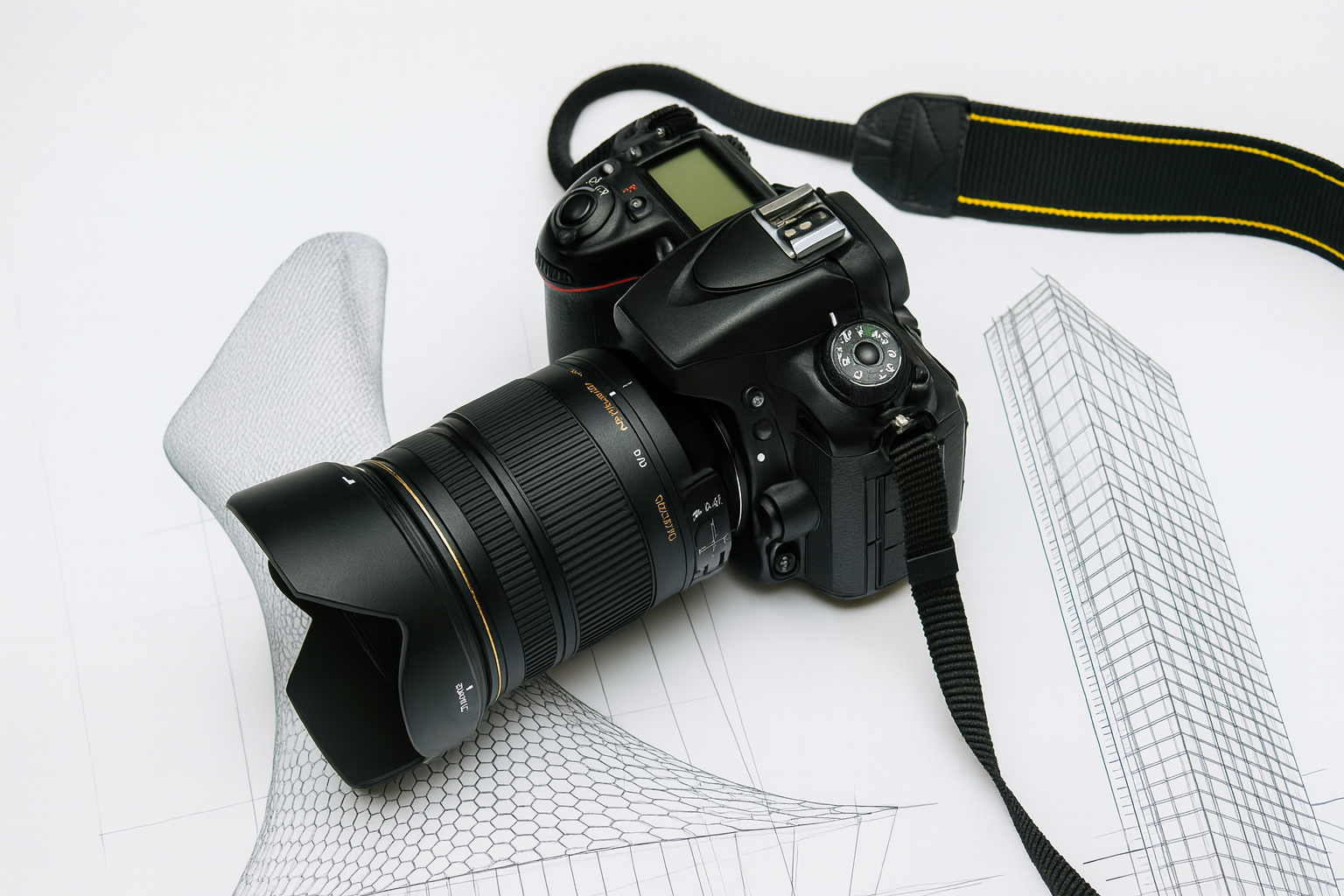
Julius Shulman built the look of mid-century LA with a heavy 4×5 camera. Ezra Stoller turned factories and skyscrapers into icons on sheet film. They didn’t use those tools because they were easy. They used them because they held lines and detail. Today we have mirrorless cameras, tilt-shift lenses, and high-res sensors doing the same job. The principle hasn’t changed. Precision first.
What You Actually Need
Architectural photographers work slow and deliberate. You need gear that keeps up. That means:
-
A full-frame body with at least 30 megapixels.
-
A tilt-shift or wide zoom for control in tight spaces.
-
A tripod that won’t wobble when you press the shutter.
-
A mid-range zoom for detail shots that clients care about.
This is the baseline kit. Anything less, and you’ll spend hours fixing distortion and soft edges in post.
Why Architectural Photography Demands Its Own Gear
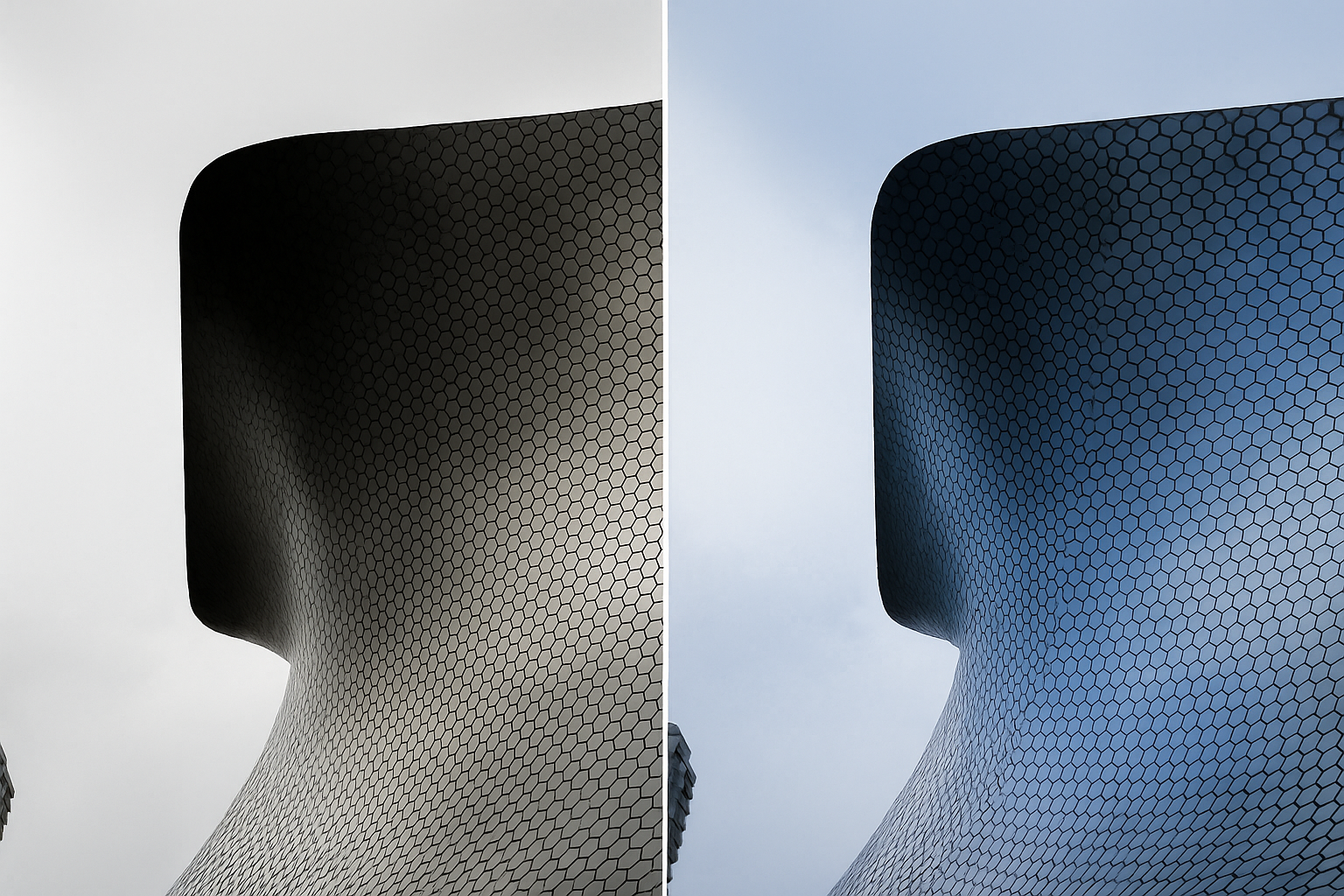
Buildings don’t pose for you. They fight you. A tower leans away the moment you tilt your lens. A glass wall fills with your reflection. A vaulted ceiling swallows detail until the stone looks flat. This is where regular cameras fold.
Architecture leaves no room for error. Distortion shows in every wall. Reflections clutter every window. Shadows bury the lines the architect obsessed over. If your gear can’t control that, the image fails.
This isn’t decoration. It’s record. Architects, clients, and publishers expect proof. Lines must hold straight. Glass must cut sharp. Concrete should carry weight. Wood needs warmth. A photo that doesn’t feel as solid as the building itself doesn’t pass.
The old masters knew it. Julius Shulman staged ladders and lights to keep geometry clean. Ezra Stoller’s 4×5 negatives caught steel and stone with a sharpness no handheld camera could match. They weren’t chasing art. They were chasing accuracy.
Today’s gear is smaller, faster, sharper. But the demand hasn’t shifted. Precision and control still separate snapshots from architectural photography. If your kit can’t hold a line true, you’re not recording architecture. You’re just taking pictures of buildings.
You might like: Architectural Photography Guide: Tools, Tips & Techniques
Best Canon Lens for Architectural Photography
Canon’s tilt-shift series is the gold standard. The Canon TS-E 24mm f/3.5L II Tilt-Shift is the most practical choice. Its shift movement keeps verticals straight when photographing tall buildings. For interiors, the Canon EF 16–35mm f/4L IS USM gives wide coverage without harsh distortion.
FIELD PICK: Canon TS-E 24mm f/3.5L II on Amazon
Best Tripod for Architectural Photography
A sturdy tripod matters more than people think. Architecture demands sharp edges and often long exposures. The Manfrotto 055 Aluminum 3-Section Tripod is heavy but stable. If weight matters, the Peak Design Carbon Fiber Travel Tripod packs down small yet stays steady indoors.
FIELD PICK: Manfrotto 055 Tripod on Amazon
Best Lens for Architectural Photography
● Tilt-Shift Lenses – For precise perspective correction.
● Ultra-Wide Zooms (14–24mm / 16–35mm) – For tight interiors and dramatic exteriors.
● Standard Zooms (24–70mm) – For details and context shots.
If budget is tight, stick with a sharp 16–35mm and learn to correct distortion in post.
Best Cameras for Architectural Photography
Full-frame sensors win here. More resolution equals more detail in lines, windows, and textures.
● Canon EOS R5 – 45MP mirrorless, strong color and sharpness.
● Nikon Z7 II – 45.7MP, excellent dynamic range.
● Sony A7R IV – 61MP, the king of detail.
For interiors with tricky light, these cameras handle shadows and highlights well.
Good Cameras for Interior Architectural Photography
Interiors are about low light and straight lines. Look for:
● High resolution (30MP+).
● Good ISO performance.
● Wide lens support.
Canon EOS R6 Mark II is a strong “good camera” option for mixed work. Cheaper but versatile.
Best Lens for Interior Design Photography
● Canon RF 15–35mm f/2.8L IS USM – Crisp, wide, and stabilized.
● Nikon Z 14–30mm f/4 S – Lightweight and distortion-controlled.
● Sony 12–24mm f/2.8 GM – Expensive, but flawless for interiors.
Architectural Photography Cameras by Budget
● Best Budget Camera for Architectural Photography – Nikon Z5 or Canon EOS RP. Full-frame on a budget.
● Best Compact Camera – Fujifilm X100V (fixed lens, sharp for street architecture).
● Best DSLR for Architecture – Nikon D850 or Canon 5DS R (both still industry benchmarks).
● Best Mirrorless – Sony A7R IV or Canon EOS R5.
Architectural Camera Lenses
● Canon – TS-E 24mm tilt-shift for exteriors, 16–35mm zoom for interiors.
● Nikon – PC NIKKOR 19mm tilt-shift for pro-level correction.
● Sony – 12–24mm GM for interiors, 24mm tilt-shift (via adapters).
Special Mention: Tilt-Shift Lenses
Nothing replaces a tilt-shift when photographing tall buildings. Vertical lines stay straight, not falling back. They also allow depth-of-field tricks that no regular lens can.
If you shoot architecture professionally, buy or rent one.
Best Camera Picks by Year
● 2021 – Nikon Z7 II and Sony A7R IV led the field.
● 2022 – Canon EOS R5 and Sony A7R V became the most used.
● 2023–2025 – High-resolution mirrorless cameras dominate. DSLRs are fading.
Comparison: Canon vs Nikon vs Sony for Architecture
Canon – Best tilt-shift lens options.
Nikon – Best dynamic range for exteriors.
Sony – Highest resolution mirrorless cameras.
Mistakes to Avoid
✕ Shooting tall buildings without a tilt-shift or correction.
✕ Using cheap tripods indoors. Small vibrations kill sharpness.
✕ Relying only on wide angles. Mid-range zooms capture details clients care about.
How to Apply This
✓ If you’re starting: buy a good tripod + 16–35mm zoom.
✓ If you’re professional: add a tilt-shift lens.
✓ If budget is tight: get a used full-frame DSLR with a sharp wide zoom.
✓ Always shoot RAW. Correct perspective in post when needed.
KEEP LEARNING
Top resource: Michael Freeman’s Architecture Photography
Why: Freeman explains both the technical gear choices and the composition logic architects care about.
Buy on Amazon
FAQs
FAQs on Architectural Photography Gear
Cameras for Architecture
1. Do I really need a full-frame camera for architecture?
Yes. Full-frame sensors capture wider angles, better dynamic range, and more detail. Crop sensors can work, but you’ll fight distortion and noise more often.
2. Is 20MP enough for architectural photography?
It works for web, but not for print or clients who want giant files. 30–45MP is the safe zone for sharp lines and textures.
3. DSLR or mirrorless for architecture?
Mirrorless wins now. Better EVFs for live preview, lighter bodies, and newer lens options. DSLRs still hold up (D850, 5DS R), but they’re aging.
4. What’s the best budget camera for architecture?
Canon EOS RP or Nikon Z5. Full-frame, affordable, and compatible with wide lenses. Don’t go cheaper than that if you want real results.
5. Can I use a smartphone for architectural photography?
For casual shots, yes. For client or portfolio work, no. Phones distort wide angles and lack dynamic range. Even the best iPhone can’t replace tilt-shift glass.
6. How important is dynamic range in an architecture camera?
Critical. Interiors with windows blow out highlights while keeping shadows dark. High dynamic range cameras (Nikon Z7 II, Sony A7R IV) hold both ends without losing detail.
Lenses for Architecture
7. Do I really need a tilt-shift lens?
If you shoot tall buildings, yes. It keeps vertical lines straight in-camera. Without it, you’ll spend hours fixing distortion in post and lose resolution.
8. What’s the best focal length for architectural photography?
24mm is the sweet spot. Wide enough for interiors, natural for exteriors. Anything wider risks distortion, anything longer loses context.
9. Are ultra-wide lenses (14mm, 16mm) good for architecture?
Only indoors or in cramped spaces. They exaggerate perspective. Use carefully or you’ll end up with cartoonish results.
10. Can I use a 50mm lens for architecture?
Yes, but it’s for details, not full buildings. Great for staircases, facades, or material studies. Not for exteriors.
11. What’s the difference between a tilt-shift and a wide-angle zoom?
Tilt-shift controls perspective. Wide zooms give coverage but distort. They’re different tools. Pros often carry both.
12. Which Canon lens is best for architecture?
Canon TS-E 24mm f/3.5L II Tilt-Shift. Every pro either owns it or rents it.
13. Best Nikon lens for architecture?
PC NIKKOR 19mm tilt-shift. Sharp, wide, and built for perspective control.
14. Best Sony lens for interiors?
Sony 12–24mm f/2.8 GM. Expensive but flawless.
15. Can I shoot interiors without a wide lens?
Not well. You’ll cut off half the room. 16–35mm is the safe interior range.
Tripods and Support
16. Do I need a tripod for architecture?
Yes. Even in daylight, small shakes ruin sharp lines. A tripod also lets you bracket exposures for HDR interiors.
17. Best tripod for architectural photography?
Manfrotto 055 for stability, Peak Design Travel Tripod for portability. Avoid cheap aluminum tripods — they wobble.
18. What tripod head works best?
A geared head. It gives precise control for lining up verticals. Ball heads are fast but sloppy for architecture.
19. Can I get away with handheld shots?
Only in bright daylight with wide lenses. Anything indoors or at twilight needs a tripod.
Shooting Interiors
20. Best camera settings for interior architectural photography?
Low ISO, narrow aperture (f/8–f/11), tripod-mounted long exposures. Avoid handheld at all costs.
21. Should I use flash for interiors?
Not unless you’re doing real estate style. Natural light is king for architecture. If you must, use subtle bounced light, never direct flash.
22. How do you handle mixed light indoors?
Shoot RAW and correct white balance in post. No lens or camera fixes bad lighting.
23. Do crop-sensor cameras work for interiors?
They work, but you’ll struggle with true wide angles. A 16mm lens on a crop body acts like a 24mm. Sometimes that’s not wide enough.
Technique and Common Problems
24. How do you stop buildings from looking like they’re falling over?
Use a tilt-shift lens or correct verticals in post. Don’t just tilt your camera up — that’s why lines converge.
25. Do you always need to shoot straight-on?
No. Angles work too, but keep verticals straight. A slightly off-axis perspective looks dynamic without distortion.
26. What’s the biggest beginner mistake in architectural photography?
Using ultra-wide lenses too close. It makes walls bend and spaces look fake. Step back and compose with care.
27. How do you capture both bright windows and dark interiors?
Bracket exposures and blend them in post. Or use a high dynamic range body like the Nikon Z7 II.
28. Should I correct distortion in camera or in post?
Tilt-shift in camera is best. Software correction helps, but you lose resolution when stretching pixels.
29. Can I shoot architecture at night?
Yes. Long exposures on a tripod give beautiful results with artificial lighting. Just avoid handheld — it will be unusable.
30. How do I build a starter kit for architecture?
One full-frame body, one 16–35mm wide zoom, one tilt-shift (rented if needed), and a solid tripod. That covers 90% of jobs.