
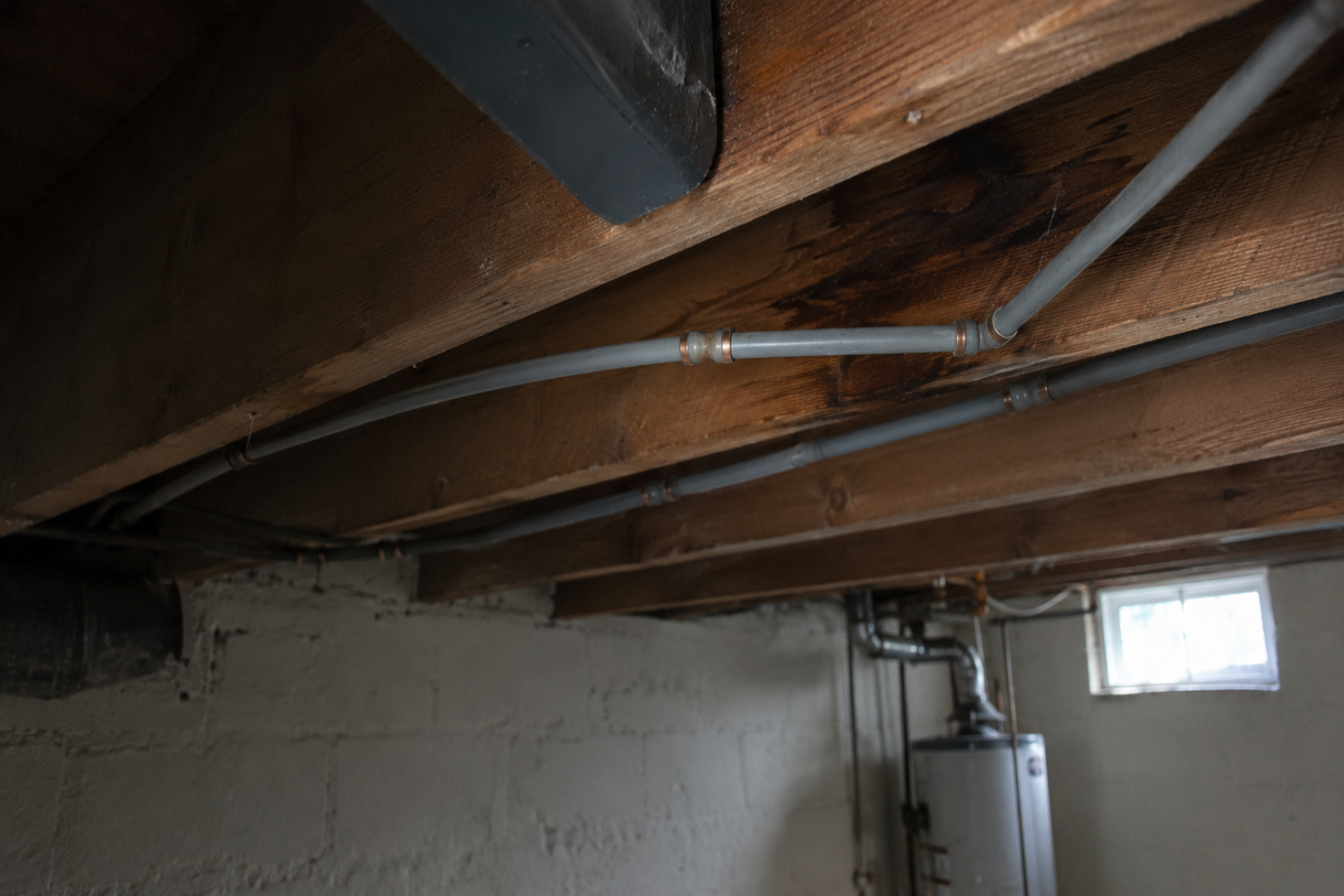


Polybutylene pipes can turn a good-looking house into an expensive surprise after closing.
The pipe you see under a sink is only a clue. The real cost depends on the pipe you cannot see: inside walls, above finished ceilings, behind showers, under slabs, and around remodeled rooms.
Before you offer, get a plumber to confirm the material, price the full replacement, include drywall repair, check insurance in writing, and put that number into the deal. If the seller will not move and the budget does not work, walk before the house becomes your problem.
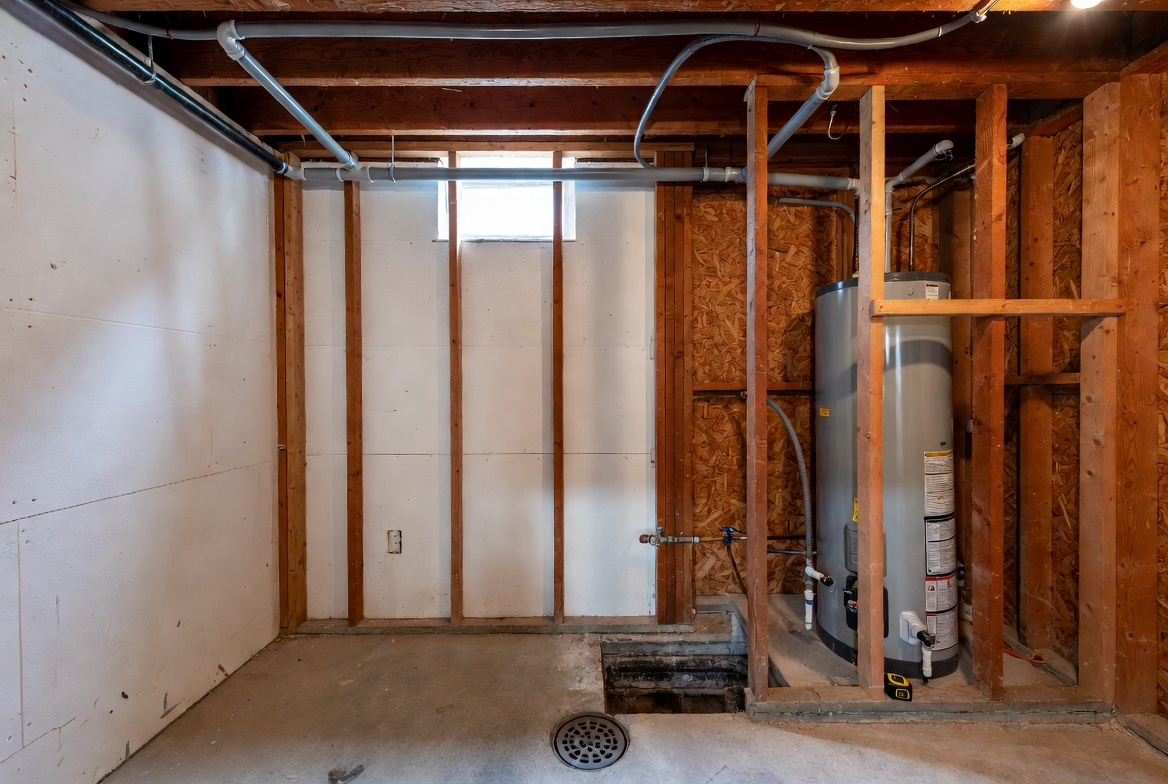
Polybutylene, called PB in the U.S. and Poly-B in Canada, went into homes from about 1978 to 1995. Roughly six to ten million American houses were built with it. Most of them are still in service. Some have been repiped. Many have not. If you are shopping for a house built in the late 70s, 80s, or early-to-mid 90s, this is a system you check for before you fall in love with the kitchen.
The Short Version
Buy the house if the risk is priced into the deal, insurance is confirmed in writing before closing, and you have a plumber's estimate for a full repipe with drywall repair included. Do not buy it if the price is at the top of your budget, the seller will not negotiate, insurance is fuzzy, or the pipes run through finished ceilings and freshly remodeled bathrooms.
Everything else in this article is the detail behind those two paragraphs.
What Polybutylene Is
Polybutylene is a flexible gray plastic pipe, usually about half an inch across, that carries pressurized clean water to sinks, tubs, showers, toilets, laundry, and water heaters. It is not drain pipe. You will find it running through basement ceilings, out of concrete slabs, through crawl spaces, and up the walls to second-floor bathrooms.
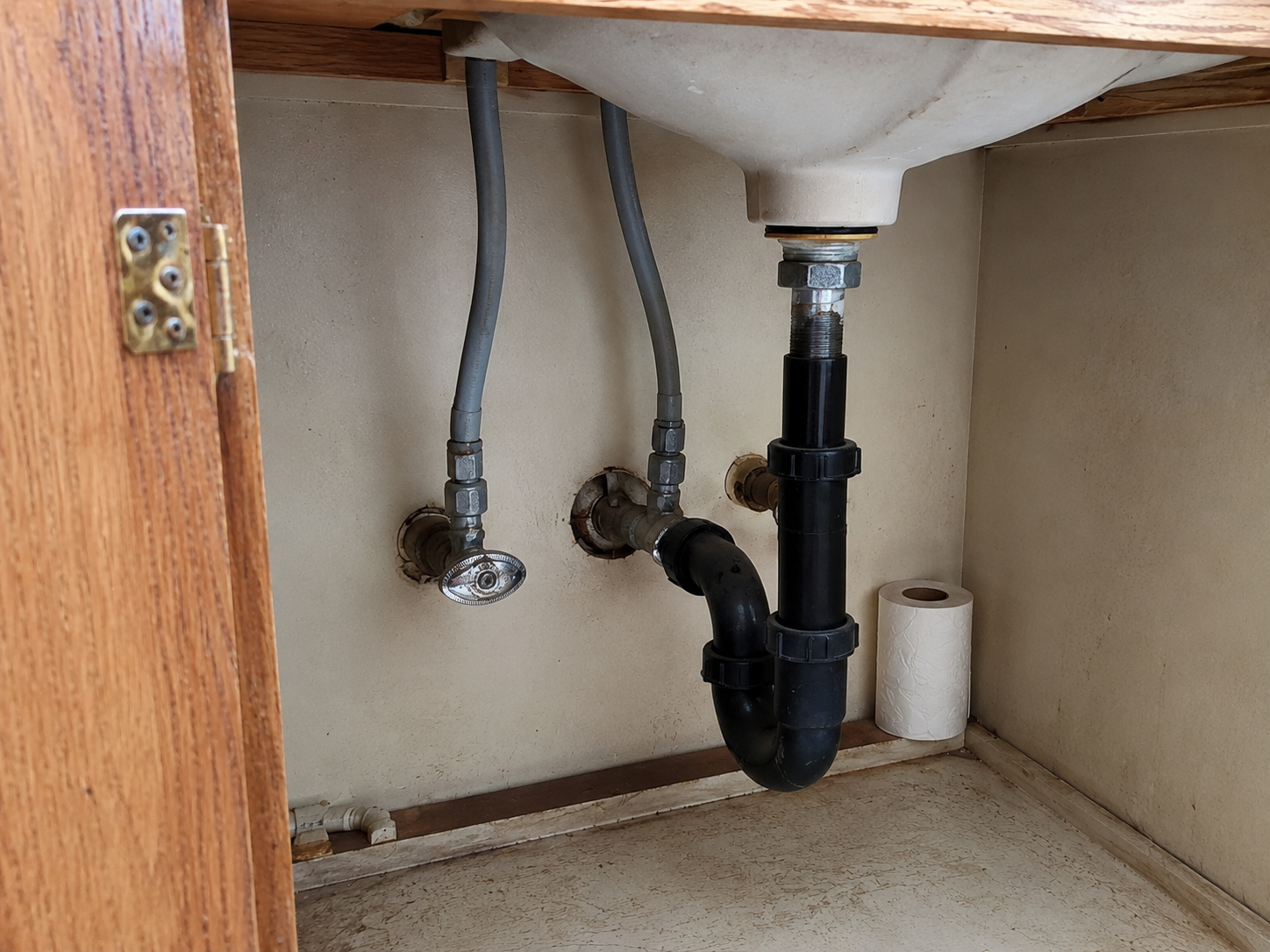
Gray is the giveaway color, but not the only one. Poly can be blue, silver, black, or white depending on the era and the region. Color alone does not confirm anything. Look on the pipe for a stamped marking that reads PB2110. That is the identifier. If a plumber cannot read it in daylight, the pipe needs to be photographed at multiple points in the house before anyone signs anything.
Why the Failure Pattern Is Different
Old copper leaks at a pinhole. It weeps. You get a stain on the ceiling before you get a flood. You have time to notice.
Polybutylene does not always give you that time. Chlorine and other oxidizers in municipal water slowly attack the pipe from the inside. Micro-fractures form. They spread. Then a fitting splits, usually one of the older gray acetal fittings, and the pipe releases water at full supply pressure into the wall. A homeowner at work finds out from a neighbor that water is running out the front door.
That is why insurers care about this material. The claims file is decades deep. Some carriers now refuse to write new policies on a house with confirmed polybutylene. Others will write it but exclude losses caused by the plumbing. A few will still cover it normally. You cannot guess which one you have without asking your specific broker about your specific address.
Which Houses Actually Have It
Any house built or replumbed between 1978 and about 1995 is a suspect. The strongest overlap is the mid-1980s. The Sun Belt got the heaviest concentration, especially Florida, Texas, the Carolinas, Arizona, and parts of Southern California, but polybutylene showed up in every state.
Manufactured homes from the same window used a lot of it. Townhouses and condos are complicated because the pipes may cross a shared wall, and the association may or may not own them. If the unit is attached, ask before you offer, not after.
1980s houses often carry other issues from the same era, so a polybutylene finding is worth reading against the rest of the plumbing, electrical, and HVAC. The broader picture is in 1980s house renovation.
The Section Nobody Writes: The Disclosure Trap
This is the part that has cost buyers their savings, and no cost guide or plumber blog will tell you about it in plain terms.
Most state seller disclosure forms have a line asking whether the house has polybutylene. Sellers can check three boxes: yes, no, or I do not know. Almost every seller who knows they have poly checks "I do not know."
That is legal in most places. Sellers only have to disclose what they have "actual knowledge" of. If nothing has leaked yet, and no plumber ever wrote them a report saying the word polybutylene, they can honestly say they were never told. Real estate lawyers deal with this pattern constantly. The Avvo forums are full of buyers who found leaks a year after closing, went to sue, and learned the seller's "I do not know" was almost impossible to disprove without a paper trail, even in neighborhoods where every other house had already been repiped.
Two things follow from this, and they matter more than the color of the pipe.
First, do not rely on the disclosure form. Assume the seller checked "I do not know" and act as if the answer is "yes, it is here." Send your plumber, in addition to the home inspector. Home inspectors are not required to flag polybutylene in most jurisdictions, and there are Avvo threads where the inspector wrote "copper and PVC" on a report because he glanced at one section under a sink. Once the deal closed, the plumber found gray pipe in the attic. The inspector's contract had liability limits down to the price of the inspection.
Second, if you buy the house and the seller checked "no" instead of "I do not know," your lawyer's job later becomes easier. Save every disclosure form. If it turns out the seller had a permit pulled on a previous property in the same subdivision to repipe polybutylene, or their neighbors know their history, that record can shift the case. It does not guarantee a win. It gives you a starting point.
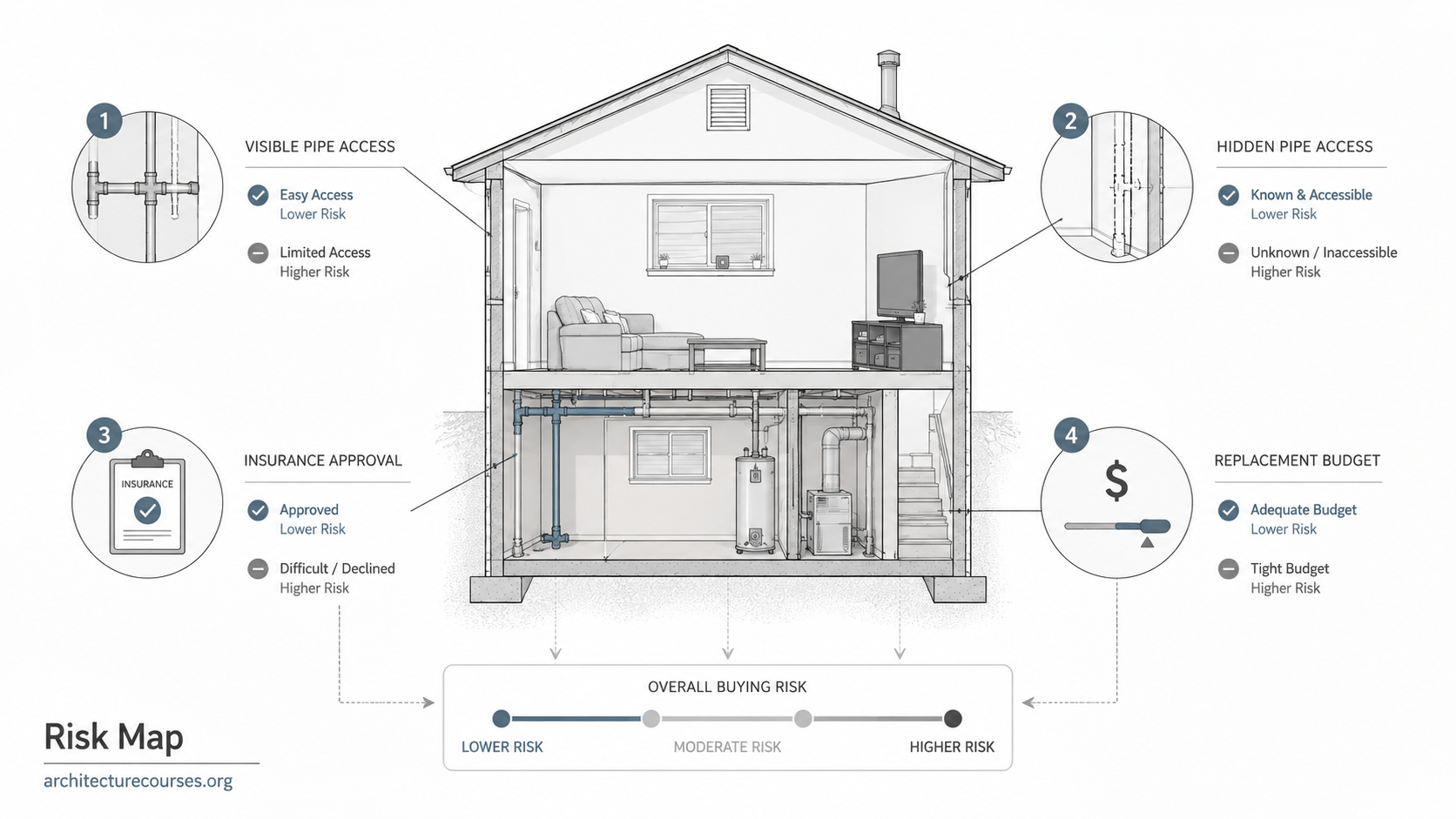
What to Check Before You Sign Anything
Get a licensed plumber into the house before your inspection contingency runs out. A general home inspection is not enough for this. Ask the plumber to look at:
- The line coming in from the water meter
- Both sides of the water heater
- The basement ceiling or crawl space, at multiple points
- Under every sink, including the fixture connections
- Access panels behind tubs and showers
- Washing machine hookups
- Any pipe visible in the attic running down to second-floor bathrooms
Ask for photos of every visible section, with the PB2110 marking if it can be read. Ask what the plumber thinks is still hidden inside walls and slab.
Then check what the pipes may have already ruined. A fresh coat of paint on one ceiling area, patchy drywall texture near a bathroom wall, swollen baseboards, soft cabinet bottoms under sinks, a musty smell in a finished basement, warped flooring near a plumbing wall. These are not proof of anything. They are places to point the plumber and the inspector.
Get water pressure measured. High pressure stresses old plumbing. A pressure-reducing valve at the main is worth checking for. This does not make polybutylene safe. It just tells you whether the system is running under extra load.
The Insurance Call Comes Before the Offer
Call your insurance broker before you write the offer. Ask directly: will you write a policy on a house at this address with confirmed polybutylene water supply piping, and if so, what are the exclusions?
Get the answer in writing. An email is fine. A verbal "should be OK" from an agent is not.
If your broker cannot get a straight answer from the carrier within a few days, that is your answer. Some carriers will not write. Some will write but exclude any loss traceable to the plumbing, which is the loss you actually care about. A few will still cover normally. Your specific carrier, your specific state, your specific ZIP code, and your specific claim history are what matter. Not what worked for a stranger on Reddit in a different market five years ago.
Lenders sometimes get involved too. FHA, VA, and some conventional loans have flagged houses with active polybutylene as a condition problem. That does not mean automatic denial. It means the lender may want the pipes replaced before closing, and you need to know that before the appraisal report lands.
Access Is Half the Price
Two houses with the same amount of polybutylene do not cost the same to repipe. The difference is what the plumber has to open to get at the pipes and what the drywaller has to close afterward.
| Access condition | Risk level | What it means for the repipe |
|---|---|---|
| Unfinished basement, pipes visible in the ceiling | Lower | Most of the system is reachable without demolition. Plumber may finish in a day or two. |
| Open crawl space with real clearance | Moderate | Access is possible. The work is slower and dirtier. Labor cost climbs. |
| Finished basement ceiling | Higher | Every pipe run means a drywall cut, patch, texture match, and repaint. |
| Two-story house with upstairs bathrooms | Higher | Vertical runs hidden in wall chases. Bedrooms and ceilings get opened. |
| Slab foundation | Highest | Some plumbers reroute overhead through attic and walls to avoid breaking the slab. Adds cost and finish repair. |
| Recently remodeled kitchen or bathroom | Highest | New tile, new cabinets, new backsplash may need to come apart. Sunk cost undone. |
| Condo or townhouse | Variable | Shared walls, HOA rules, and unclear ownership of the pipes complicate everything. |
What This Costs in 2026
Treat these numbers as planning ranges, not quotes. A U.S. whole-house PEX repipe runs roughly $4,000 on a simple single-story job with easy access to about $15,000 on a two-story house with finished ceilings, custom tile, and awkward routing. Copper repipes run higher. Slab houses can push past $20,000 once slab breakthroughs and finish repair are counted.
What the plumbing quote often does not include: drywall repair, texture matching, paint, tile repair, cabinet removal and reset, flooring at doorways, and cleanup. Ask the plumber directly whether their number is "pipes only" or "pipes plus put-back." The gap between those two answers can be $3,000 to $8,000 depending on the house.
Negotiation, Not Fear
When you go back to the seller, the strongest position is calm and specific. Not "the plumbing is bad." Something more like: the inspection confirmed polybutylene water supply piping throughout the house, a licensed plumber estimates full replacement with drywall repair at $X, and the insurance broker has indicated coverage will be conditional. Given that, we are asking for one of four things.
| Option | When it makes sense | What to watch |
|---|---|---|
| Seller replaces before closing | When your insurance or your lender needs it done for the deal to close. | Review the plumber, the scope, the permit, and the material used. Get the invoice and the photos. |
| Price reduction | When you want to control the work yourself and pick your own plumber. | Reduction must cover pipes plus finish repair, not the pipes alone. |
| Closing credit | When the lender allows it and it fits inside the contract. | Some loan programs cap credits. Confirm with your lender before you rely on this. |
| Escrow holdback | When the work has to happen soon after closing but cannot happen before. | Not all states or lenders allow it. Get the terms in writing. |
If the seller refuses all four, that is data. It tells you what kind of person you were about to buy a house from, and how negotiable other problems will be if they come up in the next thirty days.
What Not to Spend Money On First
If you buy the house, this is the order that saves you the most pain.
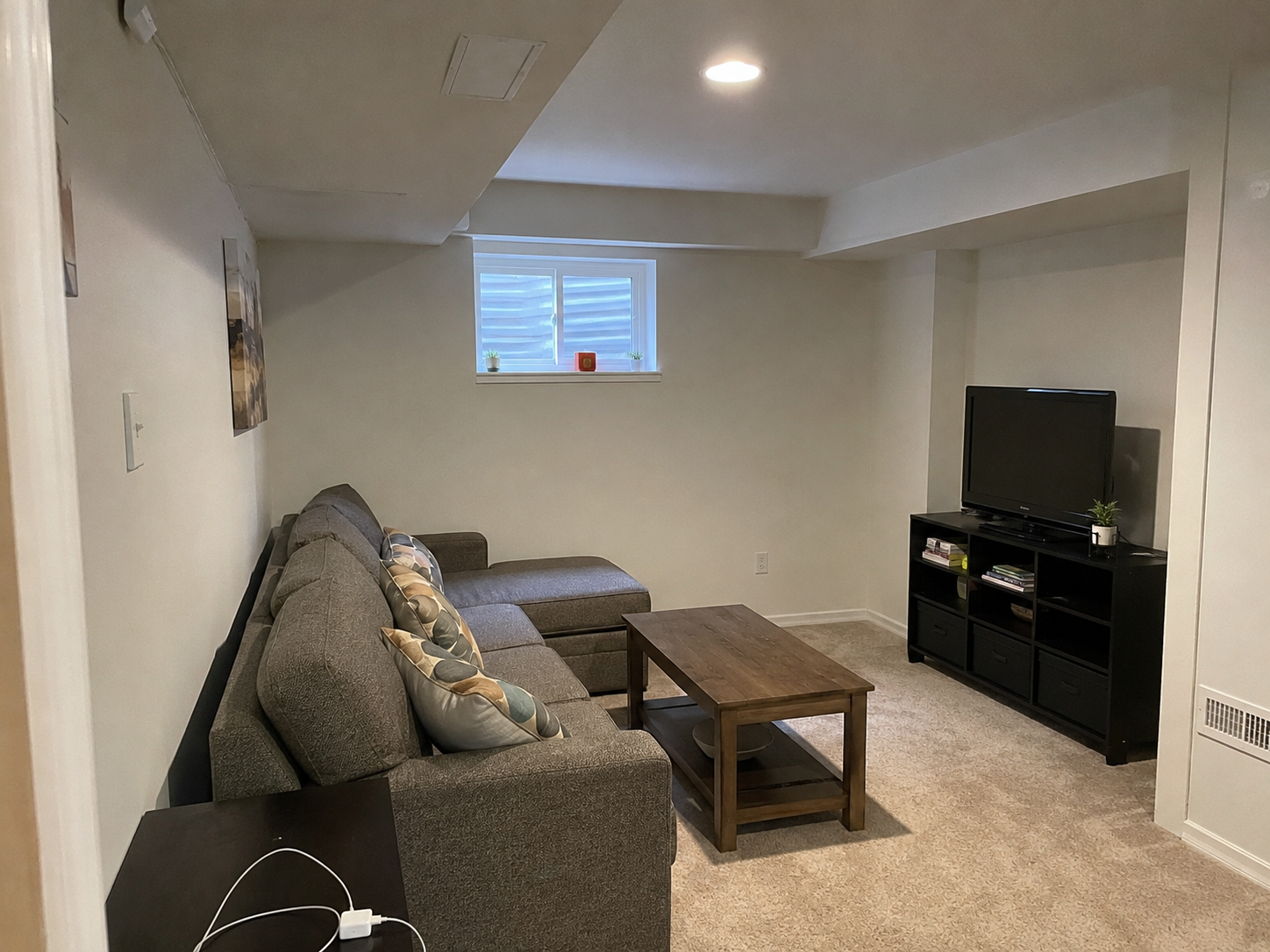
Do not finish the basement first if pipes run through the ceiling. Every fixture, every drywall sheet, every recessed light will be in the way of the plumber a year from now.
Do not remodel the kitchen before you know where the pipes run. New cabinets and backsplashes are exactly what the plumber has to open to get behind the sink.
Do not retile bathrooms until the supply lines are settled. Tile is expensive to open and expensive to close.
Do not assume that some new PEX under a sink means the house was repiped. Sometimes it just means a leak happened there once and a plumber fixed that one section.
Do find your main shutoff on move-in day and confirm it works. If it does not, replacing it is the first check you write. A working main shutoff turns a burst pipe from a flood into a bucket.
Install leak sensors under sinks, behind the washing machine, near the water heater, and in the basement. They are cheap and they work. If a fitting splits at three in the morning, the sensor screams before the ceiling comes down.
If You Buy It, Fix It First
The most expensive version of this whole situation is the buyer who moves in, paints, replaces carpet, remodels a bathroom, finishes the basement, and then has a leak in year two that forces a full repipe through everything they just paid for.
The order that keeps the budget intact is: plumbing first, cosmetics after. If you cannot afford the plumbing this year, delay the cosmetics too. A dated bathroom that stays dry is cheaper than a new bathroom that gets torn open.
Before opening any wall for any project during the first two years, think through what happens once a wall is open and whether the plumbing should be handled at the same time.
DIY vs. Professional Work
Homeowner work here is real, but it is bounded. You can photograph and document. You can clear stored items from under pipe runs. You can install leak sensors. You can keep a folder of every inspection, every plumber note, every disclosure form, every photo you took at showing. That folder is the single most valuable thing you own if this ever ends up in front of a lawyer.
What you should not DIY: pressurized supply lines, water heater connections, work behind slab, and anything requiring a permit or an inspection. This is a system where a mistake floods a house. Hire a licensed plumber and pull the permit.
What About the Class Action?
Do not plan around it. The Cox v. Shell class action, which paid out $950 million to affected homeowners in the 1990s, closed its claim window on May 1, 2009. Anyone finding polybutylene now has no access to that fund. The lawyers who worked those cases will tell you the same thing. If you own the house and the pipes fail today, the money comes out of your insurance or your pocket.
Should You Buy It?
Yes, if the plumber confirmed the extent, the insurance broker confirmed coverage in writing, the seller adjusted the price or fixed the pipes, and you still have money left over for the surprise the house will hand you in year one. Every old house hands you something in year one.
No, if the house is priced as if nothing is wrong, the seller checked "I do not know" and refuses to move, and your insurance answer is "we'll figure it out later." The people who lose the most on this material are the ones who accepted "we'll figure it out" as the plan.
FAQ
Is polybutylene always a deal breaker?
No. It is always a serious inspection, insurance, and negotiation issue, but it does not always kill the deal.
What year houses have polybutylene?
Roughly 1978 through 1995, with the heaviest concentration in the 1980s and early 1990s.
Can a home inspector spot it?
Sometimes. Most are not required to, and Avvo threads are full of cases where a general inspector misidentified poly as PVC or copper. Bring in a licensed plumber before your inspection window closes.
Does gray pipe always mean polybutylene?
No. Gray pipe is a strong hint. The confirming mark is PB2110 stamped on the pipe. Have a plumber verify.
Can you insure a house with polybutylene?
Sometimes. It depends on the carrier, the state, the ZIP code, and whether any losses are on record. Get the answer from your specific broker in writing before you commit.
Should the seller replace the pipes before closing?
That is the cleanest path when insurance or the lender needs it done. Ask for the permit, the invoice, and photos of the work.
Is partial replacement enough?
Not really. If any polybutylene is still in the walls, the risk and the future resale problem are still there. Insurance underwriters do not care that most of it is gone.
What should replace polybutylene?
Usually PEX or copper. Local code, water chemistry, and the plumber's preference decide which.
Should I remodel before repiping?
No. Remodel over old poly and you may end up tearing the remodel apart later to reach a burst pipe.
What is the safest way to buy a house with polybutylene?
Confirm the material with a plumber, map the system, get the insurance answer in writing, price the full repipe with drywall repair, negotiate before closing, and stay out of cosmetic work until the plumbing plan is settled.