
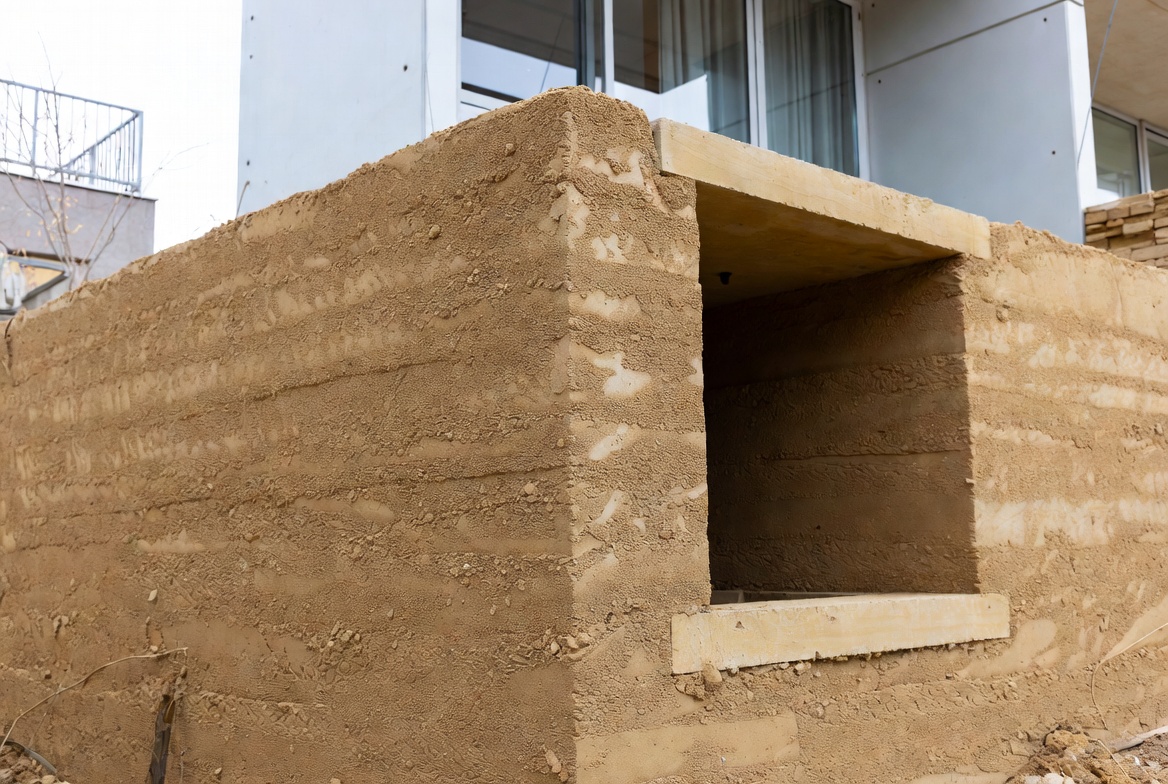
Rammed earth wall thickness looks simple until you start comparing actual numbers.
One source says 8 inches. Another says 12. Another shows a wall closer to 20. Then the units switch, the wall type changes, and half the examples are talking about different assemblies without saying so.
That is where the confusion starts. There is no single correct thickness for every rammed earth wall. An interior partition, an exterior load-bearing wall, an insulated assembly, and a non-structural feature wall are not solving the same problem.
The real question is not “What is the right thickness?” It is “Right for what?” Structure, weather protection, insulation strategy, height, span, code, and cost all push the answer in different directions.
Sometimes more thickness helps. Sometimes it just burns floor area, adds material, slows the build, and costs more without solving the actual problem.
Also useful: Rammed Earth: An Ancient Technique for Modern Sustainable Construction covers the broad method. Rammed Earth Walls: What They Are and Why They’re Back goes deeper into wall systems, moisture, and insulated assemblies.
Start Here
For a lot of modern work, the rough starting points look like this:
| Wall Type | Common Starting Thickness | Typical Use |
|---|---|---|
| Internal feature or partition wall | 200 mm to 300 mm about 8 to 12 in |
Interior walls, thermal-mass walls, non-exterior work |
| External stabilized wall | 300 mm to 500 mm about 12 to 20 in |
Most exterior rammed earth walls |
| Heavier or more traditional wall | 500 mm or more about 20 in and up |
Older thick-wall work, some custom structural work, some climate or design choices |
| Insulated rammed earth system | Often 400 mm or more total assembly about 16 in and up |
Cold-climate or higher-performance exterior walls |
Use that as a starting point. Not a rule.
The better question is not “what thickness do rammed earth walls use?” It is “what is this wall trying to do?”
Why 200 mm, 300 mm, and 500 mm All Show Up
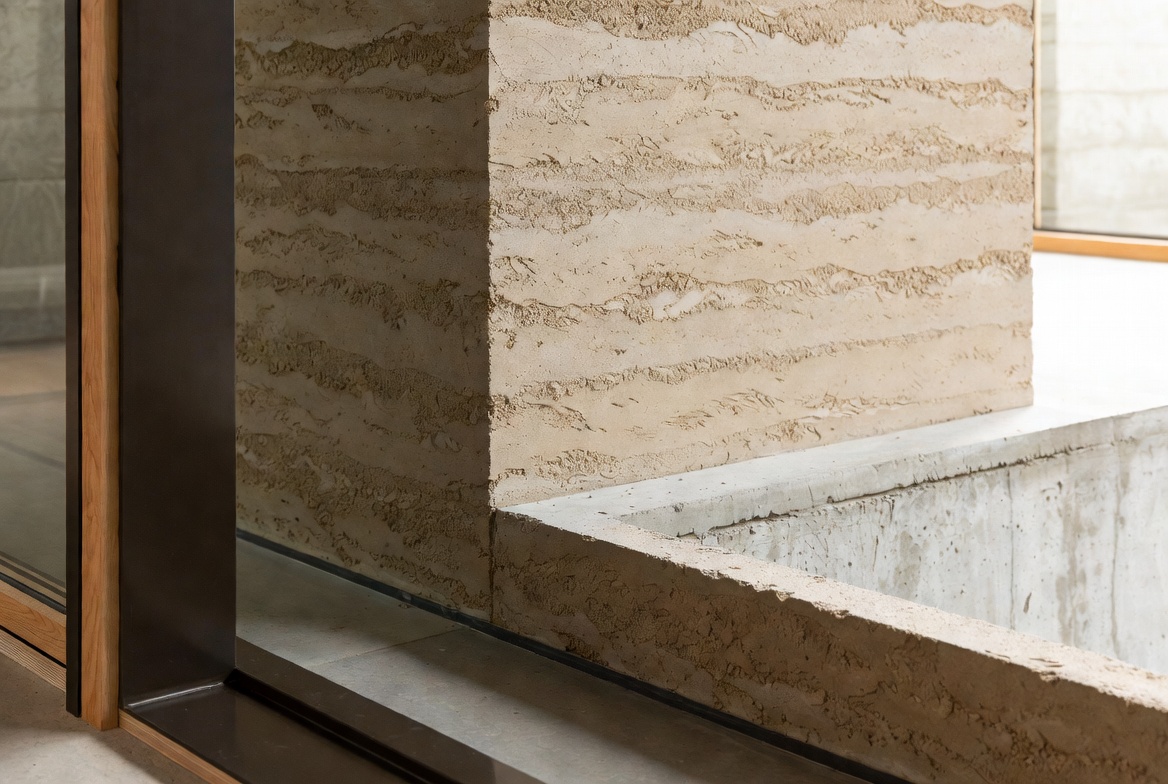
Image by ArchitectureCourses.org. Rammed earth wall corner showing the depth and mass of the wall above a concrete base.
These numbers keep showing up because they belong to different wall jobs.
200 mm
This is often where modern internal rammed earth walls start. It can work for interior partitions, feature walls, and some non-exterior conditions where the wall does not need to deal with weather, insulation demands, or heavier structural loads.
A 200 mm wall can still look solid. It just does not behave like a thick exterior earth wall.
300 mm
This number keeps showing up for a reason. It is often the practical starting point for many exterior walls. Thick enough to feel like rammed earth. Thick enough to work structurally in many basic conditions. Not so thick that the wall starts swallowing too much floor area.
For many projects, 300 mm is the modern middle ground.
500 mm
This is where the older image of rammed earth comes from. Very thick walls. Deep reveals. Heavy edges. More visual weight.
They still get built. They can make sense. But they are not the default answer for every modern house.
A 500 mm wall gives you more mass and more depth. It also costs more, takes more space, and does not magically solve insulation.
Internal Walls and External Walls Are Not the Same Job
This is the first split that matters.
| Wall Type | What It Needs To Do | Thickness Pressure |
|---|---|---|
| Internal wall | Provide mass, finish, separation, and maybe some structural help | Can often be thinner |
| External wall | Handle weather, structure, openings, moisture risk, and sometimes insulation strategy | Usually needs to be thicker |
An interior rammed earth wall has an easier life. It does not see rain. It does not need the same base detail. It does not need the same weather tolerance.
That is why internal walls can often stay in the 200 mm to 300 mm range and still make sense.
Exterior walls are different. They carry more responsibility, so they often start around 300 mm and move upward from there.
Thickness Helps Structure, But It Is Not the Whole Story
Thicker walls usually carry more structural potential. That part is true.
But thickness is not the only thing doing the work.
Structure also depends on:
- the soil mix
- stabilization level
- reinforcement, where used
- wall height
- openings and lintels
- loads from roof and floors
- wind and seismic demands
That means a badly designed 500 mm wall is not automatically better than a well-designed 300 mm wall.
Wall thickness helps. It does not replace engineering.
More Thickness Gives More Mass, Not Magic
This is where the advice starts going wrong.
Yes, thicker rammed earth walls give you more thermal mass. That can help smooth temperature swings. It can help passive solar performance. It can make a house feel steadier through the day.
But thermal mass is not insulation.
Once the wall is thick enough to do useful thermal-mass work, making it much thicker does not always change the house as much as people expect. At some point, the extra thickness mostly adds weight, cost, and floor-area loss.
That is where the “thicker must be better” idea starts falling apart.
Thickness Does Not Solve Insulation
This is the part that confuses people most.
A thicker rammed earth wall is still mostly a mass wall, not an insulation wall. A 500 mm wall stores more heat than a 300 mm wall, but that does not mean it suddenly behaves like a high-R insulated assembly.
In mild climates, that may be enough.
In colder climates, it often is not.
| Wall Strategy | What Thickness Does | What It Does Not Do |
|---|---|---|
| Plain rammed earth | Adds mass, depth, and structure | Does not solve cold-climate insulation on its own |
| Thicker plain rammed earth | Adds more mass and deeper reveals | Still does not act like a modern insulated wall |
| Insulated rammed earth system | Uses thickness as part of a layered assembly | Costs more and needs more detailing |
If the project is in a real winter climate, thickness alone is not the answer. That is where insulated or hybrid wall systems start making more sense.
Low Walls and Tall Walls Are Not the Same Job
Wall height matters almost as much as wall thickness.
A low single-story wall with limited openings can often work cleanly at a thickness that would start feeling weak or underbuilt once the wall gets taller or starts carrying more complicated loads.
As walls get taller, the pressure usually goes one of two ways:
- the wall gets thicker
- the engineering gets more specific
Often it is both.
That is why copying a thickness from one project photo and assuming it belongs on your own house is a bad move.
When More Thickness Helps
- When the wall is exterior.
- When the design wants deep window reveals.
- When the wall is carrying more load.
- When the project wants more thermal mass.
- When the wall is meant to feel heavy and monolithic.
Thicker walls can make a house feel calmer, heavier, and more grounded. That part is true.
When More Thickness Starts Hurting the Project
- When it starts stealing too much floor area.
- When the project is in a cold climate and still has no insulation strategy.
- When thickness is being used to avoid real engineering decisions.
- When the budget is already stretched.
- When the house is small and every inch matters.
This is where thick walls stop being a design asset and start becoming a space penalty.
On a small house, a thicker wall can tighten the inside faster than people expect. That is especially true when the plan was not designed around the wall from the start.
12 Inches vs 18 Inches vs 24 Inches
Put in simpler North American terms, the rough logic looks like this:
| Thickness | Where It Often Fits | What To Watch |
|---|---|---|
| 12 in about 300 mm |
Many modern stabilized exterior walls, some strong internal walls | Still not an insulation answer by itself |
| 18 in about 450 mm |
Heavier exterior walls, some custom structural work, some stronger visual goals | More cost, more footprint loss, not always a better value |
| 24 in about 600 mm |
Traditional thick-wall work, some seismic or heavy-wall contexts, some very custom projects | Big space penalty, big cost, easy to overspecify |
The jump from 12 inches to 18 inches is a major design decision. The jump from 18 inches to 24 inches is not something to do just because thicker sounds safer.
Do This Instead of This
| Do This | Instead of This | Why |
|---|---|---|
| Choose thickness by wall job | Using one thickness for every wall in the project | Internal and external walls are not doing the same work |
| Start around 300 mm for many exterior walls | Assuming 500 mm is always the safe answer | 500 mm adds cost and footprint fast |
| Design the plan around the wall | Forcing thick walls into a plan made for thin framing | That is how layouts get awkward |
| Decide insulation strategy early | Using extra thickness as a substitute for insulation | Mass and insulation do different jobs |
| Use engineering when loads rise | Assuming more thickness solves every structural problem | Structure depends on more than width |
Where It Usually Goes Wrong
- They think there is one standard thickness.
- They copy a builder detail without knowing what that wall was doing.
- They confuse thermal mass with insulation.
- They push walls thicker without checking what that does to floor area.
- They treat internal and external walls as the same thing.
- They assume thicker automatically means better.
What To Read Next
This part matters: Rammed Earth Walls: What They Are and Why They’re Back if you want the broader wall-system view after thickness is clear.
Also useful: Rammed Earth: An Ancient Technique for Modern Sustainable Construction if you want the wider method page.
Worth knowing: Compressed Earth Blocks and Sustainability if you are still deciding between monolithic rammed earth and modular earth construction.
FAQ
How thick should an exterior rammed earth wall be?
A lot of modern projects start around 300 mm, or about 12 inches, then move thicker if the wall system, climate, loads, or design call for it.
How thick should an internal rammed earth wall be?
Many internal walls can be thinner than exterior walls. Around 200 mm to 300 mm is a common modern range depending on the job.
Is 500 mm still used?
Yes. It still shows up, especially in heavier traditional work and some custom projects. It is just not the automatic answer for every modern wall.
Does a thicker wall mean better insulation?
No. A thicker wall gives more mass, not the same thing as a high-insulation wall.
Is 12 inches enough for rammed earth?
It can be for many modern exterior walls, but only when the mix, engineering, climate, and wall role all support it.
When should a rammed earth wall be thicker than 18 inches?
Usually when the wall is taking on heavier structural work, a particular design effect, or a thicker system strategy. It should not happen by default.
Do insulated rammed earth walls need to be thicker?
Usually yes, because the total assembly has to hold both the earth and the insulation layer.
What is the main mistake people make about thickness?
They assume there is one ideal number, when the real answer depends on what the wall is doing.