
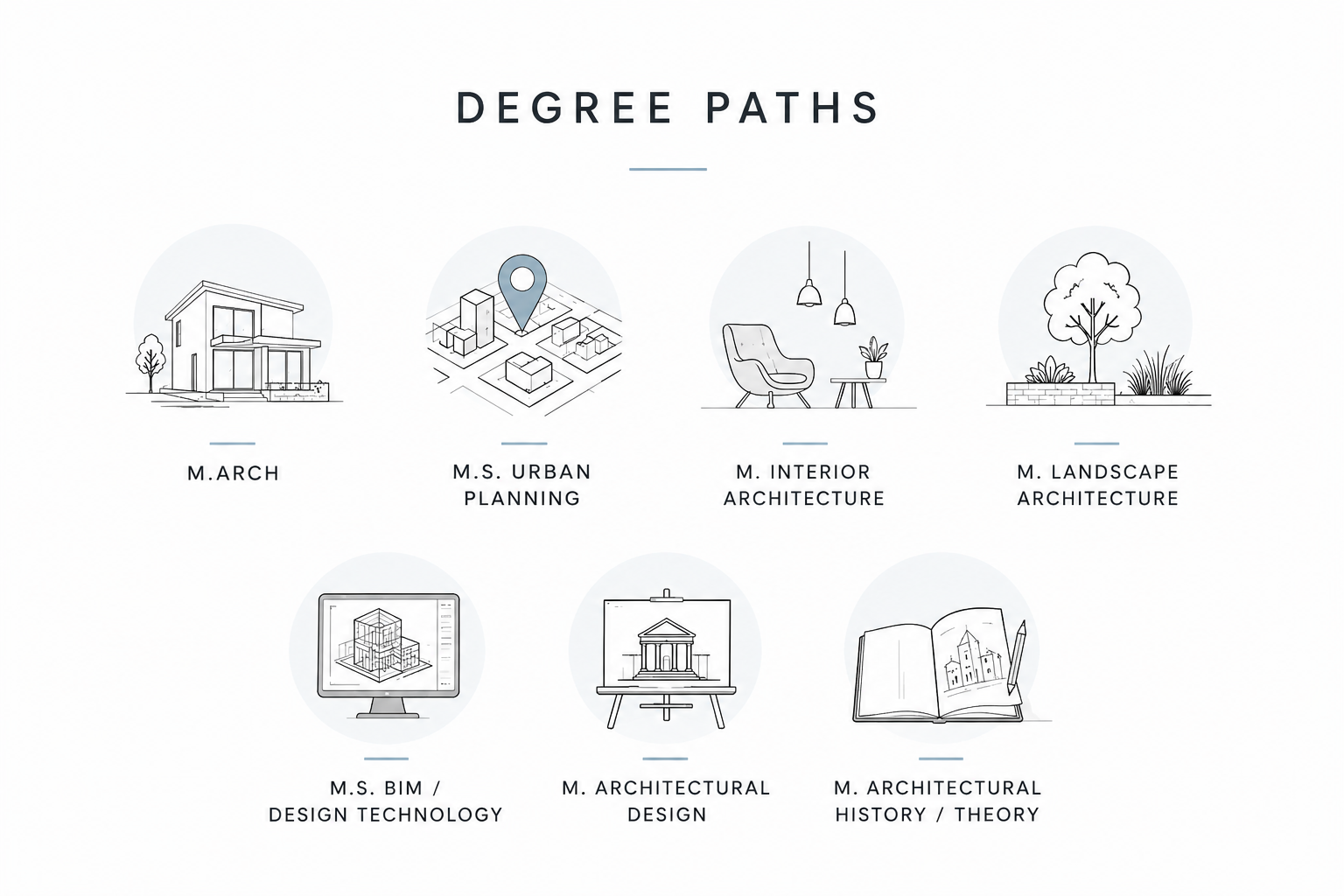
Common Types of Architecture Graduate Programs
For those who want to continue their studies after earning a bachelor’s degree in architecture or a related field, there are several distinct postgraduate degree options—each tailored to a different career path or academic focus.
Postgraduate Degrees in Architecture Explained
Guide to Architecture Master’s Degrees
Different Architecture Master’s Degrees and What They Mean
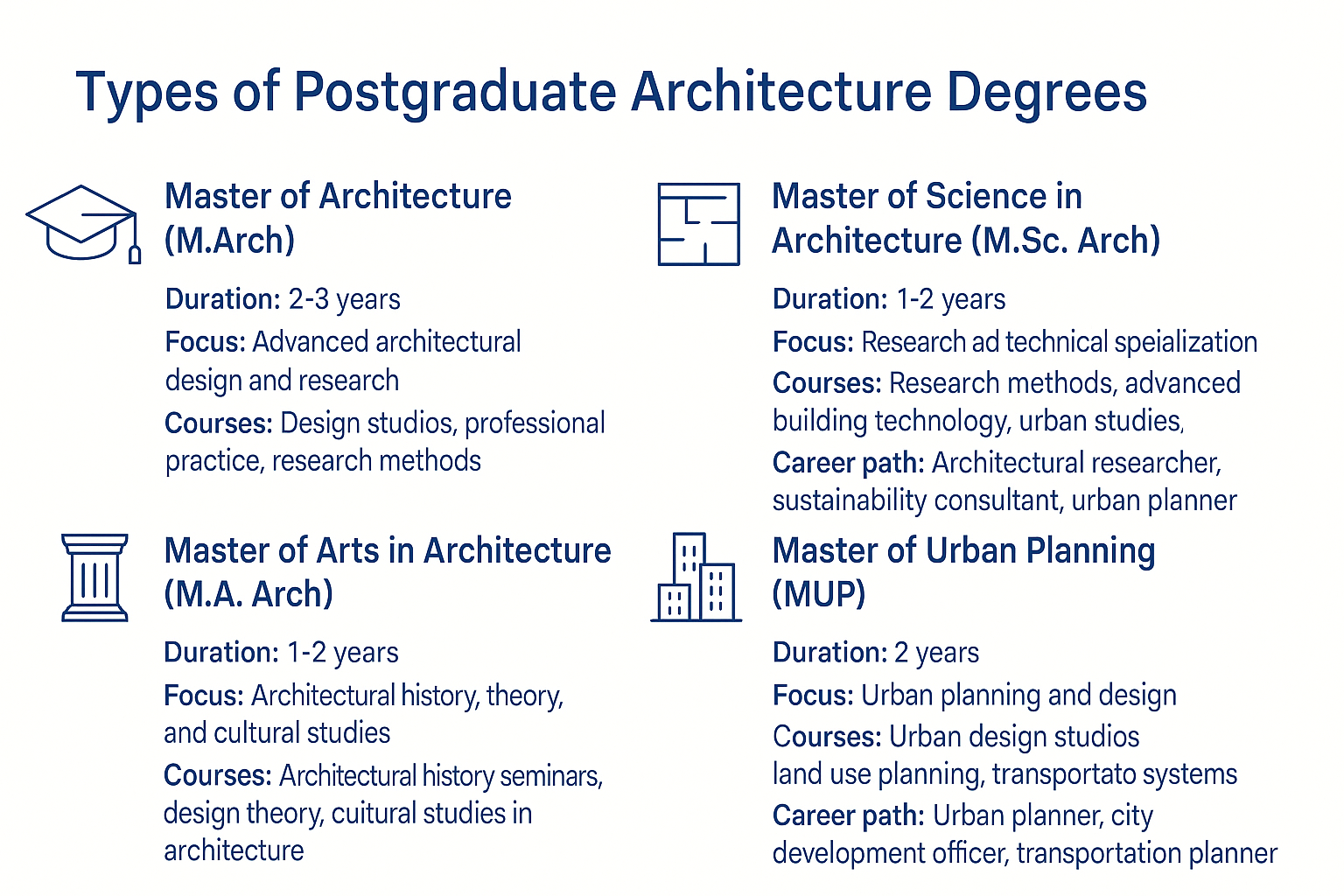
1. Master of Architecture (M.Arch)
The M.Arch is the most widely recognized professional degree for becoming a licensed architect. It focuses on design mastery, technical skill, and professional preparation.
● Duration: 2–3 years
● Focus: Advanced architectural design + professional practice
● Key Courses:
▪ Design studios
▪ Architectural theory
▪ Construction systems
▪ Research methods
● Career Path:
→ Licensed architect
→ Design director
→ Academic lecturer or researcher
2. Master of Science in Architecture (M.Sc. Arch)
This research-intensive degree is ideal for those who want to specialize in sustainability, technology, or urban systems, rather than traditional architectural licensure.
● Duration: 1–2 years
● Focus: Research and technical specialization
● Key Courses:
▪ Environmental systems
▪ Building performance
▪ Urban design theory
▪ Data and digital methods
● Career Path:
→ Sustainability consultant
→ Architectural researcher
→ Urban systems designer
3. Master of Arts in Architecture (M.A. Arch)
This degree blends architecture with the humanities. It’s suited to those interested in history, theory, criticism, and cultural aspects of the built environment.
● Duration: 1–2 years
● Focus: Architectural theory, history, and culture
● Key Courses:
▪ Cultural studies in architecture
▪ Design philosophy
▪ Writing and criticism
▪ Architecture and society
● Career Path:
→ Architectural historian
→ Cultural consultant
→ Critic or curator
4. Master of Urban Planning (MUP)
For those who want to shape cities and influence the future of urban life, the MUP offers a strong foundation in sustainable development, transportation systems, and public policy.
● Duration: 2 years
● Focus: Urban design, land use, transportation, and policy
● Key Courses:
▪ Urban design studios
▪ Land use planning
▪ Environmental planning
▪ Transportation systems
● Career Path:
→ Urban planner
→ City development officer
→ Transit and mobility strategist
Summary Table: Master’s Degrees in Architecture
What You Need to Know
| Degree | Duration | Best For | Common Careers |
|---|---|---|---|
| M.Arch | 2–3 years | Licensure, studio-based design | Architect, designer, researcher |
| M.Sc. Arch | 1–2 years | Technical, research-focused roles | Consultant, researcher, urban analyst |
| M.A. Arch | 1–2 years | Theory, history, and architectural writing | Historian, curator, academic |
| MUP | 2 years | Urban strategy and city development | Planner, policy advisor, development lead |
Notes
● Most M.Arch programs are NAAB-accredited or regionally accredited where applicable (depending on the country).
● M.Sc. and M.A. degrees are non-licensure programs but offer more academic or analytical flexibility.
● Dual degrees (e.g., M.Arch + MUP) are increasingly common in advanced research institutions.
Picking the Right Architecture Master’s Degree for You
A Simple Guide to Choosing Your Architecture Graduate Program
In Focus: Choosing the Right Architecture Graduate Program
Tips for Choosing the Perfect Architecture Master’s Program
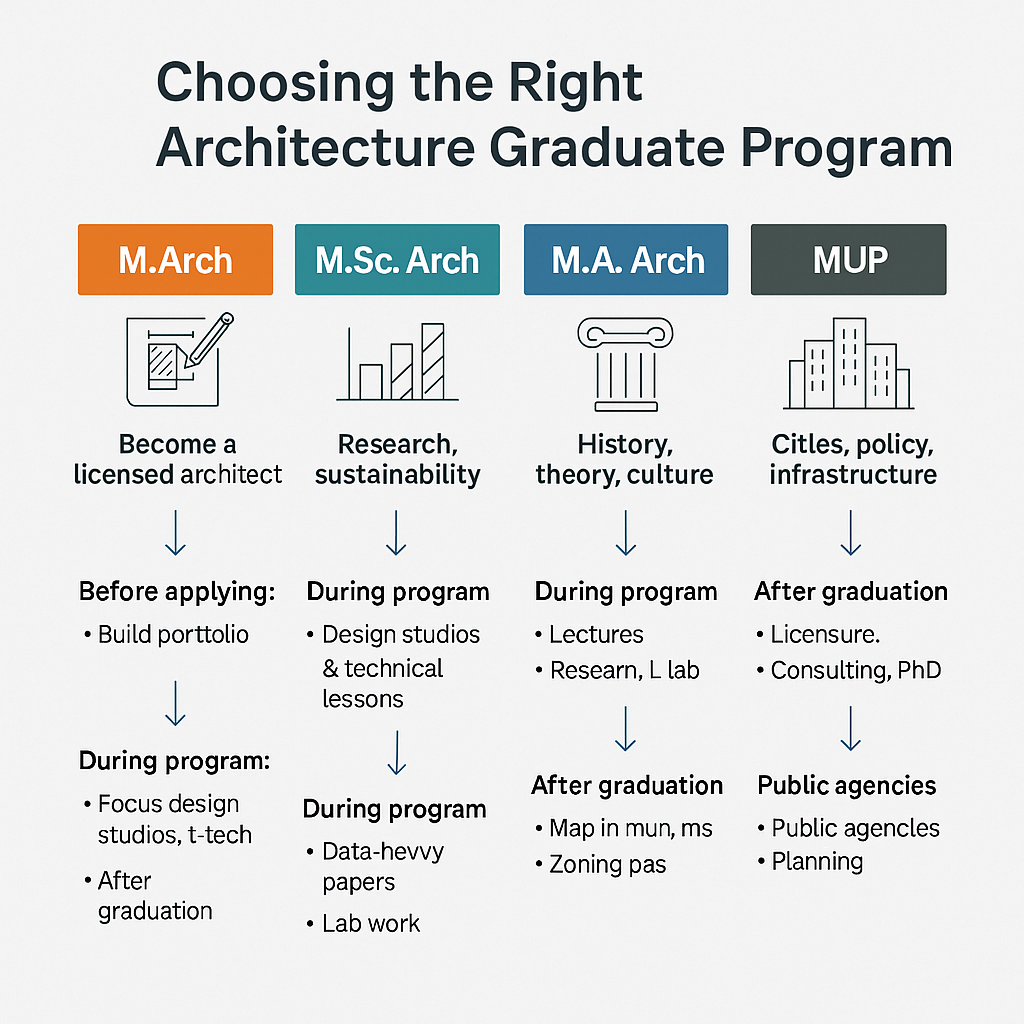
Not all architecture master’s degrees are the same. Picking the right one depends on what you want to do—design buildings, research how they work, study their cultural meaning, or shape cities.
Finding the Right Graduate Program in Architecture
This section breaks down each program clearly, shows what kind of student it fits, and gives you a practical roadmap for what to focus on during and after the degree.
How to Choose the Best Architecture Graduate Program
M.Arch (Master of Architecture)
Goal: Become a licensed architect
Roadmap:
-
Before applying: Build a strong portfolio. Know if you’re applying to M.Arch I (no B.Arch) or M.Arch II (with B.Arch).
-
During the program: Focus on design studios, tech systems, building codes, and your thesis. Take internships seriously.
-
After graduation: Log your experience hours (AXP in the U.S.), pass licensure exams (like ARE), and apply for registration.
What to Focus On:
-
Design thinking and technical skills
-
Communication (visual + written)
-
Code compliance and sustainable design
-
Time management in studio deadlines
Best for:
-
Students who want to practice as architects
-
Those who enjoy design challenges and client-driven work
M.Sc. Arch (Master of Science in Architecture)
Goal: Specialize in research, sustainability, or digital tools
Roadmap:
-
Before applying: Decide your focus—climate design, building tech, data analysis, etc. This is not for licensure.
-
During the program: Take data-heavy courses, write papers, do lab work, and maybe publish. Join faculty research if possible.
-
After graduation: You can go into consulting, research labs, PhD, or advanced industry roles.
What to Focus On:
-
Research methods and data analysis
-
Environmental systems and modeling
-
Coding tools (Grasshopper, Rhino, etc.)
-
Scientific writing and publishing basics
Best for:
-
Those who love deep dives into how buildings work
-
People interested in R&D, academia, or green tech
M.A. Arch (Master of Arts in Architecture)
Goal: Study architecture from a cultural, historic, or philosophical perspective
Roadmap:
-
Before applying: Read widely—architecture criticism, theory, history. You’ll write more essays than you’ll build models.
-
During the program: Attend lectures, research, and write. You may not be doing studio design work. Focus on how buildings reflect society.
-
After graduation: Work in museums, publishing, teaching, or cultural policy.
What to Focus On:
-
Writing and critical analysis
-
Reading architectural theory and history
-
Connecting buildings with cultural shifts
-
Public speaking and presenting arguments
Best for:
-
Thinkers, writers, and critics
-
People interested in how design relates to identity, politics, or art
MUP (Master of Urban Planning)
Goal: Shape cities, policies, and infrastructure
Roadmap:
-
Before applying: Learn basics of city systems—transport, zoning, climate. Have interest in policy + public life.
-
During the program: Work on land-use maps, mobility studies, zoning plans, and community consultation projects.
-
After graduation: Join public agencies, consultancies, or work in local or regional planning.
What to Focus On:
-
Policy and zoning laws
-
Urban data, mapping (GIS tools)
-
Community design and equity
-
Transportation and land use
Best for:
-
People who want to shape how cities grow
-
Those who like systems thinking and long-term planning
Related: Types of Architecture Degrees: Which Path Is Right for You?
FAQs
General Questions About Architecture Graduate Programs
1. What is a Master of Architecture (M.Arch) degree?
A professional graduate degree qualifying individuals for architectural licensure.
2. How long does it take to complete an M.Arch program?
Typically 2–3 years, depending on prior education and program structure.
3. What are the prerequisites for enrolling in an M.Arch program?
A bachelor's degree in architecture or a related field; some programs accept students from other disciplines with additional coursework. CMU School of Architecture
4. Is an M.Arch degree necessary to become a licensed architect?
In many countries, including the U.S. and Canada, an accredited M.Arch is required for licensure.
5. What is the difference between M.Arch I and M.Arch II programs?
M.Arch I is for students without a professional architecture degree; M.Arch II is for those with a B.Arch or equivalent. School of Architecture
Specialized Architecture Degrees
6. What is a Master of Science in Architecture (M.Sc. Arch)?
A research-focused degree emphasizing technical and scientific aspects of architecture.
7. Who should pursue an M.Sc. Arch?
Individuals interested in architectural research, technology, or academic careers.
8. What is a Master of Arts in Architecture (M.A. Arch)?
A degree focusing on the theoretical, historical, and cultural aspects of architecture.
9. Who is the M.A. Arch degree suited for?
Those aiming for careers in architectural history, criticism, or education.
10. What is a Master of Urban Planning (MUP)?
A professional degree focusing on urban development, policy, and planning.
Admissions and Application Process
11. What materials are typically required for application?
Transcripts, letters of recommendation, statement of purpose, portfolio, and sometimes GRE scores.
12. How important is the portfolio in the application?
Extremely; it showcases design skills and creativity.
13. Can I apply to architecture graduate programs without an architecture background?
Yes, many programs offer pathways for students from other disciplines, though additional coursework may be required.
14. Are there online M.Arch programs available?
Some institutions offer online or hybrid programs, but hands-on studio work is often essential.
15. What is the typical application deadline for these programs?
Deadlines vary but often fall between December and February for fall admission.
Career Prospects and Outcomes
16. What careers can I pursue with an M.Arch degree?
Licensed architect, urban designer, project manager, academic roles, among others.
17. Does an M.Sc. Arch degree lead to architectural licensure?
Not typically; it's more research-oriented and doesn't usually fulfill licensure requirements.
18. What are the benefits of a dual degree, like M.Arch/MUP?
Combines architectural design with urban planning, broadening career opportunities.
19. How does a graduate degree impact salary prospects?
Generally leads to higher earning potential compared to a bachelor's degree alone.
20. Are internships or practical experience part of these programs?
Many programs incorporate internships or co-op experiences to enhance practical skills.
International Considerations
21. Are architecture graduate programs internationally recognized?
Accreditation varies by country; it's essential to check if a program meets local licensure requirements.
22. Can international students apply to these programs?
Yes, most programs accept international applicants, often requiring proof of English proficiency.
23. What is the cost range for architecture graduate programs?
Costs vary widely based on institution and location; research specific programs for accurate information.
24. Are scholarships or financial aid available?
Many institutions offer scholarships, assistantships, or financial aid; eligibility varies.
25. How can I verify if a program is accredited?
Check with relevant accrediting bodies, such as the NAAB in the U.S. or the CACB in Canada.