

How Canada’s Parliament Buildings Were Actually Built
Construction began in 1859. The goal wasn’t symbolism. It was style. Gothic Revival or Neoclassical.
The final result was a mix. Architects blended Victorian Gothic Revival with Canadian materials, steep towers, and heavy detailing. It wasn’t European copywork. It became its own thing.
MUST READ
Visual Handbook of Building and Remodeling by Charlie Wing (1990) is packed with real construction logic—framing, materials, load paths, and what makes old buildings last. Still one of the best references out there.
What Makes the Design Work

Everything about the design moves upward.
● Lancet windows
● Pointed arches
● Spires with crockets
● Slate roofs, later replaced by copper
● Walls built with rubble-course stone
The stone was rough on purpose. It gave the buildings depth, shadow, and strength. Copper eventually replaced slate because it lasted longer and aged better in Ottawa’s climate.
The layout still follows this logic:
● Centre Block holds the House of Commons and Peace Tower
● Library sits at the rear, round and detailed
● East and West Blocks flank the Centre Block with matching stone and trim
Why Nepean Sandstone Was Chosen
The original plan called for limestone from Hull and Gloucester, with Ohio sandstone for decoration. That changed in 1860.
Architects Thomas Fuller and Chilion Jones pushed for Nepean sandstone. It was lighter, easier to carve, and looked better on large façades. It cost more but delivered better results. And it’s still what you see today.
The Fire That Changed Everything
In 1916, fire destroyed most of the Centre Block. The original tower—called the Victoria Tower—collapsed.
It was replaced with a taller structure: the Peace Tower, rising 97.5 meters. It wasn’t built to look symbolic. That came later. The name honored Canadians who served in World War I.
How They Built It, Before and After
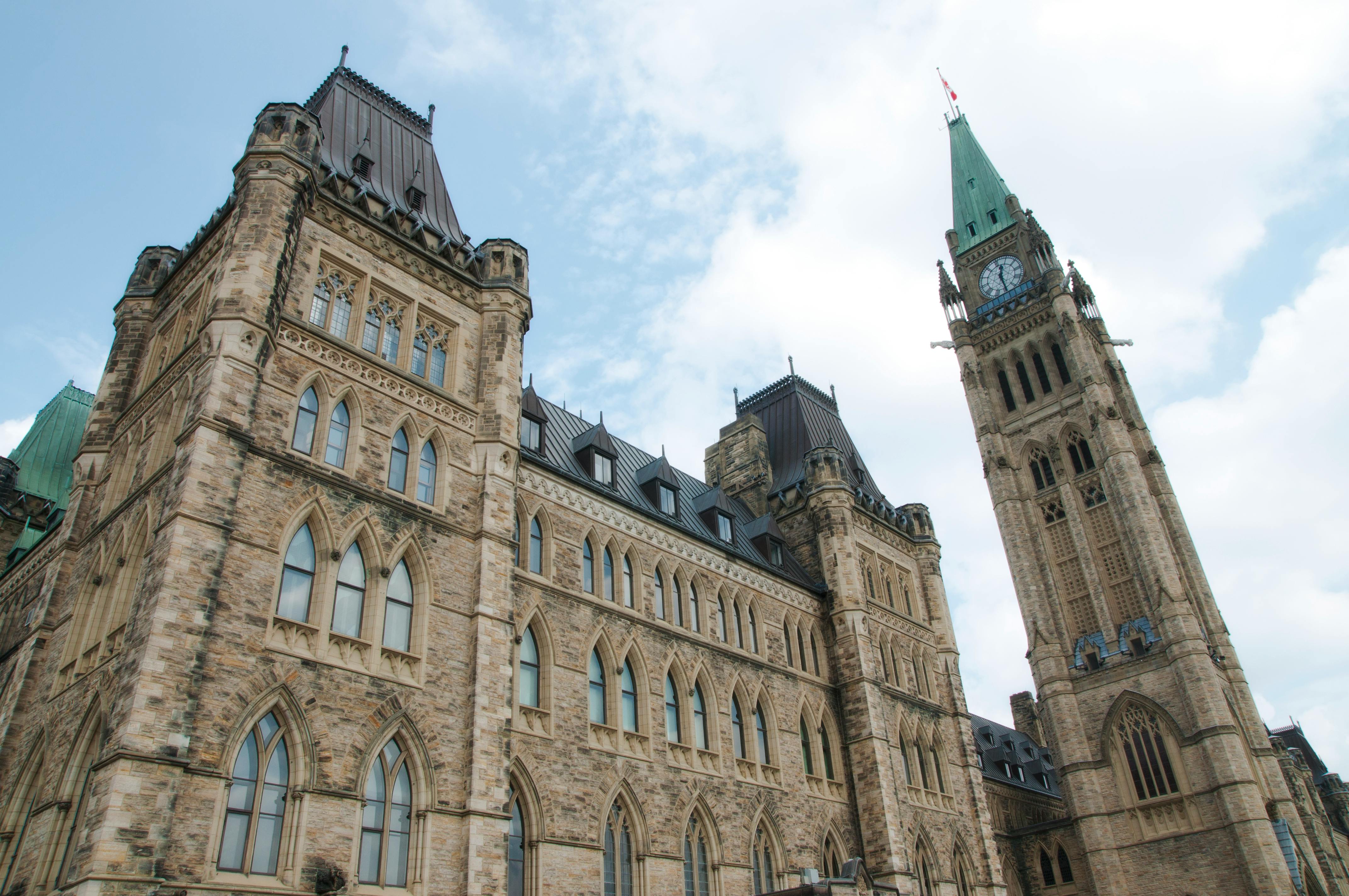
IMAGE: Front facade of the Canadian Parliament Centre Block in Ottawa, showing Gothic Revival stonework, pointed arch windows, and the Peace Tower .
The original build used muscle.
● Timber ramps
● Pulley cranes
● Wheelbarrows and scaffolding
● About 400 to 500 workers in rotating teams
After the fire, modern framing replaced timber.
● Steel skeletons were faced with Nepean sandstone
● Ohio sandstone returned for chimneys and ventilation towers
● Manitoba limestone replaced interior wood
● Marble flooring was installed in key areas
The outside kept the same look. But inside, everything got stronger.
How the Layout Changed
The rebuilt Centre Block followed a bi-axial layout. That design came from the École des Beaux-Arts in Paris. Corridors aligned cleanly. Rooms grouped by function. Everything had flow and symmetry.
What Parliament Hill Actually Teaches About Architecture
If you’re studying architecture, don’t just admire the towers. Read the logic.
Parliament Hill isn’t just a monument. It’s a working system—one that solved design problems in real time, with real constraints.
Here’s what it teaches:
● Style follows climate
Gothic Revival in Ottawa isn’t just for looks. The steep roofs shed snow fast. The copper holds up in freeze-thaw cycles. The deep window reveals insulate the thick stone walls. This isn’t textbook Gothic. It’s cold-climate Gothic.
● Material choice drives form
Rubble-course stone is rough, but fast to lay. Nepean sandstone cuts cleaner, which is why the trim looks so sharp. Manitoba limestone inside resists moisture. These weren’t aesthetic picks—they were functional decisions.
● Symbolism came second
The Peace Tower looks like a symbol now. It wasn’t designed as one. It was designed as a clock, a ventilation shaft, and a vertical anchor for the façade. Meaning came later. Form came first.
● Planning follows purpose
The bi-axial plan isn’t decorative. It makes Parliament function as both a workplace and a public building. Ceremonial routes are wide and central. Offices and support areas are tucked along the wings. That’s good institutional design—before modernism ever showed up.
If you’re in architecture school, read this place like a problem set.
● What did they need to solve?
● What did they have to work with?
● Why do the proportions still feel right?
Inside Parliament: What the Interior Actually Looks Like
The outside gets all the attention. But the real design work shows up inside. Most of what you see today was rebuilt after the 1916 fire. Materials, layout, finishes. All redesigned to function and last.
It looks Gothic. But underneath, it’s smart. Fire-resistant. Clear and efficient.
The Main Layout
The Centre Block follows a bi-axial plan. Straight corridors run east and west, north and south. Public spaces like the House of Commons and Senate Chamber sit at the center. Offices and service zones run along the wings. It’s balanced. It flows.
That came straight from the École des Beaux Arts in Paris. Pure layout logic. Nothing wasted.
Materials and Finishes
Every surface was picked for longevity and safety.
● Walls use Manitoba limestone instead of timber
● Floors use marble in main halls, mosaic and tile in side areas
● Ceilings are vaulted in stone or plastered with rib patterns
● Woodwork is solid oak or walnut, hand-carved with Gothic motifs
● Ironwork frames balconies and screens in the Library and chambers
Everything is thick. Nothing is tacked on. All the detail is part of the structure.
The House of Commons Chamber
Gothic arches line the walls. The ceiling is a timber shell shaped like an inverted boat. Stained glass windows run high, throwing filtered color across the room. The speaker’s chair sits under a carved Gothic canopy.
It’s not just decoration. Every line frames the space and controls the light.
The Library Interior
The Library is round. Three stories tall. Every wall lined with walnut shelves. A central reading floor sits under a high iron dome. Iron balconies curve around the second level. The ribs of the dome match the floor pattern below.
Nothing is random. Every part connects.
The acoustics are clean. Light enters through carved windows. It’s quiet. And it’s built to stay that way.
Symbolism in the Structure
The interior isn’t loud. But the message is clear.
● Provincial emblems are carved into stone
● Latin inscriptions line the arches
● Stained glass shows key events and military honors
● Coats of arms repeat across vault bosses and wood trim
Every symbol is built in. Nothing is pasted on.
After 2018
Since 2018, the Centre Block has been under major renovation. Crews are adding seismic upgrades, rebuilding systems, and restoring every carved surface by hand. The work blends new tech with old craft.
The goal isn’t to change the building. It’s to make it last another hundred years.
Why the Library’s Iron Dome Still Stands Out
Most visitors focus on the Peace Tower, but the Parliament Library is the real masterpiece. It’s round, precise, and built like a fortress. But one detail sets it apart: the cast iron dome.
Here’s why it matters:
● Fireproof by design
In 1916, fire destroyed almost everything. The Library survived. Why? The dome was built with iron ribs and a masonry shell. Fire couldn’t collapse it. Massive iron doors sealed it off from the flames. While the Centre Block burned, the library stayed intact.
● Structure drives beauty
The iron dome isn’t just strong—it’s graceful. It rises clean from the circular walls, with an internal rhythm that matches the shelves below. Every rib supports the weight above and guides the eye upward. The beauty comes straight from the geometry.
● Ventilation built in
Even in the 1800s, the design included passive ventilation. The dome pulls air upward. The outer shell acts like insulation. The space stays dry, even with all that paper inside.
● Craftsmanship in the details
Look at the woodwork. Carved capitals. Rosettes. Shelf brackets that repeat the rhythm of the dome. It’s not decoration—it’s a visual echo. The stone floor pattern mirrors the dome’s layout. That’s real coordination between trades.
This wasn’t an afterthought. The Library was built first, and built to last. It shows what you can do when structure, use, and beauty all align.
What the 1916 Fire Took—and What It Taught
The Parliament fire of 1916 exposed how architecture fails when structure and safety don’t align.
A cigar left burning in the reading room set off the blaze. The fire moved fast—fueled by wood walls, paper archives, and poor fireproofing. Within hours, most of Centre Block was gone.
What was lost:
● The original Victoria Tower
● Early frescoes, wood carvings, and stained glass
● Hand-built structural timber framing
● Parliamentary records, library collections, and architectural details that were never documented
What survived:
● The Library, saved by fireproof design—iron dome, masonry walls, and thick doors that sealed shut
● The overall Gothic Revival structure, later rebuilt with tougher materials but the same silhouette
The lesson: style isn’t enough. Beautiful architecture still fails without smart systems. The rebuild added steel framing, fire doors, marble floors, and updated ventilation—all while keeping the original visual language.
The fire became part of the building’s identity. Not just a tragedy, but a reset. A reminder that materials, layout, and safety have to work together.
What Makes Canadian Architecture Its Own Thing
Nothing in the design is there for show. Every part does a job.
Canadian architecture didn’t invent Gothic Revival. Or Neoclassicism. Or Modernism. But it takes styles and grounds them—by material, by climate, and by use.
Parliament Hill is the clearest example. Gothic forms, sure. But look closer:
● Nepean sandstone, not limestone from abroad
● Copper roofs made for Canadian winters
● Tall towers shaped for identity
● Rugged façades that match the landscape
● Symmetry borrowed from France, built by Canadian hands
That’s the pattern across Canadian public architecture. Blended influences. Local sourcing. Buildings that sit heavy on the land, not as ornaments, but as anchors.
It’s also practical. Canada doesn’t build with flash. It builds with intent. From brutalist city halls to simple rural churches, the focus is always on longevity, performance, and place. Even in Parliament, every stone and line solves a real problem: weather, space, structure.
One thing worth noticing is that Canadian architecture usually isn’t loud. It’s built to last. Built to work. The buildings that stay up don’t make a statement. They just do their job.
FAQs
Canadian Parliament Buildings (Architecture, History, and Construction)
ARCHITECTURE & STYLE
1. What architectural style are Canada’s Parliament Buildings built in?
They follow Victorian Gothic Revival, adapted with Canadian materials and layout logic.
2. Why was Gothic Revival chosen over Neoclassical?
Gothic Revival better suited the northern climate, vertical site, and national mood. It also reflected British parliamentary traditions.
3. What is Victorian Gothic Revival, and how does it differ from true Gothic?
Victorian Gothic borrowed Gothic features—pointed arches, spires, lancet windows—but used modern construction methods and mixed materials. It's more eclectic, less religious.
4. What are the main Gothic features visible on Parliament Hill?
● Pointed arches
● Lancet windows
● Crocketed spires
● Ornamental stone carving
● Steep gables and verticality
5. How did the building design respond to Ottawa’s cold climate?
Steep roofs shed snow fast. Thick stone walls insulate. Copper roofing resists freeze-thaw cycles. Window depth cuts drafts.
MATERIALS & CONSTRUCTION
6. What materials were used to build the Parliament Buildings?
Rubble-course stone, Nepean sandstone, slate (later copper), timber (later steel), Ohio sandstone, and Manitoba limestone.
7. Why was Nepean sandstone chosen?
It was lighter, easier to carve, more uniform in color, and looked better on tall façades. It aged well and was quarried locally.
8. Where was the original stone sourced from?
Hull and Gloucester provided limestone. Ohio sandstone was used for trim. Nepean sandstone replaced both in key areas.
9. How did construction techniques change after the 1916 fire?
Steel frames replaced timber. Fireproof materials were added. Interiors used stone and marble. The exterior look stayed the same.
10. Why were slate tiles replaced with copper on the roof?
Copper lasts longer, handles Canadian weather better, and requires less maintenance over time.
11. What is rubble-course stone, and why was it used?
It's irregular, rough-cut stone laid without uniform shaping. It’s faster to build with, structurally solid, and visually textured.
12. What replaced wood in the interior walls during reconstruction?
Manitoba limestone was used for strength, durability, and fire resistance.
13. How does the bi-axial layout affect building flow and use?
It creates symmetry, clear circulation, and better spatial organization. Public, ceremonial, and administrative functions are separated cleanly.
PEACE TOWER & LIBRARY
14. What is the Peace Tower, and how tall is it?
It’s the central clock tower of Centre Block. It stands 97.5 meters tall.
15. What was the Victoria Tower, and what happened to it?
It was the original tower of Centre Block. It collapsed in the 1916 fire.
16. When was the Peace Tower built, and what does it represent?
Completed in 1927. It honors Canadian soldiers who served in World War I.
17. Why is the Library of Parliament round?
The circular plan improves acoustics and reading light. It also sets it apart visually and structurally.
18. How did the Library survive the 1916 fire?
Iron doors sealed it off. The dome and walls were built fireproof with iron and masonry.
19. What makes the Library’s iron dome architecturally significant?
It’s both fire-resistant and structurally expressive. The internal ribs follow the book layout below.
20. What materials are used in the Library’s interior?
Walnut woodwork, iron framing, marble floors, and decorative stone. Every piece is custom-made and hand-finished.
FIRE & RECONSTRUCTION
21. What caused the 1916 Parliament fire?
An unattended cigar in the reading room ignited papers and wood. It spread fast due to flammable materials.
22. Which parts of the building were destroyed in the fire?
Centre Block, including Victoria Tower. The Library survived.
23. How long did reconstruction take?
From 1916 to 1922, with later finishes completed by 1927.
24. Who designed the rebuilt Centre Block?
Architects John A. Pearson and Jean-Omer Marchand led the redesign.
25. What changes were made to improve fire resistance?
Steel framing, masonry partitioning, marble floors, and iron fire doors were added.
26. Did the exterior style change after the fire?
No. The rebuilt structure stayed faithful to the original Gothic Revival look.
NATIONAL SIGNIFICANCE & DESIGN LOGIC
27. Is the Peace Tower considered a national symbol?
Yes. It appears on Canadian currency and marks major state events.
28. How is the Parliament building used today?
It houses the House of Commons, Senate (temporarily relocated during renovations), and various parliamentary functions.
29. What influence did the École des Beaux-Arts have on the layout?
The rebuilt Centre Block used a Beaux-Arts bi-axial plan: symmetrical, hierarchical, and clearly organized.
30. Why are the buildings considered a mix of British and Canadian architectural values?
They borrow British Gothic forms but use Canadian materials, construction methods, and adapt to the climate and landscape.
Sources
Government of Canada – Official Site
→ https://www.parl.ca
Parliament Hill – National Historic Site (Parks Canada)
→ spx?id=471
Library of Parliament – Historical Documents & Restoration Archives
→ https://lop.parl.ca
National Capital Commission – Building Materials and Heritage
→ https://ncc-ccn.gc.ca
Canada’s Historic Places Database – Heritage Registries
→ https://www.historicplaces.ca
Public Services and Procurement Canada – Parliamentary Precinct Rehabilitation
→ https://www.tpsgc-pwgsc.gc.ca/citeparlementaire-parliamentaryprecinct
Royal Architectural Institute of Canada – National Building Awards Archive
→ https://raic.org