
Ukrainian Baroque took a broad European style and made it local.
It used parts of the Baroque language: curved silhouettes, layered facades, plaster detail, strong rooflines, color, and movement. Then it reshaped them through local materials, climate, craft, patronage, and regional identity.
The result is quieter than many Western Baroque examples, but not weaker. Ukrainian Baroque often feels more grounded, more compact, and more craft-driven than the palace-heavy Baroque seen elsewhere in Europe.
For the broader Baroque overview, start with Baroque architecture. This page stays regional: how Ukrainian Baroque works, what makes it different, which examples are safer to study, and what students should look for.
What Makes Ukrainian Baroque Different From Western Baroque
The main difference is not only ornament. It is attitude.
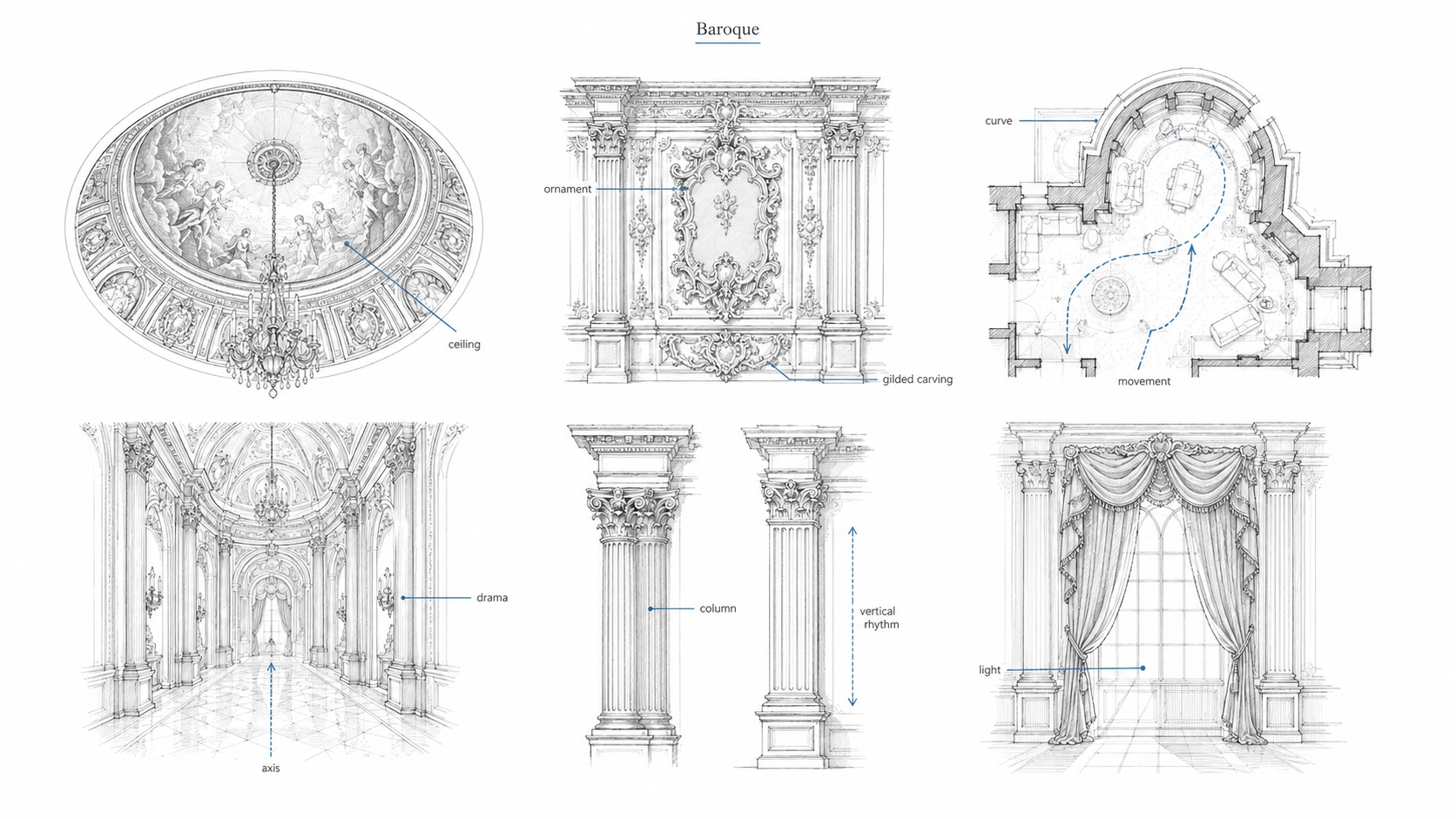
Western Baroque often uses large spatial drama, deep perspective, grand stairs, domes, courts, and theatrical interiors. Ukrainian Baroque usually works through silhouette, surface rhythm, roof form, plaster detail, color, and a closer relationship to local building traditions.
| Design issue | Western Baroque often does this | Ukrainian Baroque often does this |
|---|---|---|
| Scale | Large palaces, major stair halls, long axes, dramatic rooms | More compact masses, layered facades, strong silhouettes |
| Ornament | Deep carving, heavy sculptural programs, strong theatrical surfaces | Shallower plaster relief, painted surfaces, rhythmic trim, local craft detail |
| Roof form | Domes, mansards, large roof volumes, palace profiles | Tiered rooflines, bulbous domes in some examples, compact vertical emphasis |
| Color | Stone, gilding, marble, dark wood, fresco, strong contrast | Pale limewash, soft greens, whites, blues, ochres, and restrained highlights |
| Local logic | Often tied to court culture, urban spectacle, and patronage | Often shaped by regional identity, climate, material availability, and craft continuity |
How the Style Took Shape
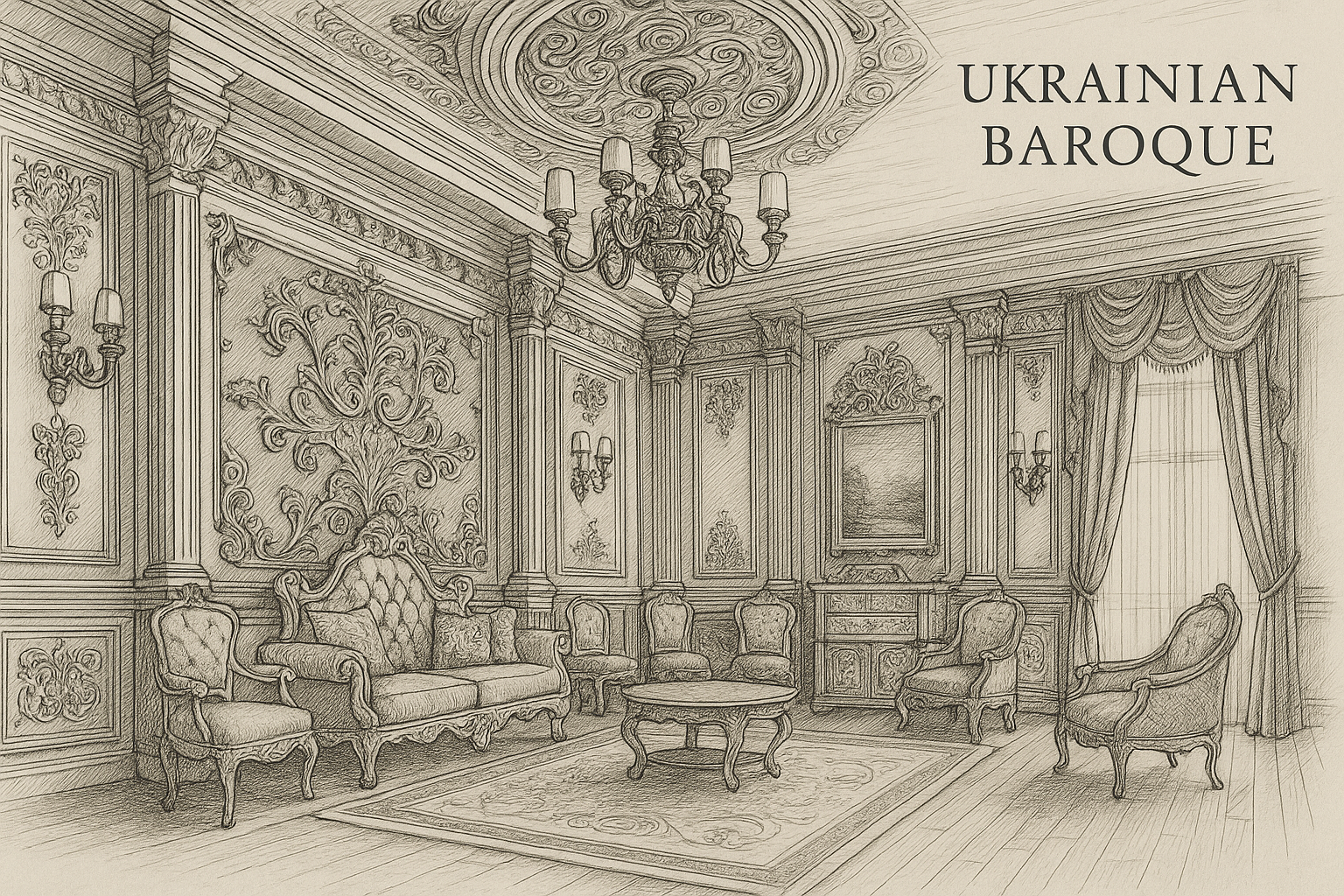
Ukrainian Baroque developed during a period of shifting borders, changing patronage, and contact with surrounding European building cultures.
Western Baroque ideas arrived through craftsmen, patrons, printed sources, travel, and religious and civic networks. Local builders did not simply copy those ideas. They adjusted them to local construction methods, available materials, weather, older building memory, and regional taste.
That is why Ukrainian Baroque can feel familiar and different at the same time. It belongs to the Baroque family, but its proportions, surfaces, and silhouettes often read as more local and less theatrical.
Adaptation instead of imitation
The strongest examples show adaptation rather than imitation. Facades may have Baroque rhythm, but the details are often simplified. Roofs may carry a dramatic profile, but the mass remains grounded. Plaster may be decorative, but it often works with broad wall surfaces instead of covering every inch.
This gives Ukrainian Baroque a controlled character. It is not plain, but it is rarely careless. The richness comes from proportion, color, roofline, surface, and craft more than from overload.
Examples Students Should Study First
Ukrainian Baroque needs named examples. Otherwise the style becomes too abstract.
Start with buildings and ensembles where the regional character is easier to read: wall mass, roofline, plaster rhythm, local craft, civic identity, and measured ornament.
| Example | Where | What to study |
|---|---|---|
| Kyiv-Pechersk Lavra buildings | Kyiv | Ensemble planning, domes, vertical accents, plastered surfaces, skyline, and how older sacred buildings gained Baroque layers over time |
| Zaborovsky Gate near Saint Sophia Cathedral | Kyiv | Gateway as architectural event, plaster relief, threshold, ornament, and urban approach |
| St. Catherine’s Church | Chernihiv | Five-part silhouette, vertical lift, restrained surface treatment, and the link between Cossack identity and built form |
| Chernihiv Regimental Chancellery | Chernihiv | Secular Baroque scale, administrative identity, brick and plaster rhythm, and civic rather than palace expression |
| Transfiguration Church | Velyki Sorochyntsi | Patronage, wall mass, roof profile, ornament restraint, and the connection between regional craft and high-style Baroque influence |
| Kyiv-Mohyla Academy historic buildings | Kyiv | Educational architecture, facade rhythm, Baroque-era additions, and how institutional buildings used the language without becoming palaces |
Materials and Construction Logic
Ukrainian Baroque depends heavily on material behavior.
Brick, local stone, lime plaster, timber traditions, and mineral color all shaped the style. Even when a building was masonry, older timber habits could still influence proportion, spacing, roof form, and opening rhythm.
Lime plaster was especially important. It could soften uneven masonry, accept color, catch daylight, and allow older walls to release moisture better than hard modern coatings. That does not mean every old wall survived perfectly. It means the material system was part of the architecture, not just a finish.
Surface that works with light
Ukrainian Baroque surfaces often avoid extremely deep relief. Instead, shallow moldings, raised frames, softened corners, and painted fields let daylight do much of the work.
A small shadow can matter more than a heavy carving. A pale surface can make the roofline stronger. A narrow band of color around a window can organize the facade without making it look overloaded.
Color, Limewash, and Climate
Color is one of the easiest ways to recognize Ukrainian Baroque.
White, pale blue, soft green, ochre, warm yellow, and muted earth tones appear often in regional examples and later restorations. These colors make plaster surfaces legible in changing weather and give the buildings a lighter identity than many darker Western Baroque interiors.
Color should not be treated as paint slapped onto a historic form. In this architecture, color works with wall thickness, roofline, window frames, shadows, and the sky.
Why soft color matters
Soft color can reduce glare, make mass feel lighter, and help shallow plaster detail read from the street. Strong contrast may be used at trim, domes, or selected accents, but the best effect usually comes from restraint.
That restraint is one reason Ukrainian Baroque can feel calm even when the building has complex rooflines or rich facade rhythm.
Geometry, Balance, and the Regional Eye
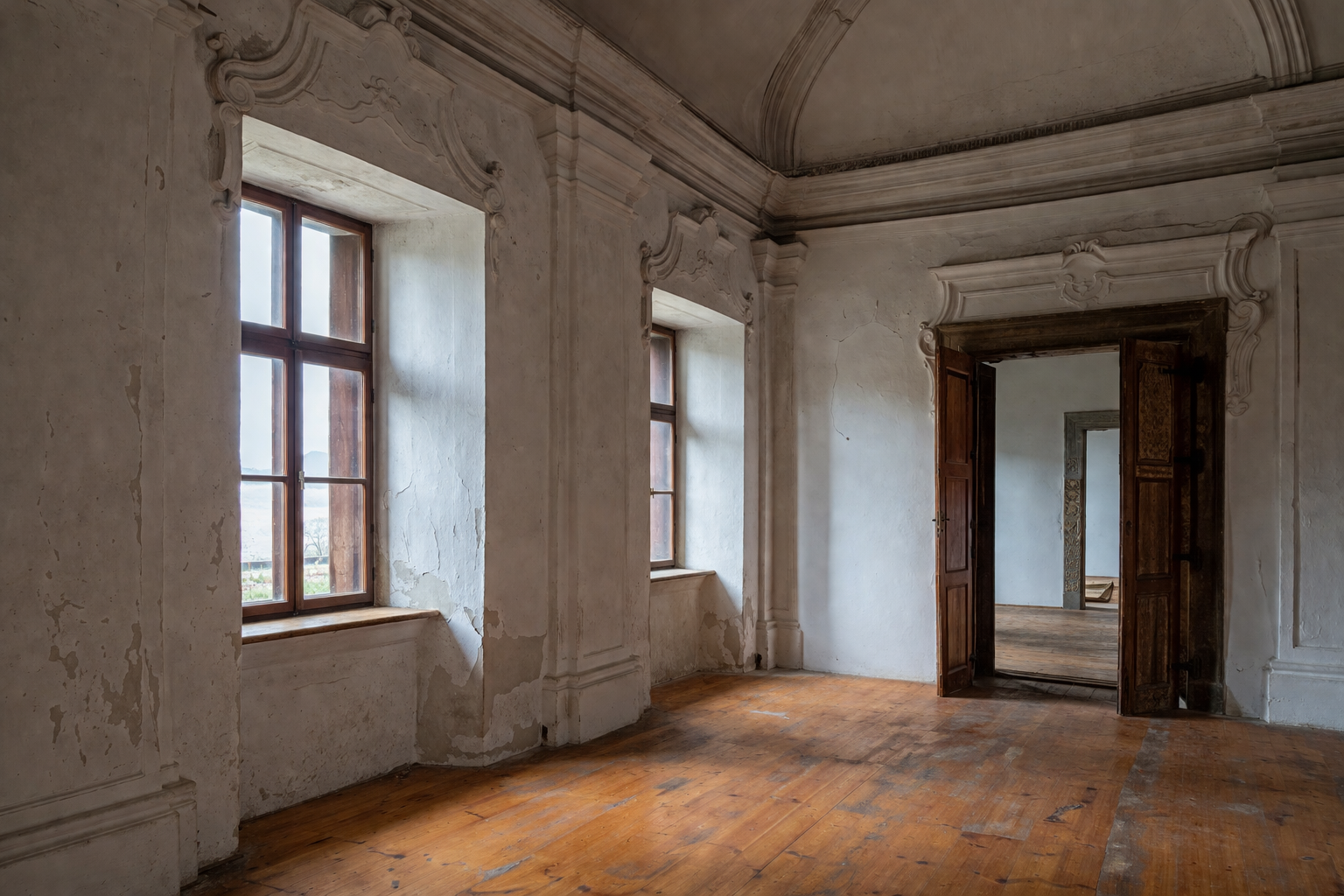
Ukrainian Baroque uses geometry, but usually not in the same way as the most theatrical Western Baroque interiors.
Look for repeated openings, layered rooflines, carefully placed vertical elements, shallow relief, and a balance between wall mass and surface detail. The geometry is often disciplined rather than explosive.
Curves that stay controlled
Curves appear in roof profiles, domes, gables, window frames, and facade edges. They usually do not make the whole building feel restless. They soften the mass and help light move across the surface.
Proportion before display
The strongest Ukrainian Baroque buildings often feel composed before they feel decorative. The wall, roof, window rhythm, and trim work together. No single detail needs to dominate the whole facade.
Shadow as ornament
Shallow moldings can look plain in a flat photograph, but they become active when daylight moves. A thin raised edge around a window may cast enough shadow to organize the whole wall.
This is one of the best lessons from the style: ornament does not need to be deep to matter. It needs to be placed where light can use it.
Regional Signatures Across Ukraine
Ukrainian Baroque is not identical in every city or region.
Local materials, urban history, preservation patterns, weather, and later rebuilding all affect how the style appears today. Use regional labels carefully. They are helpful for study, but real buildings often contain layers from different periods.
Kyiv: formal rhythm and layered identity
Kyiv is one of the most important places for studying Ukrainian Baroque because the style appears within a deep urban and cultural history.
Look at the Kyiv-Pechersk Lavra ensemble, the Baroque layers around Saint Sophia, Zaborovsky Gate, and Kyiv-Mohyla Academy buildings. These examples show pale surfaces, vertical rhythm, layered rooflines, domes, and the relationship between wall mass and skyline.
Kyiv examples also teach caution. Many sites are older than the Baroque period but gained Baroque forms, additions, restorations, or surface treatments later. Do not treat the whole site as one single-period object.
Chernihiv: Cossack identity and measured vertical form
Chernihiv is one of the clearest places to study Cossack Baroque character.
St. Catherine’s Church is useful because the silhouette does much of the work. The building does not need palace-scale ornament to feel strong. Its vertical rhythm, domes, plastered mass, and controlled profile make the style legible from a distance.
The Chernihiv Regimental Chancellery gives a different lesson. It is not only about sacred architecture. It shows how Ukrainian Baroque could carry civic and administrative identity through wall rhythm, brick, plaster, and measured detail.
Poltava, Sorochyntsi, and the Hetmanate landscape
Poltava-region examples help explain how Ukrainian Baroque relates to patronage, local craft, and landscape.
The Transfiguration Church in Velyki Sorochyntsi is especially useful because it connects regional building habits, surface detail, and patronage. Study the relationship between mass, roofline, openings, and ornament before looking at any single decorative feature.
Lviv: craft, density, and later historic layers
Lviv is useful because it shows how Baroque, later historicism, urban density, and craft traditions can overlap.
The city has many architectural layers, so not every ornate or dramatic building should be called Ukrainian Baroque. Study window rhythm, plaster detail, street proportion, and how later buildings borrow older visual habits.
What Not to Confuse With Ukrainian Baroque
Not every historic Ukrainian building with ornament is Ukrainian Baroque.
Some buildings are later historicist, Neo-Baroque, Neo-Renaissance, Neoclassical, Eclectic, or heavily restored. Others contain mixed layers. A building may borrow Baroque profiles or color but belong to a different period.
| If you see... | Do not assume... | Check instead... |
|---|---|---|
| Rich facade ornament | It must be Ukrainian Baroque | Date, construction history, roofline, wall rhythm, and source context |
| Colorful plaster | Color alone defines the style | How color works with openings, trim, mass, and silhouette |
| Domes or curved rooflines | The building is pure Baroque | Whether the form is original, restored, later, or mixed |
| Later city landmarks | They belong to the same period | Whether they are historicist echoes rather than Baroque works |
Design Principles That Still Teach
Ukrainian Baroque is useful for modern designers because it shows how regional identity can come from proportion, material, and climate rather than from copying decoration.
Precision before decoration
A simple cornice, clear window rhythm, or carefully proportioned wall can communicate more than a crowded facade. The detail works because the base geometry is calm.
Balance through repetition
Openings, panels, pilasters, and trim often repeat in a measured rhythm. This gives larger walls a human scale and helps the facade feel orderly without becoming stiff.
Texture as evidence of craft
Limewash, plaster, brick, timber, and mineral surfaces age differently than plastic coatings or sealed cement finishes. The texture is part of the architectural memory. If restoration erases all unevenness, the building can lose part of its character.
What the Walls Teach About Climate
Climate matters in Ukrainian Baroque.
Thick walls, deep openings, pitched or tiered roof forms, lime-based finishes, and breathable surfaces all affect comfort and durability. These are not decorative afterthoughts. They shape how the building handles sun, rain, snow, moisture, and seasonal change.
Built for seasons
In a climate with cold winters and warm summers, wall thickness and roof form matter. Deep reveals can reduce glare and protect openings. Roofs need to shed snow and water. Plaster needs to handle moisture movement without trapping it.
Ventilation and daylight
Older buildings often used wall thickness, window placement, ceiling height, and room layout to moderate daylight and air movement. These passive strategies still matter in renovation and conservation.
Maintenance as part of the system
Limewash and plaster require care. That is not a flaw. It is part of how many older wall systems survived. Problems often begin when breathable materials are sealed with hard, incompatible coatings.
Preservation: What Can Go Wrong
Ukrainian Baroque buildings can be damaged by repairs that ignore the original wall system.
Hard cement patches, sealed coatings, trapped moisture, badly matched plaster, poor drainage, and careless replacement windows can do more damage than age alone. A wall that was built to breathe should not be sealed like a modern concrete surface.
| Damage sign | Possible cause | Better response |
|---|---|---|
| Flaking plaster | Moisture trapped behind a hard coating | Investigate drainage, wall breathing, and compatible lime repair |
| Salt marks near base | Rising damp or splashback | Fix drainage and ground contact before repainting |
| Cracks near trim | Movement, trapped water, or failed joint repair | Read the crack path before filling it |
| Flat modern paint | Incompatible finish over lime or plaster | Use breathable mineral or lime-based finishes where appropriate |
Modern Lessons Without Copying the Style
Modern designers do not need to copy Ukrainian Baroque as a costume.
Copy the discipline instead: local materials, quieter color, repeated openings, wall depth, breathable finishes, and surface detail that responds to light. A modern building can learn from the style without pretending to be historic.
- Use local material logic: let available brick, stone, plaster, timber, or mineral finishes shape the design.
- Design color with daylight: test color on the real facade, not only on a screen.
- Respect wall depth: deep openings and reveals can improve shadow, comfort, and facade strength.
- Keep detail proportional: shallow relief can work if the wall rhythm is clear.
- Repair with compatible materials: old breathable walls need repairs that do not trap moisture.
How Students Should Study Ukrainian Baroque
Do not start by memorizing dates and names only.
Start with what the building is doing. Look at the wall thickness. Study how openings repeat. Watch how the shadow moves across shallow plaster detail. Compare roof form to wall mass. Ask where color clarifies the building and where it is only decorative.
A simple observation exercise
- Choose one facade or historic photograph.
- Sketch only the wall mass, roofline, and major openings.
- Add the plaster bands, trim, and color zones after the mass is clear.
- Mark where shadows create the strongest architectural effect.
- Ask which parts feel local rather than imported.
That exercise will teach more than copying ornament. Ukrainian Baroque makes sense when structure, surface, color, climate, and craft are read together.
How Ukrainian Baroque Fits the Cluster
Ukrainian Baroque is a regional branch of the Baroque story, not a replacement for the broader style.
The main Baroque architecture page explains the larger design language. The Baroque architecture characteristics page gives a general checklist. The Baroque architecture examples page shows major building cases. This page belongs beside them because it explains what happens when Baroque ideas become regional, local, and material-specific.
References and Resources
- Encyclopedia of Ukraine: Baroque for Ukrainian Baroque, Cossack Baroque, and major examples.
- Encyclopedia of Ukraine: Architecture for broader Ukrainian architectural context.
- UNESCO: Kyiv Saint-Sophia Cathedral and Kyiv-Pechersk Lavra for the protected historic ensemble context.
- National Preserve “Kyiv-Pechersk Lavra” for current institutional information on the Lavra complex.
- Kyiv-Mohyla Academy: Old Academic Building for the academy building context.
FAQ
What makes Ukrainian Baroque different from other Baroque styles?
Ukrainian Baroque adapts Baroque ideas through local materials, plaster, color, rooflines, regional craft, and a more restrained surface language. It is often less theatrical than Western Baroque palace architecture.
Where can Ukrainian Baroque be studied?
Kyiv, Chernihiv, Poltava-region sites, Velyki Sorochyntsi, and other historic Ukrainian places contain buildings, fragments, restored works, and urban patterns that help explain the style. Always check the building date and restoration history because many sites contain mixed layers.
Is Ukrainian Baroque the same as Cossack Baroque?
The terms are related and sometimes overlap in common use, but they are not always used with the same precision. Cossack Baroque often refers more specifically to the Ukrainian Baroque tradition associated with the Hetmanate period and regional patronage.
What are good Ukrainian Baroque examples to study first?
Start with the Kyiv-Pechersk Lavra buildings, Zaborovsky Gate near Saint Sophia Cathedral, St. Catherine’s Church in Chernihiv, Chernihiv Regimental Chancellery, and the Transfiguration Church in Velyki Sorochyntsi.
What materials are important in Ukrainian Baroque?
Brick, local stone, lime plaster, limewash, timber influence, mineral color, and hand-finished surfaces are important to the style’s regional character.
What should students sketch first?
Sketch the mass, roofline, window rhythm, wall thickness, and shadow bands first. Add ornament later. The regional character usually lives in proportion and surface before decoration.
Can Ukrainian Baroque ideas work in modern design?
Yes, if the lesson is local adaptation rather than imitation. Use breathable materials, measured color, wall depth, repeated openings, and restrained detail instead of copying historic ornament without context.