
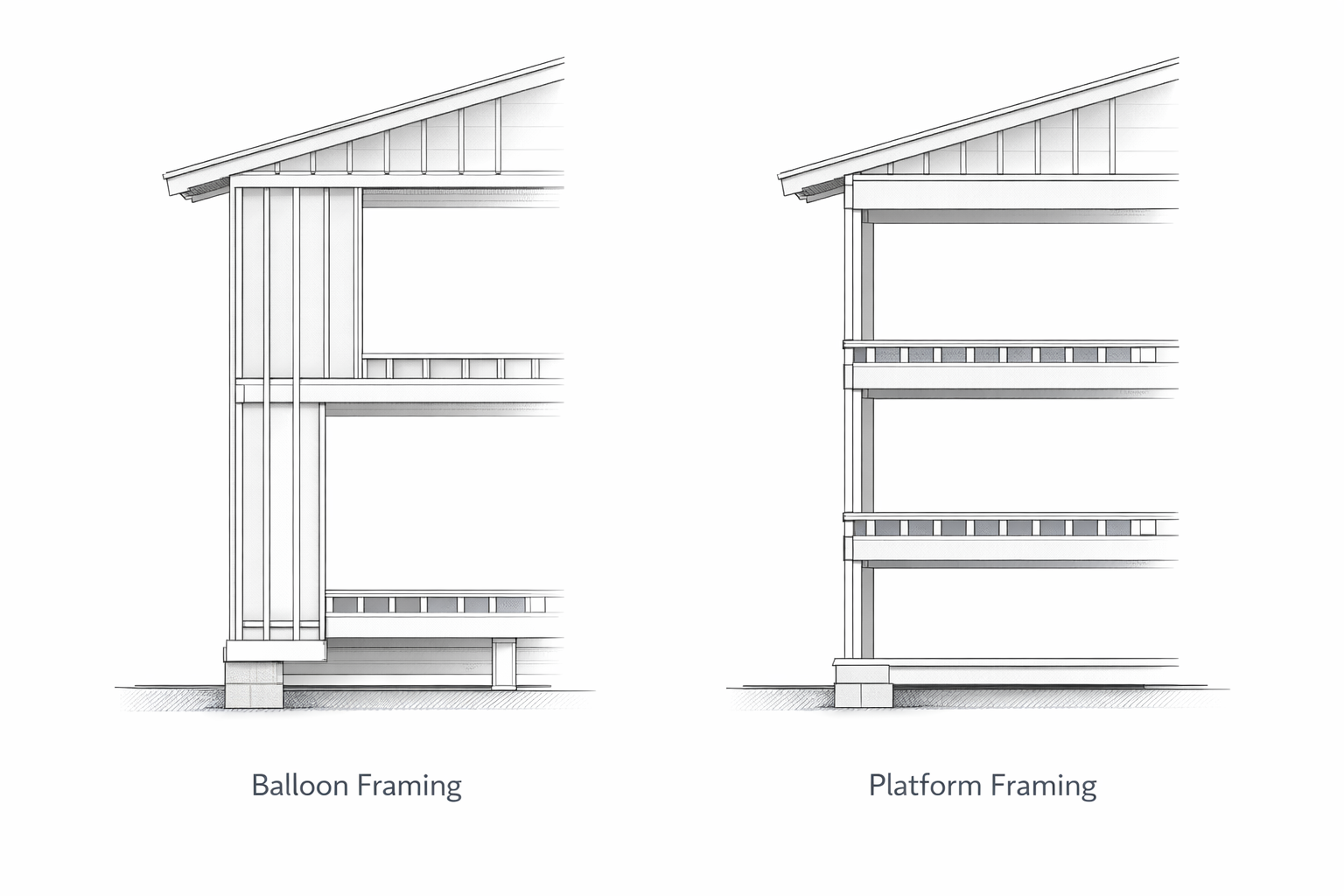
Balloon framing and platform framing build the house in two different ways. That one change affects how floors connect, how fire moves, how walls get insulated, and how ugly the repair work gets later.
Most older wood houses still hide balloon framing inside the walls. Most newer ones use platform framing. If you are opening walls, pricing a renovation, or trying to understand why one house turns simple work into a long list of surprises, this is one of the first things to identify.
Start With the Main Difference
| Question | Balloon Framing | Platform Framing |
|---|---|---|
| Wall studs | Long studs continue past floor lines | Studs stop at each floor |
| Floor framing | Floors are supported into the wall framing | Each floor is built as a platform and the next wall sits on top |
| Fire spread risk | Open wall cavities can run upward if not blocked | Each floor interrupts the wall cavity naturally |
| Ease of framing | Harder to handle because the studs are long | Easier to build, brace, and stage floor by floor |
| Retrofit difficulty | Usually harder | Usually easier |
| Best fit today | Old-house repair, restoration, some specialty tall-wall work | Most ordinary residential construction |
If you only need the short version, that table is it. Balloon framing gives you a continuous wall. Platform framing gives you one framed level at a time. That one change affects almost everything else.
What Balloon Framing Is Doing
Balloon framing uses long wall studs that run from the sill area upward past the floor line instead of stopping at each story. In a two-story house, the studs often continue from the lower wall up toward the roof. The second floor is then carried by joists tied into the side of that wall framing, usually on a ribbon, ledger, or similar support detail.
That gives you a continuous wall line. It also gives you a continuous wall cavity unless someone adds blocking. That is the part that matters later.
This method spread in the nineteenth century because it made light wood construction much faster. Standard lumber and cheap nails let builders move away from heavy timber joinery for a lot of ordinary houses. It changed the pace of building, especially in fast-growing towns and expanding neighborhoods.
The structural idea is clean enough. Long studs carry loads down. Floor framing ties into the wall. Sheathing stiffens the wall. Roof framing lands at the top. The trouble is not the concept. The trouble comes later, when the same continuous wall that made the building quick to frame also makes fireblocking, insulation, repairs, and some structural changes more awkward.
If you want the broader background first, use wood construction. Balloon framing makes more sense once the larger light-frame system is clear.
What Platform Framing Is Doing
Platform framing builds the house one level at a time.
The first floor deck is framed. Then the first-story walls sit on that deck. Then the next floor deck is framed on top of those walls. Then the next wall sits on that new platform. The structure stacks upward in steps.
That sounds ordinary now because it is ordinary now. But it solved a lot of practical problems at once:
- studs got shorter and easier to handle
- walls got easier to raise and brace
- each floor interrupted the wall cavity
- staging the job became simpler
- framing crews could repeat the same sequence over and over
That is why platform framing took over most ordinary house construction. It is not romantic, but it is efficient, easier to control, and easier to keep aligned with modern code expectations.
The key thing to understand is this: platform framing does not just replace long studs with short ones. It changes the whole build sequence and the way loads are staged through the house. Floors are not hanging into a continuous wall line anymore. They are becoming the next work platform and the next structural break point.
How the Floor Connection Changes Everything
This is the comparison that matters most.
In balloon framing
The wall continues upward and the floor ties into it. That makes the floor line feel secondary to the wall line. From a renovation standpoint, that means the wall cavity may keep running, the framing logic is less compartmentalized, and structural changes at the floor edge need more care.
In platform framing
The floor becomes the stage the next wall sits on. That makes the floor line a structural and practical break. Fireblocking gets easier. Air sealing gets easier. Repairs often get easier too because the wall is not acting like one long vertical shaft.
That is why platform framing tends to be friendlier once the drywall comes off. The building is divided into more manageable chunks.
Balloon framing is not worse at every structural task. It is just less forgiving once you start cutting into it without a clear plan.
Why Platform Framing Won
Balloon framing did not disappear because it never worked. It disappeared from ordinary house construction because platform framing was easier to build, easier to brace, easier to fireblock, and easier to do with shorter lumber lengths.
That matters more than nostalgia. Once builders had a method that staged the job floor by floor and fit the way crews wanted to work, the old speed advantage of balloon framing faded.
Platform framing also fits modern inspection and modification better. Electricians, plumbers, HVAC crews, insulation installers, and framing crews can all work in a structure that is divided more cleanly by floor level.
So the shift was not only structural. It was logistical.
| Why Platform Framing Took Over | What It Improved |
|---|---|
| Shorter studs | Easier handling, easier sourcing, less flex during framing |
| Floor-by-floor sequencing | Cleaner staging and easier crew coordination |
| Built-in cavity interruption | Better fire control and easier compartmentalization |
| Simpler bracing process | Less trouble keeping walls stable during framing |
| Easier future work | Renovation, wiring, insulation, and repairs became more manageable |
That is the plain answer. Platform framing fit the jobsite better.
Where Balloon Framing Still Hits Harder
Balloon framing is not dead because the logic still solves a few useful problems.
Tall wall lines
Continuous framing can still make sense where a long vertical wall condition matters more than ordinary floor-by-floor sequencing.
Historic restoration
If the building already is balloon framed, matching the existing logic often makes more sense than pretending the old structure is something else.
Preservation work
Museum work, heritage replication, and some specialty restoration jobs need the framing method to stay legible.
Some hybrid systems
Now and then, parts of the continuous-stud idea still show up in custom or engineered situations, even when the whole building is not being framed the old way.
That does not make balloon framing the better default. It just means it still has a reason to exist in some jobs.
Use This When / Avoid This When
| System | Use This When | Avoid This When |
|---|---|---|
| Balloon framing | You are repairing an existing balloon-framed building, doing historic replication, or solving a specific tall-wall condition that benefits from continuous studs | You are building an ordinary new house and do not need the old method’s special wall logic |
| Platform framing | You want the standard modern residential system with easier staging, fireblocking, and future work | You are trying to preserve the structure of an existing historic wall and platform conversion would damage the building or complicate the job more |
That table is blunt on purpose. Most ordinary new residential work does not need balloon framing. Most repair work on an existing balloon-framed house does need you to understand it before you start cutting into it.
What Changes in Renovation
This is where the comparison gets expensive.
Fireblocking
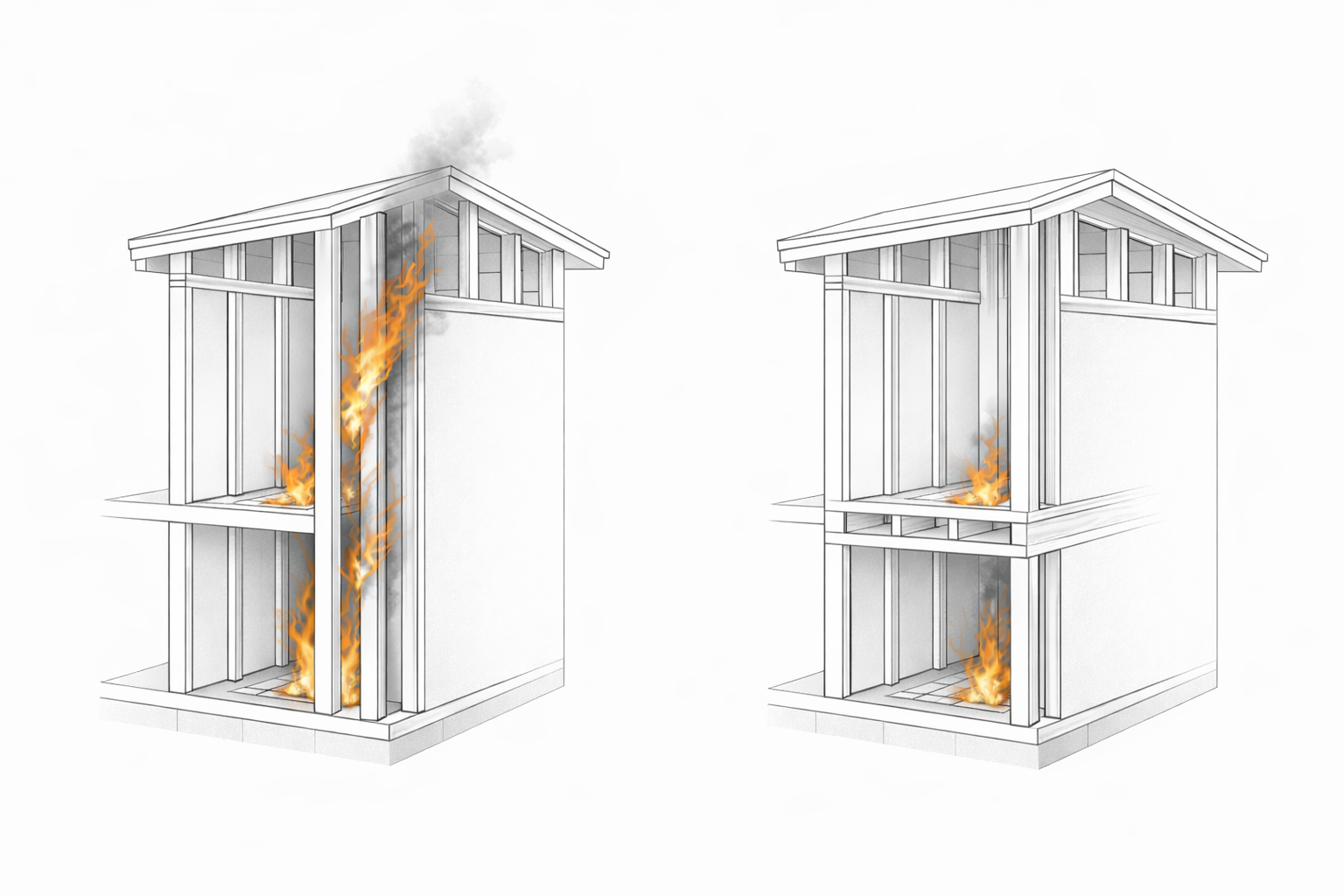
Illustration by ArchitectureCourses.org. Side-by-side wall section comparison showing continuous fire travel in balloon framing and interrupted fire spread at the floor platform in platform framing.
Balloon framing makes fireblocking a bigger job because the stud cavity can keep running. Platform framing gives you a natural break at each floor. Once an old balloon-framed wall is open, blocking is one of the first things to think about.
Insulation and air sealing
Balloon-framed walls can be useful for some retrofit insulation strategies because the cavity is deep and continuous. They can also be a problem because air can move farther, hidden voids can connect levels, and moisture control can get messy if the retrofit is sloppy. Platform-framed walls are easier to divide, inspect, and compartmentalize.
Wiring and plumbing
Balloon framing can look convenient because the runs are long. That convenience disappears fast if the wall is being cut without a plan or if the old framing has weak connections, hidden gaps, or missing blocking. Platform framing tends to be more predictable by floor.
Structural repair
Repairing a section of balloon-framed wall is not the same as patching a short wall sitting on a platform. The long stud line matters. Floor support details matter. Sheathing matters. Platform framing isolates problems more cleanly.
Budgeting
Balloon framing often turns a “simple wall opening” into a more careful structural and fire-safety review. That changes labor and sequencing. Platform framing is not free of surprises, but the surprises are usually smaller.
That is why older houses can blow up a budget so fast. The wall is doing more than it looks like it is doing.
How to Tell Which One You Have
Do not guess from style alone. Check the framing logic.
Signs of balloon framing
- studs continue past the floor line
- floor joists are supported into the wall with a ribbon, ledger, or similar detail
- no full platform break is visible between stories
- wall cavities may appear open upward once the wall is exposed
- the house is old enough that balloon framing is plausible
Signs of platform framing
- studs stop at each floor level
- the next wall sits on top of the floor below
- the structure reads as stacked levels
- fireblocking is easier to trace because the floor line breaks the wall cavity
The best proof is not the window pattern or the age of the house. The best proof is the wall and floor connection.
Common Mistakes in This Comparison
- Treating balloon framing like a historic curiosity only. It still changes renovation work right now.
- Treating platform framing like it is always structurally superior. It is more practical for most new work, but that does not make every old balloon-framed wall bad.
- Assuming a house is balloon framed because it is old. Age is a clue, not proof.
- Ignoring fireblocking. This is one of the first places the comparison stops being academic.
- Thinking long studs automatically mean stronger walls. Continuous framing changes the behavior, but repair quality, sheathing, bracing, and condition still decide a lot.
- Pricing the renovation before identifying the framing. That is how a small job turns into a bad estimate.
Most framing comparison mistakes start when the house gets reduced to a label. The label matters, but the condition and the details matter more.
Which One Is Better?
For most ordinary new houses, platform framing is the better answer. It is easier to stage, easier to fireblock, easier to brace, and easier to work on later.
For an existing old house that already has balloon framing, the better answer is usually not “rip it out and make it modern.” The better answer is to understand the existing frame, fix what is weak, add the missing safety work, and make the renovation decisions from there.
That is the honest answer. One system won the mainstream building fight. The other still matters because old houses are still standing and still being opened up.
FAQ
What is the main difference between balloon framing and platform framing?
Balloon framing uses long studs that continue past floor levels, with floors tied into the wall. Platform framing builds each floor as its own platform and stacks the next wall on top.
Why did builders stop using balloon framing for most houses?
Because platform framing was easier to build, easier to brace, easier to fireblock, and easier to do with shorter lumber.
Is balloon framing stronger than platform framing?
Not in some blanket way. It is a different wall and floor system. Condition, bracing, sheathing, load path, and repair quality matter more than treating one label like automatic strength.
Which one is safer in a fire?
Platform framing has the easier built-in advantage because the floor line interrupts the wall cavity. Balloon framing needs more attention to blocking because open cavities can run upward.
Which one is easier to renovate?
Platform framing is usually easier because the building is divided floor by floor. Balloon framing often needs more planning once walls are open.
Can a balloon-framed house still be a good house?
Yes. A lot of them are. The framing method is not a death sentence. It just means the house needs to be understood on its own terms.
How do I know which framing system my house has?
Look at the wall and floor connection, not just the age or style. Long studs and floors tied into the wall point toward balloon framing. Stacked floor-by-floor framing points toward platform framing.
Is balloon framing still used today?
Mostly in restoration, preservation, replication, and a few specialty conditions. It is not the usual answer for ordinary new residential work.
Read This Next
If you want the wider background on how the method changed house design, read How Balloon Framing Changed the Shape of American Houses. If you need the broader historic housing context, use How U.S. Homes Changed Over 300 Years. And if you want the broader material and framing background first, start with wood construction.