

A senior architect salary in New York can look strong and still get eaten fast.
The title sounds senior. The paycheck may look solid. Then New York takes its share: federal tax, state tax, city tax, rent, health costs, transit, student loans, license costs, and the extra hours that never show up in the offer letter.
The useful question is not only, “How much do senior architects make in NYC?” The better question is: after the city, the job, and the lifestyle math are finished with that salary, what is actually left?
Senior architect salary in NYC: realistic range
There is no single official wage category called “senior architect.” The U.S. Bureau of Labor Statistics tracks the broader occupation “Architects, Except Landscape and Naval,” which includes architects at different career stages. That makes it useful as a baseline, but not enough for a senior-role salary decision.
The ranges below combine official broad architect wage data with current architecture salary guides and NYC hiring reality. They are not a guarantee for every firm, because “senior architect” is not a single standardized job title.
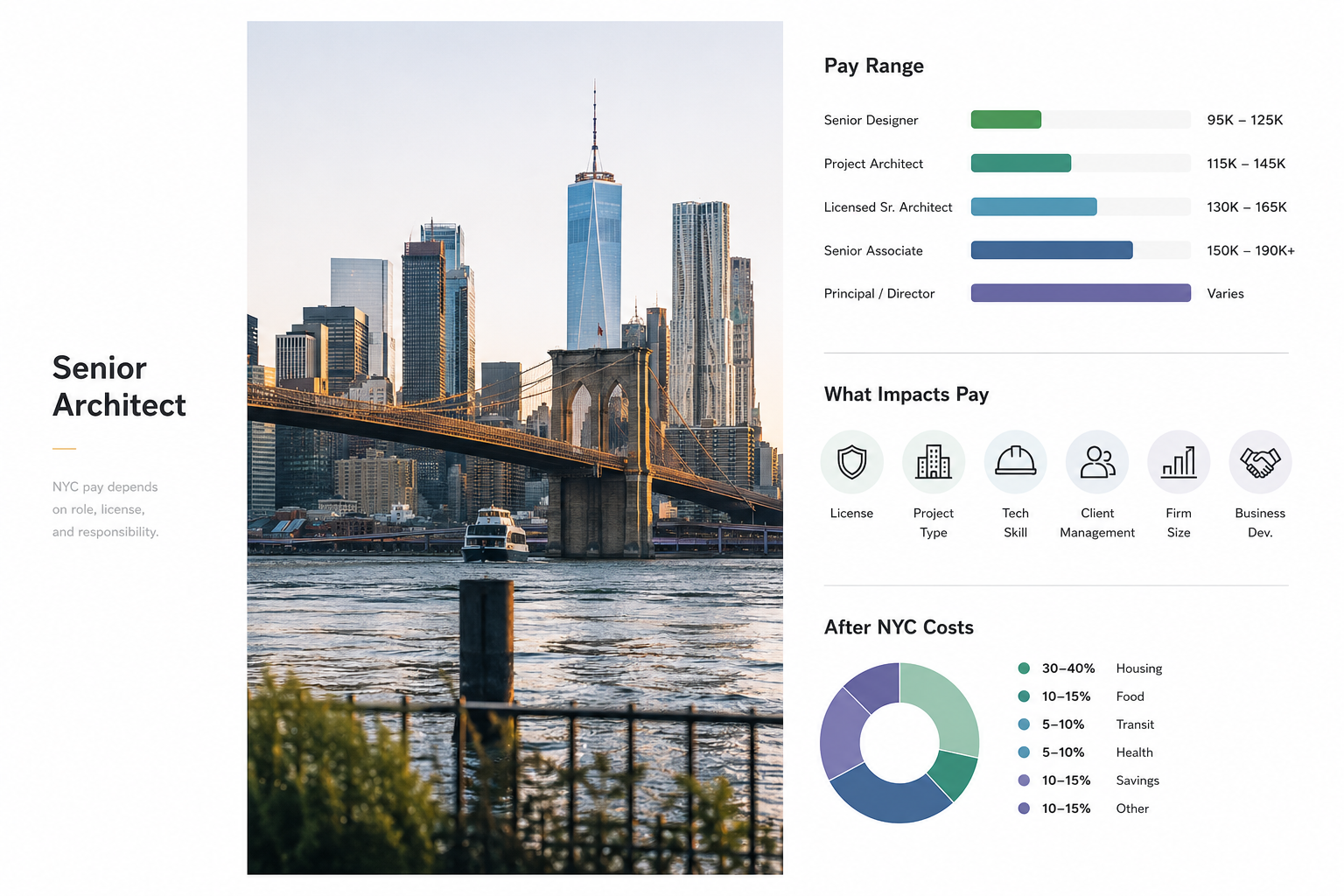
For New York City senior roles, a practical 2026 working range looks like this:
| Role type | Likely NYC salary range | What the title usually means |
|---|---|---|
| Senior designer or unlicensed senior staff | $95,000–$125,000 | Strong design, modeling, documentation, or presentation skill, but not always license-based responsibility. |
| Project architect | $110,000–$145,000 | Coordinates drawings, consultants, code issues, schedules, and technical decisions. |
| Licensed senior architect | $130,000–$170,000 | Licensed, trusted with larger responsibility, client contact, consultant coordination, and construction-phase judgment. |
| Senior architect or associate at a strong firm | $155,000–$200,000+ | Higher responsibility, larger projects, team leadership, client trust, or business development. |
| Principal, director, or owner-level role | Varies widely | Often tied to bonus, profit sharing, ownership, and firm performance rather than base salary alone. |
A $135,000 offer can be fair for one senior architect and weak for another. The title alone does not settle it. Licensure, project type, hours, technical risk, staff responsibility, and bonus history matter.
The salary can be good and still fail the monthly math
This is where many salary articles get soft. A senior architect making $135,000 or $155,000 in New York is not poor. But New York does not care that the title sounds important.
Manhattan asking rents can sit near numbers that would require a very high gross salary just to pass a landlord’s income test. A common rental rule is that annual income should be about 40 times the monthly rent. That means a $4,500 apartment points to about $180,000 in annual income. A $5,000 apartment points to about $200,000.
That does not mean everyone follows the rule perfectly. It does mean a $135,000 senior architect offer can be a strong professional offer and still be a weak Manhattan living offer.
| Annual salary | Gross monthly pay | Estimated monthly take-home before benefits and retirement | Approximate rent supported by 40x rule | Blunt read |
|---|---|---|---|---|
| $115,000 | $9,583 | $6,550–$6,850 | About $2,875 | Not enough for a serious licensed senior role unless hours, benefits, and rent are controlled. |
| $135,000 | $11,250 | $7,500–$7,900 | About $3,375 | Real salary, but not a luxury NYC salary. Debt or high rent can eat it fast. |
| $155,000 | $12,917 | $8,500–$8,900 | About $3,875 | Solid senior money for one person. Still fragile with Manhattan rent and loans. |
| $180,000 | $15,000 | $9,700–$10,200 | About $4,500 | Strong offer. Works well for a single person if lifestyle does not inflate with the raise. |
| $200,000 | $16,667 | $10,800–$11,400 | About $5,000 | Now Manhattan starts to make more sense. Still not unlimited if children or debt are involved. |
These take-home estimates are planning ranges, not tax advice. They assume a single NYC resident using standard deductions, before health insurance premiums, retirement contributions, and personal deductions. The real paycheck may be lower once benefits and 401(k) contributions come out.
What is actually left each month?
This is the table that matters more than the salary headline.
| Living situation | Estimated monthly costs | Left at $135k salary | Left at $155k salary | Left at $180k salary |
|---|---|---|---|---|
| Careful single person, outer borough or modest apartment | About $5,250 | About $2,450 | About $3,450 | About $4,700 |
| Careful single person with $600/month student loan or debt payment | About $5,850 | About $1,850 | About $2,850 | About $4,100 |
| Single person, Manhattan studio or one-bedroom, normal life | About $7,650 | About $100 | About $1,100 | About $2,350 |
| Manhattan apartment plus debt, dining, events, and normal professional costs | About $8,250 | About -$500 | About $500 | About $1,750 |
| Couple or parent household with one young child in paid care | About $12,400 | About -$4,700 | About -$3,700 | About -$2,450 |
| Family of four with larger rent and heavy childcare costs | $15,500+ | About -$7,800 or worse | About -$6,800 or worse | About -$5,550 or worse |
The point is not that a senior architect making $135,000 is broke. The point is that the salary only works if the housing, debt, and family math work.
A single architect living carefully can build savings on $135,000. The same person in a high-rent Manhattan apartment with loans may be one emergency away from credit card debt. A family relying on one architecture salary may not have a budgeting problem at all. It may have a math problem.
Where the money goes
A realistic single-person budget can look like this:
| Expense | Careful version | Expensive version | Why it matters |
|---|---|---|---|
| Rent | $2,800–$3,300 | $4,500–$5,200+ | This is the line that decides whether the salary works. |
| Utilities and internet | $225–$325 | $300–$450 | Older buildings, electric heat, and summer cooling can push this up. |
| Transit | About $152 if you hit the $35 weekly OMNY cap | $300–$600 with rideshares and late nights | The subway is manageable. Taxis and rideshares are where the leak starts. |
| Food | $650–$850 | $1,100–$1,600 | Groceries are one thing. Lunches, coffee, drinks, and delivery are another. |
| Health and out-of-pocket costs | $150–$300 | $400–$800+ | Premiums, dental, prescriptions, therapy, and co-pays vary by employer and household. |
| Student loans or debt | $0–$300 | $600–$1,200+ | This can erase the difference between a good salary and a stressful one. |
| Professional costs | $50–$150 | $250–$500+ | License renewal, continuing education, events, memberships, books, software training, and conferences may not all be reimbursed. |
| Life, clothes, phone, gifts, gym, travel, emergencies | $500–$900 | $1,200–$2,500+ | This is where people lie to themselves. It is not one big expense. It is 30 small ones. |
The danger zone is not obvious poverty. It is the professional who looks successful, rents like a senior professional, works like a senior professional, and still adds debt because every month has one surprise.
Debt turns a good salary into a weak salary
Debt changes everything.
A $155,000 salary with no loans and controlled rent can be strong. The same salary with $900 in student loans, $500 in credit card payments, and a $4,700 apartment is not strong. It is a high-income trap.
The problem is that architecture often delays earning power. Many people spend years in school, internships, exams, licensing, portfolio building, and underpaid early roles before reaching senior pay. By the time the salary improves, there may already be debt waiting for it.
| Monthly debt payment | Annual cash lost | What it really does |
|---|---|---|
| $300 | $3,600 | Annoying, but manageable if rent is controlled. |
| $600 | $7,200 | Big enough to change apartment choice, savings rate, and emergency cushion. |
| $900 | $10,800 | This is no longer background noise. It can wipe out a raise. |
| $1,200+ | $14,400+ | This can make even a strong salary feel strangely tight. |
If a senior architect earns $135,000 and spends like the salary is $180,000, the difference becomes debt. New York will not warn you politely before that happens.
The family version is much harder
For a single person, the big problem is rent. For a family, the big problem is everything arriving at once.
A larger apartment, childcare, health coverage, food, clothes, school needs, transit, emergencies, and savings do not rise one at a time. They stack.
| Family expense | Possible monthly range | Blunt read |
|---|---|---|
| Two-bedroom or larger rental | $5,000–$7,500+ | The neighborhood, commute, school access, and building condition control the number. |
| Childcare for one young child | $1,800–$3,500+ | This is often the budget breaker before public school age. |
| Food for a family | $1,400–$2,500+ | Delivery, school schedules, and tired parents raise the number. |
| Health, dental, prescriptions, and family out-of-pocket costs | $500–$1,400+ | Employer coverage can help, but family coverage can still be expensive. |
| Transit, rides, school logistics, and occasional car costs | $400–$1,000+ | One person can just take the train. A family often cannot move that cleanly. |
| Emergency fund and savings | Variable | Without this, a good income turns into credit card dependence. |
One senior architect salary can support a family in New York only if several things are working in your favor: controlled rent, public school, low debt, employer-paid benefits, a partner’s income, family help, or a move farther from the most expensive neighborhoods.
Without those advantages, the issue is not discipline. It is arithmetic.
Long hours quietly lower the salary
Architecture has a bad habit of discussing annual salaries while ignoring actual hours.
A $155,000 salary sounds different if the week is 40 hours than if the week is 55 hours for months at a time. Unpaid overtime does not reduce your official salary, but it reduces what each hour of your life is worth.
| Annual salary | 40 hours/week | 50 hours/week | 60 hours/week |
|---|---|---|---|
| $135,000 | About $65/hour | About $52/hour | About $43/hour |
| $155,000 | About $75/hour | About $60/hour | About $50/hour |
| $180,000 | About $87/hour | About $69/hour | About $58/hour |
This matters because senior architects are often used as the shock absorber for weak staffing, late consultant work, unclear client decisions, rushed deadlines, and bad fee planning.
If the firm is buying your nights and weekends, the salary needs to say that. Otherwise the offer is not generous. It is just expensive-looking.
What changes the salary most
The number changes fast once you look past the title.
| Factor | Why it affects pay |
|---|---|
| New York license | A licensed architect can carry professional responsibility that an unlicensed designer cannot. |
| Project type | Healthcare, labs, high-rise residential, institutional, airport, and complex commercial work often pay more than small residential work. |
| Construction administration skill | RFIs, submittals, site issues, change orders, and contractor coordination make you more valuable. |
| Code and technical depth | Firms pay for people who prevent failed permits, bad drawings, missed egress logic, accessibility problems, and expensive field conflicts. |
| Client management | Architects who can manage clients without losing scope, schedule, or fee usually earn more. |
| Firm size | Larger firms may have clearer salary bands. Smaller firms may give broader responsibility but not always better pay. |
| Business development | Bringing work into the firm can change compensation more than production skill alone. |
Bad offers disguised as senior titles
A weak offer is not always a low salary. Sometimes it is a normal salary attached to abnormal responsibility.
Be careful when the job expects you to manage projects, train staff, calm clients, coordinate consultants, review technical details, handle construction administration, and rescue deadlines without giving you authority over staffing, fees, schedule, or scope.
That is not leadership. That is liability with a title.
These are warning signs:
- The salary is under $125,000 but the job requires licensed senior responsibility. That is not impossible, but in NYC it needs a very good explanation.
- The firm talks about “wearing many hats” but not compensation. That often means unpaid management, production, mentoring, and client work bundled into one job.
- The bonus is vague. A theoretical bonus is not income. Ask what was actually paid last year.
- The title is senior, but the authority is junior. You cannot be responsible for outcomes if you cannot control the inputs.
- The firm avoids talking about hours. If the real answer were good, they would usually say it clearly.
What to negotiate before accepting the job
Do not negotiate only base salary. Base salary matters, but the expensive problems often hide in workload, benefits, bonus structure, and responsibility.
Ask about the last deadline, not the normal week
Do not ask, “How is work-life balance?” Ask what happened on the last major deadline. How many nights ran late? Did people work the weekend? Was the team staffed properly? Did leadership change the scope late?
That answer is worth more than the recruiting language.
Ask what the title actually controls
If the title is senior architect, does that mean you lead teams? Stamp drawings? Manage clients? Coordinate consultants? Review construction administration? Mentor junior staff? Help win work?
The wider the responsibility, the stronger your salary argument.
Ask about bonus history
A promised bonus means less than a paid bonus. Ask whether bonuses were paid in the last two years, how they were calculated, and whether people in this role actually received them.
Ask about health insurance cost
Two jobs with the same salary can feel different if one has much higher employee premiums, worse dental coverage, weak family coverage, or high deductibles.
Ask about licensure and professional reimbursement
For senior staff, ask directly about New York registration renewal, continuing education, AIA dues, conferences, software training, and professional development reimbursement.
Ask about hybrid rules in writing
One or two remote days can change the value of a longer commute. But vague flexibility is not the same as policy. Get the real rule before you price the offer.
Salary scorecard
| Offer | How to read it |
|---|---|
| Under $115,000 | Too low for a serious licensed senior architect role in NYC unless the workload is unusually light or the benefits are unusually strong. |
| $115,000–$130,000 | Possible for senior designer or project architect roles, but weak if the firm expects full senior responsibility. |
| $130,000–$150,000 | Normal senior range, but rent and debt decide whether it feels good. |
| $150,000–$175,000 | Strong for a single person. Still not automatically enough for a single-income family in NYC. |
| $175,000–$200,000+ | Strong offer. Make sure the hours, liability, and management load do not turn it into a burnout trade. |
When the salary is worth it
A senior architect salary in NYC is worth it when the role gives you more than a number.
It makes sense when the job improves your project record, exposes you to serious building types, gives you client experience, strengthens your technical judgment, and puts recognizable work on your resume.
It also makes sense when the firm has enough structure to prevent constant rescue work. Senior architects often become the safety net for weak staffing, unclear scope, late consultants, rushed drawings, and demanding clients. If the firm always depends on senior staff to absorb chaos, the salary needs to reflect that.
When the salary is not worth it
The salary may not be worth it if the role gives you senior responsibility without senior authority.
That looks like managing deadlines without control over staffing. Answering client questions without control over scope. Fixing drawings without time to review them. Training junior staff while still carrying a full production load. Being called senior, but treated like the emergency patch for every project.
In that situation, a larger paycheck can still be a bad deal.
What senior architects often discover after taking the job
The offer letter does not show the whole job.
Many senior architects discover the real role only after the first deadline. That is when they learn whether the firm has good standards, whether project managers protect the team, whether principals make decisions on time, and whether the office respects technical work.
The hidden cost is not only stress. It is career damage. If a senior architect spends two years rescuing disorganized projects, they may earn money but lose portfolio clarity, professional confidence, and time for better opportunities.
The best NYC role is not always the highest salary. It is the role where pay, responsibility, learning, reputation, and life outside work still make sense together.
FAQ
What is a good senior architect salary in NYC?
A good senior architect salary in NYC is usually around $130,000–$170,000 for a licensed architect with real project responsibility. Higher salaries are possible at large firms, technical firms, associate-level roles, or positions involving client leadership and business development.
Is $120,000 enough for a senior architect in New York?
It can be enough for some roles, but it is low if the job expects licensed senior responsibility, heavy consultant coordination, construction administration, and client management. It may be more reasonable for an unlicensed senior designer, a smaller firm, or a role with controlled hours and strong benefits.
Can a senior architect afford to live alone in NYC?
Yes, but the rent decision controls everything. A senior architect earning around $140,000–$160,000 can often live alone if they avoid the most expensive apartments, keep debt under control, and save intentionally. Manhattan rent plus student loans can make the same salary feel thin.
Can one senior architect salary support a family in NYC?
Sometimes, but it is difficult without advantages such as dual income, controlled rent, public school, subsidized childcare, family support, low debt, or strong employer-paid benefits. Childcare and larger-apartment rent are usually the biggest pressure points.
Do licensed architects make more than unlicensed senior designers?
Often, yes. Licensure can raise pay because it allows a person to take on legal and professional responsibility. But some unlicensed senior designers with strong portfolios, client value, or specialized design skill can still earn high salaries.
Should I accept a lower salary for a famous NYC architecture firm?
Only if the trade is clear. A famous firm may help your resume, portfolio, and network, but prestige does not pay rent by itself. If the salary is low and the hours are high, set a time limit and make sure the experience is genuinely useful.
What matters more: salary or bonus?
Base salary matters more because it is predictable. Bonus can be valuable, but only if the firm has a real history of paying it. Ask how bonuses were handled in the last two years and what controls eligibility.
Read next
If you are comparing early-career pay against senior pay, start with architect starting salary in NYC.
For a broader location comparison, read architect salary in New York.
If licensure is part of your next move, use how to become a licensed architect to understand the professional path behind the salary.
References
Sources used for this article
- U.S. Bureau of Labor Statistics: Architects, Occupational Outlook Handbook
- U.S. Bureau of Labor Statistics: May 2025 Metropolitan and Nonmetropolitan Area Occupational Employment and Wage Estimates
- U.S. Bureau of Labor Statistics: Occupational Employment and Wage Statistics Tables
- Bespoke Careers: Architecture Salaries in New York, 2026
- StreetEasy: How Much Rent Can You Afford in NYC?
- StreetEasy: Manhattan Rental Inventory Falls for 24th Consecutive Month
- The Corcoran Group: April 2026 Manhattan and Brooklyn Rental Market Report
- Metropolitan Transportation Authority: Subway and Bus Fares
- OMNY: Fares
- New York State Education Department, Office of the Professions: Architecture Continuing Education
- Internal Revenue Service: Tax Inflation Adjustments for Tax Year 2026
- Social Security Administration: 2026 Cost-of-Living Adjustment Fact Sheet
- New York City Comptroller: Spotlight on NYC Child Care Affordability Crisis
- Columbia University Mailman School of Public Health: Supporting New York Families with Universal Child Care