

An entry-level architect in New York City earns between $56,000 and $75,000. That range comes from Salary.com's Architect I classification for New York (average $72,437, 10th percentile $56,485) and aligns with Indeed's reported average of $64,449 for entry-level architect positions in the city. The national median for all architects is $96,690 (BLS, May 2024), but that figure includes mid-career and senior professionals — it has nothing to do with what someone earns in their first or second year.
The salary number is not the problem. The problem is what that number means once you subtract taxes, rent, transit, student loans, and food in a city where the median one-bedroom apartment rent hit $5,131 in Manhattan and $3,679 in Queens as of early 2026. This page runs the real math.
What Entry-Level Pays
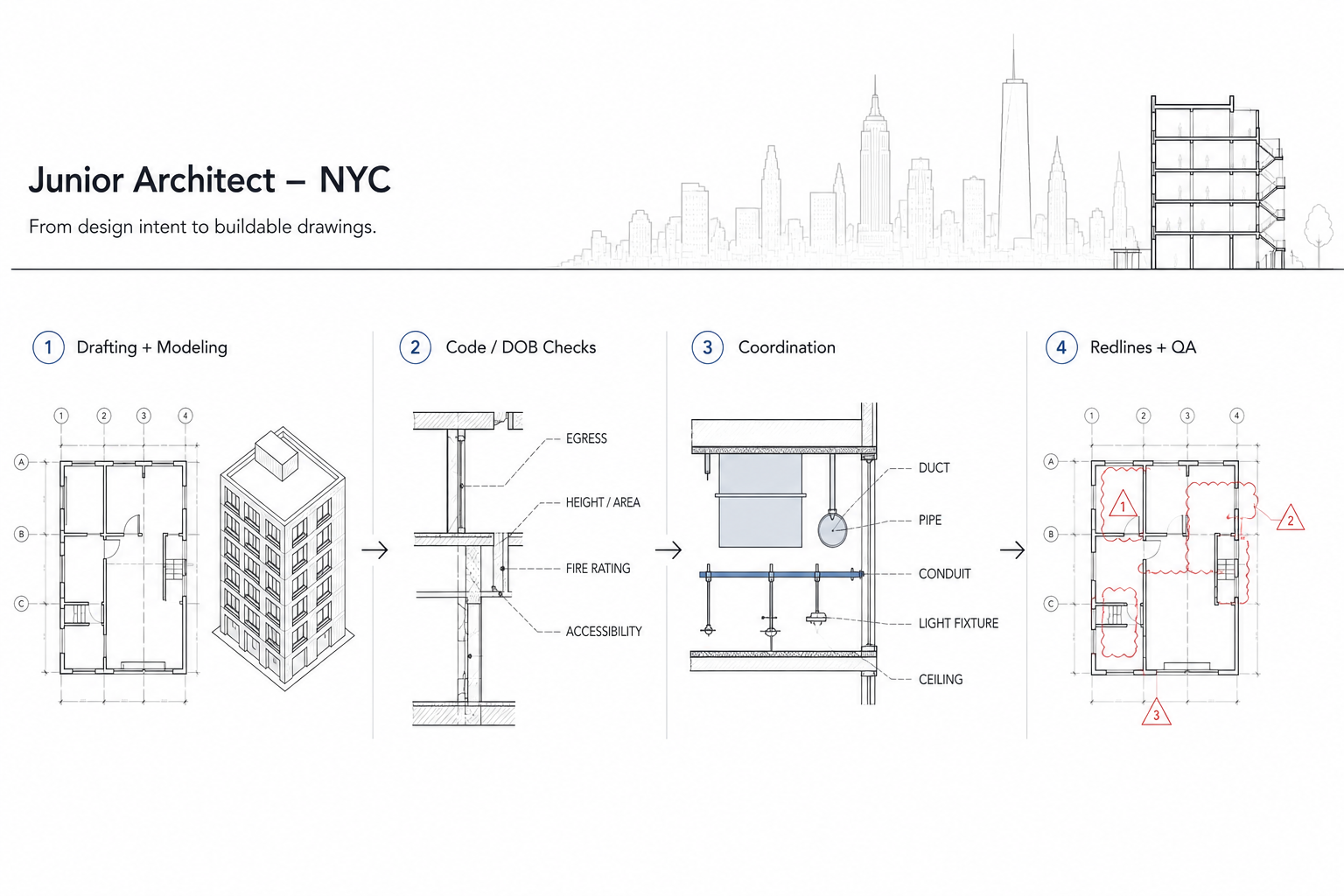
Illustration by ArchitectureCourses.org. A junior architect in NYC often moves from drafting and modeling to code checks, coordination, and redline cleanup before drawings are ready for review or filing.
Salary ranges you see on job aggregator sites vary wildly. ZipRecruiter reports an average of $140,000 for "entry-level architects" in New York — but that number mixes software architects, cloud architects, and systems architects with building architects. If you are designing buildings, not databases, ignore it.
Realistic ranges for someone with a B.Arch or M.Arch, zero to two years of post-graduation experience, working at a New York City architecture firm:
| Role | Salary Range (NYC, 2026) | Notes |
|---|---|---|
| Junior architect / Designer I | $58,000–$72,000 | Most common entry-level title at mid-size and large firms |
| Architectural drafter | $48,000–$62,000 | CAD/Revit production; lower ceiling without licensure path |
| Interior designer (architecture firm) | $52,000–$65,000 | Higher at firms with high-end residential or hospitality work |
| Landscape architect (entry-level) | $55,000–$70,000 | BLS national median for landscape architects: $79,660 |
| Urban planner (architecture-adjacent) | $58,000–$75,000 | Public sector positions sometimes higher with benefits factored in |
Sources: Salary.com Architect I data for New York, NY (April 2026); Indeed entry-level architect salary data (September 2025); BLS Occupational Employment and Wage Statistics (May 2024). The BLS bottom 10th percentile nationally for architects is $60,510 — NYC entry-level salaries cluster near or below this because the national figure includes all experience levels.
Your Actual Hourly Rate
Architecture has one of the stronger overtime cultures in the professional services world. A $65,000 salary sounds like $31.25 an hour at 40 hours a week. Most entry-level architects do not work 40-hour weeks. Fifty is common. Fifty-five is not unusual near deadlines.
| Salary | At 40 hrs/week | At 50 hrs/week | At 55 hrs/week |
|---|---|---|---|
| $58,000 | $27.88/hr | $22.31/hr | $20.28/hr |
| $65,000 | $31.25/hr | $25.00/hr | $22.73/hr |
| $72,000 | $34.62/hr | $27.69/hr | $25.17/hr |
At $65,000 working 50-hour weeks, the effective hourly rate is $25. That is lower than what many NYC bartenders, electricians, and plumbers earn per hour. This is not an argument against the profession — it is a fact that should be visible when evaluating a job offer. If a firm's culture involves regular 55-hour weeks, factor that into the comparison. The salary is the same. The hourly rate is not.
Most architecture firms do not pay overtime to salaried employees. Some offer comp time. Many offer nothing beyond the expectation that you will be there when the deadline requires it. Ask about this in interviews. The answer tells you more about the firm than the salary number does.
The Education-to-Salary Gap

Image by ArchitectureCourses.org. Early architecture work often mixes drawings, spreadsheets, office tasks, and the practical cost of building a career in New York.
Architecture requires five years for a B.Arch or six to seven years for a four-year degree plus an M.Arch. After graduation, you complete AXP hours (typically two to three years) before sitting for the ARE. Licensure takes most people over a decade from the start of their education — the median time from degree to licensure is 13.3 years according to NCARB data.
Compare the starting salary to professions with similar education investment:
| Profession | Education Required | NYC Entry-Level Salary | National Median (BLS May 2024) |
|---|---|---|---|
| Architect | 5-year B.Arch or 4+2 M.Arch | $58,000–$72,000 | $96,690 |
| Civil engineer | 4-year BS | $68,000–$80,000 | $95,890 |
| Mechanical engineer | 4-year BS | $72,000–$85,000 | $100,820 |
| Nurse practitioner | BSN + MSN (6+ years) | $105,000–$125,000 | $126,260 |
| Software developer | 4-year BS | $90,000–$130,000 | $130,160 |
Architecture has the longest education path and the lowest entry-level pay of any profession on this list. The gap narrows at senior and principal levels, but it is substantial at the beginning. A civil engineer with one less year of schooling starts $10,000–$15,000 higher. A software developer with no graduate degree starts $30,000–$60,000 higher. Anyone entering architecture should know this going in — not to be discouraged, but to plan accordingly. More on this: Why Become an Architect.
Cost of Living: The Actual Monthly Math
NYC rent data below is from RentCafe and Rent.com market analyses, updated through early 2026. Transit costs reflect the January 2026 OMNY fare structure ($3 per ride, 7-day cap at $35, which means roughly $140/month for daily commuters). The MetroCard was phased out at the end of 2025.
Scenario 1: $60,000 Salary, Shared Apartment in Ridgewood or Bushwick
This is the most common setup for a first-year architect in NYC. You share a two-bedroom with a roommate in one of the more affordable neighborhoods with decent subway access.
| Category | Monthly Cost |
|---|---|
| Gross salary | $5,000 |
| Federal + state + city tax (~30%) | -$1,500 |
| Net take-home | $3,500 |
| Rent (share of 2BR in Ridgewood/Bushwick) | -$1,200 to -$1,400 |
| Transit (OMNY 7-day cap) | -$140 |
| Groceries | -$450 |
| Phone | -$50 |
| Health insurance (employer-subsidized remainder) | -$100 to -$250 |
| Miscellaneous (laundry, household, personal) | -$200 |
| Remaining | $1,010 to $1,360 |
That remaining amount covers everything else — eating out, clothes, gym, subscriptions, emergencies, and student loan payments if you have them. If you carry $40,000 in student debt at a standard repayment plan, that is roughly $400–$500 a month, which cuts the discretionary balance to $500–$960. That is enough to live on — not enough to save meaningfully or absorb a bad month without stress. This is the reality most first-year architects in NYC live with.
Scenario 2: $68,000 Salary, Studio in Astoria or Bay Ridge
A studio in these neighborhoods runs $1,800–$2,300 depending on the building and block. You are living alone, which costs more but gives you space to work at home — something that matters when you are studying for the ARE or doing freelance work on the side.
| Category | Monthly Cost |
|---|---|
| Gross salary | $5,667 |
| Federal + state + city tax (~30%) | -$1,700 |
| Net take-home | $3,967 |
| Rent (studio, Astoria/Bay Ridge) | -$2,000 |
| Transit | -$140 |
| Groceries | -$500 |
| Phone | -$50 |
| Health insurance | -$150 |
| Miscellaneous | -$250 |
| Remaining | $877 |
More breathing room, but not much. One unexpected dental bill, one ARE exam fee ($235 per division), one month where you need new work clothes — and the cushion is gone. This is comfortable enough to sustain, but not comfortable enough to save meaningfully unless you are disciplined about it.
Scenario 3: $72,000 Salary with $45,000 in Student Loans
This is the M.Arch graduate with debt. The salary is at the higher end of entry-level for NYC, but the loan payment changes the calculation substantially.
| Category | Monthly Cost |
|---|---|
| Gross salary | $6,000 |
| Federal + state + city tax (~30%) | -$1,800 |
| Net take-home | $4,200 |
| Rent (share of 2BR in Washington Heights) | -$1,350 |
| Student loan payment | -$475 |
| Transit | -$140 |
| Groceries | -$500 |
| Phone | -$50 |
| Health insurance | -$150 |
| Miscellaneous | -$250 |
| Remaining | $1,285 |
The higher salary helps, but the loan payment eats most of the gain. This person earns $12,000 more per year than Scenario 1 — and ends up with a similar amount of discretionary money because $5,700 of that goes to loan payments. That is the math that makes people leave the profession in the first three years. It does not mean the profession is not worth it. It means the financial plan has to account for this.
What Moves Your Salary in Years 1–5
Entry-level salaries in NYC architecture firms do not move quickly. Annual raises of 2–4% are typical. That means a $65,000 starting salary becomes roughly $70,000 by year three if you stay at the same firm. The jumps happen when you change firms, get licensed, or develop a specialization the market values. Here is what actually matters:
Licensure. Passing the ARE and becoming a licensed architect adds 15–20% to your salary at most firms. It also changes what you can do — you can stamp drawings, carry professional liability, and lead projects rather than support them. Every year you delay licensure is a year at the unlicensed rate. Start your AXP hours during school if your program allows it. More: How to Become a Licensed Architect.
Revit proficiency beyond the basics. Every firm expects Revit. Not every junior architect is genuinely fast and accurate in it. Being the person who does not slow down production — who can build a clean model, manage families, and produce a coordinated set without someone checking behind them — is worth more than a second software skill. Rhino and Grasshopper matter in design-focused firms, but Revit fluency is the universal salary lever.
Changing firms at year two or three. The biggest single salary increase most architects get in their first five years comes from switching firms. Internal raises are modest. The market rate for someone with two to three years of experience and a portfolio of built work is higher than what most firms pay to retain the person they hired at the entry-level rate. This is not cynicism — it is how the market works in NYC.
Specialization that is in demand. Healthcare, data centers, high-end residential, and code/accessibility consulting all pay more than general practice. If you develop expertise in one of these during your first few years, the salary ceiling rises faster.
Business development skills. Junior architects who can interact with clients, present work clearly, and contribute to proposals are more valuable than those who can only produce. This shows up in salary faster than most people expect.
What the Salary Guides Do Not Cover
A few things that are worth knowing and rarely appear in salary articles:
NYC income tax is three taxes, not one. Federal, New York State, and New York City income tax. At $65,000, the combined effective rate is roughly 28–32% depending on deductions. Most online salary calculators default to federal only or federal plus state. The city tax adds 3–3.8% on top, which at $65,000 is another $2,000–$2,500 per year. Factor it in before comparing NYC salaries to offers in other cities.
The 30% rent rule does not work in NYC. The standard financial advice is to spend no more than 30% of gross income on rent. At $65,000, that means $1,625 per month. There are almost no solo apartments in any NYC borough at that price. You will either spend more than 30% on rent, share an apartment, or live far enough from Manhattan that the commute adds another cost in time. Most entry-level architects in NYC spend 35–45% of take-home pay on housing. That is normal for this city at this salary. It is not comfortable, but it is how it works.
Benefits vary enormously between firms. A firm that pays $62,000 with full health coverage, 401k match, and ARE exam reimbursement is often a better financial outcome than one that pays $68,000 with no benefits beyond basic insurance. Ask about health insurance contribution, retirement match, professional development budget, ARE prep reimbursement, and licensure bonus. These can be worth $5,000–$10,000 in effective compensation.
Side income is common. Many junior architects in NYC do freelance rendering, Revit drafting, or small residential projects on the side. Some teach. Some work retail on weekends. The profession's pay-to-cost-of-living ratio in NYC makes supplemental income nearly necessary for many people in their first two to three years, especially those with student debt. This is not a personal failure — it is a structural feature of the profession's economics in an expensive city.
Borough Rent Reality for Architects
Rent data from RentCafe and Rent.com, updated through April 2026. These are averages across buildings with 50+ units; individual listings vary.
| Location | Studio | 1-Bedroom | Realistic for $60K–$72K salary? |
|---|---|---|---|
| Manhattan (average) | $4,068 | $5,131 | No, unless sharing a 2BR+ |
| Brooklyn (average) | $3,775 | $4,504 | Only in budget neighborhoods or shared |
| Queens (average) | $3,207 | $3,679 | Tight solo; comfortable shared |
| Bushwick | — | ~$1,525 | Yes — one of the few neighborhoods that works solo at this salary |
| NE Queens | — | ~$2,250 | Possible solo, long commute |
| Ridgewood | — | ~$2,399 | Possible solo, good subway access |
| Bay Ridge / Washington Heights | — | ~$2,500 | Possible solo with tight budget |
The math is straightforward: if your take-home is $3,500/month and you want to live alone, you need rent under $1,400 to keep housing at 40% of take-home, or under $1,750 to stretch to 50%. That limits you to shared apartments in most of the city or solo apartments in a handful of neighborhoods. Manhattan is off the table for solo living at an entry-level architecture salary. Brooklyn and Queens work if you choose the right neighborhood.
FAQ
What is the starting salary for an architect in NYC?
$58,000–$72,000 for entry-level positions at architecture firms. Salary.com reports an average of $72,437 for Architect I roles in New York. Indeed reports $64,449. The variation depends on firm size, role, and whether you have internship experience.
Can you live in NYC on an entry-level architect salary?
Yes, with roommates and careful budgeting. Solo living is possible in Bushwick, Ridgewood, parts of Queens, or Washington Heights. Manhattan solo living is not realistic at this salary. Most first-year architects in NYC share apartments.
Does a Master's degree increase starting salary?
Modestly — $3,000 to $8,000 more than a B.Arch at most firms. The M.Arch matters more for licensure eligibility (if your undergraduate degree is not a B.Arch) than for immediate salary impact.
How does NYC compare to other cities?
NYC entry-level salaries are $5,000–$15,000 higher than cities like Atlanta, Chicago, or Denver. But the cost-of-living difference — particularly rent and city income tax — more than absorbs the gap. An architect earning $55,000 in Austin often has more disposable income than one earning $68,000 in NYC.
When does the salary get better?
Licensure is the first significant jump — typically 15–20%. After that, reaching project architect or project manager level (years 5–8) brings salaries into the $90,000–$120,000 range. Senior architects and principals in NYC can earn $130,000–$200,000+, but that is 10–15 years into the career. See: Careers in Architecture.
Should I negotiate my first offer?
Yes. Most firms expect it. A $3,000–$5,000 increase on the initial offer is common and costs the firm very little relative to their billing rates. Ask about benefits too — ARE reimbursement, licensure bonus, and 401k match are often negotiable even when salary is not.
Read Next
Architect Salary in the United States — covers how salary changes by state, firm size, licensure status, and specialization across the country. The full picture beyond NYC.
How to Become a Licensed Architect — licensure is the most reliable salary lever in the profession. This page covers the ARE, AXP, and the real timeline.
Careers in Architecture — 30 roles with salary data, from intern through equity partner. Useful for understanding where the entry-level salary sits in the full career arc.
Why Become an Architect — an honest case for and against the profession, including the education-to-salary gap and what the first five years actually look like.
Architect Salary in New York — broader salary data for all experience levels in New York, not just entry-level.
Salary data on this page uses the BLS Occupational Employment and Wage Statistics program (May 2024), Salary.com Architect I data for New York, NY (April 2026), Indeed salary reports (September 2025), and RentCafe/Rent.com rental market data (April 2026). Where sources conflict, the more conservative estimate is used. The BLS figures exclude self-employed architects.
Official resources: Bureau of Labor Statistics — Architects · American Institute of Architects · NYC Rent Guidelines Board · MTA Fares and Tolls