

Ocean and Naval Architectural Engineering Salary: The Real Story
Some career sites dress it up with neat averages and glossy charts. I’ll give you what I’ve seen, what real engineers report, and how the numbers actually play out once you’re in the field.
How Much Do Ocean and Naval Architects Actually Make
Why You Need to Read This Before You Choose a Career in Ocean or Naval Engineering
The Problem With Salary Tables
Ever scroll through salary charts and see numbers that look great? Six figures on paper, no big deal. But then you hear from people in the field who still feel broke or burned out.
I know engineers who graduated, landed shipyard or offshore jobs, loved the first paycheck, and called back six months later with regret. They felt trapped, tired, or realized the money did not stretch far enough. That is not random. It is how the industry works.
Salary Is Only Part of the Story
If you are aiming at naval architecture, marine engineering, coastal or ocean design, or offshore work, you need to know this. Your paycheck is only one part of the package.
Where you live matters. Who you work for matters. How often you are away from home matters. Burnout and stress levels can cut deeper than the paycheck itself.
What This Guide Covers
This piece is not a generic average that makes you nod and move on. It comes from real offers, interviews, and the stories of engineers who have been at it for years.
I will show you starting ranges, senior peaks, and what actually drives pay upward. You will see which roles burn you out, which skills employers really value, and how location changes everything.
The Goal
This is a field guide to naval and ocean engineering salaries. It is about what you will actually make, what it costs you to earn it, and whether that trade-off is worth it.
What You Really Start At

Starting Salaries and Median Ranges
Most entry-level naval architects and marine engineers begin their careers in the $70,000 to $85,000 range. That covers yard-level work, Navy-contractor roles, and government junior positions. By three to five years, total compensation typically reaches the low six figures—especially in active shipbuilding hubs or coastal markets.
The median salary for naval architects in the U.S. is around $105,000. The top professionals—those leading major acquisition programs, design offices, or cleared jobs—often range between $140,000 and $160,000. Offshore engineering roles, where travel is involved, can exceed this—but come at a steep personal cost.
What Actually Moves Pay
Employer Type
Working for federal agencies or Navy acquisition programs generally pays better, especially once you hit GS-12/13 levels. Shipyards, private consulting firms, and class societies sit in the same general range but vary under the hood.
Location Counts
Proximity to high-demand coastal clusters matters. DC area, Norfolk, Gulf Coast, and Southern California pay more—but housing in those places can shave off a significant portion of your take-home pay.
Clearance and Niche Skills
If you have a security clearance, ORCAFlex certification, or expertise in FEA or hydrostatics packages (NAPA, GHS, FAST), that translates into real dollars in your offer letter.
Years of Experience
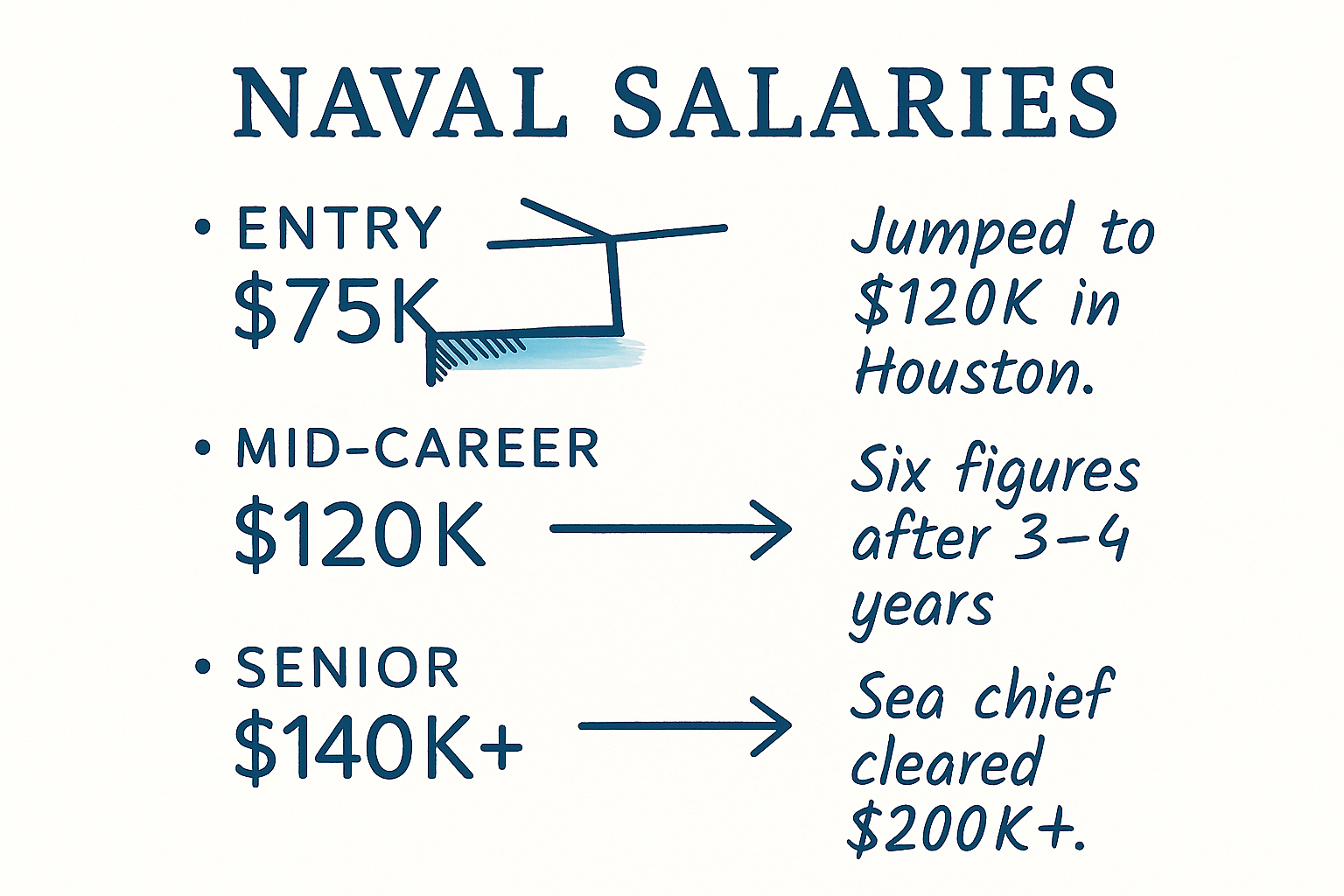
Forum consensus aligns with field data: you’ll typically start around $75–85k, hit six figures mid-career, and cross $140k+ in senior roles. That path is the typical pay ladder in marine design disciplines.
See also: Online Naval Architecture Degree: What to Know
Tradeoffs That Don’t Show on Charts
Here is what you don’t see on a salary chart:
Offshore Work
Many positions pay more, but expect 12-hour shifts, remote rotations, limited connectivity, and mental fatigue. That day rate doesn’t account for missed birthdays or a frayed home life.
Design or Office-Based Careers
Lower in terms of peak income than sea-based roles, but much more stable. Raises move slower and depend on funding cycles. A cross-continental project cancelation can stall raises indefinitely.
Cost of Living
In cities like DC or Boston, a six-figure salary doesn’t stretch as far. Meanwhile, smaller port towns often pay less but offer better spending power.
You might like: Architect Salary in United States: A State-by-State Breakdown
How People Actually Break In
-
Internships and co-ops: Whether it’s the big yards (HII, Electric Boat) or ABS/DNV labs, real hands-on port experience is often a first filter.
-
Professional networks (SNAME, student clubs): They still win jobs. It’s common to get your first full-time offer through a connection.
-
Software fluency wins interviews: Bring a live model in NAPA or OrcaFlex, and you’ll rise above degree-level resumes.
Salary Snapshots From the Field
-
Entry roles often report between $75k and $85k.
-
Mid-career talks range from $100k to $130k in total comp.
-
Senior design engineers across active markets report $140k to $160k.
-
Chief engineers serving at sea can push beyond $200k but sacrifice stability.
Forum posts and peer-reviewed job data confirm these ranges. Many also note that hours, stress, and job security matter more than raw numbers once you’re in the door.
Quick Advice From the Field
If you want highest base
Go federal design/investment roles in DC or Norfolk. With clearance, mid-career jobs tend to land at six figures, and the benefits are consistent.
If you want fast cash
Offshore contracts pay big early. But you tend to burn out or burn through pay quickly, especially once non-taxed bonuses slow down.
If you want balance
Mid-sized coastal consultancy work pays well once you go licensed, but it's cycle-dependent. You bank high in good years and sit on bench time in slow years.
Behind the Paychecks
Official Numbers
The U.S. Bureau of Labor Statistics (BLS) puts the median salary for marine engineers and naval architects around $105,670 as of May 2025. The low 10 percent earn under $79,700. The top 10 percent clear $167,660. Federal jobs average about $121,760. Deep-sea transport roles push higher at roughly $139,830. Growth is projected at 6 percent through 2034, with about 600 openings each year.
Market Data
Job boards paint a similar but wider picture.
-
Indeed lists naval architects at about $110,000 a year, with a spread from the low 70s to around 170K.
-
DataUSA puts the average closer to $111,000. Highest pay states: Maryland and California, both above $130,000.
-
Glassdoor shows coastal engineers averaging $129,000, with high earners hitting above $200,000.
-
ZipRecruiter lands around $107,000, but notes some markets—Nome, Alaska and Cupertino, California—hitting $130K+.
-
PayScale usually comes in lower, showing early-career averages closer to $73,000.
Starting Out
CollegeRaptor tracks new grads in naval architecture and marine engineering starting at about $64,700. MyFuture and Career Discovery confirm the BLS ranges: entry at about $75K, mid-career at $100K, and senior jobs pushing $160K+.
Field Concerns
Pay pressure is real. A 2025 case, Scharpf v. General Dynamics, accused major shipbuilders of coordinating hiring in ways that kept naval architect salaries pinned near $100K. The case was dismissed, but the complaint highlighted what many in the field already say: raises come slow, and mobility is limited without a security clearance, offshore experience, or specialized skills.
Quick Salary Snapshot
| Source / Role | Typical Salary Range | Notes |
|---|---|---|
| BLS – Marine Engineers & Naval Architects | $79K–$167K | Median around $105K |
| Indeed – Naval Architect | $71K–$170K | Avg ~ $110K |
| Glassdoor – Coastal Engineer | $100K–$168K | High earners $200K+ |
| ZipRecruiter – Coastal Engineer | $107K avg | Some markets $130K+ |
| PayScale – Early Career | $55K–$112K | Avg ~ $73K |
| CollegeRaptor – New Grads | ~$65K starting | |
| Forums / Field Reports | ~$85K early career | Often cited by working engineers |
Why this matters: Most salaries cluster in the $100K–$130K range, with ceilings near $160K unless you move into management, defense, or offshore roles. Real jumps depend on skills, clearances, and location, not just the degree.
Takeaway
On paper, the numbers look strong. In practice, ceilings appear fast. Most naval architects top out in the $130K–$160K range unless they move into management, defense contracts, or offshore projects. Forums and engineers I’ve spoken with echo the same point—degrees open the door, but real jumps in pay come from niche skills, timing, and willingness to move.
FAQ
-
Is $85k enough early in your career? Yes, but your lifestyle path matters. In some cities, $85k remains average; in others, you feel tight.
-
Can you move from offshore to office roles? Yes—and many do it to slow down. Office roles cap lower but reward stability and mental rest.
-
Does engineering salary widen with experience? Very much. You can double your starting pay by year 10 if you specialize and move into senior roles.
-
Do weekends matter? Not so much in office-based jobs. Offshore jobs warp your calendar entirely.
-
When do people regret their choices? Most often, early—six months to two years in—when the lifestyle doesn’t match the paycheck.
Final Take
Naval architecture and coastal science are solid career paths. With the right mix of location, skill, and experience, you land comfortable salaries. But the cost isn’t always financial. Offshore work can strain your personal life. High-cost cities eat your raises. Job cycles stall long-term growth. If you know that going in, you can optimize your path. If not, you’ll wake up wondering why a six-figure job doesn’t feel like one.
References
-
U.S. Bureau of Labor Statistics – Marine Engineers and Naval Architects:
https://www.bls.gov/ooh/architecture-and-engineering/marine-engineers-and-naval-architects.htm -
BLS Occupational Employment Data (detailed percentiles and industries):
https://www.bls.gov/oes/2023/may/oes172121.htm -
DataUSA profile – Marine Engineers and Naval Architects:
https://datausa.io/profile/soc/marine-engineers-naval-architects -
Indeed – Naval Architect salary data:
https://www.indeed.com/career/naval-architect/salaries -
Glassdoor – Coastal Engineer salaries:
https://www.glassdoor.com/Salaries/coastal-engineer-salary-SRCH_KO0,16.htm -
ZipRecruiter – Coastal Engineer salaries:
https://www.ziprecruiter.com/Salaries/Coastal-Engineer-Salary -
Payscale – Coastal Engineer salary:
https://www.payscale.com/research/US/Job%3DCoastal_Engineer/Salary -
ZipRecruiter – Naval Architect salary by state:
https://www.ziprecruiter.com/Salaries/What-Is-the-Average-Naval-Architect-Salary-by-State -
CollegeRaptor – Naval Architecture & Marine Engineering careers (starting salary):
https://www.collegeraptor.com/careers/Marine-Engineers-and-Naval-Architects--17212100/Bachelors-Degree -
MyFuture – Marine Engineers and Naval Architects:
https://myfuture.com/occupations-industries/occupations/marine-engineers-and-naval-architects -
Reddit – Coastal Engineering salary thread (real people):
https://www.reddit.com/r/civilengineering/comments/1jqoi1m/im_28_with_a_masters_in_coastal_engineering -
Reuters – Shipbuilders lawsuit over engineer pay:
https://www.reuters.com/legal/litigation/general-dynamics-other-shipbuilders-defeat-lawsuit-over-engineer-pay-2025-04-22