
Why Drywall Depends on the Frame Below It
Drywall is not structure. It is skin. But the way it performs depends entirely on what it is fastened to. If the studs wander out of plane, the wall waves. If the foundation shifts, cracks open at seams. Every call I’ve had for “bad drywall” started with framing or base movement. The finish only revealed what was already wrong.
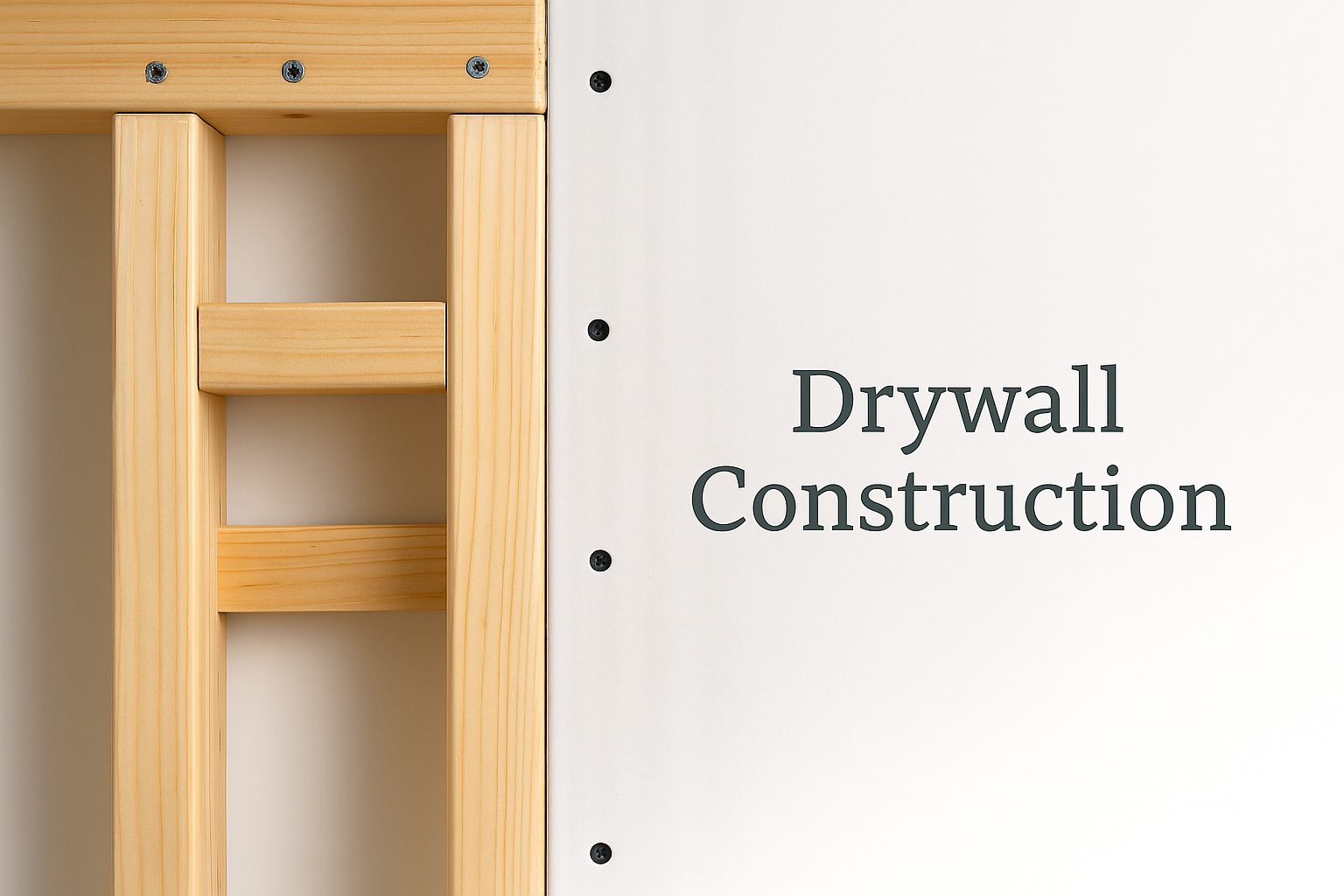
Framing sets the rules for fastener spacing, seam placement, and ceiling spans. A wall framed at 16 inches on center will carry 1/2 inch board cleanly. Stretch that to 24 inches and you need 5/8 inch or sag-resistant drywall. Joist depth, spacing, and moisture content all play into whether ceilings stay flat over time.
The foundation sets another condition: movement. If a slab curls or settles, studs move with it. Drywall joints are the first place this shows up. That’s why foundation control joints and framing anchors matter more than another coat of joint compound. Drywall highlights failure but rarely causes it.
Mistakes I See Repeated
● Ignoring stud alignment. Framers race, hangers cover it, and the taper fights shadows forever. A bowed stud left unchecked means endless rework.
● Skipping backing at seams. Butt joints without backing sag inward. No amount of mud hides that hollow.
● Forgetting moisture. Basements framed against raw concrete without a break soak humidity into gypsum. Within a year, paper facing is food for mold.
● Treating ceilings like walls. A 24-inch spaced ceiling with 1/2 inch drywall sags even when taped perfectly.
These are not cosmetic errors. They come from not linking drywall choices to the skeleton and foundation.
What It Took on Real Jobs
Getting this right has costs. Straightening studs before hanging might burn a day, but it saves weeks of callbacks. On a school project, we budgeted $3,500 for stud shimming and planing after framing inspection. That money paid off tenfold in cleaner finishes and fewer punch-list complaints.
In a basement remodel, we spent $800 on furring and a vapor-permeable barrier over block walls before hanging drywall. The client never saw the difference, but two years later there was no mold. Compare that to another job where drywall went straight on damp block. That one came back as a $15,000 gut and redo.
Drywall is cheap. The system under it is not. Time spent on framing and foundation prep is the most cost-effective insurance you can buy for interior finishes.
Pro Tips That Keep Drywall Honest
● Order 54-inch sheets for 9-foot walls. Framers love 9-foot studs, but 48-inch sheets leave a joint at eye level that always flashes under light. A 54-inch sheet run horizontally kills that seam.
● Check moisture before you cover. I carry a cheap moisture meter. If studs are over 19% or basement block is damp, drywall waits. Paper facing is unforgiving once sealed in.
● Plan penetrations with framing. Every missed box cut or pipe offset slows hanging and leaves fragile patches. Coordinate MEP with drywall layout early, not on the fly.
● Backer where you need it. Hallways, bathrooms, and kitchens get accessories. Blocking for grab bars, cabinets, and towel rods stops the drywall from becoming the load path.
How to Apply This on Your Next Job
Do a framing walk before a single sheet is delivered. Look for bowed studs, missing blocking, long ceiling spans, and damp foundations. Fix them while the studs are still open. That half-day walk sets the quality of the entire finish.
In garages or basements, check code. Many jurisdictions want 5/8-inch Type X on garage walls or ceilings under living space. In basements, a moisture break between concrete and drywall is non-negotiable. A furring channel or insulated stud wall with vapor control buys years of service.
On ceilings, run boards perpendicular to joists and stagger butt joints. Always think about light. Side lighting will find every dip. That means seams should land where light misses, not across the main window wall.
Common Failures and How We Fixed Them
Ceiling sag. A developer insisted on 1/2 inch drywall over 24-inch spaced trusses. Within a year the ceiling waved. We stripped it, added strapping at 16 inches, rehung with 5/8 inch Type X. No more sag. The fix cost double what the right choice would have.
Basement mold. A homeowner finished against bare block. Within 18 months the drywall blackened. We tore it out, added a dimpled drainage mat, framed a new wall with treated bottom plates and mineral wool, then re-hung with mold-resistant board. A $2,500 fix that would have been $600 upfront.
Cracking over door headers. Repeated hairlines above door corners were not a mud problem. The header framing was undersized and moving seasonally. We doubled studs, anchored them properly, and the cracks stopped. Sometimes the solution is carpentry, not compound.
Special Cases Where Drywall Rules Change
Fire-rated walls.
Type X or double-layer drywall is code in garages, corridors, and between units. Don’t guess. UL designs like U305 spell out layers, fasteners, and joint treatment. Miss one screw pattern and the inspector fails you.
Soundproofing.
A single board on studs won’t stop noise. If sound is a client issue, budget for resilient channel, double 5/8 inch layers, or specialty sound panels. Cheapest shortcut is mineral wool in the stud cavity, but it only buys a few decibels.
Wet areas.
Never put standard drywall in showers or directly against block. Use cement board or fiber-reinforced gypsum in tile zones. In damp basements, a treated stud wall and vapor control are non-negotiable.
Ceilings under load.
Garage ceilings below living space usually require 5/8 inch Type X. Some codes want two layers. That’s not a design choice — it’s fire separation law.
Tall walls.
In gyms, lobbies, or atriums, 12- to 16-foot spans need thicker board, extra framing, or horizontal control joints. A single 8-foot seam stacked four high will fail under its own weight.
FAQ
Does drywall add strength to a wall?
No. Drywall is finish, not structure. At best it stiffens the wall slightly against racking, but studs and plates do the real work.
Why does my new drywall crack at the seams?
Because the frame or foundation moved. Studs shrink, headers flex, slabs curl. The drywall only shows what’s happening underneath.
What’s the best drywall for basement walls?
Mold-resistant board on a furring or stud wall with a vapor break. Never put regular drywall right against concrete. That’s a guaranteed mold call.
Is 1/2 inch drywall good enough for ceilings?
Only if framing is 16 inches on center. At 24 inches, go 5/8 inch or use sag-resistant board. Otherwise the ceiling will wave within a year.
Why do I need blocking behind drywall?
Because drywall can’t hold loads. Grab bars, cabinets, towel rods — without blocking, the fasteners rip out. Always add backing where fixtures are planned.
Can I just add more mud to fix bad drywall?
No. If studs are bowed or seams aren’t backed, mud only hides it for a week. Light, moisture, and movement will bring the flaw back.
How much extra cost is it to prep framing properly?
Expect $500–$3,500 depending on project size. On a school job we spent $3,500 straightening studs. On a basement remodel it was $800 for furring and moisture control. Both saved ten times that in callbacks.
References & Citations
Gypsum Association. GA-216 Application and Finishing of Gypsum Panel Products.
https://www.gypsum.org/wp-content/uploads/GA-216-2021.pdf
ASTM International. ASTM C1396: Standard Specification for Gypsum Board.
https://www.astm.org/c1396-20.html
UL Fire Resistance Directory. Design No. U305.
https://iq.ulprospector.com/en/profile?e=12345 (requires free UL login)
USG Corporation. Sheetrock® Brand Gypsum Panels Technical Guide.
https://www.usg.com/content/usgcom/en/products/walls/drywall/sheetrock.html
CertainTeed. Gypsum Board Product Data.
https://www.certainteed.com/drywall/
International Code Council (ICC). International Residential Code (IRC), latest edition.
https://codes.iccsafe.org/codes/irc