
High-Density Polyethylene (HDPE)

Real-World Strength, Smarter Design, and What’s Coming Next
I didn’t learn HDPE from a brochure. I learned it on a job that broke every rule: remote, freezing at dawn, boiling at noon, zero backup. Steel corroded, PVC cracked, and deliveries missed for weeks. The only thing that held up was the black HDPE pipe we’d fused on site. No leaks. No drama. Just quiet performance that made the rest of the job look fragile.
That’s the real story of HDPE. It isn’t trendy. It’s tough. And if you know its limits, it’ll save you time, fuel, and call-backs.
HDPE at a Glance
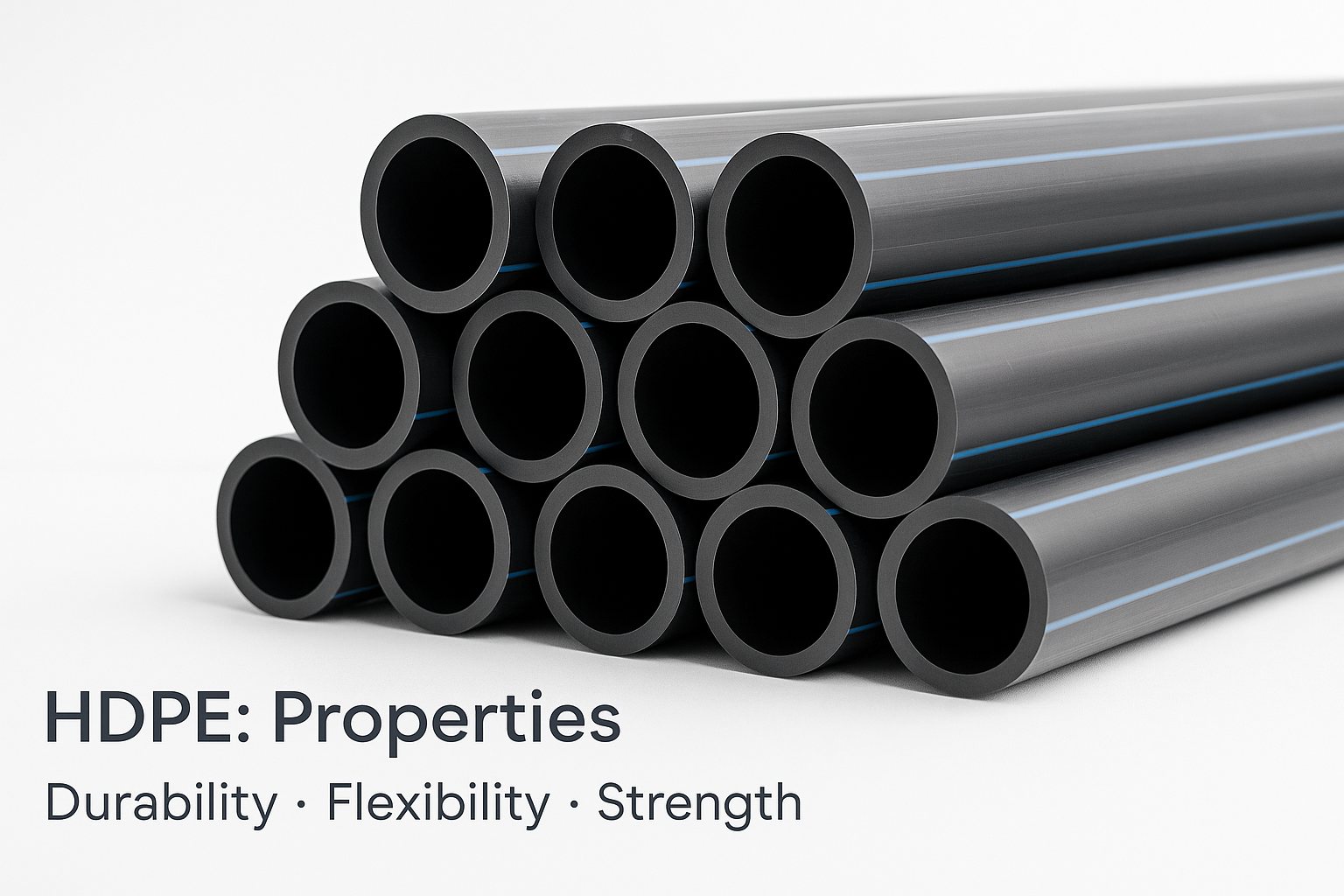
- Material logic: a high-strength, low-weight polymer built to resist corrosion and impact.
- Main uses: piping, geomembranes, tanks, cladding, packaging, and outdoor parts.
- What makes it special: flexibility plus durability—rare in one material.
- Environmental angle: highly recyclable, long service life, minimal maintenance.
If you want a clean technical snapshot, the plain-language sheet on HDPE properties and limits covers numbers and service ranges without the lab jargon.
What HDPE Is (and Isn’t)

High-Density Polyethylene is a thermoplastic made from petroleum-based ethylene. Born in the 1950s, it quickly replaced brittle plastics and corroding metals in infrastructure. It’s chemically simple but mechanically clever: long polymer chains packed tight, giving high tensile strength and minimal moisture absorption.
It’s not a miracle replacement for concrete or steel, but for buried, wet, or mobile systems, it’s the right tool. The density that gives it strength also lets it flex. You can coil it, unroll it, fuse it, and forget about it for decades.
Key Properties That Actually Matter
- Strength-to-weight ratio: 20 MPa yield strength at roughly one-third the weight of aluminum.
- Chemical resistance: unaffected by most acids, bases, salts, and fuels. Perfect for containment.
- Impact resistance: stays ductile at −50 °C. Doesn’t shatter when others do.
- UV tolerance: exterior-grade with stabilizers resists sunlight for years; cheap interior sheet will chalk fast.
- Water absorption: basically zero. That’s why HDPE pipe doesn’t blister, swell, or wick.
Where HDPE Shows Up and Why
Piping and Utilities
HDPE pressure pipe (PE4710 or PE100) dominates new water, gas, and district-energy installs. Fusion joints are leak-free, trenchless methods are simple, and buried life expectancy runs 50 + years. Full walkthroughs of jointing and bedding live in HDPE applications in construction.
Construction and Infrastructure
Used in geomembranes, vapor barriers, tank liners, and cladding. It resists chemical attack and freeze-thaw, making it ideal for foundations and landfills. The material also appears in recycled-plastic brick systems like this field test build, proving it can move beyond pipes into structural roles.
Automotive and Transport
Fuel tanks, piping, and lightweight panels rely on HDPE for toughness without weight penalties. Every kilogram trimmed helps fuel economy and cuts CO₂ emissions per mile.
Consumer and Agricultural Products
From detergent bottles to irrigation lines and greenhouse film, HDPE survives chemicals, UV, and impact. Farmers like it because it doesn’t corrode, and it keeps working through heat cycles that wreck PVC.
Where Tech Is Taking It
AI-Aided Design
AI models now predict how chain length and branching affect tensile and creep behavior, letting manufacturers tune resin grades before production. That shortens R&D time and reduces waste runs.
Smart HDPE Parts
Embedded sensors in HDPE pipe networks can log flow, pressure, and strain. With AI analysis, utilities catch leaks before they surface—predictive maintenance instead of emergency repairs.
Recycling Automation
AI vision systems in sorting plants identify HDPE by spectral signature, boosting recovery rates and cutting contamination. That’s how recycled HDPE (rHDPE) is getting cleaner, stronger, and more consistent each year.
Environmental Performance
HDPE wins on longevity and recyclability, not biodegradability. It lasts so long that its best climate move is to stay in service for decades, then re-enter production.
- Recyclable loops: clean post-consumer HDPE becomes pipe, lumber, or sheet again.
- Lower embodied carbon: compared with concrete or steel when used appropriately.
- Persistent issue: poor disposal leads to marine waste; design for collection fixes more than material swaps.
EPA and ACC data confirm HDPE’s low life-cycle energy demand relative to other polymers. See EPA plastics stewardship and American Chemistry Council reports for detailed numbers.
Real Project Snapshot
Site: Northern water-supply line retrofit.
Challenge: −40 °C winters, no replacement access for months.
Choice: PE4710 HDPE fused into 600-m strings; trenchless install.
Outcome: Ten years in, zero failures. Crew turnover changed; the pipe hasn’t.
This same logic scales down to urban stormwater lines and up to cross-country transmission mains. The weak links aren’t the pipes—they’re the design shortcuts.
Tips That Keep It Working
- Use trained fusion techs; bad welds are 99 % of HDPE failures.
- Shield storage from UV before install; light-degraded pipe loses surface gloss fast.
- Allow for thermal movement—slot holes, expansion loops, or slip joints.
- Stick to exterior-grade compounds outdoors.
- Recycle off-cuts; rHDPE board stock can replace timber for curbs or benches.
Next-Gen Moves
- Biopolymer blends: labs are testing partially bio-based HDPE to trim fossil input.
- 3D printing: modified HDPE filaments now print structural prototypes without cracking.
- Nanofillers: adding clay or graphene improves stiffness and barrier resistance.
NIST and DOE research hubs track these advances—browse NIST polymer-science bulletins and DOE sustainable-materials programs for updates.
FAQ
Is HDPE recyclable? Yes—#2 on the recycling code. It reprocesses easily with minimal property loss.
Is it food-safe? Virgin HDPE meets FDA standards; recycled grades must be verified for contact use.
Can it handle heat? Service up to ~80 °C. Above that, stiffness drops; use PP or CPVC for hotter fluids.
Will sunlight ruin it? Not if it’s UV-stabilized. Black and grey exterior grades last decades outdoors.
How does it compare to PVC? More flexible, tougher, fusion-joined (not glued), and fully recyclable.
Practical Reading and Field Picks
FIELD PICK
Building Construction Illustrated — Francis D.K. Ching. For anyone detailing HDPE parts into real assemblies.
MUST READ
Plastics in Architecture and Construction — concise reference on thermoplastics in buildings.
Disclosure: As an Amazon Associate, this site earns from qualifying purchases.
External Professional and Government Resources
- U.S. Environmental Protection Agency – Plastics and Environmental Stewardship
- American Chemistry Council – HDPE Data and Standards
- National Institute of Standards and Technology – Polymer Science
- Association of Plastic Recyclers – Technical Guidelines
- International Association for Plastics Distribution – Material Resources
Closing Note
HDPE doesn’t need hype. It just needs correct detailing and disciplined crews. Design for expansion, protect from UV, fuse clean, and give it a recycling path at the end. That’s it. The rest of the industry keeps rediscovering what field crews already know: this plastic, used right, outlasts the hype cycle every time.