
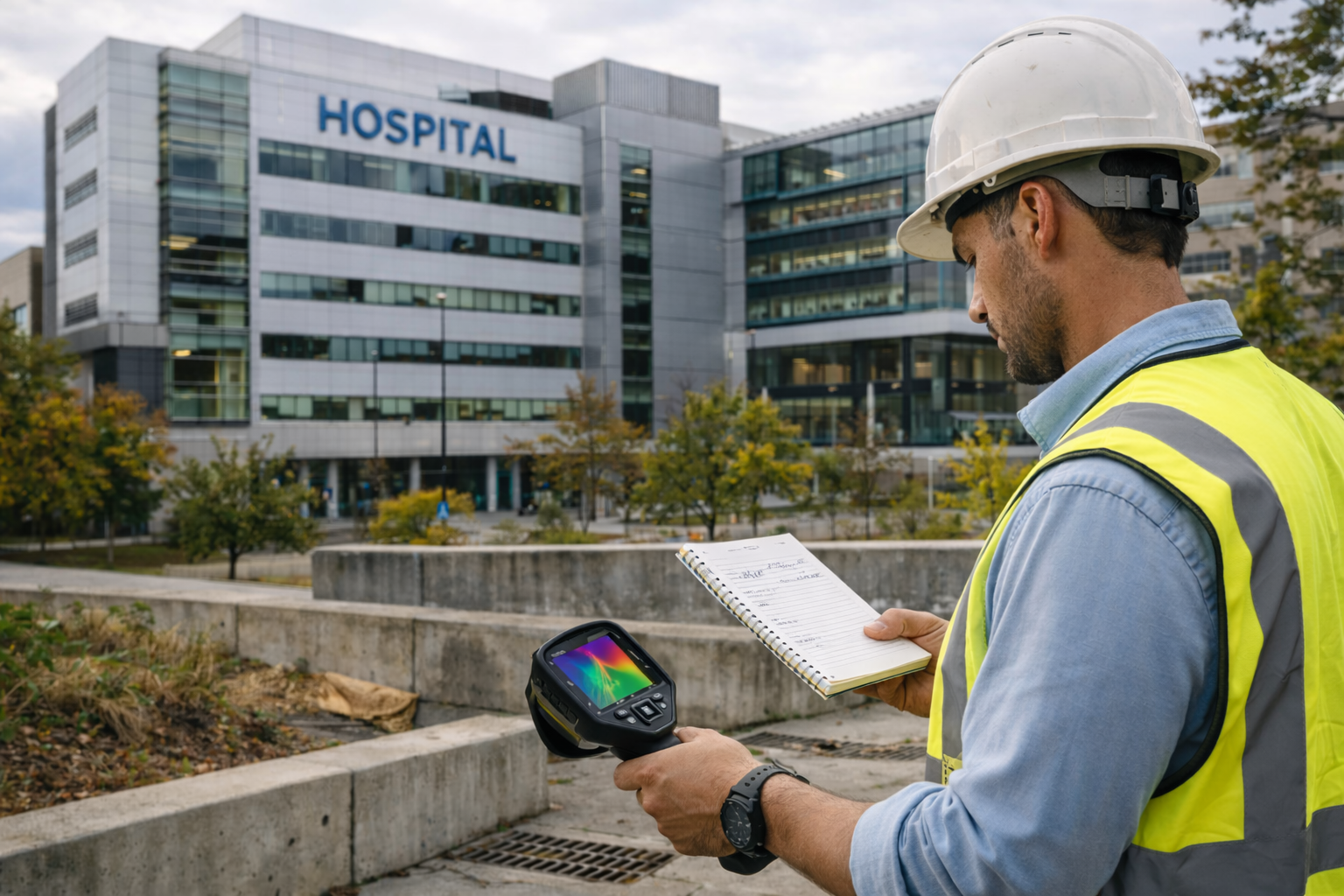
“Envelope commissioning” and “building enclosure commissioning” are the same idea: someone independent verifies the parts that keep the building dry and stable. Not the pretty parts. The parts that fail quietly for a year, then explode into leaks, rot, mold, and lawsuits.
Most people looking for BECx are trying to answer one urgent question: how do we stop the building from getting wet (or leaking air) after we’ve already paid for it?
What this covers: what BECx actually is, what a real scope looks like, where projects usually fail, and how to hire it without wasting money.
What this is not: a buzzword page or a sales pitch.
What BECx is
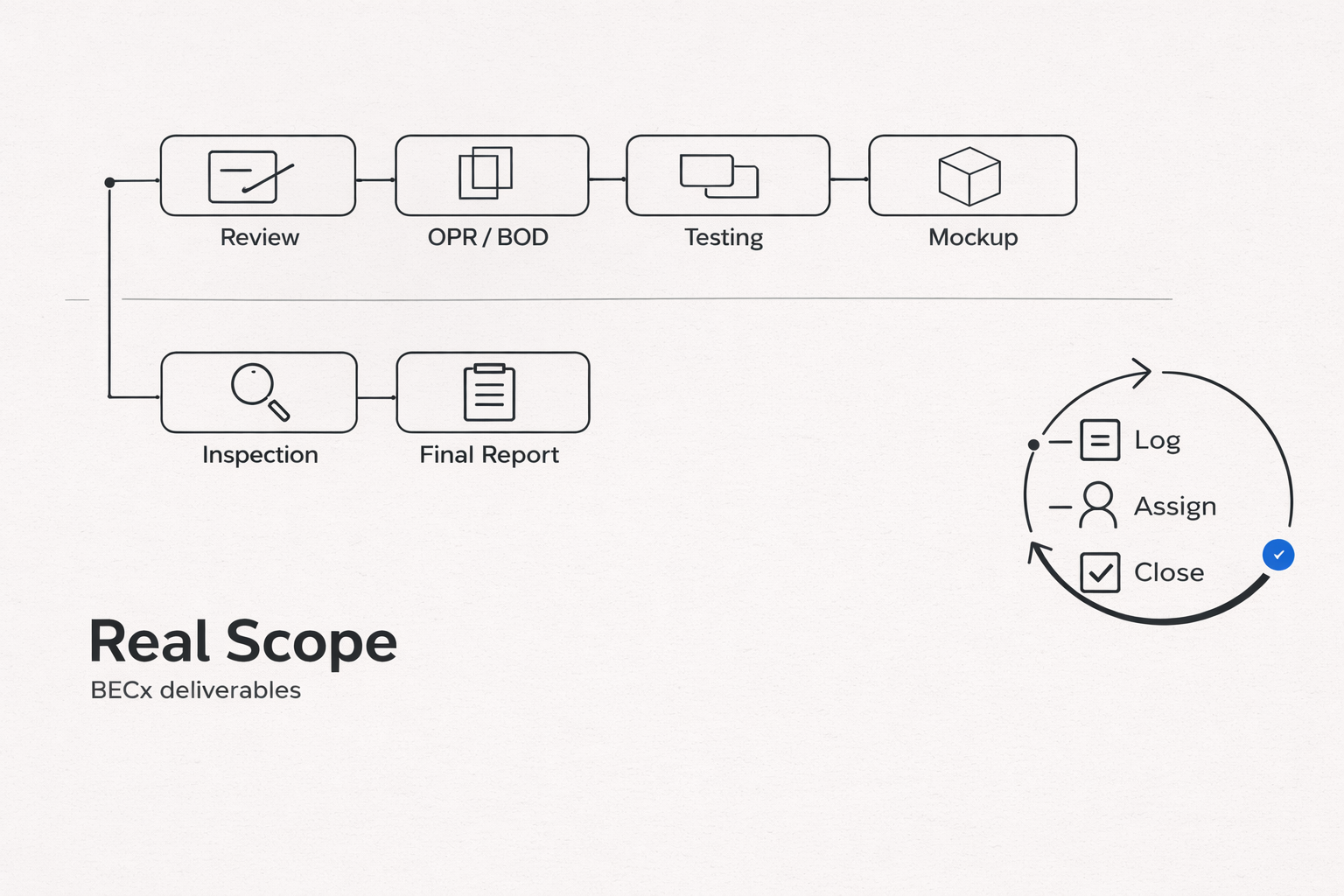
In plain language: BECx is a structured way to review, verify, and test the enclosure so it performs the way the project promised.
Two references people point to when they want something real (not vibes): ASTM E2813 (standard practice) and NIBS Guideline 3 (PDF) (process framework).
The value is timing. Catching the dumb failures before they get buried behind cladding, roofing, insulation, or drywall.
What BECx is not
Not a single blower door test at the end. Not a consultant report that sits in someone’s inbox. Not a replacement for good trades. If the team treats it like a checkbox, you still get the same failures. Just with a nicer PDF.
What it catches before it gets buried
BECx isn’t “extra paperwork.” It’s how you make the enclosure boring: no mystery leaks, no surprise condensation, no “why is this room freezing?” six months after handover.
The repeat offenders are almost always the same:
- Openings: window/door corners, sills, end dams, bad tie-ins to WRB/air barrier.
- Roof edges: parapets, copings, terminations, roof-to-wall transitions.
- Balconies and decks: waterproofing continuity, guard penetrations, thermal bridge traps.
- Below grade: “dampproofing vs waterproofing” confusion, drainage breaks, bad terminations at grade.
- Penetrations: the classic “we’ll seal it later” that never gets sealed.
Is BECx only for big commercial buildings?
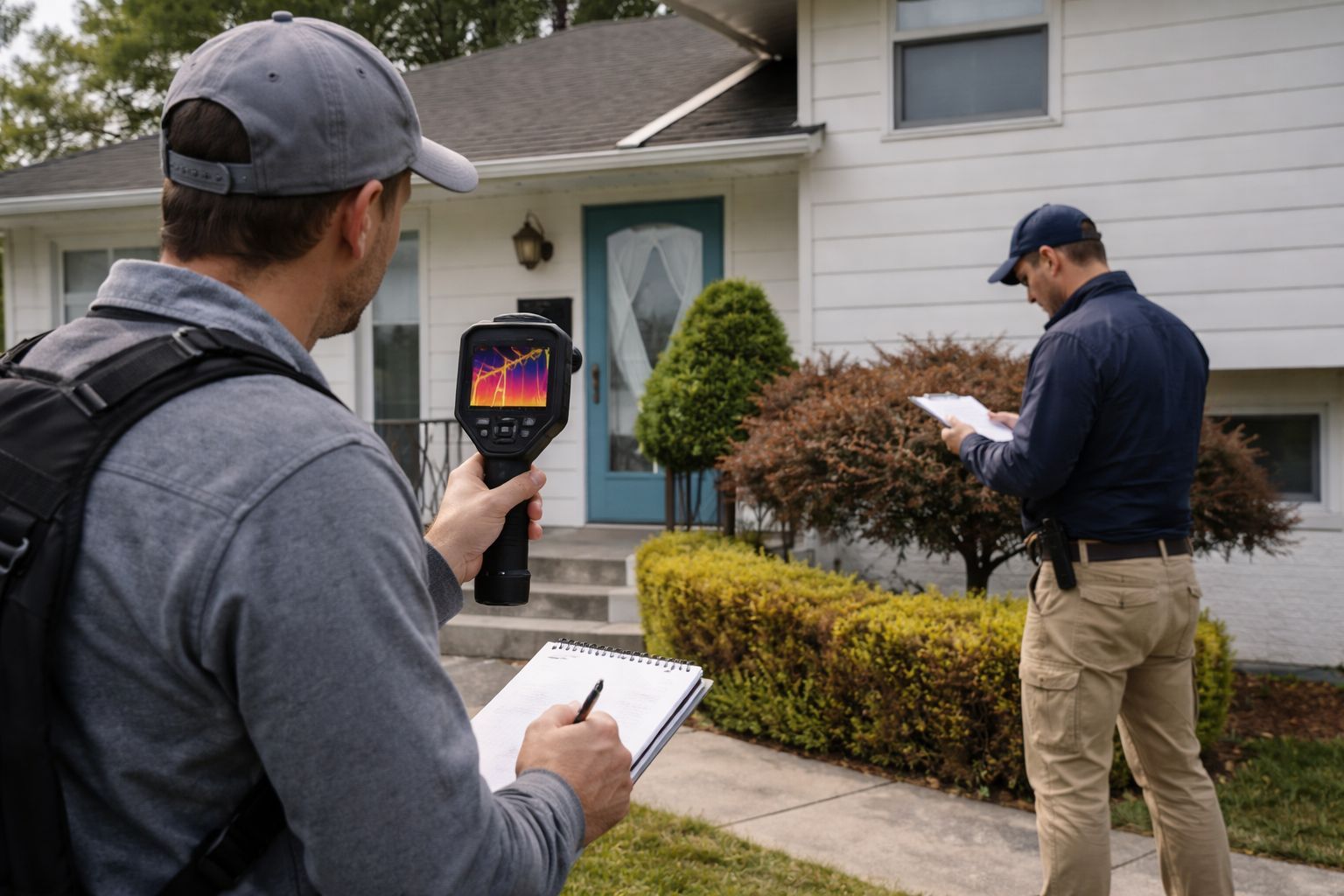
No. It started in commercial work because curtain walls, complex roofs, and interfaces fail in expensive ways. But the same failure modes show up in houses too — just with different labels.
In residential, it’s worth it when the enclosure is even slightly “not basic”:
- High-performance goals (tight air leakage, net-zero-ish targets, “Passive House-ish” expectations).
- Lots of openings (big sliders, lots of windows, recessed installs, fancy sill conditions).
- Tricky roofs (valleys, parapets, low-slope tie-ins, decks over living space).
- Hard climates (cold + humid = condensation risk shows up fast).
- Renovations (old + new assemblies meeting = the leak zone).
On houses you’ll hear: enclosure review, envelope QA, blower door + thermal scan, window leak testing, “high-performance consultant.” Same idea: verify the control layers before they get covered.
When to hire BECx
If you bring BECx in after the wall is closed, you’re mostly paying for bad news. Timing is half the value.
- Early design: set enclosure intent and risk areas (wind-driven rain, parapets, balconies, below-grade, big glazing).
- Design development: review details and continuity (water shedding, air barrier continuity, drying paths).
- Construction: hold-points, submittals, mockups, observations, targeted testing, deficiency log, re-checks.
- Closeout: final verification and a clean “here’s what you actually built” package.
The not-obvious move that makes BECx 10x easier
Do one short meeting early that feels almost too simple: an enclosure redline session.
Print one wall section, one roof edge detail, one slab edge, and one window head/jamb/sill. Big enough to write on. Trace the control layers with a marker. Circle every transition.
Then the part people skip: for every circled transition, write one name beside it. One owner. Not “GC and window guy and framer and the taper will figure it out.” One person owns the detail getting built, and one person owns the photo before it’s covered.
That single move kills most of the later chaos: fewer trade fights, fewer “I thought you were sealing that,” fewer Friday-night patch jobs right before cladding.
If you want to act professional without pretending you are: slow down at edges. Openings, corners, roof-to-wall, slab edges, penetrations, bottom-of-wall. That’s where buildings fail. Not in the middle of a perfect field sheet.
What a good BECx scope looks like
You’re paying for timing and follow-through. A good scope is specific about deliverables and checkpoints. A vague proposal (“site visits as needed”) usually means disappointment.
- Design review: continuity on paper (water, air, thermal, vapor) and the weak interfaces called out.
- Detail review: openings, terminations, transitions, and trade interfaces.
- Submittal sanity: tapes/primers/sealants/membranes checked as a system (mixing chemistry blindly is how you get weird failures).
- Hold-points: “don’t cover this until it’s seen.”
- Deficiency log that closes: photos, locations, responsibility, fix verification. Not random notes in email.
If BECx shows up only after everything is installed, you’re basically paying for documentation of failure.
Testing people ask about
The professional move is not “do every test.” It’s match tests to risk, and do them while fixes are still cheap.
- Whole-building air leakage: best when the air barrier is complete but still accessible for fixes.
- Water testing at openings: useful for high exposure, complex window systems, big glazing, or repeat leak history.
- Infrared: good for missing insulation patterns and some air leakage clues (when conditions cooperate).
- Roof moisture surveys: useful when the roof assembly hides moisture and leaks are hard to track.
How to hire BECx services without getting played
People hire BECx and still get leaks for one main reason: they bought a report, not a process.
Ask these before you sign anything:
- When do you start? “After install” is a red flag.
- What are your hold-points? No hold-points = no leverage.
- Show me a sample issue log. If there’s no clean tracking, nothing gets fixed.
- What testing is included? What triggers re-test?
- Who sees the reports? If trades never see findings, nothing changes on site.
- Who owns fixes? If responsibility is fuzzy, the building pays for it later.
Simple red flag: they can’t point to the air barrier line on a plan, or they won’t force that conversation early. That’s the job.
LEED and “envelope commissioning”
People search this because LEED sometimes ties commissioning scope to credits and documentation. That’s fine — but don’t let the paperwork become the goal. The goal is still the same: water out, air controlled, assemblies able to dry.
If you’re in LEED land, start with the official credit library and read the exact version you’re registered under: USGBC LEED credit library.
Official and manufacturer links worth bookmarking
These are the sources that actually get cited when people stop arguing and start proving.
Standards and process (the “what is BECx” backbone):
- ASTM E2813 — the standard practice reference many specs point to when they say “BECx.”
- NIBS Guideline 3 (PDF) — the enclosure commissioning process framework used as a baseline on many projects.
- ASHRAE commissioning process resources — commissioning language that shows up in professional scopes and owner requirements.
Government / public-owner guidance (how serious owners structure it):
- City of Calgary: Building Envelope Commissioning Guide (PDF) — a public-owner example of what gets checked and when.
- Government of Alberta: Building Envelope Commissioning Guide (PDF) — Canadian-climate framing for scope, timing, and verification.
- City of Edmonton: Commissioning Manual, Volume 2 (PDF) — shows how owner-side commissioning requirements get written and enforced.
- U.S. DOE: commissioning cost guidance (PDF) — a reality check when someone asks “what does commissioning usually cost?”
Manufacturer installation rules (where failures actually start):
- DuPont Tyvek: installation guides — WRB and flashing sequencing details (laps, corners, openings) that warranties and inspections lean on.
- HUBER ZIP System: installation manual — surface prep, roller pressure, temperature limits, corners, penetrations. The “boring rules” that decide performance.
- IAPMO ER-0424 (ZIP System evaluation report, PDF) — a third-party code evaluation document that helps when you need “what’s accepted” language.
FAQ
Is BECx worth it on smaller projects?
If you’ve got real exposure (wind-driven rain), tricky transitions (balconies, complex roofs), lots of glazing, or tight performance targets, it can be worth it. If the project is simple, do a light version: early detail review + a couple hold-points + airtightness testing.
When should BECx start?
Early design. If the first time someone “commissions” the enclosure is after cladding, you’re late. You can still find problems, but fixes get expensive and political.
Is a blower door test the same thing as BECx?
No. A blower door is one tool. BECx is the bigger process: review details early, verify installs, test what matters, and close issues before the building hides them.
What do owners usually regret not doing?
Not setting hold-points. Not assigning one owner per transition. Not forcing a clean issue log to close. Those three create most of the “we tore it out” stories.
What’s the fastest way to waste money on BECx?
Hiring it late, ignoring the issue log, and letting scope be vague. If nobody is responsible for fixes, commissioning just becomes documentation of failure.
Short close
BECx isn’t about perfection. It’s about catching the predictable failures early, while fixes are still cheap and clean. Do the redline session. Assign owners. Hold the line at transitions. Then the building stays boring. That’s the win.
If you’re considering fast-track, start here: