
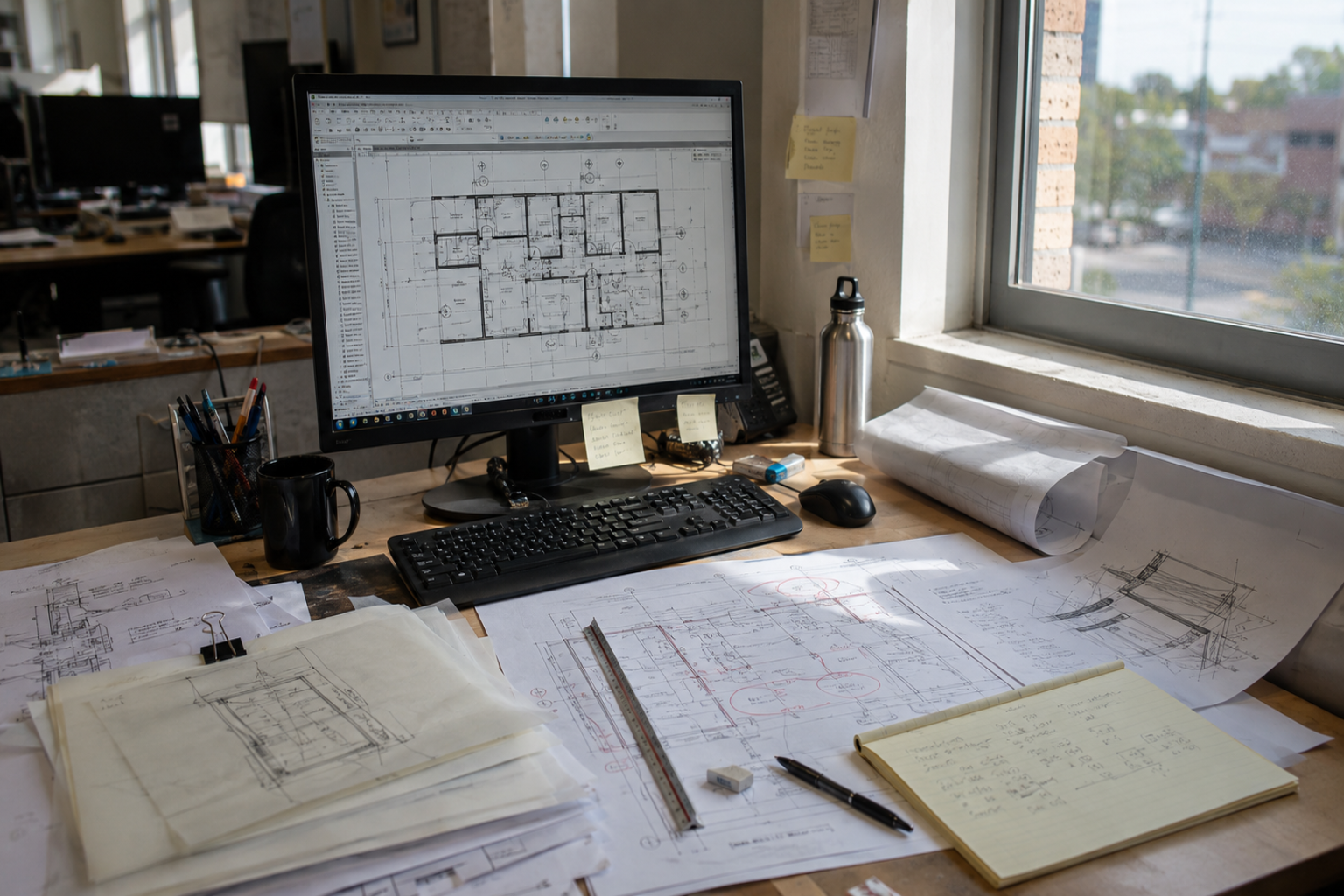
An architectural draftsman turns design ideas into technical drawings people can use.
The work goes far beyond drawing plans. A good draftsman checks dimensions, organizes construction documents, updates CAD or BIM files, coordinates details, catches conflicts, and helps turn rough design intent into drawings that architects, engineers, permit reviewers, contractors, and clients can understand.
The title can be confusing. Some employers say architectural draftsman. Others say architectural drafter, draftsperson, CAD technician, BIM technician, or architectural technician. The words change, but the value is the same: accurate technical drawing, clear building information, and fewer expensive mistakes.
What an architectural draftsman does
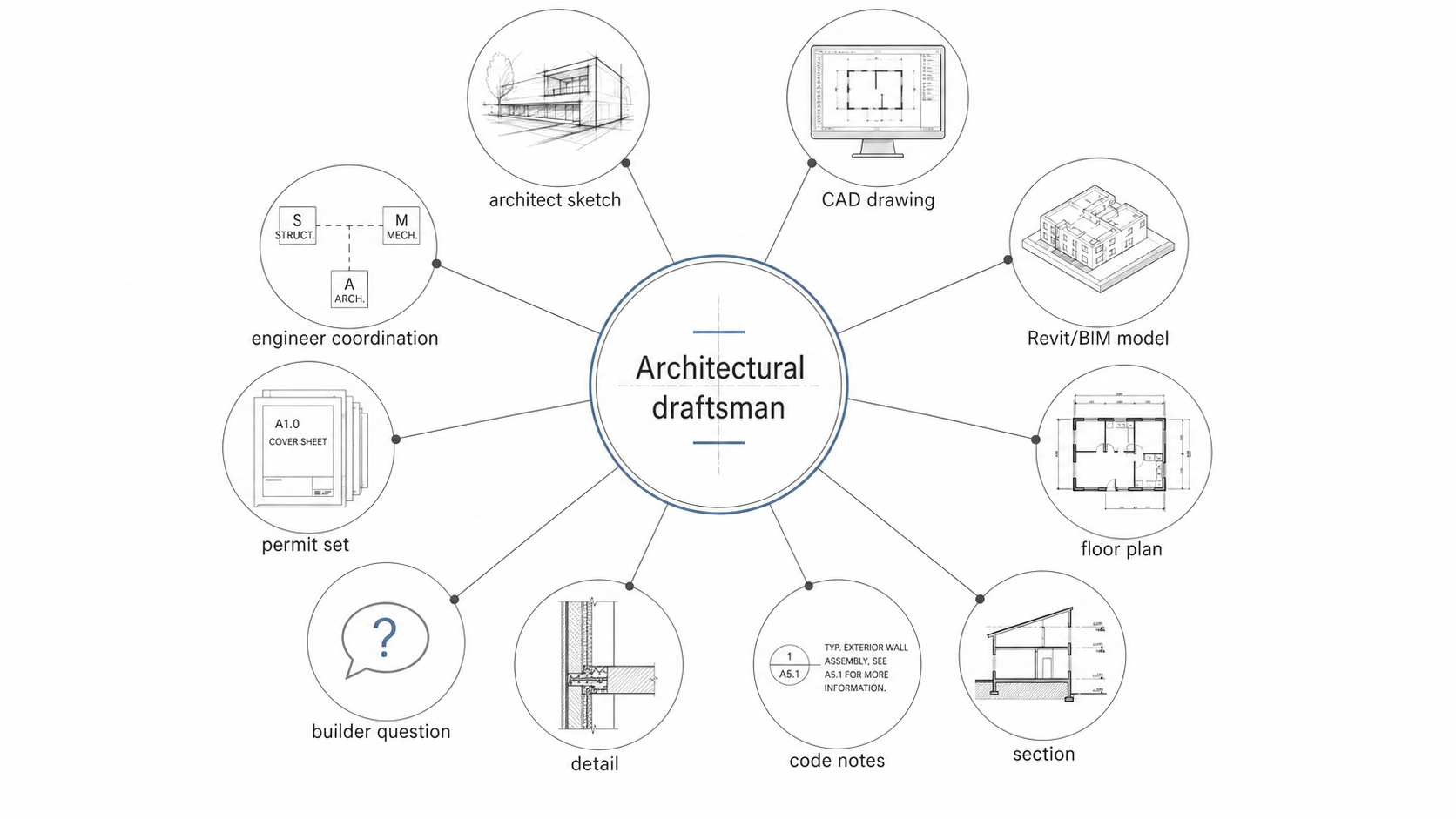
An architectural draftsman prepares technical drawings for buildings. Those drawings may include floor plans, elevations, sections, wall details, door and window schedules, reflected ceiling plans, site plans, permit drawings, and construction documents.
In a small residential office, the draftsman may work from an architect’s sketch and turn it into a full drawing set. In a larger commercial office, the role may be narrower: updating Revit models, coordinating details, cleaning redlines, producing sheets, or helping a project architect keep the drawing set consistent.
The job sits between design and construction. That is why careless drafting causes real problems. A missing dimension can delay pricing. A bad wall section can confuse the builder. A door schedule error can become a field change. A roof detail that does not line up with the section can waste hours in review.
Architectural draftsman, drafter, draftsperson, and draughtsman
The title changes by country, employer, and industry.
| Title | What it usually means | Where you may see it |
|---|---|---|
| Architectural draftsman | Traditional title for someone preparing architectural drawings. | Older job posts, small firms, residential design offices, and search queries. |
| Architectural drafter | Modern U.S. title for the same general role. | U.S. job ads, BLS/O*NET language, CAD roles, and technical drafting programs. |
| Draftsperson | Gender-neutral version of draftsman. | Canada, Australia, some public agencies, and modern job descriptions. |
| Architectural draughtsman | British spelling of draftsman. | UK, India, Middle East, and Commonwealth usage. |
| CAD technician | Drafting role focused heavily on CAD production. | Architecture, engineering, manufacturing, construction, and design-build firms. |
| BIM technician | Drafting and modeling role focused on Revit or BIM workflows. | Architecture firms, engineering consultants, contractors, and larger project teams. |
Do not get stuck on the title alone. Read the job description. A “CAD technician” in one office may do the same work as an “architectural drafter” in another office. A “BIM technician” may be more advanced than both if the role includes model coordination and construction-document responsibility.
Architectural draftsman vs architect
An architectural draftsman and an architect have different responsibilities.
An architect is responsible for design direction, professional judgment, client decisions, code strategy, coordination, and, when licensed, legal responsibility for architectural services. A draftsman usually prepares drawings under the direction of an architect, designer, engineer, or project lead.
That does not make the draftsman unimportant. It means the responsibility is different.
| Question | Architect | Architectural draftsman |
|---|---|---|
| Main responsibility | Design, professional judgment, client coordination, code strategy, and project responsibility. | Technical drawings, CAD/BIM files, details, redlines, and documentation support. |
| Licensing | Architects are licensed where the title and practice are regulated. | Drafters are usually not licensed as architects. |
| Typical education | Professional architecture degree plus experience and exams in many jurisdictions. | Drafting certificate, diploma, associate degree, architectural technology program, or strong portfolio. |
| Daily work | Design decisions, consultant coordination, client meetings, code issues, review, and project management. | Drawing production, model updates, dimensions, schedules, details, corrections, and file coordination. |
| Where mistakes show up | Design risk, code risk, budget risk, client problems, and professional liability. | Drawing errors, missing information, unclear details, coordination problems, and field confusion. |
A strong draftsman can become extremely valuable because architects depend on clear documents. A weak drawing set can make a good design hard to price, permit, or build.
The drawings a draftsman works on
Architectural drafting is not one drawing. It is a set of connected documents.
The drawings need to agree with each other. The floor plan should match the elevations. The section should match the roof. The wall detail should match the materials. The door schedule should match the plan. The dimensions should not fight the structure.
| Drawing type | What it shows | Why accuracy matters |
|---|---|---|
| Floor plans | Room layout, walls, doors, windows, dimensions, and circulation. | Wrong dimensions can affect framing, furniture, access, and pricing. |
| Elevations | Exterior or interior wall faces, openings, materials, and heights. | Openings, cladding, rooflines, and design intent must match the plans. |
| Sections | Vertical cuts through the building. | Sections reveal floor heights, roof slopes, stairs, structure, and assemblies. |
| Details | Connections, wall assemblies, waterproofing, flashing, joints, and transitions. | Bad details can lead to leaks, rot, code issues, and field improvisation. |
| Schedules | Doors, windows, finishes, rooms, hardware, and equipment. | Schedule errors can cause ordering mistakes and expensive changes. |
| Site plans | Property lines, setbacks, access, grading, utilities, parking, and drainage. | Site mistakes can delay permits or create construction conflicts. |
| Permit sets | Drawings prepared for review by local authorities. | Missing code information can trigger comments, revisions, and delays. |
| Construction documents | More complete drawing sets used for pricing and construction. | Unclear documents create bids with assumptions, exclusions, and change orders. |
This is why architectural drafting rewards patient people. The work is often quiet, but the consequences are not small.
CAD, Revit, and BIM skills that matter now
Old drafting was mostly hand drawing. Modern drafting is mostly digital.
AutoCAD still appears in many offices, especially for 2D drafting, details, renovation work, and legacy files. Revit is common in architecture offices that use BIM. Some firms also use Archicad, Vectorworks, SketchUp, Rhino, Bluebeam, Navisworks, or other tools depending on the project type.
Software names help, but software alone does not make someone good. Employers care about whether you can produce clean work without creating a mess for the rest of the team.
| Skill | Beginner version | Stronger version |
|---|---|---|
| AutoCAD | Draw plans, use layers, annotate, and print sheets. | Clean standards, xrefs, blocks, sheet setup, and detail organization. |
| Revit | Model walls, doors, windows, floors, roofs, and basic sheets. | Families, view templates, schedules, phasing, worksets, and model cleanup. |
| BIM coordination | Understand that the model feeds drawings. | Coordinate disciplines, catch conflicts, manage standards, and protect model health. |
| Construction details | Copy standard details and adjust notes. | Understand assemblies, flashing, structure, waterproofing, and build sequence. |
| Redlines | Make corrections from markups. | Catch the reason behind the correction and prevent the same mistake later. |
| Drawing set control | Update sheets when told. | Keep plans, sections, elevations, schedules, tags, and notes aligned. |
The best drafters are not only fast. They are clean. They make files other people can open without wasting time.
Salary and job outlook for architectural drafters
Salary depends on location, experience, software skill, project type, and whether the role is basic drafting or higher-value BIM and documentation work.
The current U.S. data is useful as a baseline. O*NET lists architectural and civil drafters at a 2024 median wage of $64,280 per year, or $30.90 per hour. It also lists job-title examples including architectural drafter, architectural draftsman, CAD designer, drafting technician, and draftsperson.
BLS groups drafters more broadly and reports that drafters had 2024 median pay of $65,380 per year. BLS also reports typical entry-level education as an associate degree and projects little or no employment change from 2024 to 2034, with openings still expected mainly from replacement needs.
| Career stage | Typical U.S. salary pressure | What changes the number |
|---|---|---|
| Entry-level CAD drafter | Often lower than the median. | Basic software ability, clean portfolio, local market, and internship experience. |
| Architectural drafter | Often around the middle range once useful in production. | Speed, accuracy, redline handling, and residential or commercial experience. |
| Experienced drafter | Can move above the median. | Construction documents, details, code awareness, and independent drawing-set control. |
| BIM technician or BIM coordinator | Can be stronger than basic drafting. | Revit depth, coordination skill, model standards, clash issues, and team support. |
| Senior drafter or project technician | Higher value if tied to project delivery. | Mentoring, QA, consultant coordination, field questions, and drawing-set leadership. |
The important point is this: drafting is not a guaranteed high-growth job just because construction exists. Basic drafting can be vulnerable to automation, outsourcing, and software changes. People who understand buildings, details, BIM coordination, and clean documentation can still be valuable.
How to become an architectural draftsman
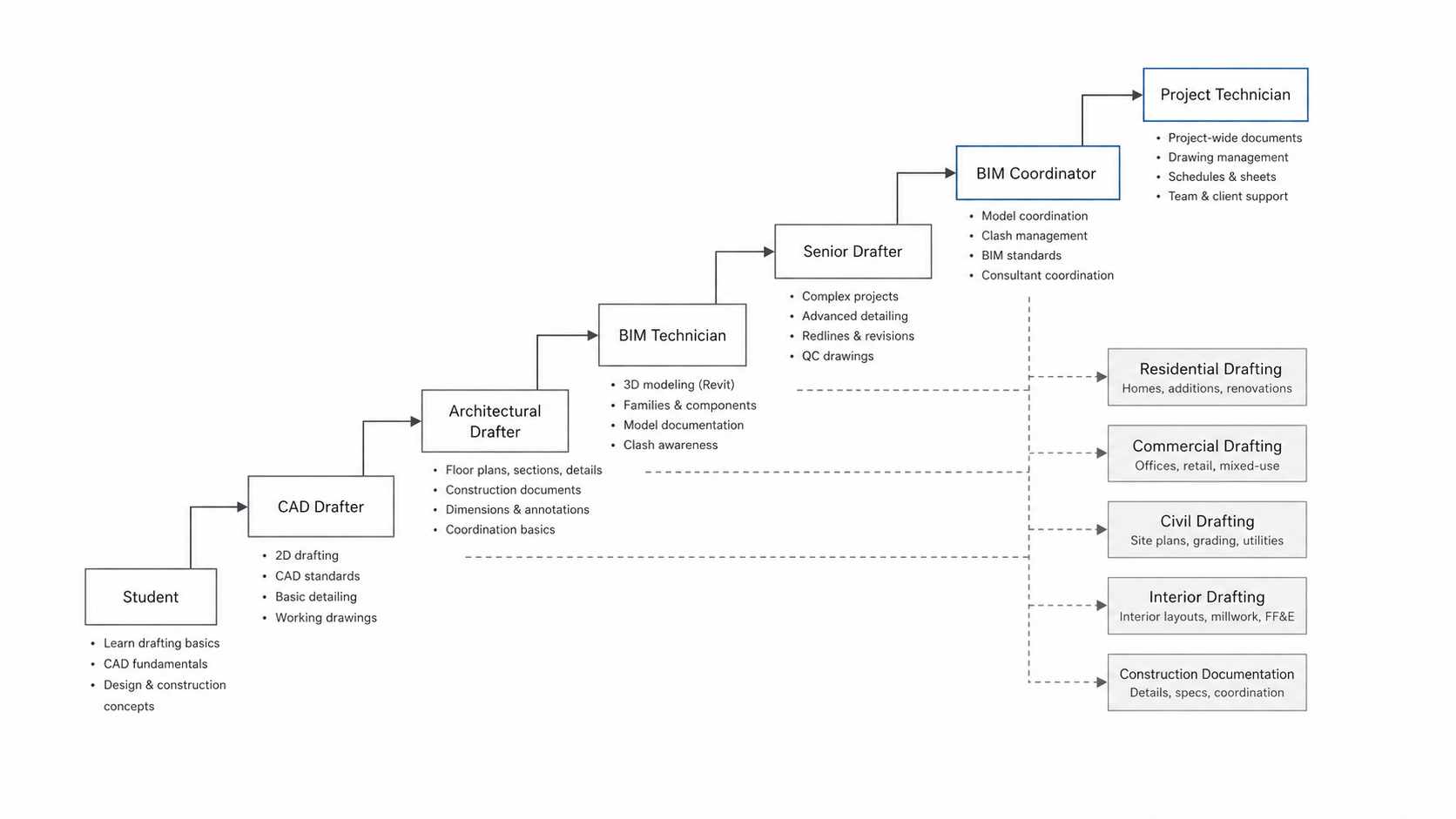
The most common path is practical: learn drafting, learn building basics, learn CAD/BIM software, build a portfolio, and get experience on real drawing sets.
You do not need the same path as an architect. Many drafting roles do not require a professional architecture degree. Employers often care more about whether you can produce clean, accurate work.
| Step | What to do | What not to waste time on |
|---|---|---|
| Learn drafting basics | Plans, elevations, sections, dimensions, scale, lineweights, symbols, and details. | Do not jump straight into software without understanding drawings. |
| Learn CAD and BIM | Start with AutoCAD and Revit if you are targeting architecture offices. | Do not list ten programs you barely know. |
| Study building systems | Walls, floors, roofs, stairs, foundations, openings, waterproofing, and structure basics. | Do not treat drafting like graphic design only. |
| Build a portfolio | Show clean sheets, not only renderings. | Do not fill it with vague school images that hide your drafting skill. |
| Get real feedback | Have architects, drafters, instructors, or builders mark up your work. | Do not assume clean-looking drawings are buildable drawings. |
| Apply for entry roles | Look for CAD drafter, architectural drafter, BIM technician, and drafting assistant jobs. | Do not apply only to jobs with the exact words “architectural draftsman.” |
Related training can come through community college, technical college, vocational programs, drafting certificates, architectural technology programs, or building design programs. The right path depends on your country and local job market.
Can you become a draftsman without a degree?
Sometimes, yes. But do not romanticize it.
A person without a formal drafting degree can still enter the field if they build real skill and prove it. That usually means learning CAD/BIM, understanding drawing conventions, building a strong portfolio, and finding a small firm, contractor, designer, or drafting office willing to judge the work instead of the credential.
The harder truth is that no-degree entry is easier in some markets than others. Government jobs, larger firms, engineering offices, and corporate employers may filter applicants by education. Smaller residential firms may care more about whether you can produce clean drawings quickly.
| No-degree route | What helps | Risk |
|---|---|---|
| Self-taught CAD portfolio | Strong drawing samples, clean layers, and good sheet organization. | May be ignored by employers that require formal credentials. |
| Certificate program | Shorter training with focused drafting and software skills. | Quality varies; weak programs produce weak portfolios. |
| Small firm apprenticeship-style work | Real-world feedback and practical habits. | Can trap you in narrow tasks if there is no mentoring. |
| Freelance drafting support | Can build experience and client examples. | Risky if you take on code, structure, or permit responsibility beyond your competence. |
If you skip formal education, your portfolio has to work harder. It should show plans, elevations, sections, details, schedules, and at least one coordinated mini drawing set.
Career paths for architectural draftsmen
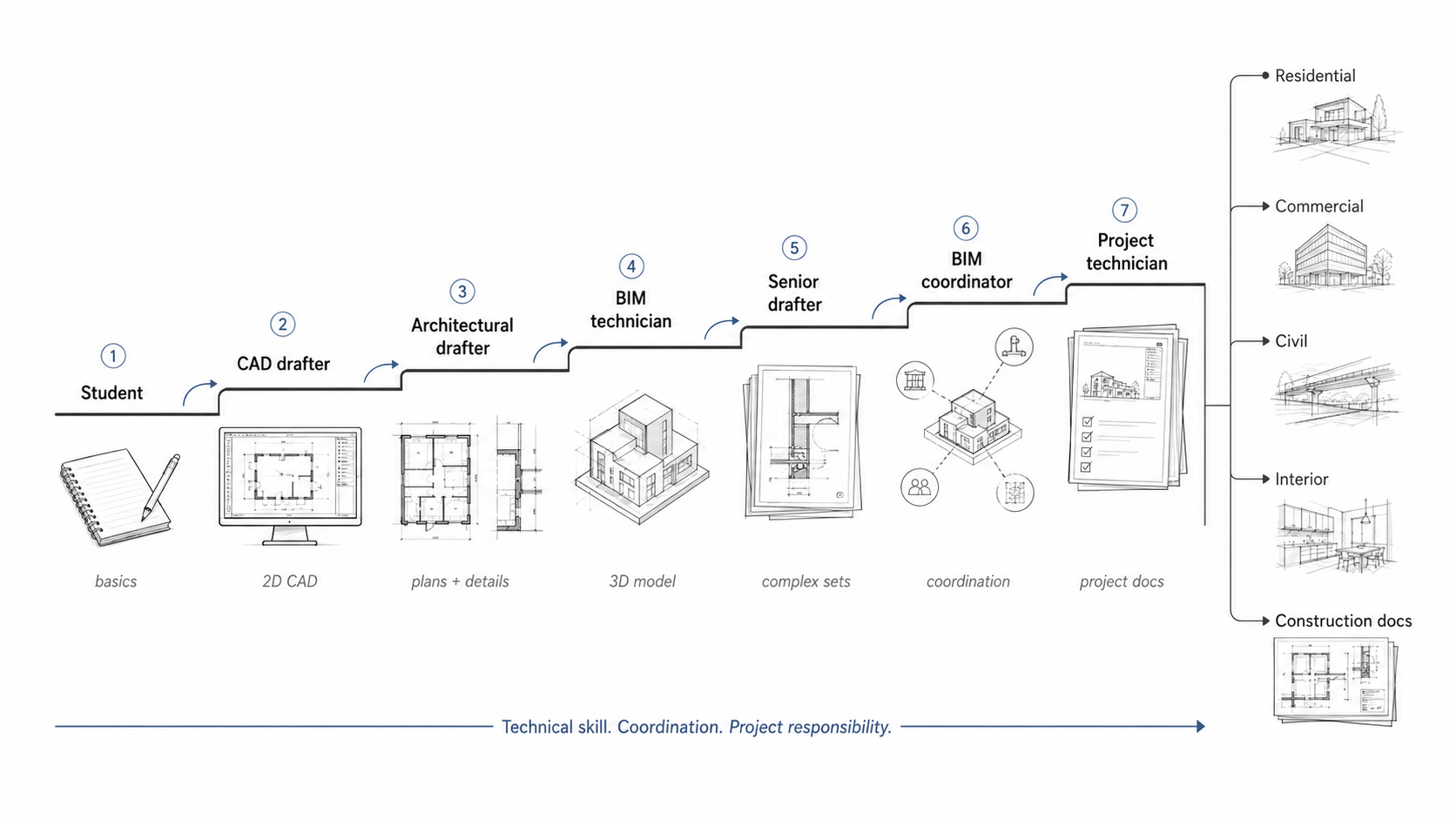
Drafting can stay narrow, or it can grow into a technical career.
The strongest path is usually not drafting forever through the same redlines. It is becoming more useful: better details, better BIM skills, better coordination, better construction knowledge, and better quality control.
| Path | What it becomes | Best fit |
|---|---|---|
| Residential architectural drafter | House plans, renovation drawings, permit sets, additions, and builder support. | People who like practical buildings, homeowners, small firms, and clear results. |
| Commercial architectural drafter | Larger drawing sets, office standards, consultants, code notes, and coordination. | People who can handle bigger teams and more complex documents. |
| BIM technician | Revit models, drawing sheets, schedules, model cleanup, and family use. | People who like software structure and technical systems. |
| BIM coordinator | Model standards, clash issues, discipline coordination, and workflow support. | People who can protect quality across teams. |
| Senior drafter | Drawing-set control, detail review, mentoring, QA, and project support. | People who become trusted for accuracy and judgment. |
| Architectural technologist | Technical design, documentation, building systems, code, and detailing support. | People who want more technical responsibility without necessarily becoming architects. |
| Future architect | Drafting experience becomes one step toward architecture school or licensure. | People who want full professional design responsibility later. |
Some drafters later become architects. Some become BIM managers. Some move into construction documentation, estimating, building technology, code review, or design-build work. The path depends on what skills you keep adding.
Weak drawings cost real money
Bad drafting is more than an office annoyance.
It can create real construction problems. A missing dimension can stop framing. A wrong window size can delay an order. A detail that does not show flashing can lead to water damage. A plan that does not match the section can trigger permit comments. A door schedule that does not match the plan can become a change order. A wall assembly copied from the wrong project can fail in the real climate.
This is why experienced architects and builders value good drafters. A good draftsman does not only make the drawing look nice. A good draftsman protects the drawing set from confusion.
| Drafting mistake | What it can cause | What a careful drafter checks |
|---|---|---|
| Missing or conflicting dimensions | Framing confusion, pricing assumptions, and field calls. | Plans, sections, details, gridlines, and opening sizes. |
| Unclear wall assemblies | Bad insulation, moisture problems, code comments, and wrong pricing. | Materials, thicknesses, vapor control, fire ratings, and structural notes. |
| Copied details from old projects | Wrong climate, wrong product, wrong structure, and wrong waterproofing. | Whether the detail fits this project. |
| Plan and elevation mismatch | Wrong windows, wrong rooflines, and ugly field fixes. | Opening locations, heights, cladding breaks, and roof geometry. |
| Schedules not updated | Wrong doors, windows, finishes, hardware, or quantities. | Tags, counts, sizes, types, notes, and revisions. |
| Messy CAD/BIM files | Slow teams, bad exports, wrong sheets, and coordination errors. | Layers, views, templates, families, links, sheets, and lineweights. |
This is the difference between beginner drafting and professional drafting. Beginners draw what they see. Better drafters ask what the drawing will cause on site.
AI, BIM, and the future of drafting
Drafting is changing, but not in the cartoon way people talk about it online.
AI and automation can help with repetitive tasks, early layout studies, model checking, drawing cleanup, documentation support, and software workflows. That does not mean every drafting job disappears. It means basic drafting that adds no judgment is easier to replace or outsource.
The safer path is to become the kind of drafter who understands the building, not only the command line.
| Vulnerable work | Stronger work |
|---|---|
| Tracing simple plans with no building knowledge. | Coordinating plans, sections, schedules, and details. |
| Only copying redlines. | Understanding why the redlines were made. |
| Using software as a digital pencil. | Using BIM/CAD to organize building information. |
| Relying on one old software workflow. | Learning model standards, coordination, automation, and QA. |
| Producing pretty sheets with missing information. | Producing drawings that reduce confusion for reviewers and builders. |
The future belongs less to people who draw lines and more to people who manage technical building information clearly.
How to build a drafting portfolio employers trust
A drafting portfolio should not look like an architecture school mood board.
Employers want to see whether you can produce usable drawings. That means clean sheets, consistent notation, correct scales, readable details, and organized information. Renderings can help, but they should not hide weak drafting.
| Portfolio piece | Why it helps | What to avoid |
|---|---|---|
| Small house drawing set | Shows plans, elevations, sections, roof, dimensions, and sheet layout. | Do not show only a floor plan. |
| Wall section and detail | Shows construction thinking and assembly awareness. | Do not copy details you cannot explain. |
| Redline before/after | Shows that you can correct and improve drawings. | Do not include confidential office work unless allowed. |
| Revit model screenshots | Shows BIM organization and 3D understanding. | Do not rely only on dramatic render views. |
| Door/window schedule sample | Shows document discipline and coordination. | Do not leave schedules disconnected from plans. |
| Renovation field-measure drawing | Shows real-world accuracy and existing-condition work. | Do not invent field conditions without checking them. |
A strong portfolio says, “I can help your office produce cleaner drawings.” That is more useful than saying, “I am passionate about design.”
Common beginner mistakes
New drafters often think speed is the goal. Speed matters, but speed without accuracy creates faster mistakes.
- They overfocus on software. Knowing Revit is useful. Knowing what a wall section means is more useful.
- They ignore lineweight and hierarchy. Drawings need to read clearly, not only contain information.
- They do not check drawings against each other. Plans, elevations, sections, details, and schedules must agree.
- They copy details blindly. A copied detail can be wrong for the climate, material, wall type, or project scale.
- They hide confusion. Good drafters ask questions before confusion becomes a drawing error.
- They treat redlines like punishment. Redlines are how many people learn office standards and building logic.
Is architectural drafting a good career?
It can be a good career for the right person.
It fits people who like precision, buildings, software, technical drawings, and practical problem-solving. It is less ideal for people who want full design control, dislike detail work, or get bored when the job becomes repetitive.
The safest drafting career is not frozen at basic CAD production. It grows toward BIM, documentation leadership, technical detailing, code awareness, coordination, or project technician work.
| Good fit if you like... | Poor fit if you hate... |
|---|---|
| Precise drawings and details. | Checking small inconsistencies. |
| CAD, Revit, BIM, and technical systems. | Learning new software workflows. |
| Buildings and construction logic. | Practical constraints and standards. |
| Quiet production work with real consequences. | Long periods at a computer. |
| Supporting architects, engineers, and builders. | Working under someone else’s design direction. |
If you want the title of architect, drafting may be one step. If you want a technical building career, drafting can be the main path.
FAQ
Is an architectural draftsman the same as an architect?
No. An architectural draftsman prepares technical drawings, usually under the direction of an architect, designer, engineer, or project lead. An architect has broader design, coordination, client, code, and professional responsibilities. In many places, the title “architect” is legally regulated.
What does an architectural draftsman do?
An architectural draftsman prepares drawings such as floor plans, elevations, sections, details, schedules, site plans, permit drawings, and construction documents. The work often includes CAD or BIM software, redline corrections, dimensions, drawing coordination, and detail cleanup.
What is the difference between an architectural draftsman and an architectural drafter?
They usually mean the same general job. “Architectural drafter” is the more modern U.S. occupational title. “Architectural draftsman” is older but still commonly searched and used. “Draughtsman” is the British spelling.
How much does an architectural draftsman make?
In the United States, O*NET lists architectural and civil drafters at a 2024 median wage of $64,280 per year. Actual pay depends on location, experience, software skill, project type, and whether the role is basic drafting or higher-level BIM/documentation work.
Do you need a degree to become an architectural draftsman?
Many drafting roles prefer postsecondary drafting education, such as a certificate, diploma, associate degree, or architectural technology program. Some people enter without a degree if they have strong CAD/BIM skills and a solid portfolio, but the no-degree path can be harder.
What software should an architectural draftsman learn?
AutoCAD and Revit are the safest starting points for many architecture-related drafting jobs. Depending on the office, Archicad, Vectorworks, SketchUp, Rhino, Bluebeam, Navisworks, or other tools may also matter.
Can an architectural draftsman become an architect?
Yes, but drafting experience alone is not enough. A draftsman who wants to become an architect usually needs the required education, supervised experience, exams, and registration for the jurisdiction where they want to practice.
Is AI replacing architectural drafters?
AI and automation can reduce repetitive drafting work, but they do not remove the need for people who understand buildings, details, codes, drawing coordination, and construction documents. Basic line production is more vulnerable than technical drafting judgment.
Is architectural drafting a good job?
It can be a good job for people who like technical drawing, buildings, software, details, and practical problem-solving. It is stronger as a career when the drafter keeps growing into BIM, coordination, detailing, code awareness, or senior technical roles.
What should be in an architectural drafting portfolio?
A good portfolio should include clean plans, elevations, sections, details, schedules, and at least one coordinated mini drawing set. Employers need to see that you can produce usable technical documents, not only attractive renderings.
Read This Next
If you want the broader field, start with architectural drafting.
If you are comparing training options, read online drafting degree.
If money is the main question, compare this with drafting associate degree salary.
If you are looking for work, use draftsman jobs.
If you are deciding between drafting and architecture, read architectural career and entry-level architect salary.