

An entry-level architect salary can sound fine until rent, tax, debt, and long hours start taking pieces out of it.
That is the part many salary pages skip. They throw out one national number and act like the answer is finished. It is not finished until you know what kind of first job you are looking at, whether the role supports licensure, what city you will live in, and how much money is left once the basic costs hit.
This page is the blunt version. It explains what beginners in architecture usually make, why job titles at the bottom of the ladder are messy, what the first years of work really look like, and when a starting offer is weaker than it sounds.

Entry-level architect salary: realistic starting range
There is no single clean national starting salary for beginners in architecture. The official federal numbers cover the whole profession, and that includes many experienced and licensed architects. That is useful for context, but it is not the same thing as first-job pay.
As a planning range, many entry-level architecture offers in the United States land somewhere around $55,000 to $70,000. Some offers come in lower, especially in smaller firms or lower-cost markets. Some come in higher, especially in expensive metro areas or firms that need strong software and production ability immediately.
The problem is that “entry-level architect” is often not even the real title. A new graduate may be called an architectural designer, junior designer, intern, design professional, or drafting support staff. So if you compare salaries without comparing the actual work, the numbers get misleading fast.
| First-job range | What it usually means | Blunt read |
|---|---|---|
| Under $50,000 | Weak market, weak firm, part support role, or a bad offer. | Usually too low unless cost of living is very low and the training is unusually strong. |
| $50,000–$58,000 | Common lower-end starting range for junior production work. | Can work, but usually feels tight once housing and loans show up. |
| $58,000–$65,000 | Solid early-career range in many markets. | Reasonable if the firm also offers mentorship, AXP support, and sane hours. |
| $65,000–$75,000 | Higher-cost city, stronger production skill, or a better-resourced office. | Looks better on paper, but high-rent cities can erase the advantage fast. |
| $75,000+ | Less common for true beginners. | Usually tied to expensive cities, unusual skill value, or a title that is not really beginner-level. |
A good starting salary is not just a number. It is a number attached to a workload, a city, and a learning path.
Entry-level architecture titles are confusing
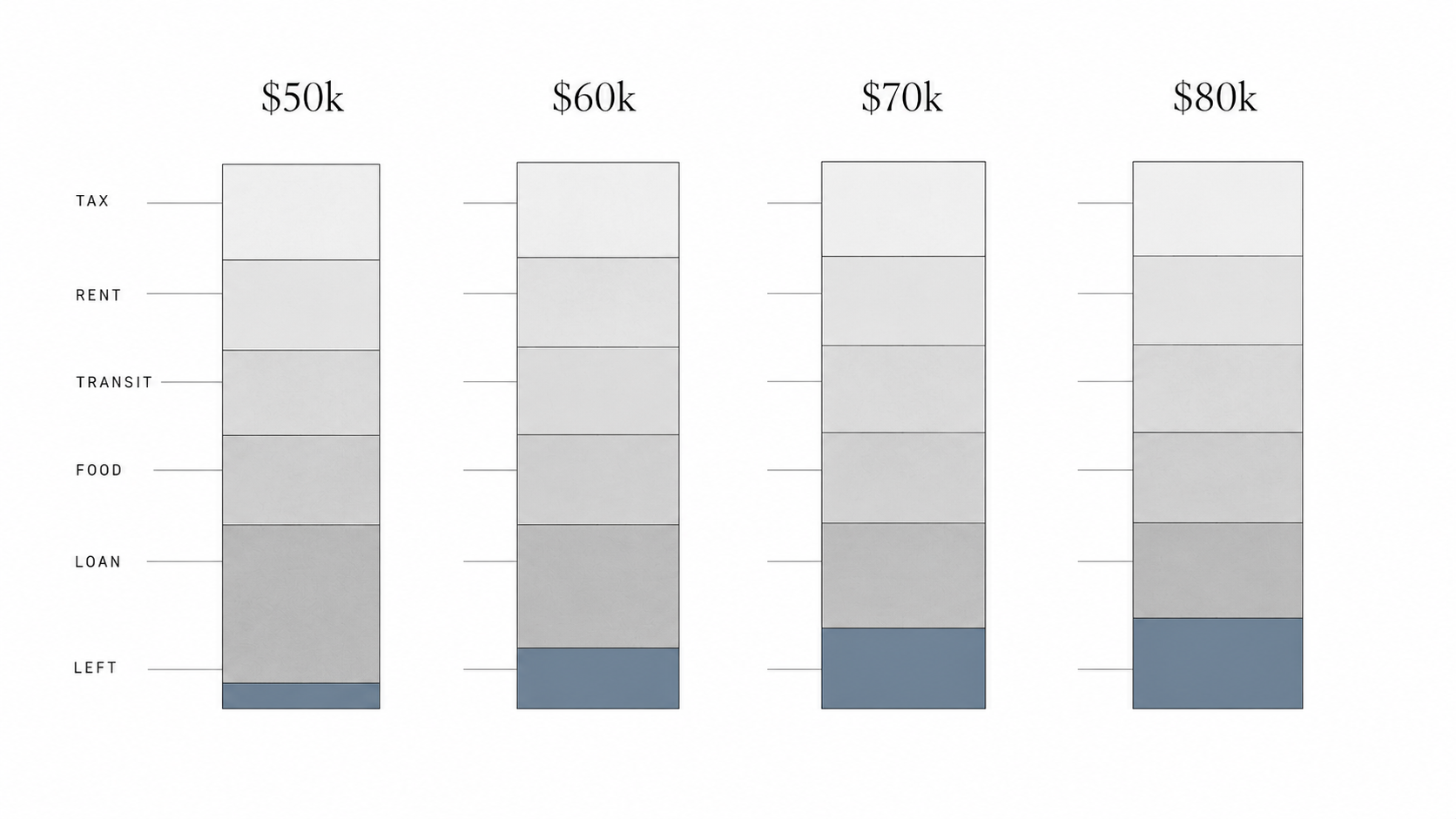
The first trap is title confusion.
Many new graduates search for “entry-level architect jobs” even though the first roles are often listed under different names. In some places, “architect” is used loosely in job ads. In others, firms avoid the title for unlicensed staff. The result is that beginners compare job listings that sound different even when the work overlaps.
| Common title | What the role often includes | What to watch for |
|---|---|---|
| Architectural designer | Modeling, drawings, presentations, plan revisions, and project support. | Strong title for early work, but it does not mean licensure or authority. |
| Junior designer | Production work, renderings, diagrams, redlines, and team support. | Can become endless support work if the office never hands over responsibility. |
| Design professional | General architecture staff role with mixed tasks. | Sometimes clean, sometimes vague on purpose. |
| Intern architect | Early-career work under supervision, often tied to licensure progress. | Some firms still use it loosely, and some do not use it at all. |
| Drafting or BIM support | Documentation, model work, details, standards, and drawing cleanup. | Useful skill path, but not always a direct design track. |
This is why salary comparisons get sloppy. A weak office may advertise a low-paid “architectural designer” role that is really heavy drafting. Another office may pay more for the same title because they expect stronger technical ability and more responsibility.
What beginners actually do in the first job

Most beginners do not start by designing iconic buildings.
The first architecture job usually means production work. That can include drawing revisions, wall types, door schedules, dimension cleanup, code research, consultant backgrounds, simple details, rendering support, redline corrections, permit packages, and Revit or CAD work that makes the project usable for the rest of the team.
That may sound less glamorous than architecture school. It is. But it is also where many people finally learn how buildings get put together.
| Task | Why beginners get it | Why it matters |
|---|---|---|
| Redline revisions | It teaches accuracy and standards. | Small drawing mistakes can become field mistakes later. |
| Revit or CAD production | Firms need useful output fast. | Software ability often matters more than school prestige in the first hire. |
| Code and zoning support | Beginners can help gather rules and organize requirements. | Bad code assumptions can trigger permit delays or redesign. |
| Presentation support | Firms still need diagrams, renderings, and decks. | Good graphics help, but they are not the whole job. |
| Detail and documentation support | It builds technical judgment. | This is where office work starts to become real architecture, not just studio imagery. |
A first job is usually better when it teaches more than one thing. If the office only uses you as a rendering machine or cleanup worker for years, the salary may not be the biggest problem. The slow learning path may be the bigger one.
What entry-level architects actually keep each month
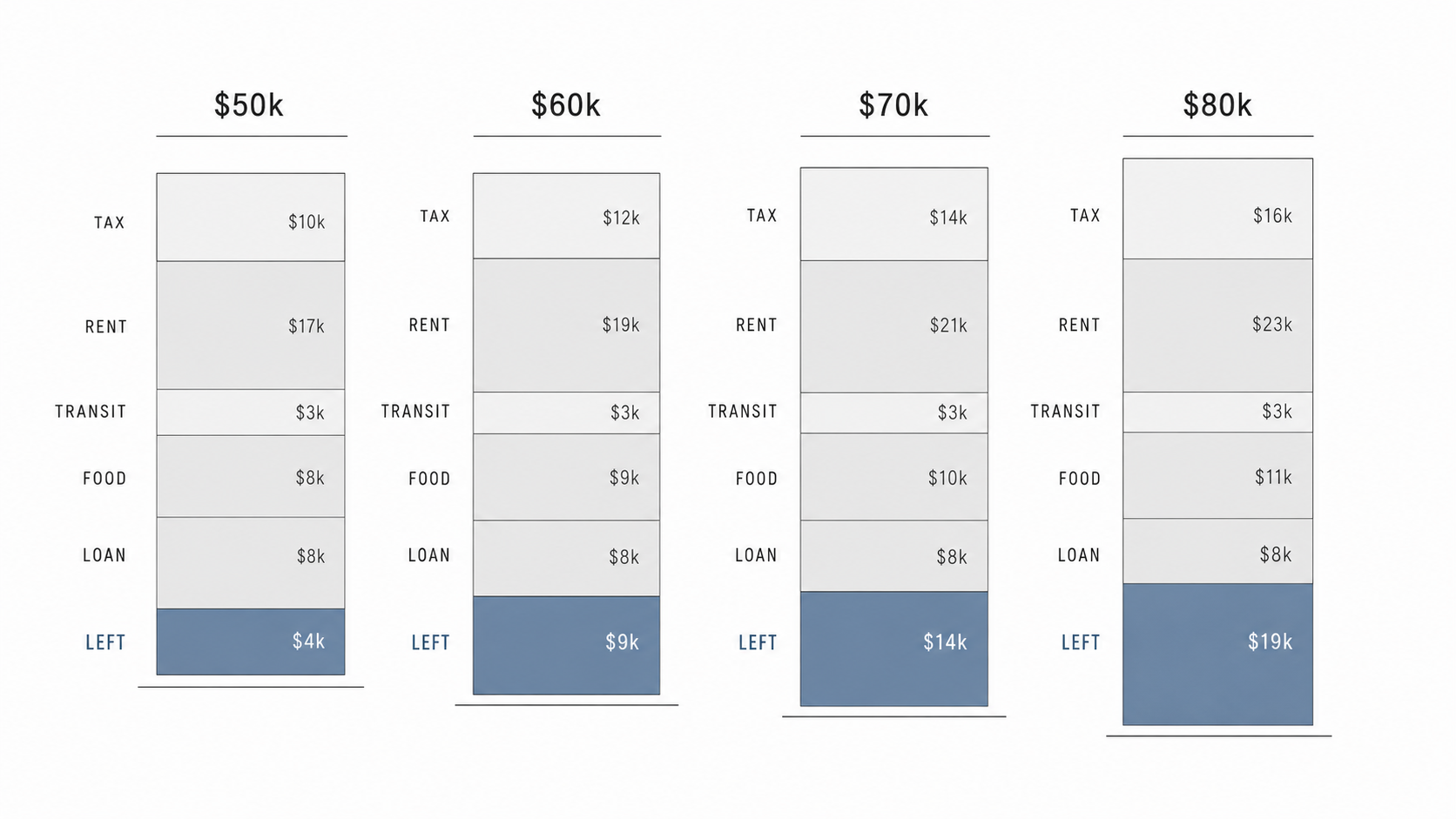
This is where the article gets more useful.
A gross annual salary does not tell you what life feels like. Taxes come out. Rent comes out. Transportation, food, health costs, and student loans come out. If the office expects long hours, the salary can feel worse because the real hourly value drops.
These are rough planning examples, not tax advice. They are here to show pressure, not pretend every person has the same exact budget.
| Annual salary | Gross monthly pay | Rough monthly take-home before insurance and retirement | Blunt read |
|---|---|---|---|
| $50,000 | About $4,167 | About $3,250–$3,400 | Tight in many cities once rent and debt show up. |
| $60,000 | About $5,000 | About $3,800–$4,000 | Decent start, but not easy if the city is expensive. |
| $70,000 | About $5,833 | About $4,350–$4,650 | Better breathing room, but high rent can still chew it up. |
| $80,000 | About $6,667 | About $4,900–$5,250 | Strong for a beginner, but not automatic comfort in top-cost cities. |
Now look at the cost side.
| Typical monthly expense | Careful version | Expensive version |
|---|---|---|
| Rent or housing | $900–$1,400 with roommates | $2,000–$3,200 alone in a high-cost city |
| Utilities and internet | $150–$250 | $300–$450 |
| Transportation | $80–$180 | $250–$500 |
| Food | $300–$500 | $650–$900 |
| Student loans | $0–$250 | $400–$900+ |
| Health, phone, basics | $250–$450 | $500–$900 |
The ugly truth is that a first architecture salary often works because people share housing, live farther away, delay savings, or accept a narrow budget for a few years. That does not mean the career is broken. It means the early stage needs realistic expectations.
Why a good first offer can still feel tight
This is the section many salary pages skip.
A good first offer can still feel bad for three reasons.
First, the city can erase it. A beginner making $68,000 in a very expensive city can feel poorer than a beginner making $58,000 in a cheaper one.
Second, debt changes the whole picture. A graduate carrying school loans may lose the “extra” money before it even feels real.
Third, unpaid overtime quietly lowers the real value of the salary. A $60,000 job looks one way at 40 hours a week and another way at 55 or 60 hours a week.
| Annual salary | 40 hours/week | 50 hours/week | 60 hours/week |
|---|---|---|---|
| $50,000 | About $24/hour | About $19/hour | About $16/hour |
| $60,000 | About $29/hour | About $23/hour | About $19/hour |
| $70,000 | About $34/hour | About $27/hour | About $22/hour |
A first job should not be judged only by gross pay. It should be judged by what the work takes from you to earn that pay.
AXP, licensure, and why the first job matters
The first job is not only about money. It is also about the path.
In the United States, licensure is controlled by individual jurisdictions, and the standard route usually combines education, experience, and examination. NCARB’s current experience program is the AXP, not the old IDP language many outdated articles still use.
That matters because a weak first job can slow down your progress even if the paycheck looks acceptable. If the office does not support your experience growth, does not expose you to real project stages, or leaves you stuck in narrow production work, the career cost can be bigger than the salary cost.
A better first office helps you build the kind of experience that counts. NCARB’s AXP requires 3,740 hours across six areas, so the first years should teach more than one narrow software task.
Architecture designer vs intern architect vs junior drafter
These roles can overlap, but they are not identical.
An architectural designer often sits closest to general early-career architecture work. The role may include design support, plans, modeling, and documentation. It can be a good starting title, but it does not guarantee licensure progress on its own.
An intern architect title usually signals a licensure-track role under supervision. Some firms use the title carefully. Others barely use it at all.
A junior drafter or BIM support role may be more technical and production-heavy. That does not make it low value. In fact, some beginners grow faster because they learn drawing discipline early. But if the role never expands beyond repetitive cleanup, it can become limiting.
The smart question is not “Which title sounds best?” The smart question is “What will I actually do, who will review me, and will I leave this role more valuable than I entered it?”
Landscape architecture and planning are different paths
This page should stay focused on architecture, but it helps to clear up related paths.
Landscape architecture is a separate profession with its own scope, training path, and salary picture. Urban planning is another separate field with its own degree patterns and job structure. They are not the same thing as entry-level architect jobs, even if students sometimes compare them while deciding on a direction.
If someone is deciding between those paths, the decision should be based on the work itself, not only the paycheck.
First-job red flags
A weak first offer is not always the lowest salary. Sometimes it is the offer that sounds respectable until you read the details.
- The salary is vague until late in the process. That often means the number is not strong.
- The title sounds junior, but the responsibility sounds heavy. That is a warning sign.
- The office expects long hours but avoids saying so clearly. A healthy office can explain workload honestly.
- There is no clear mentor or review structure. A beginner without guidance can stay cheap and confused for too long.
- The firm wants strong software, strong design, strong technical work, and full flexibility for low pay. That is usually overreach.
- The office offers “prestige” instead of support. A famous name can help, but it does not pay rent.
- The role does not help licensure progress if licensure is your goal. That can cost you time later.
What to ask before accepting an entry-level architecture job
Do not stop at “What is the salary?” Ask what the salary has to survive.
Ask what a normal week looks like
Not the polished answer. Ask what happened on the last deadline. Did people work late? Did they work weekends? Was the team understaffed? Did junior staff get buried?
Ask who reviews your work
A first job is much better when someone experienced is actually teaching, not just marking things wrong after the deadline is already close.
Ask what software and production standards matter most
If they need Revit depth, drawing accuracy, or consultant coordination support, that should be clear up front.
Ask how the role supports AXP and licensure
If you want to become licensed, ask whether the office helps you gain broad experience, log hours properly, and grow beyond one narrow task.
Ask when pay gets reviewed
“We review regularly” is too vague. Ask when, how, and what makes someone move up.
Ask what the title really controls
If the role includes site visits, consultant meetings, code research, or detail development, the salary and title should match that reality.
How to raise your pay faster without pretending
The fastest pay growth usually comes from becoming more useful, not just waiting longer.
| Skill or move | Why it helps |
|---|---|
| Revit or BIM depth | Firms pay for staff who can produce clean work with less hand-holding. |
| Technical documentation skill | Good documentation reduces confusion and makes you harder to replace. |
| Code and permit awareness | Early technical judgment saves time and builds trust. |
| Construction exposure | People who understand field conditions often become more valuable faster. |
| Licensure progress | It does not fix salary instantly, but it strengthens the long path. |
| Changing firms when growth stalls | Sometimes the raise is not in the current office. |
The goal is not to become a superhero junior employee. The goal is to become the kind of early-career architecture worker who solves real problems instead of only needing assignments handed down.
FAQ
What is a good entry-level architect salary?
A good entry-level architecture salary depends on city, debt, hours, and training value, but many beginners look for something around the upper-$50,000s into the $60,000s or more. A lower salary may still be workable in a lower-cost area if the role teaches well and supports licensure.
Is $50,000 too low for an entry-level architecture job?
In many markets, it is on the weak side, especially if rent is high or the office expects long hours. It may still be workable in a lower-cost area, but the training value needs to be strong to justify it.
Do entry-level architects make the BLS median salary?
No. The BLS median wage for architects reflects the profession broadly, not only first-job workers. Beginners typically earn less than that number.
What title should I search for if I want an entry-level architect job?
Search several titles: architectural designer, junior designer, design professional, intern architect, and BIM or drafting support. The real work matters more than the exact wording.
Does licensure raise salary right away?
Sometimes, but not always immediately. Licensure matters most when it comes with wider responsibility, stronger trust, and the ability to handle more of the project.
Is a high salary in a major city always better?
No. A bigger salary in a high-rent city can leave less money than a smaller salary in a cheaper market. Cost of living changes the answer.
Should I take a lower salary for a famous firm?
Only if the trade is clear and worth it. A famous office can help your resume, but low pay, weak mentoring, and heavy hours can damage the value fast.
What matters more than salary in the first job?
Mentorship, drawing standards, technical growth, licensure support, and workload honesty matter almost as much as salary. A first job shapes your next few years.
Read This Next
If you want the broader career picture before judging the salary, read architectural career.
If you are trying to understand licensure and the long path after school, read how to become a licensed architect.
If you want to compare beginner pay logic with a high-cost market salary page, read architect salary in New York.
References
Sources used for this article
- U.S. Bureau of Labor Statistics: Architects, Occupational Outlook Handbook
- U.S. Bureau of Labor Statistics: Landscape Architects, Occupational Outlook Handbook
- U.S. Bureau of Labor Statistics: Urban and Regional Planners, Occupational Outlook Handbook
- NCARB: How to Earn Your Architecture License
- NCARB: AXP Experience Requirements