
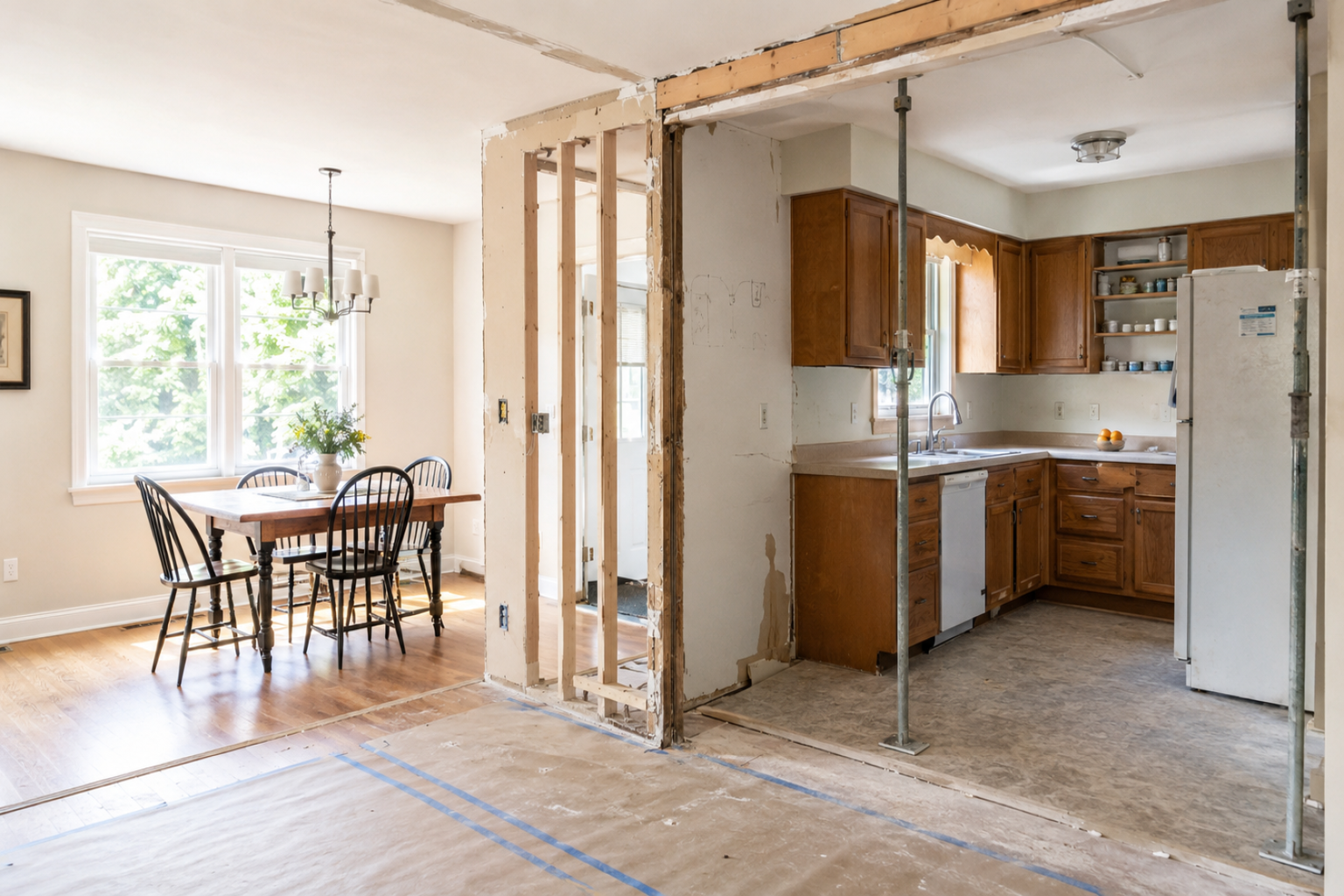

Stand in a closed-off kitchen for a week and the conclusion writes itself: tear down the wall. Contractors hear it constantly. The kitchen feels dark and boxed in, the dining room sits half-used on the other side, everyone crowds into the kitchen anyway — so why not open it up and let the two rooms become one.
A lot of the time that instinct is right. But “tear down the wall” is not a decorating decision, and the wall rarely comes out as cleanly as the daydream. It may be carrying roof or floor load. It may be full of wiring, a plumbing vent, a duct, or switches that run other rooms. And even when it is a plain partition, pulling it out leaves a strip of missing floor where the two rooms used to meet — which is how a one-day demo turns into relaying the flooring across both rooms.
So the first question is not “can I knock this wall out?” It is: what is the wall doing, what replaces it, and will the new room actually cook and eat better than the two old ones did?
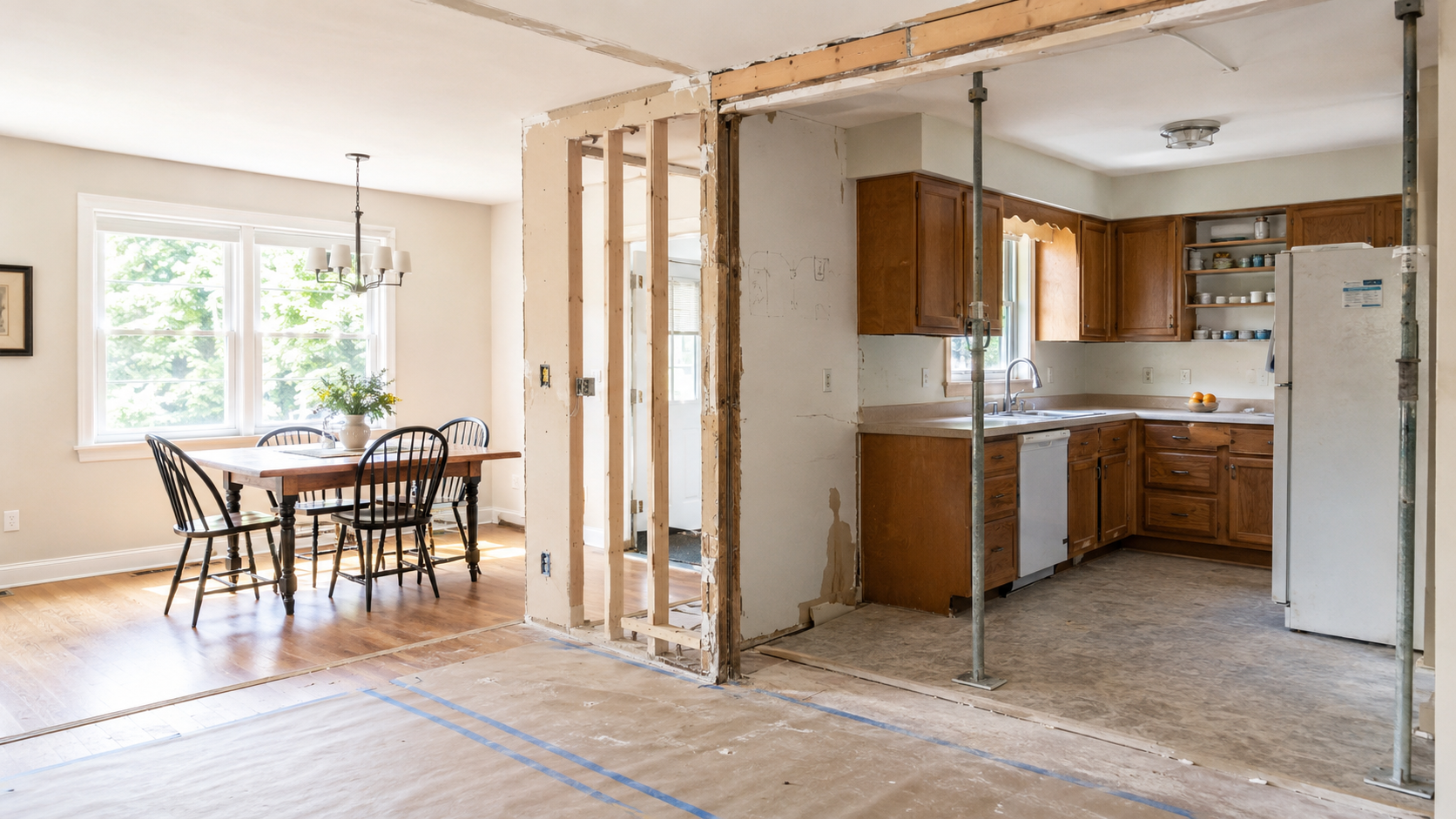
First: Is Wall Removal Actually the Right Fix?
A closed-off kitchen can feel dark, cramped, and cut off, and wall removal looks like the obvious cure. Sometimes it is. Often the wall is only one part of why the room feels bad.
Half the kitchens I look at have a lighting problem, a heavy bank of upper cabinets, a doorway that is too narrow, an oversized island, or a dining table parked in the wrong spot — and the wall gets blamed for all of it. Leave those problems in place and you end up with a bigger room that still works badly. So before committing to full removal, weigh the real options:
- Keep the wall and fix the light: lowest structural risk, usually the cheapest.
- Widen the opening: better flow without erasing the room boundary.
- Cut a pass-through: more connection while keeping storage or wall function.
- Build a half wall: keeps some separation and can hold seating, cabinets, or switches.
- Remove the wall fully: the strongest open-concept result, and usually the most involved.
Full removal is the right call only when the structure, the cost, the layout, and the finish repairs all line up. It is not the default just because it is the biggest move.
Kitchen/Dining Wall vs. Kitchen/Living Wall
People lump these together, but they cause different problems, and the difference is the whole reason this page exists.
A kitchen-to-dining wall is mostly about everyday use: meal flow, where the table sits, how the floors meet, and how connected the kitchen feels while you are actually cooking and eating. A kitchen-to-living wall is about sightlines and noise: the TV wall, the furniture layout, cooking mess and sound carrying into the room where people relax. They are not the same project, and opening the wrong one can solve a problem you did not have while creating one you did.
| Wall Location | Main Goal | Common Problem After Removal |
|---|---|---|
| Kitchen to dining room | Better meal flow, more daylight, easier entertaining. | Flooring patch, lost cabinet wall, table crowded against the island. |
| Kitchen to living room | Bigger open-concept family space. | Noise, cooking clutter on display, awkward post, poor furniture layout. |
| Kitchen to dining and living together | Full open-plan transformation. | Larger beam, more ceiling repair, lighting confusion, less wall storage. |
This page is about the first one. If your wall opens to the living room, the noise-and-mess side of it is covered in open-concept kitchen mistakes.
Yes, You Still Have to Check What the Wall Is Doing
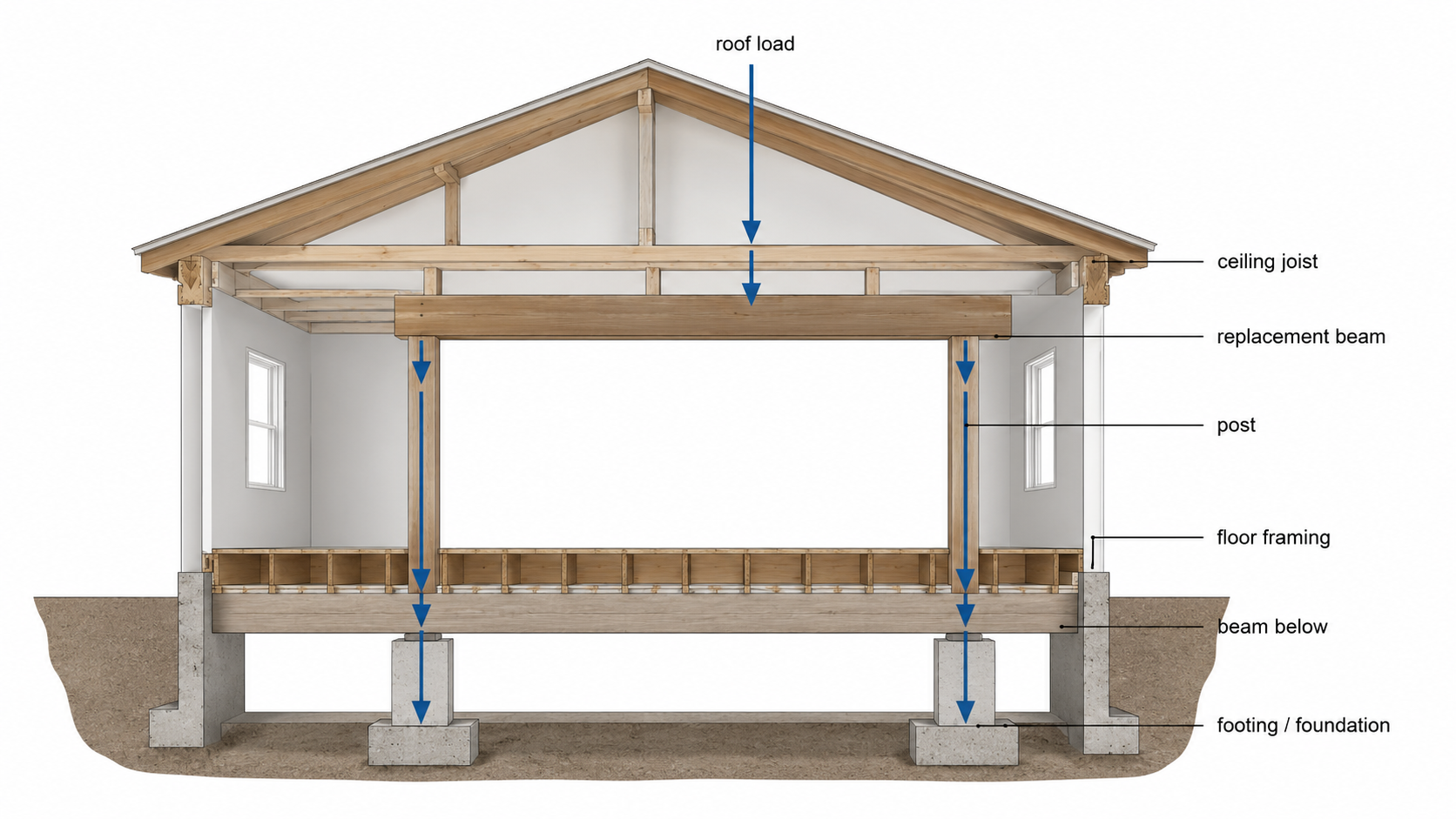
Before any of the layout fun, the wall gets one sober look: what is above it, inside it, and below it. You cannot confirm a load-bearing wall from a single clue — a header, a stud pattern, a wall thickness all help, but none of them prove the full load path on their own.
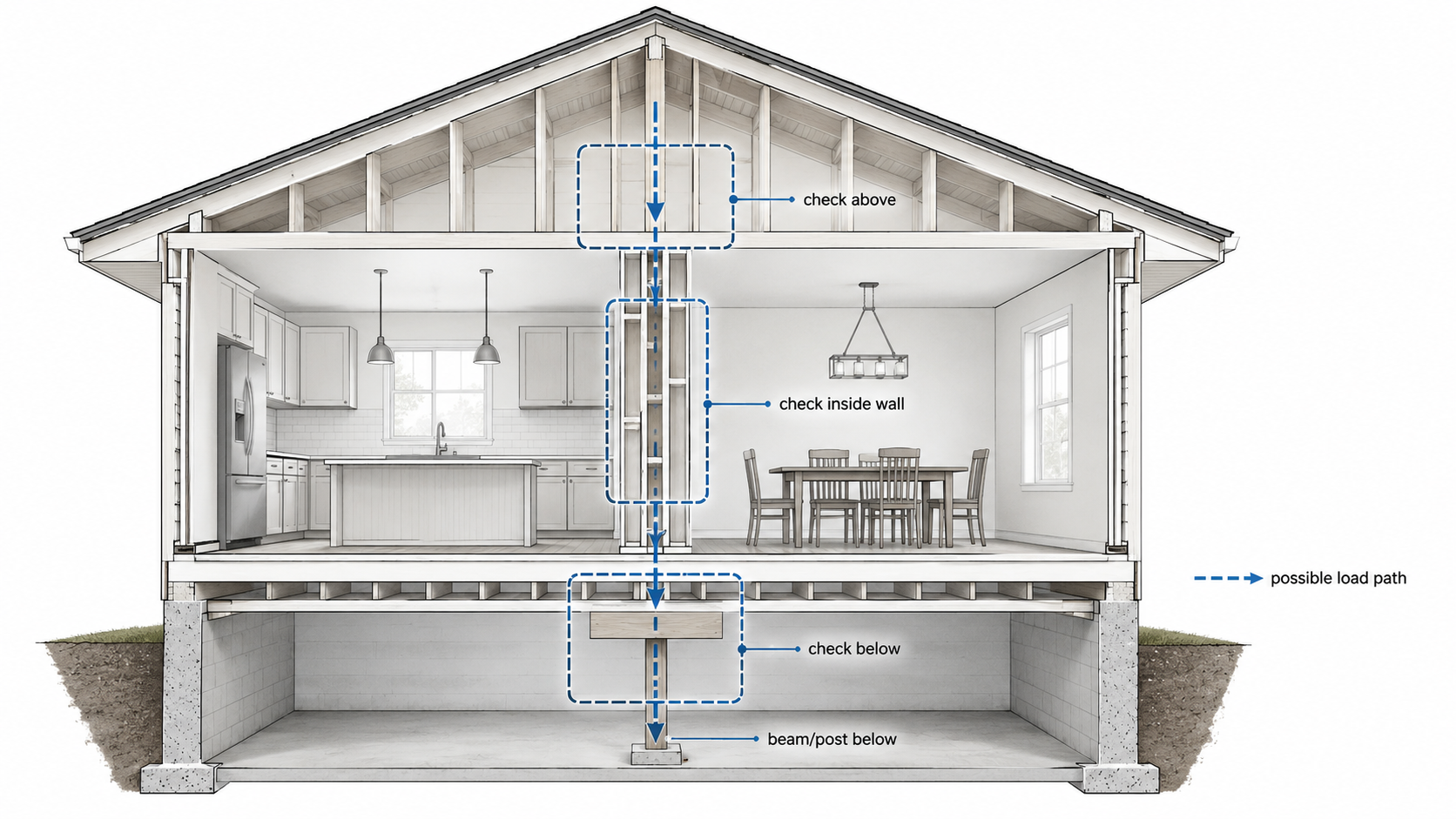
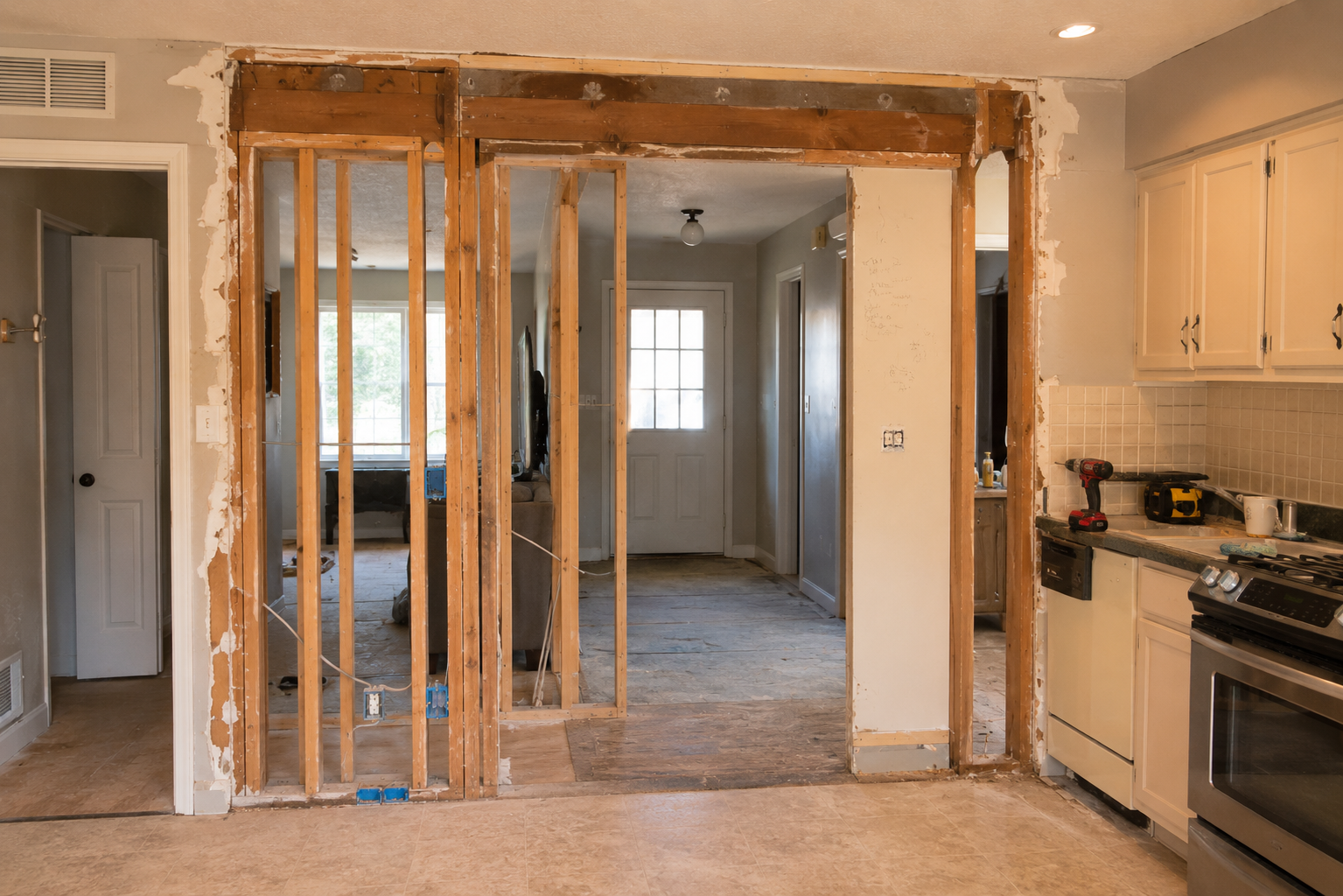
Opening up a section of the wall helps — you may see studs, headers, wiring, old patches, or doubled framing — but it is one piece of evidence, not the verdict. The real question is where the load comes from and where it lands, and a single-story house is not automatically safe just because there is no second floor. Roof load still has to land on something. The full diagnostic workflow lives on how to tell if a wall is load-bearing in a single-story house — run that before you price anything.
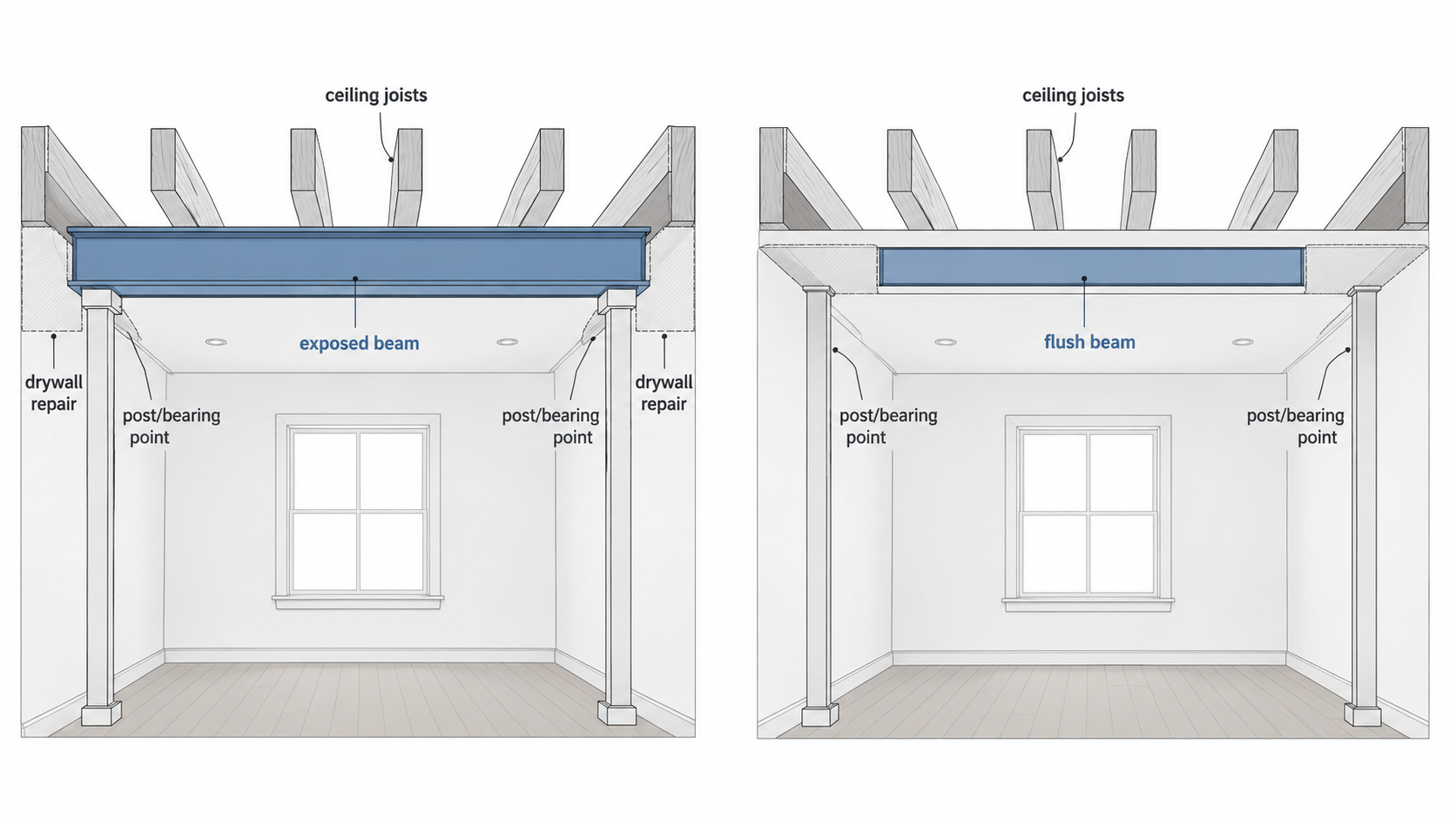
If it turns out to be bearing, removal means a beam with proper support at both ends, and possibly temporary shoring, an engineered beam, posts, a permit, and inspection. The beam can sit below the ceiling as an exposed beam, or be recessed flush so the ceiling stays flat — and flush almost always costs more, because the work moves up into the framing and drywall. None of that is unique to a kitchen, so I will not re-explain it here; the full money side is on load-bearing wall removal cost.
The one structural thing that is really a kitchen-layout decision is the post, so it gets its own section below.
The Layout Is the Real Project
Here is where a kitchen/dining opening is actually won or lost. The wall coming down is the easy day. Making the island, the table, the walkway, the beam, and any post agree with each other is the hard part, and it is the part people skip until it is too late to change cheaply.
The post lands where you wanted to sit
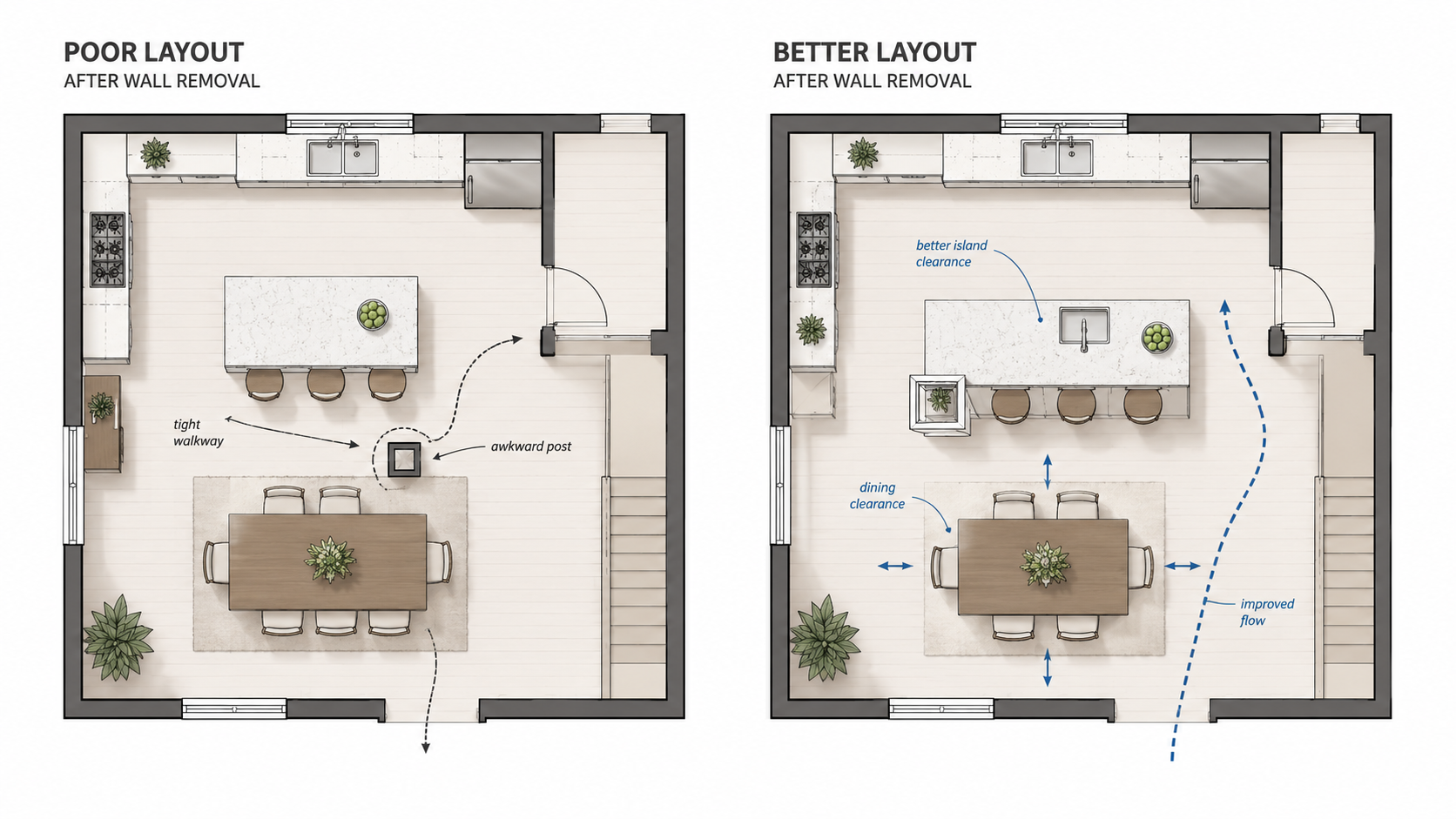
If the wall is bearing and you want a wide opening with no post, that load has to go somewhere — a bigger beam, a steel beam, more engineering, or new support below the floor. Fine. But the place a post wants to land is very often the exact place you wanted island seating, a clear walkway, or a sightline to the table. A post is not just a design request you can wave off; the load is real. So decide early. A post you plan for can disappear into an island end, a cased opening, a short partition, or a run of cabinetry. A post everyone pretended would not exist is the one that ends up marooned in the middle of the room.
Plan the island and the table before the wall, not after
The island usually becomes the new center of gravity once the wall is gone, and it quietly eats the room. Mark the real clearances first — the refrigerator and oven door swings, the walkway from the back door, the chairs pulled out from the dining table, the stool overhang. The most common version of this gone wrong: the table ends up jammed against the island because the opening was planned around the wall instead of around how people move through to eat. The table needs pull-out room, a walking lane, and lighting that still makes sense once the two rooms read as one.
The floor seam is the kitchen/dining special
This is the one that surprises people most, and it is specific to this opening. The kitchen and the dining room very often have different floors — tile on one side, hardwood or laminate on the other — and the old wall was hiding the seam. Take the wall out and you are left with a strip of missing floor right down the line where they met, plus two materials that were never meant to touch. I have watched a structurally trivial partition turn into a four-month job for exactly this reason: the only clean fix was pulling up both floors and relaying a single material across the whole space.
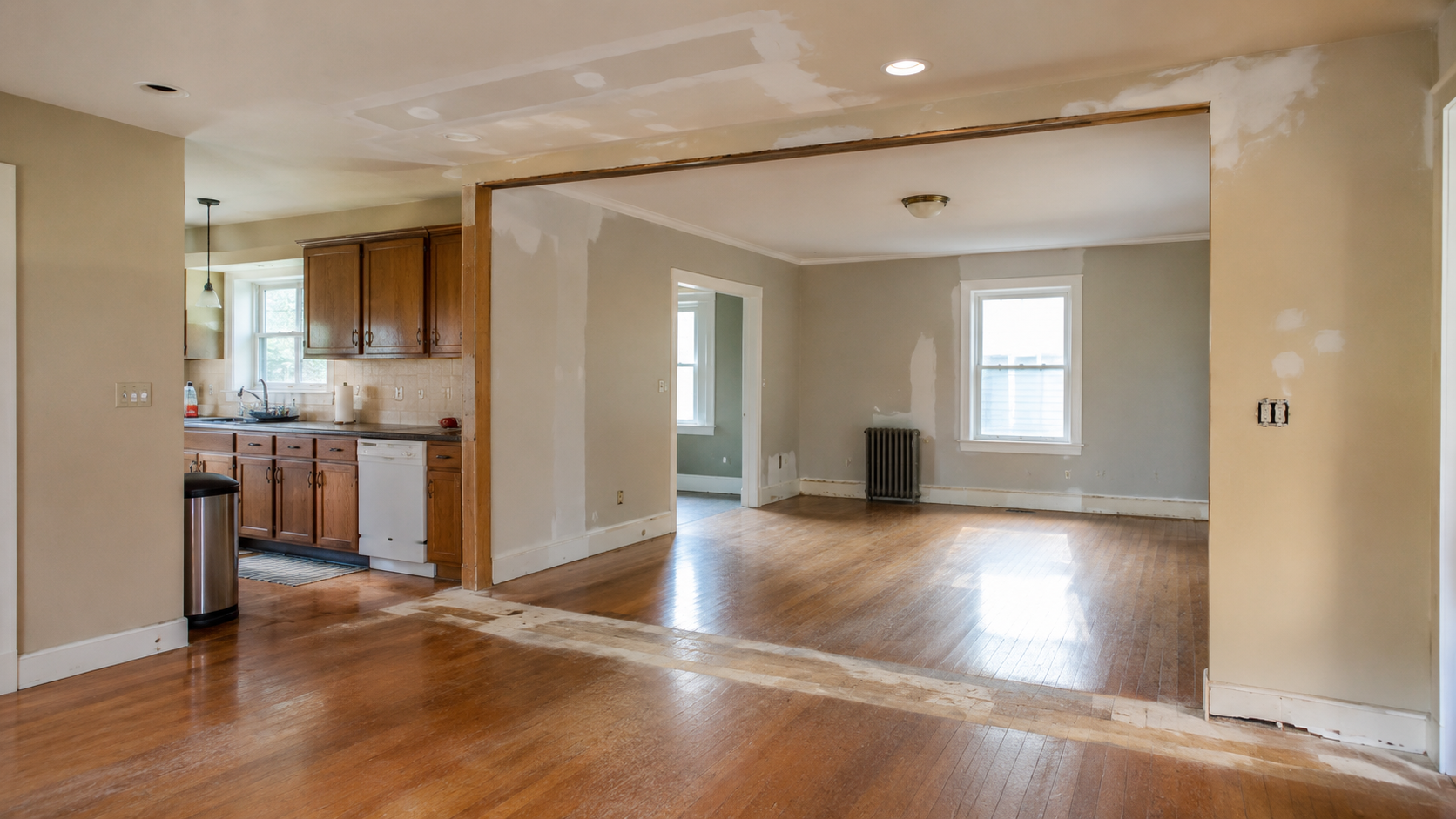
Price the floor before you celebrate the wall. The same goes for the ceiling line, the old wall’s paint and trim edges, and the lighting that was laid out for two separate rooms and now lands in odd places. In an older kitchen and dining room, the finish work is frequently the part everyone actually sees — and the part the original quote glossed over.
The Wall Is Probably Not Empty
Even a non-bearing kitchen wall tends to be busy inside: switches that run several rooms, outlets on both faces, a plumbing vent from a nearby sink, an old radiator or HVAC line, a return-air path in the cavity, or patched framing from a remodel two owners ago. None of that is a reason to cancel the project. It is a reason to budget it honestly, and to get the quote to separate structure, utilities, and finish work into three numbers instead of one vague one. When everything hides inside a single figure, you cannot see where the risk is — and the full breakdown is on load-bearing wall removal cost.
When to Stop and Call an Engineer
Bring in an engineer or qualified structural pro when the wall may be bearing, the span is long, the roof framing is unclear, there is a second floor above, a post has nowhere obvious to land, or you want a flush, no-post opening. Stop and get eyes on it if you see any of these:
- cracks in the ceiling near the wall,
- doors that have started rubbing nearby,
- visible sag,
- old patched framing,
- trusses or roof framing you do not understand,
- a beam or post line directly below the wall,
- a vaulted or cathedral ceiling.
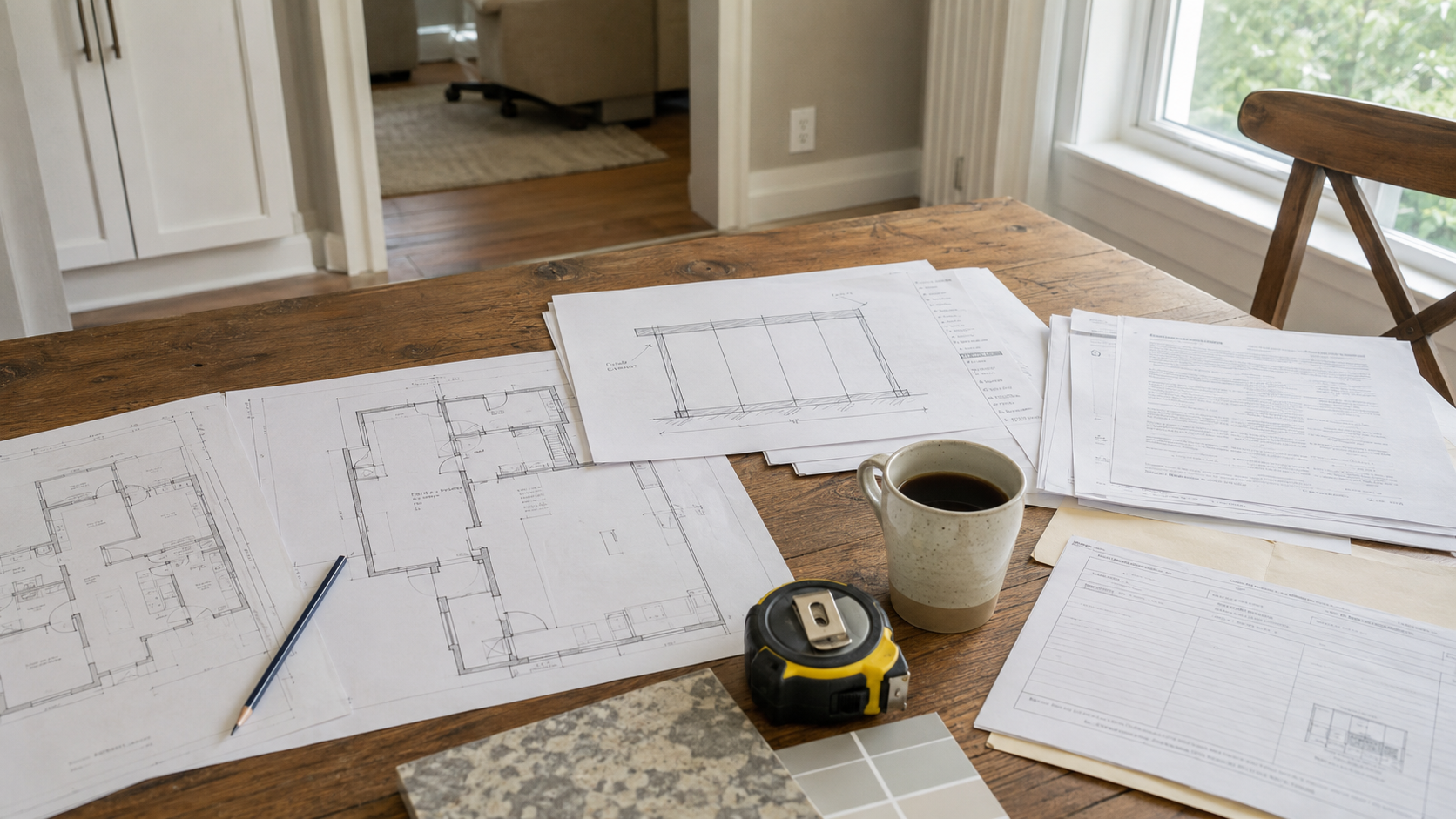
The engineer is not there to make the job harder. They are there to say exactly how the load travels once the wall is gone — which is the one question you do not want to answer by guessing.
Bottom Line
Opening the wall between the kitchen and dining room can be one of the best decisions in an older house. Just do it in the right order. Confirm what the wall is carrying. Settle the beam and whether you can live with a post. Then — before the wall comes down — plan the island, the table, the walkway, the lighting, and the floor seam, because in a kitchen/dining opening those are the parts that decide whether you actually like the room.
The best open kitchen is not the one with the biggest hole in the wall. It is the one where the structure, the budget, and the way you cook and eat all agree.