

A 2000s Tuscan kitchen is dated when it gets too heavy, not because warmth itself is wrong. Dark cherry cabinets, brown granite, travertine backsplash, bronze fixtures, and gold-beige walls can make the room feel stuck in the early 2000s when every surface pushes in the same direction.
That matters more now because the warm Tuscan idea is coming back. Not the overloaded builder version with sponge-painted walls, heavy bronze lights, and busy granite fighting for attention. The cleaner version is lighter, calmer, and more natural: warm stone, softer plaster-like walls, simpler metal finishes, better daylight, and fewer fake old-world details.
So the job is not to erase the kitchen into a cold white box. The job is to edit the weight. Keep the warmth that still works, remove the parts that make the room feel muddy, and spend money in the right order so the kitchen does not end up trapped between two eras.
Where the 2000s Tuscan Kitchen Look Came From
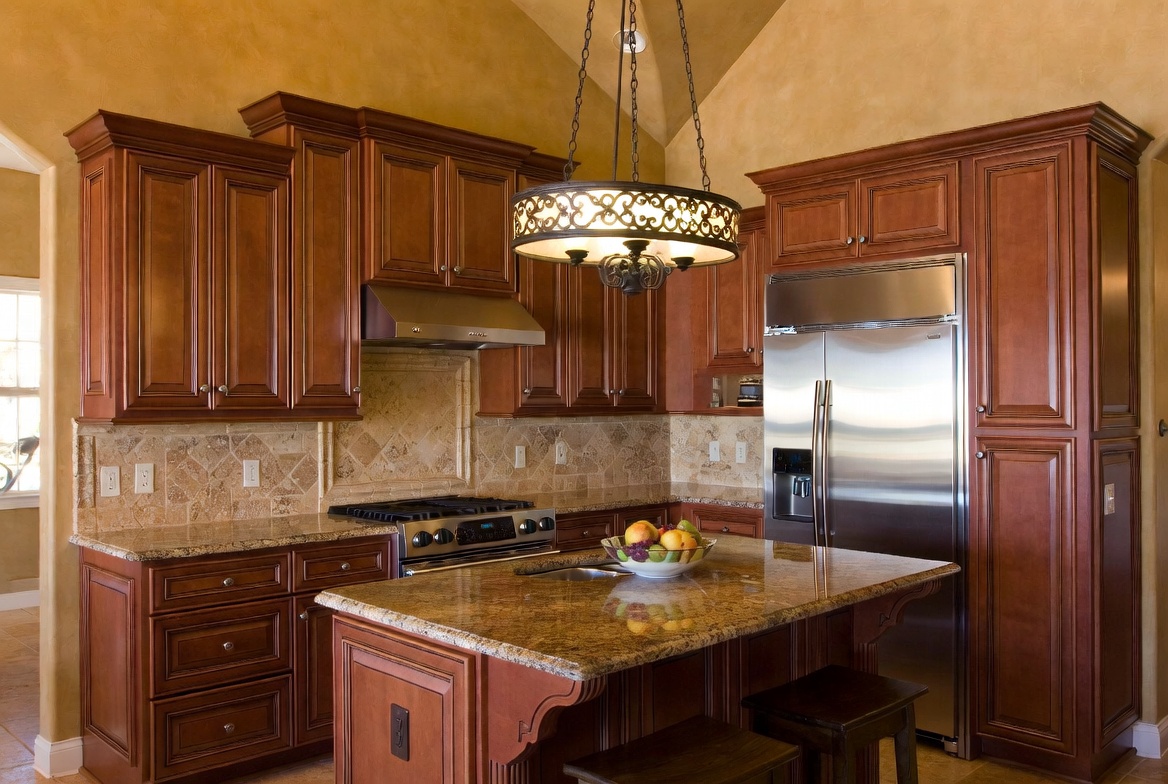
The American 2000s Tuscan kitchen was not a careful copy of old Italian houses. It was a builder and remodeling package. Dark stained cabinets, granite counters, stone tile, bronze fixtures, arched details, corbels, scrollwork, and warm wall color all worked together to create a heavy “old world” look.
In a large kitchen with high ceilings and strong daylight, that look could hold up better. In a smaller kitchen, or one with only one window, the same finishes could make the room feel brown from every angle.
The most common version had five or six strong materials competing at once: cherry or espresso cabinets, brown granite, a travertine or tumbled stone backsplash, beige tile floor, oil-rubbed bronze hardware, and yellow, tan, or gold wall paint. That is why the room can feel dated even when nothing is broken.
Why the Warm Tuscan Look Is Coming Back
After years of cool gray, flat white, and minimal kitchens, warm materials are getting attention again. Tuscan-style kitchens are part of that swing because they offer something colder remodels often removed: warmth, texture, stone, wood, patina, and a room that feels lived in.
That does not mean a 2000s kitchen is suddenly current as-is. The revived version is lighter and more edited: muted terracotta instead of gold, honed stone instead of shiny speckled granite, simpler brass or bronze instead of heavy oil-rubbed fixtures, and plaster-like walls instead of faux finishes.
The warmth stays. The weight goes.
For this kind of kitchen, that changes the remodel plan. Ripping everything out can waste good materials and leave the room colder than the house wants. A better update removes the heavy layers first and protects the parts that are coming back into favor.
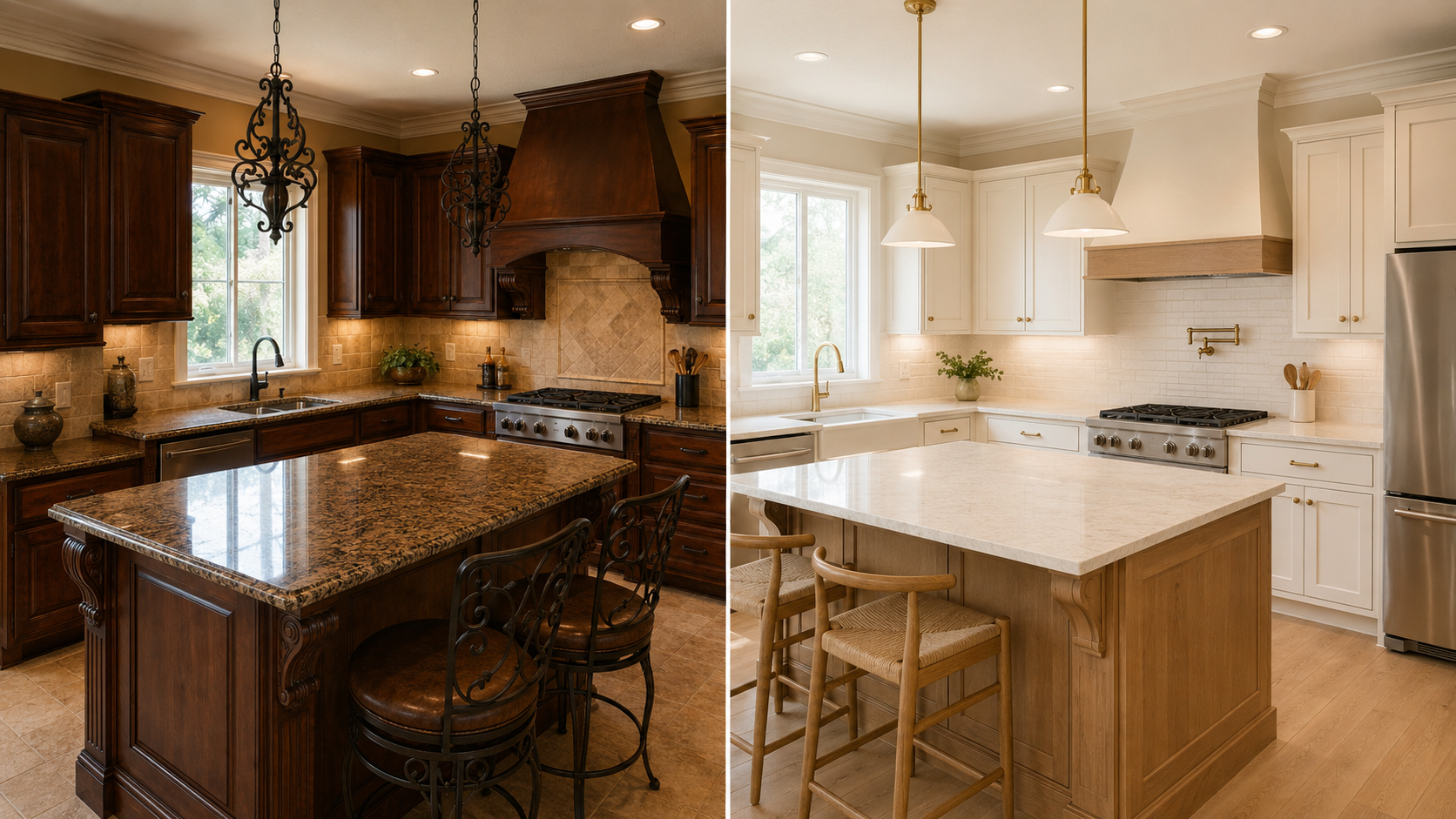
Travertine is the clearest example. If it is cracked, stained, badly installed, or fighting every other finish, replacement may make sense. But if it is in good condition, it may be better treated as one warm color in the palette instead of a mistake that has to be demolished.
What Dates a 2000s Tuscan Kitchen First
The first thing that dates the room is the color stack, not the dark cabinets alone and not the granite alone. The problem is that everything lands in the same muddy middle-brown: cabinets, counter, backsplash, floor, and walls all sit in one warm tone with no contrast to break it up.
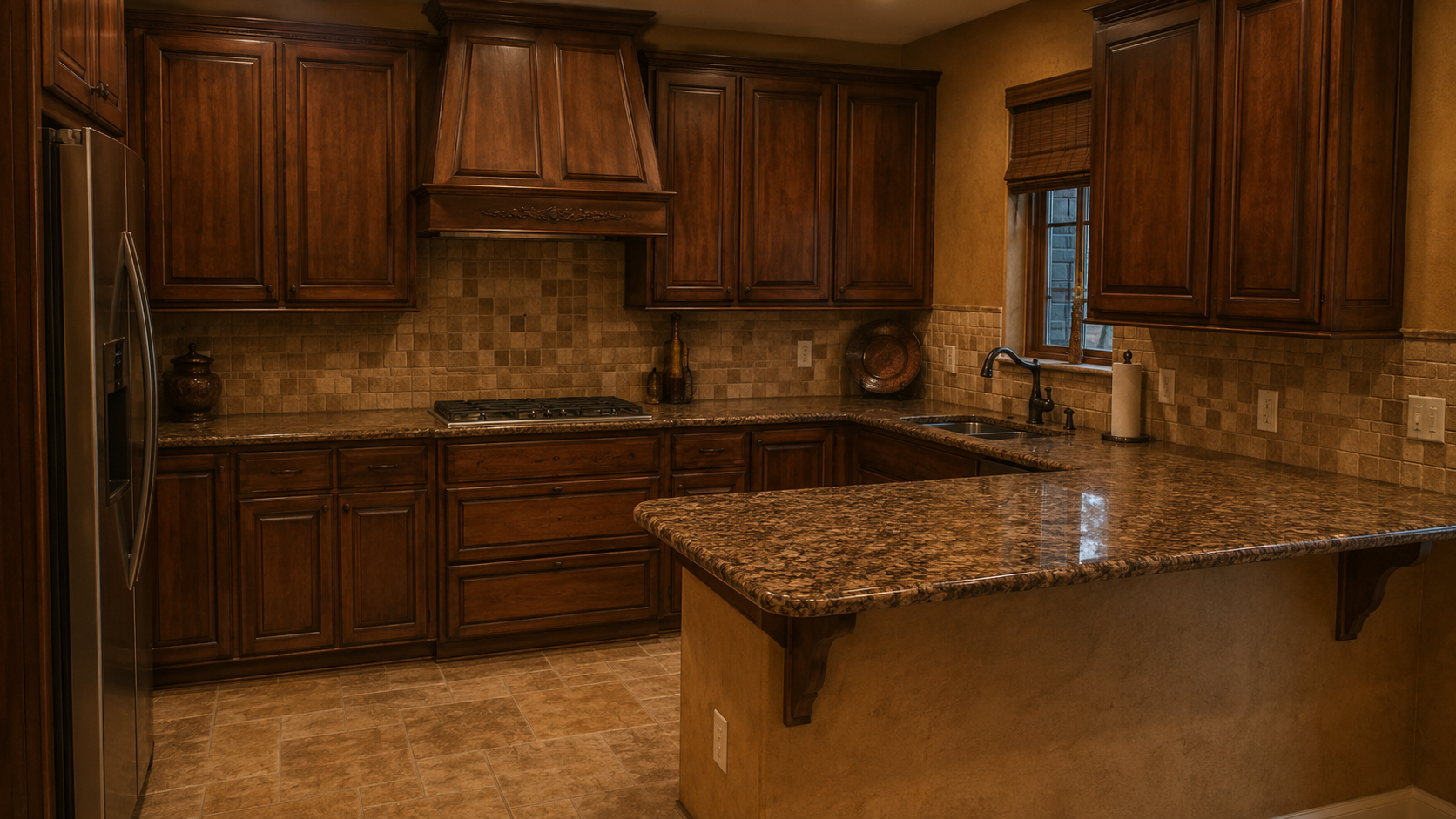
Look for these clues:
- Busy brown granite with gold, black, cream, red, or green movement, including stones like Baltic Brown, Tropic Brown, Santa Cecilia, and Uba Tuba.
- Dark raised-panel cabinets, often cherry, reddish brown, espresso, or glazed cream.
- Tumbled stone backsplash with uneven edges, accent tiles, or decorative inserts.
- Oil-rubbed bronze fixtures, heavy pendants, ornate chandeliers, or scrollwork.
- Warm wall color, especially yellow-beige, gold, tan, or orange-toned paint.
- Old-world props, including silk grapevines, ceramic roosters, and above-cabinet displays.
One of those elements may be fine. Three or four together make the kitchen read as early 2000s. The cabinets may still be worth saving, the counter may still be usable, and the lighting may only need better color temperature and a simpler fixture. But the room needs one clear direction instead of six heavy finishes fighting to stay.
What Might Be Worth Keeping
Do not start by assuming the whole kitchen needs to be gutted. A lot of 2000s kitchens have better cabinet boxes than newer budget remodels: plywood boxes, decent storage, full-height pantry cabinets, and workable appliance locations.
The first test is not style. It is function. Keep the cabinet layout if the refrigerator, sink, range, dishwasher, trash, and main prep space already work. A pretty kitchen with bad clearances is still a bad kitchen. If the dishwasher blocks the sink path, the island is too tight, or the refrigerator door hits a wall, finishes will not fix the room.
A 36-inch walkway is often the bare minimum in a tight kitchen, and more is better near the range, dishwasher, and island seating. If the existing layout already gives you comfortable movement, keeping the boxes can save a lot of disruption.
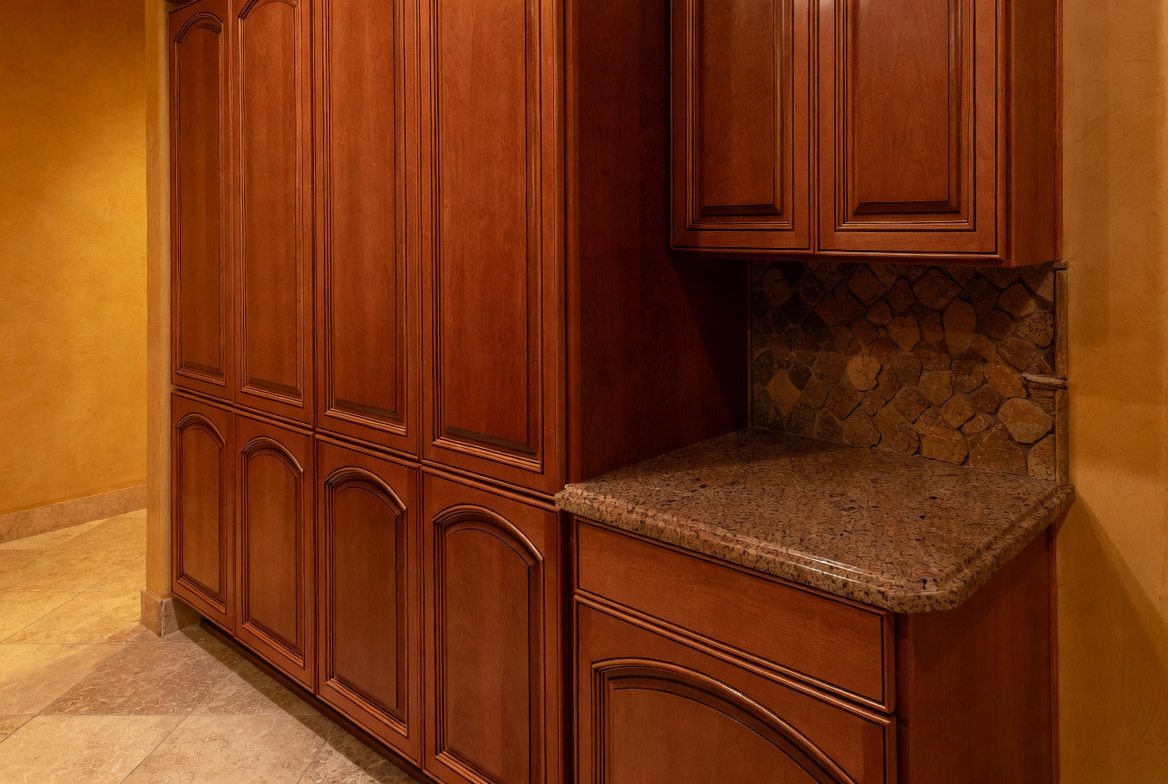
Cabinet doors matter too. Raised-panel cherry doors can look heavy, but solid doors with good hinges are not junk. If the boxes are square, the drawers work, and the layout is sound, refinishing or repainting may make sense. If the boxes are swelling, shelves are sagging, or drawer glides are failing, paint is just a delay. The same keep-or-replace logic applies to older wood kitchens, including 1990s oak kitchen cabinets.
The Update Order That Saves the Most Money
The biggest mistake is choosing cabinet color first. In a Tuscan kitchen, the cabinet color has to answer to the lighting, wall color, backsplash, counter, and floor.
Use this order:
- Fix the lighting.
- Change the wall color.
- Simplify the hardware and faucet.
- Judge the backsplash.
- Judge the countertops.
- Choose the cabinet finish last.
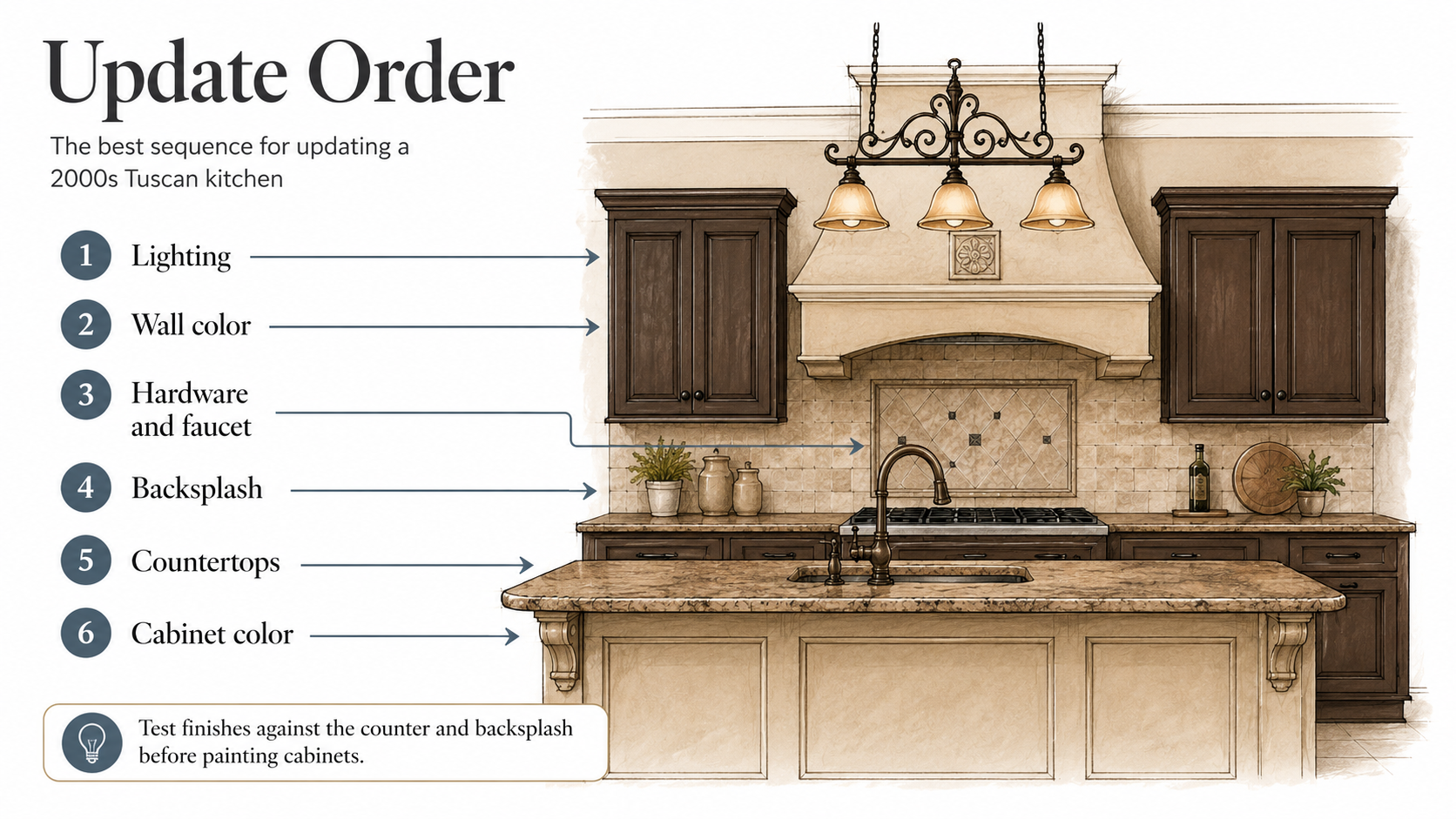
Lighting comes first because many of these kitchens still have warm bulbs, dark pendants, or undercabinet lights that make everything look orange. Test bulbs around 2700K to 3000K before choosing paint. Go too cool and the granite can look harsh. Stay too yellow and the room stays stuck.
Wall color comes next because it is the lowest-disruption change. A cleaner warm white, soft cream, muted greige, or pale taupe can pull a lot of yellow out of the room without touching the cabinets.
Hardware and faucet changes are small, but they can drop the old-world signal quickly. That does not always mean polished chrome or matte black. Simple aged brass, soft bronze, brushed nickel, or a cleaner dark metal can work if the rest of the room supports it.
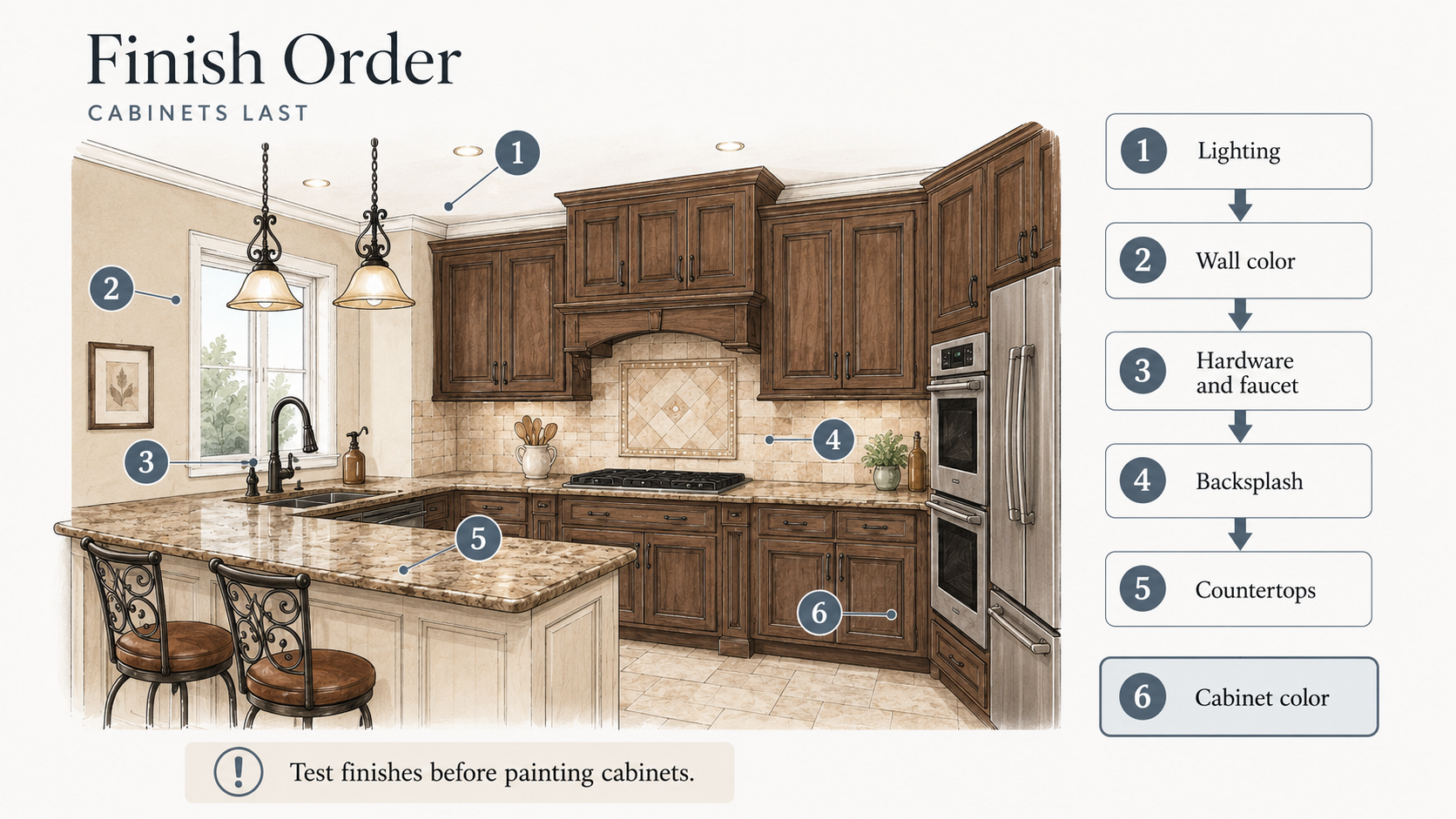
Cabinet paint comes late because it is expensive, messy, and easy to get wrong. A white that looks clean on a sample board can look chalky beside brown granite. A cream that looks warm online can turn yellow beside travertine. Test the cabinet color against the actual counter, backsplash, floor, and daylight before committing.
Brown Granite Is Usually the Hardest Constraint
Brown granite controls more decisions than homeowners expect. It can carry black, cream, gold, burgundy, green, gray, or orange inside the same slab, and those flecks affect which cabinet paint, wall color, backsplash, and metal finish will work.
This is where online inspiration can mislead you. A white kitchen with pale quartz does not tell you what will happen beside Baltic Brown, Santa Cecilia, or Uba Tuba. The counter in your kitchen is the control sample, not the photo on your screen.
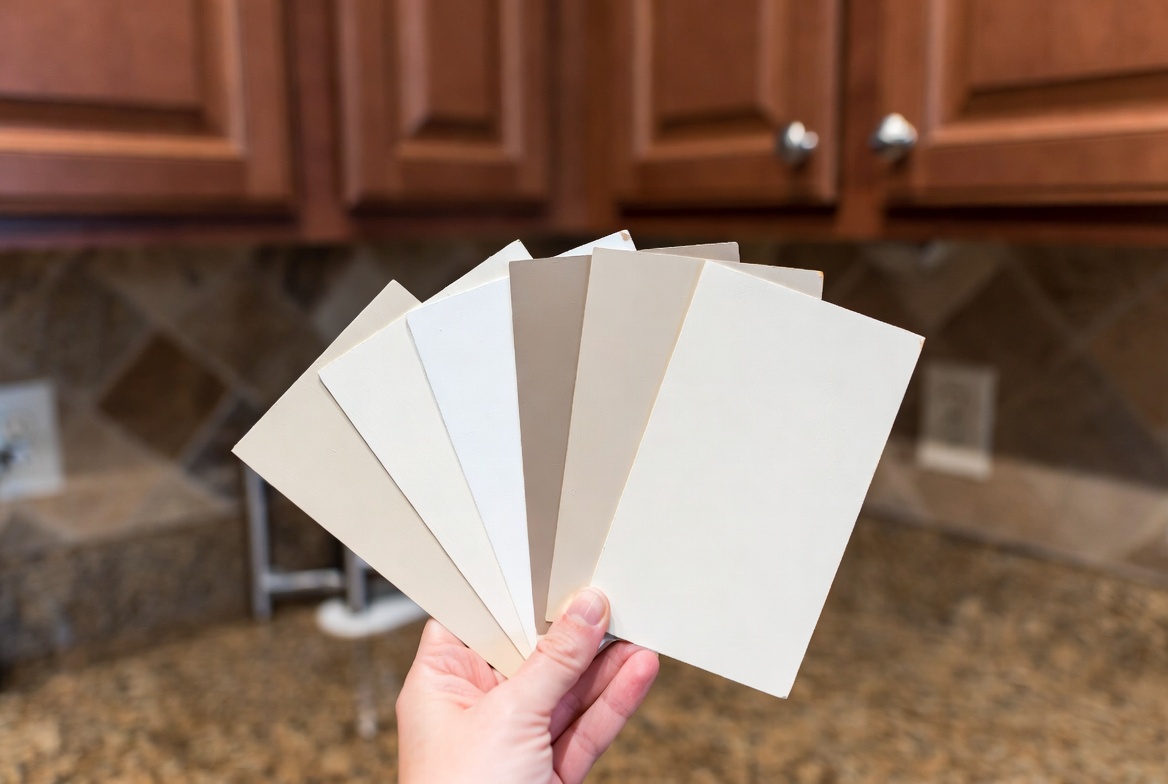
Test finishes in the kitchen for at least one full day. Morning light, afternoon light, and evening bulbs can change the same sample. A color that looks soft at noon can turn pink, green, gray, or yellow at night.
Do not test only on the wall. Put the sample beside the granite, under the cabinet, near the backsplash, and beside the floor. That is where the conflict shows up.
If the granite is the strongest visual element in the room, you have two honest choices: work with it and calm everything around it, or remove it and open the palette. Trying to ignore it creates a kitchen that feels patched together.
When White Cabinets Help and When They Make It Worse
White cabinets can help a 2000s Tuscan kitchen, but only when the other surfaces can support them. White or soft cream cabinets work better when the backsplash is simple, the counter has enough cream or light movement, the floor is not too orange, and the room has good daylight.
They fail when the granite is very dark and busy, the backsplash is tumbled stone, the floor is beige travertine, and the lighting is still heavy bronze. Then the cabinets look new, but everything around them looks older and stronger.
There is another problem: white paint can expose door style. A raised-panel cherry door may look calmer in a darker stain than it does in bright white, because paint does not erase every profile. Sometimes a softer taupe, warm mushroom, muted olive-gray, or natural-wood direction fits the kitchen better than plain white. Given the warm revival, those warmer directions may also feel more current.
Small Update, Larger Remodel, or Full Reset
A Tuscan kitchen update should match the condition of the room. A working kitchen with solid cabinets does not need the same plan as a kitchen with failing boxes, bad clearances, and worn finishes.
| Scope | What Changes | Best For |
|---|---|---|
| Light refresh | Bulbs, wall color, hardware, faucet, simple decor cleanup | A dark but functional kitchen with decent cabinets and counters |
| Mid-range update | Backsplash, lighting, sink, faucet, hardware, wall color, possible cabinet refinish | A kitchen with good layout but dated surfaces |
| Full remodel | Layout, cabinets, counters, backsplash, floor, lighting, appliance locations | Poor storage, bad clearances, failing cabinets, or a layout that does not work |
The middle option is often the sweet spot for a 2000s Tuscan kitchen: remove the most dated surface, simplify the lighting, calm the wall color, and keep the good parts.
As rough 2026 planning numbers, not quotes, repainting or refinishing cabinets professionally tends to run about $3,000 to $8,000 for a typical kitchen, new stone or quartz counters about $3,000 to $7,000 and up, and a new backsplash about $1,000 to $2,500. Lighting, hardware, and paint can land anywhere from a few hundred dollars to about $1,500. A full remodel that moves cabinets and layout climbs into the $30,000-plus range quickly. Local labor, material grade, layout changes, and hidden conditions move all of these.
A bigger remodel makes sense when the problem is not just color. If the island blocks movement, the pantry is too shallow, the range has poor ventilation, or the cabinets are worn out, surface updates will not fix the kitchen.
The Half-Finished Update Problem
This is where many Tuscan kitchen updates go sideways. One new finish gets installed, but the rest of the room stays old-world. New white quartz with the same tumbled backsplash, bronze chandelier, yellow walls, and dark ornate island does not read as modern. It reads unfinished.
The same thing happens with cabinet paint. Fresh white cabinets beside busy brown granite and a heavy stone backsplash can make the counter and backsplash look even louder. The kitchen has not been updated as a system. It has been interrupted.
The fix is sequence. Before spending on the largest item, decide which surface is controlling the room. In some kitchens it is the backsplash. In others it is the granite. Sometimes it is the lighting and wall color. Spend there first.
This is the same reason a strong kitchen before-and-after works only when the fixed surfaces agree with each other. One new finish does not carry the whole room if the old surfaces still control the light, color, and mood.
The Backsplash Often Decides the Room
A tumbled stone backsplash is one of the strongest Tuscan signals. It has texture, shadow, grout, and uneven color. Even when the tile is neutral, it can keep the kitchen looking older because it sits right at eye level.
If the backsplash has accent tiles, fruit motifs, bronze inserts, diagonal patterns, or a framed range feature, it will fight most modern updates. You can paint cabinets, change pulls, and replace lights, but the backsplash still tells the room what era it belongs to.
A cleaner backsplash does not have to be cold. Cream tile, handmade-look tile, quiet stone, soft zellige-style texture, or a simple slab can calm the wall without stripping out every warm material. The important move is to reduce noise: if the counter is busy, the backsplash should be quieter. If the backsplash is busy, the counter and cabinet color have less room to move.
What to Do With Bronze Fixtures
Oil-rubbed bronze was a major part of the 2000s Tuscan look, and it is not automatically wrong. The problem is the heavy version: dark metal everywhere, ornate shapes, curled arms, thick pulls, and oversized pendants.
If the kitchen still has warm stone and wood, a softer bronze or aged brass can work better than a hard switch to black or chrome. But the shape should be simpler. Thin pulls, cleaner pendants, and a quieter faucet keep the warmth without repeating the old look.
Do not mix too many metals at once during a partial update. Two finishes can work. Four usually looks accidental.
What to Do With Cherry Cabinets
Cherry cabinets are one of the hardest calls in a 2000s kitchen. The wood can be good quality, but the red tone can dominate the room.
First, check the cabinet construction: the boxes, hinges, drawer glides, shelf sag, water damage near the sink, and finish wear around the pulls. If the cabinets are failing, refinishing is not a rescue. If they are solid, you have options.
You can soften cherry cabinets without painting them white. Better lighting, lighter wall color, simpler hardware, and a quieter backsplash can reduce the red-brown cast. In some kitchens, the cabinets become acceptable once the yellow walls and stone backsplash are gone. If the doors are ornate and the stain is very red, painting or refacing may be the cleaner move. Just do it after the other fixed surfaces are tested.
If the kitchen sits near a 1990s or early-2000s interior with oak, brass, beige tile, or builder-grade trim, read the broader 1990s kitchen remodel advice too. The eras overlap more than clean decade labels suggest.
Best Modern Direction for a 2000s Tuscan Kitchen
The best update is usually not a cold white kitchen. A Tuscan kitchen already has warmth, and with the warm look back in style, the job is to edit the weight, not erase every warm material.
These directions tend to work better:
- Warm transitional: simpler cabinets, soft neutral walls, quiet backsplash, cleaner lighting.
- Soft Mediterranean: lighter plaster-like walls, warm wood, simple stone, fewer ornate details.
- Modern traditional: classic cabinet profiles, better lighting, calmer counters, restrained metal finishes.
- Cream and natural wood: useful when the kitchen has good daylight and the floor is not too orange.
The room should still feel like it belongs to the house. A heavy 2000s Tuscan kitchen does not need to become a sterile showroom. It needs fewer competing signals.
What to Check Before You Spend
Before ordering cabinets, counters, or tile, check the parts that can create expensive surprises.
- Cabinet height and soffits: Removing soffits can expose ducts, wiring, plumbing, or uneven ceiling repairs.
- Island clearances: A larger island may make the kitchen worse if walkways shrink below comfortable use.
- Flooring under cabinets: A cabinet layout change can expose missing tile, mismatched hardwood, or floor height problems.
- Range ventilation: A decorative hood may not mean the kitchen has good exterior venting.
Those checks matter because a finish update can turn into a construction project fast. Moving an island, deleting a raised bar, or replacing cabinets may trigger floor patching, ceiling repair, electrical work, and appliance clearance changes.
That is why the first decision is scope. If the layout works, protect it. If the layout fails, do not spend all the money making the old plan prettier.
Best First Moves for Most 2000s Tuscan Kitchens
Start with changes that reveal the room before locking into expensive work.
- Replace yellow bulbs and test better lighting.
- Paint the walls a cleaner neutral.
- Remove heavy decor, valances, and extra Tuscan accessories.
- Test hardware and faucet finishes against the counter.
- Decide whether the backsplash or counter is the bigger problem.
After those steps, the cabinet decision becomes clearer. Sometimes the cabinets need paint. Sometimes the backsplash was the problem. Sometimes the counter is driving everything.
A good 2000s Tuscan kitchen update does not chase one trend. It removes the heaviest layer, protects what still works, and keeps the kitchen from getting stuck between two eras.
Read This Next
- 2000s Kitchen Remodel: What Dates It and What Still Works
- 1990s Kitchen Remodel: What to Update First and What to Leave Alone
- 1990s Oak Kitchen Cabinets: Keep, Refinish, Paint, or Replace?
- 1990s Kitchen Before and After: What Actually Makes It Look New