
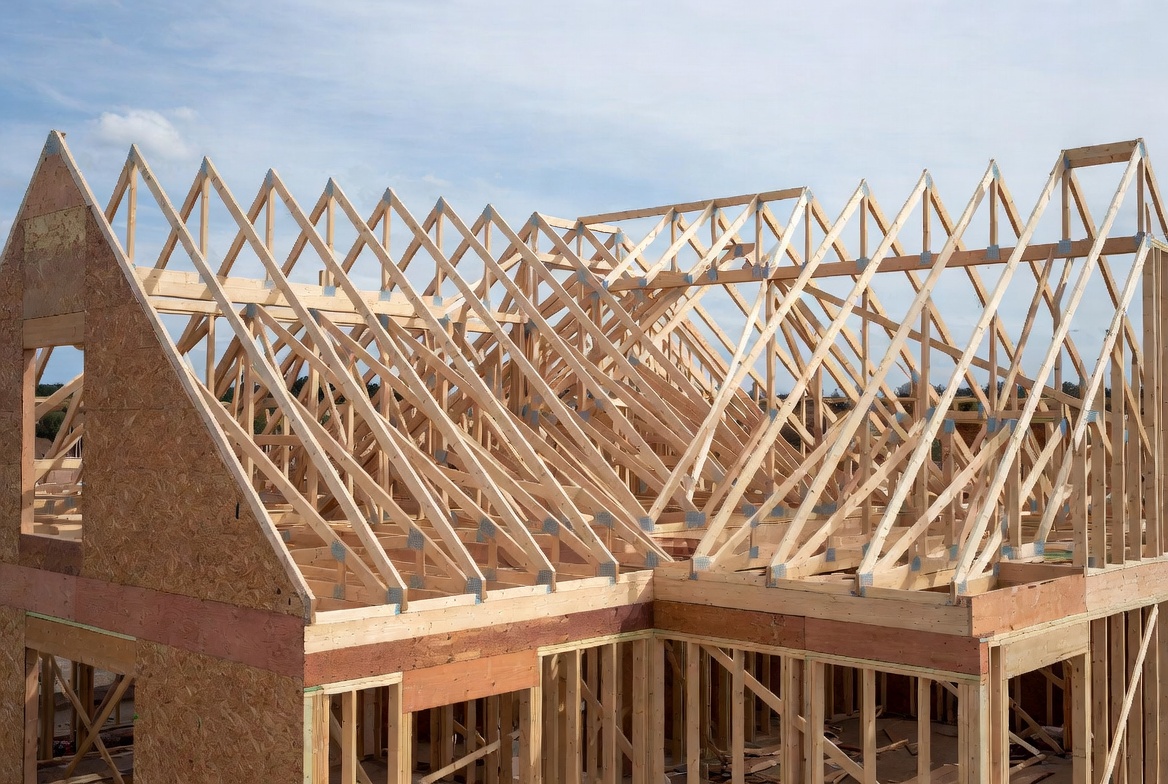
The truss choice affects more than the roof shape.
It changes span, ceiling form, bracing, load path, attic use, and how cleanly the roof goes together. Get it right and the package works. Get it wrong and the problems show up in field fixes, movement, cracked finishes, and wasted money.
Start there: common residential truss types, span limits, loading, layout, site issues, and where truss jobs usually go wrong.
What Roof Trusses Do
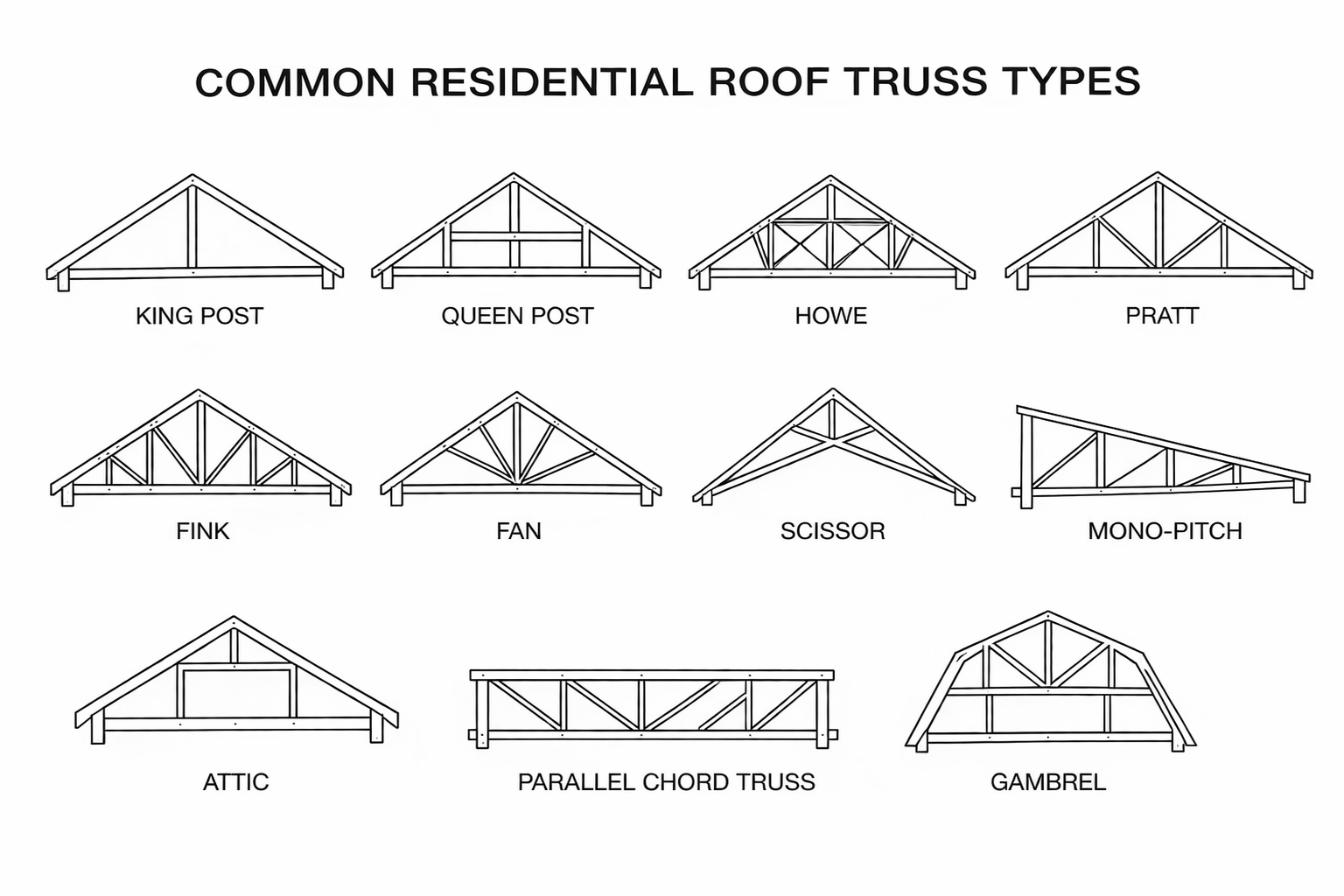
Illustration by ArchitectureCourses.org. Common residential roof truss types, including king post, queen post, Howe, Pratt, Fink, fan, scissor, mono-pitch, attic, parallel chord, and gambrel.
A roof truss is a framed structural unit that carries roof loads to the walls below. Instead of building the roof one rafter at a time, the truss uses a designed arrangement of top chords, bottom chords, and web members to span the building efficiently.
In a house, that affects more than strength. Trusses shape the ceiling, control attic space, influence mechanical runs, and decide whether the roof needs interior bearing walls or not.
That is why a roof truss is not just a lumber package. It is part of the house structure, and once it is wrong, the whole roof starts paying for it.
Main Residential Truss Types
| Truss Type | Best Fit | Why It Gets Used | Where It Starts Going Wrong |
|---|---|---|---|
| King post | Small spans, sheds, porches, small garages | Simple and low-cost | Too limited for wider house spans |
| Queen post | Moderate spans | More reach than a king post without getting too complex | Not the best choice once spans keep growing |
| Fink | Standard house roofs | Efficient, common, and economical | Not ideal when the roof needs open attic use or a vaulted ceiling |
| Scissor | Vaulted rooms and higher interior ceilings | Creates ceiling volume without switching to a stick-framed roof | Costs more and tightens insulation and service space |
| Attic truss | Homes that want usable roof space | Builds storage or room space into the truss form | Gets deeper, heavier, and less forgiving |
The fink truss is still the workhorse for ordinary residential roofs. It is common because it is efficient and fits a lot of basic house plans. Scissor and attic trusses solve different problems, and they cost more because of it.
Worth knowing. If you want the deeper pages on individual types, start with King Post Truss, Scissor Trusses, and Fink Trusses.
What Controls Spans
Span is not one number you pull from the air. It comes from the whole roof system.
| Design Input | Why It Matters | Where People Slip |
|---|---|---|
| Span length | Controls truss type, depth, and member forces | Trying to stretch a cheap truss too far |
| Roof pitch | Affects geometry, drainage, attic volume, and ceiling shape | Choosing pitch for looks only |
| Spacing | Affects sheathing, bracing, and how loads are shared | Changing spacing without checking the whole system |
| Bearing points | Loads need to land where the structure can take them | Assuming walls can carry what the truss delivers |
| Ceiling and attic use | Changes truss shape, depth, and service space | Wanting storage or vaulted space without redesign |
| Roof loads | Snow, wind, roofing weight, ceilings, and equipment all count | Using a nice-looking layout that does not match the load |
This is where a lot of trouble starts. Someone treats trusses like a catalog item instead of part of the house structure. Then the roof, the ceiling, the HVAC runs, and the bearing layout start fighting each other.
Loads the Truss Has to Carry
A residential truss is not carrying one clean load. It is carrying several at once.
| Load Type | What It Includes | Why It Matters |
|---|---|---|
| Dead load | Roofing, sheathing, underlayment, insulation, drywall, and the truss itself | This weight is always there |
| Live load | Construction traffic, temporary loading, maintenance access | The roof still has to handle people and short-term use |
| Snow load | Ground snow conditions converted into roof loading | Often the load that changes the whole design in cold climates |
| Wind load and uplift | Wind pressure, suction, uplift at edges and roof surfaces | Controls tie-downs, connections, and bracing |
| Added equipment | Solar, HVAC, venting, storage, future changes | These loads get missed all the time |
That is why truss design is tied to the project location. A house in a mild climate is one thing. A house in heavy snow, high wind, or a special exposure zone is another.
A Simple Load Example
This is only a basic example. It is not a truss design.
| Item | Example Value |
|---|---|
| Span length | 30 feet |
| Truss spacing | 2 feet |
| Dead load | 15 psf |
| Live or snow load | 20 psf |
| Total design load used in the example | 35 psf |
Roof area supported by one truss in this example:
30 ft × 2 ft = 60 square feet
Total load on one truss in this example:
60 sq ft × 35 psf = 2,100 pounds
That is a simple tributary load example only. Actual truss design depends on full engineering, local code loading, truss geometry, connections, bracing, and the complete roof system.
Layout Comes Before Delivery
Truss layout is where the package either fits the house cleanly or starts causing field trouble.
Bearing lines have to be clear
The truss has to land where the structure can take the load. If the wall below is not meant to carry that load, the problem does not stay in the roof.
Openings change the layout
Stair openings, attic access, vaulted spaces, chimneys, mechanical chases, and large window walls all affect the truss plan.
Spacing is part of the system
Truss spacing affects deck spans, bracing, and layout rhythm. It is not just a material count decision.
Mechanical runs need room
Ducts, vents, and future service paths should be thought about before the trusses arrive, not after someone starts cutting around them.
Good layout work saves money because it avoids field improvisation. Bad layout work just moves the mess to site.
The Basic Design Process
- Set the span, pitch, and roof shape.
- Calculate the design loads for the project location.
- Choose the truss type that matches the house plan and ceiling needs.
- Lay out spacing, bearing points, and openings.
- Coordinate bracing, uplift restraint, and connections.
- Check the roof against mechanical runs, attic access, and any future loads.
On paper, that looks simple. On a real house, that is where most of the important calls get made.
Engineers and truss designers do the detailed sizing. But even at a homeowner or designer level, these are the decisions driving the truss package.
What to Watch During Installation
A well-designed truss can still become a bad roof if the installation goes sloppy.
- Inspect on delivery. Damaged trusses should not go up just because the truck is already there.
- Set them in the right order. Roof layout errors get expensive fast once braces and sheathing start following the wrong line.
- Brace them early. Temporary bracing is not optional.
- Keep them aligned. A truss package that starts wandering out of plumb creates problems for the whole roof plane.
- Do not field-cut members casually. That is how people ruin engineered parts and then act surprised later.
The most dangerous moment for many truss jobs is before the roof diaphragm is complete. That is when temporary bracing, sequencing, and clear site control matter most.
Where Truss Jobs Go Wrong
- Loads were underestimated. Snow, wind, or equipment got treated too lightly.
- The wrong truss type was used. A standard truss got asked to do an attic or vaulted job.
- Temporary bracing was weak. This is how installations go sideways before the roof is even finished.
- Field changes were made without design review. Cutting, drilling, or modifying trusses in place is where people create failures.
- Communication broke down. Designer, engineer, supplier, and installer were not working from the same understanding.
- Future loads were ignored. Solar, equipment, storage, or later ceiling changes got added without checking the trusses.
Most roof truss problems are not mysterious. They start with wrong assumptions early, then the whole roof pays for them later.
Do This Instead of This
| Do This | Instead of This | Why |
|---|---|---|
| Match the truss type to the ceiling and attic plan | Use a standard truss for every roof | The ceiling plan changes the whole package |
| Check local loading early | Assume a standard package will work anywhere | Snow and wind change the design fast |
| Coordinate layout with openings and mechanical runs | Fix conflicts in the field | Field fixes usually cost more and work worse |
| Brace the trusses as they go up | Wait until the roof feels stable | The unstable phase is when truss jobs fail |
| Get approval before any truss modification | Cut members on site and hope | Trusses are engineered parts, not guesswork lumber |
Questions to Ask Before You Approve the Truss Package
- Was the truss design checked for local snow and wind loads?
- Does the truss type match the ceiling and attic plan?
- Where are the bearing points, and do they land where the structure can take them?
- What temporary and permanent bracing is required?
- Can the roof carry planned future loads, like solar or equipment?
- Is anyone assuming field cuts or other truss changes later?
These are basic questions. They still stop a lot of bad roofs.
FAQ
What is the most common residential roof truss?
The fink truss is one of the most common because it is efficient, economical, and works for a wide range of standard house roofs.
Are roof trusses better than rafters?
Not in every case. Trusses are usually more efficient and faster for many standard residential roofs. Rafters can make more sense when the house has unusual geometry or custom framing conditions.
Can roof trusses span without interior bearing walls?
Often yes. That is one of the main reasons they are used. The exact span still depends on the truss type, load, depth, spacing, and material.
Can I modify a roof truss after installation?
Not casually. Trusses are engineered parts. Field cuts and unreviewed changes can weaken the whole roof system.
What usually causes roof truss failure?
Common causes include overloading, poor bracing, installation mistakes, field modifications, and bad coordination between design and construction.
Do attic trusses cost more?
Yes, usually. They have to do more than a standard truss, so they get larger, deeper, and more complex.
Read This Next
If you are comparing truss types one by one, start with King Post Truss, Scissor Trusses, and Fink Trusses. If the next problem is bigger spans or tougher loads, go to Steel Truss Design.