
Pick the wrong roof and you pay for it twice.
First when it goes on. Then later when it leaks at the flashing, cooks the attic, or turns into a repair job you did not plan for.
The material matters, but the roof system matters more. Pitch, structure, underlayment, flashing, ventilation, fasteners, and drainage all decide how long the roof lasts.
What matters is where each roofing material works, what it costs, and where it starts causing trouble.
If you are still sorting roof shapes first, start with Types of Roof Lines: Which One Fits Your Home?.
Anatomy of a Roof
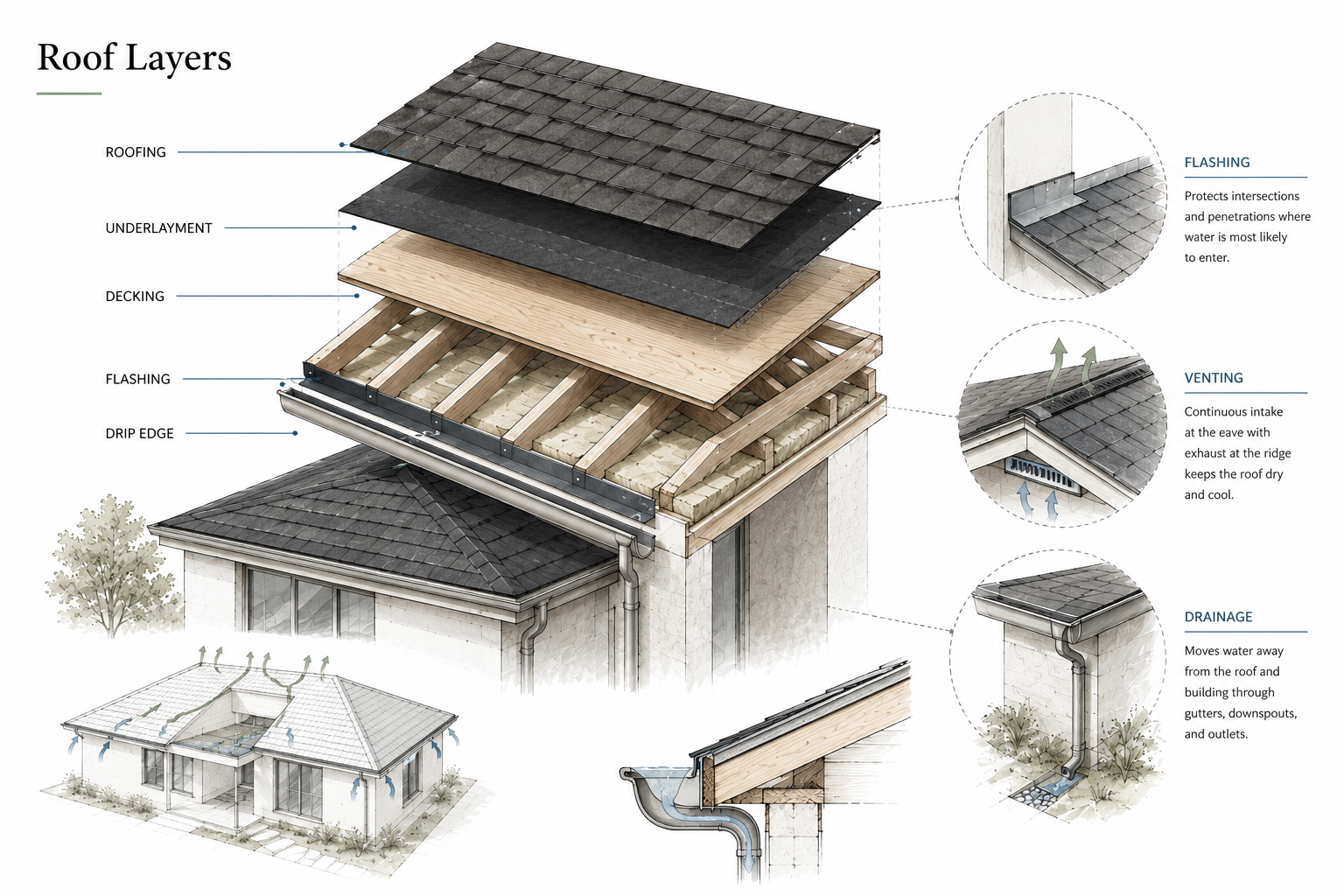
A roof is not just shingles or panels nailed to wood. It is a layered system. Miss one layer, or cheap out on the wrong part, and the finish material on top will not save you.
Decking (sheathing)
This is the base. Usually plywood or OSB. It ties the roof framing together and gives the installer something solid to fasten into. If the deck is soft or rotted, the roof above it is already compromised.
Underlayment
This is the second line of defense between the deck and the finish roofing. Synthetic underlayments and self-adhered membranes now do most of the heavy lifting that old felt paper used to do.
Flashing
Flashing handles the places where roofs usually fail first: valleys, walls, chimneys, skylights, vents, and roof-to-wall intersections. Expensive roofing over bad flashing is still a leaky roof.
Drip edge and starters
These keep wind and water from getting under the first course. They also protect fascia and help move runoff where it belongs.
Roofing systems
The visible roof covering is only the armor layer. Shingles, metal panels, tile, slate, membranes, and specialty panels all depend on the layers below them being right.
Ventilation
A roof can fail from the inside out. Poor intake and exhaust trap heat and moisture, shorten roof life, and raise energy bills.
Drainage
Gutters, downspouts, scuppers, valleys, and outlets are not side issues. A roof without drainage is a roof on borrowed time.
Roofing Materials List: What Works, What It Costs, and Where It Fits
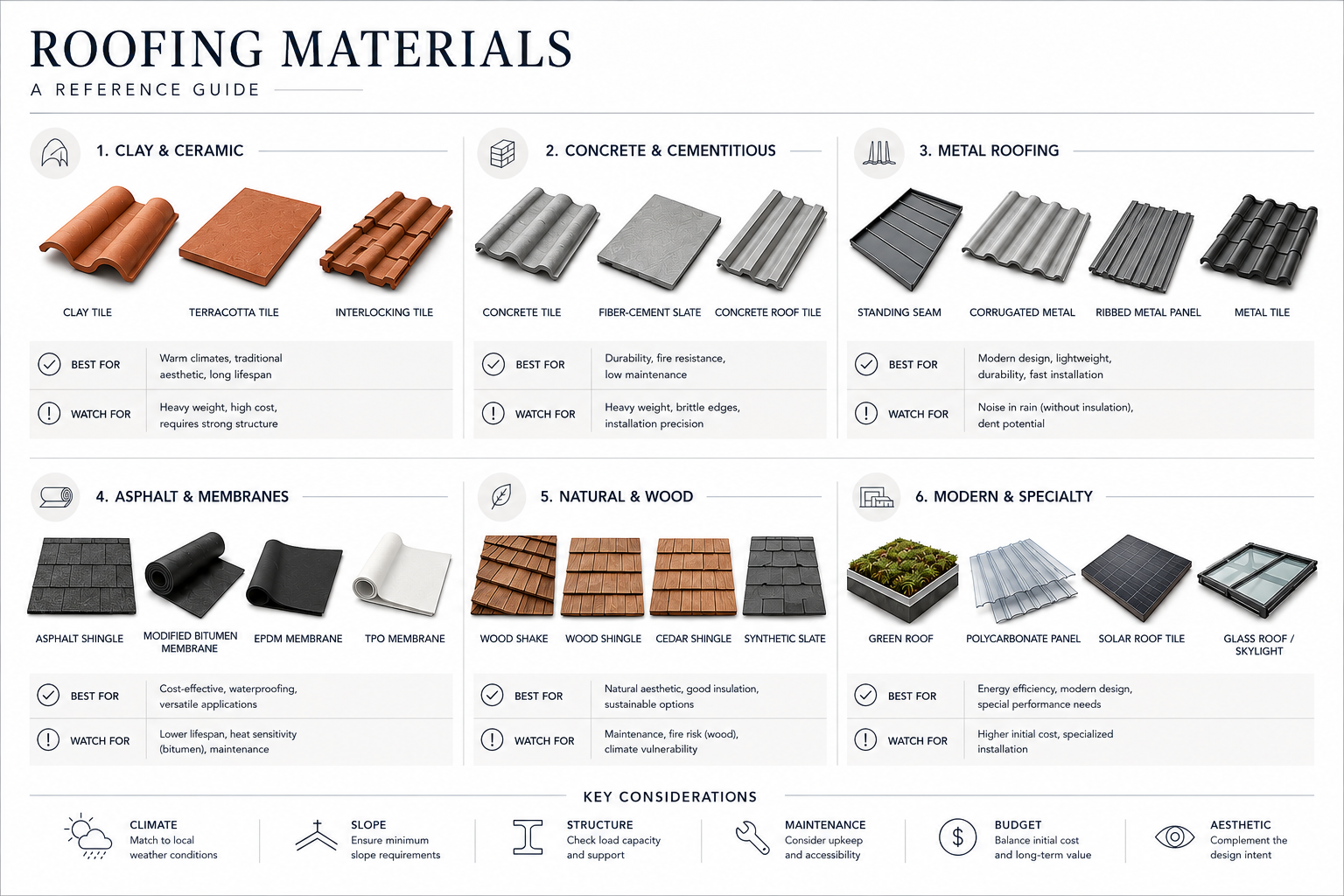
Asphalt shingles
Still the default for a reason. Cheap, familiar, easy to source, easy to repair, and acceptable on most ordinary pitched houses.
Best for: standard residential reroofs, budget-conscious builds, simple gable or hip roofs, neighborhoods that expect a conventional roof look
Lifespan: roughly 15 to 30 years depending on shingle grade, climate, attic ventilation, and installation quality
Typical cost: about $100 to $200 per square for material, and roughly $350 to $650 per square installed
What to watch: poor ventilation, missing starter strips, weak drip edge, careless valley work, and bad shingle choice on shallow slopes
Architectural shingles are usually worth the upgrade over bare-bones 3-tab. In storm country, impact-rated versions can make sense. On lower slopes, stop and compare them against Low-Pitched Roof Pros and Cons before assuming shingles are the right answer.
Metal roofing
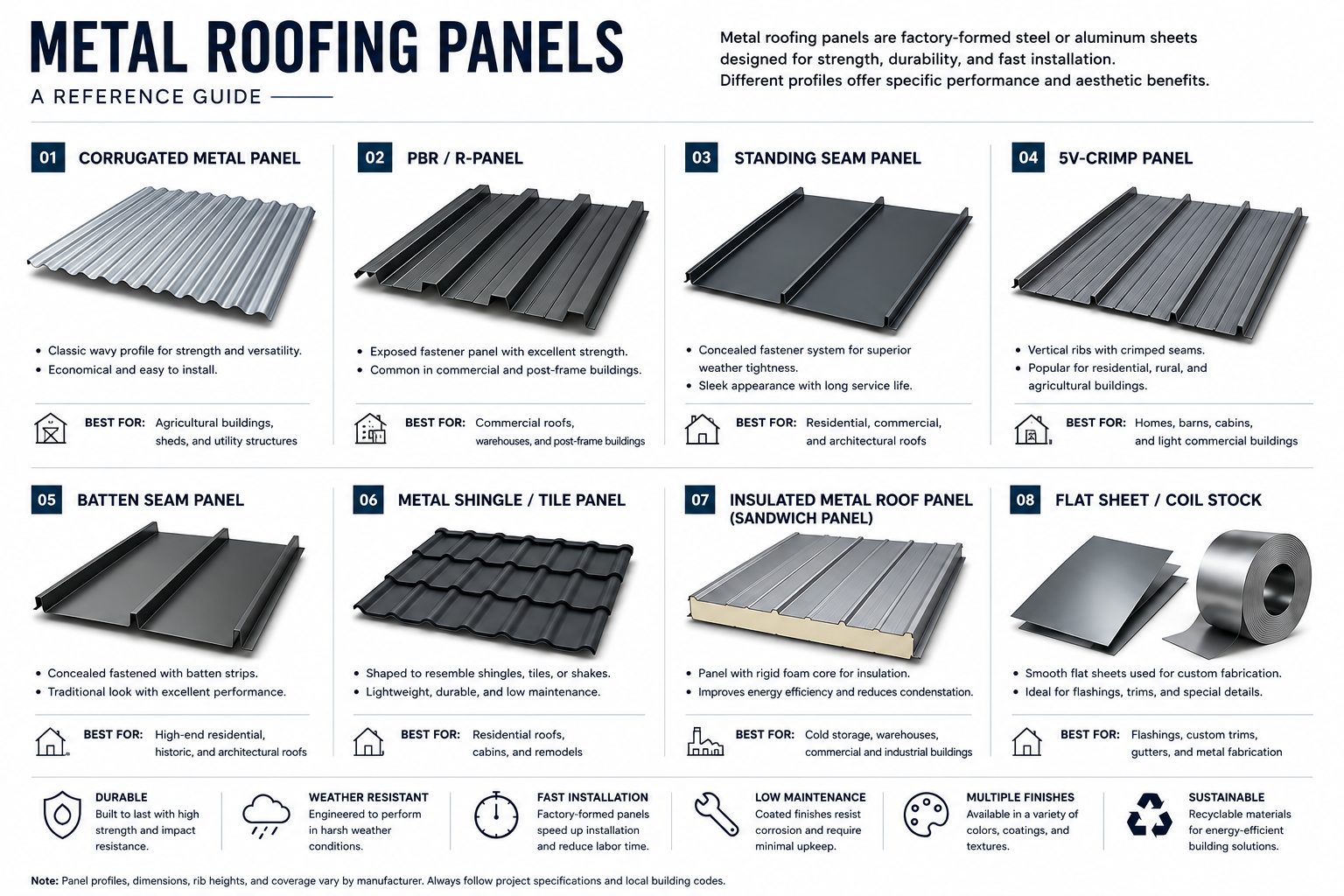
Metal works in more climates than almost any other roof covering. It sheds snow well, dries fast, reflects heat when finished properly, and can last a long time without constant attention.
Best for: snow country, hail-prone regions, long-life roofs, modern houses, barns, sheds, and simpler roof geometries
Lifespan: roughly 40 to 70 years depending on gauge, coating, fasteners, and maintenance
Typical cost: about $250 to $800 per square for material, and roughly $700 to $1,400 per square installed
What to watch: wrong fasteners, mixed metals, bad trims, poor underlayment choice, and cheap paint systems in coastal or high-sun zones
Standing seam is the cleaner long-term choice when the budget supports it. Corrugated or exposed-fastener metal can still work, but it depends more on detailing and fastener discipline.
Clay and concrete tile
These are heavy roofs with long life and strong visual character. They make sense when the house wants that profile and the structure is designed to carry the load.
Best for: hot and sunny regions, Mediterranean and Spanish-style houses, fire-conscious areas, roofs where long life and appearance both matter
Lifespan: roughly 40 to 100 years, though underlayments often need earlier replacement than the tile itself
Typical cost: concrete around $400 to $900 per square material, clay around $700 to $1,200 per square material, with installed costs rising significantly once structure and trim are included
What to watch: framing load, freeze-thaw damage in the wrong climate, brittle breakage from foot traffic, and sloppy valley or hip details
Tile is not a cheap “upgrade.” It is a system choice that affects framing, installation, and future repairs.
Slate
Slate is the long-game roof. Heavy, expensive, beautiful, and unforgiving of cheap labor.
Best for: historic houses, luxury builds, restorations, long-hold properties where lifespan matters more than first cost
Lifespan: roughly 75 to 150 years when the slate quality, fastening, flashing, and structure are all right
Typical cost: roughly $1,000 to $2,000+ per square for material and about $1,800 to $3,500+ per square installed
What to watch: structure, copper or stainless flashing, snow retention, installer skill, and source consistency
Slate belongs on houses that can carry it, afford it, and justify it. It does not belong on a weak retrofit just because the owner likes the look.
Wood shingles and shakes
Wood roofs look warm and natural, but the maintenance burden is the deal hidden inside the aesthetic.
Best for: cottages, cabins, rustic houses, selected historic districts, dry climates where the roof can dry well
Lifespan: roughly 20 to 35 years depending on species, roof pitch, maintenance, and local conditions
Typical cost: about $400 to $900 per square material and roughly $800 to $1,500 per square installed
What to watch: fire risk, rot, moss, poor airflow, insect damage, and shaded slopes that stay damp
Wood can still be the right call, but only when the owner understands that it is a living maintenance choice, not just a visual one.
Single-ply membranes (TPO, EPDM, PVC)
These are the workhorse materials for low-slope and flat roofs. Not glamorous, but usually the right answer when the roof is shallow and waterproofing discipline matters most.
Best for: commercial roofs, modern low-slope houses, garages, additions, rooftop mechanical areas, roofs where weight matters
Lifespan: roughly 20 to 30 years depending on seam quality, drainage, traffic, and exposure
Typical cost: roughly $250 to $600 per square material and around $500 to $1,000 per square installed
What to watch: seam quality, drainage taper, perimeter terminations, rooftop traffic, and penetrations
If the roof is flat or nearly flat, stop comparing it to shingles and use the correct category. The closer follow-up page is Flat Roofing Materials Guide.
Insulated roof panels
These combine metal skins and insulation in one system. They are common on agricultural, industrial, storage, and design-build projects where speed matters.
Best for: warehouses, shops, cold storage, fast enclosure projects, agricultural buildings
Lifespan: roughly 30 to 50 years depending on coatings, joint quality, and sealants
Typical cost: about $600 to $1,200 per square material and around $1,000 to $1,800 per square installed
What to watch: expansion joints, joint sealing, thermal breaks, cut-up geometry, and finish coordination
They are efficient. They are not the default answer for a cut-up house roof or a historic-looking street.
Polycarbonate sheets
These are not a main house-roof material. They are a specialty daylighting material for the right kind of structure.
Best for: greenhouses, patio covers, carports, daylight bands, utility structures
Lifespan: roughly 10 to 20 years depending on UV protection and framing
Typical cost: roughly $150 to $500 per square material and about $300 to $800 per square installed
What to watch: movement, fastener detailing, grime buildup in channels, and weak framing in wind
Use it where daylight is part of the job. Do not use it as a substitute for a real house roof.
Cool roof coatings and reflective finishes
This is not a main roof category by itself. It is a performance layer or finish strategy that can improve heat control in the right climate.
Best for: hot sunny regions, energy-conscious roofs, certain low-slope retrofits, code-driven reflectance targets
Typical cost impact: often a modest premium over standard materials, or a coating cost on top of the roof below
What to watch: actual reflectance ratings, dirt pickup, recoating cycles, and climate fit
Reflective roofs can be worth it, but they are not magic. In the wrong climate they help less than people expect.
Quick Comparison
| Type | Lifespan | Material cost / square | Installed cost / square | Best fit |
|---|---|---|---|---|
| Asphalt shingles | 15–30 years | $100–$200 | $350–$650 | Standard pitched residential roofs |
| Metal roofing | 40–70 years | $250–$800 | $700–$1,400 | Snow, hail, long-life roofs, simpler geometries |
| Clay / concrete tile | 40–100 years | $400–$1,200 | $900–$2,200 | Hot climates and style-driven roofs |
| Slate | 75–150 years | $1,000–$2,000+ | $1,800–$3,500+ | Historic or premium long-hold roofs |
| Wood shingles / shakes | 20–35 years | $400–$900 | $800–$1,500 | Rustic, cottage, selected historic work |
| TPO / EPDM / PVC | 20–30 years | $250–$600 | $500–$1,000 | Flat and low-slope roofs |
| Insulated roof panels | 30–50 years | $600–$1,200 | $1,000–$1,800 | Industrial, agricultural, and fast-close projects |
| Polycarbonate | 10–20 years | $150–$500 | $300–$800 | Daylighting and utility structures |
Note: A square means 100 square feet. Real costs move by region, roof shape, access, tear-off conditions, waste, and the hidden work below the finish roof.
What Protects the Roof
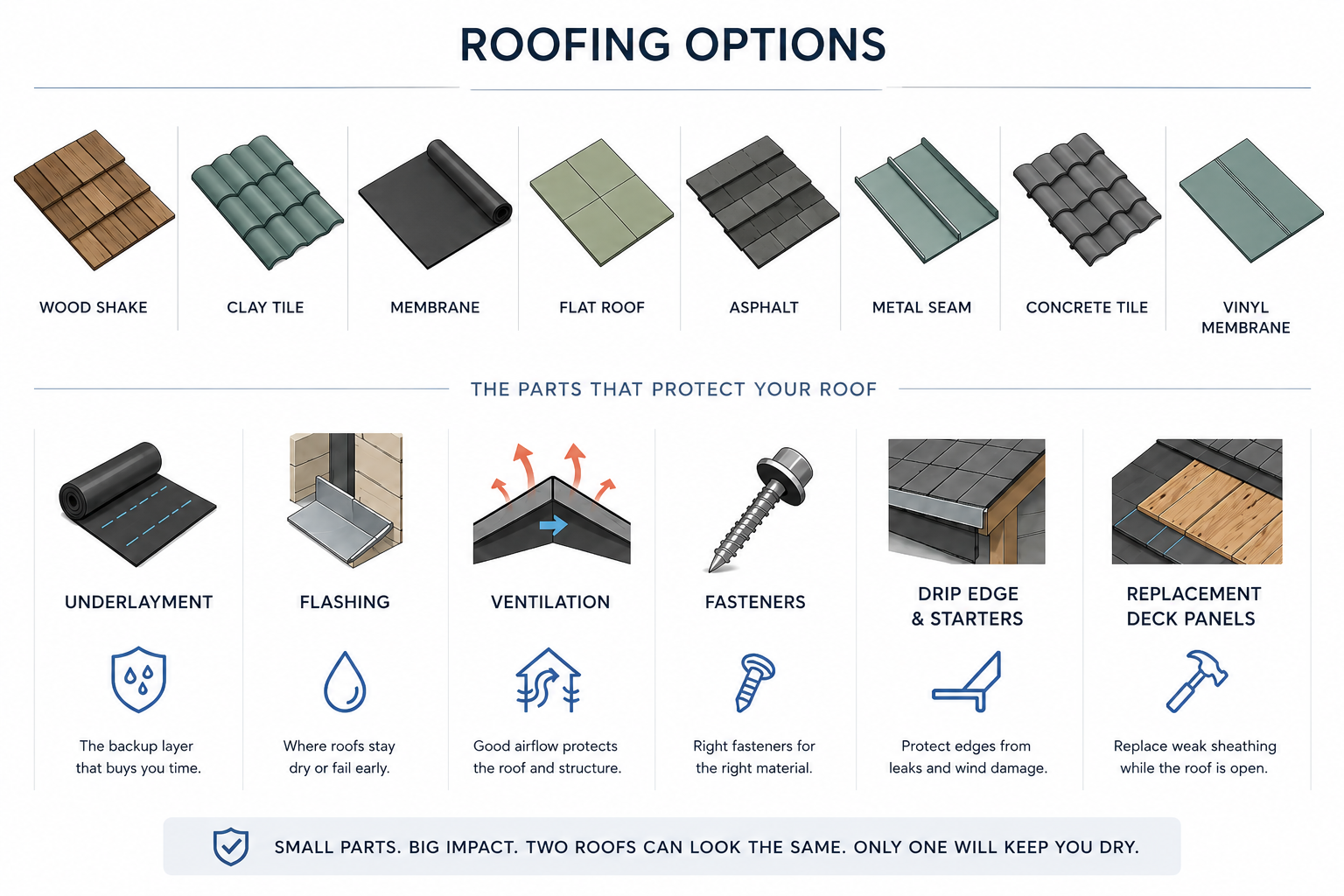
Most roof failures do not start with the visible surface. They start in the parts people try to save money on.
Underlayment
Synthetic underlayments and self-adhered membranes are not optional upgrades on a serious roof. This is the layer that buys you time when shingles tear off or wind-driven water gets past the finish surface.
Flashing
Step flashing, valley metal, apron flashing, counterflashing, vent boots, edge terminations. This is where roofs either stay dry or fail early.
Ventilation
Bad ventilation shortens roof life, overheats attic spaces, and traps moisture. If the insulation and venting are weak, the roof starts aging from the inside. That is why it helps to understand thermal insulation materials alongside the roof finish.
Fasteners
Wrong nails or screws ruin good roofs. Match fasteners to the roof metal, coating, and exposure. Rust and back-out failures are cheaper to prevent than to repair.
Drip edge and starters
These keep edges from turning into leak points and wind failure points.
Replacement deck panels
Tear-offs expose weak sheathing. The time to replace bad deck boards is when the roof is open, not after the new roof is on. For that part of the job, see Replacing Roof Sheathing: Cost and Process.
These “small parts” are not extras. They are why two roofs with the same shingles can perform completely differently.
When to Pick What
Hot, high-sun climates
Metal with a high-reflectance finish works well. Cool-rated tile can also make sense where the structure and style support it.
Hail belt
Class 4 asphalt shingles or heavier-gauge metal are usually the safer starting points.
Heavy snow
Keep the geometry simple. Metal on a clean roof plane works well. Snow country also makes the pitch decision more important, so compare materials against Steep Roofs when the roof needs to shed snow aggressively.
Historic look without true slate money
Composite slate or good synthetic alternatives can sometimes bridge the gap, but only if the profile and finish hold up.
Fast commercial or low-slope work
Single-ply membranes with proper insulation and drainage taper stay the practical answer most of the time.
Short-hold or budget resale
Architectural asphalt is still the most common move, as long as the roof geometry is not too complicated and the accessory work is done right.
Field Notes That Save Money
Keep the geometry simple. Every valley and extra intersection raises leak risk and labor cost.
Buy one lot. Color consistency matters more than people think, especially on shingles, tile, and metal with visible finish variation.
Do not reuse flashing. New roof, new metal.
Match metals. Mixed-metal corrosion is not a theory problem. It is a tear-off problem later.
Do not pick the finish before the roof type. A low-slope roof and a steep roof are not just visual choices. They change what materials make sense. That is why this page works best alongside the broader building materials list, not as a catalog by itself.
Replacement Checklist
- Plan tear-off and disposal before the first shingle comes off.
- Inspect the deck once the old roof is stripped.
- Replace rotten sheathing before new roofing starts.
- Run ice and water shield where the climate and roof geometry demand it.
- Replace all flashing, not just the pieces that look bad from the ground.
- Check intake and exhaust ventilation before closing the roof.
- Install edge metal, starters, caps, and sealants as part of the system, not as afterthoughts.
- Water-test sensitive penetrations before calling the job finished.
Roofing Bid Sheet Example: 24 Squares Architectural Asphalt
| Item | Qty / units | Unit price range | Subtotal range |
|---|---|---|---|
| Architectural shingles | 24 squares | $110–$150 / square | $2,640–$3,600 |
| Synthetic underlayment | About 10 rolls | $40–$60 / roll | $400–$600 |
| Ice and water shield | 2–3 rolls | $100–$150 / roll | $250–$450 |
| Ridge vent and caps | As required by roof length | Varies | $420–$780 |
| Flashing package | Lump sum | — | $215–$475 |
| Edge metal | Approx. 240 ft plus waste | $1.50–$3.00 / ft | $360–$720 |
| Fasteners and sealants | Lump sum | — | $120–$192 |
| Tear-off and disposal | Dumpster plus labor setup | — | $400–$600 |
Estimated material range: about $4,805 to $7,417
Estimated labor range: about $5,000 to $8,500
Estimated total installed: roughly $9,800 to $15,900
That number still moves with slope, access, rot repairs, flashing complexity, dormers, skylights, permits, and region. But it is a better starting point than pretending the bundle price is the whole roof price.
FAQ
What is the best budget roof that does not look cheap?
Architectural asphalt shingles are still the default answer for most ordinary houses.
Metal or shingles for heat?
Usually metal with a high-reflectance finish, especially in hot sunny climates.
Can I lay metal over shingles?
Sometimes, but not blindly. Code, structure, moisture control, and the condition of the roof below all matter.
Tile or slate if I want a forever roof?
Slate is the true century roof when the structure and installer are right. Tile can also last a long time, but the system below it still matters.
What is the best material for a flat roof?
Usually a well-installed membrane system such as TPO, EPDM, or PVC, depending on climate, use, and installer experience.
Where do roofing bids usually blow up?
Rotten decking, hidden flashing problems, poor ventilation, and change orders around penetrations, valleys, and reused accessories.
What matters more: the shingle or the system below it?
The system below it. A good finish roof over bad underlayment, flashing, and ventilation is still a bad roof.
What to Read Next
- Types of Roof Lines: Which One Fits Your Home?
- Roofing Systems Guide
- Flat Roofing Materials Guide
- Low-Pitched Roof Pros and Cons
- Steep Roofs: Design, Construction, and Maintenance
- Replacing Roof Sheathing: Cost and Process
- Thermal Insulation Materials: Types, Uses, and Best Practices
- The Complete List of Building Materials: Key Types and Their Applications