
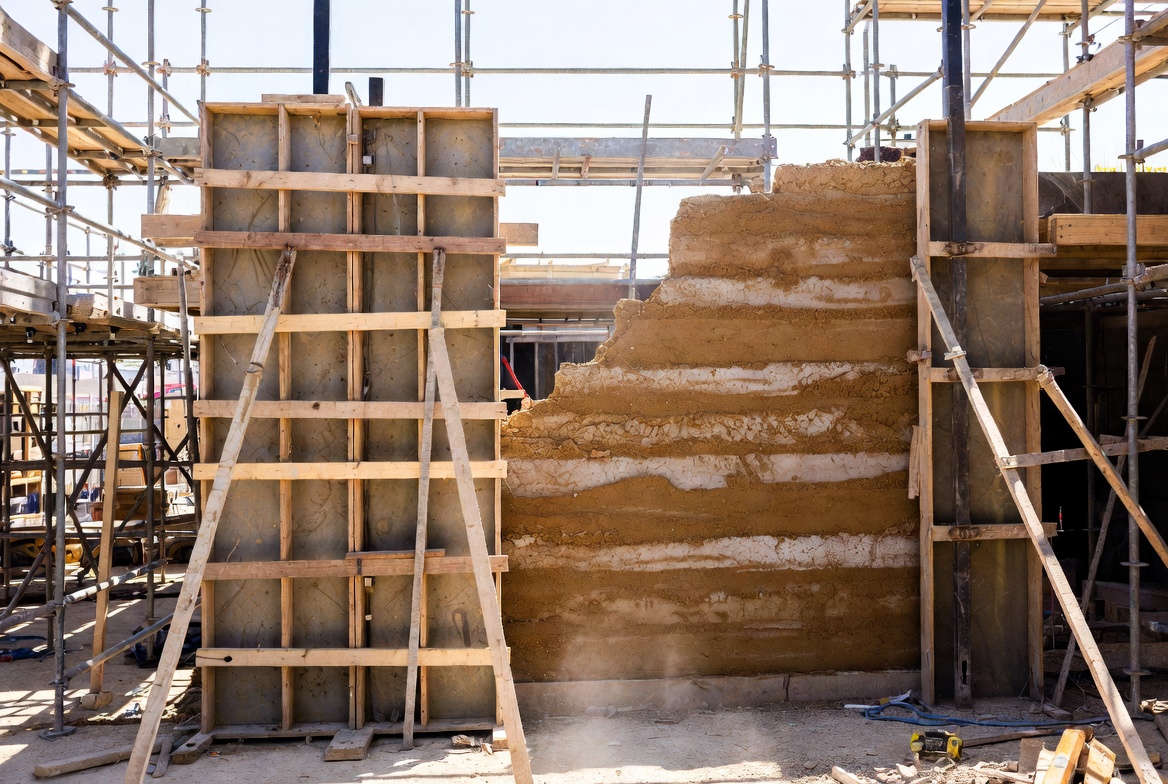
Formwork is what turns rammed earth into a wall.
Loose soil will not hold shape on its own. It needs strong faces, solid ties, and bracing that can hold steady while the earth is compacted hard, lift after lift.
This is where cost climbs fast and where a lot of failures start. Good formwork keeps the wall straight, the face clean, and the thickness consistent. Bad formwork leads to bulging, blowouts, ugly joints, wasted labor, and a lot of cleanup later.
Start with the real choices: plywood or steel, ties and bracing, lift height, panel size, curved work, reuse vs one-off systems, and when prefab panels make more sense.
Also useful: Rammed Earth: An Ancient Technique for Modern Sustainable Construction covers the broad method. Rammed Earth Walls: What They Are and Why They’re Back goes deeper into wall systems, panels, and moisture details.
Good Reading
Modern Rammed Earth Construction
A useful reference if you want the wall-building side of rammed earth, not just the design side.
What Formwork Does
Formwork does four jobs at once:
- holds the wall thickness
- holds the wall line and plumb
- resists compaction pressure
- controls the final wall surface
That last part matters more than people think. In many rammed earth projects, the wall face that comes out of the form is the finished wall. If the form face is poor, the wall face will show it.
Good formwork is not just “strong enough.” It also has to come apart, move, and go back together without slowing the job to a crawl.
Plywood vs Steel Formwork
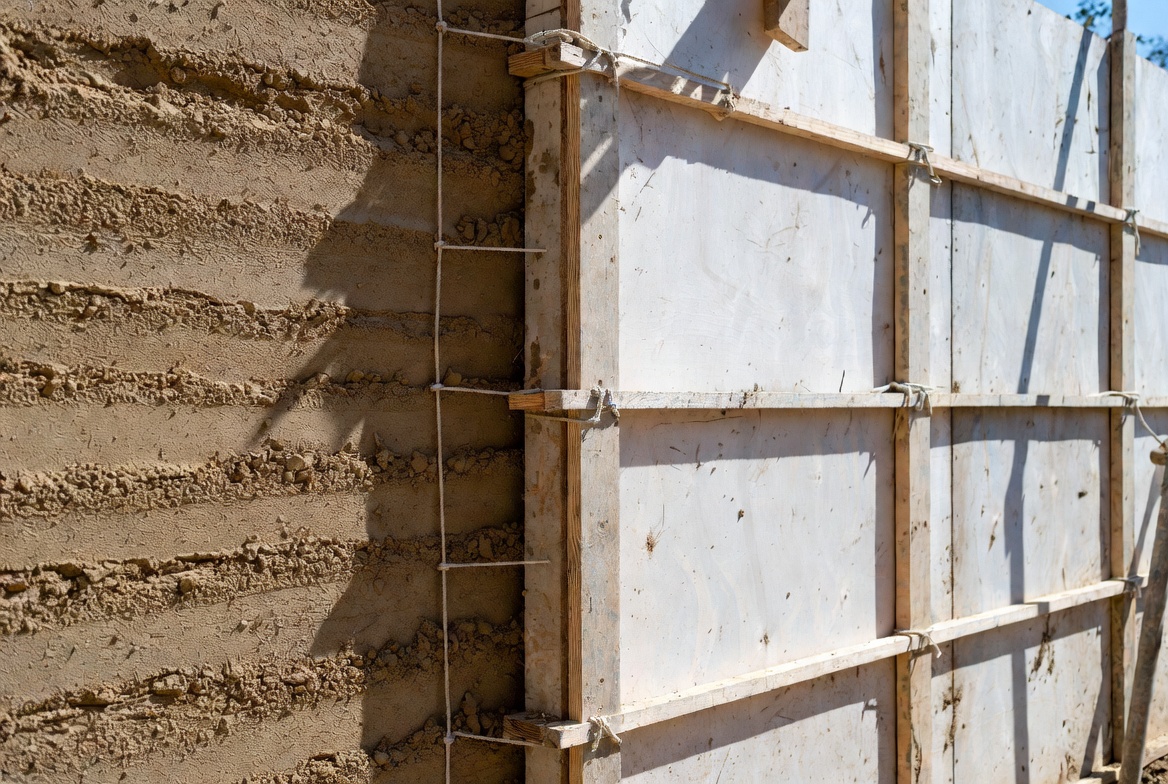
Image by ArchitectureCourses.org. Plywood-faced rammed earth formwork beside a freshly compacted wall, where panel face quality and alignment affect finish, labor, and cost.
| Type | Good At | Weak At | Best Fit |
|---|---|---|---|
| Plywood-faced formwork | Lower setup cost, lighter handling, easier one-off work, easier cutting and adjustment | Surface wear, lower reuse life, easier to bow if under-braced | Custom houses, smaller jobs, mixed formwork systems |
| Steel formwork | High stiffness, repeat use, better control on demanding jobs, cleaner repetition | Higher cost, heavier handling, harder to modify on the fly | Repeat work, larger jobs, commercial or panel production |
| Steel frame with plywood face | Good stiffness with workable face material, common hybrid setup | Still needs careful face maintenance and strong bracing | Professional site-built wall work |
For a lot of projects, the answer is not pure plywood or pure steel. It is a hybrid: a steel frame carrying structural plywood or another panel face.
That is the practical middle ground. You get enough stiffness to resist ramming pressure, but still keep the face manageable and replaceable.
Do this instead of this: use the form system that matches the number of repeats you need. Do not overspend on a heavy steel system for one custom wall. Do not underbuild a plywood system for a long, high-pressure run and then act surprised when it moves.
Panel Size and Lift Height
Formwork size is not random. It affects speed, alignment, labor, and pressure control.
One specialist builder publishes form panels from about 600 to 2400 mm long and form heights of 300 and 600 mm, with setup length usually kept under about 4500 mm depending on the soil and wall condition. Another technical source describes filling the form in loose lifts of about 150 mm before ramming. Those numbers are not universal, but they are useful because they show the scale at which professionals are working.
| Decision | Smaller Setup | Larger Setup |
|---|---|---|
| Panel length | Easier to handle and align | Fewer joints, faster coverage if the system is stiff enough |
| Form height | Better control, slower cycling | Fewer resets, more pressure on the form |
| Lift depth | More consistent compaction | Faster filling, but easier to compact badly if pushed too far |
The job is to find the size that your crew can fill, ram, strip, and reset well. Bigger is not always faster if the form starts fighting you.
Ties, Spacers, and Bracing
This is where the form either holds or starts to drift.
Form ties
Ties hold the two faces together and resist the outward pressure of compaction. Weak ties, bad spacing, or sloppy tightening show up fast. The wall gets thicker than planned, the face bows, and the final finish goes bad.
Spacers
Spacers control wall thickness. That sounds basic, but thickness matters everywhere: at openings, at roof bearing, at intersections, and at every place the wall meets another system. A sloppy spacer setup can turn into a layout problem later.
Bracing
Bracing holds line and plumb. It also stops the form from walking under repeated impact.
One builder working on thin rammed-earth panels described form pressure strong enough to stretch a three-inch wall to four inches before they switched to heavy tube steel bracing, hydraulic jacks, and steel plates fixed to the floor. That is an extreme example, but the lesson is simple: compaction loads are not theoretical.
If the formwork looks light, improvised, or under-tied, the job is already in trouble.
Curved Formwork
Curved walls are where formwork gets expensive fast.
Straight rammed earth formwork is already a technical system. Curved formwork adds layout control, custom fabrication, harder stripping, and more chances for the surface to go wrong.
Curves can be worth it when the wall is a major design move. They are not worth it when the job is already cost-sensitive and the design could work just as well with straight runs.
| Use Curved Formwork When | Avoid Curved Formwork When |
|---|---|
| The curve is central to the design | The job is trying to stay simple and economical |
| The wall is short enough to control well | The crew has never done curved formwork before |
| The budget can carry custom fabrication | The finish has to be perfect on a weak budget |
| The geometry is repeatable and well set out | The shape is irregular and still changing |
Reuse vs One-Off Formwork
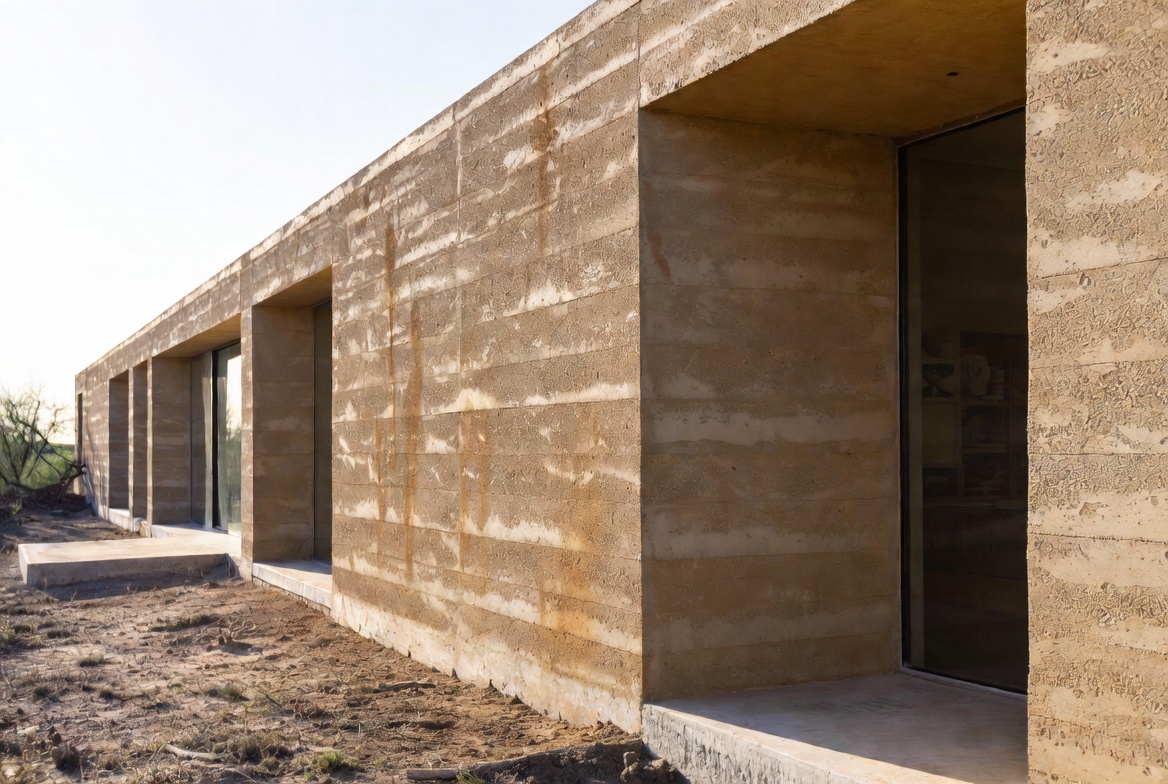
Image by ArchitectureCourses.org. A finished rammed earth home with the thick walls and custom detailing that make this a premium build type.
This is one of the main budget questions.
If the formwork will be used over and over, the math changes. A stronger, cleaner, more expensive system makes sense because setup time drops and the cost is spread across more wall area.
If the job is one house with a lot of custom conditions, the formwork has to stay adaptable. That often pushes the job toward simpler framed systems with replaceable plywood faces rather than a heavy fixed system built for repetition.
Reuse makes sense when:
- wall sizes repeat
- the wall line is simple
- panel cycling is fast
- the crew already knows the system
One-off formwork makes more sense when:
- the job is highly custom
- the geometry changes often
- there are many unique corners and openings
- you would spend more adapting a repeat system than building a custom one
The wrong move is buying or fabricating a premium repeat system for a one-off house that cannot use it efficiently.
What Causes Bulging and Blowouts
Bulging is the warning. Blowout is the failure.
They usually come from the same problems:
- weak form faces
- poor tie spacing
- bad bracing
- trying to build too long a run in one setup
- uneven compaction
- rushing the fill and ramming cycle
- a crew treating the form like light carpentry instead of loaded equipment
| Problem | What It Looks Like | What Usually Caused It |
|---|---|---|
| Bulging face | Wall bows outward, face goes soft or wavy | Weak panels, weak bracing, bad tie control |
| Misaligned joint | Lift line or reset line steps out of plane | Sloppy reset, poor line control, rushed assembly |
| Edge blowout | Failure at an end or corner | Weak end shutter, poor fixing, compaction too aggressive at the edge |
| Thickness drift | Wall varies in width | Bad spacers, loose ties, panel movement |
Once a form starts moving, the crew usually knows it. The mistake is thinking they can ram through it and fix it later.
Labor, Rental, and Cost Logic
Formwork costs do not sit in one neat line item. They spread across labor, material, rental, transport, setup time, stripping time, and how much wall the system lets the crew build in a day.
That is why the cheapest-looking formwork is not always the cheapest system.
Where the money goes
- fabricating or buying the form system
- plywood faces and replacement faces
- ties, bolts, wedges, spacers, and hardware
- bracing steel and supports
- lifting and moving equipment
- carpenter time for setup and reset
- crew slowdown when the formwork is fussy
Static or system-built formwork can sometimes be hired or bought, which makes sense on larger repeat work. Moveable formwork can be more economical for smaller custom work, but only if it cycles fast and the crew knows it.
Spend here, not here: spend on stiffness, reliable ties, and a reset method the crew can repeat cleanly. Do not waste money on surface perfection or over-engineered hardware if the wall layout is too custom to benefit from it.
See also:
When Prefab Panels Make More Sense
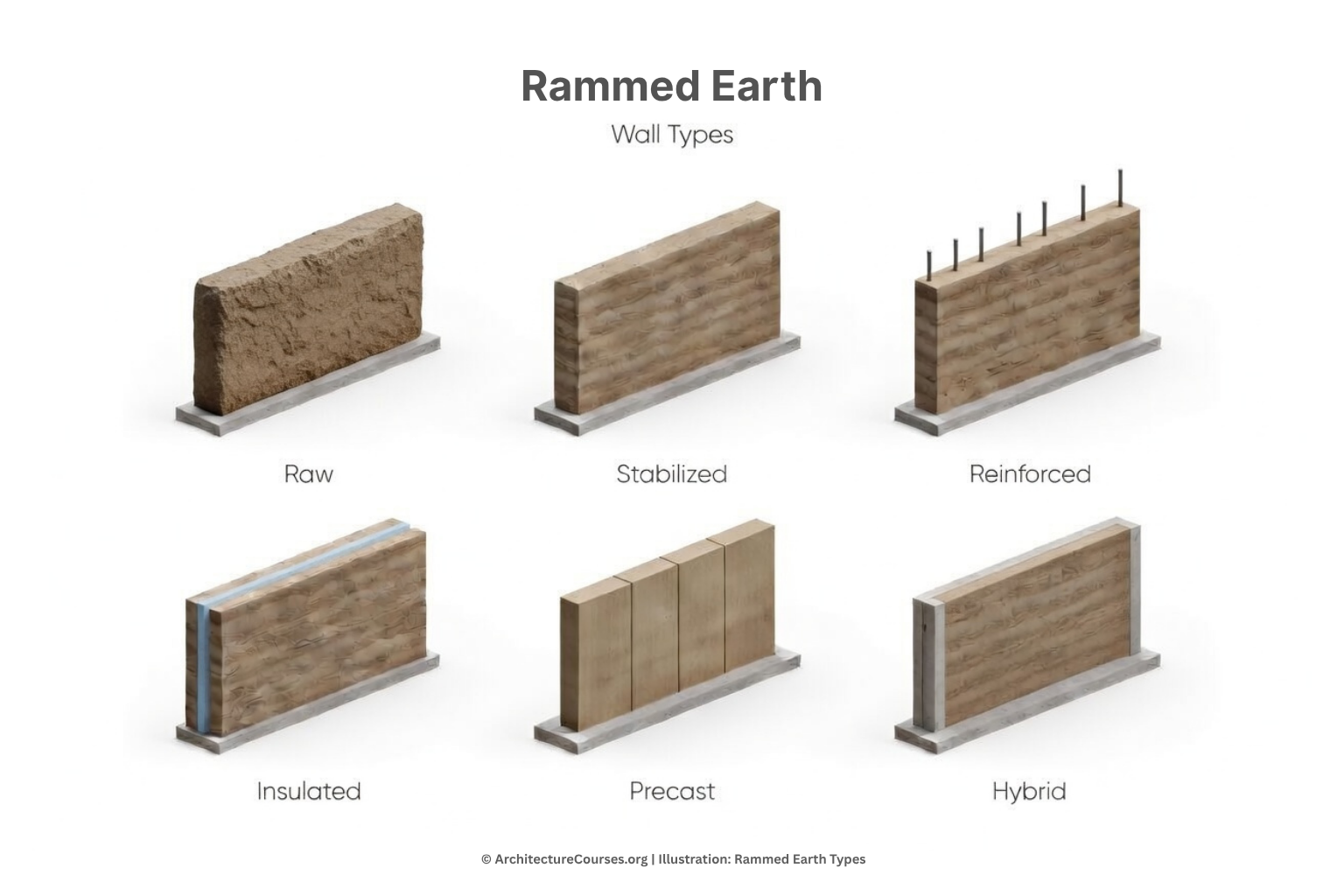
Illustration by ArchitectureCourses.org. Precast rammed-earth panels fit projects that need repetition, factory control, and faster installation.
Prefab rammed-earth panels beat site formwork when time, access, or repetition matter more than monolithic site-built purity.
They make the most sense when:
- the wall design repeats
- the site is tight
- weather or schedule is a problem
- the project needs factory control
- site labor is hard to manage
They make less sense when:
- the wall is highly custom
- the site cannot handle delivery and lifting well
- joints would ruin the look
- the project is too small to absorb transport and crane costs
This is where the larger cluster splits cleanly. If the question is “what is the best wall system?”, that belongs with the walls page. If the question is “how do I build and control the formwork on site?”, this page is the right one.
What People Get Wrong
- They underbuild the form. Rammed earth pushes harder than it looks.
- They treat plywood as the whole system. The frame, ties, and bracing matter just as much.
- They make the setup too long. A long run is not a win if the form starts moving.
- They chase speed with bigger lifts. That often trades time for poor compaction and more risk.
- They ignore reset quality. A fast reset that throws the wall out of line costs more later.
- They think panels solve everything. Panels solve some site problems and create transport and lifting problems of their own.
FAQ
What is rammed earth formwork usually made from?
Often from timber or steel framing with plywood, timber, or steel panel faces. Many professional systems use steel frames with structural plywood faces.
How deep should each lift be before ramming?
Many technical references describe loose lifts around 150 mm before compaction, though the right depth depends on the mix, the tool, and the crew.
What causes formwork bulging?
Weak faces, poor ties, bad bracing, long unsupported runs, and uneven or rushed compaction are the usual causes.
Is steel formwork better than plywood?
Not always. Steel is stiffer and better for repeat work, but plywood-faced systems are often more practical for smaller custom jobs.
Can you use rammed earth formwork for curved walls?
Yes, but curved formwork costs more and needs tighter control. It is a design choice, not a default choice.
Is rented system formwork worth it?
It can be on larger repeat work. On one-off custom house walls, rental and adaptation costs can wipe out the benefit.
When do prefab panels beat site-built formwork?
Usually when the project repeats, the schedule is tight, or the site makes long on-site formwork work awkward or slow.
What is the biggest mistake crews make with formwork?
Underestimating the pressure and thinking they can save money with a lighter system than the job needs.