
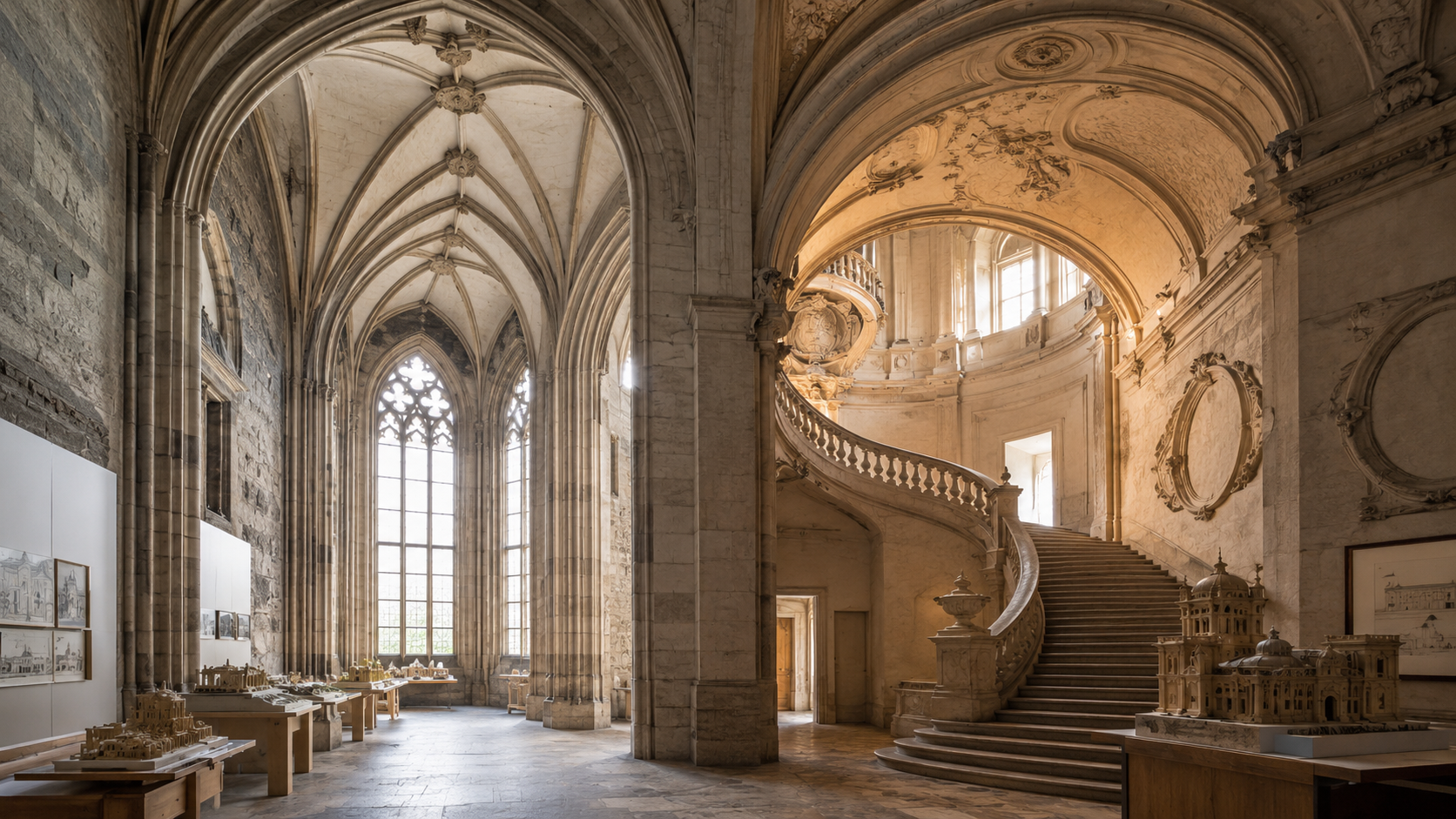
Gothic and Baroque architecture can both feel dramatic, but they create drama in different ways.
Gothic architecture usually pulls the eye upward. It uses pointed arches, ribs, vaults, buttresses, tall openings, and vertical structure to make a building feel lifted and stretched. Baroque architecture usually pulls the body through space. It uses curves, stairs, domes, light, shadow, ornament, and staged views to make movement feel controlled.
The fastest way to remember the difference is simple: Gothic climbs. Baroque flows.
That difference matters more than decoration. A pointed arch does not make a building Gothic by itself, and gold ornament does not make a room Baroque by itself. The real question is what the space is doing to your eye and body.
Gothic Climbs, Baroque Flows
| Question | Gothic | Baroque |
|---|---|---|
| Main movement | Upward | Forward, around, and through |
| Structure | Pointed arches, rib vaults, buttresses, tall bays | Domes, curved walls, stairs, deep facades, layered interiors |
| Light | Filtered through tall openings and tracery | Directed across surfaces to create shadow, depth, and focus |
| Visual effect | Height, structure, vertical rhythm | Drama, movement, theater, controlled arrival |
| Common mistake | Thinking Gothic means any pointed old building | Thinking Baroque means any ornate old room |
Gothic Architecture: Structure That Climbs
Gothic architecture is easiest to read through structure.
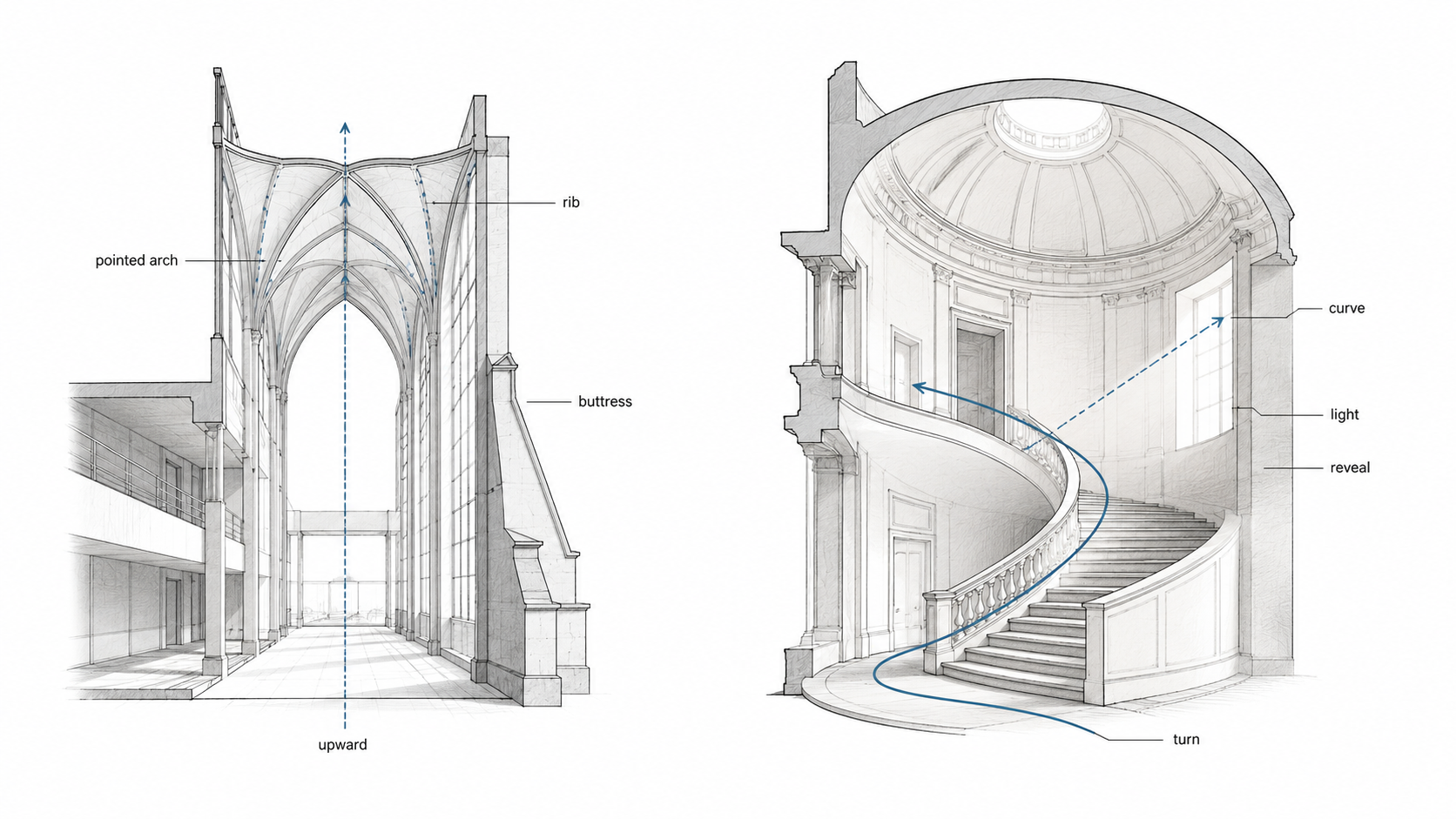
Pointed arches reduce side thrust compared with round arches. Rib vaults organize the ceiling into a visible structural system. Buttresses move loads outward and down. Tall openings and vertical lines make the building feel stretched upward.
Many early Gothic examples were religious buildings, but the architectural lesson here is structural: height, ribs, pointed forms, buttresses, light, and vertical rhythm.
The drama comes from height, load, light, and exposed rhythm. The ornament matters, but the skeleton matters first. For the structural side of the style, use Gothic structures.
Gothic features to look for
- Pointed arches: openings and vaults that rise to a point instead of a semicircle.
- Rib vaults: ceiling ribs that organize loads and create strong overhead geometry.
- Flying buttresses: exterior supports that carry thrust away from the wall.
- Vertical emphasis: tall bays, spires, narrow openings, and upward lines.
- Tracery: stone or carved patterns that divide large openings into lighter pieces.
- Layered stone detail: carved edges, deep portals, shafts, moldings, and repeated vertical elements.
Baroque Architecture: Space That Moves
Baroque architecture is easiest to read through movement.
A Baroque building may use a curved facade, a grand stair, a dome, a deep cornice, a bright focal point, or a staged approach. The point is not only to decorate the building. The point is to control how the visitor moves, turns, pauses, and looks.
This is why Baroque architecture can feel theatrical without being random. The space often works like a sequence: compress, release, turn, reveal.
Baroque features to look for
- Curved forms: oval rooms, concave and convex facades, rounded stairs, and flowing walls.
- Dramatic light: strong contrast, bright focal surfaces, deep shadow, and reflected glow.
- Staged movement: entrances, stairs, halls, and rooms arranged as a sequence.
- Domes and ceilings: overhead space used to lift the eye and shape the room.
- Integrated art: architecture, sculpture, painting, furniture, and surface detail working together.
- Rich materials: stone, plaster, gilding, marble, dark wood, bronze, and patterned surfaces.
The Real Difference: Structure vs Staging
The cleanest comparison is not “simple vs ornate.” Gothic can be ornate. Baroque can be disciplined. The stronger comparison is structure vs staging.
Gothic architecture often makes the structure visible. The ribs, arches, piers, buttresses, and vertical bays show how the building stands and how the eye should travel upward.
Baroque architecture often makes the sequence visible. The stair, curve, light source, dome, mirror, ceiling, and wall surface show how the visitor should move through the space.
| Design question | Gothic answer | Baroque answer |
|---|---|---|
| How does the space create drama? | By height, structure, vertical light, and exposed rhythm | By movement, contrast, curves, staged views, and surface depth |
| Where does the eye go? | Upward along arches, ribs, windows, and towers | Across, around, forward, and toward a focal point |
| What should students sketch first? | The load path, arch, vault, pier, and buttress | The approach, stair, dome, light path, and turn |
| What gets copied badly? | Pointed arches without structural logic | Gold and curves without spatial control |
Light Works Differently in Each Style
Gothic light often enters through tall openings, tracery, and stained or patterned glass. It can feel filtered, vertical, and structural because the light is tied to the height of the wall and the rhythm of the bay.
Baroque light often lands on selected surfaces. It may strike a stair, graze a dome, catch a gilded edge, or leave a wall partly in shadow. The light is staged to make the room feel deeper, warmer, or more dramatic.
This is one of the easiest tests in person. In Gothic buildings, ask how the light rises. In Baroque buildings, ask what the light is trying to make you notice.
Ceilings Tell the Story
Gothic ceilings usually reveal a structural pattern. Rib vaults divide the ceiling into bays. The eye follows the ribs back down into piers, shafts, and supports. The ceiling is not just overhead decoration; it explains the building’s load logic.
Baroque ceilings usually create an effect. A dome, fresco, cove, or painted vault may blur the edge between wall and ceiling. The goal is often movement, depth, surprise, or upward pull.
A Gothic ceiling says, “Here is how the structure climbs.” A Baroque ceiling says, “Look up; the room is opening.”
Ornament Is Not the Same Thing
Gothic ornament often grows out of structure: tracery in windows, carved shafts, ribs, finials, portals, leaf patterns, and repeating vertical elements. Even when it is rich, it tends to follow the building’s structural rhythm.
Baroque ornament often works as part of the room’s drama. It may frame a view, thicken a shadow, mark a threshold, catch light, or intensify a stair, dome, or wall surface.
The mistake is judging both styles by how decorated they are. Look at what the decoration is doing. Is it explaining structure, or staging experience?
Examples That Make the Difference Clear
It helps to compare examples that are not only famous, but useful.
Gothic example: Palace of Westminster
The Palace of Westminster in London is Gothic Revival, not medieval Gothic, but it is useful because it shows how Gothic language can serve a public building. Look at the vertical rhythm, pointed forms, towers, tracery, and repeated stone detail.
The lesson is not that every Gothic building must be medieval. The lesson is that Gothic can organize height, identity, and public presence through vertical structure and repeated detail.
Gothic example: Château de Pierrefonds

Château de Pierrefonds is useful because it shows Gothic Revival as a reconstructed architectural mood. Towers, crenellations, stone mass, pointed openings, and layered details make the building feel vertical, fortified, and historical.
It is not a clean medieval document. It is a restored and reimagined work, which makes it useful for understanding how later architects borrowed Gothic language.
Baroque example: Versailles

Versailles is useful because it shows Baroque planning at a large scale. The building, interiors, mirrors, gardens, axes, and long views work together.
The Hall of Mirrors is not only famous because it is ornate. It is useful because reflection, window rhythm, chandeliers, garden views, and interior sequence all support one controlled experience.
Baroque example: Schönbrunn Palace
Schönbrunn Palace is useful because it shows Baroque planning, interior sequence, garden order, and controlled grandeur. The building does not depend on one detail. The power comes from how rooms, views, outdoor space, and surface treatment work together.
How These Styles Influence Modern Design
Modern designers should not copy either style literally. The useful move is to borrow the design logic.
What Gothic can teach modern design
- Use vertical rhythm: tall windows, repeated structural lines, and narrow proportions can make a room feel higher.
- Make structure legible: exposed ribs, beams, frames, or repeated supports can give a space order.
- Use filtered light: patterned screens, deep window reveals, and textured glass can create softer interior light.
- Let detail follow structure: decoration works better when it grows from joints, openings, and load paths.
What Baroque can teach modern design
- Control arrival: the entry, stair, lobby, or threshold can shape the whole experience.
- Use light directionally: let light graze a wall, catch a rail, or reveal a ceiling edge.
- Think in sequences: compress, release, turn, reveal.
- Use one strong gesture: a curved stair, deep jamb, cove, dome light, or focal wall can do more than many small decorations.
What Goes Wrong When People Copy Them
The biggest mistake is copying the surface without the system behind it.
| Copied feature | Why it fails | Better lesson |
|---|---|---|
| Pointed arch | Looks pasted on if the room has no vertical rhythm | Use height, narrow proportion, and structural repetition together |
| Ribbed ceiling | Can look fake if the ribs do not follow the bay or room logic | Let ribs align with structure, lighting, or acoustic breaks |
| Gold trim | Feels cheap under flat light | Use shadow, warm light, and fewer highlights |
| Curved stair | Becomes awkward if the landing and view target are not planned | Design the turn, handrail, view, and lighting as one move |
| Mixed Gothic and Baroque details | Can feel chaotic because one climbs and the other flows | Choose one main spatial idea and let the other stay secondary |
Which Style Fits Which Space?
Gothic and Baroque can both influence modern rooms, but they solve different problems.
Use Gothic ideas when the room needs height
Gothic logic works well in libraries, tall halls, reading rooms, university spaces, galleries, towers, narrow rooms, and interiors where vertical rhythm matters. You do not need to copy a medieval building. You can use tall proportions, deep reveals, pointed forms, rib-like ceiling lines, or structured window rhythm.
Use Baroque ideas when the room needs arrival
Baroque logic works well in lobbies, stair halls, restaurants, hotels, theaters, galleries, showrooms, and formal interiors. The useful tools are a strong entry, a curved path, a focal stair, a dome light, a rich wall, or a controlled reveal.
Be careful when mixing them
Gothic and Baroque can be mixed, but one idea should lead. If the room is mainly Gothic, keep the vertical rhythm clear. If it is mainly Baroque, keep the movement sequence clear. Too many arches, curves, ribs, mirrors, chandeliers, and carved details in one room will usually read as costume instead of architecture.
The Sketch Test
A fast way to understand the difference is to sketch each style without ornament.
- For Gothic, draw a pointed arch, rib vault, pier, buttress, and upward load path.
- For Baroque, draw a curved wall, stair turn, dome or cove, light path, and reveal.
- For Gothic, ask: where does the structure climb?
- For Baroque, ask: where does the body move?
If the sketch still makes sense without decoration, you are reading the style properly.
Common Questions
What is the main difference between Baroque and Gothic architecture?
Gothic architecture is mainly about vertical structure, pointed forms, ribs, buttresses, and upward movement. Baroque architecture is mainly about staged movement, curves, light, shadow, rich surfaces, and controlled drama.
Which came first, Gothic or Baroque?
Gothic came first, developing in medieval Europe. Baroque came later, mainly in the 17th century, after Renaissance architecture.
Is Gothic architecture always religious?
No. Many famous early Gothic examples were religious buildings, but Gothic language also appears in castles, universities, civic buildings, government buildings, houses, and Gothic Revival architecture.
Is Baroque architecture only about gold and ornament?
No. Gold and ornament are visible, but the deeper Baroque lesson is spatial control. Baroque architecture uses movement, light, sequence, and surface depth to shape experience.
Can Gothic and Baroque elements be used in modern design?
Yes, but the structure matters more than the look. Use Gothic ideas for height, vertical rhythm, and structural expression. Use Baroque ideas for arrival, movement, warm light, and dramatic focal points.
Can Gothic and Baroque be mixed?
They can be mixed, but one should lead. Gothic wants vertical rhythm. Baroque wants movement and staged views. If both compete equally, the room can feel confused.
The Better Way to Remember It
Gothic is the upward pull. Baroque is the staged turn.
Gothic shows how structure can lift the eye. Baroque shows how movement, light, and surface can guide the body. Once you see that difference, the two styles become much easier to identify without memorizing a long list of features.