

Architecture school rankings miss the parts that decide whether the program actually makes you better.
They rarely show who gets real building experience, who gets useful criticism, how expensive the studio becomes, or whether the degree keeps the licensure route open.
A school can look excellent from the outside and still be the wrong place for the kind of architect you are trying to become.
If you need the full school-choice checklist first, read Choosing the Right Architecture School. This page goes deeper into the things rankings usually miss: design-build work, studio visibility, portfolio style, hidden costs, and whether the school teaches buildings or only presentation.
What Rankings Miss

Image by ArchitectureCourses.org. Design-build programs give architecture students direct experience with drawings, materials, budgets, and construction decisions.
Most architecture students graduate having designed more buildings than they have helped build.
That gap matters.
Studio teaches design judgment, presentation, iteration, and criticism. It does not always teach what happens when drawings meet real material, weather, tolerances, budgets, clients, and a site that refuses to behave like the model.
Schools with serious design-build work close part of that gap. Students draw something, price it, revise it, build it, and then live with the consequences of their decisions. A detail that looked clean on paper suddenly has to shed water. A wall has to meet the floor. A budget line forces a choice. A client asks for something that makes the design worse unless the student can explain the trade-off clearly.

Image by ArchitectureCourses.org. Rankings rarely show whether students work with real materials, budgets, site problems, and construction decisions. Design-build programs expose those gaps early.
When comparing schools, ask directly:
- What did students build in the last three years?
- Was it a real project for a real client, or only a studio exercise?
- Who handled budget, approvals, shop drawings, and site coordination?
- Can you talk to graduates who went through the build process?
A site visit is useful. It is not the same as building.
Also Useful: Understanding the Basics of Architecture
Design-Build Is Not a Bonus
Design-build experience changes how students draw.
Once a student has watched a detail fail in real material, they stop treating construction as a technical afterthought. Lines become commitments. Dimensions become promises. That is the part of architecture school many programs still underteach.
Programs such as Auburn’s Rural Studio, Yale’s Vlock Building Project, and University of Kansas Studio 804 are known because they put students close to real building responsibility. The point is not that every student must attend one of those programs. The point is that the best schools can explain how students move from design idea to physical consequence.
If a school only says students “engage with the community” or “visit construction sites,” ask for specifics. What was built? Who used it? What failed? What changed after construction started?
The answer tells you whether the program teaches buildings or only building images.
Studio Politics, Honestly

Illustration by ArchitectureCourses.org. The hidden studio dynamics that shape feedback, peer groups, faculty relationships, and recognition in architecture school.
Architecture studio has a social structure. Nobody explains it clearly to incoming students.
Work is reviewed in public. Critics form impressions quickly. Faculty remember who asks sharp questions, who disappears, who defends weak ideas too long, and who can revise without collapsing.
The students who get the best feedback are not always the most talented. They are often the ones who arrive with enough work to discuss, explain the problem clearly, and ask for criticism in a way that gives the critic something to grab.
That matters because studio is not graded like a normal lecture course. It is judgment-heavy. The relationship between student, critic, peers, and work shapes the education.
This does not mean performing for attention. It means learning how to participate without hiding.
- Come to desk crits with a clear question, not only a model to react to.
- Build a small peer group that gives serious criticism before the final review.
- Defend a decision when there is a reason for it.
- Change direction when the better argument is obvious.
The quiet student who waits to be discovered usually loses time.
The Studio Visibility Problem
This is where studio culture starts affecting opportunities outside the review itself.
The student who pins up early, asks for feedback, shows process, and lets faculty see the project forming often gets a different education from the student who works privately and appears only at review.
That is not fair or unfair. It is studio reality.
Visibility affects who gets remembered for assistantships, exhibitions, internships, research positions, and casual faculty recommendations. A visiting critic asks who is doing interesting work. A professor names the students they have seen thinking in public. The hidden student may be strong, but invisible strength rarely travels.
The protective move is not self-promotion. It is process discipline. Show the rough model. Bring the bad section. Ask the uncomfortable question before the deadline makes it expensive.
Studio rewards students who make their thinking available while it can still change.
The Basics Still Decide the Route

Image by ArchitectureCourses.org. Architecture school choices start with the basics: accreditation, degree path, faculty practice, and access to the tools students actually need.
The advanced questions matter, but they do not replace the basic checks.
Accreditation. In the United States, NAAB accredits professional degree programs in architecture. If licensure is the goal, verify the exact program through the official NAAB list and your target licensing board. Do not rely on the school’s general reputation.
Degree type. A B.Arch is the direct professional undergraduate route when accredited. A BA or BS in Architecture is often pre-professional and may require an M.Arch later. Both routes can work. They do not cost the same amount of time or money.
Faculty practice. Architecture is a practice discipline. Some excellent professors are researchers and theorists. Some are active practitioners. A good school usually needs both. The danger is a program where studio work becomes detached from buildings, clients, budgets, codes, materials, and construction reality.
Facilities. Fabrication labs, print rooms, software access, studio desks, and model shops are not decorative selling points. They shape what students can actually produce.
Before You Move On: Undergraduate Architecture Students
School Names Are Less Useful Than Program Behavior
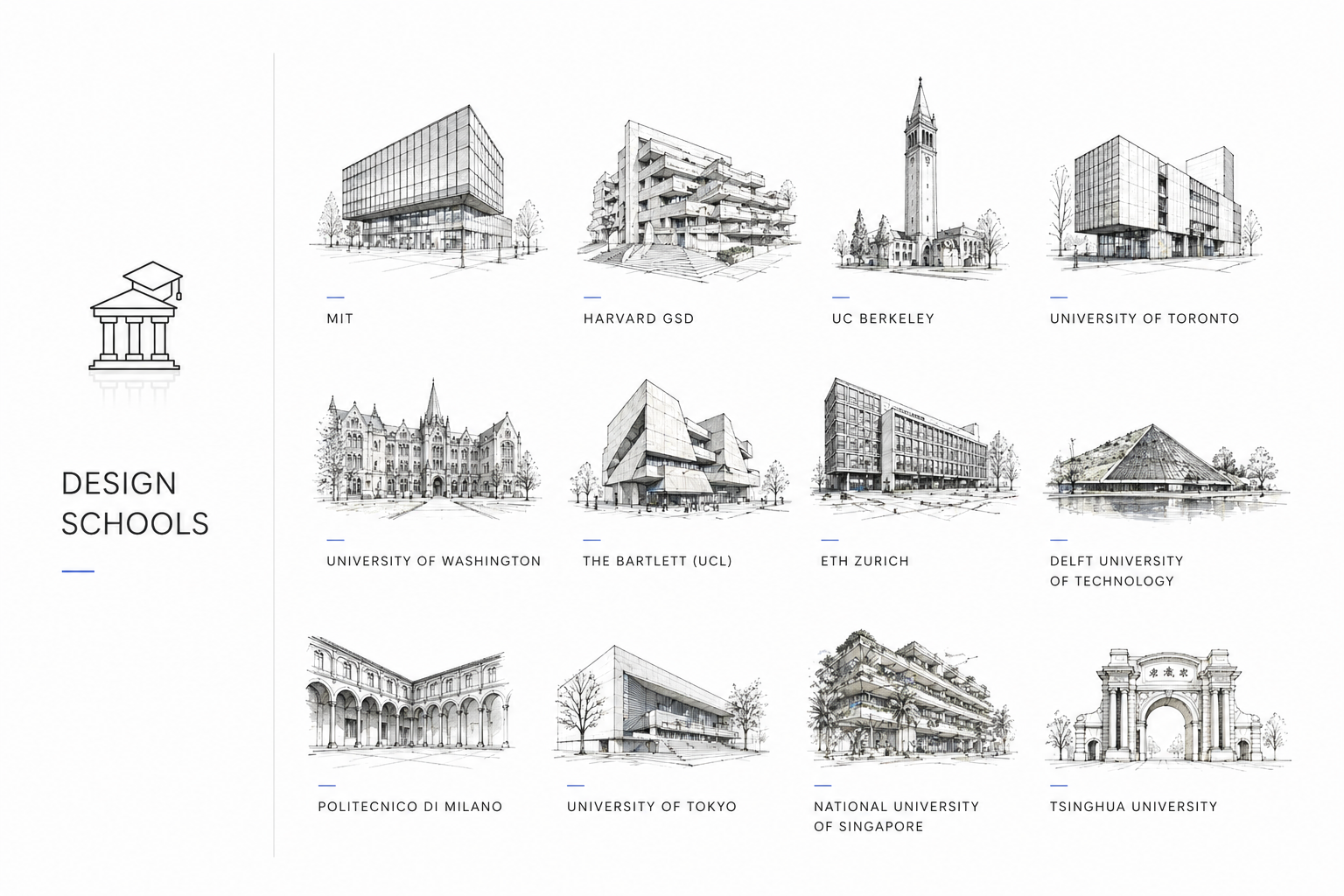
Illustration by ArchitectureCourses.org. Selected architecture and design schools worth knowing about.
Some schools are known for technical rigor. Some are known for theory. Some are known for experimental form-making. Some are deeply connected to local practice networks. Some produce unusually strong portfolios because the studio culture is brutally iterative.
The school name matters less once you understand what kind of work the program repeatedly produces.
SCI-Arc, for example, has a very different studio culture from Rice or Waterloo. The point is not which one is “better.” The point is whether the program’s habits match the architect you are trying to become.
A program’s behavior matters more:
- Does it produce technically believable portfolios?
- Do students get internships before graduation?
- Does the school teach construction as a core concern or a side topic?
- Do reviews help students improve, or mostly perform intensity?
A famous school can still be wrong for a student who wants a practical, construction-aware education. A less famous public program can be excellent if it has strong faculty attention, lower debt, good local firm connections, and a studio culture that builds durable work habits.
The school name opens a door. The work still has to walk through it.
Money Goes Beyond Tuition
Tuition is the number everyone sees first.
The rest of the costs arrive more quietly.
Many students spend hundreds of dollars per semester on prints, model materials, blades, chipboard, basswood, adhesives, and replacement tools alone. Thesis years and fabrication-heavy studios can push that much higher before housing even enters the equation.
Students also pay for software gaps, storage, transportation, site visits, replacement tools, and sometimes outside printing when the school’s facilities are overloaded.
Housing is usually the biggest variable, especially in cities where the school sits near expensive urban cores.
| Cost Area | What to Ask | Why It Changes the Decision |
|---|---|---|
| Studio supplies | What do students spend in a normal semester? | Small costs repeat every review cycle |
| Printing and fabrication | Are school shops included, limited, or fee-based? | Outside fabrication can become expensive near deadlines |
| Software and hardware | Which licenses are included, and what laptop specs are expected? | Weak equipment wastes deadline time |
| Housing | What do students actually pay near studio or reliable transit? | A cheap school in an expensive city may not stay cheap |
| Scholarship renewal | What GPA, credit load, or review condition keeps the award? | Studio workload can collide with renewal rules |
The scholarship line matters. A generous first-year award can shrink if the renewal rules are harder to maintain inside a studio-heavy curriculum.
Related Reading: Financial Aid Guide for Architecture Grad Students
The School Shapes the Portfolio Before You Do
Architecture students think they build portfolios alone.
They don’t.
The school shapes what students think good work looks like. Some programs reward abstract speculation. Some reward polished renderings. Some push technical plans, sections, wall details, construction logic, and real site constraints.
Look at ordinary student portfolios, not only award winners. Ask whether the work shows plans that make sense, sections that explain structure and light, and details that could survive outside a review room.
If every project looks dramatic but weak in plan, the program may be teaching persuasion more than architecture.
Rendering is persuasion, not proof.
Before You Move On: Real Architecture Portfolios That Work
What the Best School Does for You
The best school is not the most famous one.
It is the school that makes the right kind of work harder to avoid.
For one student, that may mean a NAAB-accredited B.Arch with strong building technology and a clear route toward licensure. For another, it may mean a public university with lower debt, strong local firms, and faculty who know how projects get built. For someone else, it may be a theory-heavy graduate program that opens research and teaching paths.
The decision gets clearer when you stop asking which school is best and start asking what kind of pressure you need.
| If You Need | Look For | Be Careful With |
|---|---|---|
| Licensure route | Accredited professional degree path | Architecture programs that sound professional but are not |
| Construction confidence | Design-build, strong technology courses, active practitioners | Programs where details appear only at the end |
| Internships | Local firm network, co-op, alumni pipeline, visiting critics | Beautiful isolated campuses with weak office access |
| Lower debt | Public programs, strong aid, lower rent, included software and shop access | Scholarships with fragile renewal terms |
| Research or theory | Faculty depth, writing culture, graduate pathways | Programs that use theory to hide weak design teaching |
Read This Next
If you are still comparing degree routes, start with Types of Architecture Degrees. It separates B.Arch, BA, BS, M.Arch, and technical routes before the school-choice question gets expensive.
If licensure is your goal, read How to Become a Licensed Architect before assuming any architecture degree will count the same way.
If you are applying soon, read Preparing an Architecture Portfolio for School Admission. Admissions decisions often turn on the portfolio more than students expect.
If you are already in school or worried about workload, read Architecture Coursework Tips for Success and Effective Time Management for Architecture Students.
If you are not sure architecture is the right field, read Why Study Architecture and List of Careers in Architecture before committing to a long professional route.
FAQ
What matters most when choosing an architecture school?
Accreditation comes first if licensure is the goal. After that, look at studio culture, faculty, internship access, portfolio quality, facilities, city, and cost.
Are architecture school rankings useful?
Only as a rough signal. Rankings do not show whether students get useful feedback, real building experience, strong internships, or manageable debt.
Is design-build experience important?
Yes, especially for students who want to understand how drawings become buildings. It is not required everywhere, but it is one of the clearest signs that a program takes construction seriously.
Do I need a famous architecture school?
No. A famous school can help, but firms still judge the portfolio, interview, work habits, and technical confidence. A strong public program with lower debt and good local firm connections can be a better decision.
Should I choose a B.Arch or a BS plus M.Arch?
Choose a B.Arch if you are confident about the professional architecture route and want the direct path. Choose a BA or BS first if you want more time before committing to the professional degree route.
How expensive is architecture school beyond tuition?
Costs vary, but studio supplies, printing, model materials, software gaps, hardware, housing, and unpaid time can change the real cost. Ask current students what they spend in a normal semester, not what the brochure says.
Do schools care more about GPA or portfolio?
Portfolio usually carries more weight once basic academic thresholds are met. GPA still matters, especially for scholarships and admissions filters, but weak work is hard to hide in architecture.
What if I change direction during the program?
Architecture training can transfer into planning, interiors, construction management, building science, visualization, and design research. The key is to pivot with structure, not drift from one idea to another every semester.
Final Word
A good architecture school should make you harder to fool.
It should teach you when a drawing is only beautiful, when a detail will fail, when a critic is right, when a program does not fit your route, and when a famous name is not enough.
Choose the school that will make your work stronger after the romance wears off.