
Beyond Flat: Parametric Ceilings That Break All the Rules
Parametric ceiling design turns the ceiling into a working system, not a flat lid. You set rules. The model responds. The result is cleaner light, better acoustics, and a ceiling that earns its place. If you want the broader logic first, scan the core ideas in parametric design, then come back here and use them overhead.
The Next Frontier in Architecture
What is Parametric Ceiling Design?
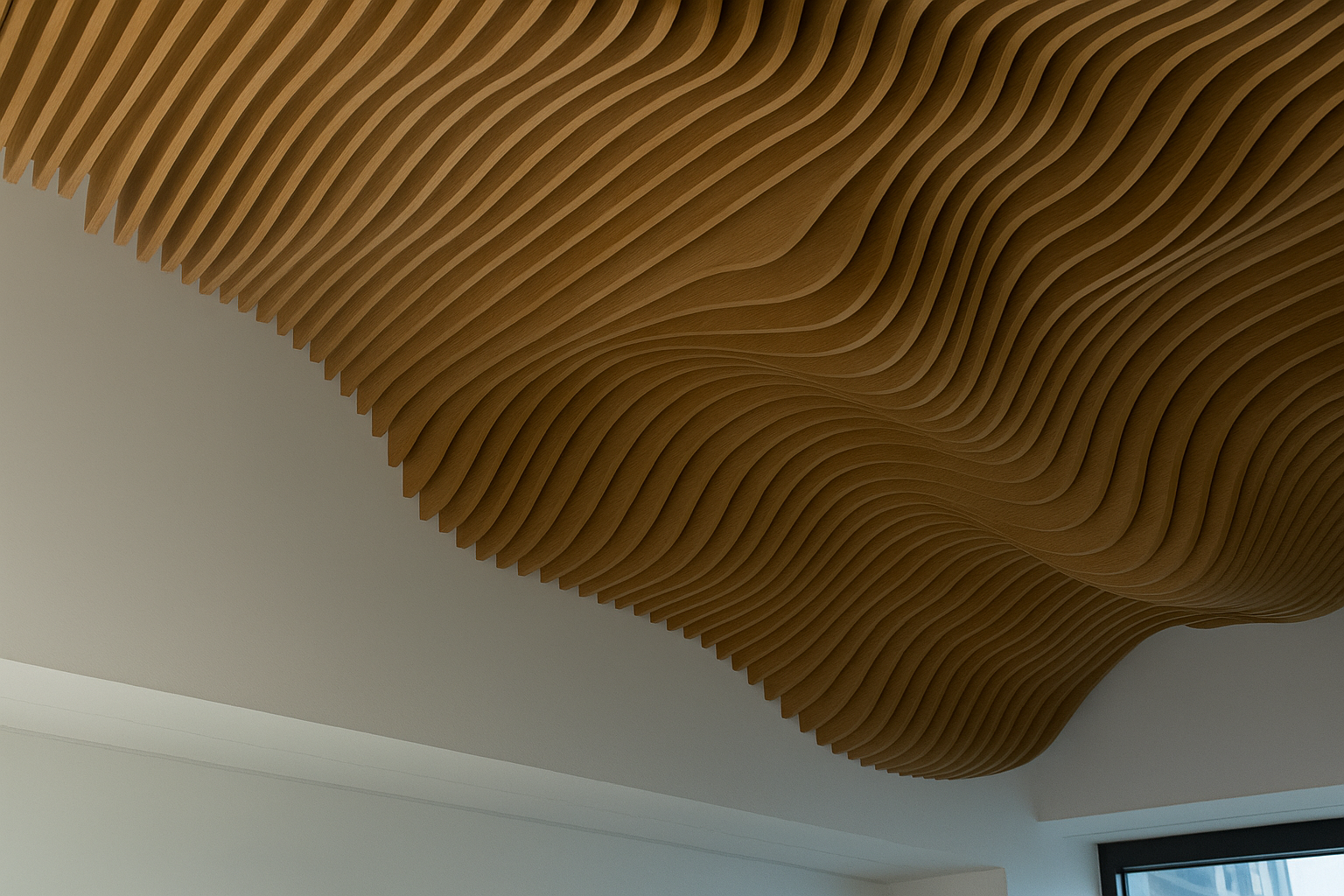
Parametric ceiling design uses rule sets to drive form, pattern, and performance. You adjust inputs like span, panel size, light levels, or acoustic targets. The model updates without breaking structure or cost. This is not random geometry. It is controlled behavior tied to clear goals. For a survey of tools that handle this well, see parametric software and tools.
How it behaves. You define the room’s bounding box, the service zones, the allowable depth, and the target reverberation time. You link daylight targets to panel perforation and tilt. You let the graph drive densities and joints. One change updates the set. Drawings and schedules follow the same source.
What it replaces. Manual pattern chasing. Ceiling grids that ignore light and sound. Late-stage fixes with patches and random baffles. Parametric logic removes the guesswork and turns the ceiling into a controllable system.
Ceilings Gone Wild: Parametric Design Like You’ve Never Seen Before
Why Parametric Ceilings Matter

Good ceilings do more than hide services. They shape sound, light, and air. Parametric logic lets you tune all three while keeping the kit of parts simple.
Key Benefits of Parametric Ceiling Design
- Customization. Modules fit the room, not the other way around. Spacing and depth follow real targets like lux levels and decay time, not vibes.
- Environmental response. Geometry shifts to manage daylight and reverberation. Fewer hotspots. Cleaner sound fields. Less rework on site.
- Aesthetic range. From calm ribs to complex fields. The rules hold. The look shifts. You get variety without chaos.
- Material innovation. Perforated metal, CNC timber, GFRG, PET felt, printed composites. All can slot into the same logic. See how this ties back to whole-room decisions in parametric interiors.
- Honest cost control. Repetition where it counts. Limited unique parts. Geometry that respects shipping, lift, and install sequences.
What clients feel. Fewer glare complaints. Quieter open areas. A space that looks intentional at every hour. That is value you can explain and defend.
Tools that keep ceilings buildable
Ceilings live in tight tolerances and crowded service zones. Your tools need to handle geometry, schedules, and real coordination.
1. Rhino + Grasshopper
Use Rhino for clean base geometry. Use Grasshopper to encode the rules. Group inputs, evaluators, and outputs. Limit sliders. Most values should compute from targets. Name every wire that matters. Bake only when you are ready to document.
Practical stack. Panel centerline field → curvature culling → depth map from daylight grid → perforation map from acoustic plan → seam logic → hardware points. Tag everything.
2. Autodesk Revit + Dynamo
BIM-first teams rely on adaptive components and schedules that match the model. Dynamo helps translate ceiling logic into families you can detail and quantify. The win is simple. The same rules that set the pattern also fill the sheets and the takeoffs.
3. CATIA
Use when spans are large and joints must align across big fields. CATIA keeps geometry exact for fabrication partners who demand stable surfaces and true curves. It is overkill for small rooms. It is perfect for long atria and transport halls.
4. Fusion 360
Great for modular panels, clips, and trims. Prototype parts. Test fasteners. Push final sizes back into the main graph so shop drawings and models agree.
Workflow note. Pick one source of truth. If Rhino drives form, let Revit follow with references and adaptive families. Do not run two masters. That is how ceilings drift.
Parametric Ceiling Design Examples
Three intents. One approach. Rules first. Geometry follows.
1. The Oculus, World Trade Center Transportation Hub — New York
Arched ribs read fluid, but the spacing follows structure and light. Depth and gaps shift with span and orientation. Parametric control kept the rhythm consistent while structural bays changed. The result is calm order, not noise.
2. Yas Island Hotel — Abu Dhabi
Undulating fields manage glare and bounce light deep into the interior. The pattern tightens near bright edges and opens toward the core. Panels repeat. Fixings repeat. The field looks complex. The parts stay simple. If you work with interiors often, cross-check the strategies in parametric interior design.
3. Elbphilharmonie — Hamburg
Acoustic panels vary micro-relief based on simulation. Same family. Different surface logic. Even distribution without ad-hoc patching. The point is not the pattern. The point is the target and the control.
Parametric ceilings in everyday interiors
Not every project is a concert hall. Rules still help in homes, clinics, offices, and retail. Small changes do the heavy lifting.
Light first
Run a quick daylight grid. Tie panel tilt to a threshold. Aim to flatten contrast before you chase style. People notice glare more than they notice geometry.
Sound without drama
Pick a reverberation target. Change depth and perforation only as much as you need. Do not over-treat rooms. Low frequency issues live in volume and mass, not just in holes.
Services that disappear
Slot linear diffusers into the rule set. Let sprinkler heads land in regular fields. Align access panels with seams. If maintenance cannot find the fasteners, you failed the room.
Materials that behave
PET felt for speech privacy. Timber slats where warmth helps. Perforated metal for clean edges and hard wear. GFRG for smooth curves at weight the crew can lift. Use a small kit of parts and push logic, not decoration.
Retrofits with tight budgets
Add a rib field that clips under an existing grid. Use depth to manage glare near glass and leave the rest flat. Tie everything to a few repeating parts so cost stays honest.
Ceilings that move when it matters
Motion is not a party trick. Make it earn its keep. If panels pivot, they should fix glare or improve sound. If louvers track the sun, they should save energy you can measure. Keep actuator types few. Plan the fail-safe state. Route service paths from day one.
Two useful scenarios
- Music halls. Baffles rotate to tune early reflections between rehearsal and performance setups. Inputs are presets, not infinite sliders.
- Atriums. Louvers adjust seasonally. Winter invites warmth. Summer kills glare. Sensors feed a simple control path with manual override.
Rule of thumb. More than two motion modes usually means you are masking a design gap. Fix the gap first.
How teams keep parametric ceilings real
This is the loop that works in practice. No hype. Just work.
- Define targets. Light, sound, depth, budget, service zones. Write them down. Lock them.
- Build the rule graph. Inputs on one side. Evaluators in the middle. Output geometry and schedules on the other.
- Generate options. Ten to fifty versions. Kill the weak ones with metrics, not taste.
- Freeze the kit of parts. Decide panel sizes, thickness, perforation families, hardware.
- Document. Shop drawings and schedules come from the same model. No redraws.
- Coordinate. Clash with structure, sprinklers, lights, speakers. Move rules, not traces.
Common failure. Geometry gets ahead of targets. Teams fall in love with a field and then start negotiating exceptions. Reverse it. Targets first. Field follows. The room stays honest.
Materials and joints that do the heavy lifting
Materials matter more than shapes. They set the limits and the look.
Perforated metal
Clean edges. Good fire performance. Predictable spans. Tie open area to acoustic targets. Keep three hole sizes and two patterns to control cost.
PET felt
Lightweight and easy to hang. Works well over desks and meeting rooms. Mind dust and edges. Use simple trims. Avoid complex curves that reveal seams.
Timber
Warmth and rhythm. Slats do more with less material. Back with black acoustic fleece. Keep removable bays for access. Wood moves with humidity. Allow for it.
GFRG and composites
Curves without heavy mass. Good for continuous surfaces that would fight with seams in metal. Make sure service access is real and reachable.
Joints and hardware
Choose fasteners once. Repeat them. Hide fixings where you can. Expose them cleanly when you cannot. A neat screw line is better than a failed clip you cannot reach.
Mistakes that waste weeks
- Endless arrays that solve nothing. If a pattern does nothing for light, cost, structure, or experience, remove it. Design is not a screensaver.
- Too many uniques. Costs explode when each bay is special. Use fields and families. Let density, rotation, or depth carry variation.
- Shallow coordination. Speakers and sprinklers will arrive. Plan for them. Parametric does not mean you get to ignore codes.
- Slider overload. Five inputs are plenty. The rest should calculate. If you cannot explain a slider to a client, you do not need it.
Spec cheat sheet you can lift into a project
Performance. Target average 300 to 500 lux on workplane. Keep daylight autonomy solid without glare spikes. Reverberation 0.5 to 0.8 seconds in open offices. Tighter for speech rooms.
Geometry. Max panel 1200 by 2400 where lifts are small. Depth under services set at the start. No last-minute surprises.
Acoustics. Use perforation open area 10 to 20 percent for general control. Increase depth over noisy zones. Always check low frequency with volume and mass.
Access. Every room needs a clear bay for service entry. Mark it in the rule set so it repeats cleanly and does not break the field.
Where this is heading
This is not science fiction. It is basic evolution of best practice.
Smarter control without drama
Simple sensors feed light and sound targets. The logic trims glare and smooths decay. Manual override stays on the wall. People trust rooms that do not surprise them.
Cleaner fabrication links
More shops want geometry they can trust. That means stable surfaces and tidy joints. If your model produces exact edges and repeatable parts, partners say yes faster.
Better operations data
Post-occupancy feedback loops push small updates. You learn where glare still hits and where sound pools. Next ceiling gets smarter without getting louder.
Tips
- Start simple. Two parameters, one output. Add complexity only when a target demands it.
- Simulate early. Daylight and acoustics before form locking. Data kills weak ideas fast.
- Study natural fields. Use them to set rules, not to draw shapes.
- Work with engineers. Structure and MEP drive real limits. Encode those limits so the model can respect them.
- Keep skills current. New plugins arrive often. Test, document, standardize. Do not rebuild a working stack for fun.
FAQ
What is parametric ceiling design?
A rule-based approach where geometry responds to inputs like light, sound, spans, and cost. Change inputs and the ceiling updates without breaking structure.
How does it improve functionality?
By tying geometry to daylight and acoustic targets. You get better comfort, lower energy, and consistent quality across options. It also keeps services aligned and access predictable.
Which software should I use?
Rhino + Grasshopper for rule authoring. Revit + Dynamo for BIM and documentation. CATIA for large, tight-tolerance systems. Fusion 360 for parts and hardware. If you are starting out, begin with Rhino, then add Grasshopper slowly.
Can this work in homes?
Yes. Slat fields, perforated panels, and shallow coffers respond to light and sound in living rooms, kitchens, and halls. Keep the kit of parts small. Keep access simple.
How do I keep costs under control?
Limit unique panels. Repeat hardware. Lock maximum sizes early. Show the cost model on screen while you design. Do not wait for late estimates.
Does a parametric ceiling have to move?
No. Most do not. Motion is used only when it fixes a clear problem like glare at specific hours or shifting acoustic needs.
How do sprinklers and lights fit?
They become inputs. You reserve zones and let the rule set place fixtures cleanly. Access panels align with seams. The ceiling stays readable.
Is coding required?
Logic is required. Visual scripting in Grasshopper or Dynamo gets you far. Code helps later when you need custom evaluators or faster tools, but it is not a barrier to start.
What is the biggest beginner mistake?
Starting with shapes. Start with targets. Define what cannot break. Then let geometry respond inside those limits.
Conclusion
Parametric ceilings turn the top of a room into a working system. Write clear rules. Pick a small kit of parts. Tie geometry to light and sound that people can feel. Let the model adapt. Your drawings stay honest. Your room works under real daylight and real noise. That is the point.