
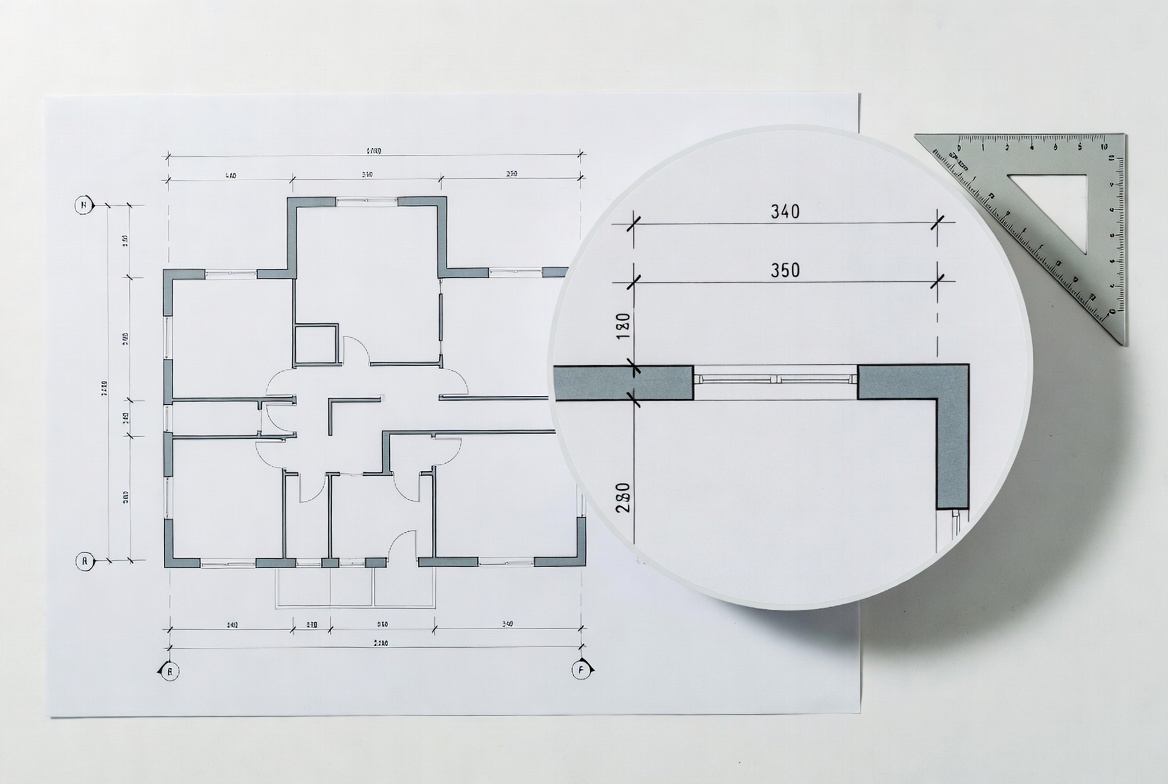
Blueprint scale is where beginners start trusting the wrong thing.
A plan can look clean and still be wrong the minute it is printed at the wrong size, measured off an NTS detail, or read without checking the dimensions.
That is the real issue here: when scale matters, when dimensions matter more, and when measuring the drawing is the wrong move.
If you are still getting oriented to plan sets in general, start with What Blueprints Are and How a Plan Set Is Organized. If you want the wider reading workflow after this, go next to How to Read Blueprints.
What Scale Is Doing
Scale is the agreement between the drawing and the built thing. It tells you how much the real building has been reduced to fit on the sheet.
If a floor plan is drawn at 1/4 inch equals 1 foot, every quarter inch on paper stands in for one real foot in the building. That is the whole game. The sheet is small. The building is not.
This sounds basic, but the mistake people make is acting as if scale is just a label in the title block. It is not. It controls how the drawing gets read, printed, checked, and trusted.
That is also why a note marked NTS matters. If a detail says not to scale, do not measure it like a plan. The drawing may only be diagrammatic, cropped, or adjusted for clarity. The note and dimensions outrank your ruler.
If drawing notation itself is still slowing you down, keep Architectural Drawing Symbols: Complete Guide for Students and Professionals open beside this page.
The Residential Scales You Will See Most Often
| Scale | Usually used for | What it means in practice |
|---|---|---|
| 1/8" = 1'-0" | Larger floor plans or simpler overview plans | Fits more building on the sheet, but small details get harder to read |
| 1/4" = 1'-0" | Typical residential floor plans | Common working scale for house plans because it balances fit and readability |
| 1/2" = 1'-0" | Small plans, bathroom layouts, kitchen layouts, enlarged plans | Shows more detail and is easier to check carefully |
| 3/4" = 1'-0" | Very tight areas or millwork-style enlarged views | Used when the designer wants more readable construction information |
| 1" = 1'-0" or larger | Details and very small assemblies | Used where junctions and build-up matter more than overall layout |
For many house plans, 1/4 inch equals 1 foot is the scale people run into first. It is common because it keeps the sheet readable without getting too coarse. But not every sheet in a set uses the same scale, and that is where beginners get caught.
A floor plan may be at 1/4 inch scale while a wall section is at 1/2 inch scale and the detail bubble is at 1 1/2 inch scale or marked NTS. You cannot carry one scale assumption across the whole set.
Do This Instead of Guessing
| Bad habit | Better move |
|---|---|
| Assuming every sheet uses the same scale | Check the title block or drawing title every time |
| Scaling a detail marked NTS | Read the written dimensions and notes instead |
| Trusting a PDF print without checking settings | Confirm full-size or correct print percentage first |
| Eyeballing room size from the drawing | Use the dimension strings before anything else |
| Using only the graphics | Cross-check graphics, dimensions, tags, and notes together |
How to Read Dimension Strings
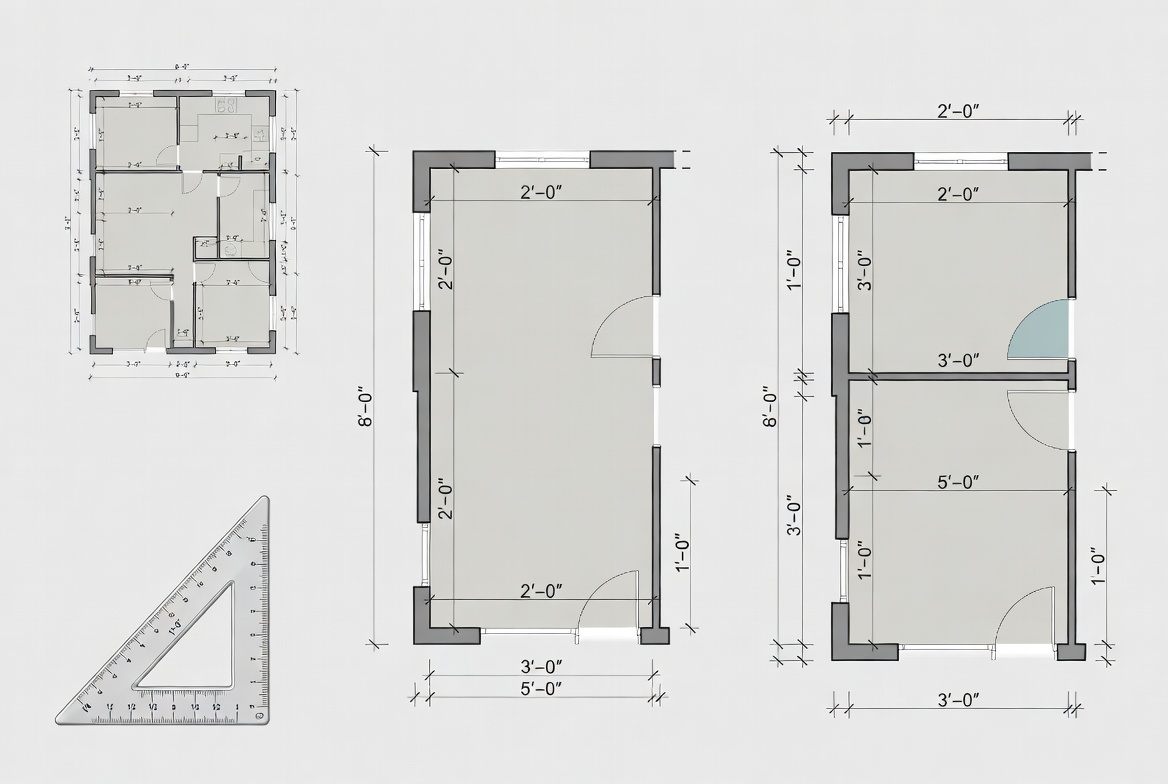
The dimensions are usually more important than the geometry you think you are seeing.
A wall might look centered on the sheet and still be offset by several inches from where you assumed. A window might look generous and still be narrower than expected. The dimension strings are what lock the drawing down.
On residential plans, you will often see dimensions stacked in layers outside the plan. The outermost string usually gives the overall building size. The next one often breaks that down into major wall locations or room zones. The inner strings usually pick up openings, offsets, and tighter control points.
Read them in that order: overall first, then major breaks, then small pieces. If you jump straight into the tiny numbers without understanding the larger frame, the plan gets confusing fast.
| Dimension layer | What it usually controls | Why it matters |
|---|---|---|
| Overall dimensions | Total width or length of the building or wall line | This is your first check against bad assumptions |
| Intermediate dimensions | Major wall breaks, room zones, or structural intervals | Helps you understand layout logic |
| Opening and offset dimensions | Door locations, window locations, recesses, or tighter control points | This is where accuracy starts getting expensive if ignored |
The thing people miss is that dimensions are not decoration. They are the hard edge of the drawing.
The Detail People Miss First
When the dimensions and the linework seem to disagree, trust the dimensions first.
That sounds obvious, but many beginners still read the drawing by visual impression. The room looks square, so they assume it is square. The window looks centered, so they assume it is centered. The stair looks generous, so they assume it works.
That habit causes trouble fast. Plans are graphic reductions. Lineweights, tags, hatches, and screen viewing can all distort what your eye thinks it sees. The dimension strings, notes, and written scale are there to stop that drift.
How to Scale Off a Drawing Safely
There are times when scaling off a drawing is fine. There are also times when it is exactly the wrong move.
Safe enough situations
- checking rough layout relationships during early study
- reading a plan that is clearly to scale and clearly printed correctly
- testing whether something is approximately in the right range before you cross-check the dimensions
Bad situations
- details marked NTS
- screen grabs or cropped PDFs
- printed sheets with unknown scale settings
- permit or construction decisions where exact dimensions already exist in the drawing
- existing-condition work where field verification matters more than old documents
That last one matters. Existing houses drift. Walls bow. Floors run out. Remodel drawings can be wrong before you even open the file. So even when the plan gives you dimensions, field conditions still get the final vote.
PDF and Print Mistakes That Throw People Off
This is where digital workflow creates a new kind of confusion.
- Fit to page. One click and the drawing is no longer at the printed scale you thought it was.
- Cropped screenshots. They may preserve the look of the drawing but not the actual scale relationship.
- Mixed sheet sizes. One page may be Arch D, another a reduced export, another a letter-sized markup print.
- No graphic scale bar. If the drawing has no graphic bar and the print settings are uncertain, trust drops fast.
- Working only on screen. Things that seem readable on a monitor can become muddy or compressed when printed.
The practical fix is simple: print one test sheet correctly and check it before you trust the rest. That five-minute check saves a lot of dumb confusion.
What People Commonly Do Wrong
- They read the room shape and ignore the dimensions.
- They assume one scale applies to the whole set.
- They measure a PDF without checking print or export conditions.
- They skip the title block and miss the scale note entirely.
- They treat NTS details as measurable drawings.
- They trust old drawings more than field conditions.
The repeated pattern is simple: the drawing feels clear before it has actually been checked.
How This Helps If You Are Drawing Your Own Plans
If you are making your own house plans, scale discipline is where the drawing starts becoming usable.
It is also where a lot of DIY drawings fail. The layout may be promising, but if the sheet size is random, the scale drifts, the dimensions are weak, and the print check never happens, the drawing stops being dependable.
That is why How to Draw Your Own House Blueprints should sit right beside this page. One page explains how to build the drawing. This page helps make sure the drawing can be read honestly once it exists.
What To Do Next
- How to Read Blueprints if you want the bigger reading workflow beyond scale and dimensions.
- How to Draw Your Own House Blueprints if you are making your own plans and need the drawing workflow itself.
- Architectural Drawing Symbols: Complete Guide for Students and Professionals if notes, symbols, and tags are still slowing you down.
- Components of a Construction Document Set if you want the wider document picture around drawings, specs, and addenda.
FAQ
What is the most common blueprint scale for house plans?
For many residential floor plans in the US, 1/4 inch equals 1 foot is one of the most common working scales. But you still have to check each sheet instead of assuming.
Can I measure directly from a PDF blueprint?
Only if you know the file and print conditions are correct and the drawing is intended to be scaled. A cropped image, reduced print, or sheet marked NTS can throw you off fast.
What does NTS mean on a blueprint?
It means not to scale. The drawing may be diagrammatic or adjusted for clarity, so you should rely on written dimensions and notes instead of measuring it.
Should I trust the dimensions or the linework?
Trust the dimensions first. The linework helps you understand the layout, but the dimensions are what lock the drawing down.
Why are dimensions usually outside the plan?
Because the plan interior gets crowded quickly. Keeping dimension strings outside the main linework usually makes the drawing easier to read and check.
Can two drawings in the same set use different scales?
Yes, all the time. Floor plans, sections, enlarged plans, and details often use different scales because they are doing different jobs.
What is the biggest beginner mistake with blueprint scale?
Assuming the drawing “looks right” and skipping the actual scale note, dimension strings, and print check.
Do I still need field measurements if I have the drawings?
For existing buildings, often yes. Old drawings can drift away from field reality, especially on renovations and additions.