
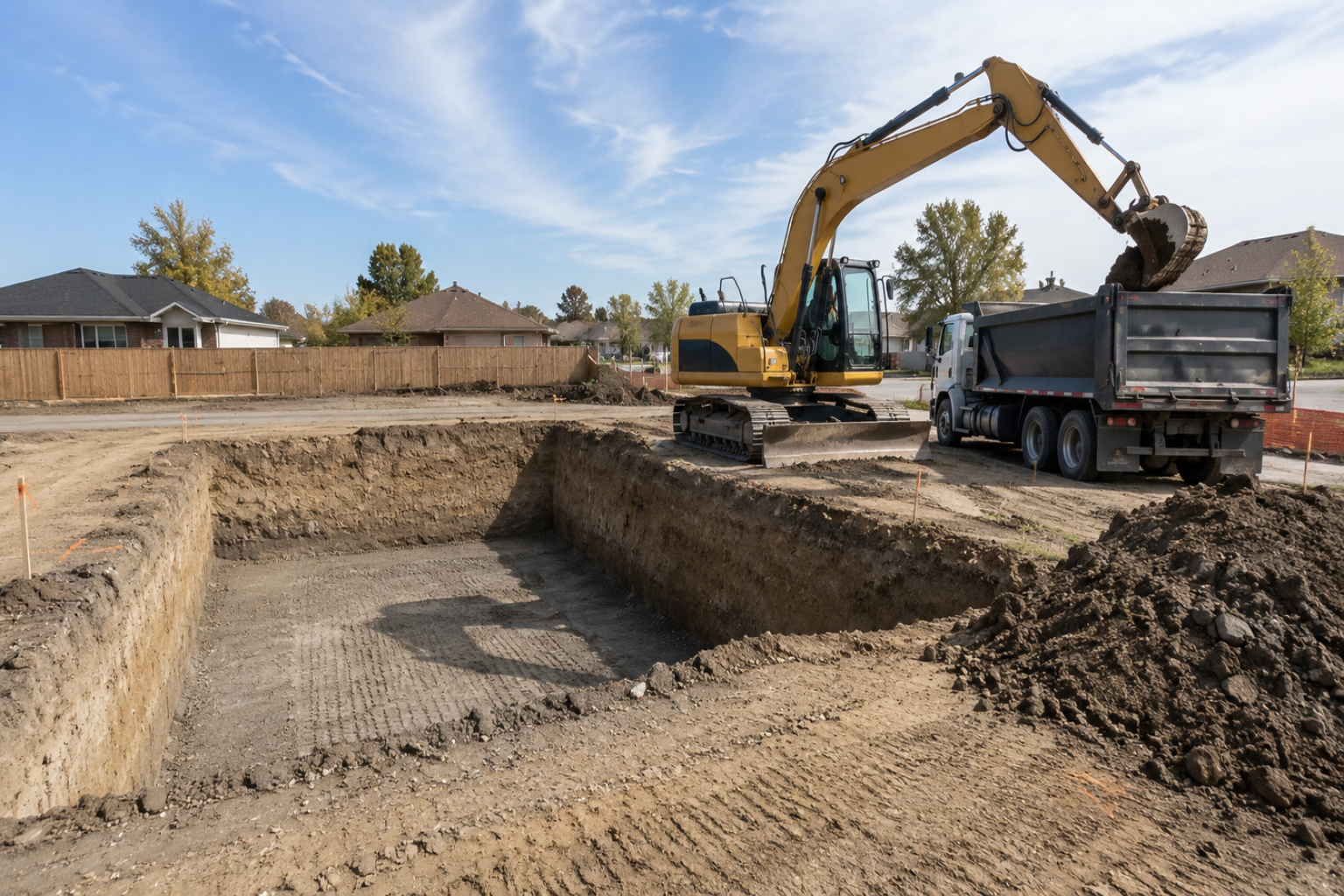
Foundation excavation has to reach the correct depth without damaging the soil that will support the building. The crew also has to control water, keep equipment and spoil away from the edge, and protect nearby footings and structures.
The method depends on the soil, excavation depth, groundwater, site access, and the space available for sloping or shoring. Work beside or below an existing house needs a planned support sequence before digging starts.
Foundation Type and Excavation Method Are Not the Same Thing

A basement, crawl space, slab-on-grade, and pier-and-beam foundation describe the finished foundation system. They do not describe how the ground is safely opened.
| Foundation configuration | Common excavation approach | Main concern |
|---|---|---|
| Full basement | Bulk open-cut excavation, sloped or supported | Depth, groundwater, haul-out volume, wall access |
| Crawl space | Shallow bulk excavation or perimeter trenches | Drainage, clearance, moisture control |
| Slab-on-grade | Site stripping, grading, footing trenches, local thickened areas | Undisturbed subgrade, fill quality, compaction |
| Strip footings and foundation walls | Continuous trench excavation or open cut | Trench stability and clean bearing surface |
| Piers or drilled shafts | Augered or drilled holes with local excavation | Hole stability, groundwater, correct bearing layer |
| Existing house being lowered or strengthened | Sectional excavation, underpinning, benching, or a designed combination | Maintaining support under the occupied structure |
This distinction matters. A contractor may be experienced at digging new basements on open lots but not qualified to excavate beneath an occupied house or beside a weak stone foundation.
The Four Foundation Excavation Jobs Homeowners Most Often Pay For
New House or Addition Excavation
The site is opened for new footings, basement walls, a crawl space, or a slab. The work usually includes stripping topsoil, bulk excavation, footing preparation, soil stockpiling or haul-out, backfill, and rough grading. Access is often easier than on repair projects, but the volume of soil can be large.
Exterior Foundation Repair or Waterproofing Excavation
A trench is opened along an existing foundation wall so the contractor can expose cracks, remove failed coatings, repair masonry or concrete, install a waterproofing membrane, and replace or add footing drainage. This is not the same as digging a new basement. Utilities, porches, decks, driveways, landscaping, window wells, and unstable backfill can make a narrow repair trench much harder than it looks.
Basement Lowering and Underpinning
Soil is removed inside an existing basement to gain headroom or reach a new slab elevation. If the new floor will be below the existing footing, the structure usually needs engineered underpinning, bench footing, or another support system. Digging continuously beneath an existing footing can remove the soil that is holding the house up.
Crawl Space to Basement Conversion
This combines restricted access, heavy handwork or small equipment, major soil removal, temporary support, new drainage, and often underpinning. The excavation itself is only one part of the price. Concrete, structural work, stairs, plumbing relocation, waterproofing, mechanical systems, and interior rebuilding can cost more than the digging.
Main Foundation Excavation Methods
Bulk Open-Cut Excavation
Bulk excavation removes most of the soil from a basement or foundation footprint in a planned sequence. Tracked excavators load soil into stockpiles or trucks while loaders, skid steers, or dozers manage material and access roads.
This is usually the fastest approach when the lot has enough room for equipment, safe side slopes, a ramp, and truck movement. The excavation should have a coherent footprint, a stable working bench for the machine, and a practical route for getting soil out without repeatedly driving across the prepared bearing surface.
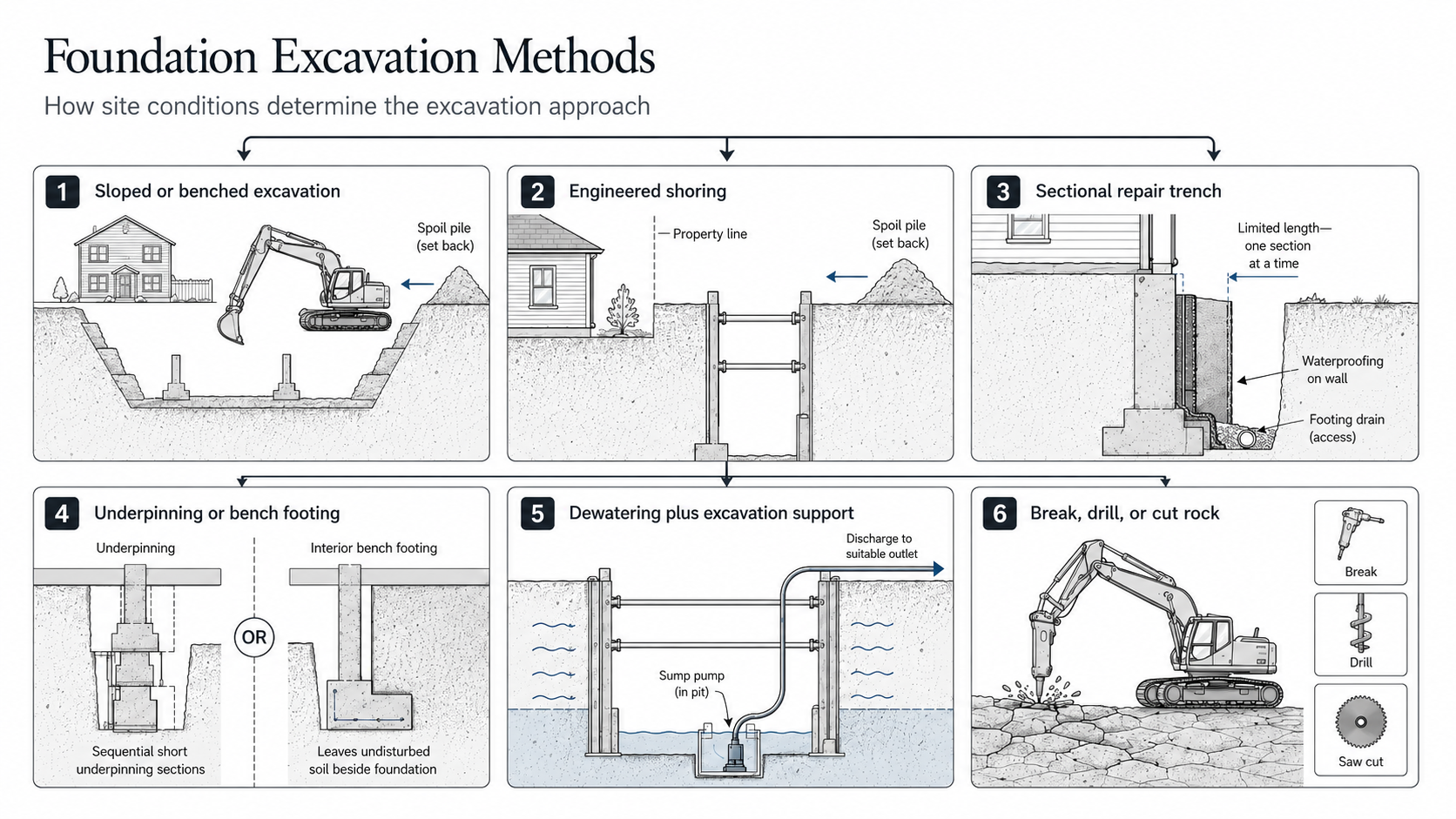
Sloped Excavation
The sides are cut back at a safe angle instead of being left vertical. Sloping reduces the likelihood of a cave-in, but it needs space. The required geometry depends on soil classification, moisture, depth, vibration, nearby loads, and the governing safety rules.
Sloped cuts work well on open sites. They can be impossible on a narrow lot where the property line, street, neighboring house, septic system, or mature trees sit close to the proposed foundation.
Benched Excavation
Benching creates a series of horizontal steps in the excavation face. It can reduce the amount of soil removed compared with one long continuous slope, but bench dimensions and suitability are not guessed in the field. Some soils and conditions are not appropriate for benching.
Benching used for excavation safety should not be confused with a permanent interior bench footing used during basement lowering. They are different systems serving different purposes.
Supported or Shored Excavation
Shoring supports the soil when the cut must be steeper than the ground can safely stand on its own. Residential work may use engineered timber or hydraulic systems in limited situations. Larger or deeper work may use soldier piles and lagging, sheet piles, secant piles, soil nails, bracing, or tiebacks.
Shoring becomes more likely when excavation is deep, groundwater is present, access is tight, or a neighboring footing, road, retaining wall, or utility is inside the zone affected by the cut. The system may require a structural or geotechnical engineer and permission to install anchors beyond the property line.
Trench Excavation
Trenches are used for strip footings, grade beams, drainage, waterproofing access, and utilities. They may be narrow, but they are not automatically safer than a large open excavation. A narrow trench can trap a worker, fill rapidly with water, or collapse with little warning.
The trench bottom should be kept at the design elevation. Loose, softened, frozen, or disturbed soil must be addressed before concrete is placed. Random over-excavation is not corrected by dumping loose soil back into the trench.
Drilled Pier or Shaft Excavation
Augers or drilling rigs create holes for concrete piers or shafts. This method concentrates excavation at support points instead of removing the entire building footprint. It is useful when loads must reach deeper competent material or when the structural design calls for isolated deep supports.
Hole stability, groundwater, collapsing soils, obstructions, reinforcement placement, and concrete quality all matter. A drilled hole that looks clean at the surface may have loose material or water at the bottom.
Rock Excavation
Rock may be removed with hydraulic breakers, ripping teeth, rock saws, drilling, expansive demolition agents, or controlled blasting where permitted. The correct method depends on rock strength, fracture pattern, neighboring buildings, vibration limits, noise rules, and access.
Rock changes the schedule quickly. It can also create an irregular excavation bottom that needs dental concrete, lean concrete, or another engineered correction before footings are formed.
Hand Excavation and Vacuum Excavation
Hand digging is slow but useful around utilities, fragile masonry, restricted crawl spaces, and locations that machinery cannot reach. Vacuum or hydro excavation can expose utilities with less mechanical contact, but it still requires a plan for slurry, water, disposal, and protection of the surrounding soil.
These are precision methods, not cheap substitutes for a properly sized machine on a large open excavation.

A tracked excavator needs a broad, level working bench, supported tracks, safe edge distance, and a planned route for loading and haul-out.
Excavating Beside or Beneath an Existing House
Existing-house excavation is where casual digging becomes dangerous. The soil beside and below a footing is part of the support system. Removing it can cause settlement, rotation, cracking, or a local collapse even when the foundation looked stable before work began.
Exterior Wall Excavation
Exterior waterproofing or structural repair usually exposes one wall at a time. The contractor must account for the wall condition, trench stability, utility crossings, roof runoff, porches, steps, driveways, and the possibility that the original backfill is loose or saturated.
Excavation should not blindly continue below the footing. If repair requires access under the footing or the wall is visibly unstable, work should stop until the support sequence is designed.
Sectional Underpinning
Traditional underpinning divides the existing footing into short sections. Selected sections are excavated and supported while untouched soil remains between them. After the new underpinning elements gain adequate strength, the intermediate sections are completed in the engineered sequence.
The sequence, section length, reinforcement, bearing elevation, concrete placement, pinning detail, and curing requirements belong in the structural design. Digging every section at once defeats the purpose.
Interior Bench Footing
A bench footing leaves soil beside the existing foundation and builds a new reinforced concrete bench inside the basement. It avoids excavating directly beneath the old footing but reduces usable floor area around the perimeter.
Benching is not automatically safer or cheaper. The bench width, connection, drainage, waterproofing, headroom, stairs, and finished layout must all work together.
Crawl Space Conversion
Converting a crawl space into a basement usually requires staged excavation, temporary access openings, conveyors or small machinery, dust control, structural support, and repeated soil haul-out. Plumbing, ducts, wiring, posts, and beams often cross the work area.
A quote that includes only “digging out the crawl space” is incomplete. The finished project needs a new structural and water-management system, not just a deeper hole.
What Determines the Excavation Method
Soil and Rock
Soil type affects bearing, cut stability, water movement, and equipment production. Dense granular soil, soft clay, loose fill, organic material, expansive clay, and weathered rock behave differently. Conditions can also change across one house footprint.
A geotechnical investigation may include borings, test pits, penetration testing, groundwater observations, laboratory classification, and recommendations for bearing, excavation support, fill, and compaction. The scope should match the size and risk of the project.
Excavation Depth
Depth increases soil pressure, haul-out volume, access difficulty, water risk, and the consequences of a collapse. It may also move the bottom of the excavation into a different soil layer than the one visible at grade.
Groundwater and Surface Water
Water can soften the bottom, erode soil from beneath adjacent footings, increase pressure on shoring, and turn a workable cut into unstable mud. A dry test pit on one day does not prove the site will remain dry after rain, snowmelt, or seasonal groundwater rise.
Access and Working Room
Machine size is controlled by gate width, overhead wires, neighboring buildings, tree canopies, driveway capacity, turning space, and the route to the truck. Restricted access can shift work from one efficient excavator to a chain of small machines, conveyors, wheelbarrows, or hand labor.
Adjacent Structures and Property Lines
Excavation can affect neighboring footings, retaining walls, utilities, sidewalks, and roads. Preconstruction surveys, monitoring points, shoring, vibration limits, and agreements with adjoining owners may be needed before work begins.
Soil Reuse and Haul-Out
Excavated material is not automatically suitable for backfill. Topsoil, wet clay, organic soil, debris, oversized rock, and contaminated material may need separation or disposal. Clean granular material may need to be imported even when a large pile of excavated soil remains on site.
Foundation Excavation Workflow
- Confirm the design. Establish footing elevations, wall lines, slab elevations, drainage, service entrances, and any temporary support requirements.
- Review site information. Use the survey, geotechnical information, utility records, flood information, and access plan.
- Obtain permits and utility locates. Mark public utilities and investigate private services that the public locate may not identify.
- Plan erosion, water, and soil handling. Decide where clean soil, topsoil, rock, waste, pumps, trucks, and imported fill will go before digging.
- Lay out the excavation. Offset stakes or control points should survive the clearing and digging work so dimensions and elevations can be checked again.
- Clear and strip the site. Remove vegetation, unsuitable topsoil, abandoned slabs, and known obstructions without disturbing more ground than necessary.
- Install temporary controls. Add fencing, access control, runoff diversion, shoring, ramps, pumps, and monitoring before the risk appears.
- Excavate in a planned sequence. Maintain stable equipment positions, avoid undercutting, and keep the bottom above final grade until the last controlled pass where practical.
- Inspect the exposed subgrade. Verify soil condition, elevation, groundwater, soft pockets, and unexpected fill before placing stone, mud slab, forms, or concrete.
- Correct unsuitable areas. Use the engineer’s direction for over-excavation, compacted structural fill, lean concrete, drainage stone, or foundation redesign.
- Build and waterproof the foundation. Coordinate footings, walls, penetrations, dampproofing or waterproofing, drainage, insulation, and inspection.
- Backfill in controlled lifts. Use suitable material and equipment that will not damage fresh walls, drains, waterproofing, or insulation.
- Complete rough and final grading. Direct surface water away from the foundation and restore drainage paths disturbed by construction.
Protecting the Excavation Bottom
The last few inches of digging matter more than many homeowners realize. The footing bears on the soil left at the bottom, not on the soil that was hauled away.
- Do not repeatedly drive heavy equipment across the final bearing surface.
- Do not leave the bottom exposed to rain and then place concrete over softened mud.
- Do not fill accidental deep spots with loose excavated soil.
- Remove loose crumbs, frozen soil, standing water, and disturbed material as directed.
- Recheck elevations before stone, forms, reinforcement, or concrete hides the bottom.
When weather threatens, contractors may leave a protective soil layer and trim to final grade shortly before footing work. On sensitive sites, a thin mud slab or other protective layer may be specified after approval of the subgrade.
Groundwater and Dewatering
Dewatering is not simply placing a pump in the lowest corner. The system must lower or control water without washing fine soil out from beneath the excavation, neighboring foundations, or utilities.
Common Approaches
- Surface diversion: Berms, swales, covers, and temporary drains keep rain and runoff from entering the cut.
- Sumps and pumps: Water is collected at controlled low points and pumped to an approved discharge location.
- Wellpoints or wells: A designed system lowers groundwater around deeper or more permeable excavations.
- Cutoff systems: Sheet piles, grouting, or low-permeability barriers reduce inflow on difficult sites.
Warning signs include sand boiling into the excavation, cloudy discharge carrying soil, new settlement beside the cut, movement in shoring, rapid inflow, and a bottom that repeatedly heaves or softens. These conditions need engineering review, not a larger pump chosen at random.
Equipment Used for Foundation Excavation
Mini Excavator
Useful for additions, repair trenches, narrow access, and interior or backyard work. Its lower production can be worth the tradeoff when a larger machine cannot enter safely.
Mid-Size Tracked Excavator
The main machine for many residential basement and foundation excavations. It offers reach, stability, bucket capacity, and the ability to use grading buckets, breakers, compactors, or other attachments.
Backhoe Loader
Flexible for smaller jobs that need both digging and loading. It is less efficient than a dedicated excavator and loader combination on a large bulk excavation but can reduce equipment mobilization on compact projects.
Skid Steer or Compact Track Loader
Moves soil, stone, and debris in tight areas. It is often used with an excavator to clean the bottom, load conveyors, spread granular fill, and manage backfill.
Loader and Bulldozer
Loaders handle stockpiles and trucks. Dozers strip, spread, and rough-grade soil. Neither replaces the precision digging and reach of an excavator around footing lines.

Bulldozers are most useful for stripping, moving soil, building access, and grading open sites rather than precision footing excavation.
Modern Grade Control
Laser receivers, GPS machine control, total stations, and digital site models can help operators track elevation and slope. They reduce repeated checking and overdig, but they do not replace survey control, operator judgment, utility verification, or inspection of the actual soil.
Excavation Safety: The Numbers That Matter
In the United States, OSHA excavation rules apply to worker protection. Local building, environmental, and public-works requirements may add other obligations.
- A protective system is generally required for workers in trenches 5 feet deep or more unless the excavation is entirely in stable rock. A competent person can still require protection in a shallower trench when a cave-in hazard exists.
- Protective systems for excavations deeper than 20 feet generally require design by a registered professional engineer.
- Trenches 4 feet deep or more require a safe means of exit positioned so workers do not travel more than 25 feet laterally.
- Spoil, materials, and equipment must be kept back from the edge or otherwise restrained from falling or rolling into the excavation. OSHA commonly identifies a minimum 2-foot setback for excavated material.
- A competent person must inspect the excavation, adjacent areas, and protective systems daily and after rain or another event that could increase hazards.
These are baseline worker-safety rules, not a complete excavation design. A deep foundation pit, excavation beside a house, or water-bearing cut may require engineered support even when nobody plans to stand in the excavation.
What Drives Foundation Excavation Cost
A price per cubic yard or an excavator hourly rate can be useful, but it rarely predicts the final project by itself. Contractors price the entire production problem.
| Cost driver | Why it changes the price |
|---|---|
| Excavated volume | More soil means more digging, truck cycles, disposal, and replacement material. |
| Site access | Small equipment, handwork, conveyors, mats, or crane lifts reduce production. |
| Soil and rock | Wet clay, loose fill, boulders, hard rock, and contaminated soil need different handling. |
| Groundwater | Pumps, wellpoints, treatment, monitoring, standby power, and discharge controls add cost. |
| Shoring | Design, installation, bracing, monitoring, rental time, and removal may exceed the digging cost. |
| Truck and disposal logistics | Long haul distances, tipping fees, traffic limits, and dirty-road cleanup add time. |
| Existing structures | Underpinning, temporary support, hand digging, and movement monitoring slow the work. |
| Backfill and compaction | Imported stone or structural fill, lift placement, testing, and small equipment are separate operations. |
| Restoration | Driveways, porches, decks, fencing, landscaping, irrigation, and interior finishes may be outside the excavation quote. |
The cheapest-looking excavation quote often excludes soil disposal, imported backfill, dewatering, shoring, compaction testing, utility relocation, or restoration. Compare scopes, not just totals.
What a Complete Excavation Quote Should State
- The excavation limits, planned depth, and estimated quantity.
- What soil information the price is based on.
- Which equipment will be used and how it will access the work.
- Whether shoring, sloping, benching, fencing, ramps, and worker access are included.
- Who obtains utility locates and who checks private services.
- Whether soil stays on site or is hauled away.
- Allowances or unit prices for rock, unsuitable soil, contaminated material, and extra trucking.
- Dewatering assumptions and the approved discharge method.
- The backfill material, lift thickness requirements, compaction method, and testing responsibility.
- Protection of waterproofing, drainage pipe, insulation, and fresh foundation walls during backfill.
- Rough grading, final grading, cleanup, and restoration exclusions.
- The process for documenting changed conditions before extra work begins.
Red Flags and Stop-Work Conditions
- The excavator is perched on a narrow ridge or its tracks are partly unsupported.
- Spoil piles, pallets, trucks, or outriggers crowd the excavation edge.
- A vertical cut is left unsupported beside a neighboring house or existing footing.
- Workers enter a deep trench with no protective system or safe exit.
- Water is carrying sand or silt into the excavation.
- The bottom is soft, pumping, frozen, or visibly disturbed before footing work.
- Unknown pipes, tanks, old foundations, buried debris, or contaminated-looking soil appear.
- Excavation continues below an existing footing without an engineered sequence.
- Survey stakes disappear and nobody can show how the excavation elevation is being checked.
- Backfill is dumped in deep lifts against a fresh wall with no compaction plan.
These conditions do not always mean the whole project is failing. They mean the crew needs to pause, verify the design and soil conditions, and correct the method before the work becomes hidden.
Common Misunderstandings
“A Bigger Excavator Is Always Cheaper”
A larger machine may move soil faster, but only when it can enter, turn, load trucks, and work from stable ground. On a tight lot, a large machine can create more damage, require more clearing, and increase edge loads.
“The Excavated Soil Can Go Straight Back Against the Wall”
Some excavated soil may be too wet, too plastic, too organic, too rocky, or too contaminated for controlled backfill. Even suitable soil must be placed and compacted without damaging the wall or drainage system.
“No Water Was Visible, So Dewatering Is Not Needed”
Groundwater can be seasonal. Rain can also enter faster than a compact excavation can drain. The project still needs a surface-water plan and a response for unexpected inflow.
“Exterior Waterproofing Is Just Digging and Painting the Wall”
The excavation exposes the problem. A durable repair may also require crack repair, masonry work, surface preparation, membrane detailing, drainage board, footing drains, sump or outlet work, window-well changes, backfill, grading, and restoration.
“Underpinning Means Digging the Whole Basement Deeper”
Underpinning is the structural support work used to deepen or strengthen a foundation. Basement excavation removes soil. The two may happen on the same project, but they are not interchangeable terms.
FAQ
How deep is a normal house foundation excavation?
There is no universal depth. It depends on the foundation type, required frost protection, finished grades, basement headroom, footing thickness, drainage, soil, and local code. The approved drawings should control the excavation elevation.
Can a homeowner excavate a foundation with rented equipment?
Small, shallow work on an open site may be possible for an experienced operator. A basement, deep trench, excavation beside an existing house, or work involving groundwater, utilities, shoring, or underpinning should be handled by qualified contractors under the required engineering and permits.
What happens if the contractor digs too deep?
The correction depends on the soil and structural design. It may involve removing more unsuitable material and placing compacted structural fill, drainage stone, lean concrete, or additional footing concrete. Loose excavated soil should not be pushed back into a bearing area without approval.
How much extra room is needed outside a basement wall?
The overdig depends on formwork, waterproofing access, drainage, insulation, safe slopes, shoring, and equipment. There is no single allowance that fits every project. It should be shown or described in the excavation and foundation plan.
Is excavation included in a foundation contractor’s quote?
Sometimes. On other projects, excavation, concrete, waterproofing, drainage, hauling, and grading are separate contracts. The written scope should state who controls elevations, accepts the subgrade, removes excess soil, supplies backfill, protects the wall, and completes grading.
Can foundation excavation damage a neighboring house?
Yes. Removing soil can affect nearby footings, retaining walls, utilities, and pavements. Tight sites may need preconstruction condition surveys, engineered shoring, movement monitoring, vibration controls, and coordination with the adjoining owner.
When is a geotechnical engineer needed?
A geotechnical engineer is especially valuable when soil is variable or unknown, the excavation is deep, groundwater is present, fill or expansive clay is suspected, rock is encountered, adjacent structures are close, or the foundation carries unusual loads. The building department or structural engineer may also require a report.
What is the difference between excavation shoring and a trench box?
Shoring supports the excavation walls to limit soil movement. A trench box primarily shields workers inside a trench; it does not necessarily prevent the surrounding soil from moving. Protecting a nearby foundation may require a designed earth-retention system rather than worker shielding alone.
The Detail People Miss
Excavation is not complete when the hole reaches the right depth. It is complete when the bearing surface is accepted, water is controlled, the foundation can be built safely, suitable backfill is available, and the finished grade will move water away from the building.
That is why a clean excavation quote is more valuable than a cheap hourly rate. The contractor is not only selling machine time. The contractor is taking responsibility for sequence, access, soil, water, support, haul-out, and the condition left for the next trade.