
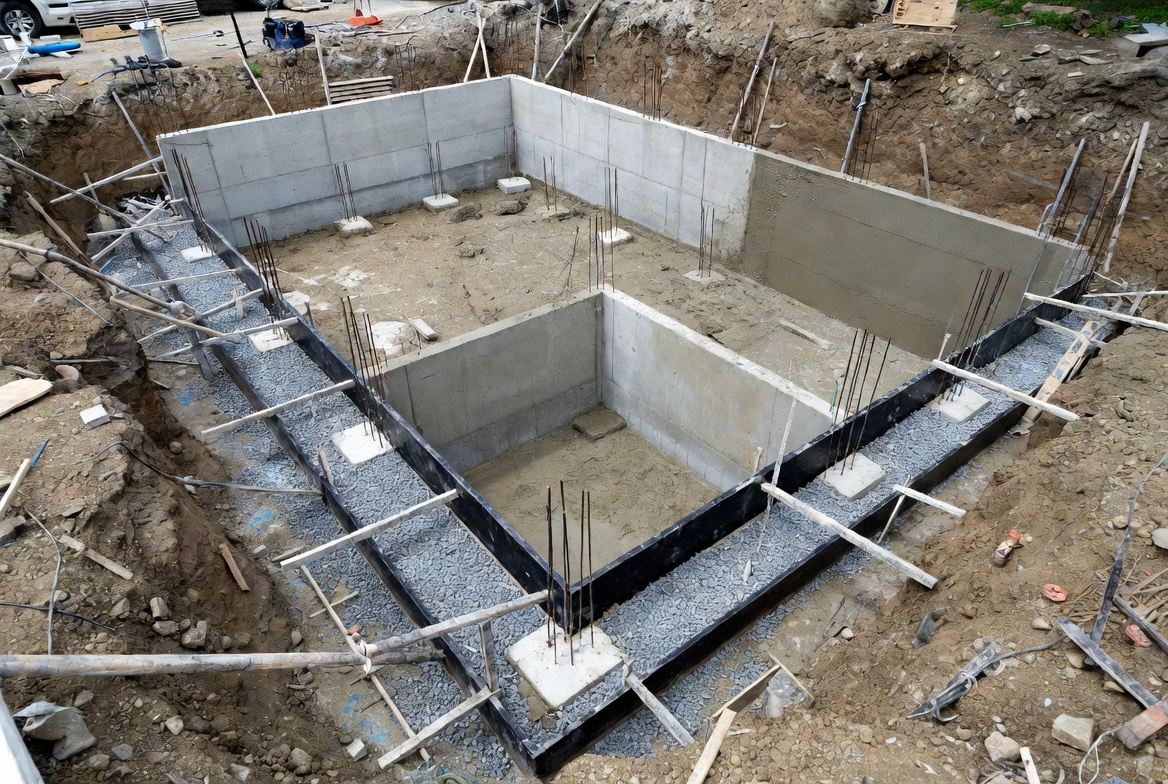
What are foundations in buildings? A foundation is the part of a building that takes the weight above and passes it into the ground below without too much movement, cracking, or moisture trouble. That is the clean definition.
The messier version is the one people learn later. A foundation is not just concrete under a house. It is the whole ground-contact system that decides whether the structure stays level enough, dry enough, and stable enough to behave over time.
That system can include footings, foundation walls, slabs, piers, piles, grade beams, drainage, waterproofing, insulation, and the soil conditions underneath all of it. Leave out the soil and you are only telling half the story.
If you want the wider breakdown after this page, go next to types of building foundations or soil testing and site investigation.
More Than Concrete
People talk about foundations like they are a block of concrete sitting under a building. Too simple.
A foundation does three jobs whether anyone notices or not.
It carries load. Roof, floors, walls, finishes, furniture, people, equipment. All of that weight moves down through the structure and ends at the foundation.
It controls movement. Not eliminates it. Controls it. Soil settles. Clay swells and shrinks. Frost lifts shallow edges. Water weakens support. A good foundation is designed so those things do not turn into sloped floors, stuck doors, cracked finishes, or leaking walls.
It manages contact with the ground. That means drainage, waterproofing, capillary breaks, and details that keep ordinary site moisture from becoming a long repair story.
The Ground Gets a Vote
This is the first wrong assumption. People think the foundation choice starts with the building. Basement or slab. Crawl space or piers. That is only part of it.
The site gets a vote first.
Soil strength, groundwater, frost depth, slope, fill, drainage path, nearby structures, excavation limits, and access all start narrowing the answer pretty quickly. A foundation is never just a concrete decision. It is a soil decision first, then a structural decision, then a construction decision, with cost hanging over all of it.
You can want a basement. The water table may not care. You can want shallow footings. Weak near-surface soil may say no.
Shallow vs. Deep Foundations
Most foundations fall into one of two groups.
Shallow Foundations
Shallow foundations transfer load into soil close to the surface. They make sense when the upper soil layers can carry the load and the structure is not asking too much from them.
- Strip footings support load-bearing walls.
- Spread footings support isolated columns or posts.
- Raft or mat foundations spread load over a larger area when the ground is weaker or the loads are spread out across a broad footprint.
- Slab-on-grade systems often combine the floor slab with thickened edges or footing zones.
These are common in houses, garages, additions, sheds, and a lot of low-rise construction.
Deep Foundations
Deep foundations carry the load farther down to stronger soil or rock when shallow support is not reliable enough.
- Piles may be driven, drilled, cast-in-place, steel, timber, precast, helical, or micropile systems.
- Drilled shafts or caissons are larger-diameter deep elements used where higher capacities are needed.
- Piers show up in some residential and light-structure work, especially where slope, frost, or drainage pushes the structure up off grade.
These are more common on larger buildings, poor soils, flood-prone sites, bridge work, and projects where shallow bearing would settle too much or spread too wide.
What Changes the Answer
There is no single best foundation type. The answer moves with the conditions.
Load. A one-story shed and a multi-story building do not ask the ground for the same thing.
Soil bearing capacity. Strong granular soils near the surface may allow shallow systems. Soft clay, peat, loose fill, and weak saturated soils can push the job toward a larger footprint, a different system, or deeper support.
Water. High groundwater can change excavation, waterproofing, drainage, and sometimes the whole foundation strategy.
Frost. In cold parts of the U.S., shallow foundation elements have to deal with frost heave risk and local code depth requirements.
Site limits. Tight property lines, neighboring structures, restricted access, and steep grade can change the construction method even when the structure itself is not especially complicated.
Money. Cheap upfront can get expensive later if the design is fighting the site instead of working with it.
Two Quick Decision Splits
If the upper soils are strong enough, drainage is manageable, and the building loads are modest, a shallow system is often the cleaner answer.
If the near-surface soils are weak, the lot is heavily filled, groundwater is a constant problem, or the building loads are high, the job may need deeper support or a different structural approach.
That is not a full design rule. It is the practical split that changes the conversation early.
Why Soil Matters So Much
You can pour excellent concrete into a bad soil decision.
That is one of the blunt truths in foundation work.
Some soils drain well and stay reasonably stable. Others hold water, lose strength when saturated, compress under load, or change volume when moisture swings. Fill can behave differently from undisturbed soil. Organic material is trouble. So is assuming that because one corner of the lot looked good, the whole site will behave the same way.
That is why site investigation matters. Not because engineers like paperwork. Because bad assumptions under a foundation do not stay theoretical for long.
For the deeper site side, read soil testing and site investigation before getting too attached to one foundation type.
What Gets Built
The exact system changes by project, but the sequence is familiar.
- Excavation and subgrade preparation
- Footings, piers, piles, or other bearing elements
- Foundation walls, grade beams, slab edges, or structural slab zones
- Reinforcement, embeds, and load-transfer details
- Drainage, damp-proofing, or waterproofing
- Backfill, compaction, and final grading away from the structure
On paper that looks orderly. In the field, this is where jobs start drifting. Wet excavation. Soft spots in the subgrade. Footings too shallow. Rebar conflicts. Waterproofing rushed because the schedule is already slipping. A lot of foundation failures do not start with one giant mistake. They start with a handful of smaller ones that were treated like they would not matter.
For the footing side specifically, concrete foundation footings is the better next page.
Footings Are Only Part of It
This gets mixed up all the time.
A footing is usually the lower bearing element that spreads the load into the soil. The foundation is the wider system above and around it. That can include walls, slabs, piers, beams, drainage, insulation, waterproofing, and whatever else the structure needs at grade and below grade.
So every footing is part of a foundation system. Not every foundation can be reduced to just the footing.
Where Foundation Jobs Go Sideways
Settlement
Settlement happens when soil under one part of the foundation compresses or moves more than expected. Uniform settlement is one thing. Differential settlement is where cracks, sloped floors, misaligned openings, and real repair costs start showing up.
Water
Water keeps winning on jobs where drainage was treated like an accessory. Poor grading, clogged perimeter drains, weak discharge paths, missing waterproofing details, and hydrostatic pressure against walls can turn a sound structural system into a damp, shifting, expensive mess.
Cracks
Not every crack means structural trouble. But not every crack is harmless either. Width, direction, location, and whether the crack is moving all matter. A thin shrinkage crack is not the same thing as a horizontal crack under pressure or a recurring settlement crack reopening through a finished wall.
Bad Soil Assumptions
This is the slow one. The building looks fine at first. Then the seasons work on it. Then moisture changes. Then the drainage pattern shifts. Then the repair quotes show up.
If you are already on the repair side of the problem, read foundation cracks in houses and foundation waterproofing.
Drainage Is Not Optional
This is the detail people skip because it is not as visible as concrete.
But drainage is part of the foundation system whether the drawings treated it with enough respect or not.
Surface grading, downspout discharge, perimeter drainage, waterproofing continuity, backfill quality, and water exit paths all matter. Ignore them and the foundation ends up doing two jobs at once: carrying the building and resisting water it should have been protected from in the first place.
DIY Has a Short Leash
Sometimes a DIY foundation makes sense. Sometimes it absolutely does not.
A simple shed pad or a light-duty slab for a detached structure may be realistic if local rules allow it, the site is straightforward, and the loads are modest.
A house foundation, deep foundation system, basement wall assembly, heavy-load footing layout, or anything on questionable soil is a different category. Once excavation depth, bearing conditions, reinforcement, drainage, waterproofing, frost protection, and inspections start stacking up, the cost of being wrong gets ugly fast.
DIY can save money on the right job. It can also create a repair bill that makes the original savings look silly.
If you are seriously comparing the two paths, read foundation construction DIY tips and foundation footing cost and DIY considerations.
Start With the Site, Not the Preference
If you remember one thing, remember that.
The useful question is not just “what are foundations in buildings?” The better question is what kind of foundation makes sense for this ground, this building, this water condition, and this level of risk.
That is where the real answer starts. Not with a dictionary definition. With load, soil, moisture, movement, and what it costs when one of those gets misread.